Slides
Lesson plan
Cracking Right-Angled Triangles with Pythagoras and Ratios
Students learn to use Pythagoras and matching ratios in similar triangles. They sort triangle families and solve missing-side problems.
Objectives
- Students will use Pythagoras’ theorem to find missing sides in right-angled triangles.
- Students will use scale factor and trig ratios in similar triangles to find unknown sides.
Success criteria
- I can find the hypotenuse and short sides using a² + b² = c².
- I can use matching ratios in similar triangles to calculate missing sides.
Key words
| Word | Meaning |
|---|---|
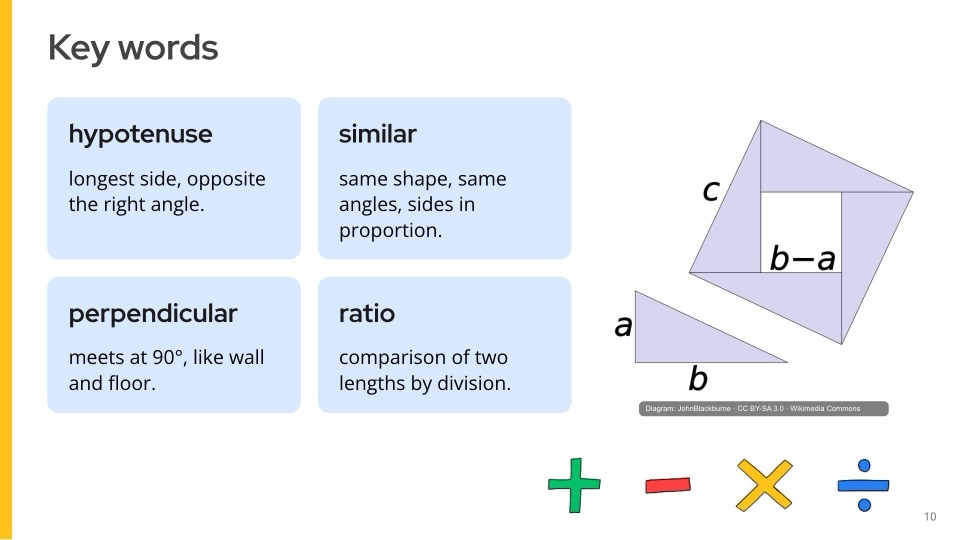
| hypotenuse | longest side, opposite the right angle in a right-angled triangle |
| similar | same shape with same angles and sides in proportion |
| perpendicular | meets at 90 degrees, like a wall meets a floor |
| scale factor | multiplier that enlarges one shape to match another of the same shape |
| ratio | comparison of two amounts found by division, kept the same in similar triangles |
Timed plan (60 minutes)
| Time | Stage | What happens |
|---|---|---|
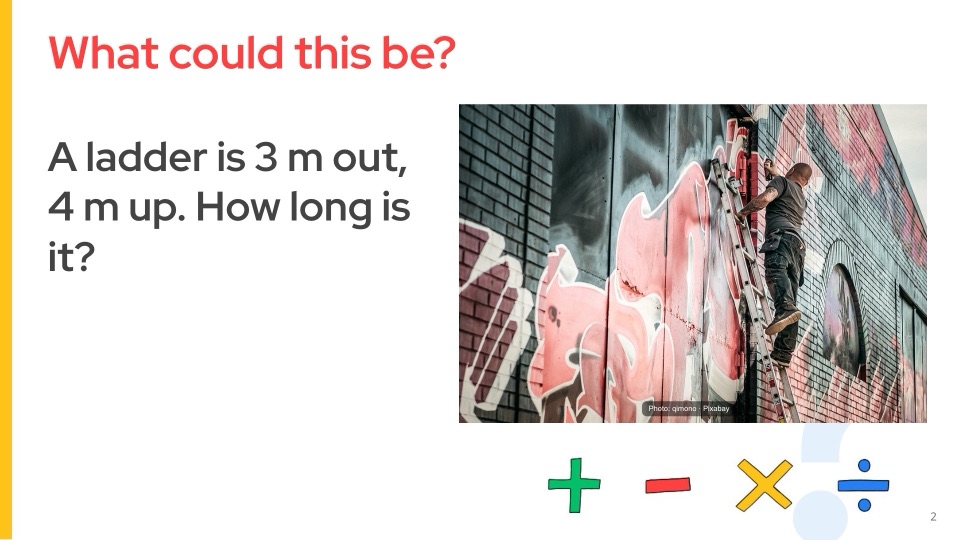
| 7 min | Starter | Recall squares and spot hidden right-angled triangles to launch both tools. Display Slide 1 and give the hook for the main card sort. Show Slide 2 mystery: a ladder is 3 m out, 4 m up, how long is it. Quick-fire 3², 4², √25 and ask students to point to the hypotenuse. Ask pairs to predict the ladder length and what maths would prove it. |
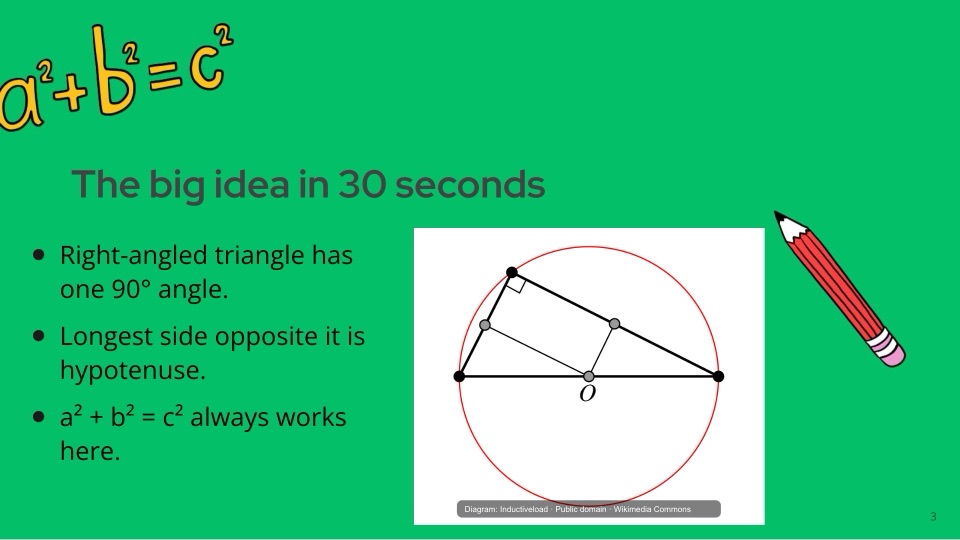
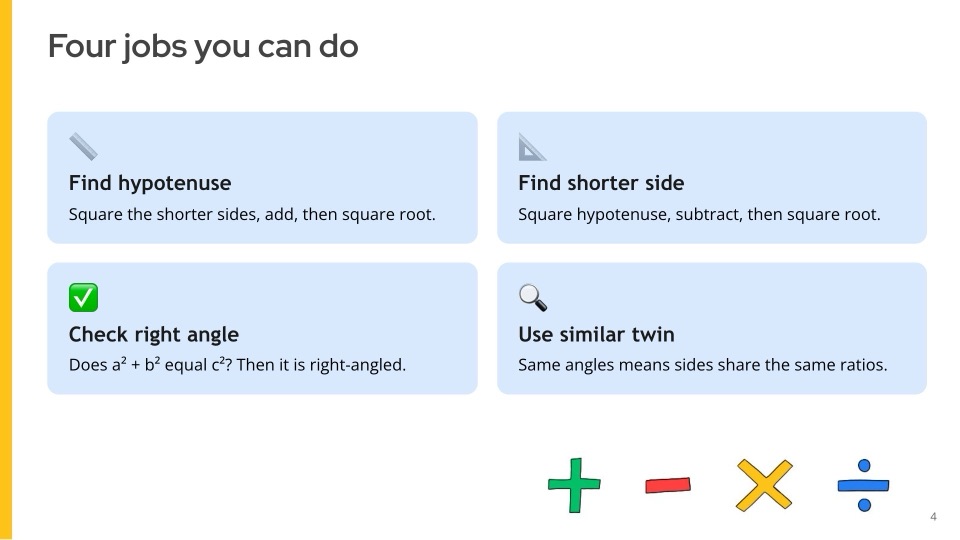
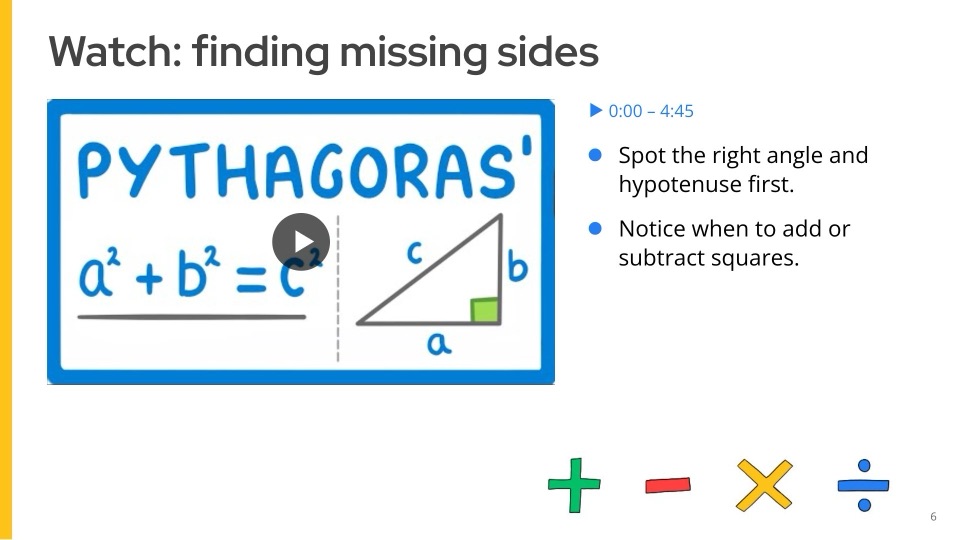
| 13 min | Teaching | Model finding the hypotenuse and a short side using a² + b² = c². Show Slide 3 and name the right angle and hypotenuse as longest side opposite it. Show Slide 4 cards: add squares then square root for hypotenuse; subtract then square root for a short side. Play Slide 6 Video clip 1 (0:00–4:45) and tell students to spot when to add or subtract. Model two examples on the board with full substitution and estimate check. |
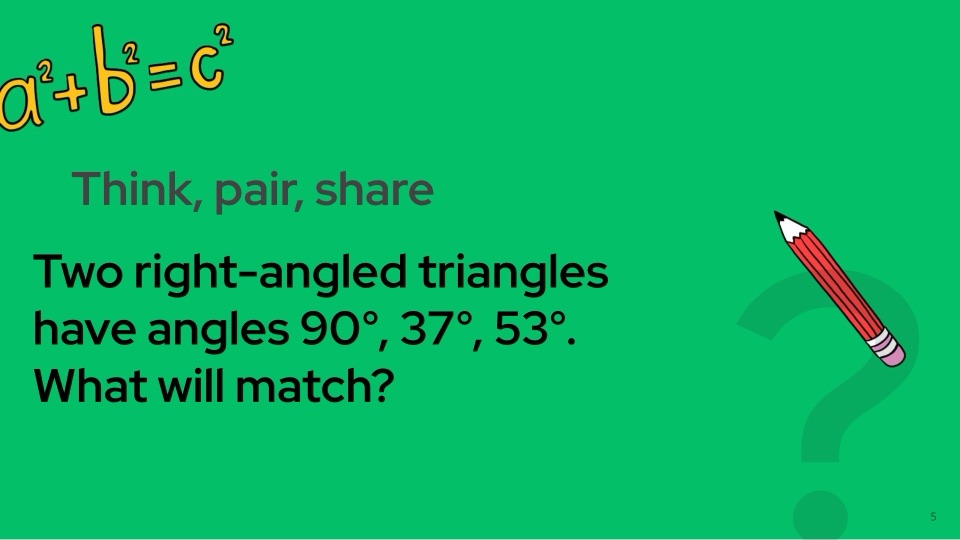
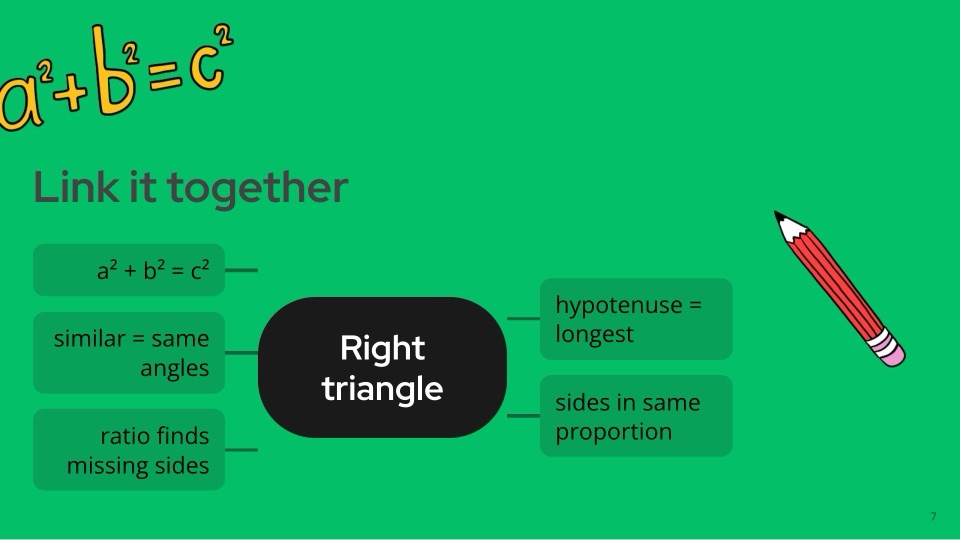
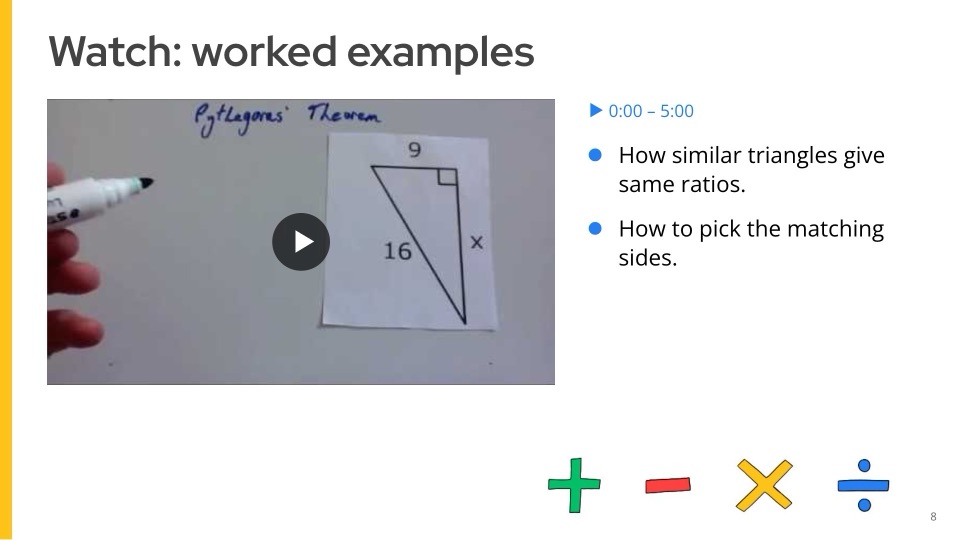
| 12 min | Guided practice | Link similar right-angled triangles to equal side ratios for finding sides. Pose Slide 5 question: two triangles with 90°, 37°, 53°, what will match. Build Slide 7 mindmap together: same angles, sides in same proportion, ratio finds missing sides. Play Slide 8 Video clip 2 (0:00–5:00) to show how similar triangles give same ratios and how to pick matching sides. Model one ratio calculation with opposite divided by hypotenuse to 2 decimal places. |
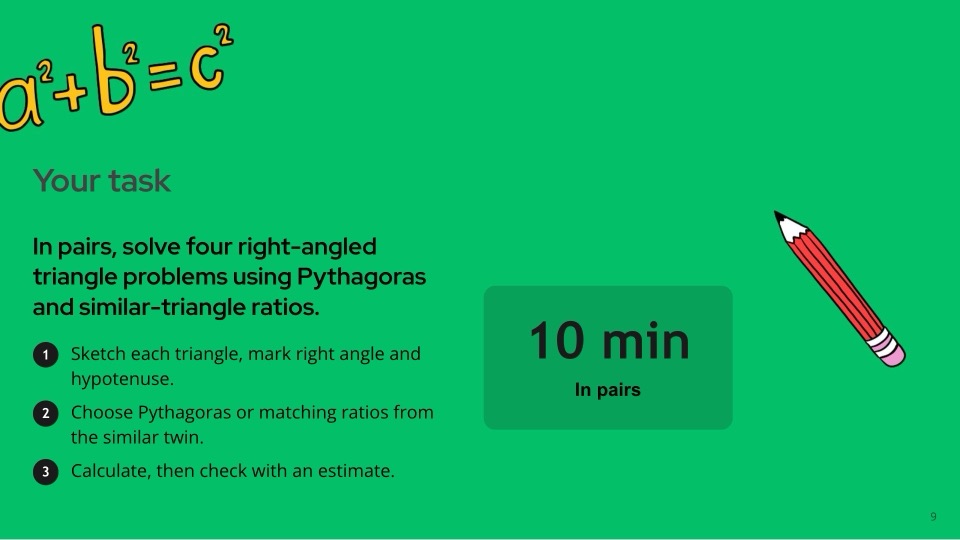
| 20 min | Main activity | Find unknown sides in similar triangles using scale factor and trig ratios. Hand out 12 triangle cards, squared paper and calculators and show Slide 9 task steps. Direct pairs to sketch each triangle, mark right angle and hypotenuse, then sort into families with same shape. Direct pairs to measure corresponding sides, calculate short side ÷ hypotenuse, and use the common ratio to find a missing side. Circulate to check choice of Pythagoras or matching ratios from the similar twin, then set Worksheet Task D. |
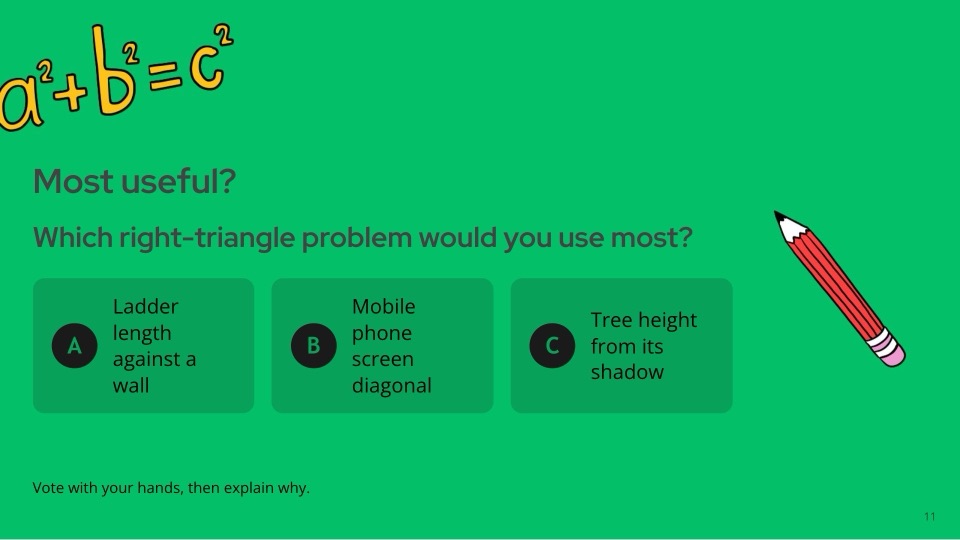
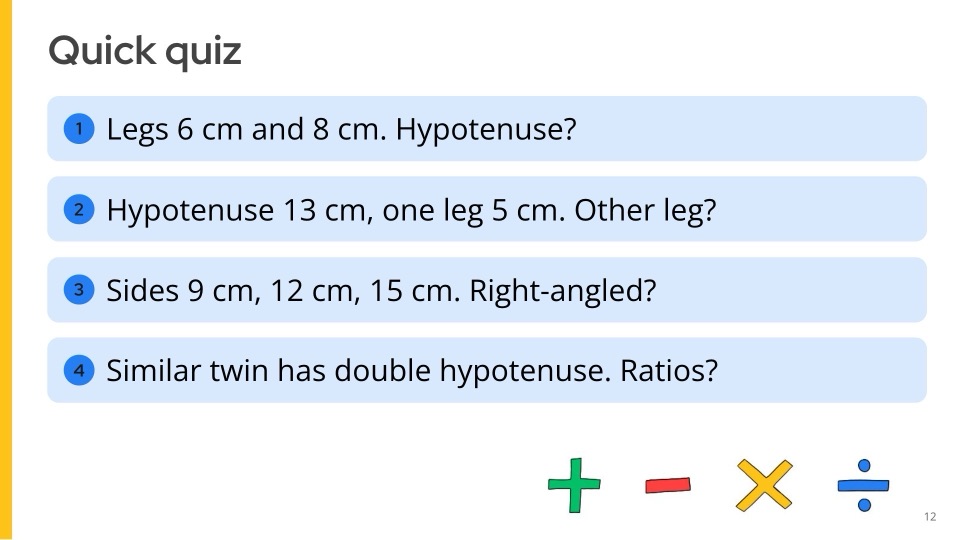
| 8 min | Plenary | Secure key words and check both skills with a quick quiz. Revisit Slide 10 words: hypotenuse, similar, perpendicular, and take quick definitions. Run Slide 11 vote on most useful problem: ladder, mobile phone screen diagonal, tree height from shadow. Run Slide 12 quick quiz on whiteboards for hypotenuse, short side and right-angled check. Link back to success criteria and set homework. |
Common mistakes
- Adding squares when finding a short side instead of subtracting
How to spot it: Answer larger than hypotenuse
Remind hypotenuse is longest side opposite right angle; do hypotenuse² minus known leg² then square root - Dividing non-matching sides in similar triangles
How to spot it: Ratios in same family do not match
Mark right angle and equal acute angles first, then divide the same positions, using the three trigonometric ratios in similar right-angled triangles - Claiming a triangle is right-angled by look alone
How to spot it: No check calculation shown
Test if a² + b² = c²; triangle is right-angled only if it satisfies Pythagoras’ theorem
Support
- Highlight the right angle and the same acute angle in the same colour so students can see which sides correspond before dividing.
- Give pre-filled tables and writing frames for squaring, adding or subtracting, and square rooting.
Stretch
- Students are given only one side and the common ratio for a new triangle in the same family and must work backwards to find the scale factor.
- Challenge with decimal triples and working backwards from diagonal and width to find height.
Check questions
- Legs 6 cm and 8 cm. Hypotenuse?
Answer: 10 cm - Hypotenuse 13 cm, one leg 5 cm. Other leg?
Answer: 12 cm - Sides 9 cm, 12 cm, 15 cm. Right-angled?
Answer: Yes, 9² + 12² = 15²
Curriculum
use Pythagoras’ Theorem and trigonometric ratios in similar triangles to solve problems involving right-angled triangles
From National curriculum in England, Key Stage 3 mathematics.
Video clips
Clips on YouTube, from the start and end times we chose. Check each one before you show it.
-
GCSE Pythagoras to find missing sides from 0:00 to 4:45
Cognito: GCSE Maths - Pythagoras' Theorem And How To Use It (2026/27 exams)
Made for UK GCSE learners so vocabulary and pace are perfect for 13-14-year-olds learning to solve right-angled triangles.
-
Corbettmaths Pythagoras examples from 0:00 to 5:00
corbettmaths: Pythagoras - Corbettmaths
UK classroom-style teaching aimed at 13-16-year-olds with clear worked examples ideal for Year 9.
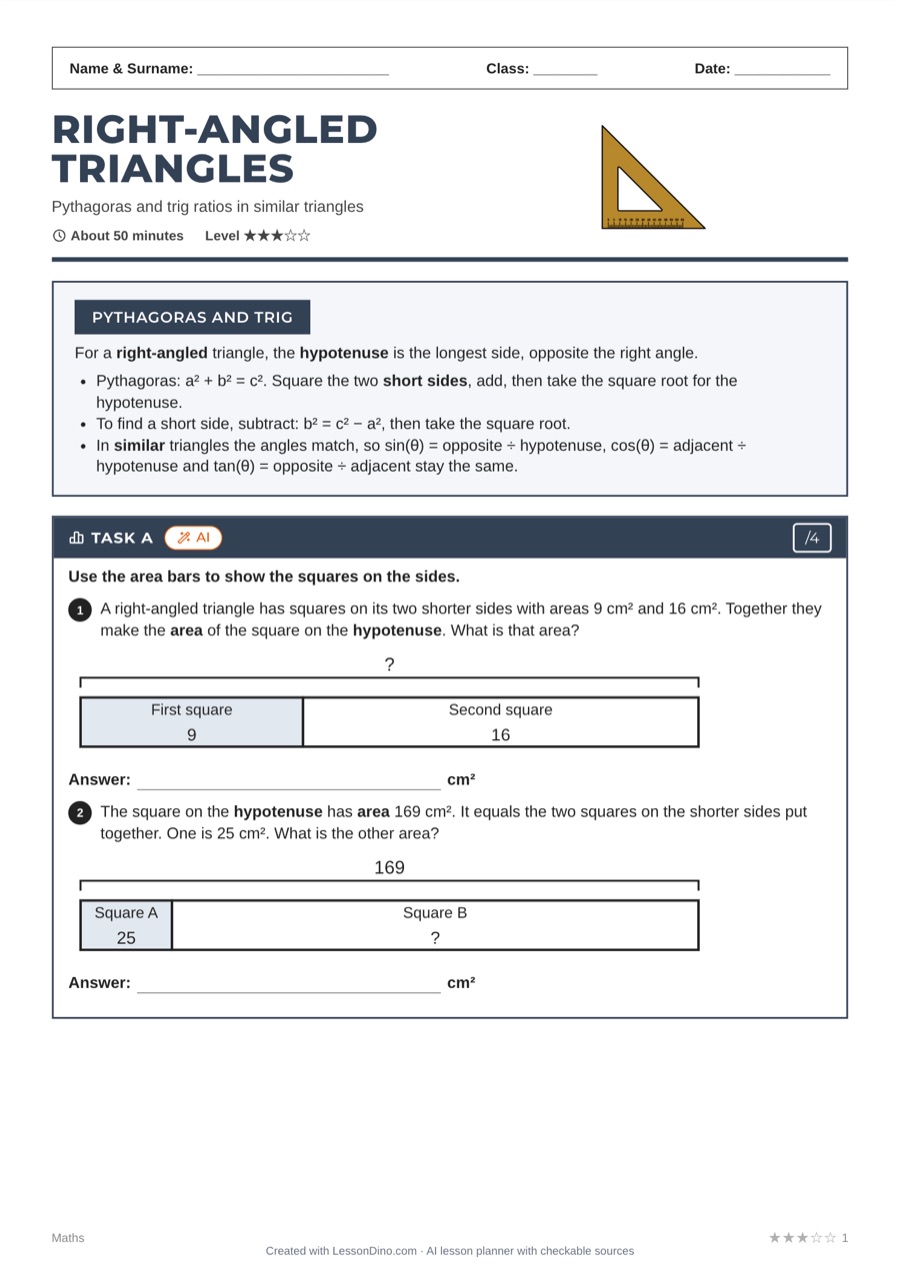
Worksheet
Sources
- maths yr 9 curriculum trinity.bexley.sch.uk
- Hounsdown School - Year 9 Curriculum hounsdown.hants.sch.uk
- Pythagoras’ theorem mathcentre.ac.uk
- What is Pythagoras' theorem? - BBC Bitesize bbc.co.uk
- Pythagoras' theorem - Part 1 - KS3 Maths - BBC Bitesize bbc.co.uk
- Pythagoras' Theorem - CIMT cimt.org.uk
- Pythagoras' theorem in context KS3 | Y9 Maths | Lesson Resources thenational.academy
- Lesson: Demonstrating Pythagoras' theorem | Oak National Academy thenational.academy
- Pythagoras | Biography, Philosophy, & Facts | Britannica britannica.com
- Pythagoras' Theorem - Transum transum.org
- pythagoras' theorem | plus.maths.org plus.maths.org
- Pythagoras and trigonometry - KS3 Maths - BBC Bitesize bbc.co.uk
- Pythagorean theorem | Definition & History | Britannica britannica.com
- BYJU'S Online learning Programs For K3, K10, K12, NEET, JEE ... byjus.com
- Pythagoras Theorem Questions - Math Salamanders math-salamanders.com
- Pythagoras Theorem - Formula, Proof, Examples - Cuemath cuemath.com
- PYTHAGORAS THEOREM | Dr Austin Maths draustinmaths.com
- Stonehenge Builders Used Pythagoras' Theorem 2,000 Years Before He Was Born techtimes.com
- Kids Math: Pythagorean Theorem - Ducksters ducksters.com
- Pythagorean theorem Facts for Kids kids.kiddle.co
- Stonehenge Builders Used Pythagoras' Theorem 2,000 Years Before He Was Born : ScienceAlert sciencealert.com
Picture credits
- Photo: qimono · Pixabay
- Diagram: Inductiveload · Public domain · Wikimedia Commons
- Diagram: JohnBlackburne · CC BY-SA 3.0 · Wikimedia Commons
- Pictograms: Sergio Palao, ARASAAC (arasaac.org) · CC BY-NC-SA
Made with Lesson Dino's AI on 17 October 2026. AI can make mistakes, so check facts against the sources before you teach.