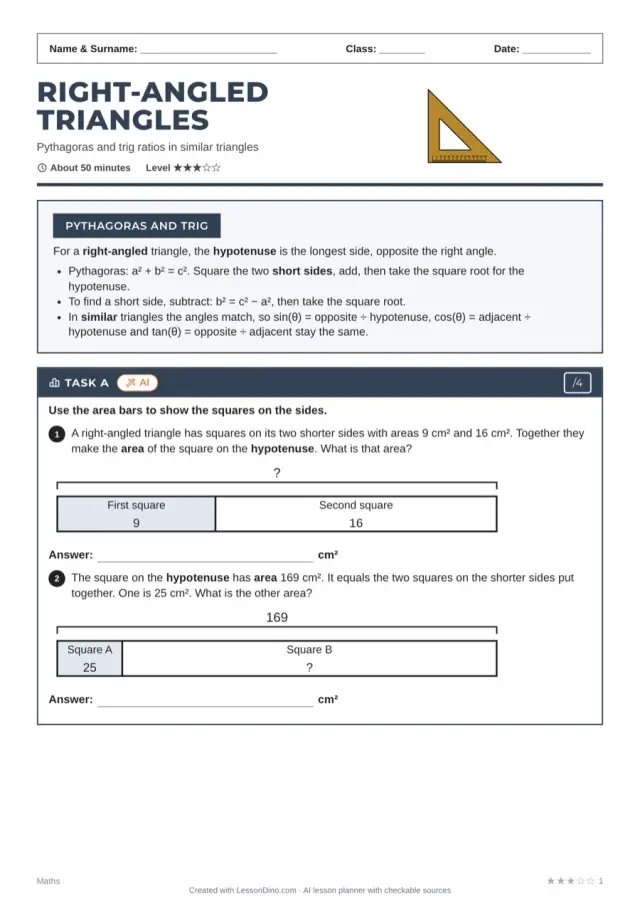
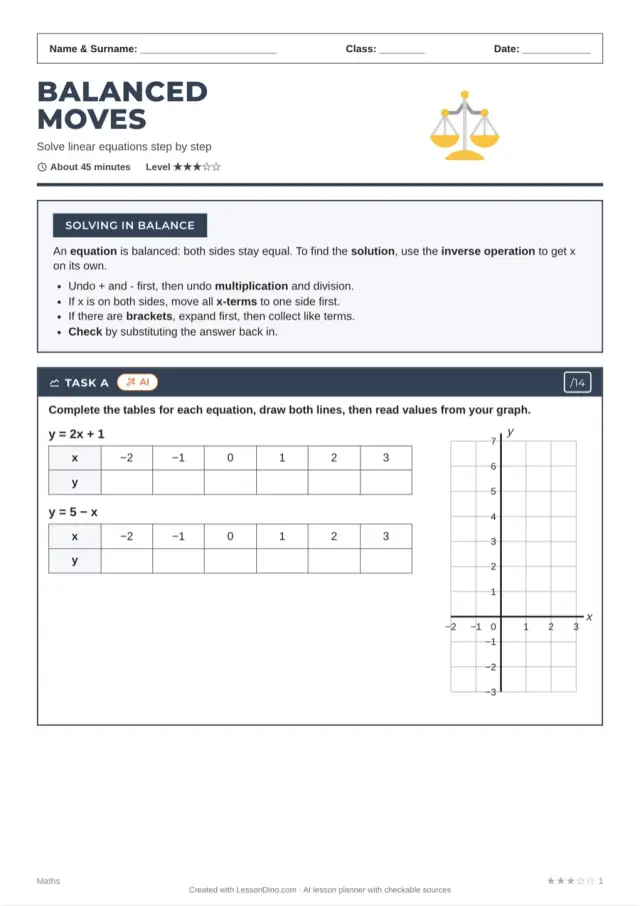
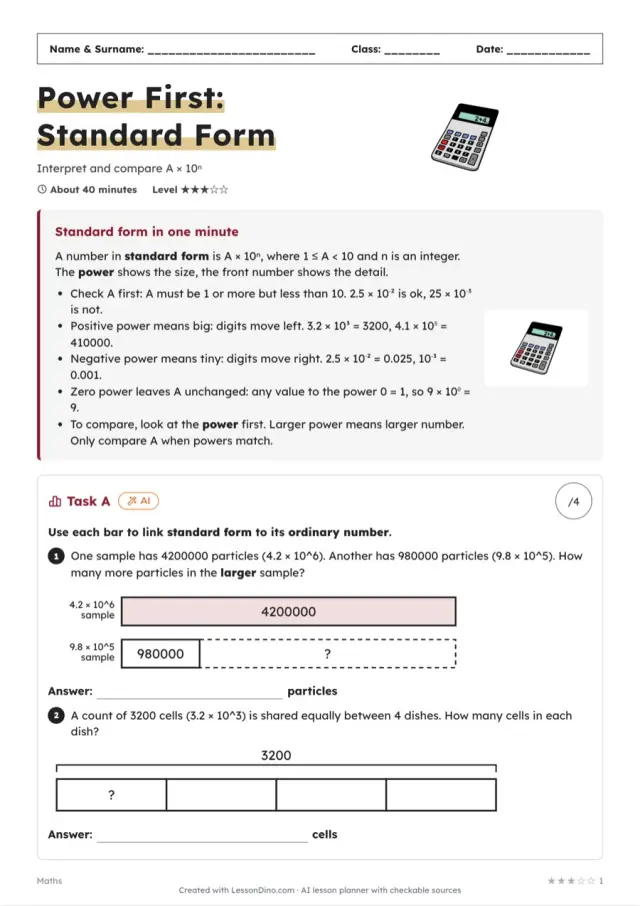
The worksheet
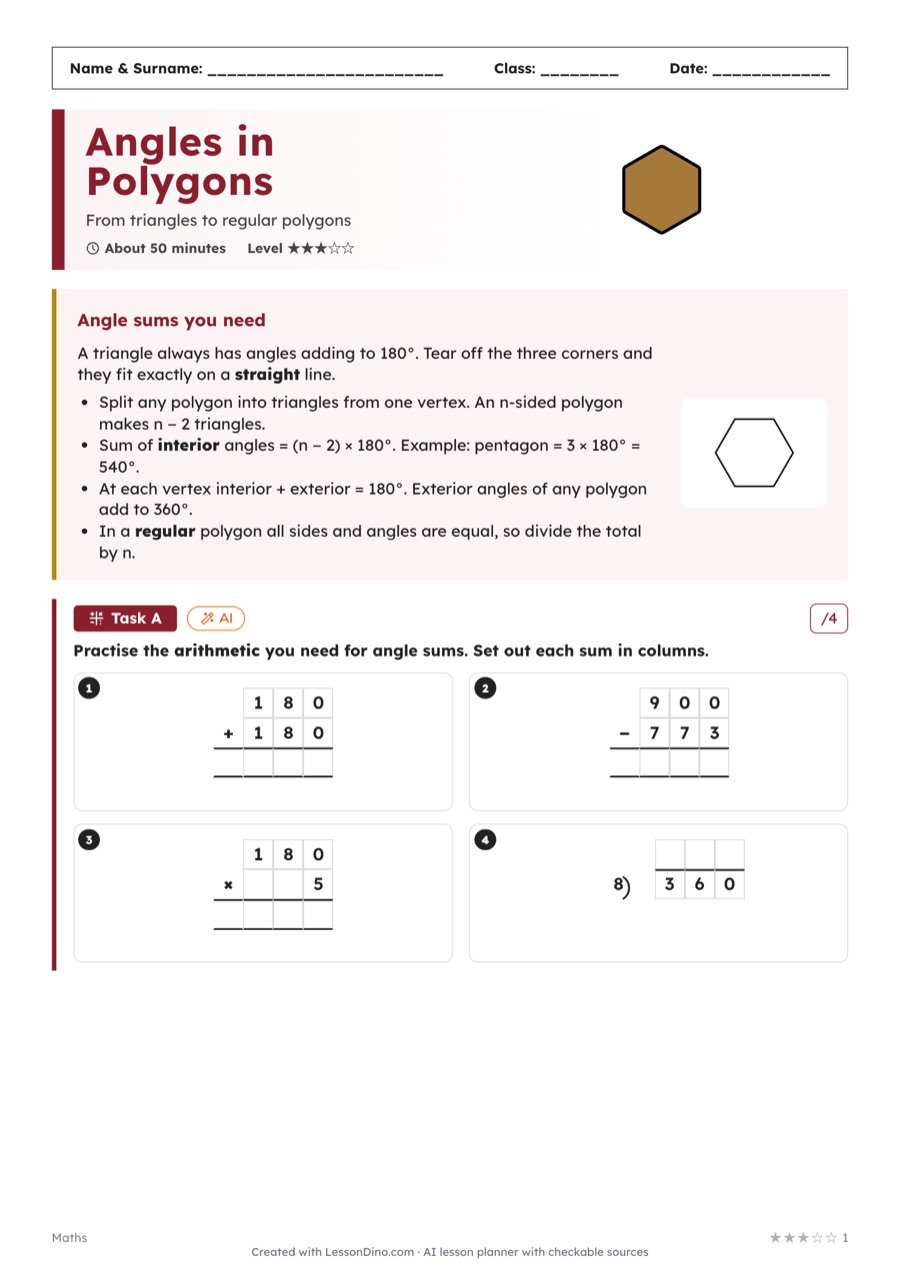
About this worksheet
Students derive the polygon angle rule from triangles. They use it to find missing and regular polygon angles. This Year 9 Maths worksheet gives students (ages 13–14) five pages of practice on angles in polygons, part of the geometry and measures unit. It goes with our free Angles in polygons lesson, which has the slides and a timed lesson plan.
What it covers
By the end, students should be able to:
- Students will derive triangle sum and extend it to any polygon.
- Students will use (n-2) x 180° to find missing interior angles.
- Students will derive regular polygon properties using 360° ÷ n.
How to use it
- Use it for practice after the teaching part of the lesson, once students have seen the worked examples on the slides.
- Support: Provide the shapes with one starting vertex marked and the table headings already drawn.
- Stretch: Ask them to explain in writing why the number of triangles is always two fewer than the number of sides.
- The answer sheet is the last page, so you can print it on its own or let students check their own work.
Key vocabulary
- interior angle: size of a corner inside a shape
- exterior angle: size of the turn outside a shape when one side is extended
- regular polygon: closed straight-sided shape where all edges and corners match
- irregular polygon: closed straight-sided shape where edges or corners differ
- diagonal: straight join between two corners that are not next to each other
- angle sum: total found by adding all the corners together
Mistakes to watch for
- Using 180n instead of (n-2) x 180° for the total. Always subtract 2 first to count triangles, then multiply by 180°.
- Dividing the total by n for an irregular polygon. Only divide when all corners match; otherwise add known and subtract from total.
- Mixing interior and exterior and adding to wrong total. Remember they pair to 180° at each corner; exteriors together make 360°.
What's on the worksheet
Start with triangles
Derive the triangle sum and build up to any polygon.
Angle sums you need
- A triangle always has angles adding to 180°. Tear off the three corners and they fit exactly on a straight line.
- Split any polygon into triangles from one vertex. An n-sided polygon makes n − 2 triangles.
- Sum of interior angles = (n − 2) × 180°. Example: pentagon = 3 × 180° = 540°.
- At each vertex interior + exterior = 180°. Exterior angles of any polygon add to 360°.
- In a regular polygon all sides and angles are equal, so divide the total by n.
Practise the arithmetic you need for angle sums. Set out each sum in columns.
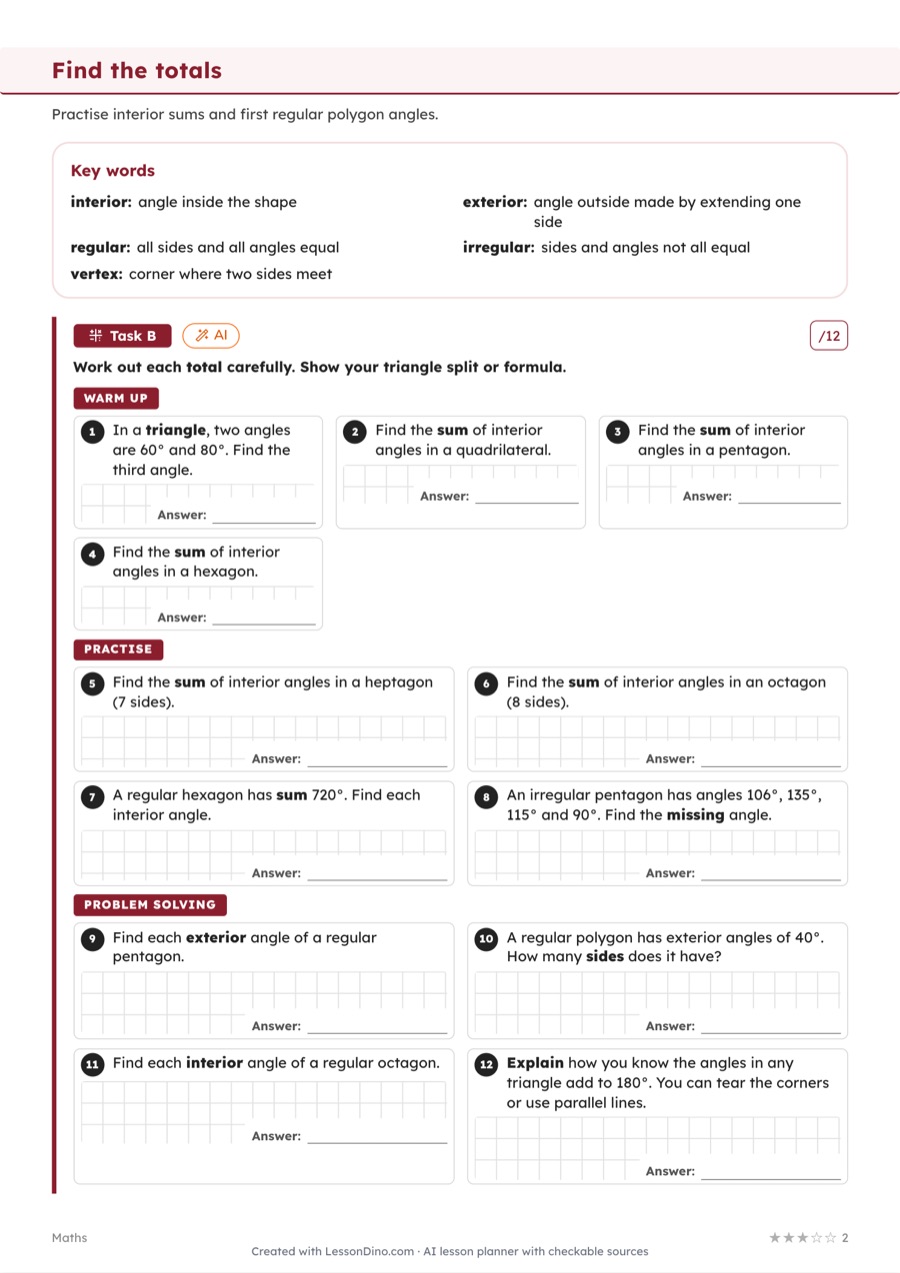
Find the totals
Practise interior sums and first regular polygon angles.
| Word | Meaning |
|---|---|
| interior | angle inside the shape |
| exterior | angle outside made by extending one side |
| regular | all sides and all angles equal |
| irregular | sides and angles not all equal |
| vertex | corner where two sides meet |
Work out each total carefully. Show your triangle split or formula.
Warm up
- In a triangle, two angles are 60° and 80°. Find the third angle.
- Find the sum of interior angles in a quadrilateral.
- Find the sum of interior angles in a pentagon.
- Find the sum of interior angles in a hexagon.
Practise
- Find the sum of interior angles in a heptagon (7 sides).
- Find the sum of interior angles in an octagon (8 sides).
- A regular hexagon has sum 720°. Find each interior angle.
- An irregular pentagon has angles 106°, 135°, 115° and 90°. Find the missing angle.
Problem solving
- Find each exterior angle of a regular pentagon.
- A regular polygon has exterior angles of 40°. How many sides does it have?
- Find each interior angle of a regular octagon.
- Explain how you know the angles in any triangle add to 180°. You can tear the corners or use parallel lines.
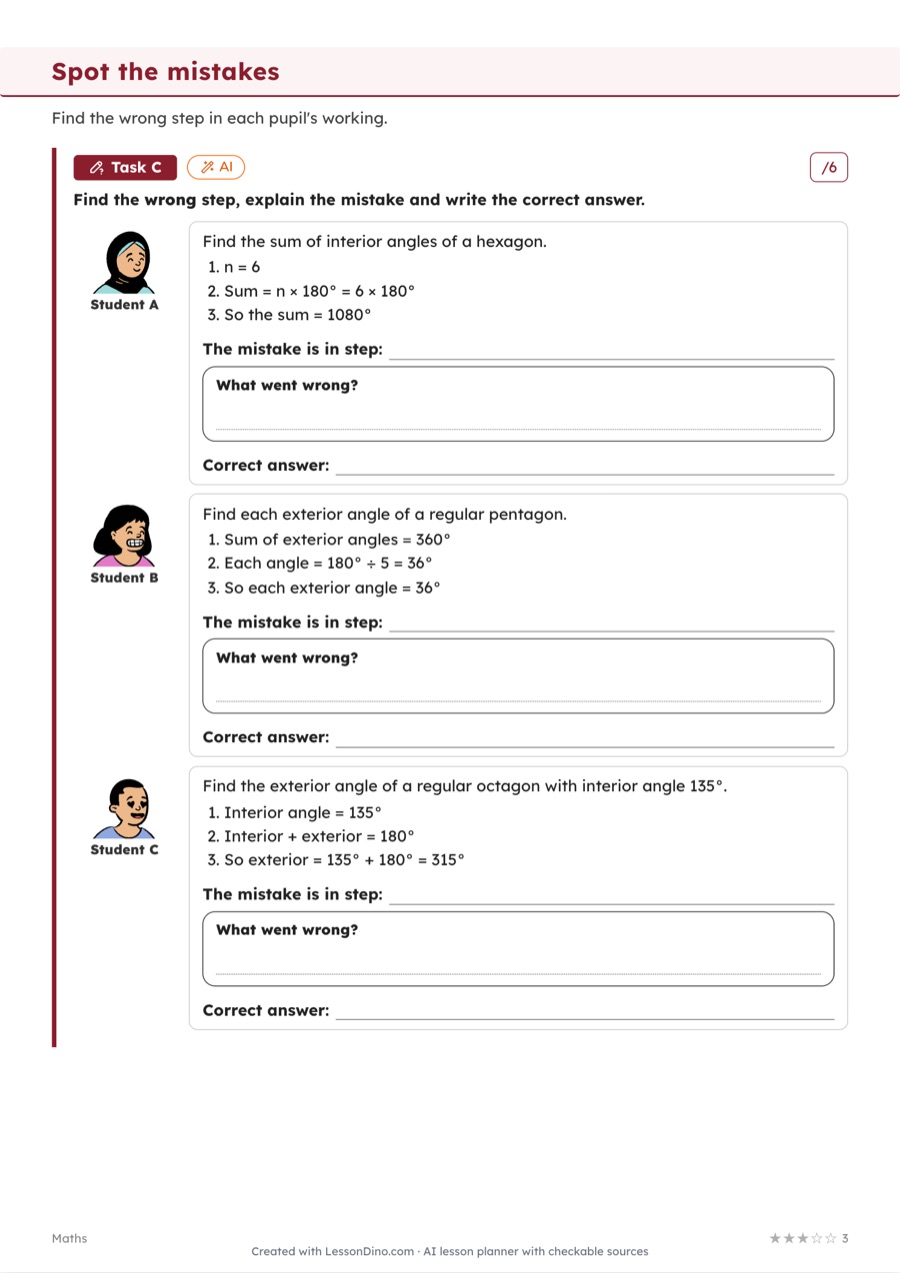
Spot the mistakes
Find the wrong step in each pupil's working.
Find the wrong step, explain the mistake and write the correct answer.
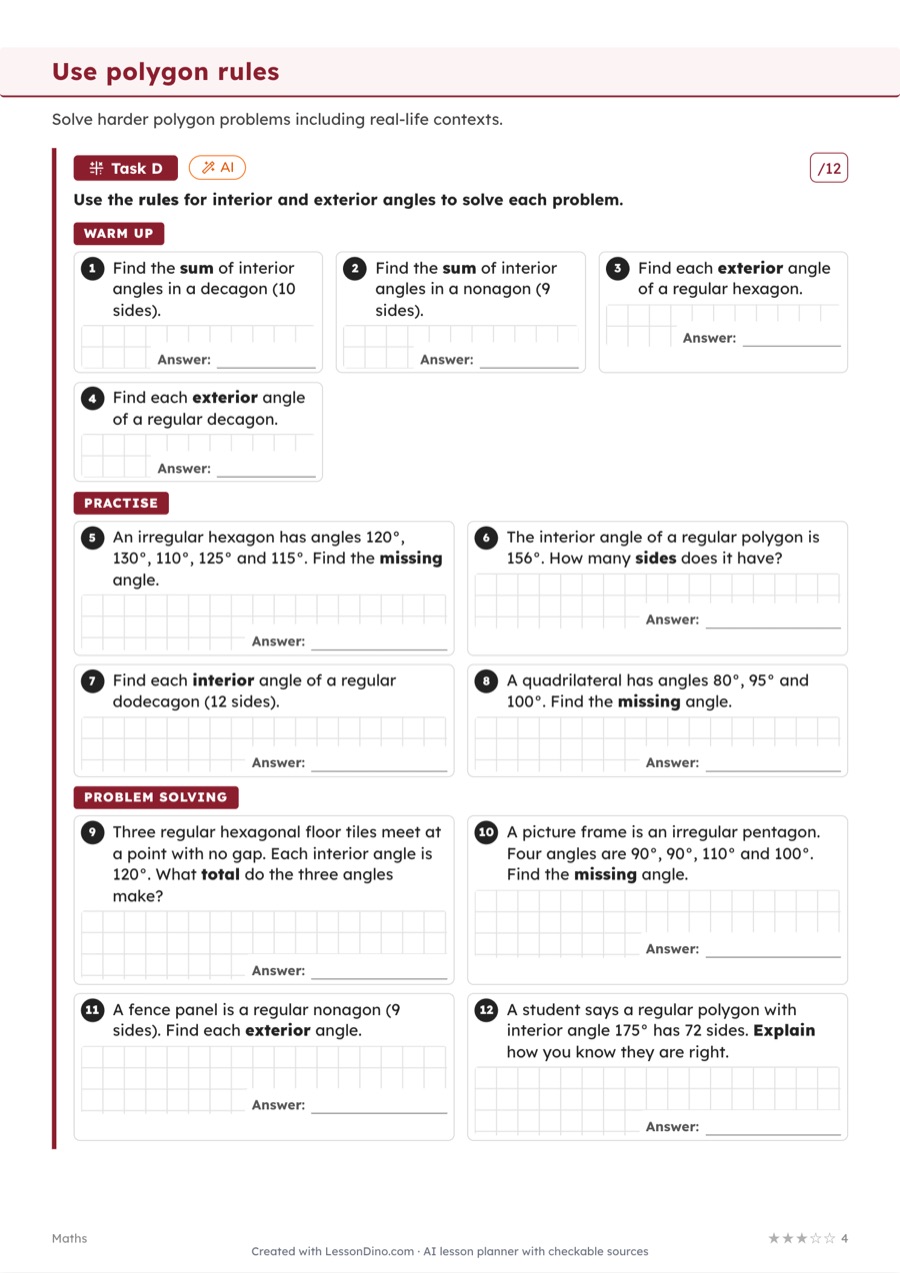
Use polygon rules
Solve harder polygon problems including real-life contexts.
Use the rules for interior and exterior angles to solve each problem.
Warm up
- Find the sum of interior angles in a decagon (10 sides).
- Find the sum of interior angles in a nonagon (9 sides).
- Find each exterior angle of a regular hexagon.
- Find each exterior angle of a regular decagon.
Practise
- An irregular hexagon has angles 120°, 130°, 110°, 125° and 115°. Find the missing angle.
- The interior angle of a regular polygon is 156°. How many sides does it have?
- Find each interior angle of a regular dodecagon (12 sides).
- A quadrilateral has angles 80°, 95° and 100°. Find the missing angle.
Problem solving
- Three regular hexagonal floor tiles meet at a point with no gap. Each interior angle is 120°. What total do the three angles make?
- A picture frame is an irregular pentagon. Four angles are 90°, 90°, 110° and 100°. Find the missing angle.
- A fence panel is a regular nonagon (9 sides). Find each exterior angle.
- A student says a regular polygon with interior angle 175° has 72 sides. Explain how you know they are right.
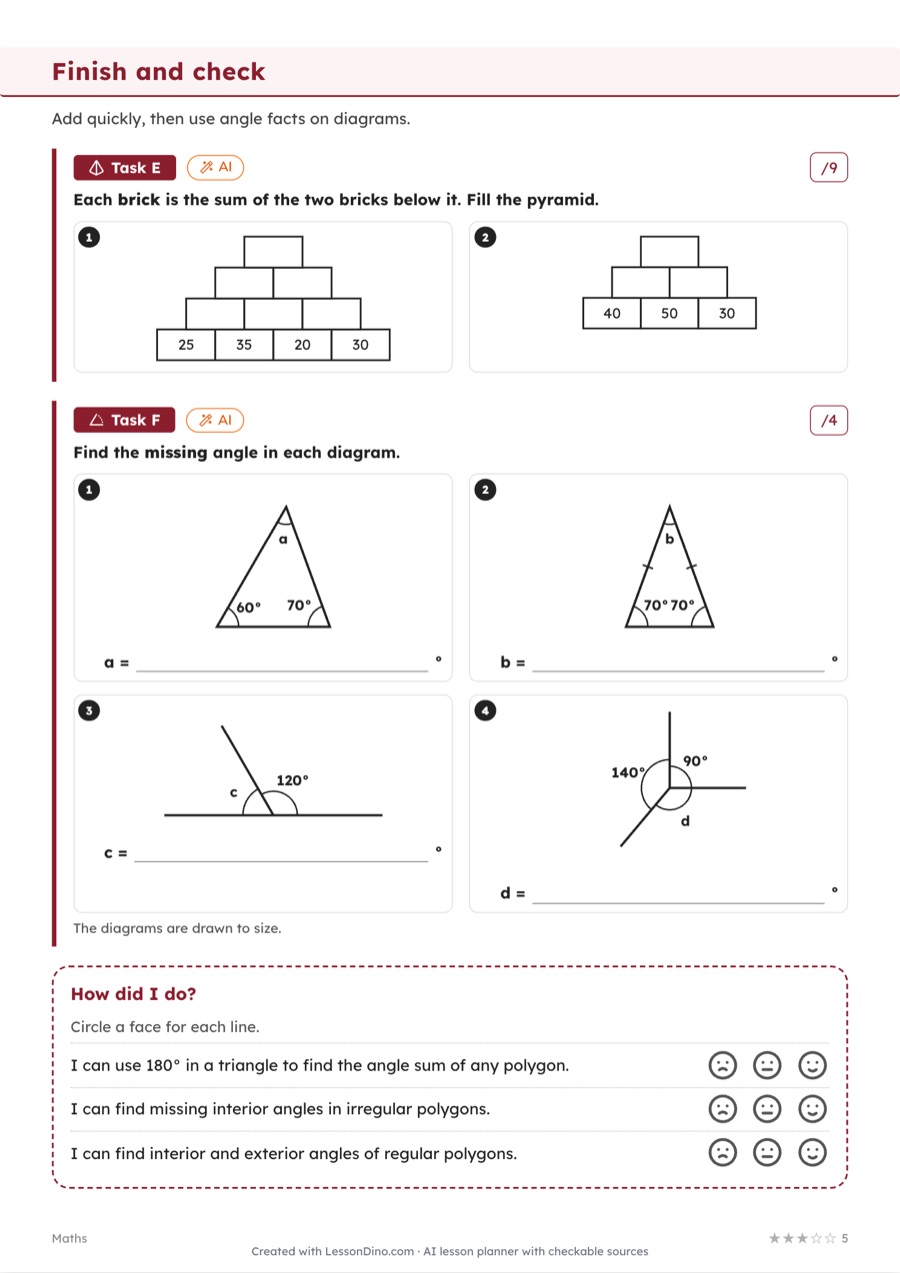
Finish and check
Add quickly, then use angle facts on diagrams.
Each brick is the sum of the two bricks below it. Fill the pyramid.
Find the missing angle in each diagram.
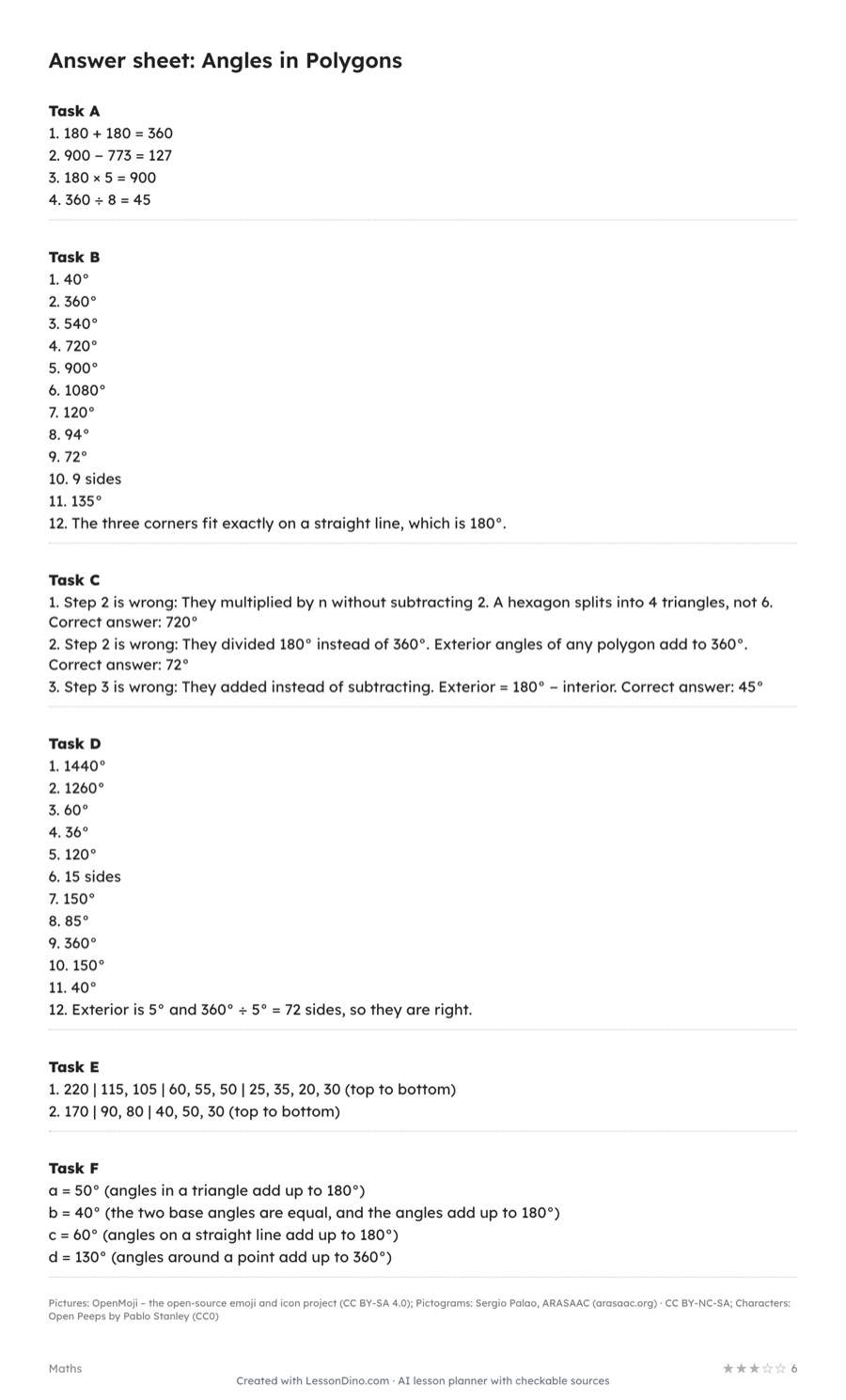
Answers
Show the answers
- In a triangle, two angles are 60° and 80°. Find the third angle. 40°
- Find the sum of interior angles in a quadrilateral. 360°
- Find the sum of interior angles in a pentagon. 540°
- Find the sum of interior angles in a hexagon. 720°
- Find the sum of interior angles in a heptagon (7 sides). 900°
- Find the sum of interior angles in an octagon (8 sides). 1080°
- A regular hexagon has sum 720°. Find each interior angle. 120°
- An irregular pentagon has angles 106°, 135°, 115° and 90°. Find the missing angle. 94°
- Find each exterior angle of a regular pentagon. 72°
- A regular polygon has exterior angles of 40°. How many sides does it have? 9 sides
- Find each interior angle of a regular octagon. 135°
- Explain how you know the angles in any triangle add to 180°. You can tear the corners or use parallel lines. The three corners fit exactly on a straight line, which is 180°.
- Find the sum of interior angles in a decagon (10 sides). 1440°
- Find the sum of interior angles in a nonagon (9 sides). 1260°
- Find each exterior angle of a regular hexagon. 60°
- Find each exterior angle of a regular decagon. 36°
- An irregular hexagon has angles 120°, 130°, 110°, 125° and 115°. Find the missing angle. 120°
- The interior angle of a regular polygon is 156°. How many sides does it have? 15 sides
- Find each interior angle of a regular dodecagon (12 sides). 150°
- A quadrilateral has angles 80°, 95° and 100°. Find the missing angle. 85°
- Three regular hexagonal floor tiles meet at a point with no gap. Each interior angle is 120°. What total do the three angles make? 360°
- A picture frame is an irregular pentagon. Four angles are 90°, 90°, 110° and 100°. Find the missing angle. 150°
- A fence panel is a regular nonagon (9 sides). Find each exterior angle. 40°
- A student says a regular polygon with interior angle 175° has 72 sides. Explain how you know they are right. Exterior is 5° and 360° ÷ 5° = 72 sides, so they are right.
The answer sheet is the last picture above.
Curriculum
derive and use the sum of angles in a triangle and use it to deduce the angle sum in any polygon, and to derive properties of regular polygons
From National curriculum in England, Key Stage 3 mathematics.
Made with Lesson Dino's AI on 19 October 2026. AI can make mistakes, so check the answers and facts against the sources before you teach.