The worksheet
About this worksheet
Students learn to use Pythagoras and matching ratios in similar triangles. They sort triangle families and solve missing-side problems. This Year 9 Maths worksheet gives students (ages 13–14) six pages of practice on pythagoras' theorem, part of the geometry and measures unit. It goes with our free Pythagoras' theorem lesson, which has the slides and a timed lesson plan.
What it covers
By the end, students should be able to:
- Students will use Pythagoras’ theorem to find missing sides in right-angled triangles.
- Students will use scale factor and trig ratios in similar triangles to find unknown sides.
How to use it
- Main activity (20 minutes): Circulate to check choice of Pythagoras or matching ratios from the similar twin, then set Worksheet Task D.
- Support: Highlight the right angle and the same acute angle in the same colour so students can see which sides correspond before dividing.
- Stretch: Students are given only one side and the common ratio for a new triangle in the same family and must work backwards to find the scale factor.
- The answer sheet is the last page, so you can print it on its own or let students check their own work.
Key vocabulary
- hypotenuse: longest side, opposite the right angle in a right-angled triangle
- similar: same shape with same angles and sides in proportion
- perpendicular: meets at 90 degrees, like a wall meets a floor
- scale factor: multiplier that enlarges one shape to match another of the same shape
- ratio: comparison of two amounts found by division, kept the same in similar triangles
Mistakes to watch for
- Adding squares when finding a short side instead of subtracting. Remind hypotenuse is longest side opposite right angle; do hypotenuse² minus known leg² then square root.
- Dividing non-matching sides in similar triangles. Mark right angle and equal acute angles first, then divide the same positions, using the three trigonometric ratios in similar right-angled triangles.
- Claiming a triangle is right-angled by look alone. Test if a² + b² = c²; triangle is right-angled only if it satisfies Pythagoras’ theorem.
What's on the worksheet
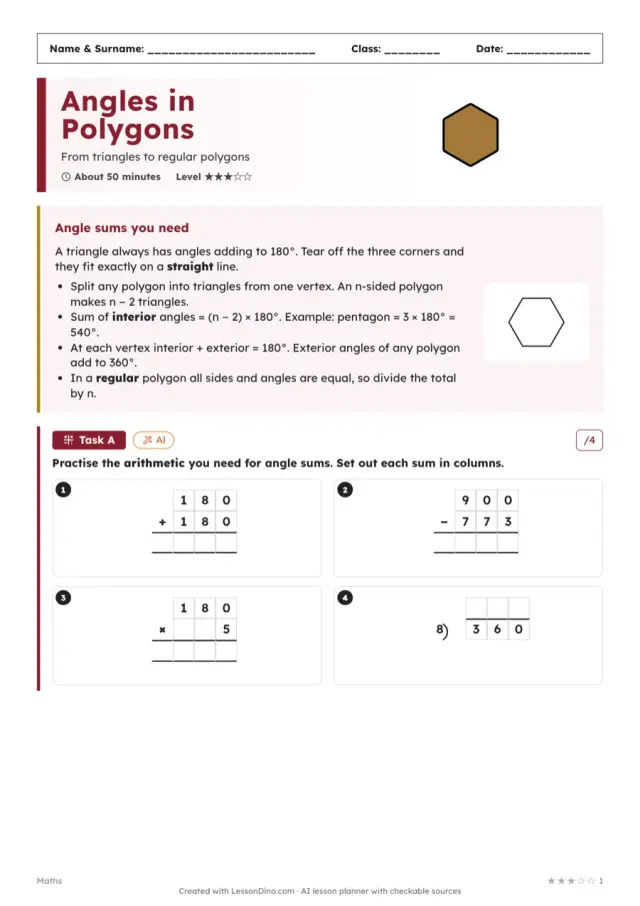
Right triangles first
Recall the rules for Pythagoras and trig ratios.
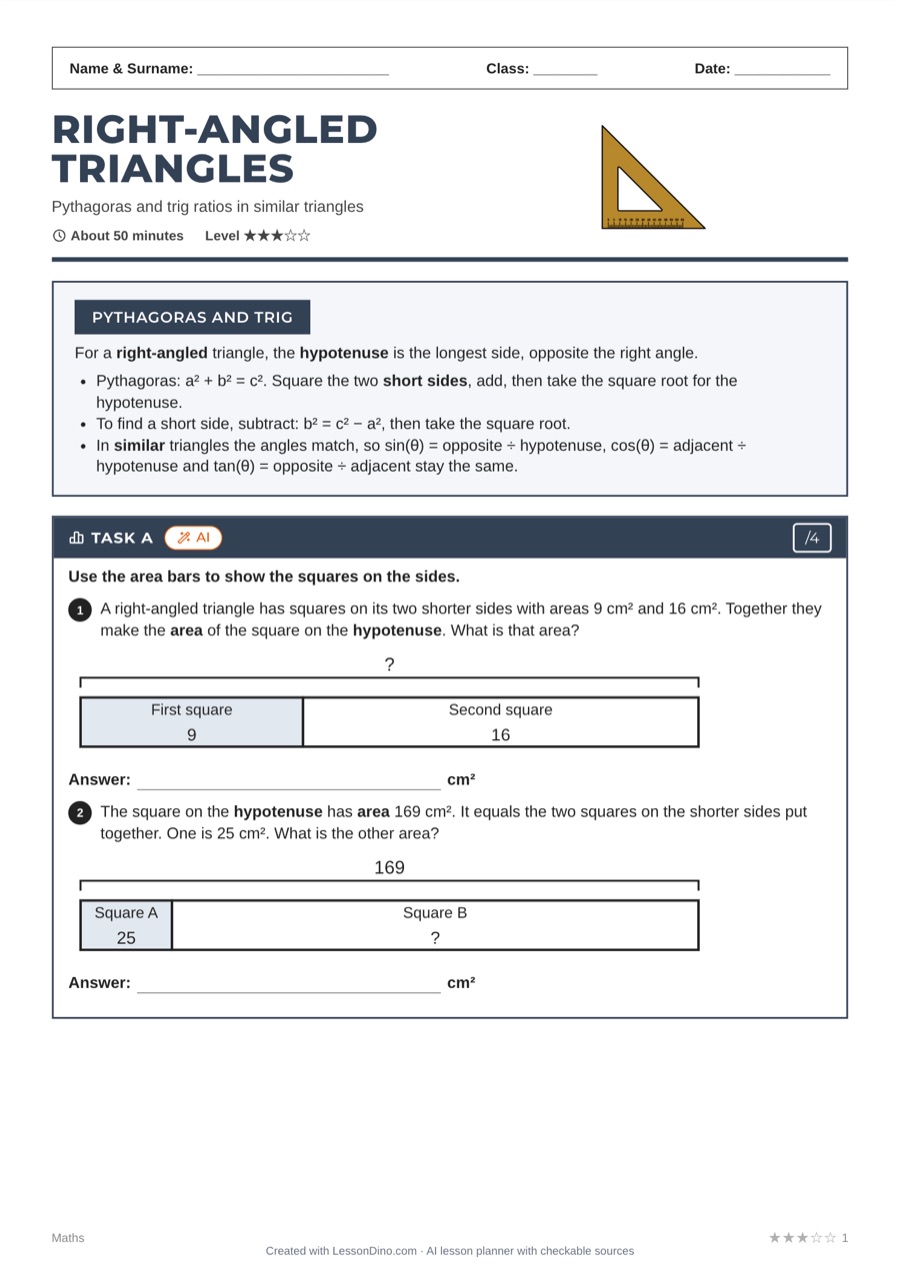
Pythagoras and trig
- For a right-angled triangle, the hypotenuse is the longest side, opposite the right angle.
- Pythagoras: a² + b² = c². Square the two short sides, add, then take the square root for the hypotenuse.
- To find a short side, subtract: b² = c² − a², then take the square root.
- In similar triangles the angles match, so sin(θ) = opposite ÷ hypotenuse, cos(θ) = adjacent ÷ hypotenuse and tan(θ) = opposite ÷ adjacent stay the same.
Use the area bars to show the squares on the sides.
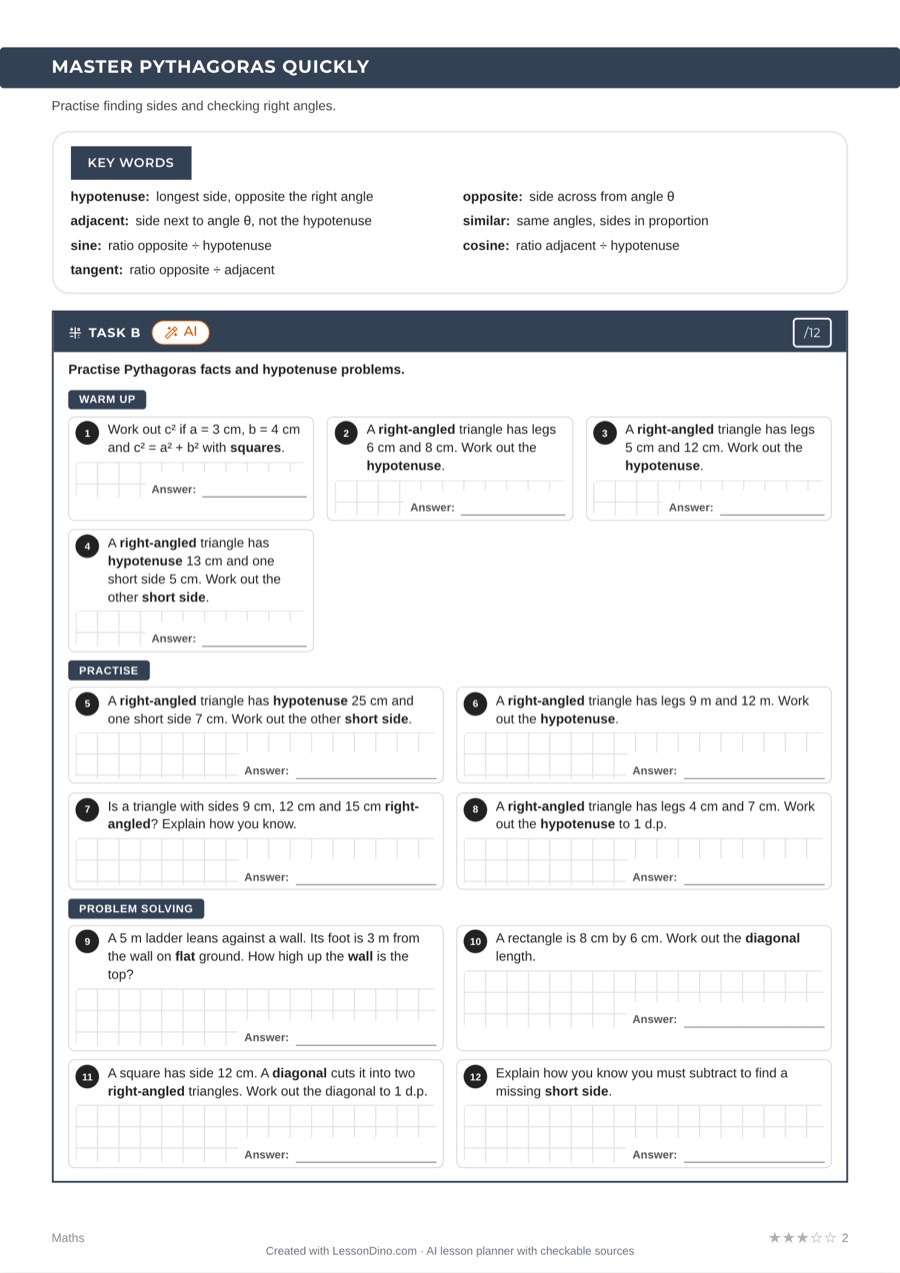
Master Pythagoras quickly
Practise finding sides and checking right angles.
| Word | Meaning |
|---|---|
| hypotenuse | longest side, opposite the right angle |
| opposite | side across from angle θ |
| adjacent | side next to angle θ, not the hypotenuse |
| similar | same angles, sides in proportion |
| sine | ratio opposite ÷ hypotenuse |
| cosine | ratio adjacent ÷ hypotenuse |
| tangent | ratio opposite ÷ adjacent |
Practise Pythagoras facts and hypotenuse problems.
Warm up
- Work out c² if a = 3 cm, b = 4 cm and c² = a² + b² with squares.
- A right-angled triangle has legs 6 cm and 8 cm. Work out the hypotenuse.
- A right-angled triangle has legs 5 cm and 12 cm. Work out the hypotenuse.
- A right-angled triangle has hypotenuse 13 cm and one short side 5 cm. Work out the other short side.
Practise
- A right-angled triangle has hypotenuse 25 cm and one short side 7 cm. Work out the other short side.
- A right-angled triangle has legs 9 m and 12 m. Work out the hypotenuse.
- Is a triangle with sides 9 cm, 12 cm and 15 cm right-angled? Explain how you know.
- A right-angled triangle has legs 4 cm and 7 cm. Work out the hypotenuse to 1 d.p.
Problem solving
- A 5 m ladder leans against a wall. Its foot is 3 m from the wall on flat ground. How high up the wall is the top?
- A rectangle is 8 cm by 6 cm. Work out the diagonal length.
- A square has side 12 cm. A diagonal cuts it into two right-angled triangles. Work out the diagonal to 1 d.p.
- Explain how you know you must subtract to find a missing short side.
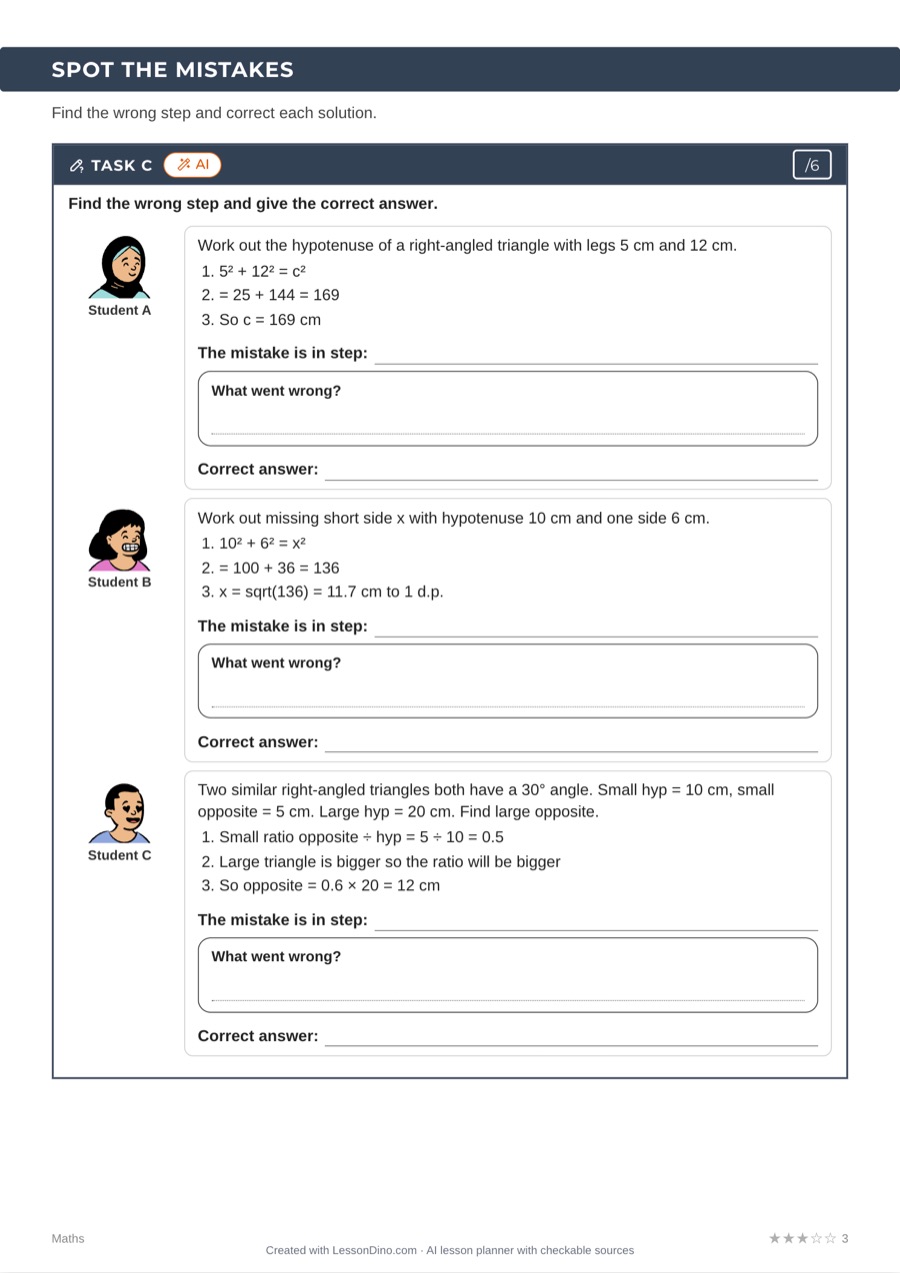
Spot the mistakes
Find the wrong step and correct each solution.
Find the wrong step and give the correct answer.
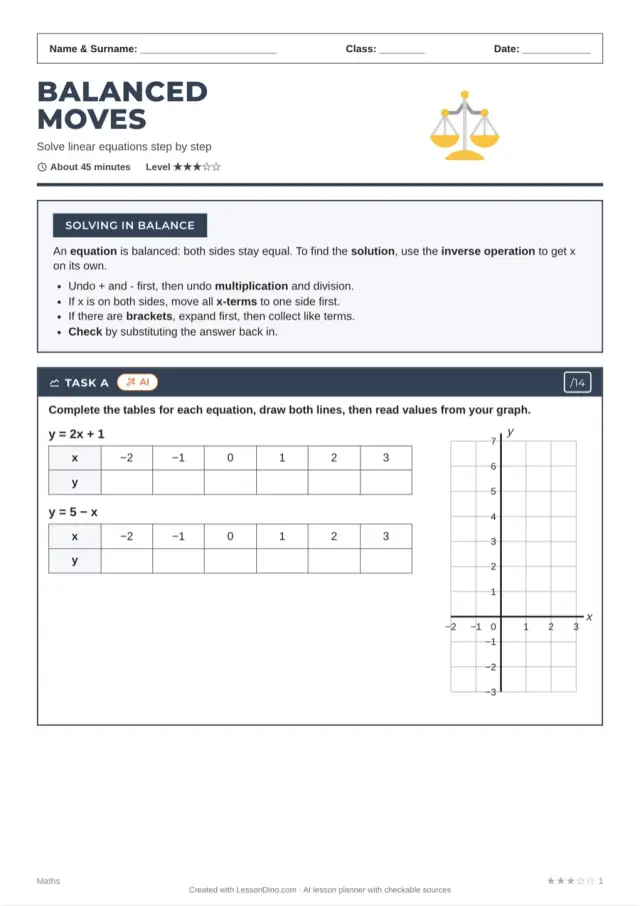
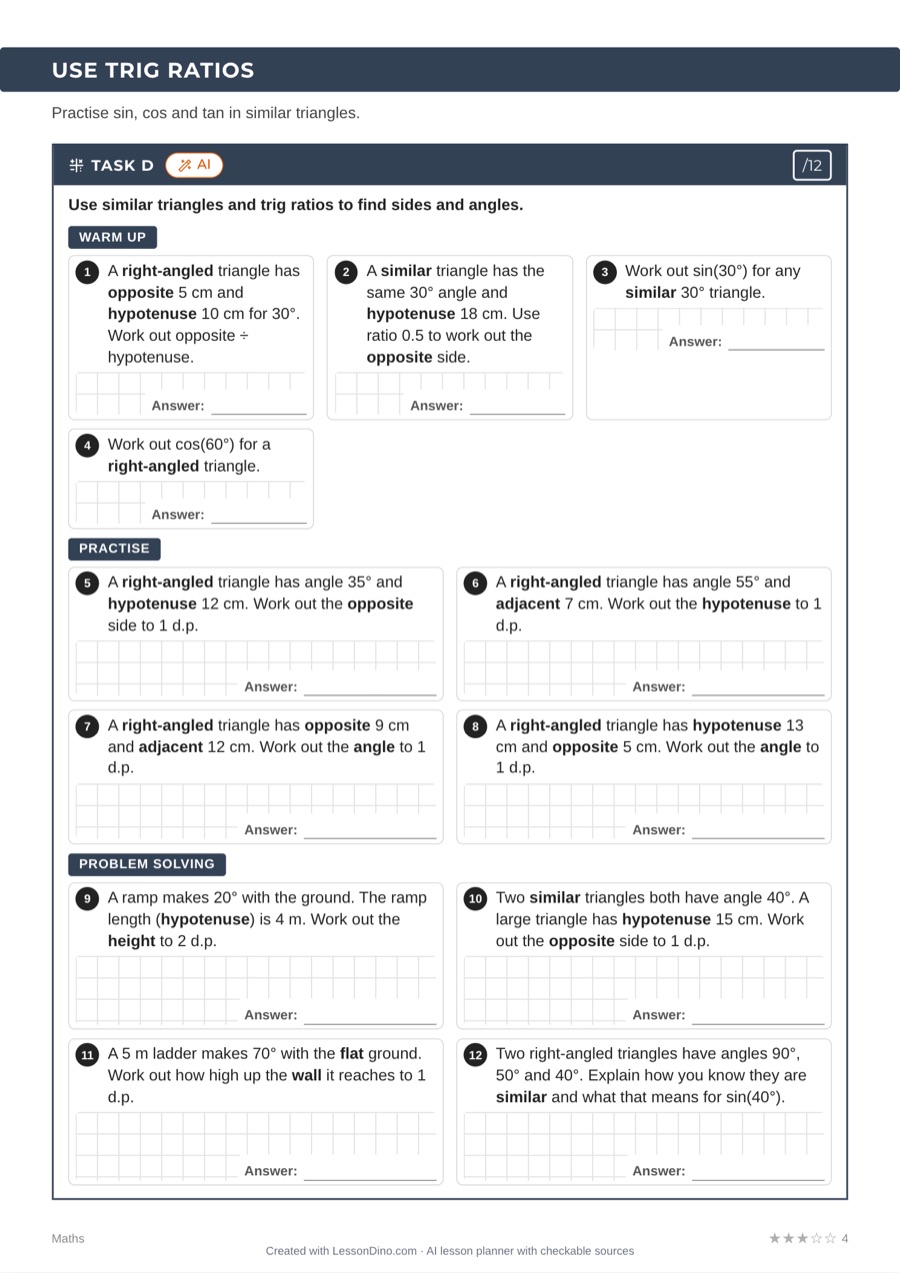
Use trig ratios
Practise sin, cos and tan in similar triangles.
Use similar triangles and trig ratios to find sides and angles.
Warm up
- A right-angled triangle has opposite 5 cm and hypotenuse 10 cm for 30°. Work out opposite ÷ hypotenuse.
- A similar triangle has the same 30° angle and hypotenuse 18 cm. Use ratio 0.5 to work out the opposite side.
- Work out sin(30°) for any similar 30° triangle.
- Work out cos(60°) for a right-angled triangle.
Practise
- A right-angled triangle has angle 35° and hypotenuse 12 cm. Work out the opposite side to 1 d.p.
- A right-angled triangle has angle 55° and adjacent 7 cm. Work out the hypotenuse to 1 d.p.
- A right-angled triangle has opposite 9 cm and adjacent 12 cm. Work out the angle to 1 d.p.
- A right-angled triangle has hypotenuse 13 cm and opposite 5 cm. Work out the angle to 1 d.p.
Problem solving
- A ramp makes 20° with the ground. The ramp length (hypotenuse) is 4 m. Work out the height to 2 d.p.
- Two similar triangles both have angle 40°. A large triangle has hypotenuse 15 cm. Work out the opposite side to 1 d.p.
- A 5 m ladder makes 70° with the flat ground. Work out how high up the wall it reaches to 1 d.p.
- Two right-angled triangles have angles 90°, 50° and 40°. Explain how you know they are similar and what that means for sin(40°).
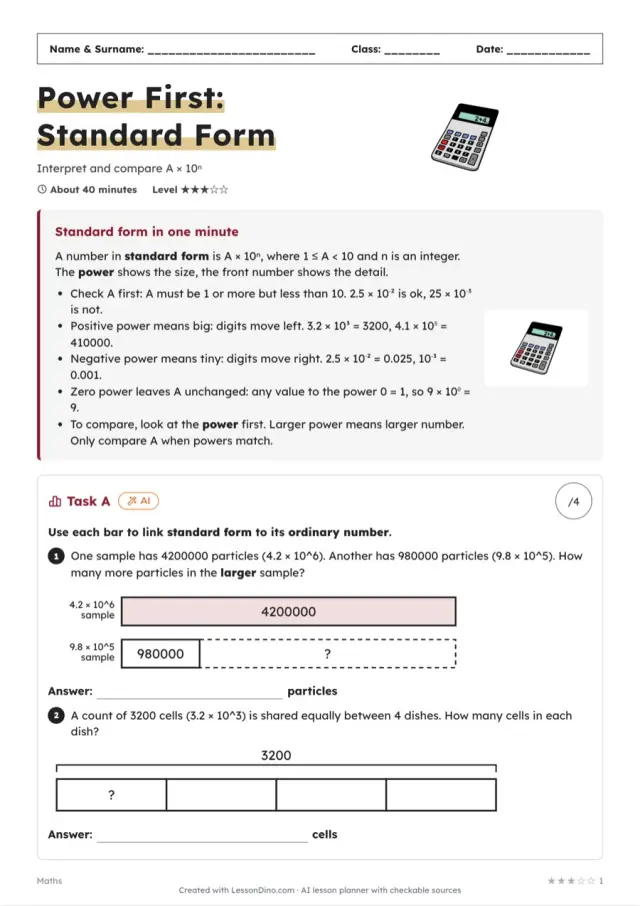
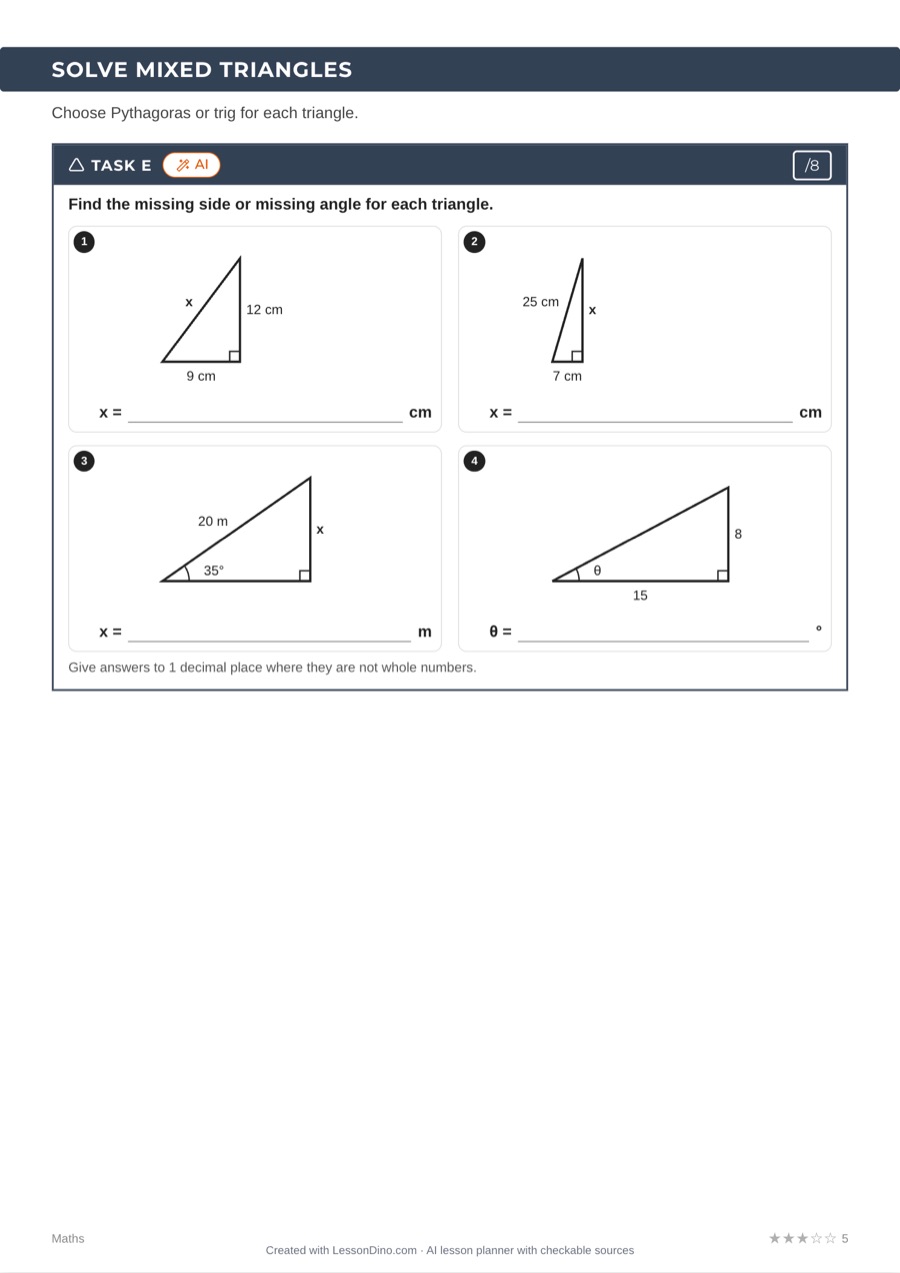
Solve mixed triangles
Choose Pythagoras or trig for each triangle.
Find the missing side or missing angle for each triangle.
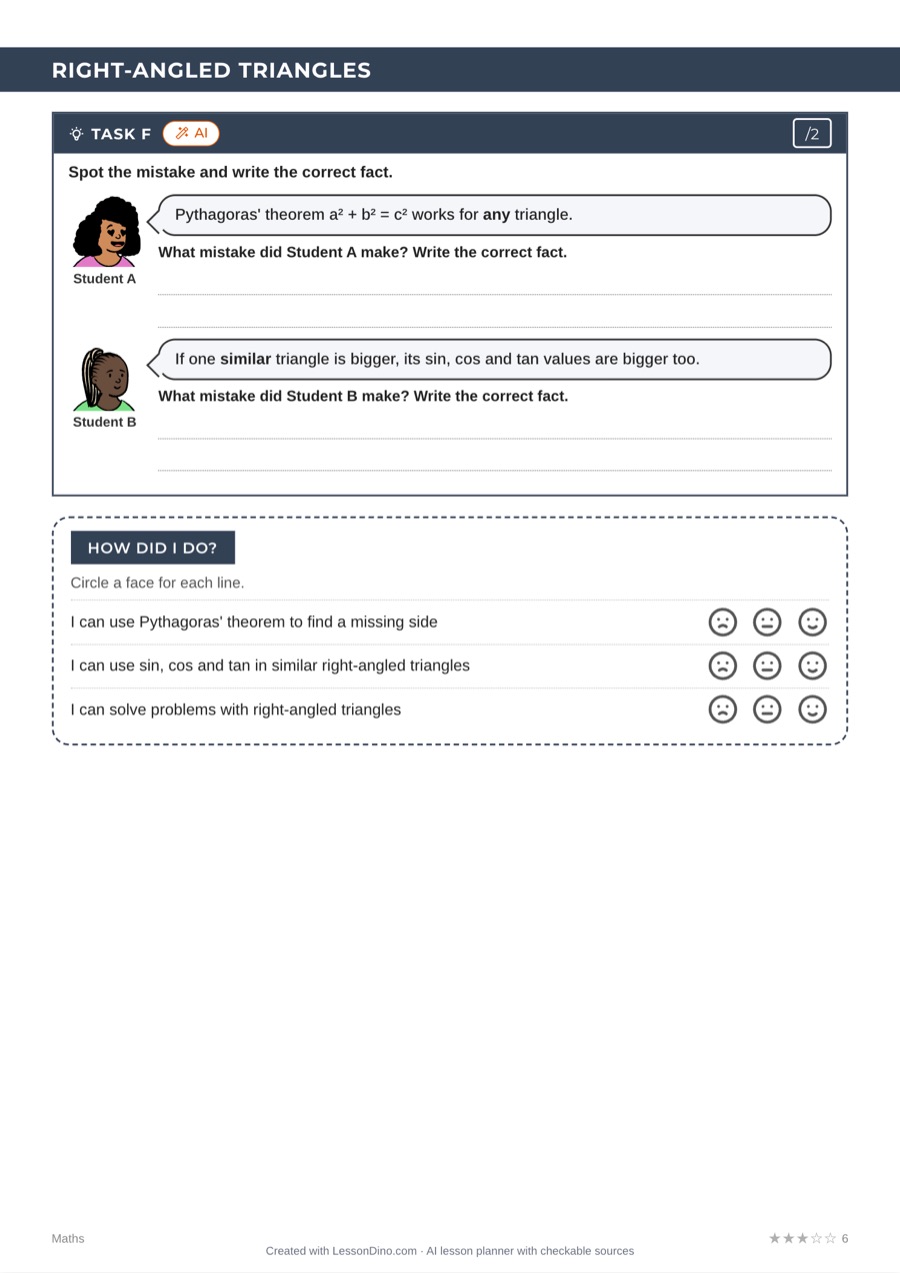
Page 6
Spot the mistake and write the correct fact.
Answers
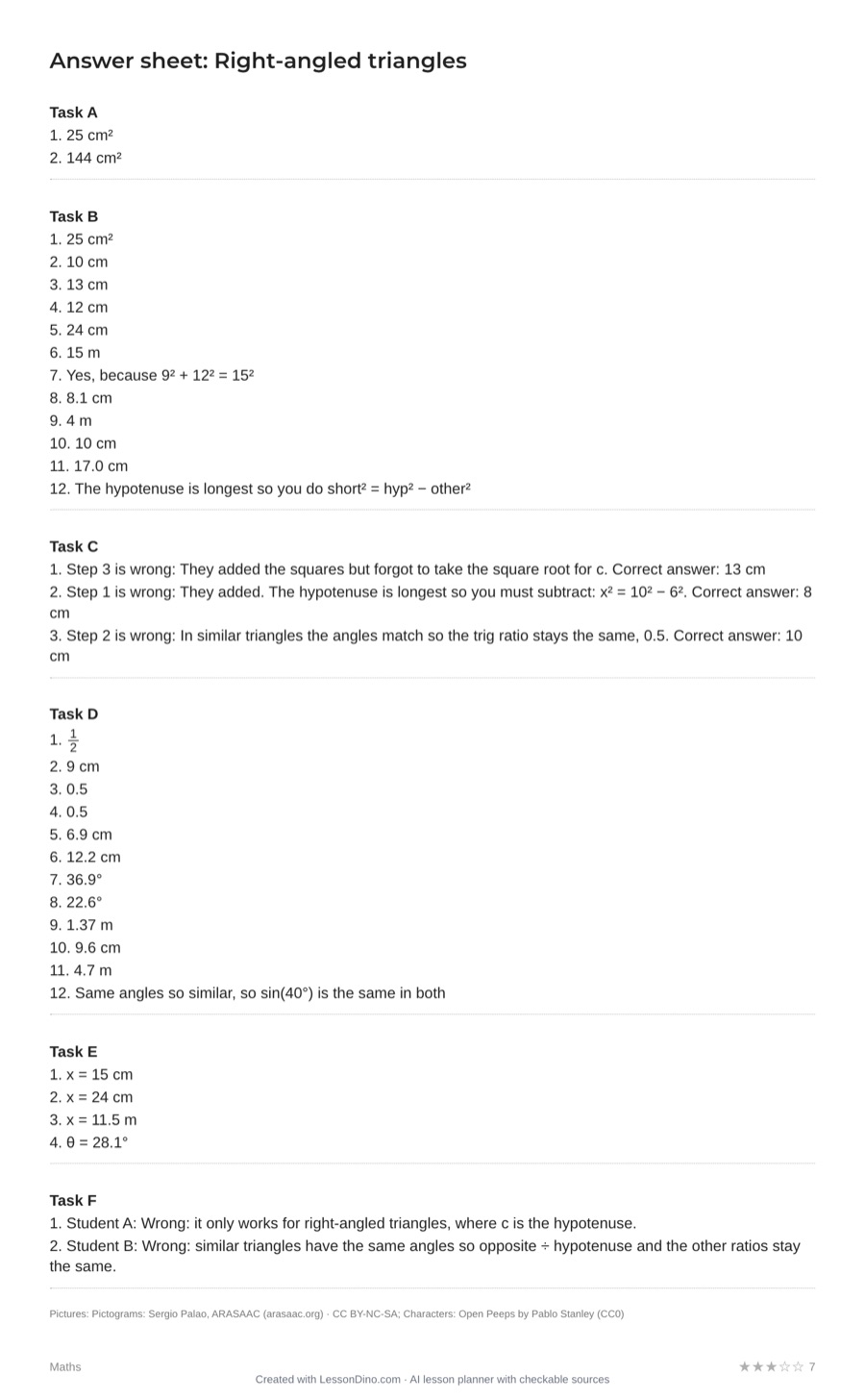
Show the answers
- Work out c² if a = 3 cm, b = 4 cm and c² = a² + b² with squares. 25 cm²
- A right-angled triangle has legs 6 cm and 8 cm. Work out the hypotenuse. 10 cm
- A right-angled triangle has legs 5 cm and 12 cm. Work out the hypotenuse. 13 cm
- A right-angled triangle has hypotenuse 13 cm and one short side 5 cm. Work out the other short side. 12 cm
- A right-angled triangle has hypotenuse 25 cm and one short side 7 cm. Work out the other short side. 24 cm
- A right-angled triangle has legs 9 m and 12 m. Work out the hypotenuse. 15 m
- Is a triangle with sides 9 cm, 12 cm and 15 cm right-angled? Explain how you know. Yes, because 9² + 12² = 15²
- A right-angled triangle has legs 4 cm and 7 cm. Work out the hypotenuse to 1 d.p. 8.1 cm
- A 5 m ladder leans against a wall. Its foot is 3 m from the wall on flat ground. How high up the wall is the top? 4 m
- A rectangle is 8 cm by 6 cm. Work out the diagonal length. 10 cm
- A square has side 12 cm. A diagonal cuts it into two right-angled triangles. Work out the diagonal to 1 d.p. 17.0 cm
- Explain how you know you must subtract to find a missing short side. The hypotenuse is longest so you do short² = hyp² − other²
- A right-angled triangle has opposite 5 cm and hypotenuse 10 cm for 30°. Work out opposite ÷ hypotenuse. 1/2
- A similar triangle has the same 30° angle and hypotenuse 18 cm. Use ratio 0.5 to work out the opposite side. 9 cm
- Work out sin(30°) for any similar 30° triangle. 0.5
- Work out cos(60°) for a right-angled triangle. 0.5
- A right-angled triangle has angle 35° and hypotenuse 12 cm. Work out the opposite side to 1 d.p. 6.9 cm
- A right-angled triangle has angle 55° and adjacent 7 cm. Work out the hypotenuse to 1 d.p. 12.2 cm
- A right-angled triangle has opposite 9 cm and adjacent 12 cm. Work out the angle to 1 d.p. 36.9°
- A right-angled triangle has hypotenuse 13 cm and opposite 5 cm. Work out the angle to 1 d.p. 22.6°
- A ramp makes 20° with the ground. The ramp length (hypotenuse) is 4 m. Work out the height to 2 d.p. 1.37 m
- Two similar triangles both have angle 40°. A large triangle has hypotenuse 15 cm. Work out the opposite side to 1 d.p. 9.6 cm
- A 5 m ladder makes 70° with the flat ground. Work out how high up the wall it reaches to 1 d.p. 4.7 m
- Two right-angled triangles have angles 90°, 50° and 40°. Explain how you know they are similar and what that means for sin(40°). Same angles so similar, so sin(40°) is the same in both
The answer sheet is the last picture above.
Curriculum
use Pythagoras’ Theorem and trigonometric ratios in similar triangles to solve problems involving right-angled triangles
From National curriculum in England, Key Stage 3 mathematics.
Made with Lesson Dino's AI on 17 October 2026. AI can make mistakes, so check the answers and facts against the sources before you teach.