Slides
Lesson plan
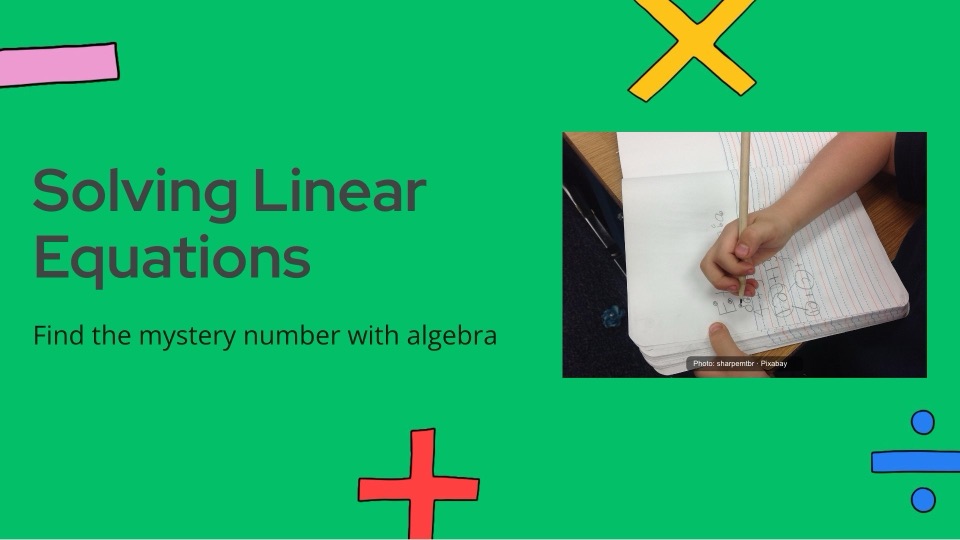
Find the Mystery Number
Students learn to rearrange and solve linear equations in one variable. They hunt matching solutions around the room and check each answer.
Objectives
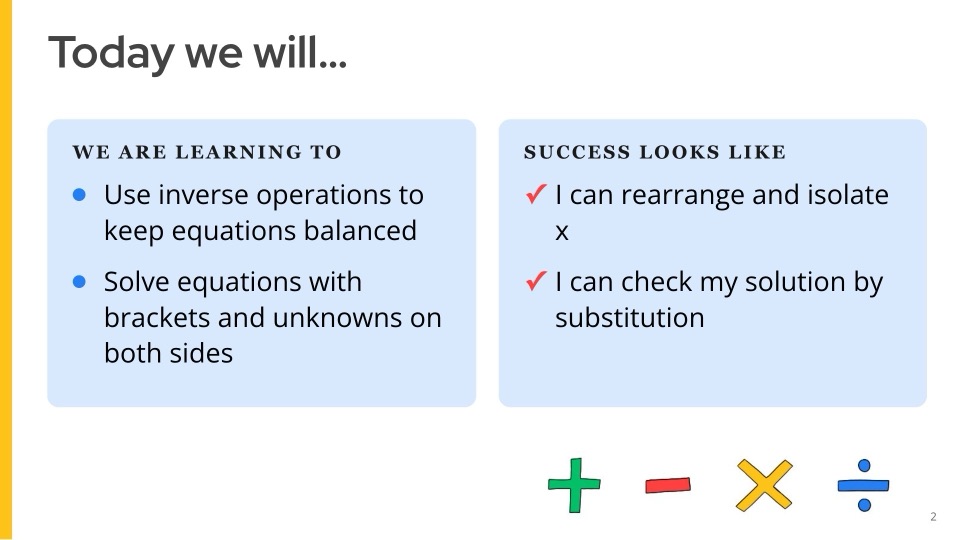
- Students will solve one- and two-step linear equations using inverse operations to isolate x.
- Students will rearrange equations with x on both sides and brackets to find solution.
- Students will check solutions by substitution to keep both sides balanced and equal.
Success criteria
- I can undo + - x ÷ in correct order to isolate x.
- I can gather x terms together and expand brackets before solving.
- I can substitute my answer to check both sides are equal.
Key words
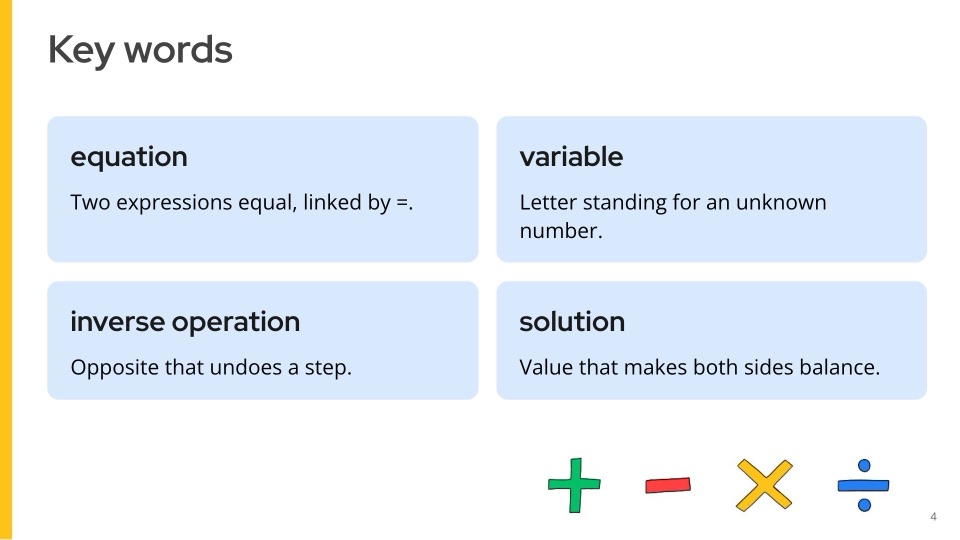
| Word | Meaning |
|---|---|
| equation | Two expressions equal, linked by =. |
| variable | Letter standing for an unknown number. |
| inverse operation | Opposite move that undoes a step. |
| solution | Value that keeps both sides equal when put in. |
Timed plan (60 minutes)
| Time | Stage | What happens |
|---|---|---|
| 5 min | Starter | Hook pupils with the equation hunt and recall what balancing means. Show Slide 1 and give the hook: Eight equations are hiding around the room. Find each one, solve it, then find its matching answer card. Show Slide 2 and share that today is about rearranging to isolate x and checking by substitution. Ask pairs to answer on whiteboards: x + 7 = 18, what is x and how do you know? Take answers and link to scales that stay equal only if we do the same to both sides. |
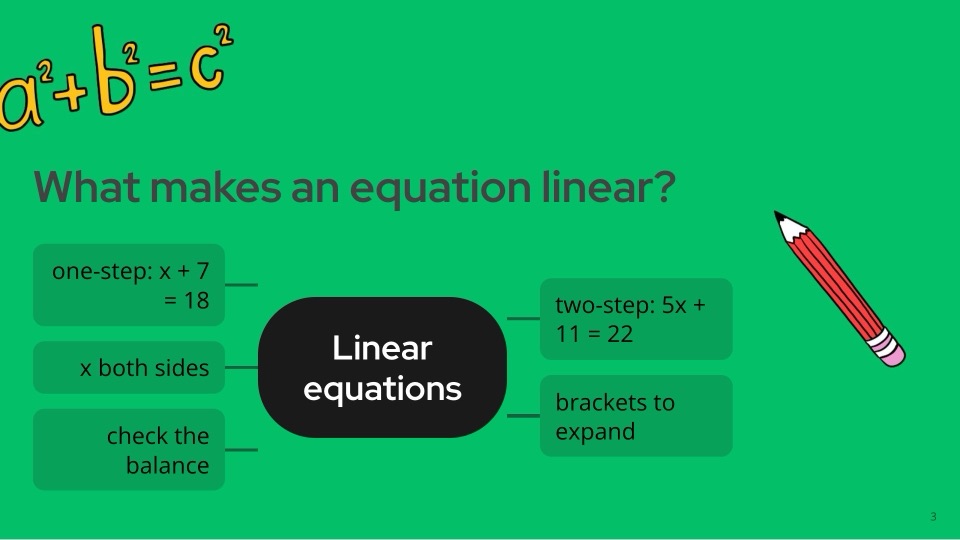
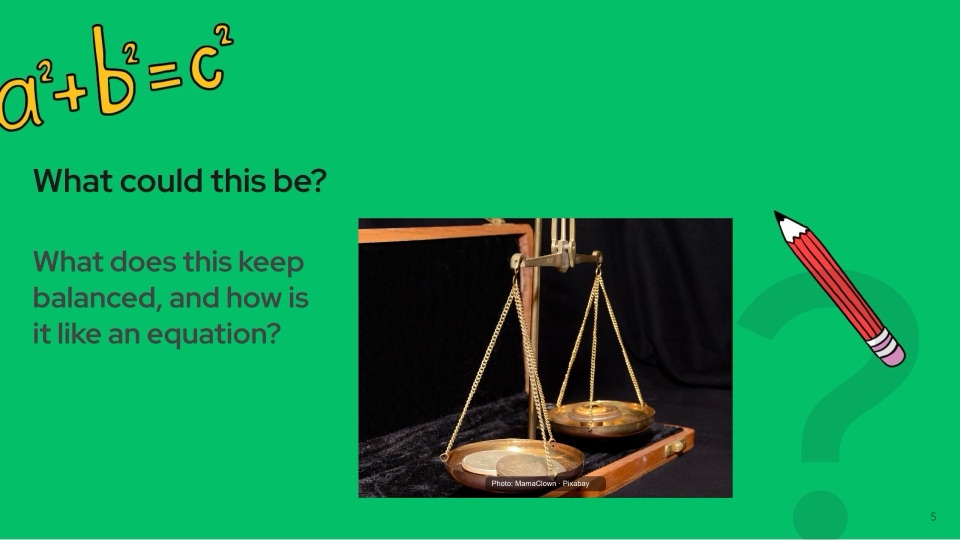
| 12 min | Teaching | Revise linear form, inverse operations and checking by substitution. Show Slides 3-4 and agree that a linear equation has x only as a multiple of x, not x squared or similar. Show Slide 5 balance scales and model x + 7 = 18 by subtracting 7 from both sides. Model 4z = 16 by dividing both sides by 4, naming division as the inverse of multiplication. Model checking by substituting the answer into the original equation. |
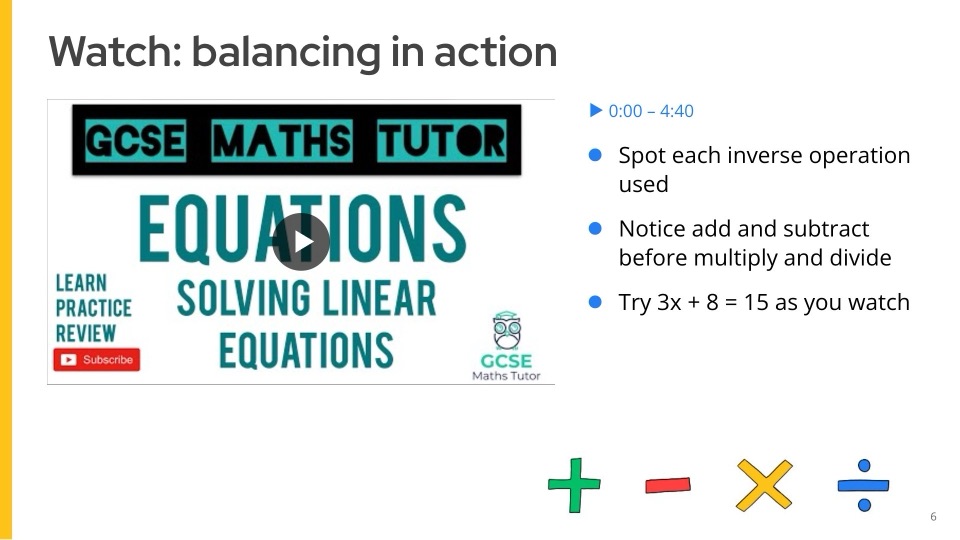
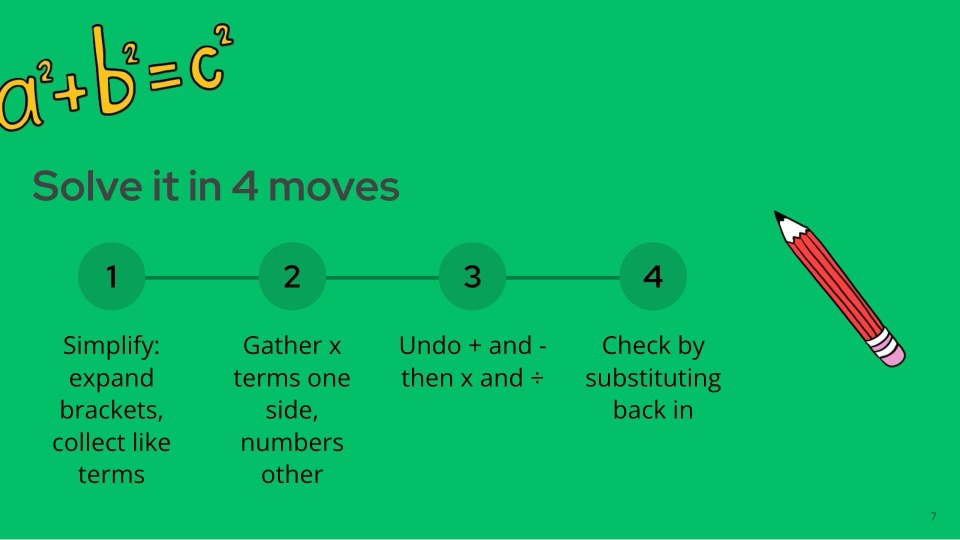
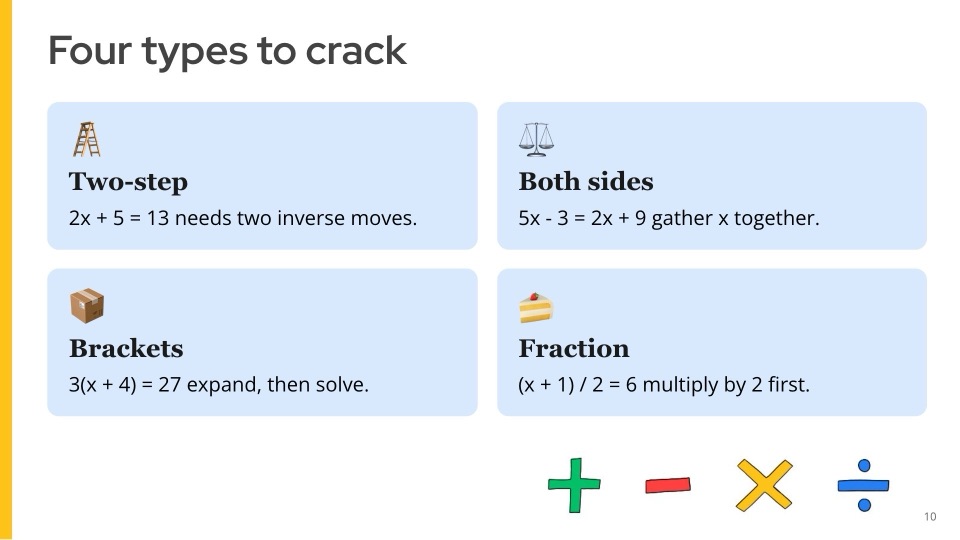
| 13 min | Modelling | Model the four-move method for two-step, both sides and brackets equations. Play Video clip 1 (0:00–4:40) on Slide 6. Pupils spot each inverse and note add and subtract before multiply and divide. Show Slide 7 steps: expand and collect, gather x terms one side, undo + and - then x and ÷, check by substituting back in. Live-model 5x + 11 = 22 by subtracting 11 then dividing by 5. Live-model 3(x + 4) = 27 by expanding to 3x + 12 = 27, then solving to x = 5. |
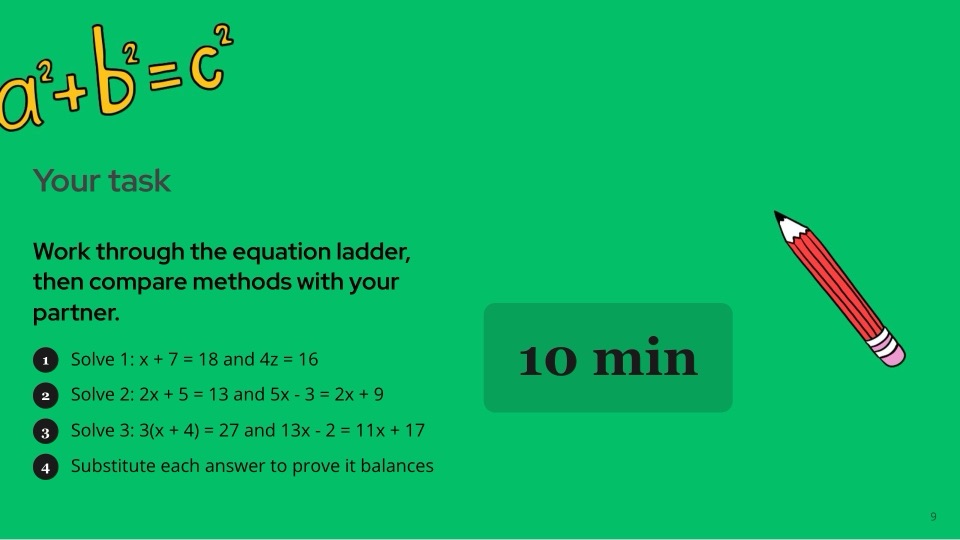
| 20 min | Main activity | Practise solving equations with unknowns on both sides to find matching solutions. Show Slides 9-10 and explain the hunt: walk only, solve, record the two moves, then find the matching answer card. Point out 8 cards such as 5x + 12 = 3x + 20 and 11x - 12 = 6x + 18, plus stretch card 7c - 22 = 10 - c. Remind pairs to move variable terms to one side so the unknowns are on one side and then solve, by subtracting the smaller x-term from both sides. Stop at 15 minutes for pairs to compare methods and substitution checks. |
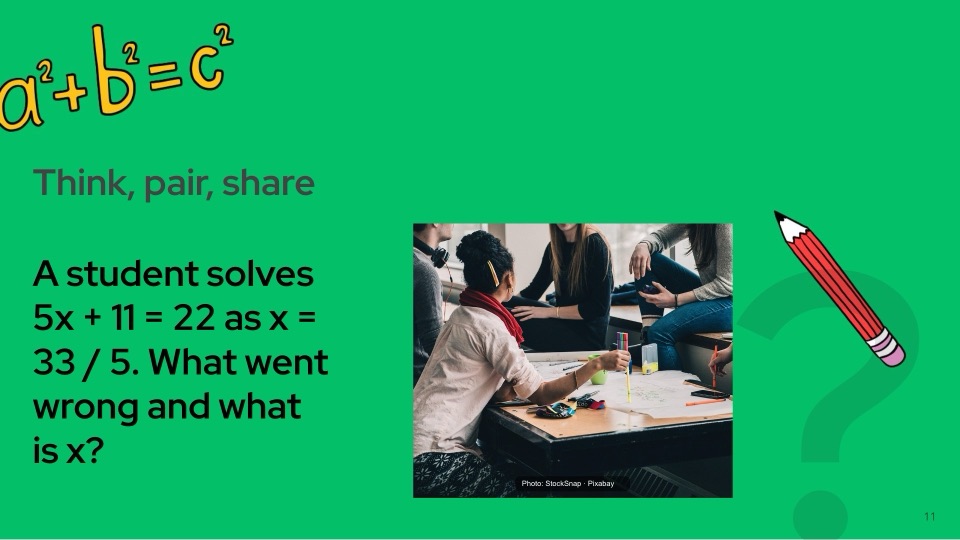
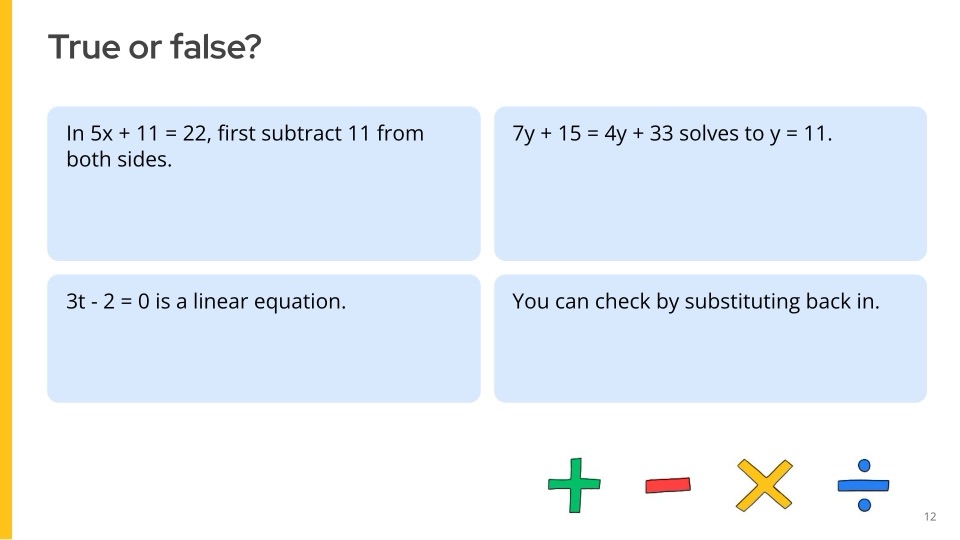
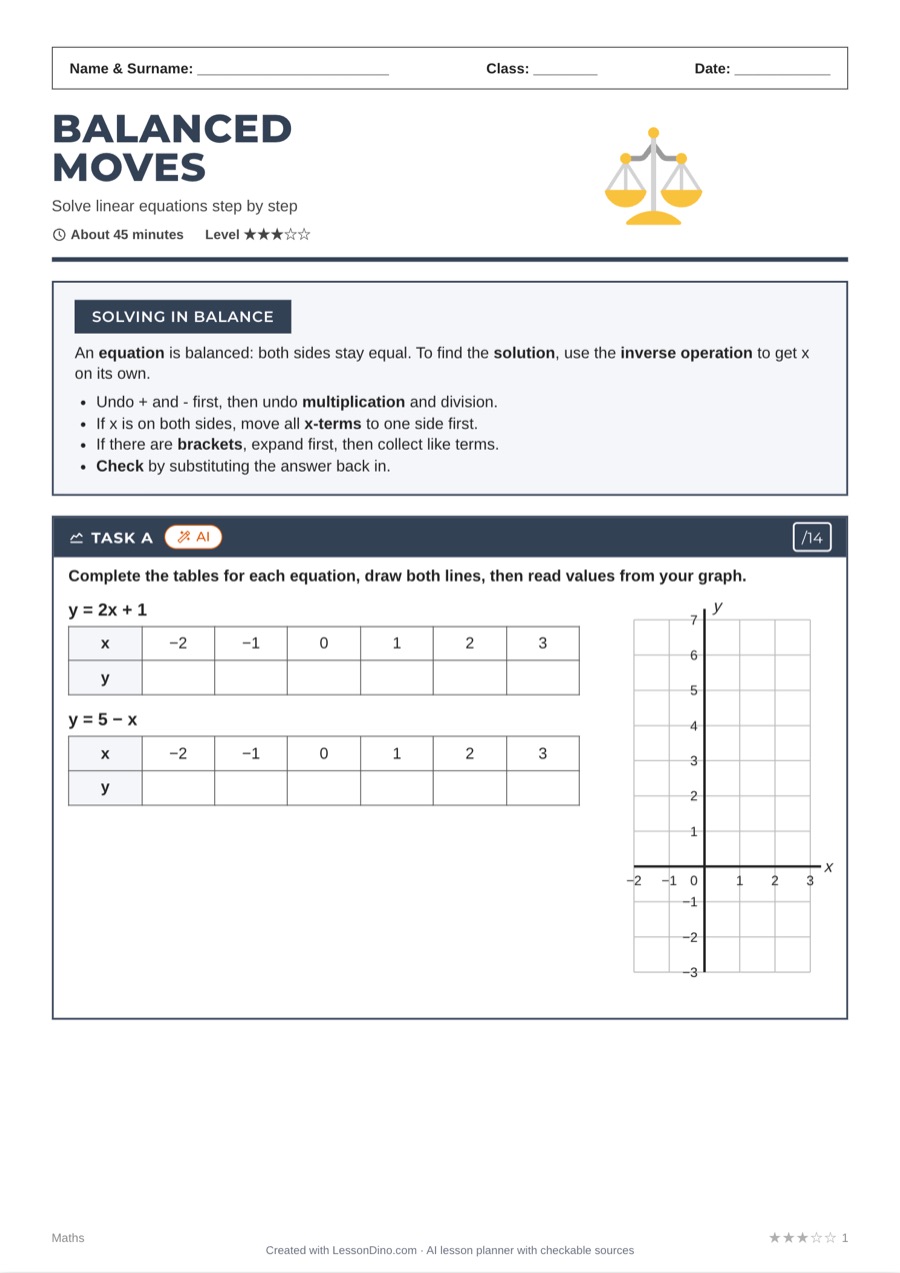
| 10 min | Plenary | Fix the common order error and prove all equation types can be solved. Show Slide 11: A student solves 5x + 11 = 22 as x = 33/5. What went wrong and what is x? Use Worksheet Task C: pupils find the first wrong step and explain the fix. Take votes and model the correct fix: subtract 11 to get 5x = 11, so x = 11/5. Return to objectives and set homework. |
Common mistakes
- Doing an operation to one side only
How to spot it: Left and right values no longer match when checked
Insist on doing the same to both sides to maintain equality; re-do with balance mat. - Dividing before undoing + or - in two-step equations
How to spot it: Answer like x = 33/5 for 5x + 11 = 22
Undo addition or subtraction before multiplication or division; subtract 11 first to get 5x = 11. - Not expanding brackets or not collecting like terms first
How to spot it: Bracket still present at divide step, or 2y + 5y left uncombined
Expand, then simplify by collecting terms together so the equation is ready to be solved.
Support
- Colour-code the x-terms and number terms so pupils can see what to collect on each side before isolating.
- Provide balance mat, step prompt card and worked example of 5x + 11 = 22.
- Provide equation skeleton with blanks to link stories to algebra.
Stretch
- Include cards where the solution check needs substitution with negatives, such as 7c - 22 = 10 - c.
- Try 4(2m - 5) = 3(m + 5) and (5x - 27) ÷ 2 = x.
- Ask pupils to write their own two-step problem and mark a partner's method.
Check questions
- Solve 2x + 5 = 13
Answer: x = 4 - Solve 5x - 3 = 2x + 9
Answer: x = 4 - Solve 3(x + 4) = 27
Answer: x = 5
Curriculum
use algebraic methods to solve linear equations in 1 variable (including all forms that require rearrangement)
From National curriculum in England, Key Stage 3 mathematics.
Video clips
Clips on YouTube, from the start and end times we chose. Check each one before you show it.
-
GCSE essentials - solving equations from 0:00 to 4:40
The GCSE Maths Tutor: Solving Linear Equations | GCSE Maths 2020 Essentials | GCSE Maths Tutor
Covers two-step, brackets and rearrangement with GCSE vocabulary and pace that is perfect for 13-14 Year 9.
-
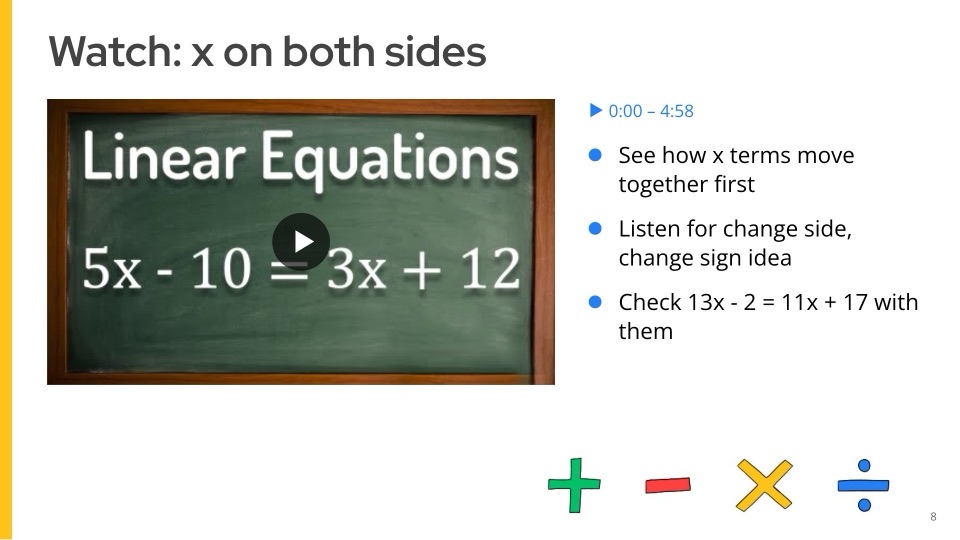
Variables on both sides from 0:00 to 4:58
JEDMATHS: Solving linear equations with variables on both sides - GCSE Maths
Exactly the rearrangement Year 9 need, explained at GCSE pace suitable for 13-14.
Worksheet
Sources
- Year 9 Mathematics - Curriculum Overview and KS3 Progress ... hgs.herts.sch.uk
- Year 9 Maths Curriculum Map - fishermore.lancs.sch.uk fishermore.lancs.sch.uk
- Solving linear equations sheffield.ac.uk
- Resources for Algebra > Simple linear equations from mathcentre mathcentre.ac.uk
- Solving one and two-step linear equations - BBC bbc.co.uk
- A Guide To Solving Linear Equations - Metatutor metatutor.co.uk
- SOLVING LINEAR EQUATIONS PRACTICE QUESTIONS - Metatutor metatutor.co.uk
- Solving Linear Equations - Quick Cover | Free Resource | Mathsbox mathsbox.org.uk
- Solving linear equations KS3 | Y8 Maths | Lesson Resources thenational.academy
- Problem solving with linear equations KS3 | Y8 Maths | Lesson Resources ... thenational.academy
- Solving basic equations & inequalities (one variable, linear) | Khan ... khanacademy.org
- Solving linear equations - Equations and formulae - WJEC - GCSE Maths ... bbc.co.uk
- Linear equations, functions, & graphs | Khan Academy khanacademy.org
- [2209.13347] Solving homogeneous linear equations over polynomia… arxiv.org
- A new approach for solving linear equations with first order through derivatives | Abstract alliedacademies.org
- Solving equations & inequalities | Algebra 1 | Math | Khan Academy en.khanacademy.org
- Solving Linear Equations - Steps and Examples mathmonks.com
- Solving Linear Equations - 4 Methods, Step-by-Step Solutions, Examples cuemath.com
- Exclusive Content Ready - Solving Linear Equations Milliken Publishing Company linuxmall.com.br
- solving linear equations in one variable tlc handout georgebrown.ca
- Solving Linear Equations - learnmath.org learnmath.org
- Linear equations - solving linear equations with one variable math.intemodino.com
Picture credits
- Photo: sharpemtbr · Pixabay
- Photo: MamaClown · Pixabay
- Photo: StockSnap · Pixabay
- Microsoft Fluent Emoji (MIT)
Made with Lesson Dino's AI on 17 October 2026. AI can make mistakes, so check facts against the sources before you teach.