Slides
Lesson plan
From 180° to Any Polygon
Students derive the polygon angle rule from triangles. They use it to find missing and regular polygon angles.
Objectives
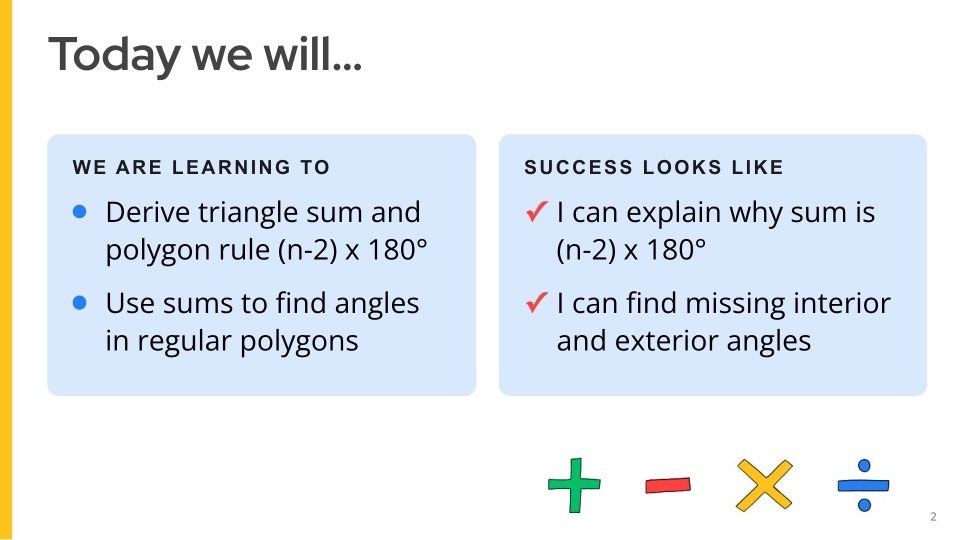
- Students will derive triangle sum and extend it to any polygon.
- Students will use (n-2) x 180° to find missing interior angles.
- Students will derive regular polygon properties using 360° ÷ n.
Success criteria
- I can explain why the total is (n-2) x 180°.
- I can find a missing angle in any polygon.
- I can find interior and exterior angles of regular polygons.
Key words
| Word | Meaning |
|---|---|
| interior angle | size of a corner inside a shape |
| exterior angle | size of the turn outside a shape when one side is extended |
| regular polygon | closed straight-sided shape where all edges and corners match |
| irregular polygon | closed straight-sided shape where edges or corners differ |
| diagonal | straight join between two corners that are not next to each other |
| angle sum | total found by adding all the corners together |
Timed plan (60 minutes)
| Time | Stage | What happens |
|---|---|---|
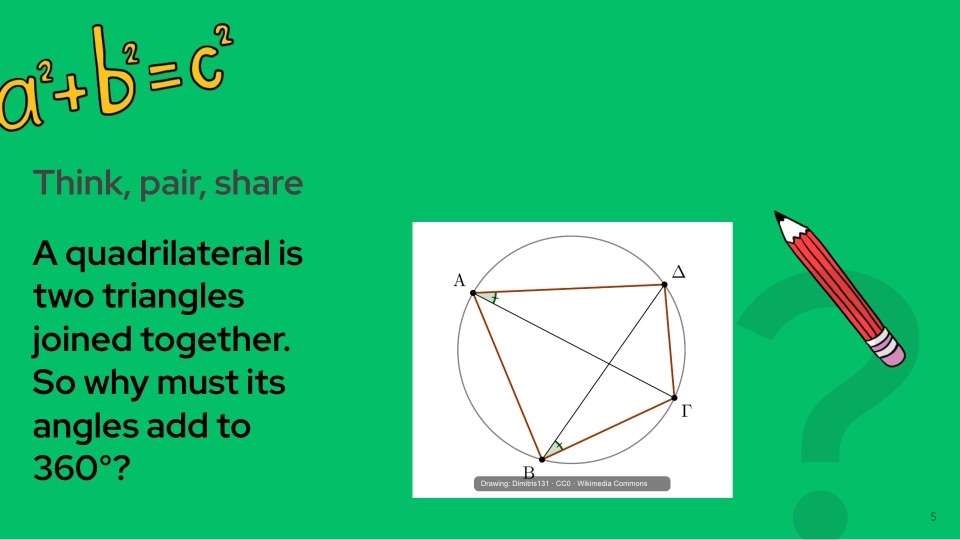
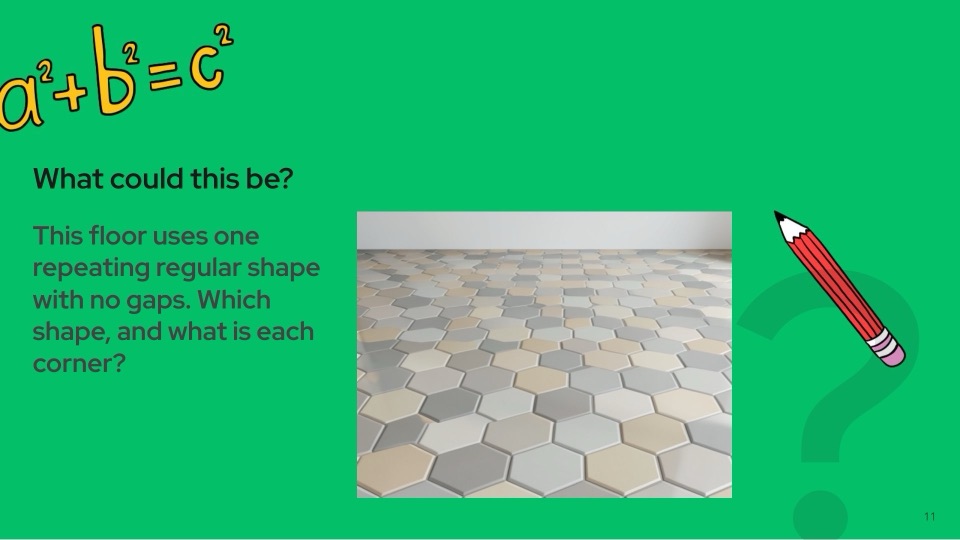
| 8 min | Starter | Recall triangle sum and hook students into splitting polygons into triangles. Show Slide 1 title and Slide 2 objectives and read the two success lines with the class. Say the hook: If one triangle is worth 180°, how many triangles can we hide inside a hexagon? Show Slide 5 question and give 2 minutes think, pair, share. Take answers and confirm a quadrilateral is two triangles joined, so 2 x 180° = 360°. |
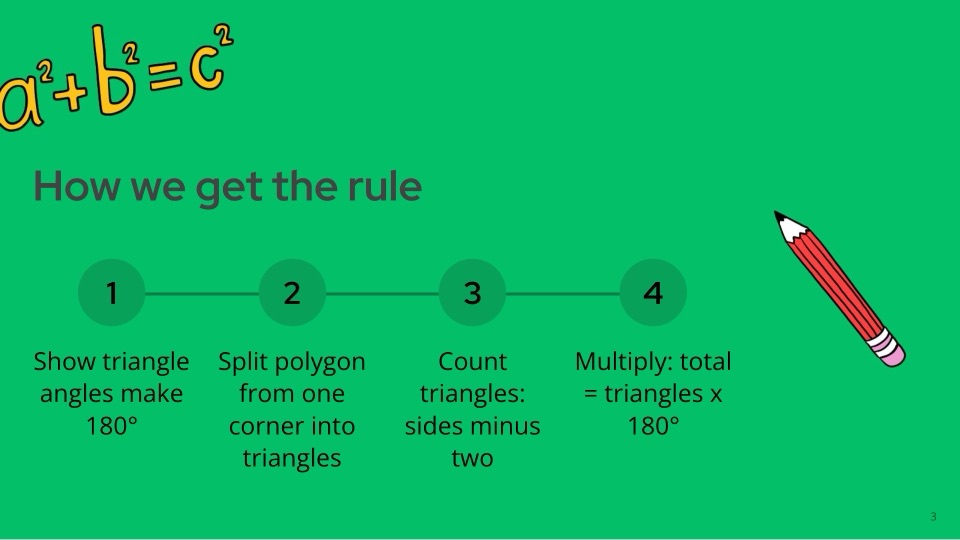
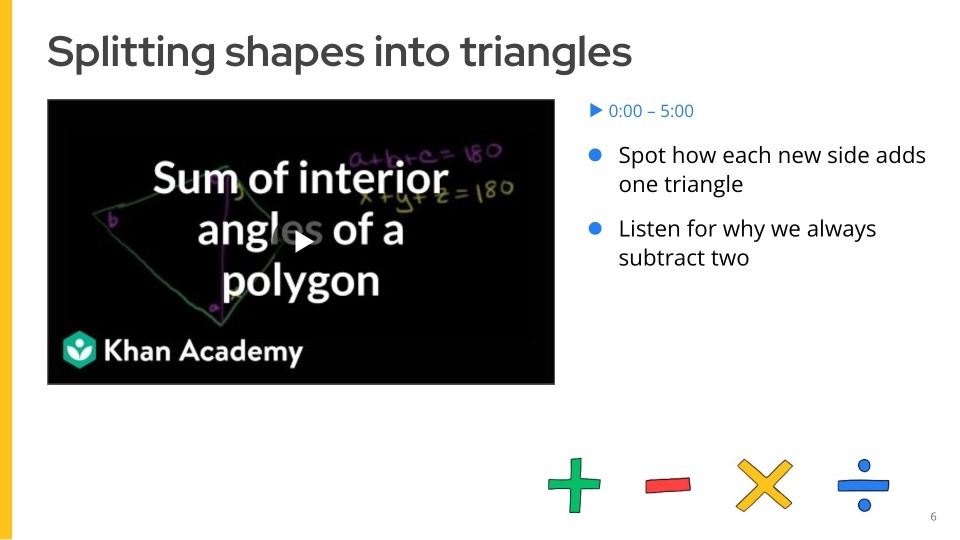
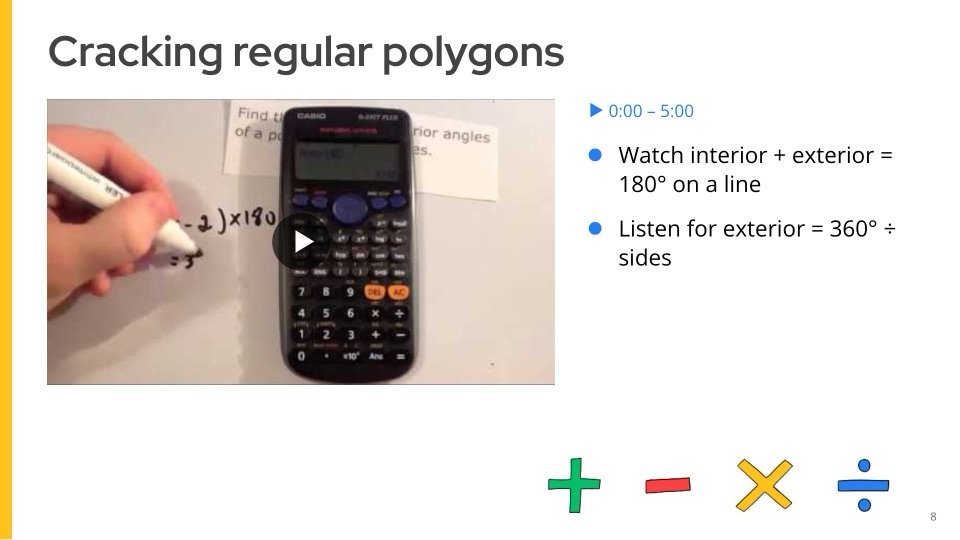
| 12 min | Teaching | Model how splitting from one vertex gives sides minus two triangles. Show Slide 3 steps and model tearing corners idea: three corners fit to a straight line, so 180°. Play Video clip 1 (0:00-5:00) on Slide 6 and ask students to spot how each new side adds one triangle. On the whiteboard draw diagonals from one vertex for quadrilateral to 2 triangles and pentagon to 3 triangles and 540°. Record that number of triangles is two fewer than sides and total is triangles x 180°. |
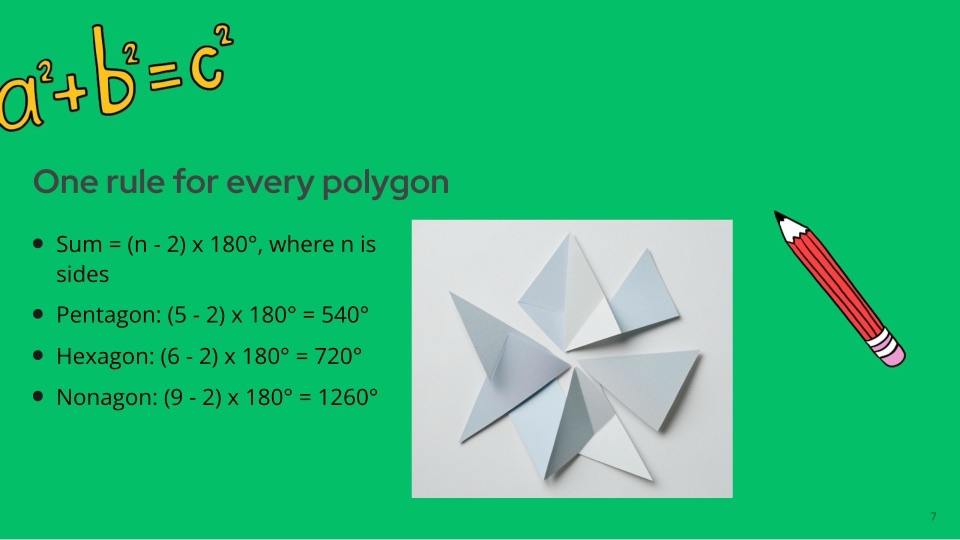
| 18 min | Main activity | Derive the interior angle sum rule by splitting polygons into triangles. Hand out printed quadrilateral, pentagon and hexagon outlines and rulers. Direct pairs to draw all diagonals from one vertex, count triangles and complete the sides-triangles-total table. Build the class table on the whiteboard: 4 sides gives 2 and 360°, 5 gives 3 and 540°, 6 gives 4 and 720°. Guide the class to generalise to sum = (n-2) x 180°, where n is sides, and show Slide 7 examples. |
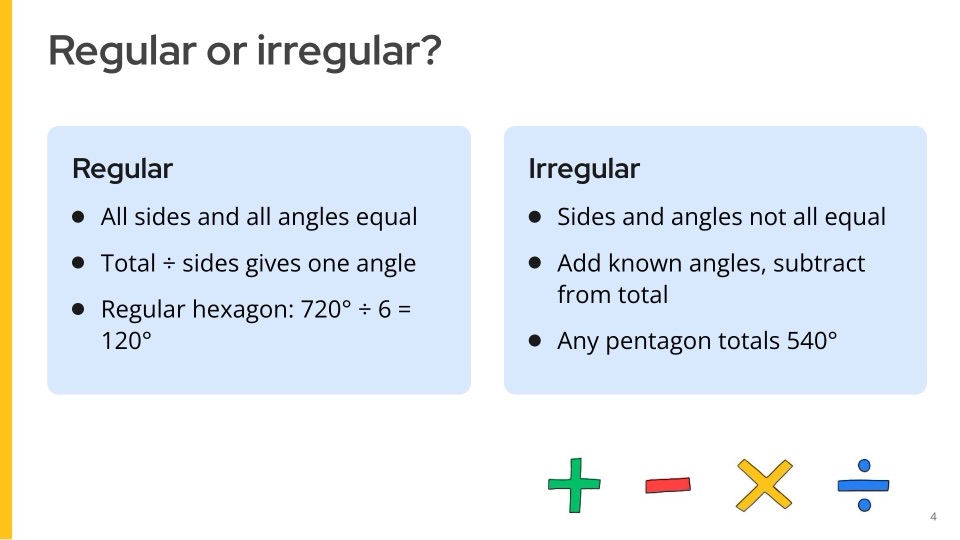
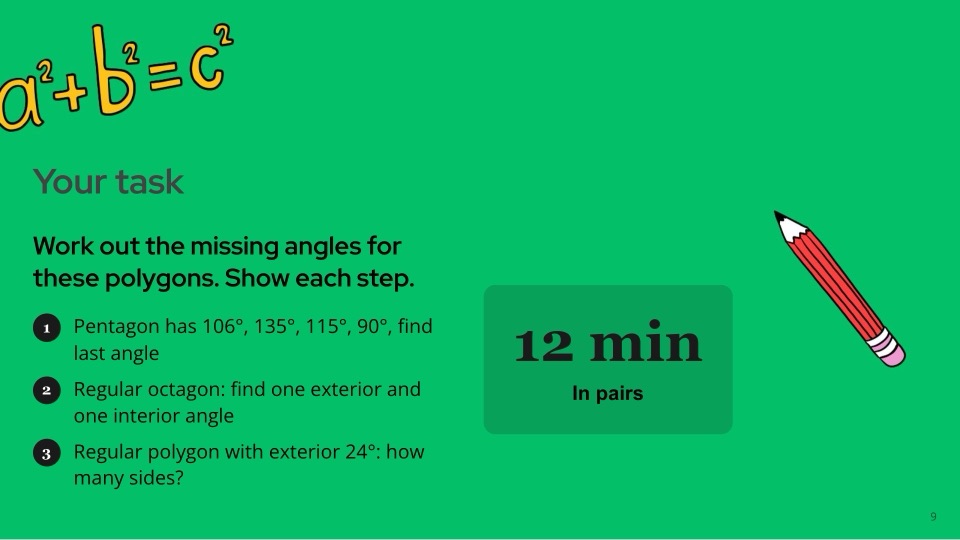
| 14 min | Practice | Use sums to find missing angles and regular polygon interior and exterior angles. Show Slide 4 and stress regular means total ÷ sides gives one angle, while irregular means sides and corners are not all equal so cannot just divide. Model regular octagon: exterior = 360° ÷ 8 = 45°, then interior = 180° - 45° = 135° because interior and exterior add to 180°. Set Slide 9 tasks: irregular pentagon last angle, regular octagon angles, polygon with exterior 24°. Circulate, marking the addition then subtraction step for the irregular case. |
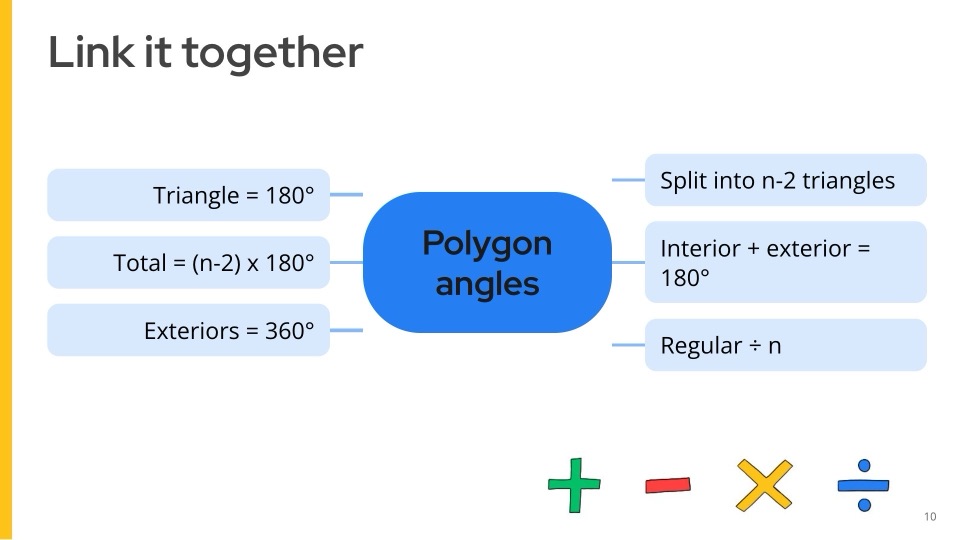
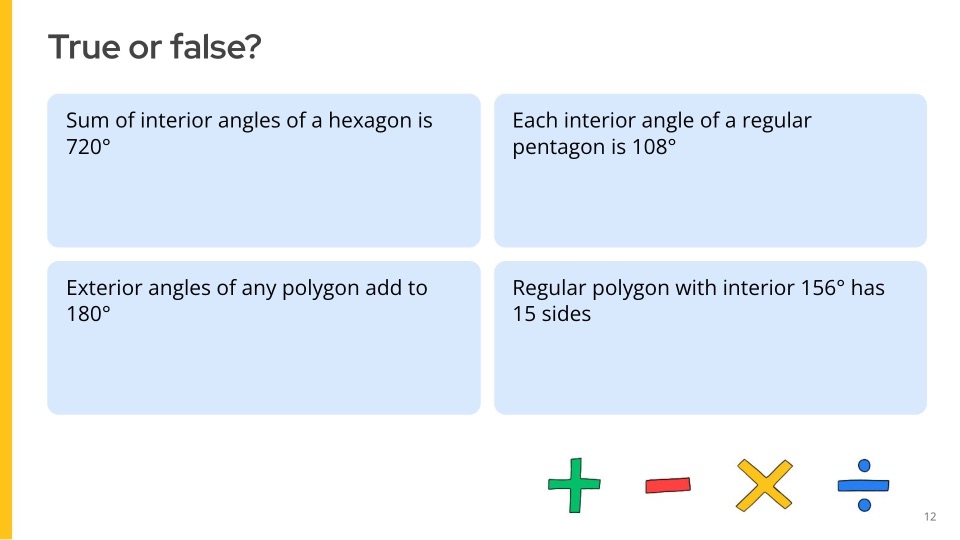
| 8 min | Plenary | Link triangle, total, and regular rules and check the objectives. Show Slide 10 mindmap and ask pairs to retell the chain from triangle to regular ÷ n. Run Slide 12 true or false: hexagon 720° with 4 x 180°, pentagon 108° with 540° ÷ 5. Confirm exterior total 360° and interior + exterior = 180°. Set one-line homework and collect tables. |
Common mistakes
- Using 180n instead of (n-2) x 180° for the total.
How to spot it: Total far too big, e.g. pentagon as 900°.
Always subtract 2 first to count triangles, then multiply by 180°. - Dividing the total by n for an irregular polygon.
How to spot it: One answer copied for all different corners.
Only divide when all corners match; otherwise add known and subtract from total. - Mixing interior and exterior and adding to wrong total.
How to spot it: Exterior found with (n-2) x 180° or interior with 360 ÷ n.
Remember they pair to 180° at each corner; exteriors together make 360°.
Support
- Provide the shapes with one starting vertex marked and the table headings already drawn.
- Keep worked subtraction layout with totals written at top and a multiplication grid for divisions.
Stretch
- Ask them to explain in writing why the number of triangles is always two fewer than the number of sides.
- Ask for proof with division why a shape with an exterior that does not divide 360 cannot be regular.
Check questions
- Find the sum of interior angles of a heptagon.
Answer: (7-2) x 180° = 900° - Each exterior angle of a regular hexagon is what, and each interior angle is what?
Answer: Exterior 360° ÷ 6 = 60°; interior 180° - 60° = 120°. - A regular polygon has exterior angles of 24°. How many sides?
Answer: 360 ÷ 24 = 15 sides
Curriculum
derive and use the sum of angles in a triangle and use it to deduce the angle sum in any polygon, and to derive properties of regular polygons
From National curriculum in England, Key Stage 3 mathematics.
Video clips
Clips on YouTube, from the start and end times we chose. Check each one before you show it.
-
Triangle split to (n-2) x 180 from 0:00 to 5:00
Khan Academy: Sum of interior angles of a polygon | Angles and intersecting lines | Geometry | Khan Academy
Derives the polygon sum from triangles by triangulation at a clear pace that suits 13-14-year-olds in Year 9.
-
Missing interior and exterior angles from 0:00 to 5:00
corbettmaths: Angles in Polygons - Corbettmaths
UK GCSE-style explanation of interior and regular-polygon angles with vocabulary and pace ideal for Year 9 aged 13-14.
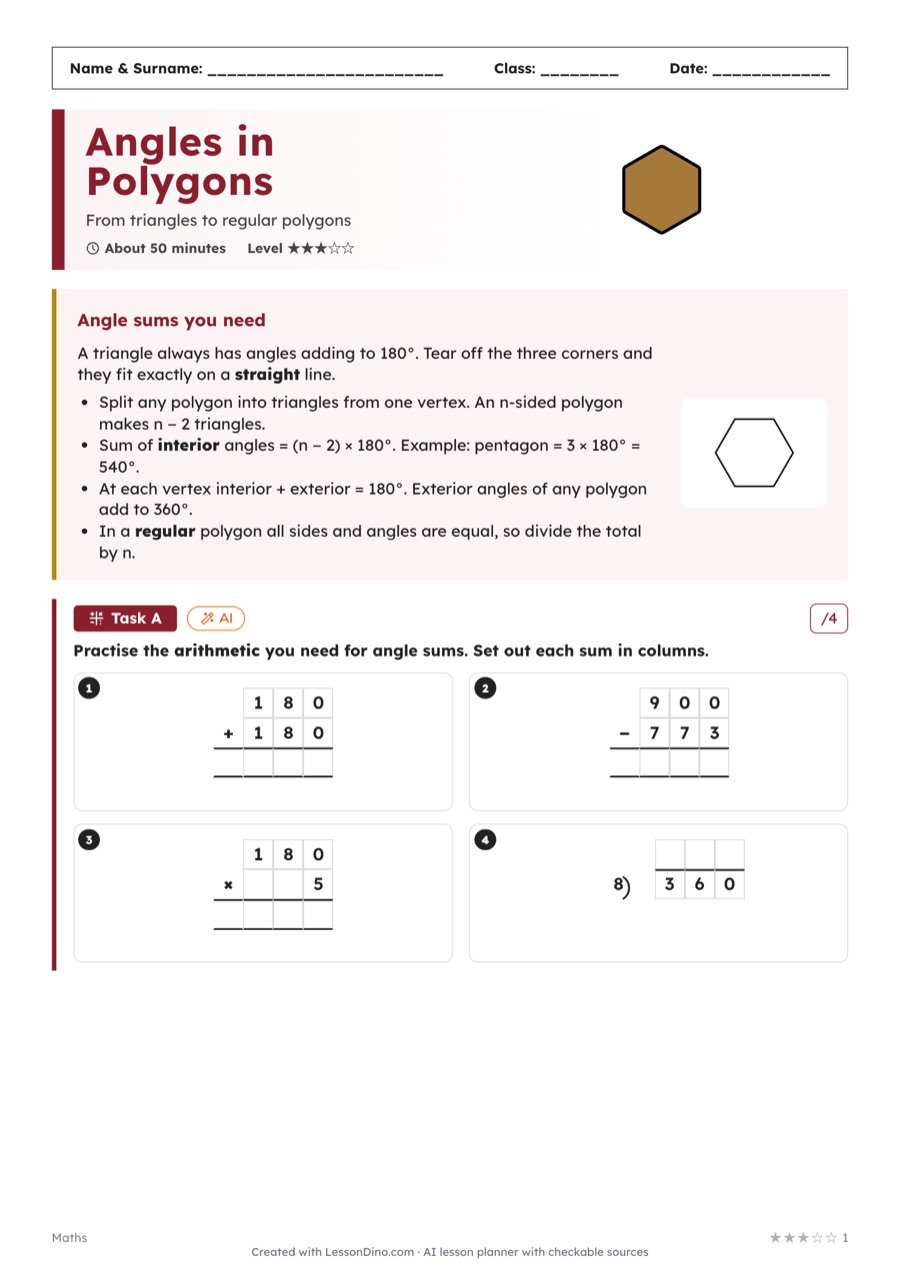
Worksheet
Sources
- Hounsdown School - Year 9 Curriculum hounsdown.hants.sch.uk
- maths yr 9 curriculum trinity.bexley.sch.uk
- Angles in polygons - KS2 Maths - Learning with BBC Bitesize bbc.co.uk
- Angles in polygons - KS3 Maths - BBC Bitesize bbc.co.uk
- Angles in Polygons | Free GCSE Maths Worksheet (PDF) | Virtus Academy virtusacademy.co.uk
- Angles in Polygons - GCSE Maths Revision Guide gcsemathsai.co.uk
- Angles in Polygons - — GCSE Maths Formula Sheet | GCSEMaths gcsemathsai.co.uk
- Angles in Polygons - League of Learning leagueoflearning.co.uk
- Flexi answers - What is the Polygon Angle Sum Theorem? | CK-12 Foundation ck12.org
- Angles in Polygons Worksheets (12 Free Printable PDFs) | Algebra911 algebra911.com
- Polygons and Angles | Plane Figures | Mathematics Grade 4 mathsolu.com
- Angles in Polygons Worksheets | Printable PDF cazoommaths.com
- ANGLES AND POLYGONS | Dr Austin Maths draustinmaths.com
- exterior angles of regular polygons edplace.com
- Year 9 Angles in polygons smallheathleadershipacademy.com
- Angles in Polygons | Teaching Resources tes.com
- Angles in Polygons • Activity by Jen Brown - Desmos classroom.amplify.com
- 131431196.H Polygons CAN ojcsmath.edublogs.org
- Geometry H Angles in polygons v2 justmaths.co.uk
Picture credits
- Photo: shannonrphillips · Pixabay
- Drawing: Dimitris131 · CC0 · Wikimedia Commons
- AI illustration · Cloudflare
- OpenMoji – the open-source emoji and icon project (CC BY-SA 4.0)
- Pictograms: Sergio Palao, ARASAAC (arasaac.org) · CC BY-NC-SA
Made with Lesson Dino's AI on 19 October 2026. AI can make mistakes, so check facts against the sources before you teach.