The worksheet
About this worksheet
Students learn to rearrange and solve linear equations in one variable. They hunt matching solutions around the room and check each answer. This Year 9 Maths worksheet gives students (ages 13–14) five pages of practice on solving linear equations, part of the algebra unit. It goes with our free Solving linear equations lesson, which has the slides and a timed lesson plan.
What it covers
By the end, students should be able to:
- Students will solve one- and two-step linear equations using inverse operations to isolate x.
- Students will rearrange equations with x on both sides and brackets to find solution.
- Students will check solutions by substitution to keep both sides balanced and equal.
How to use it
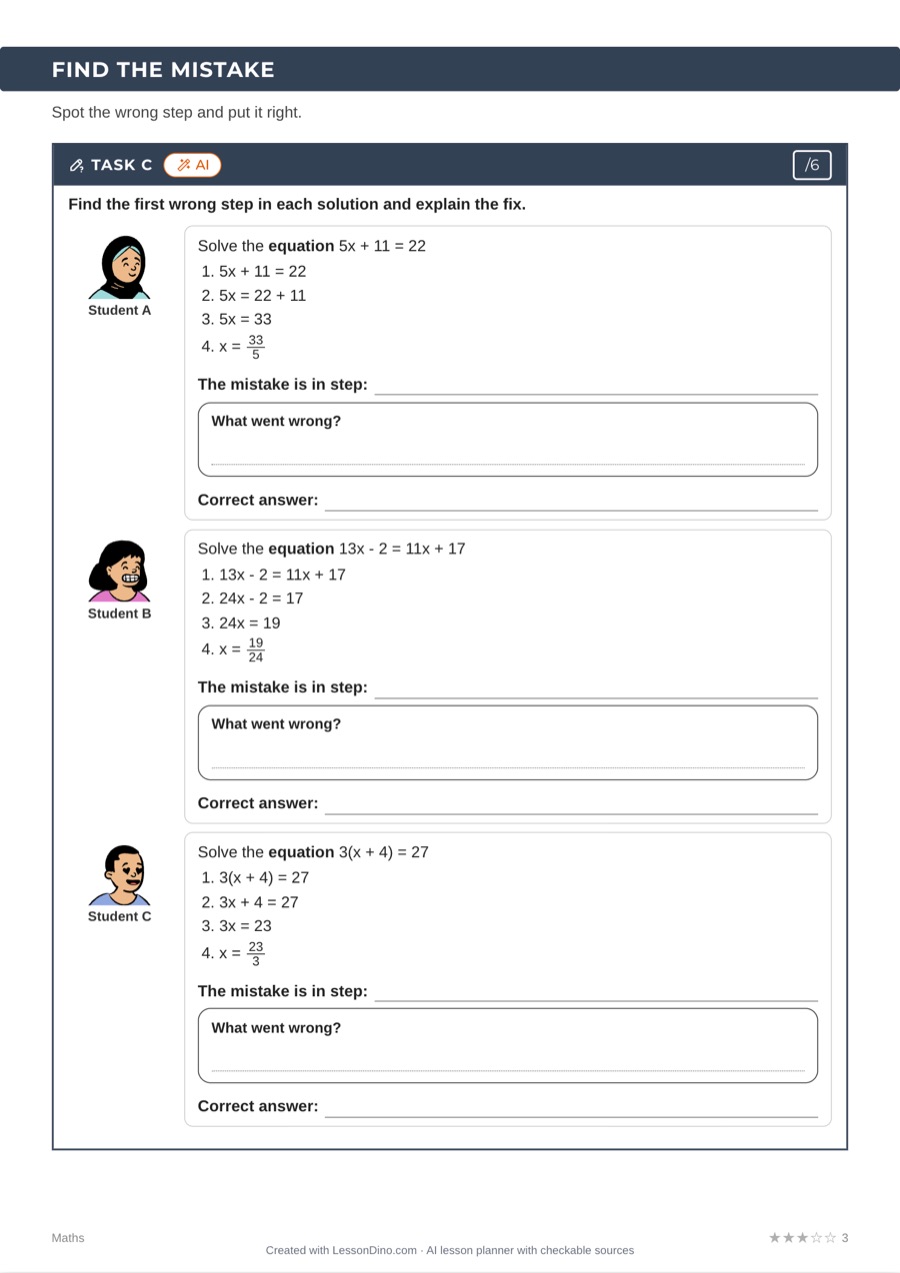
- Plenary (10 minutes): Use Worksheet Task C: pupils find the first wrong step and explain the fix.
- Support: Colour-code the x-terms and number terms so pupils can see what to collect on each side before isolating.
- Stretch: Include cards where the solution check needs substitution with negatives, such as 7c - 22 = 10 - c.
- The answer sheet is the last page, so you can print it on its own or let students check their own work.
Key vocabulary
- equation: Two expressions equal, linked by =.
- variable: Letter standing for an unknown number.
- inverse operation: Opposite move that undoes a step.
- solution: Value that keeps both sides equal when put in.
Mistakes to watch for
- Doing an operation to one side only. Insist on doing the same to both sides to maintain equality; re-do with balance mat.
- Dividing before undoing + or - in two-step equations. Undo addition or subtraction before multiplication or division; subtract 11 first to get 5x = 11.
- Not expanding brackets or not collecting like terms first. Expand, then simplify by collecting terms together so the equation is ready to be solved.
What's on the worksheet
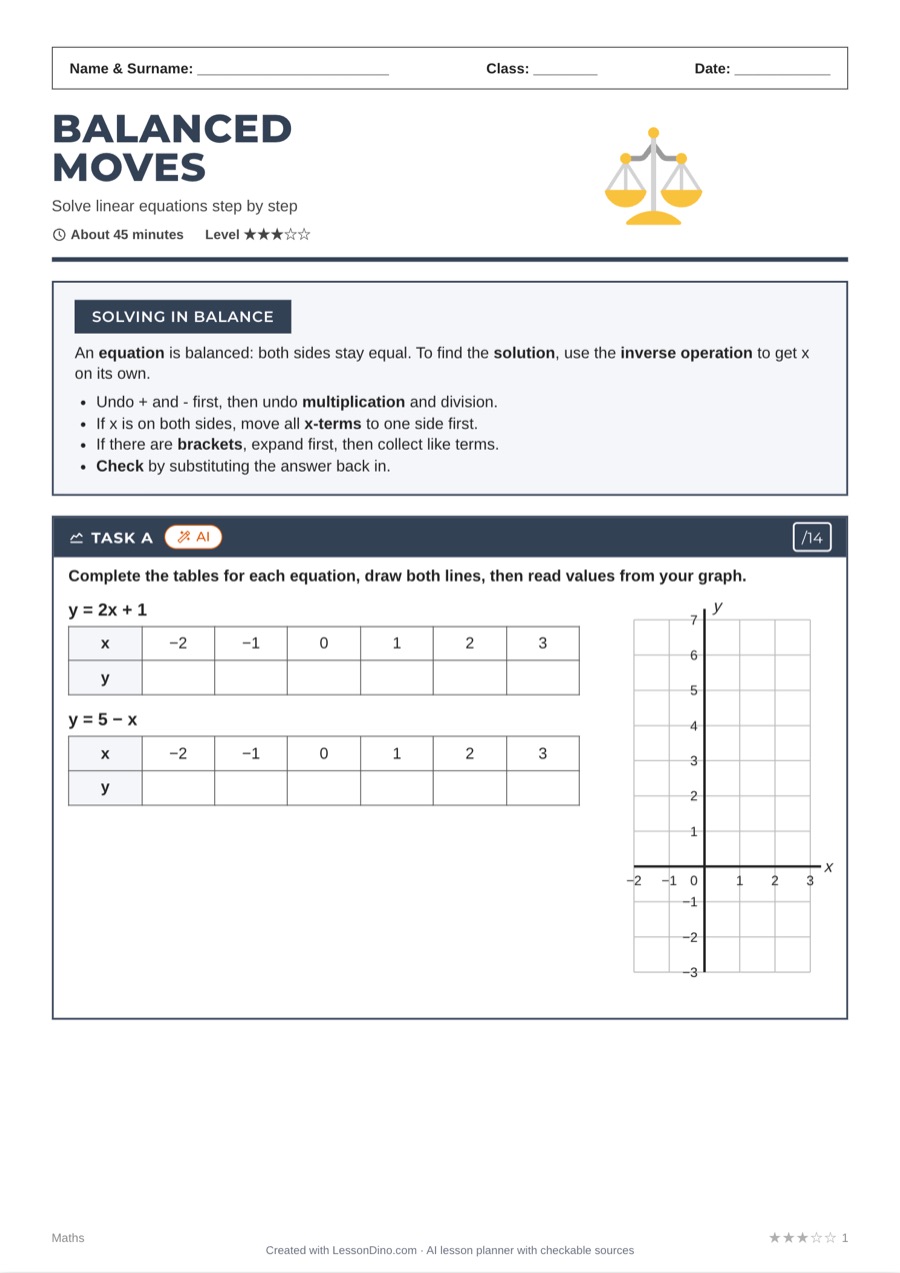
Keep It Balanced
Remember the balance rule and draw straight lines.
Solving in balance
- An equation is balanced: both sides stay equal. To find the solution, use the inverse operation to get x on its own.
- Undo + and - first, then undo multiplication and division.
- If x is on both sides, move all x-terms to one side first.
- If there are brackets, expand first, then collect like terms.
- Check by substituting the answer back in.
Complete the tables for each equation, draw both lines, then read values from your graph.
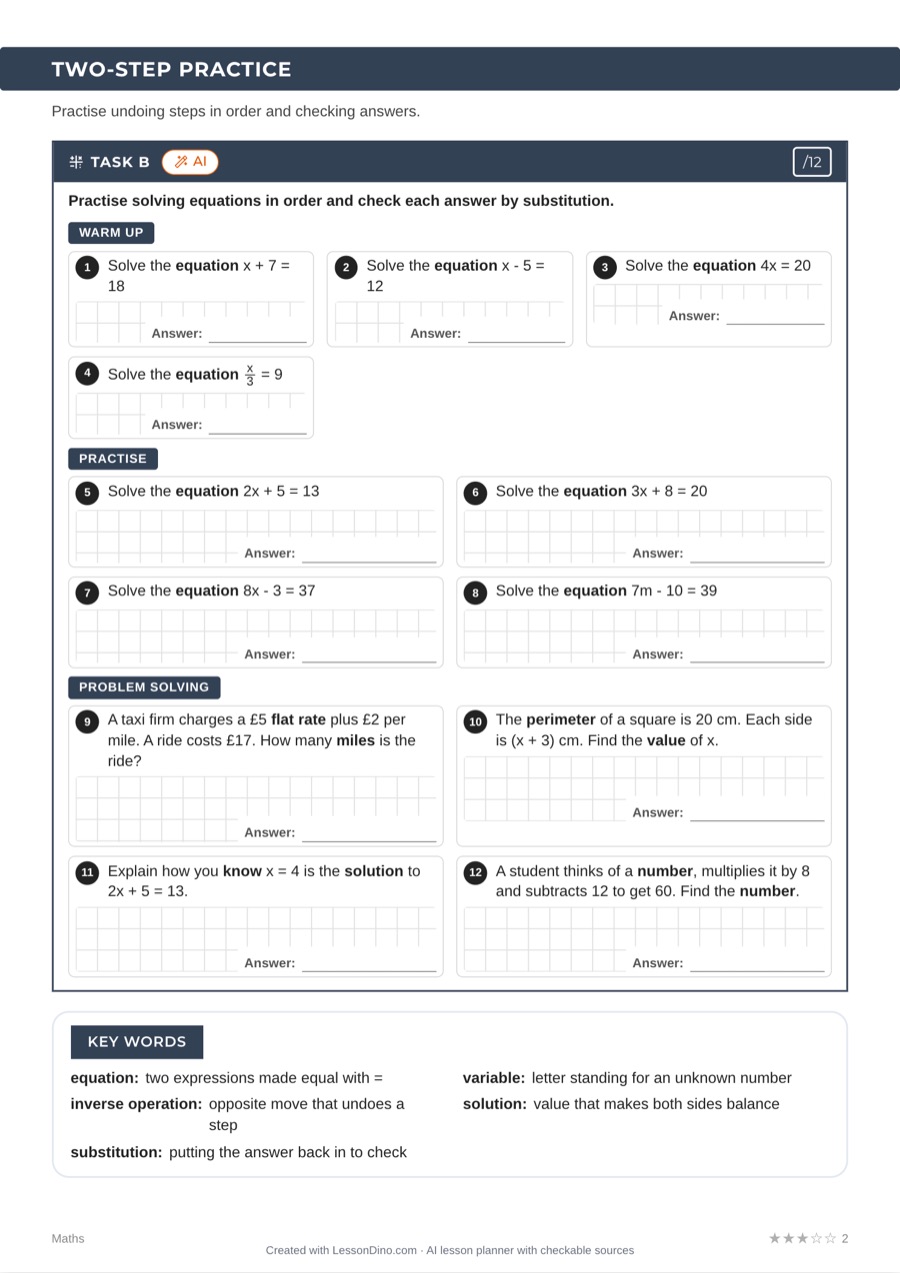
Two-Step Practice
Practise undoing steps in order and checking answers.
Practise solving equations in order and check each answer by substitution.
Warm up
- Solve the equation x + 7 = 18
- Solve the equation x - 5 = 12
- Solve the equation 4x = 20
- Solve the equation x/3 = 9
Practise
- Solve the equation 2x + 5 = 13
- Solve the equation 3x + 8 = 20
- Solve the equation 8x - 3 = 37
- Solve the equation 7m - 10 = 39
Problem solving
- A taxi firm charges a £5 flat rate plus £2 per mile. A ride costs £17. How many miles is the ride?
- The perimeter of a square is 20 cm. Each side is (x + 3) cm. Find the value of x.
- Explain how you know x = 4 is the solution to 2x + 5 = 13.
- A student thinks of a number, multiplies it by 8 and subtracts 12 to get 60. Find the number.
| Word | Meaning |
|---|---|
| equation | two expressions made equal with = |
| variable | letter standing for an unknown number |
| inverse operation | opposite move that undoes a step |
| solution | value that makes both sides balance |
| substitution | putting the answer back in to check |
Find the Mistake
Spot the wrong step and put it right.
Find the first wrong step in each solution and explain the fix.
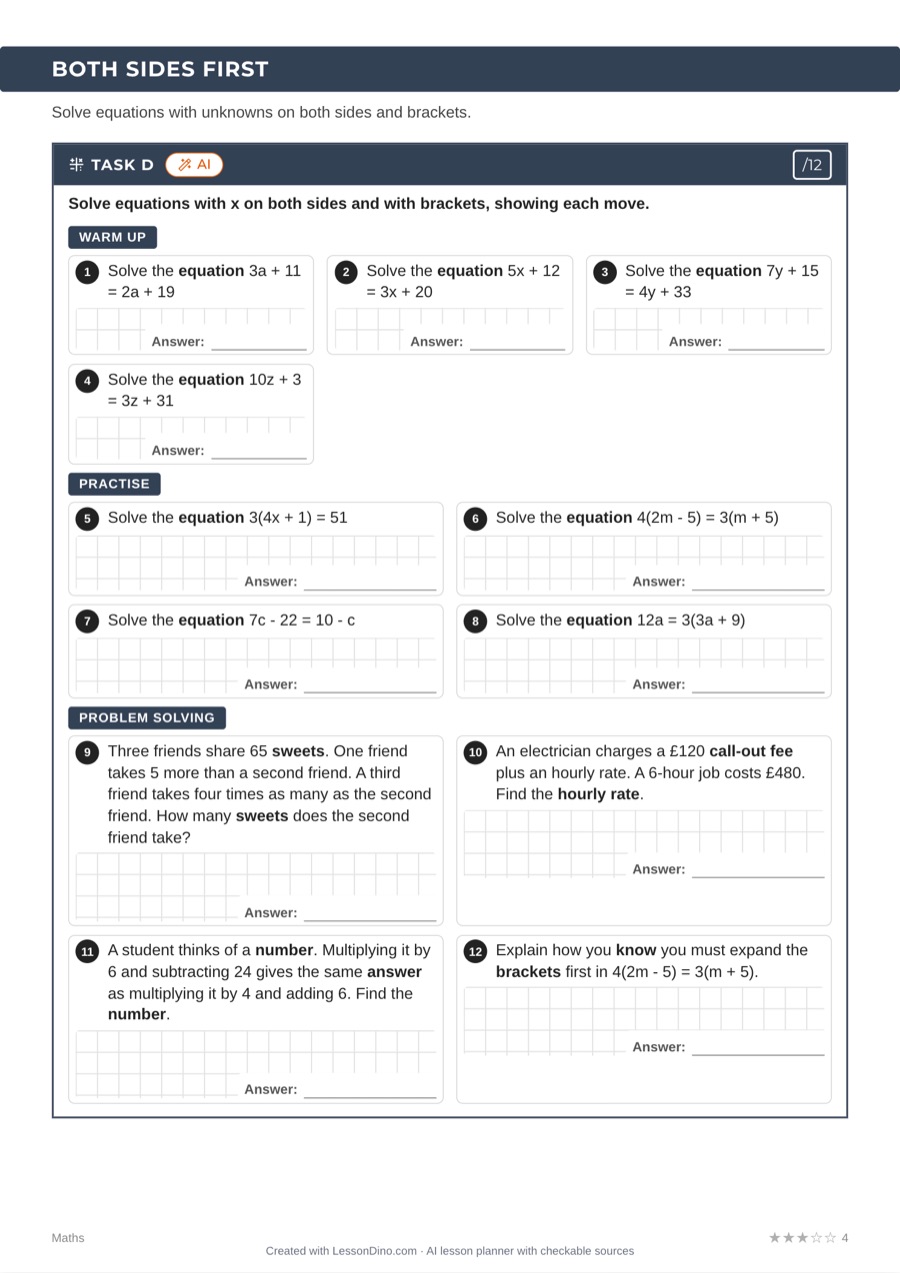
Both Sides First
Solve equations with unknowns on both sides and brackets.
Solve equations with x on both sides and with brackets, showing each move.
Warm up
- Solve the equation 3a + 11 = 2a + 19
- Solve the equation 5x + 12 = 3x + 20
- Solve the equation 7y + 15 = 4y + 33
- Solve the equation 10z + 3 = 3z + 31
Practise
- Solve the equation 3(4x + 1) = 51
- Solve the equation 4(2m - 5) = 3(m + 5)
- Solve the equation 7c - 22 = 10 - c
- Solve the equation 12a = 3(3a + 9)
Problem solving
- Three friends share 65 sweets. One friend takes 5 more than a second friend. A third friend takes four times as many as the second friend. How many sweets does the second friend take?
- An electrician charges a £120 call-out fee plus an hourly rate. A 6-hour job costs £480. Find the hourly rate.
- A student thinks of a number. Multiplying it by 6 and subtracting 24 gives the same answer as multiplying it by 4 and adding 6. Find the number.
- Explain how you know you must expand the brackets first in 4(2m - 5) = 3(m + 5).
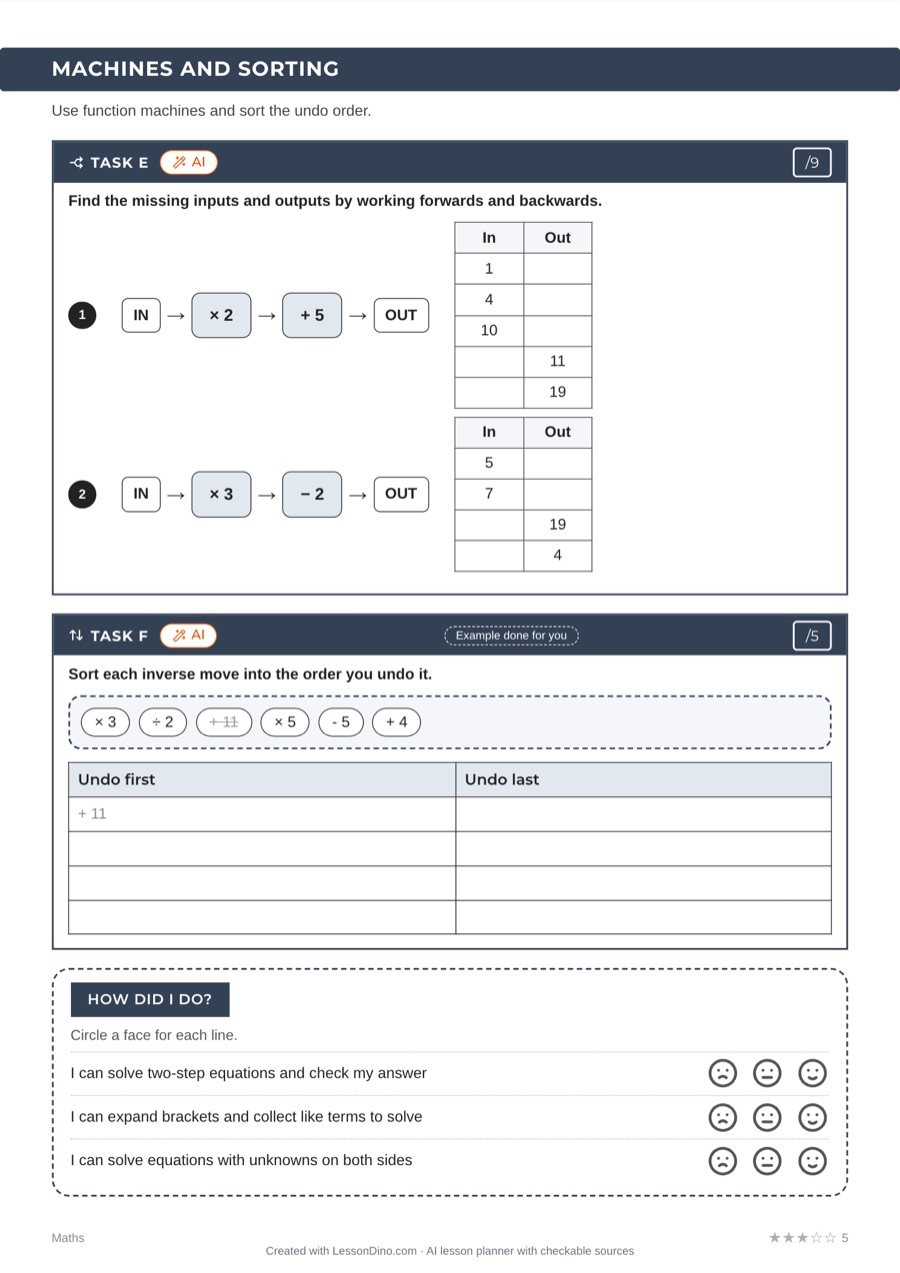
Machines and Sorting
Use function machines and sort the undo order.
Find the missing inputs and outputs by working forwards and backwards.
Sort each inverse move into the order you undo it.
Answers
Show the answers
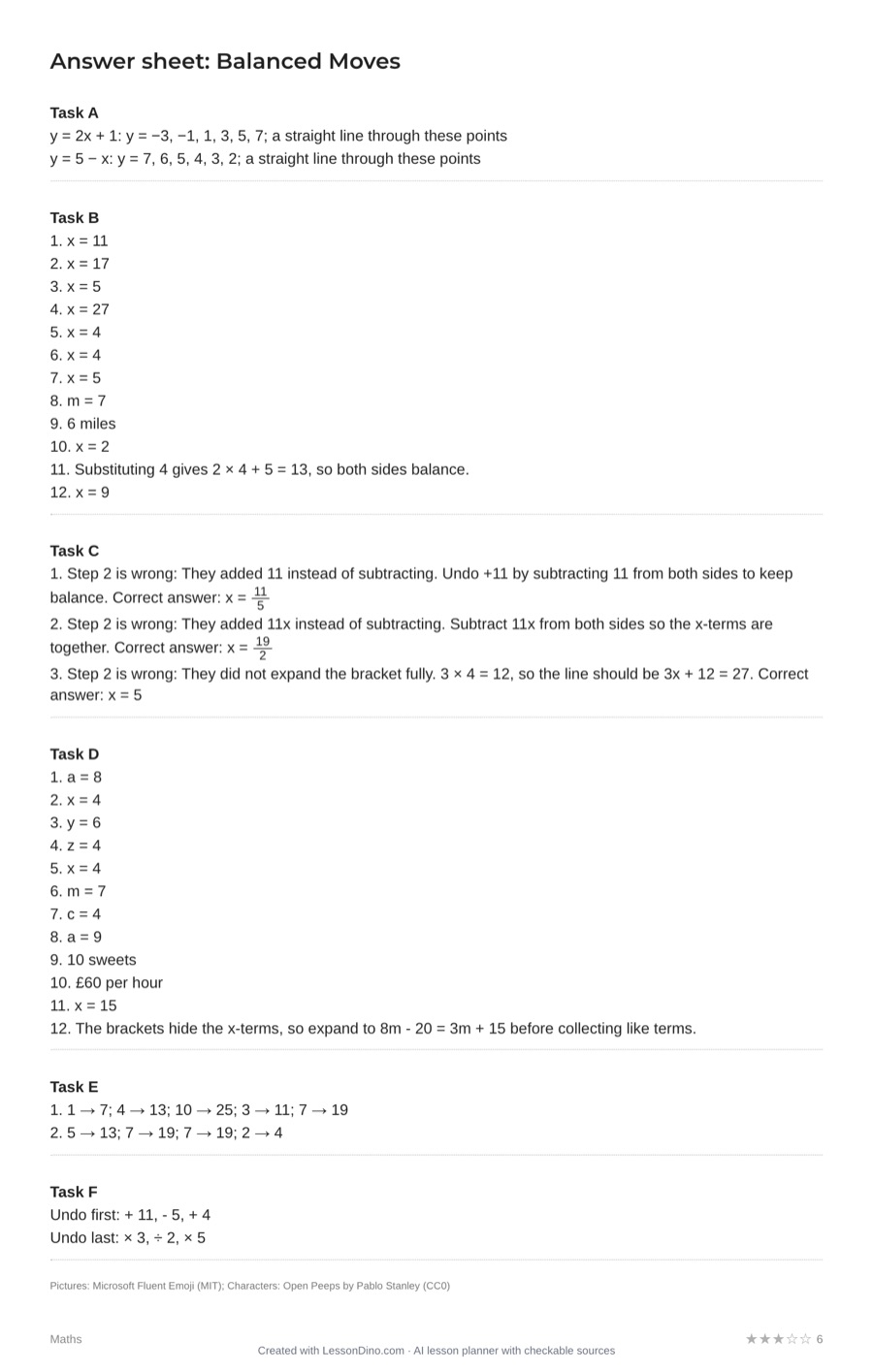
- Solve the equation x + 7 = 18 x = 11
- Solve the equation x - 5 = 12 x = 17
- Solve the equation 4x = 20 x = 5
- Solve the equation x/3 = 9 x = 27
- Solve the equation 2x + 5 = 13 x = 4
- Solve the equation 3x + 8 = 20 x = 4
- Solve the equation 8x - 3 = 37 x = 5
- Solve the equation 7m - 10 = 39 m = 7
- A taxi firm charges a £5 flat rate plus £2 per mile. A ride costs £17. How many miles is the ride? 6 miles
- The perimeter of a square is 20 cm. Each side is (x + 3) cm. Find the value of x. x = 2
- Explain how you know x = 4 is the solution to 2x + 5 = 13. Substituting 4 gives 2 × 4 + 5 = 13, so both sides balance.
- A student thinks of a number, multiplies it by 8 and subtracts 12 to get 60. Find the number. x = 9
- Solve the equation 3a + 11 = 2a + 19 a = 8
- Solve the equation 5x + 12 = 3x + 20 x = 4
- Solve the equation 7y + 15 = 4y + 33 y = 6
- Solve the equation 10z + 3 = 3z + 31 z = 4
- Solve the equation 3(4x + 1) = 51 x = 4
- Solve the equation 4(2m - 5) = 3(m + 5) m = 7
- Solve the equation 7c - 22 = 10 - c c = 4
- Solve the equation 12a = 3(3a + 9) a = 9
- Three friends share 65 sweets. One friend takes 5 more than a second friend. A third friend takes four times as many as the second friend. How many sweets does the second friend take? 10 sweets
- An electrician charges a £120 call-out fee plus an hourly rate. A 6-hour job costs £480. Find the hourly rate. £60 per hour
- A student thinks of a number. Multiplying it by 6 and subtracting 24 gives the same answer as multiplying it by 4 and adding 6. Find the number. x = 15
- Explain how you know you must expand the brackets first in 4(2m - 5) = 3(m + 5). The brackets hide the x-terms, so expand to 8m - 20 = 3m + 15 before collecting like terms.
The answer sheet is the last picture above.
Curriculum
use algebraic methods to solve linear equations in 1 variable (including all forms that require rearrangement)
From National curriculum in England, Key Stage 3 mathematics.
Made with Lesson Dino's AI on 17 October 2026. AI can make mistakes, so check the answers and facts against the sources before you teach.