Slides
Lesson plan
Power First: Reading and Comparing Standard Form
Students learn to read A x 10n and tell if it is big, tiny or near A. They order standard-form numbers power first, then by A.
Objectives
- Students will interpret standard form with positive, negative and zero powers.
- Students will compare and order standard-form numbers by power then front value.
Success criteria
- I can read A x 10n and say if it is big, tiny or near A.
- I can compare two standard-form numbers power first, then A.
- I can order a set of standard-form numbers smallest to largest.
Key words
| Word | Meaning |
|---|---|
| standard form | a short way to write very big or very tiny values using a value times a ten power |
| power of ten | a small raised number showing how many times 10 is multiplied by itself |
| ordinary number | a value written out fully with digits, without using ten powers |
| compare | to say which value is bigger or smaller and explain why |
Timed plan (60 minutes)
| Time | Stage | What happens |
|---|---|---|
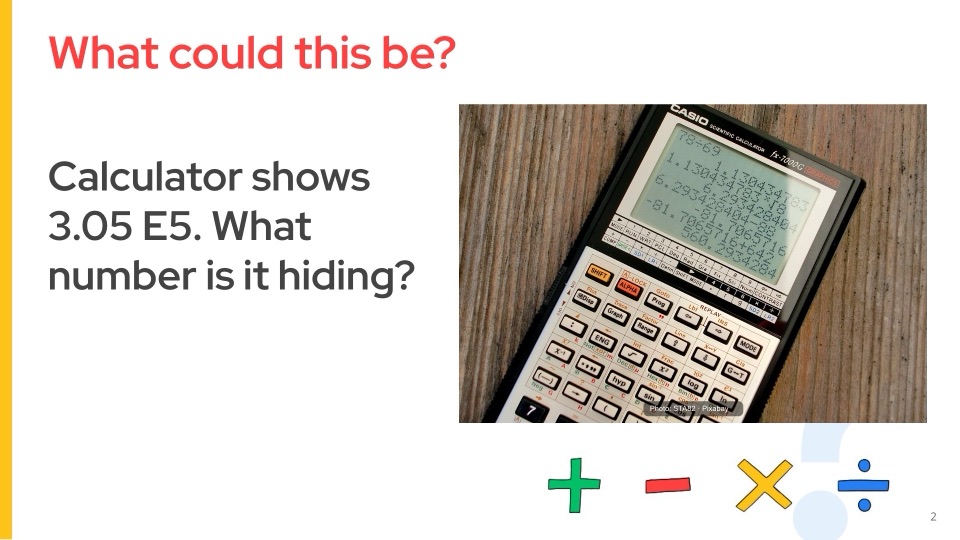
| 8 min | Starter | To hook interest in shortcut comparing and recall multiplying by powers of 10. Show Slide 1: Big or Tiny? Reading Standard Form and state today's focus on reading and comparing. Say the hook and show Slide 2 mystery: 305,000 = 3.05 x 10⁵ with calculator showing 3.05 E5. Model breaking 305,000 into 3.05 x 100,000 to get 3.05 x 10⁵. Ask pairs to write the hidden ordinary number and whether the power tells big or tiny. |
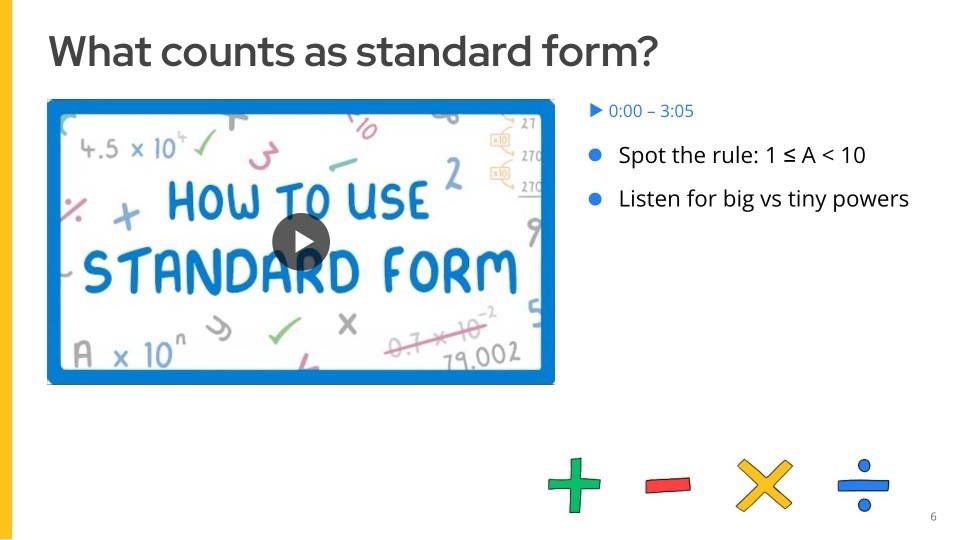
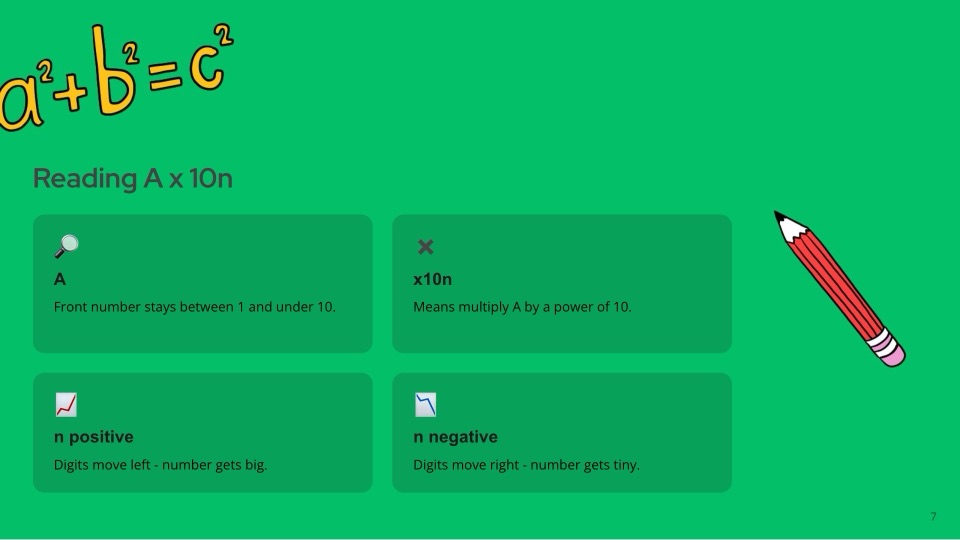
| 12 min | Teaching: what counts | To teach the rule for standard form and spot fakes fast. Play Video clip 1 (0:00–3:05) on Slide 6: What counts as standard form? Ask pupils to listen for big vs tiny powers. Show Slide 7 cards and state the rule: A x 10n, where A is greater than or equal to 1 but less than 10 and n is any integer. Model sorting: 2.5 x 10⁻² is in standard form, while 25 x 10⁻³ and 0.025 are not. Model that 3.2 x 10³ is 3200 because 10³ = 1000 and front 3.2 fits 1 ≤ A < 10. |
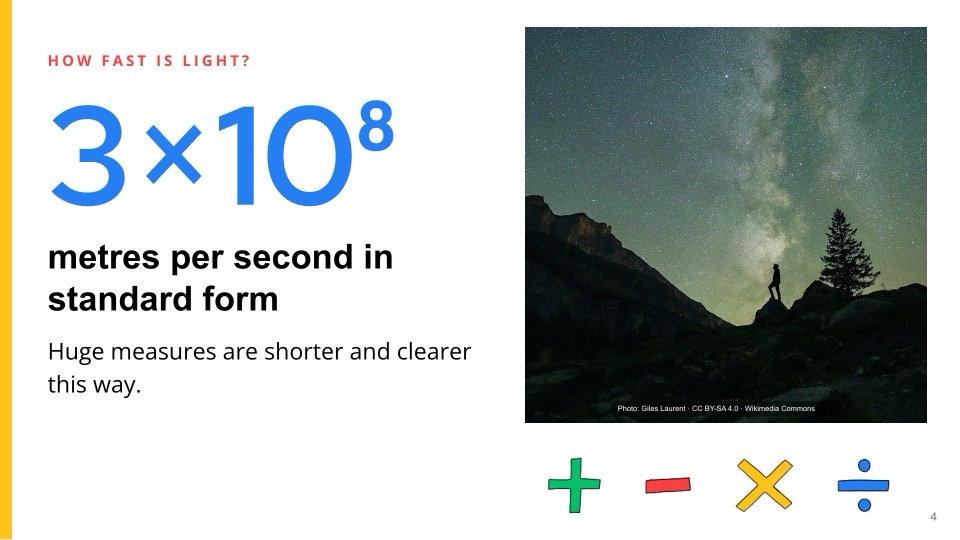
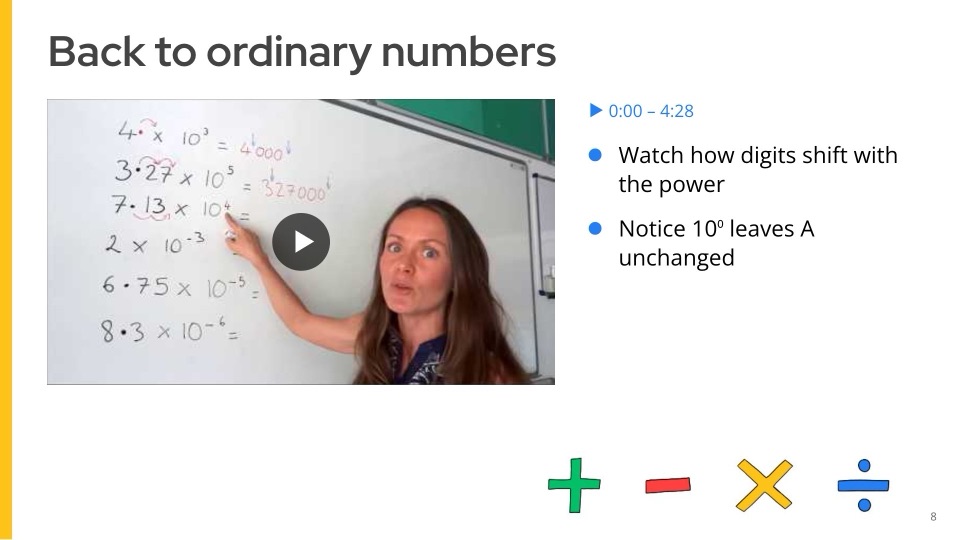
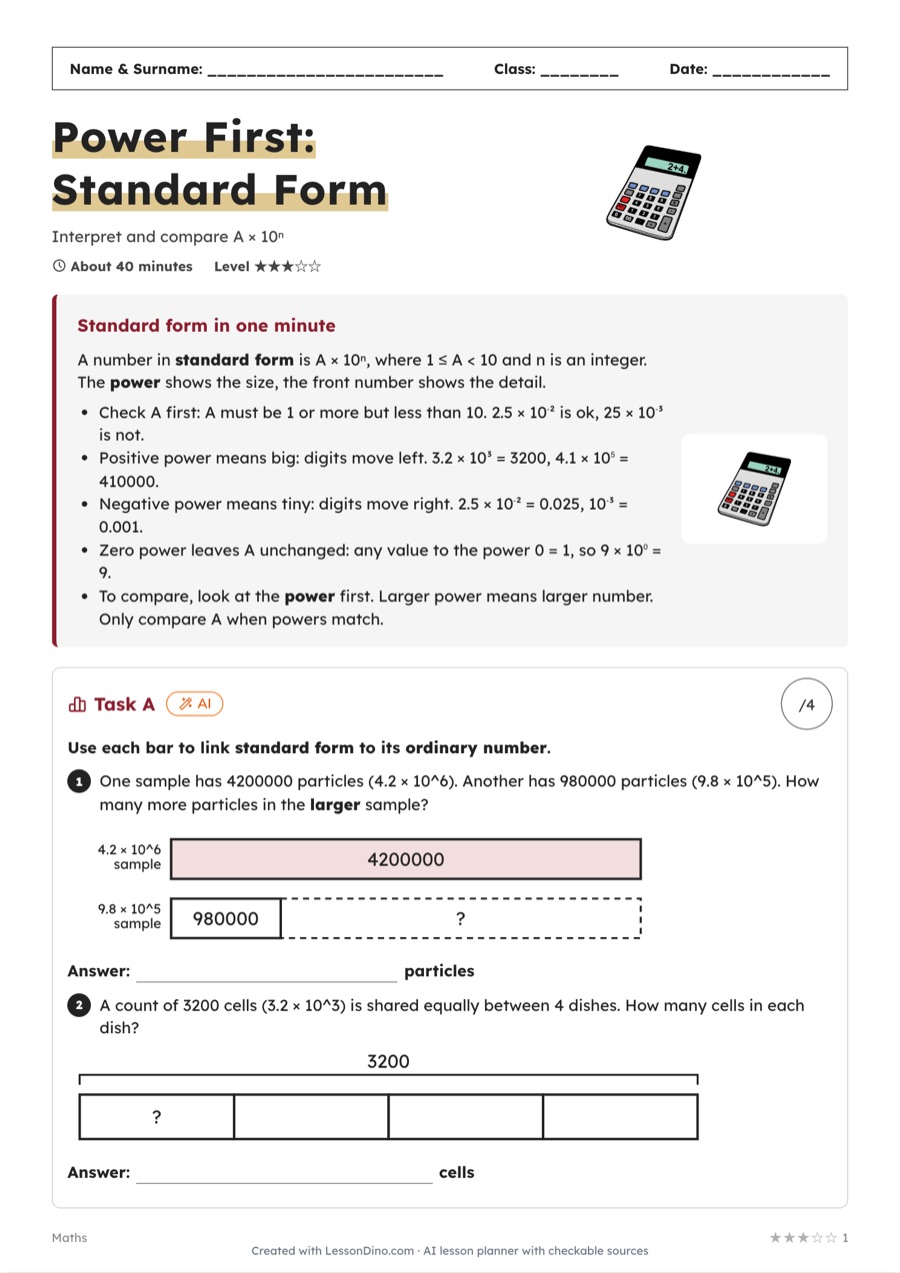
| 12 min | Interpreting to ordinary | To link standard form to ordinary numbers for very big, very small and n = 0. Show Slide 4: 3x10⁸ metres per second in standard form and note huge measures are shorter and clearer this way. Play Video clip 2 (0:00–4:28) on Slide 8 and ask pupils to watch how digits shift and notice 10⁰ leaves A unchanged. Model 3 x 10⁸ m/s is the speed of light = 300,000,000 and 1.93 x 10² is 193. Hand out Worksheet Task A and set 5 minutes to link each bar to its ordinary number. |
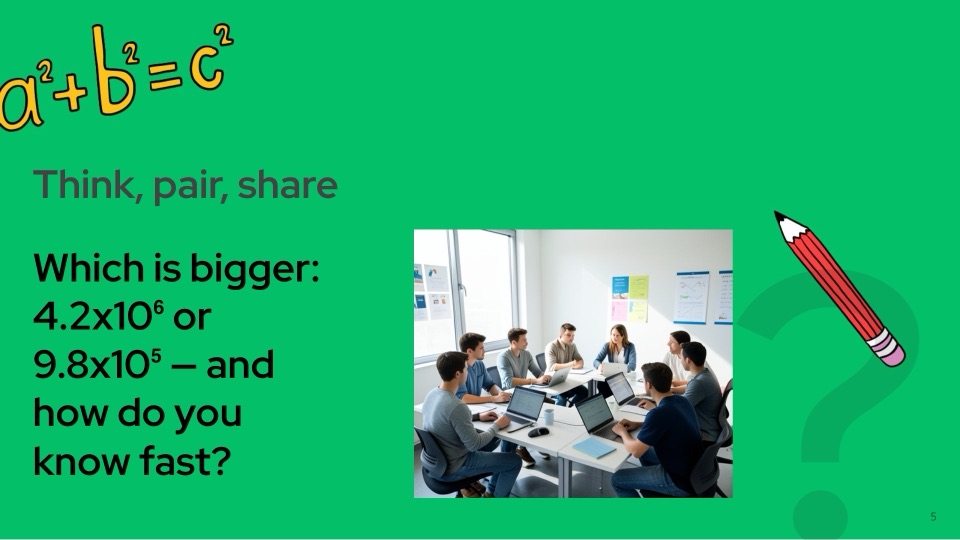
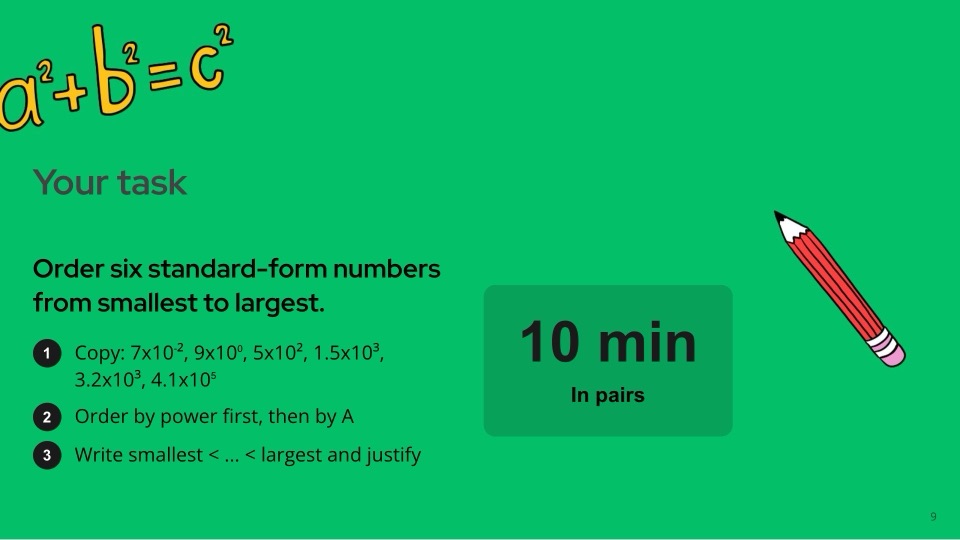
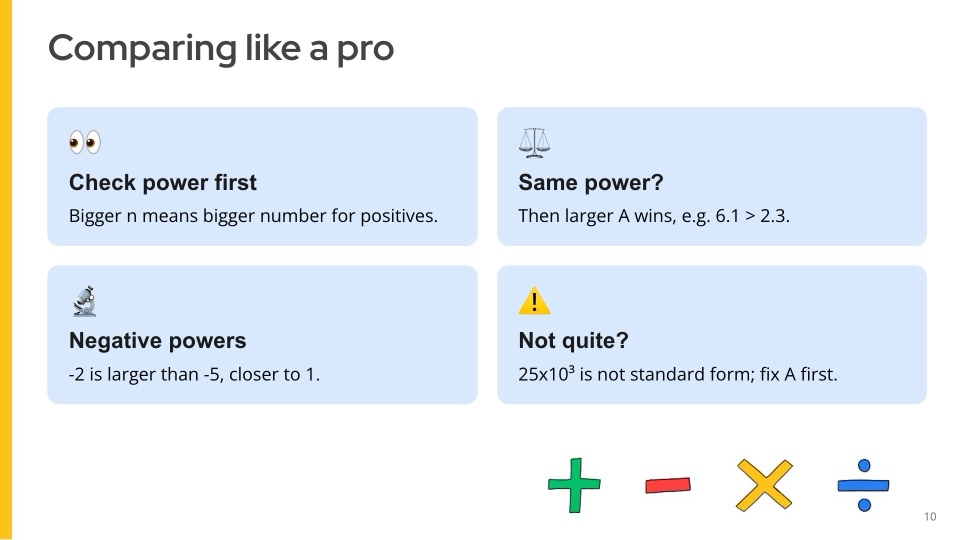
| 18 min | Main activity: Power First Talk | To compare and order standard-form numbers power first, then A. Show Slide 5 question: Which is bigger: 4.2x10⁶ or 9.8x10⁵ — and how do you know fast? Model circling powers. Teach the shortcut: a larger power of 10 always means a larger number, only compare A when powers are equal, and the exponent can tell how large or small the number will be. Set Slide 9 task: Order six numbers smallest to largest. Copy: 7x10⁻², 9x10⁰, 5x10², 1.5x10³, 3.2x10³, 4.1x10⁵. Order by power first, then by A. Hand out Task B and Task F. Show Slide 10 cards to fix same-power ties, e.g. larger A wins like 6.1 > 2.3, and -2 is larger than -5. |
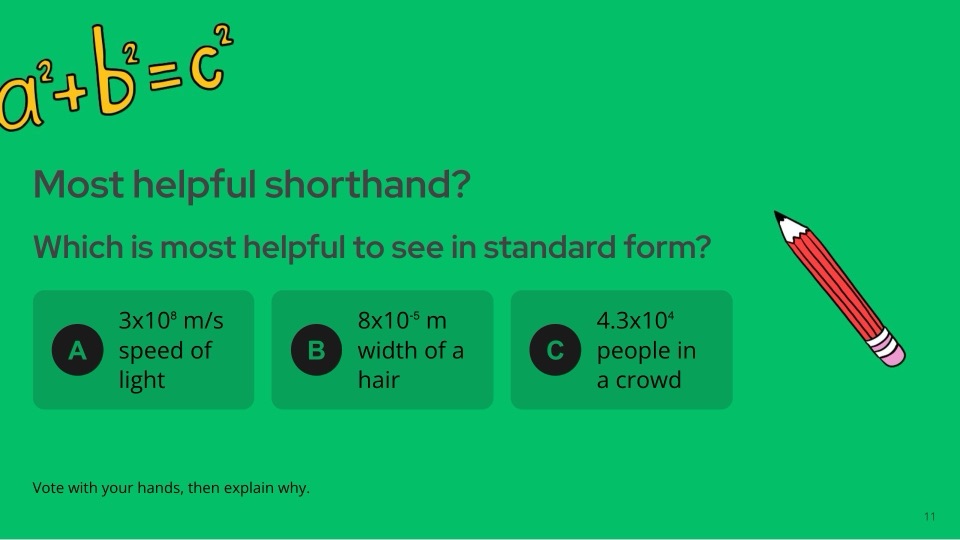
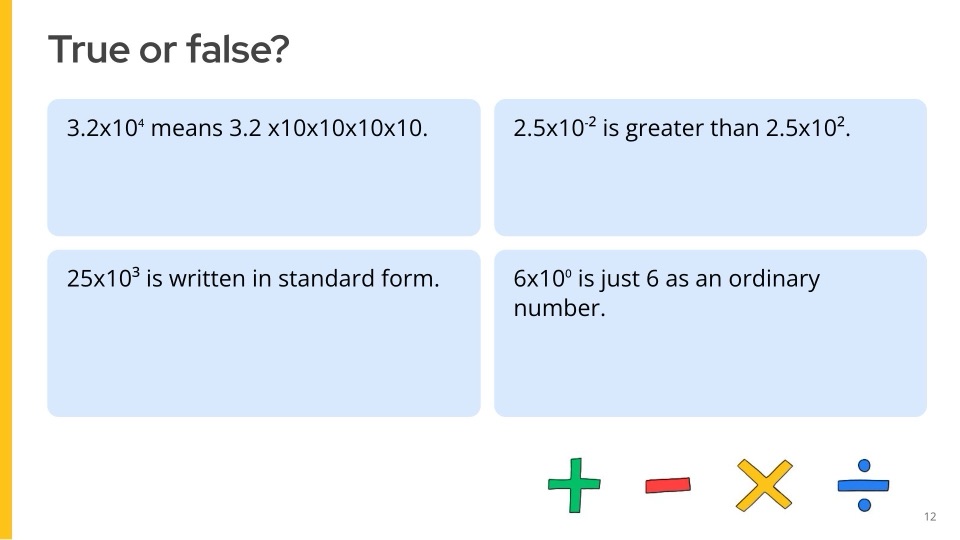
| 10 min | Plenary | To check interpreting and comparing and link to real tiny and huge uses. Show Slide 11 vote: 3x10⁸ m/s speed of light, 8x10⁻⁵ m width of a hair, 4.3x10⁴ people in a crowd. Ask which is most helpful in standard form. Draw out that scientists use standard form for the speed of light and for tiny things like bacteria or atoms, with hair width 8 x 10⁻⁵ metres and light 3 x 10⁸ m/s. Show Slide 12 True or false and poll each line, fixing that negative power makes tiny, not negative. Set exit ticket on whiteboards: order three and spot the fake. |
Common mistakes
- Writing A outside 1 ≤ A < 10, e.g. 25 x 10⁻³ or 46 x 10⁻²⁰
How to spot it: Front has two digits or starts 0. when circling A
Move one digit to make A a decimal between 1 and under 10 and adjust power by 1, because standard form needs 1 ≤ A < 10. - Thinking a negative power makes a negative number
How to spot it: Pupil says 7.601 x 10⁻³ is below zero
Show 0.007601 = 7.601 x 10⁻³ on a place-value chart: digits move right, value gets tiny and closer to 0, not negative. - Comparing A first and ignoring the power
How to spot it: Pupil says 9.8 x 10⁵ beats 4.2 x 10⁶ because 9.8 > 4.2
Re-circle powers and remind that larger power means larger number, only compare A when powers match.
Support
- Show the two numbers with the powers circled, with a prompt that a larger power of 10 means a larger number.
- Provide ordinary-number forms to copy and label, with a reminder that 10⁻⁴ = 0.0001.
- Let pupils place A on a place-value mat and show that multiplying by 1 does not move digits, since any value to the power 0 always = 1.
Stretch
- Students debate a tricky pair with the same power but different A values and explain their reasoning.
- Students explain what happens with n = 0 and why the number hardly changes.
- Students write one extra pair of their own where the powers are equal but the A values decide the order.
Check questions
- Write 7 x 10⁻² as an ordinary number. Is it big or tiny?
Answer: 0.07, tiny because power is negative. - Which is larger: 4.2 x 10⁶ or 9.8 x 10⁵? How do you know fast?
Answer: 4.2 x 10⁶, power 6 > 5 so larger power wins. - Which is not standard form: 4.1 x 10⁵, 12 x 10³ or 1.5 x 10³? Fix it.
Answer: 12 x 10³ is not, A must fit 1 ≤ A < 10; fix to 1.2 x 10⁴.
Curriculum
interpret and compare numbers in standard form A × 10ⁿ, 1 ≤ A < 10, where n is a positive or negative integer or 0
From National curriculum in England, Key Stage 3 mathematics.
Video clips
Clips on YouTube, from the start and end times we chose. Check each one before you show it.
-
What standard form means from 0:00 to 3:05
Cognito: What is Standard Form (also known as Scientific Notation)? (Part 1/4) (2026/27 exams)
Directly teaches A x 10n format, identifying correct form and positive vs negative powers for 13-14-year-olds at clear GCSE pace.
-
Standard form back to ordinary from 0:00 to 4:28
The Maths Prof: The Maths Prof: Standard Form (part 2)
Exactly matches interpreting standard form by converting back to ordinary numbers, explained simply for 13-14-year-olds.
Worksheet
Sources
- YEAR 9 - DEVELOPING NUMBER... Standard Form tiverton.devon.sch.uk
- 4 Writing large numbers in standard form I can write very large numbers in standard form and appreciate the real-life contexts where this format is us thenational.academy
- What is standard form? - GCSE Maths Revision - BBC Bitesize bbc.co.uk
- What is standard index form in maths? - BBC Bitesize bbc.co.uk
- Standard Form mathshelper.co.uk
- Standard Form - CIMT cimt.org.uk
- GCSE Standard Form — Worked Examples & Practice apex-tuition.co.uk
- Standard Form - Free maths worksheets and other resources doingmaths.co.uk
- What is standard form? - Standard form - WJEC - GCSE Maths Revision ... bbc.co.uk
- Standard form KS3 | Y9 Maths - Oak National Academy thenational.academy
- Lesson: Problem solving with standard form | Oak National Academy thenational.academy
- Writing a number in standard form (video) | Khan Academy khanacademy.org
- STANDARD | English meaning - Cambridge Dictionary dictionary.cambridge.org
- STANDARD | definition in the Cambridge English Dictionary dictionary.cambridge.org
- Form CMG3151 - Fill Out, Sign Online and Download Fillable PDF, United Kingdom | Templateroller templateroller.com
- Unit 3 Section 4 : Standard Form - CIMT cimt.org.uk
- Standard Form - GCSE Maths Complete Guide | GCSEMaths gcsemathsai.co.uk
- Standard Form - — GCSE Maths Formula Sheet | GCSEMaths gcsemathsai.co.uk
Picture credits
- Photo: Hans · Pixabay
- Photo: STA82 · Pixabay
- AI illustration · Cloudflare
- Photo: Giles Laurent · CC BY-SA 4.0 · Wikimedia Commons
- Pictograms: Sergio Palao, ARASAAC (arasaac.org) · CC BY-NC-SA
Made with Lesson Dino's AI on 19 October 2026. AI can make mistakes, so check facts against the sources before you teach.