The worksheet
About this worksheet
Students learn to read A x 10n and tell if it is big, tiny or near A. They order standard-form numbers power first, then by A. This Year 9 Maths worksheet gives students (ages 13–14) five pages of practice on standard form, part of the number unit. It goes with our free Standard form lesson, which has the slides and a timed lesson plan.
What it covers
By the end, students should be able to:
- Students will interpret standard form with positive, negative and zero powers.
- Students will compare and order standard-form numbers by power then front value.
How to use it
- Interpreting to ordinary (12 minutes): Hand out Worksheet Task A and set 5 minutes to link each bar to its ordinary number.
- Support: Show the two numbers with the powers circled, with a prompt that a larger power of 10 means a larger number.
- Stretch: Students debate a tricky pair with the same power but different A values and explain their reasoning.
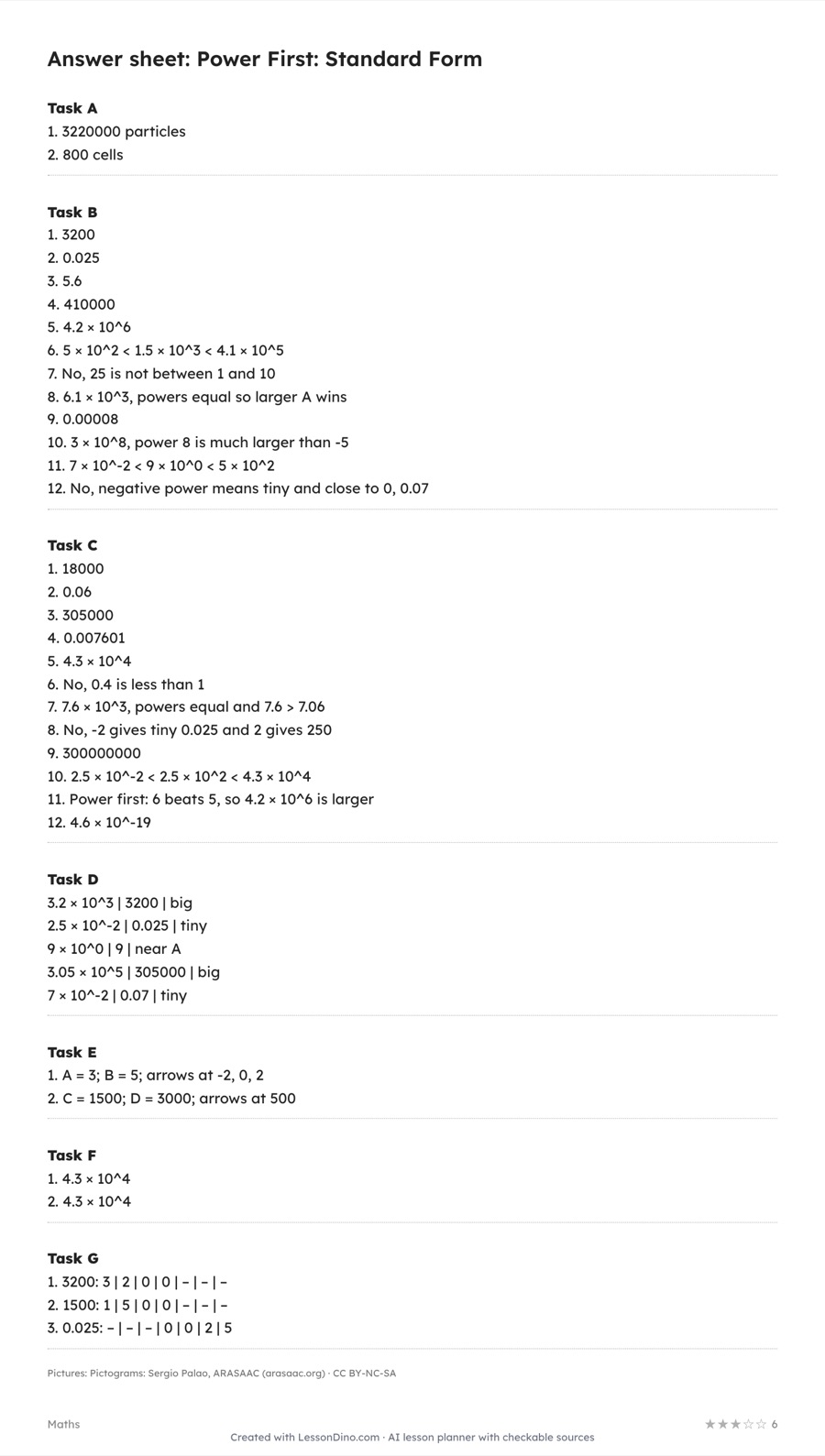
- The answer sheet is the last page, so you can print it on its own or let students check their own work.
Key vocabulary
- standard form: a short way to write very big or very tiny values using a value times a ten power
- power of ten: a small raised number showing how many times 10 is multiplied by itself
- ordinary number: a value written out fully with digits, without using ten powers
- compare: to say which value is bigger or smaller and explain why
Mistakes to watch for
- Writing A outside 1 ≤ A < 10, e.g. 25 x 10⁻³ or 46 x 10⁻²⁰. Move one digit to make A a decimal between 1 and under 10 and adjust power by 1, because standard form needs 1 ≤ A < 10.
- Thinking a negative power makes a negative number. Show 0.007601 = 7.601 x 10⁻³ on a place-value chart: digits move right, value gets tiny and closer to 0, not negative.
- Comparing A first and ignoring the power. Re-circle powers and remind that larger power means larger number, only compare A when powers match.
What's on the worksheet
Power Shows Size
How the power tells you the size fast.
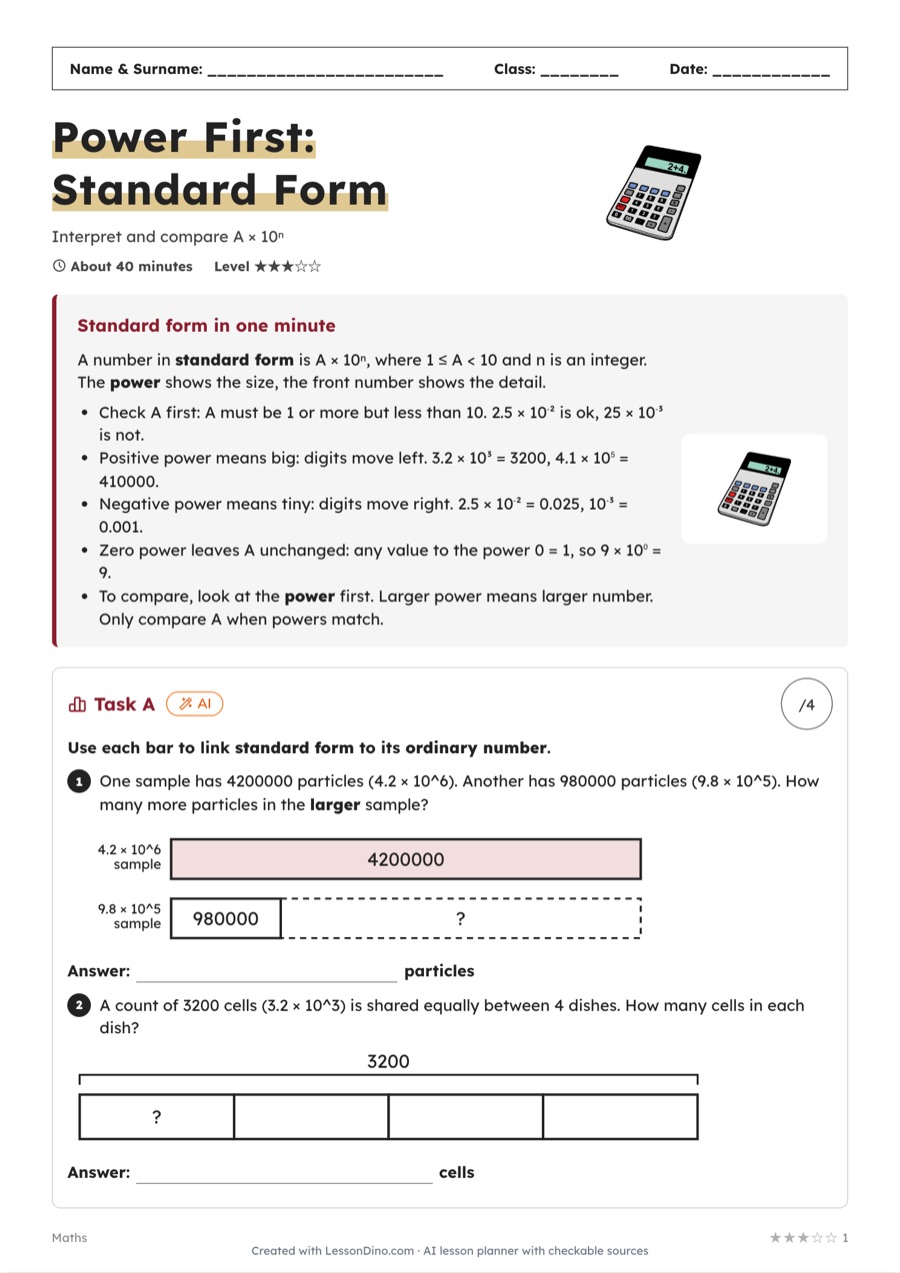
Standard form in one minute
- A number in standard form is A × 10ⁿ, where 1 ≤ A < 10 and n is an integer. The power shows the size, the front number shows the detail.
- Check A first: A must be 1 or more but less than 10. 2.5 × 10⁻² is ok, 25 × 10⁻³ is not.
- Positive power means big: digits move left. 3.2 × 10³ = 3200, 4.1 × 10⁵ = 410000.
- Negative power means tiny: digits move right. 2.5 × 10⁻² = 0.025, 10⁻³ = 0.001.
- Zero power leaves A unchanged: any value to the power 0 = 1, so 9 × 10⁰ = 9.
- To compare, look at the power first. Larger power means larger number. Only compare A when powers match.
Use each bar to link standard form to its ordinary number.
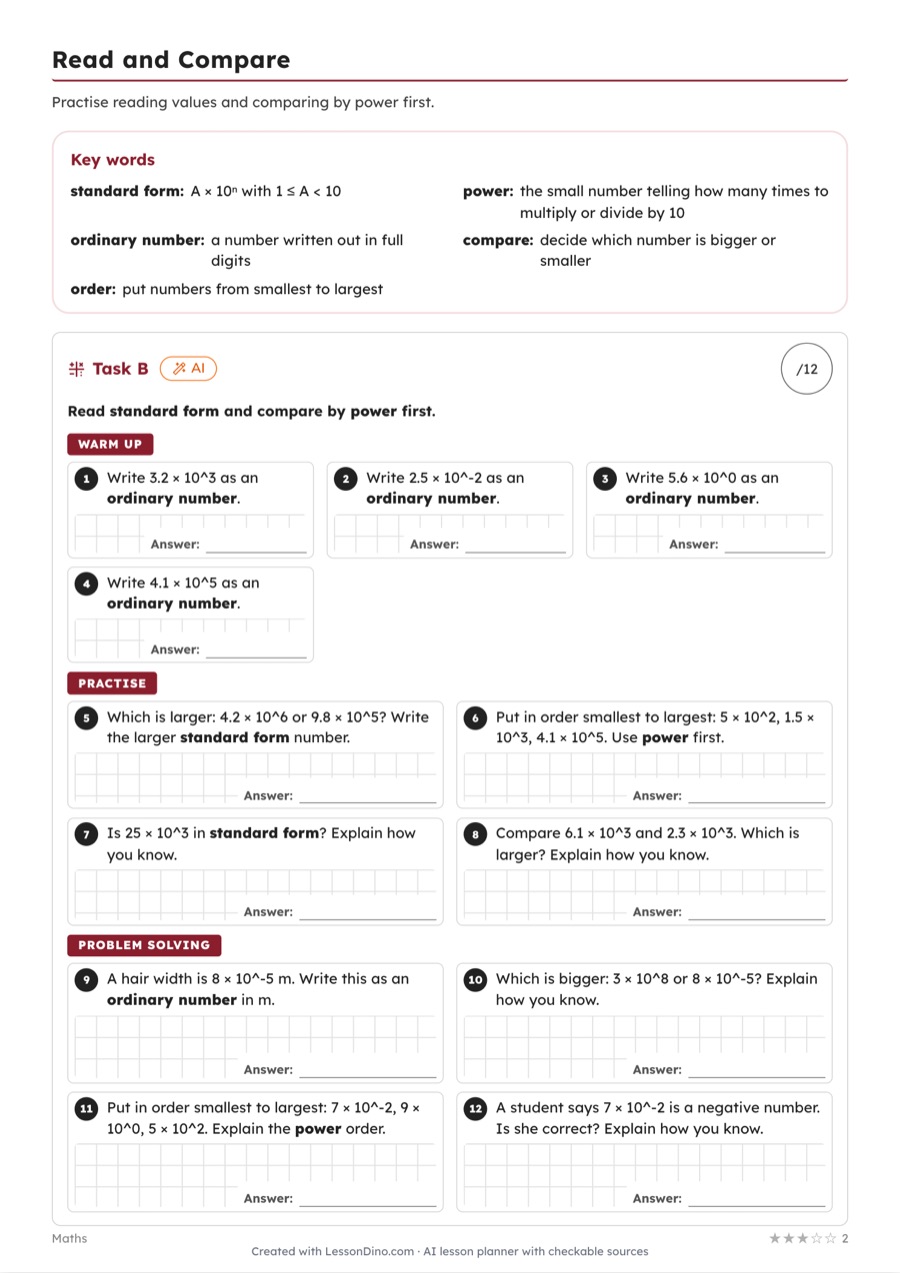
Read and Compare
Practise reading values and comparing by power first.
| Word | Meaning |
|---|---|
| standard form | A × 10ⁿ with 1 ≤ A < 10 |
| power | the small number telling how many times to multiply or divide by 10 |
| ordinary number | a number written out in full digits |
| compare | decide which number is bigger or smaller |
| order | put numbers from smallest to largest |
Read standard form and compare by power first.
Warm up
- Write 3.2 × 10^3 as an ordinary number.
- Write 2.5 × 10^-2 as an ordinary number.
- Write 5.6 × 10^0 as an ordinary number.
- Write 4.1 × 10^5 as an ordinary number.
Practise
- Which is larger: 4.2 × 10^6 or 9.8 × 10^5? Write the larger standard form number.
- Put in order smallest to largest: 5 × 10^2, 1.5 × 10^3, 4.1 × 10^5. Use power first.
- Is 25 × 10^3 in standard form? Explain how you know.
- Compare 6.1 × 10^3 and 2.3 × 10^3. Which is larger? Explain how you know.
Problem solving
- A hair width is 8 × 10^-5 m. Write this as an ordinary number in m.
- Which is bigger: 3 × 10^8 or 8 × 10^-5? Explain how you know.
- Put in order smallest to largest: 7 × 10^-2, 9 × 10^0, 5 × 10^2. Explain the power order.
- A student says 7 × 10^-2 is a negative number. Is she correct? Explain how you know.
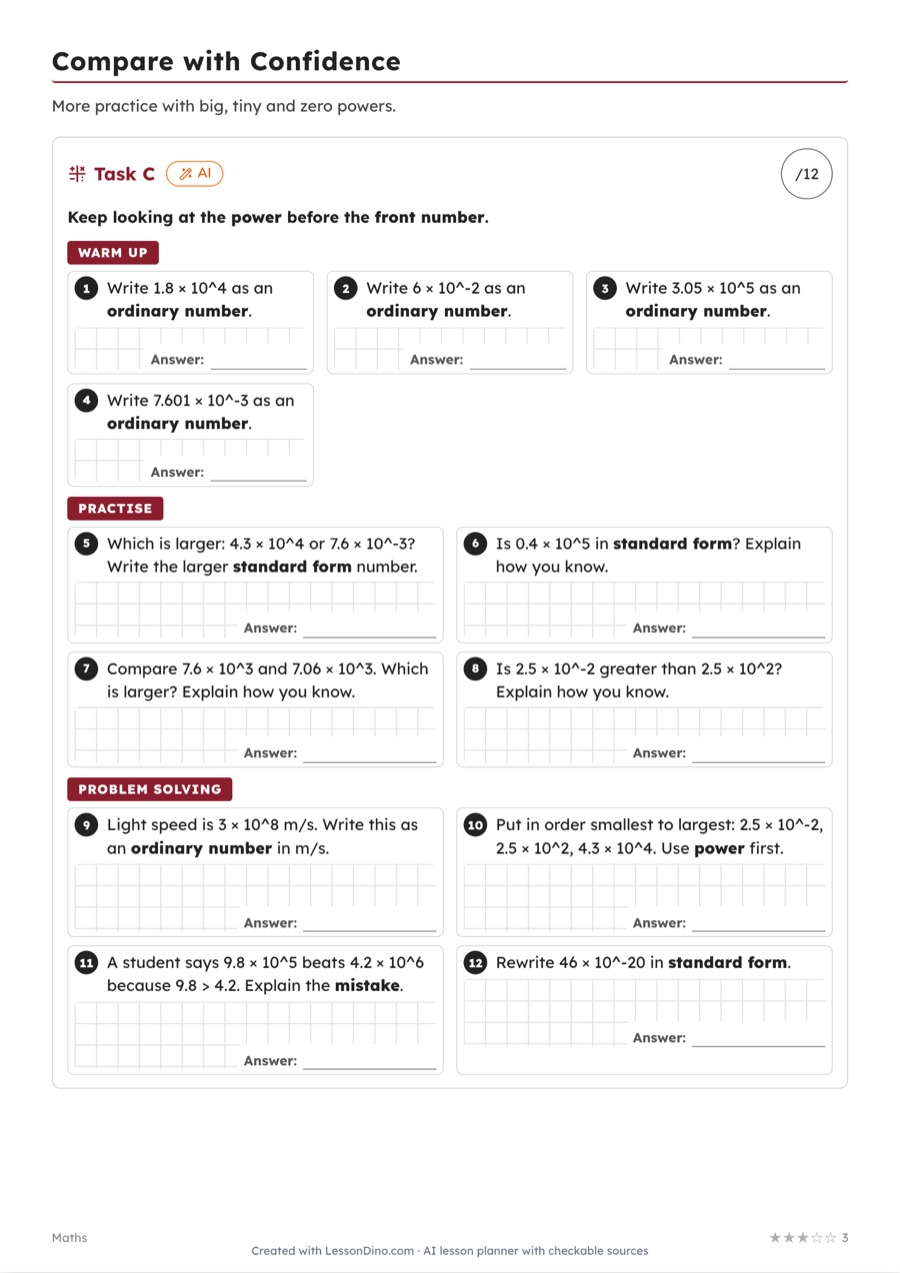
Compare with Confidence
More practice with big, tiny and zero powers.
Keep looking at the power before the front number.
Warm up
- Write 1.8 × 10^4 as an ordinary number.
- Write 6 × 10^-2 as an ordinary number.
- Write 3.05 × 10^5 as an ordinary number.
- Write 7.601 × 10^-3 as an ordinary number.
Practise
- Which is larger: 4.3 × 10^4 or 7.6 × 10^-3? Write the larger standard form number.
- Is 0.4 × 10^5 in standard form? Explain how you know.
- Compare 7.6 × 10^3 and 7.06 × 10^3. Which is larger? Explain how you know.
- Is 2.5 × 10^-2 greater than 2.5 × 10^2? Explain how you know.
Problem solving
- Light speed is 3 × 10^8 m/s. Write this as an ordinary number in m/s.
- Put in order smallest to largest: 2.5 × 10^-2, 2.5 × 10^2, 4.3 × 10^4. Use power first.
- A student says 9.8 × 10^5 beats 4.2 × 10^6 because 9.8 > 4.2. Explain the mistake.
- Rewrite 46 × 10^-20 in standard form.
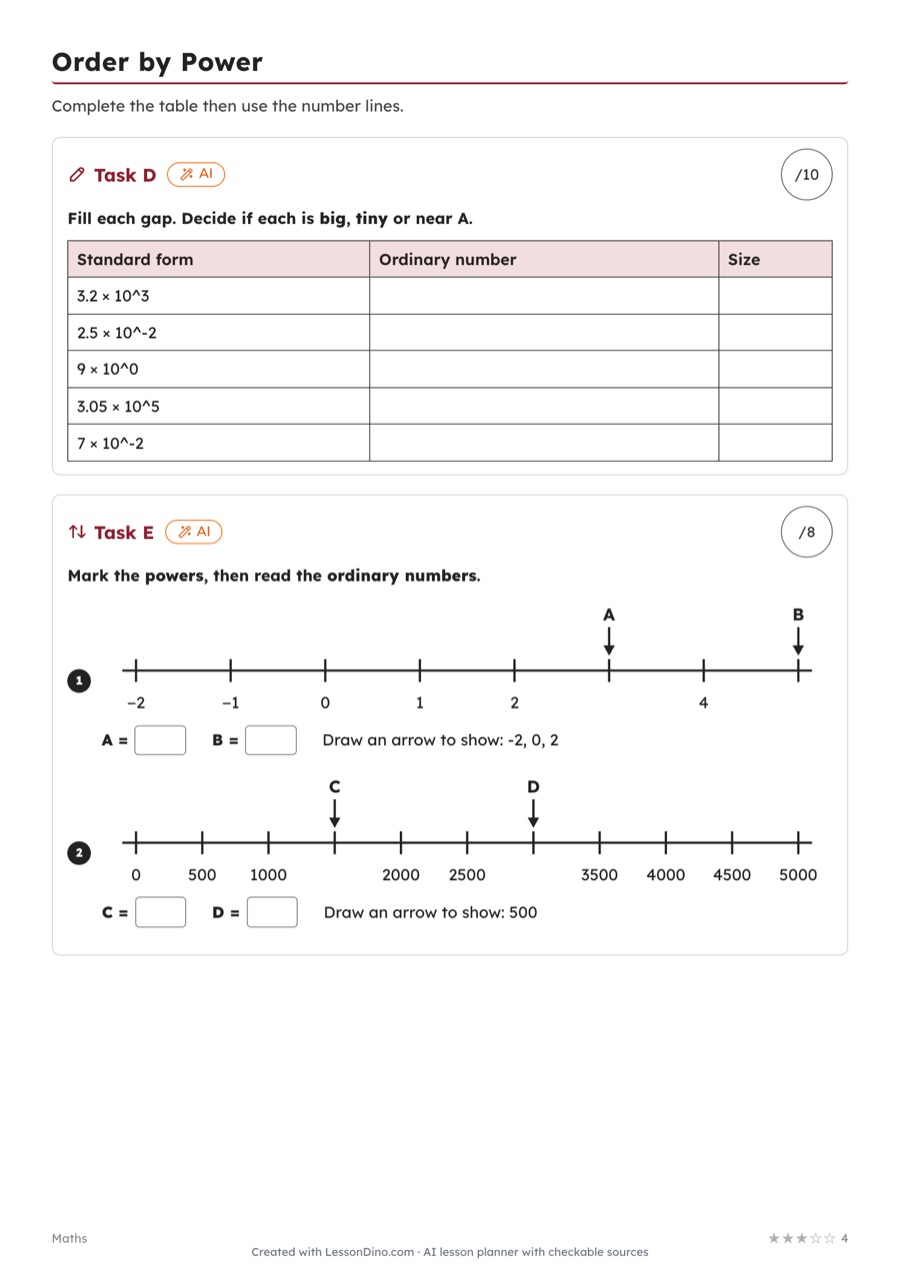
Order by Power
Complete the table then use the number lines.
Fill each gap. Decide if each is big, tiny or near A.
Mark the powers, then read the ordinary numbers.
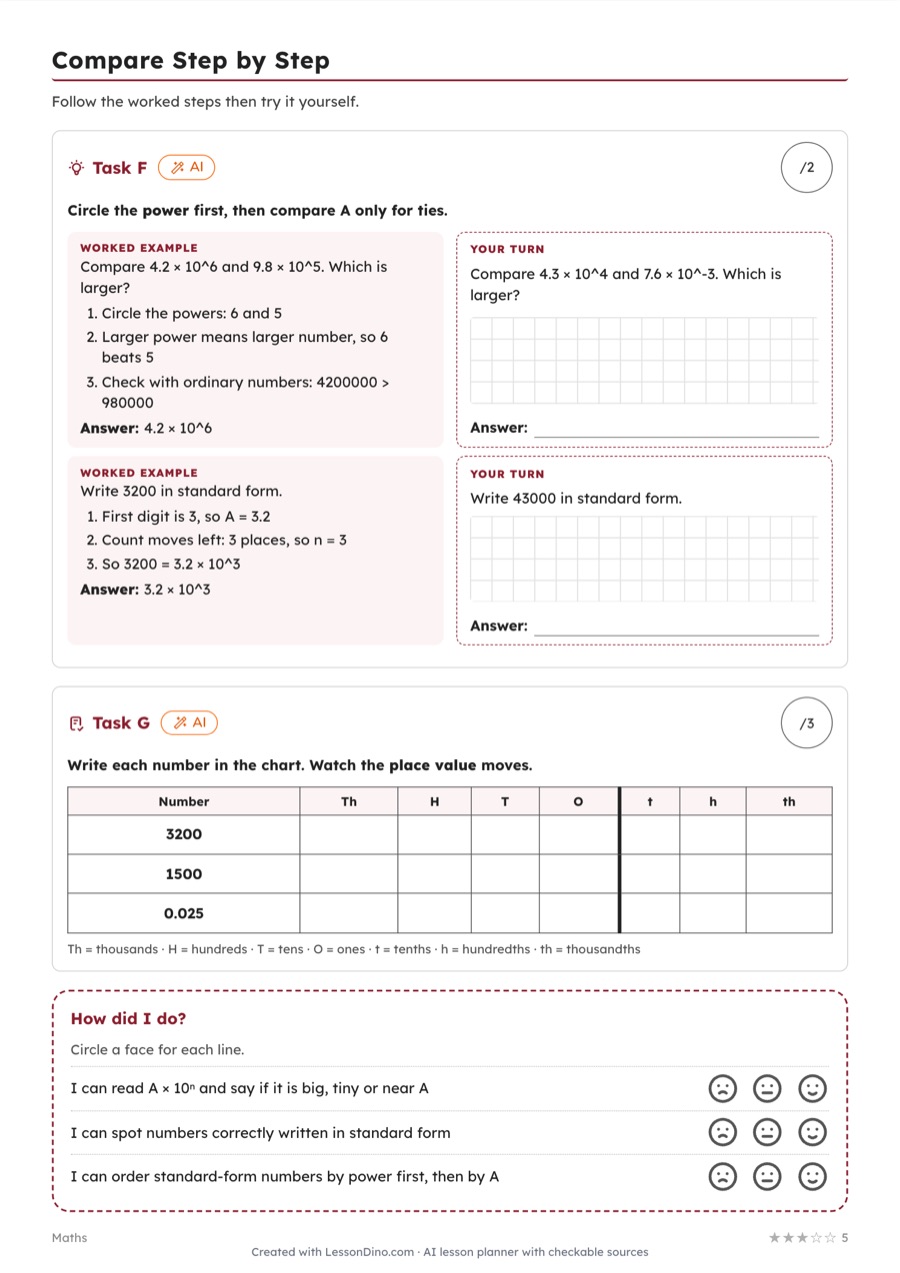
Compare Step by Step
Follow the worked steps then try it yourself.
Circle the power first, then compare A only for ties.
Write each number in the chart. Watch the place value moves.
Answers
Show the answers
- Write 3.2 × 10^3 as an ordinary number. 3200
- Write 2.5 × 10^-2 as an ordinary number. 0.025
- Write 5.6 × 10^0 as an ordinary number. 5.6
- Write 4.1 × 10^5 as an ordinary number. 410000
- Which is larger: 4.2 × 10^6 or 9.8 × 10^5? Write the larger standard form number. 4.2 × 10^6
- Put in order smallest to largest: 5 × 10^2, 1.5 × 10^3, 4.1 × 10^5. Use power first. 5 × 10^2 < 1.5 × 10^3 < 4.1 × 10^5
- Is 25 × 10^3 in standard form? Explain how you know. No, 25 is not between 1 and 10
- Compare 6.1 × 10^3 and 2.3 × 10^3. Which is larger? Explain how you know. 6.1 × 10^3, powers equal so larger A wins
- A hair width is 8 × 10^-5 m. Write this as an ordinary number in m. 0.00008
- Which is bigger: 3 × 10^8 or 8 × 10^-5? Explain how you know. 3 × 10^8, power 8 is much larger than -5
- Put in order smallest to largest: 7 × 10^-2, 9 × 10^0, 5 × 10^2. Explain the power order. 7 × 10^-2 < 9 × 10^0 < 5 × 10^2
- A student says 7 × 10^-2 is a negative number. Is she correct? Explain how you know. No, negative power means tiny and close to 0, 0.07
- Write 1.8 × 10^4 as an ordinary number. 18000
- Write 6 × 10^-2 as an ordinary number. 0.06
- Write 3.05 × 10^5 as an ordinary number. 305000
- Write 7.601 × 10^-3 as an ordinary number. 0.007601
- Which is larger: 4.3 × 10^4 or 7.6 × 10^-3? Write the larger standard form number. 4.3 × 10^4
- Is 0.4 × 10^5 in standard form? Explain how you know. No, 0.4 is less than 1
- Compare 7.6 × 10^3 and 7.06 × 10^3. Which is larger? Explain how you know. 7.6 × 10^3, powers equal and 7.6 > 7.06
- Is 2.5 × 10^-2 greater than 2.5 × 10^2? Explain how you know. No, -2 gives tiny 0.025 and 2 gives 250
- Light speed is 3 × 10^8 m/s. Write this as an ordinary number in m/s. 300000000
- Put in order smallest to largest: 2.5 × 10^-2, 2.5 × 10^2, 4.3 × 10^4. Use power first. 2.5 × 10^-2 < 2.5 × 10^2 < 4.3 × 10^4
- A student says 9.8 × 10^5 beats 4.2 × 10^6 because 9.8 > 4.2. Explain the mistake. Power first: 6 beats 5, so 4.2 × 10^6 is larger
- Rewrite 46 × 10^-20 in standard form. 4.6 × 10^-19
The answer sheet is the last picture above.
Curriculum
interpret and compare numbers in standard form A × 10ⁿ, 1 ≤ A < 10, where n is a positive or negative integer or 0
From National curriculum in England, Key Stage 3 mathematics.
Made with Lesson Dino's AI on 19 October 2026. AI can make mistakes, so check the answers and facts against the sources before you teach.