Slides

Lesson plan
Show Character Through Setting and Choice
Students learn how setting, plot and characterisation create effects on the reader. They write a short speech, action and thought exchange that reveals character.
Objectives
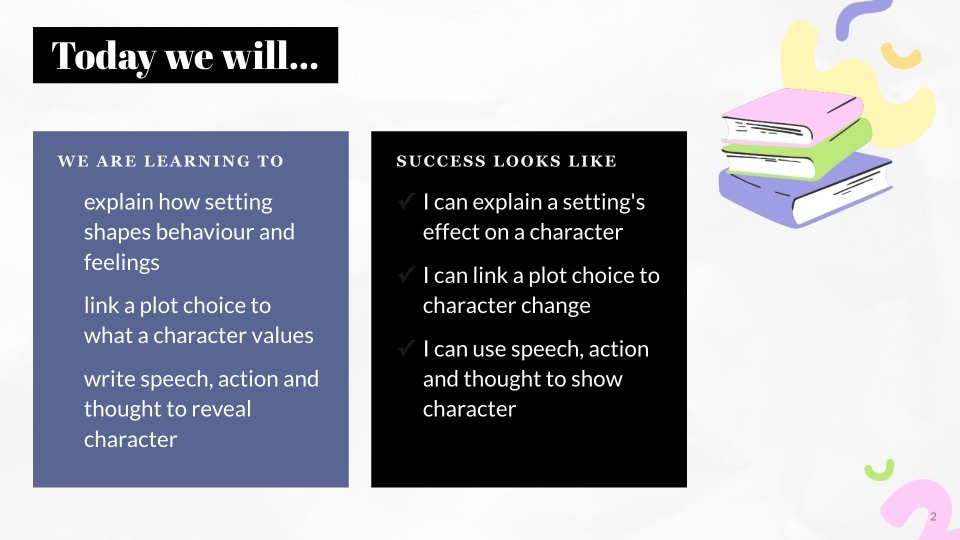
- Students will explain how setting shapes behaviour and feelings.
- Students will link a plot choice to what a character values.
- Students will write speech, action and thought to reveal character.
Success criteria
- I can explain how setting changes what a character does.
- I can link a plot choice to what a character cares about.
- I can write speech, action and thought that show character.
Key words
| Word | Meaning |
|---|---|
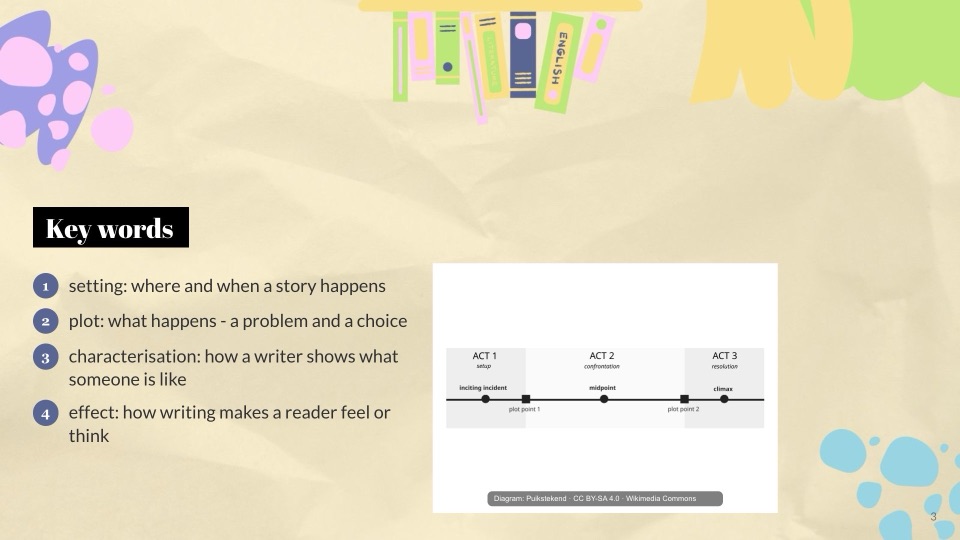
| setting | where and when a story happens |
| plot | what happens, often a problem followed by a choice |
| characterisation | how a writer shows what someone is like |
| effect | how writing makes a reader feel, think or judge |
Timed plan (60 minutes)
| Time | Stage | What happens |
|---|---|---|
| 5 min | Starter | Hook students into showing character rather than telling it. Show Slides 1-2 and read the objectives for today. Deliver the hook: Never tell me a character is kind. Make me believe it from one line they say. Take two quick offers of a kind line and ask what the reader learns without the word kind. Link to today’s goal: write speech, action and thought that reveal character. |
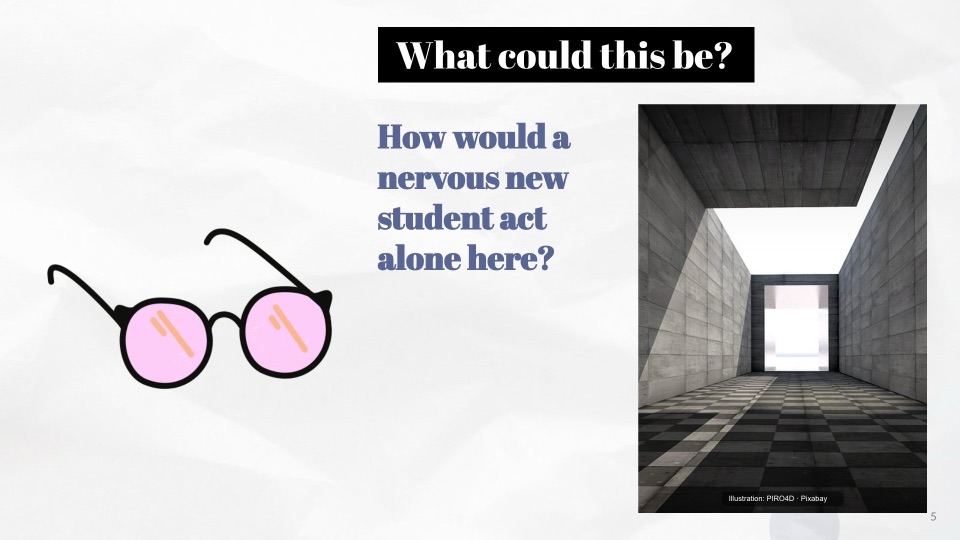
| 10 min | Teaching | Explain how setting shapes behaviour and how a plot choice shows values. Show Slides 3-5 and teach setting, plot, characterisation and effect in simple terms. Model the same nervous new student in two places: cold empty corridor and noisy canteen at lunch. Think aloud how posture, voice and thoughts change and state Slide 7 idea: a problem forces a choice and the choice shows character. Link to Year 7 move from Key Stage 2 spelling, punctuation and grammar to analysis of language. |
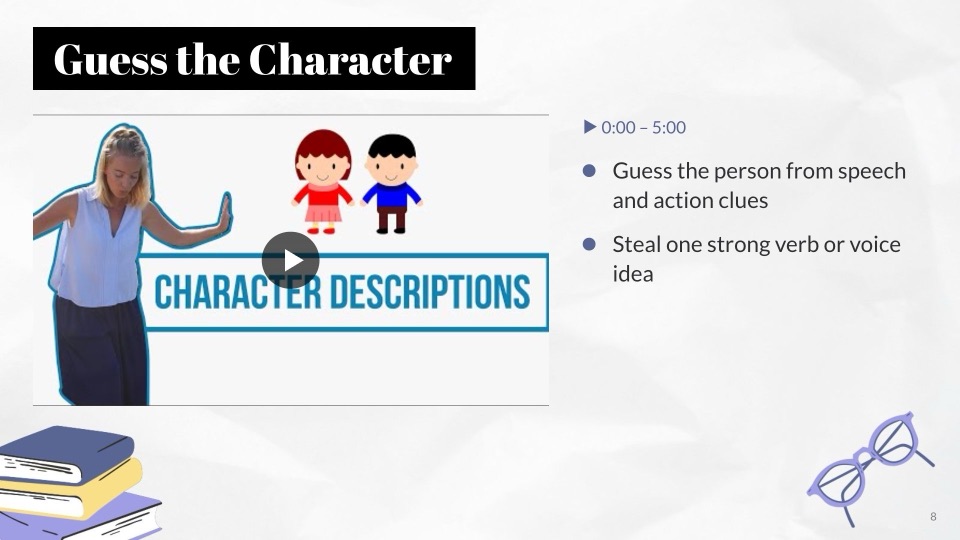
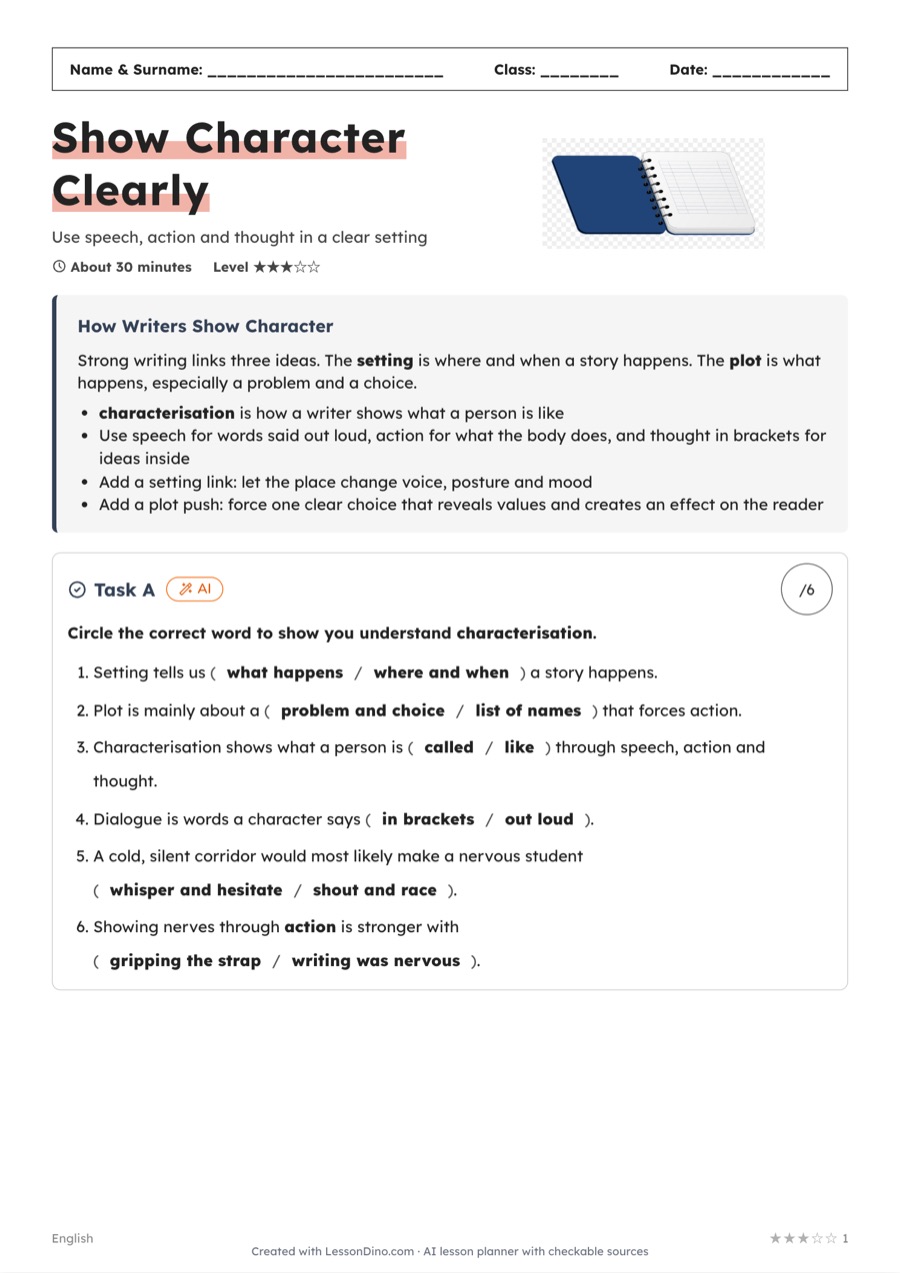
| 10 min | Guided practice | Practise spotting and labelling speech, action and thought. Play Video clip 2 Guessing Character Descriptions (0:00-5:00) on slide 8 and ask pairs to steal one strong verb or voice idea. Model labelling: speech is spoken words, action is body and voice, thought in brackets is inner worry or plan. Hand out Worksheet Task G and guide pairs to colour each box by speech, action or thought. Check answers and stress matching writing to an audience and a purpose. |
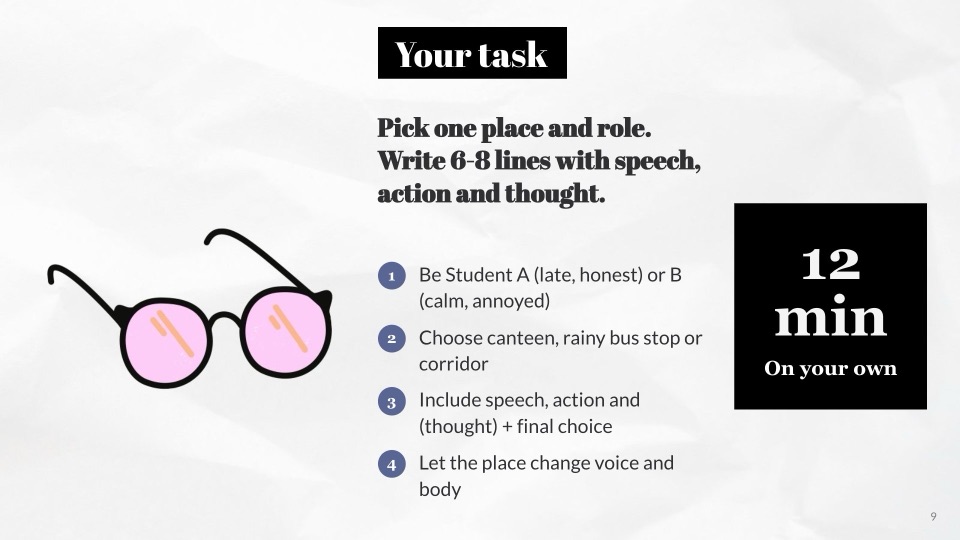
| 20 min | Main activity | Write a short exchange where speech, action, thought and choice reveal character. Show Slide 9 and give roles: Be Student A (late, honest) or B (calm, annoyed). Set choices: canteen, rainy bus stop or corridor; include speech, action and (thought) plus a final choice. Remind pairs to let the plot problem force honesty versus hiding, and circulate prompting for setting details. Stop at 15 minutes for partner swap: underline best line and label speech, action or thought. |
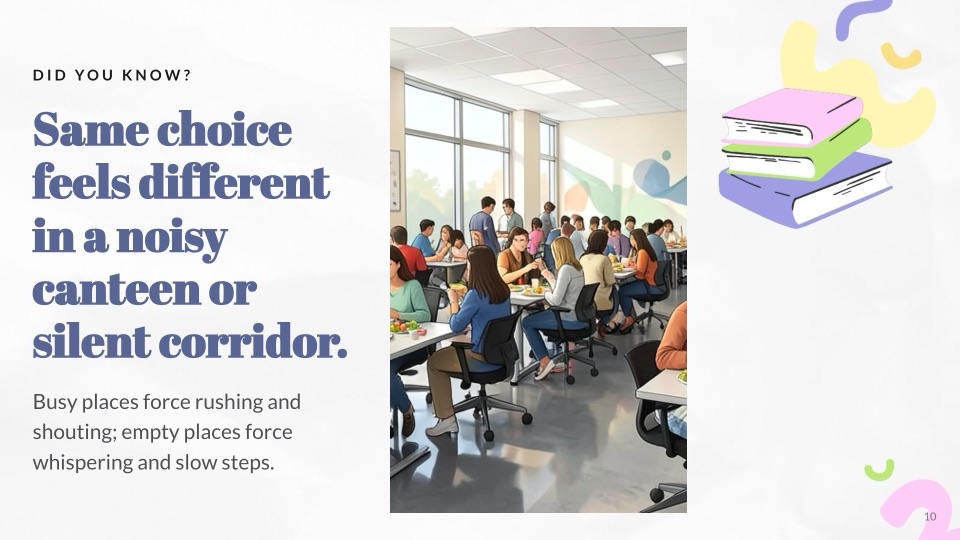
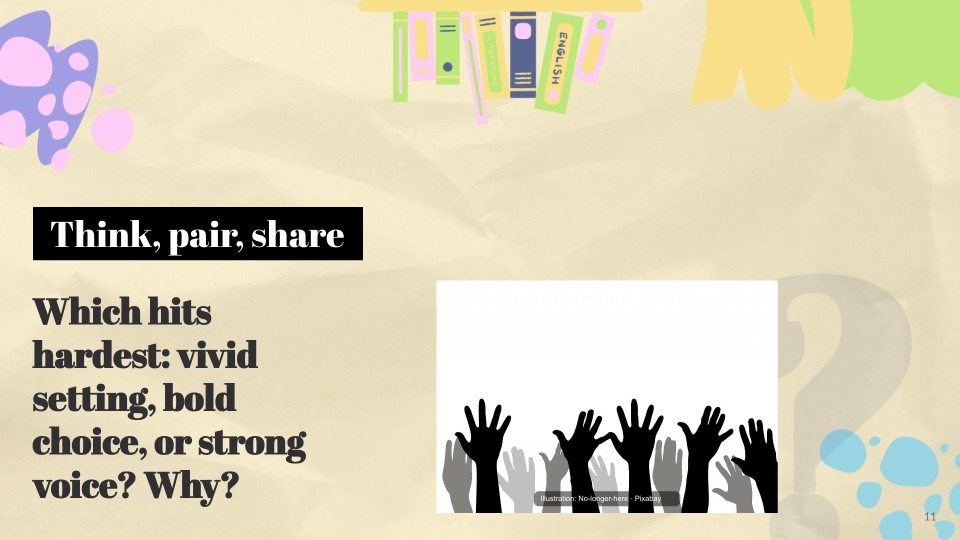
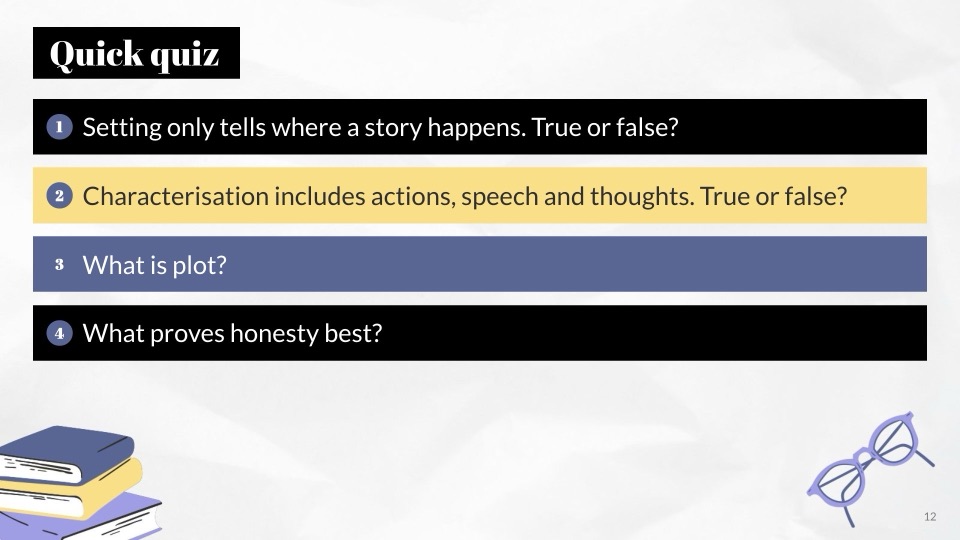
| 15 min | Plenary | Judge which technique creates the strongest effect on the reader. Show Slide 10 to contrast same choice in noisy canteen or silent corridor. Run think, pair, share on Slide 11: Which hits hardest: vivid setting, bold choice, or strong voice? Why? Run Slide 12 quick quiz live and demand evidence with quotations. Return to Slide 2 I can statements and set homework. |
Common mistakes
- Telling the trait instead of showing it, e.g. he was nervous.
How to spot it: Writing uses nervous, kind, angry with no speech, action or thought as proof.
Swap for voice and body: whispering, slow steps, gripping bag. - Treating setting as background that does not change behaviour.
How to spot it: Same posture and voice in corridor and canteen.
Add two setting-driven changes: busy places force rushing and shouting; empty places force whispering and slow steps. - Mixing up speech, action and thought.
How to spot it: Labels in Task G or swap are wrong, e.g. thought written as spoken line.
Use punctuation test: speech in quotes, thought in brackets, action is body/voice with no quotes.
Support
- Provide a model paragraph with the three parts labelled in different colours
- Give trait bank and sentence starters such as This shows and The setting makes the character seem
- Underline key setting words in advance and limit choices to one setting per pair
Stretch
- Rewrite one line of dialogue so it sounds polite but the action shows the opposite feeling
- Suggest a third setting that would make the character seem braver and justify the choice
- Explain how the effect would change with no witnesses, starting This makes the reader feel
Check questions
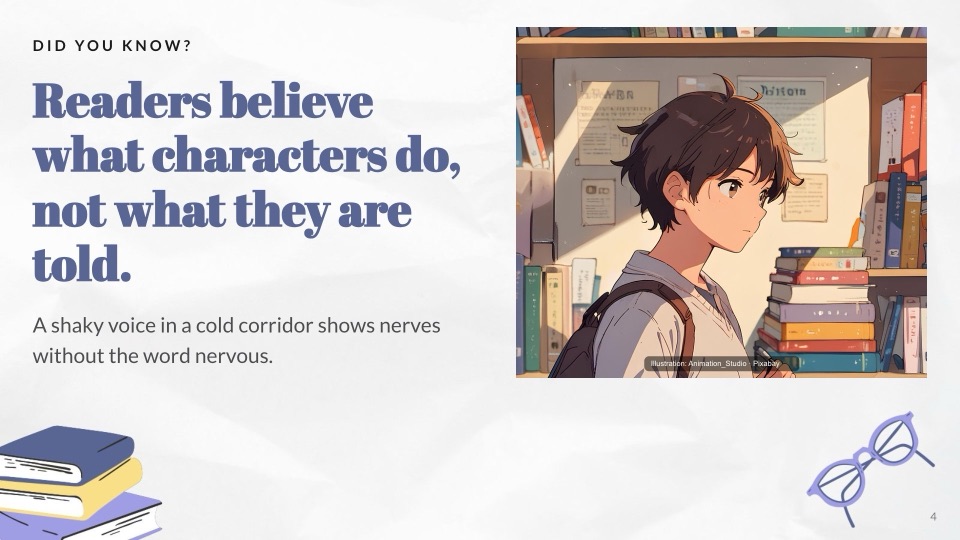
- Give one action that shows nerves without using the word nervous.
Answer: E.g. whispering / gripping bag / hands shaking. - A character owns up though they may be punished. What does the choice show?
Answer: They value honesty/courage over comfort; the reader judges them as brave/honest. - Label this: (I must tell the truth.) - speech, action or thought?
Answer: Thought, inner motive not spoken aloud.
Curriculum
studying setting, plot, and characterisation, and the effects of these
Video clips
Clips on YouTube, from the start and end times we chose. Check each one before you show it.
-
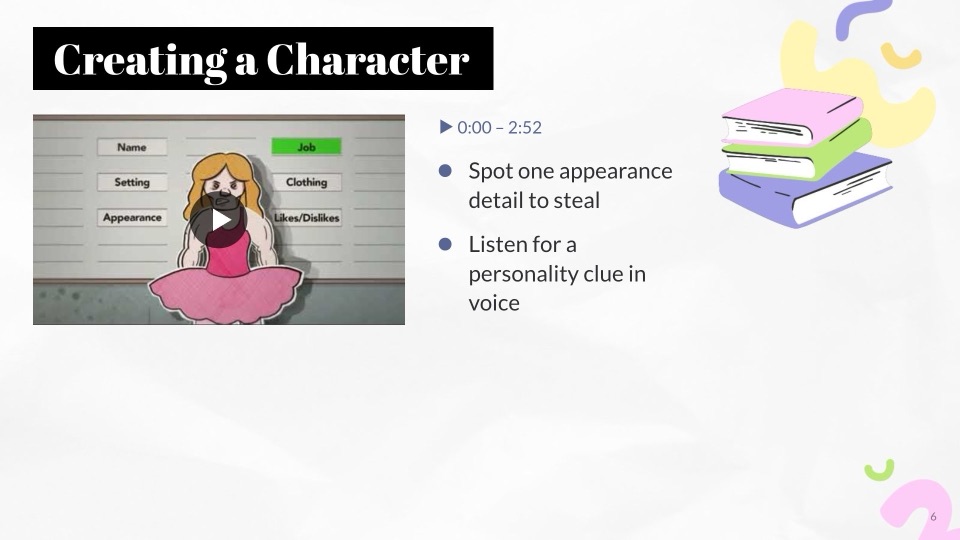
Creating a Character from 0:00 to 2:52
Leo Greaves: How to Create a Character | Creative Writing | English and Literacy | BBC Bitesize
BBC Bitesize made for UK pupils of Year 7 age and explains character creation clearly for 11-12-year-olds.
-
Guessing Character Descriptions from 0:00 to 5:00
The Touring Teacher: English Writing: Character Descriptions // Learning From Home
Teacher-led pace with guess-the-character examples suits 11-12-year-olds and models writing their own description.
Worksheet
Sources
- Year 7 English Curriculum Overview smrt.bristol.sch.uk
- Year 7 English - Curriculum Overview and KS3 Progress ... hgs.herts.sch.uk
- Writing en.wikipedia.org
- Greek alphabet Wikipedia
- Japanese writing system Wikipedia
Picture credits
Made with Lesson Dino's AI on 19 October 2026. AI can make mistakes, so check facts against the sources before you teach.