Slides
Lesson plan
Plan to Persuade: Debate Speech
Students learn to plan a formal speech for purpose and audience. They build a six-box debate plan and peer-check it.
Objectives
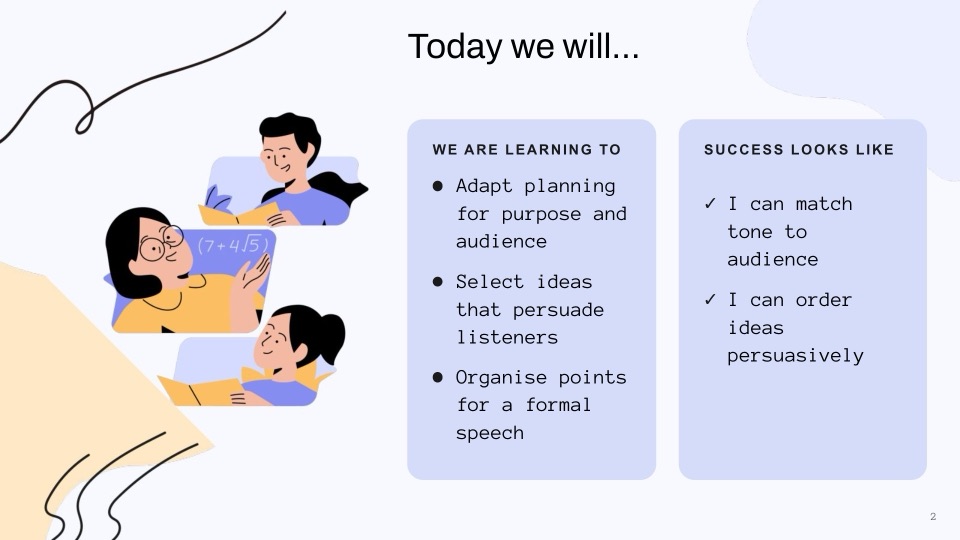
- Students will adapt speech ideas and tone for different purpose and audience.
- Students will select strong evidence and clearly organise points for formal speeches.
- Students will plan clear formal opening, rebuttal and closing for debate.
Success criteria
- I can match my tone and reasons to my audience.
- I can order my points with links and formal language.
- I can plan a debate ending with a clear action.
Key words
| Word | Meaning |
|---|---|
| audience | the people who will listen to your speech |
| purpose | the reason you speak and the change you want |
| evidence | facts or examples that show a point is true |
| organise | to put ideas in a clear order that is easy to follow |
| rebuttal | an answer that shows why the opposite view is wrong |
| formal | polite and serious, right for assembly or debate |
Timed plan (60 minutes)
| Time | Stage | What happens |
|---|---|---|
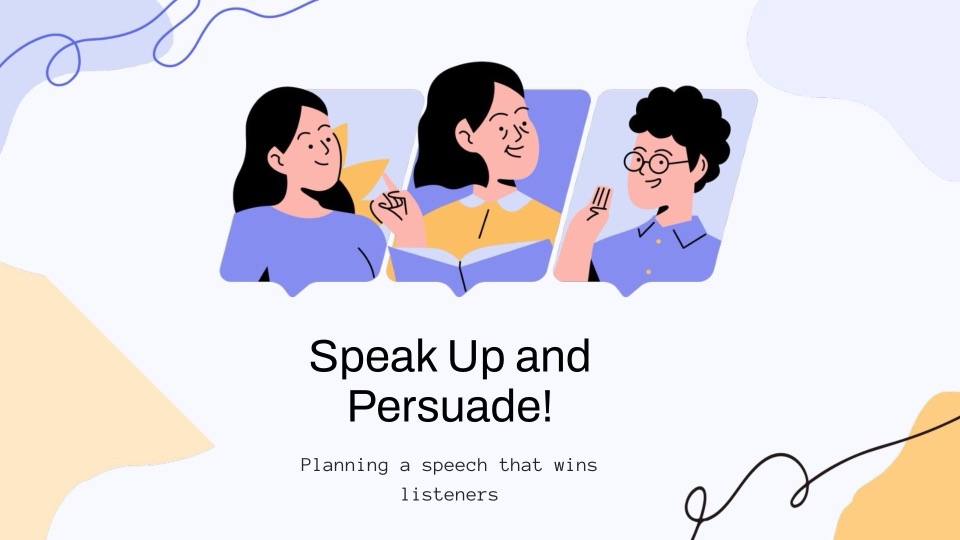
| 8 min | Starter | To hook students and link audience and purpose to speech planning. Show Slide 1 Speak Up and Persuade! and welcome the class to debate planning. Say the hook and show Slide 3 Big idea: Plan for your listeners first, then your words will persuade. Ask the prior question about persuading a friend and persuading teachers and take 3 quick answers. Link answers to today's motion: every student should join one lunchtime club. |
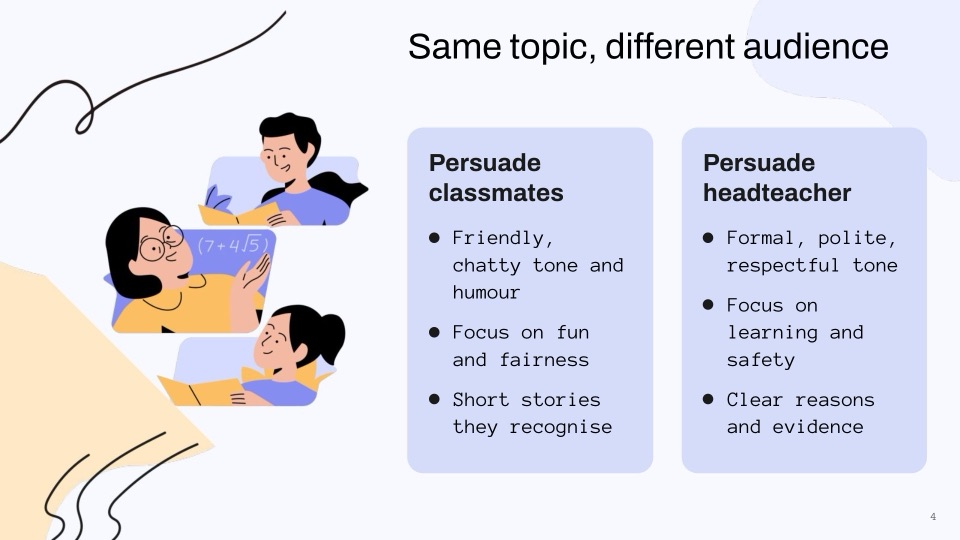
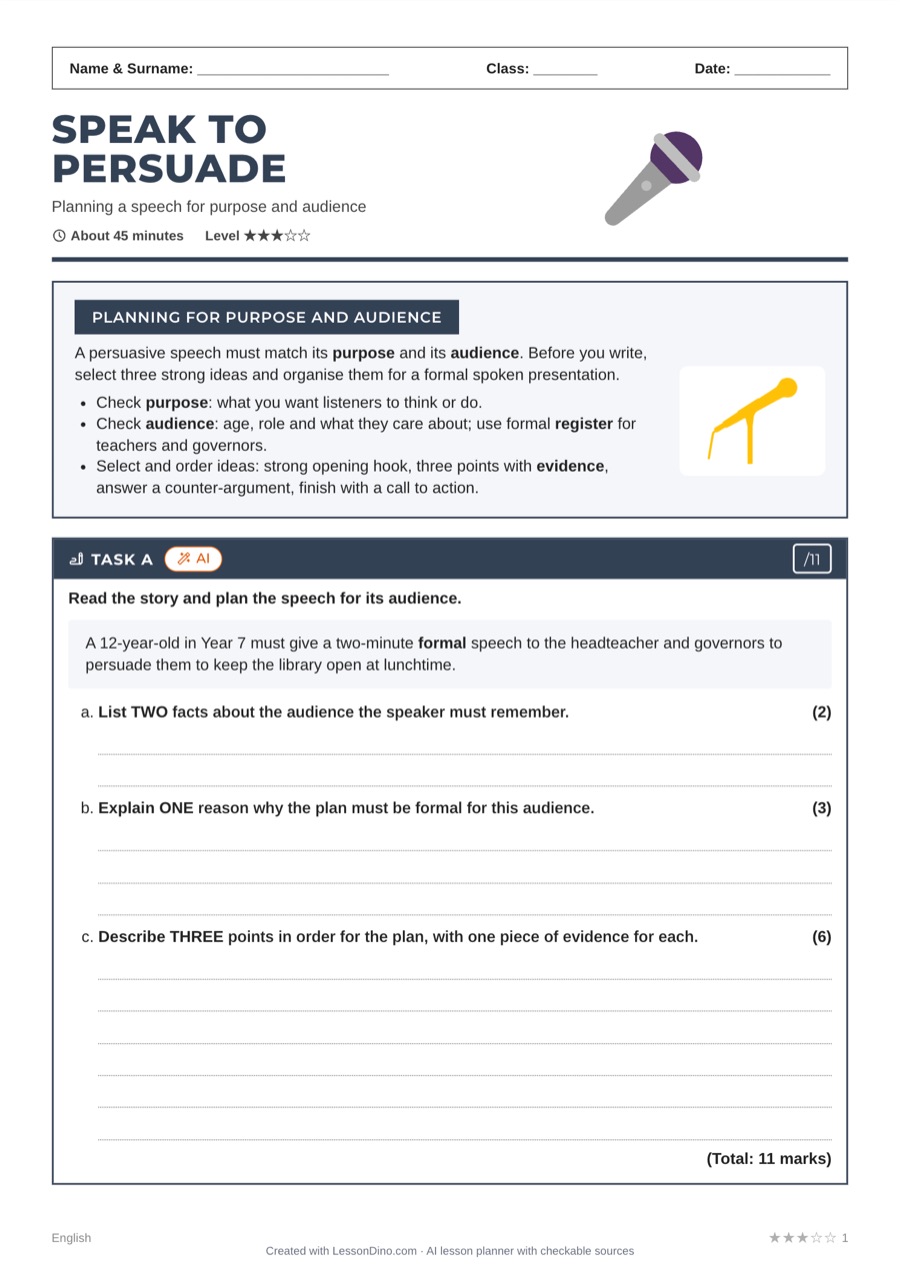
| 12 min | Teaching | To teach matching tone and reasons to audience and selecting formal language. Show Slide 2 objectives and Slide 4 Same topic, different audience for classmates and headteacher. Model two 30-second versions for longer break: chatty version for friends, polite formal version for assembly. Hand out Worksheet Task D and model circling the more formal word in the first pair. Take answers and stress that at Key Stage 3 they match writing to an audience and a purpose. |
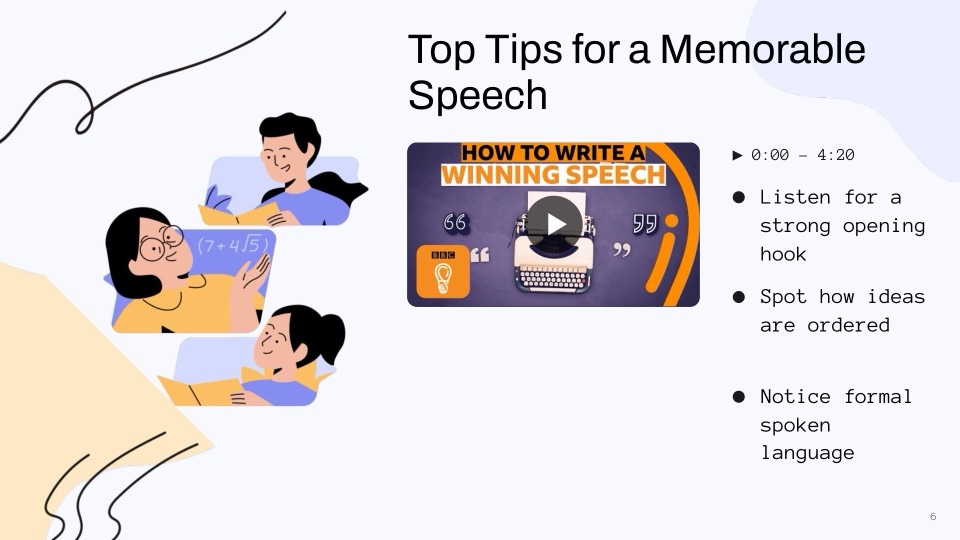
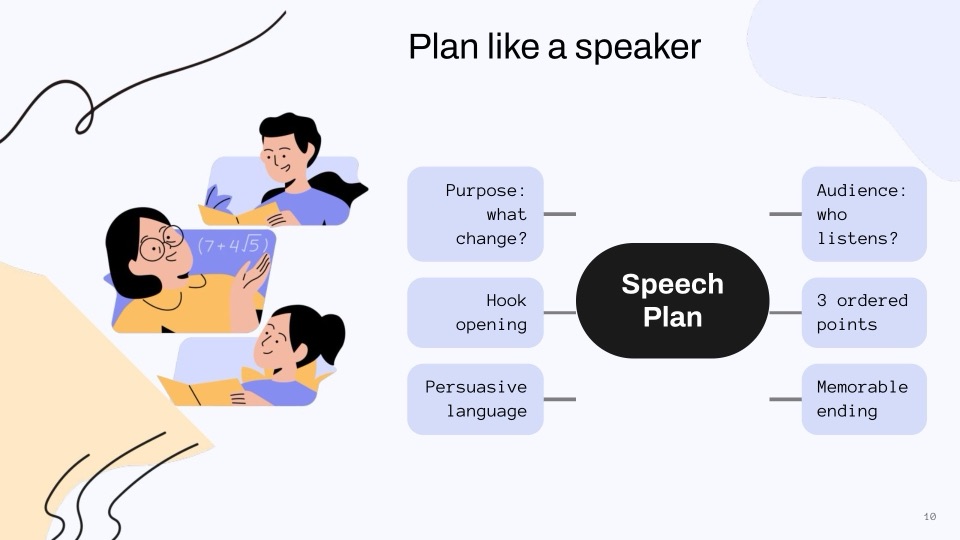
| 10 min | Modelling | To model strong opening, ordered points and persuasive language from a speech model. Show Slide 6 and play Video clip 1 Top tips for a memorable speech (0:00-4:20). Pause for students to note opening hook, order and formal spoken language. Show Slide 7 fact that rhetoric is the art of persuasion and speakers choose language on purpose. Model the six-box shape on Slide 10 Speech Plan with a lunchtime club example. |
| 20 min | Main | To create a complete selective six-box plan for a formal debate speech. Show Slide 9 Your task and give out A4 paper, pens and rulers. Demonstrate folding paper into six boxes and labelling them clearly. Set 14 minutes for planning the speech: every student should join one lunchtime club, bullet points only. Stop for partner tick check: each box has a point, evidence and audience-appropriate language. |
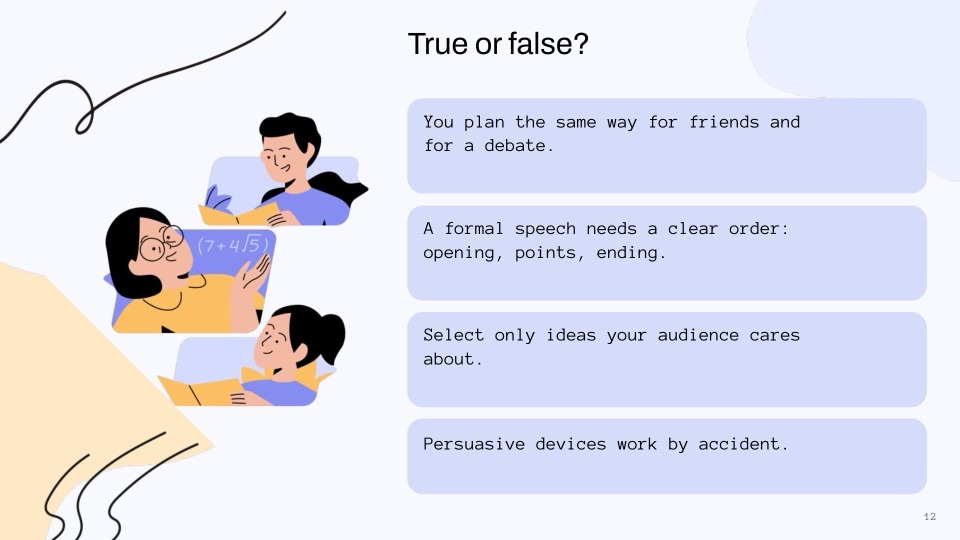
| 10 min | Plenary | To check planning choices and secure clear order and closing action. Show Slide 12 True or false? and vote on planning the same way for friends and debate. Invite two students to read only their closing 3-4 sentences aloud clearly and audibly. Hand out Worksheet Task G Ranking pyramid and ask students to rank plan parts. Close by returning to success criteria and setting homework. |
Common mistakes
- Using chatty slang in a formal assembly plan
How to spot it: Hear you guys gotta, so unfair, gonna in boxes
Swap for I strongly believe, furthermore, I urge you and rehearse aloud - Listing funny but weak or off-topic evidence
How to spot it: Plan has jokes or repeats with no link to audience
Keep only three relevant facts that would persuade adults and bin the rest - Missing rebuttal or trailing closing with no action
How to spot it: No Some may argue... however... and ending just stops
Add counter plus rebuttal frame and finish: In conclusion... I urge you to...
Support
- Half-filled six-box plan and formal word bank on desks
- Sentence frames for rebuttal and closing in every stage
- Partner tick check before plenary to catch gaps
Stretch
- Label each box with repetition, rhetorical question or emotive language
- Add counter-argument in different colour and justify its place
- Deliver closing from bullets with pause and formal assembly voice
Check questions
- Name two changes you make when planning for a formal audience.
Answer: Use formal polite tone and choose reasons that audience cares about. - Put these in speaking order: closing action, opening hook, points with evidence.
Answer: Opening hook, points with evidence, closing action. - Complete the rebuttal: Some may argue clubs take time, however...
Answer: ...they run only once a week and build skills and friendships.
Curriculum
planning for different purposes and audiences, including selecting and organising information and ideas effectively and persuasively for formal spoken presentations and debates
Video clips
Clips on YouTube, from the start and end times we chose. Check each one before you show it.
-
Top tips for a memorable speech from 0:00 to 4:20
BBC Ideas: How to write a perfect speech | BBC Ideas
Directly about planning and writing a speech, with clear vocabulary and pace that suit 11-12-year-olds.
-
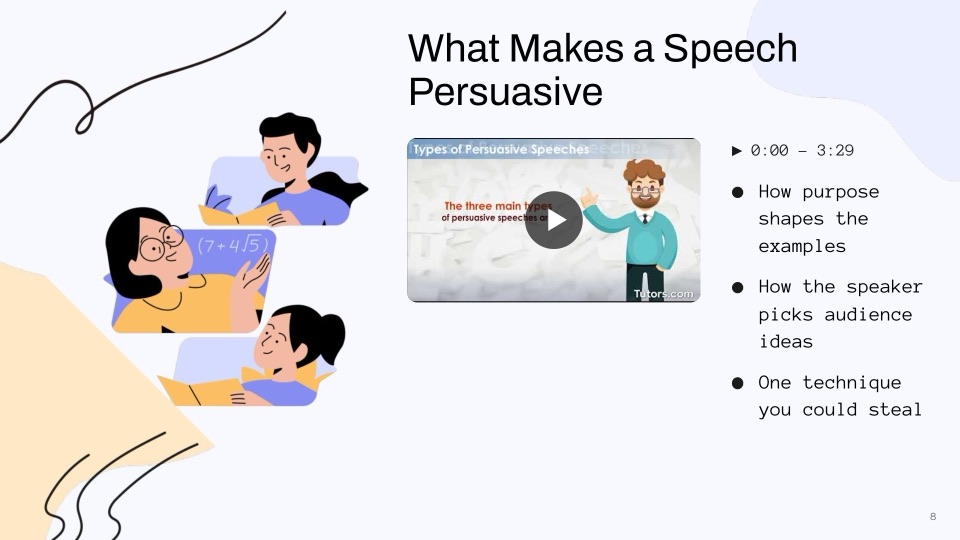
What makes a speech persuasive from 0:00 to 3:29
Tutors: Persuasive Speeches | Types, Topics, and Examples
Explains persuasive speeches with topics and examples in simple language ideal for Year 7 aged 11-12.
Worksheet
Sources
- Year 7 English Curriculum Overview smrt.bristol.sch.uk
- Year 7 English - Curriculum Overview and KS3 Progress ... hgs.herts.sch.uk
- Literary device Wikipedia
- English studies Wikipedia
- Black Speech Wikipedia
Picture credits
Made with Lesson Dino's AI on 19 October 2026. AI can make mistakes, so check facts against the sources before you teach.