The worksheet
About this worksheet
Pupils build numbers from primes and write them with indices. They sort prime cards in a Venn diagram to find HCF and LCM. This Year 7 Maths worksheet gives students (ages 11–12) five pages of practice on prime factors, HCF and LCM, part of the number unit. It goes with our free Prime factors, HCF and LCM lesson, which has the slides and a timed lesson plan.
What it covers
By the end, students should be able to:
- Students will use vocabulary of primes, factors, multiples and common factors and multiples.
- Students will write prime factorisation using product notation and index form.
- Students will find HCF and LCM from prime factors using Venn diagrams.
How to use it
- Use it for practice after the teaching part of the lesson, once students have seen the worked examples on the slides.
- Support: Hand out the prime cards already written out so students only have to sort and multiply.
- Stretch: Challenge pairs with 50 = 2 × 5 × 5 and 16 = 2 × 2 × 2 × 2 to find a much larger LCM.
- The answer sheet is the last page, so you can print it on its own or let students check their own work.
Key vocabulary
- prime number: a whole number above 1 with only two exact divisors, 1 and itself
- factor: a whole number that goes into another number exactly with nothing left over
- multiple: a number in the times table of another number
- highest common factor: the biggest number that divides two numbers exactly, found in the Venn overlap
- lowest common multiple: the smallest number found in the times tables of two numbers
- prime factorisation: writing a number using only × with numbers that cannot be split further, using powers for repeats
Mistakes to watch for
- Stopping a factor tree at composite numbers such as 10 or 6. Split every composite branch again until only circled primes remain, then write the product.
- Confusing factors with multiples. Check: factors divide the number exactly; multiples are in its times table.
- Omitting repeated primes and using all factors for HCF. Keep every repeat and multiply only the overlap for HCF, all cards for LCM; HCF uses minimum powers, LCM maximum powers.
What's on the worksheet
Breaking Into Primes
See how prime factorisation finds HCF and LCM.
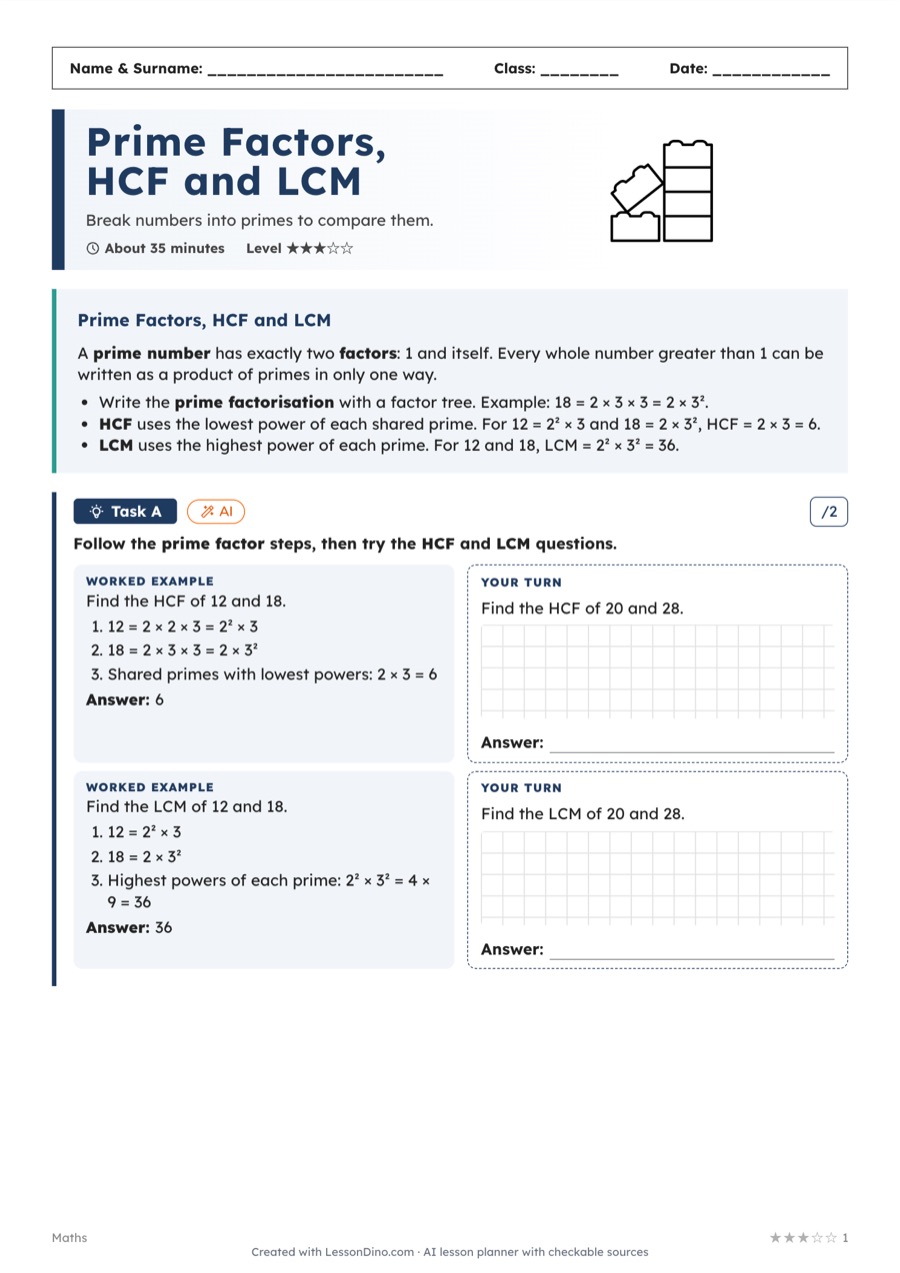
Prime Factors, HCF and LCM
- A prime number has exactly two factors: 1 and itself. Every whole number greater than 1 can be written as a product of primes in only one way.
- Write the prime factorisation with a factor tree. Example: 18 = 2 × 3 × 3 = 2 × 3².
- HCF uses the lowest power of each shared prime. For 12 = 2² × 3 and 18 = 2 × 3², HCF = 2 × 3 = 6.
- LCM uses the highest power of each prime. For 12 and 18, LCM = 2² × 3² = 36.
Follow the prime factor steps, then try the HCF and LCM questions.
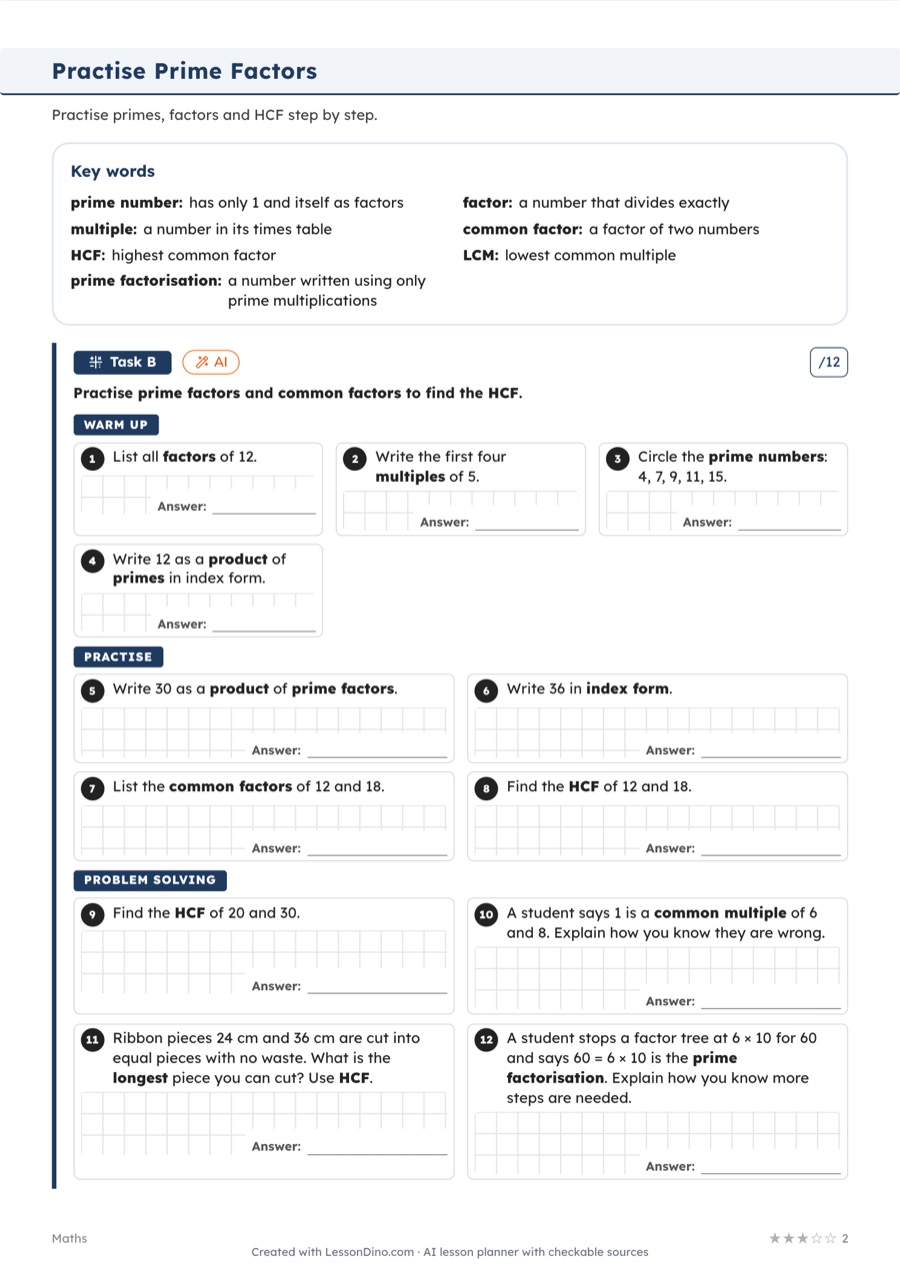
Practise Prime Factors
Practise primes, factors and HCF step by step.
| Word | Meaning |
|---|---|
| prime number | has only 1 and itself as factors |
| factor | a number that divides exactly |
| multiple | a number in its times table |
| common factor | a factor of two numbers |
| HCF | highest common factor |
| LCM | lowest common multiple |
| prime factorisation | a number written using only prime multiplications |
Practise prime factors and common factors to find the HCF.
Warm up
- List all factors of 12.
- Write the first four multiples of 5.
- Circle the prime numbers: 4, 7, 9, 11, 15.
- Write 12 as a product of primes in index form.
Practise
- Write 30 as a product of prime factors.
- Write 36 in index form.
- List the common factors of 12 and 18.
- Find the HCF of 12 and 18.
Problem solving
- Find the HCF of 20 and 30.
- A student says 1 is a common multiple of 6 and 8. Explain how you know they are wrong.
- Ribbon pieces 24 cm and 36 cm are cut into equal pieces with no waste. What is the longest piece you can cut? Use HCF.
- A student stops a factor tree at 6 × 10 for 60 and says 60 = 6 × 10 is the prime factorisation. Explain how you know more steps are needed.
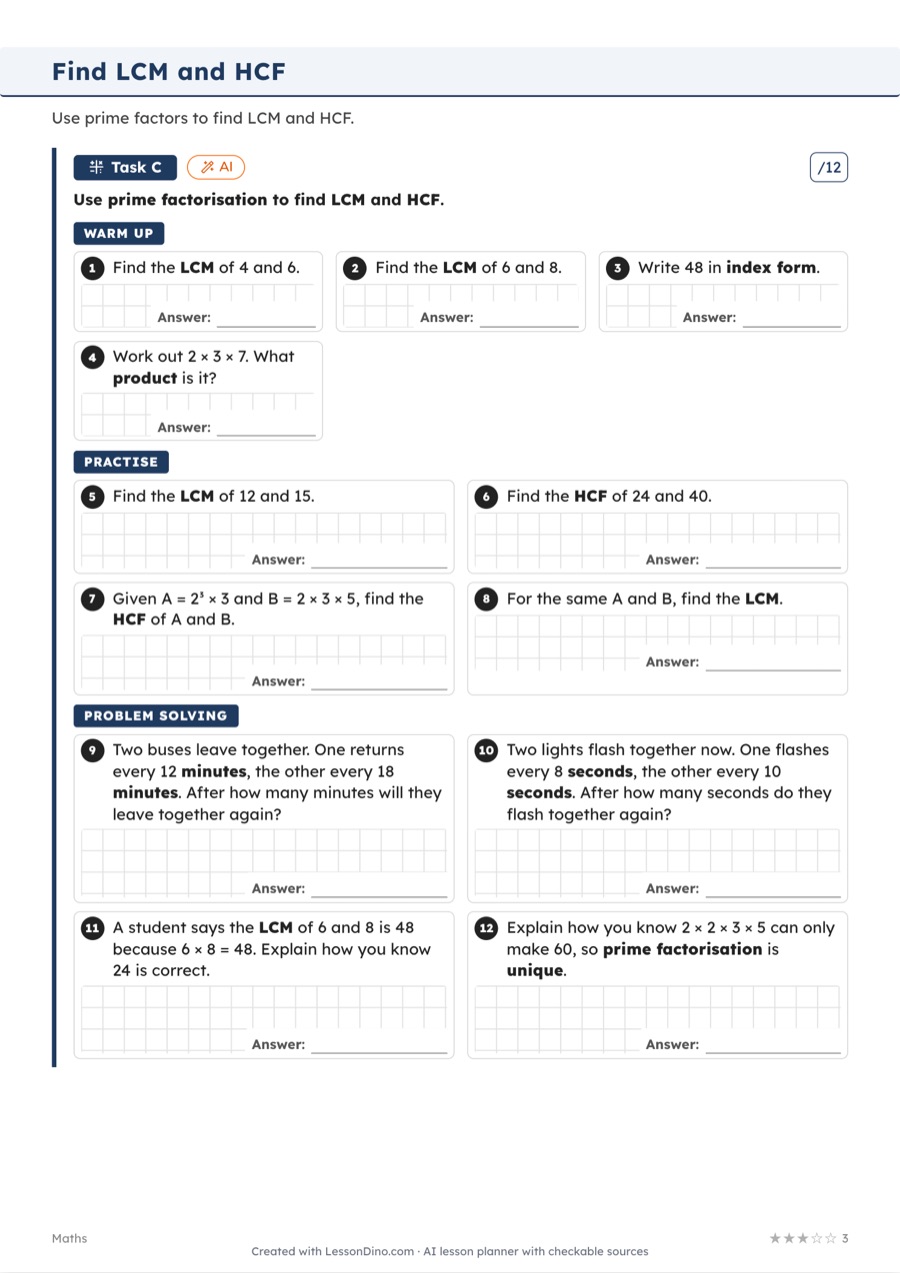
Find LCM and HCF
Use prime factors to find LCM and HCF.
Use prime factorisation to find LCM and HCF.
Warm up
- Find the LCM of 4 and 6.
- Find the LCM of 6 and 8.
- Write 48 in index form.
- Work out 2 × 3 × 7. What product is it?
Practise
- Find the LCM of 12 and 15.
- Find the HCF of 24 and 40.
- Given A = 2³ × 3 and B = 2 × 3 × 5, find the HCF of A and B.
- For the same A and B, find the LCM.
Problem solving
- Two buses leave together. One returns every 12 minutes, the other every 18 minutes. After how many minutes will they leave together again?
- Two lights flash together now. One flashes every 8 seconds, the other every 10 seconds. After how many seconds do they flash together again?
- A student says the LCM of 6 and 8 is 48 because 6 × 8 = 48. Explain how you know 24 is correct.
- Explain how you know 2 × 2 × 3 × 5 can only make 60, so prime factorisation is unique.
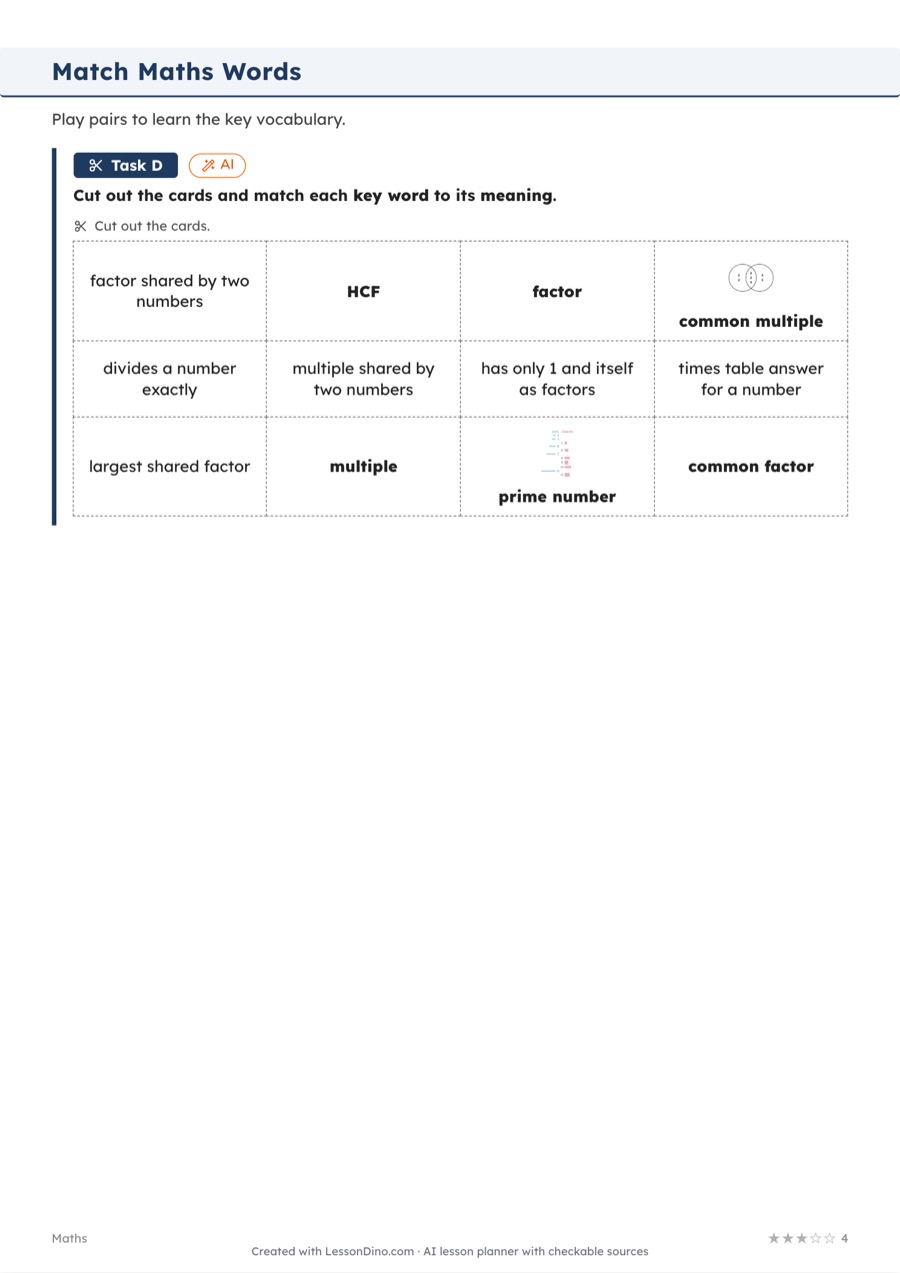
Match Maths Words
Play pairs to learn the key vocabulary.
Cut out the cards and match each key word to its meaning.
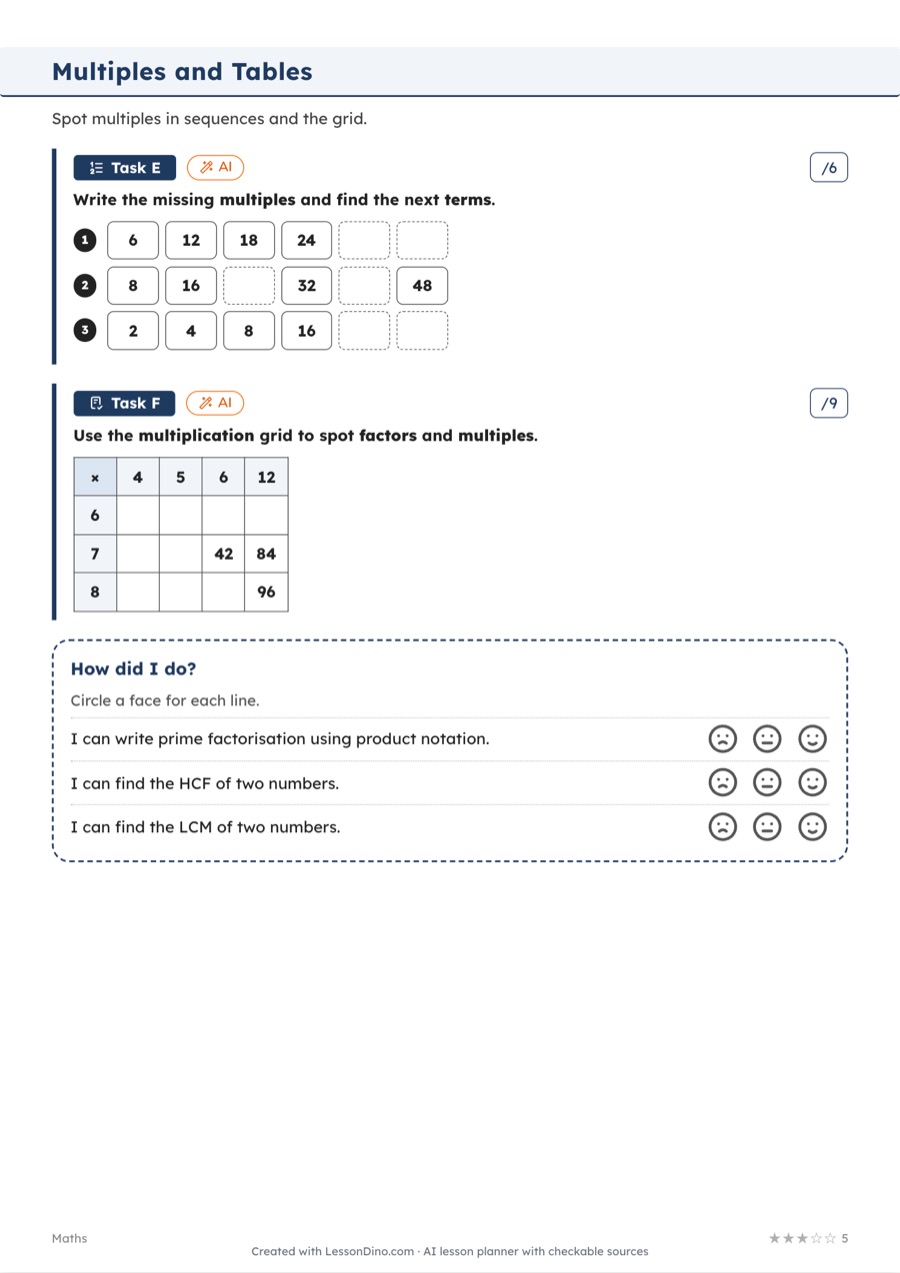
Multiples and Tables
Spot multiples in sequences and the grid.
Write the missing multiples and find the next terms.
Use the multiplication grid to spot factors and multiples.
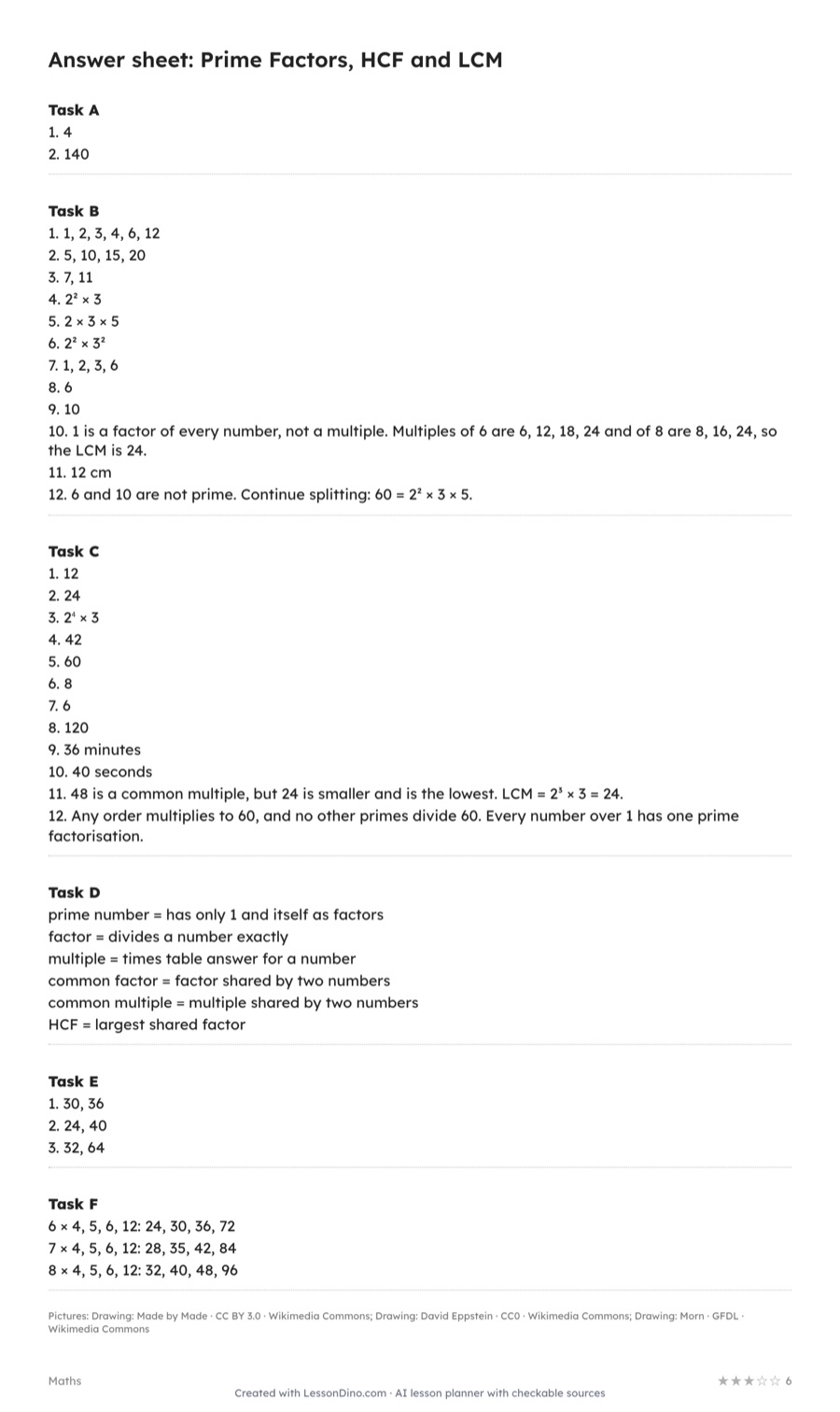
Answers
Show the answers
- List all factors of 12. 1, 2, 3, 4, 6, 12
- Write the first four multiples of 5. 5, 10, 15, 20
- Circle the prime numbers: 4, 7, 9, 11, 15. 7, 11
- Write 12 as a product of primes in index form. 2² × 3
- Write 30 as a product of prime factors. 2 × 3 × 5
- Write 36 in index form. 2² × 3²
- List the common factors of 12 and 18. 1, 2, 3, 6
- Find the HCF of 12 and 18. 6
- Find the HCF of 20 and 30. 10
- A student says 1 is a common multiple of 6 and 8. Explain how you know they are wrong. 1 is a factor of every number, not a multiple. Multiples of 6 are 6, 12, 18, 24 and of 8 are 8, 16, 24, so the LCM is 24.
- Ribbon pieces 24 cm and 36 cm are cut into equal pieces with no waste. What is the longest piece you can cut? Use HCF. 12 cm
- A student stops a factor tree at 6 × 10 for 60 and says 60 = 6 × 10 is the prime factorisation. Explain how you know more steps are needed. 6 and 10 are not prime. Continue splitting: 60 = 2² × 3 × 5.
- Find the LCM of 4 and 6. 12
- Find the LCM of 6 and 8. 24
- Write 48 in index form. 2⁴ × 3
- Work out 2 × 3 × 7. What product is it? 42
- Find the LCM of 12 and 15. 60
- Find the HCF of 24 and 40. 8
- Given A = 2³ × 3 and B = 2 × 3 × 5, find the HCF of A and B. 6
- For the same A and B, find the LCM. 120
- Two buses leave together. One returns every 12 minutes, the other every 18 minutes. After how many minutes will they leave together again? 36 minutes
- Two lights flash together now. One flashes every 8 seconds, the other every 10 seconds. After how many seconds do they flash together again? 40 seconds
- A student says the LCM of 6 and 8 is 48 because 6 × 8 = 48. Explain how you know 24 is correct. 48 is a common multiple, but 24 is smaller and is the lowest. LCM = 2³ × 3 = 24.
- Explain how you know 2 × 2 × 3 × 5 can only make 60, so prime factorisation is unique. Any order multiplies to 60, and no other primes divide 60. Every number over 1 has one prime factorisation.
The answer sheet is the last picture above.
Curriculum
use the concepts and vocabulary of prime numbers, factors (or divisors), multiples, common factors, common multiples, highest common factor, lowest common multiple, prime factorisation, including using product notation and the unique factorisation property
From National curriculum in England, Key Stage 3 mathematics.
Made with Lesson Dino's AI on 19 October 2026. AI can make mistakes, so check the answers and facts against the sources before you teach.