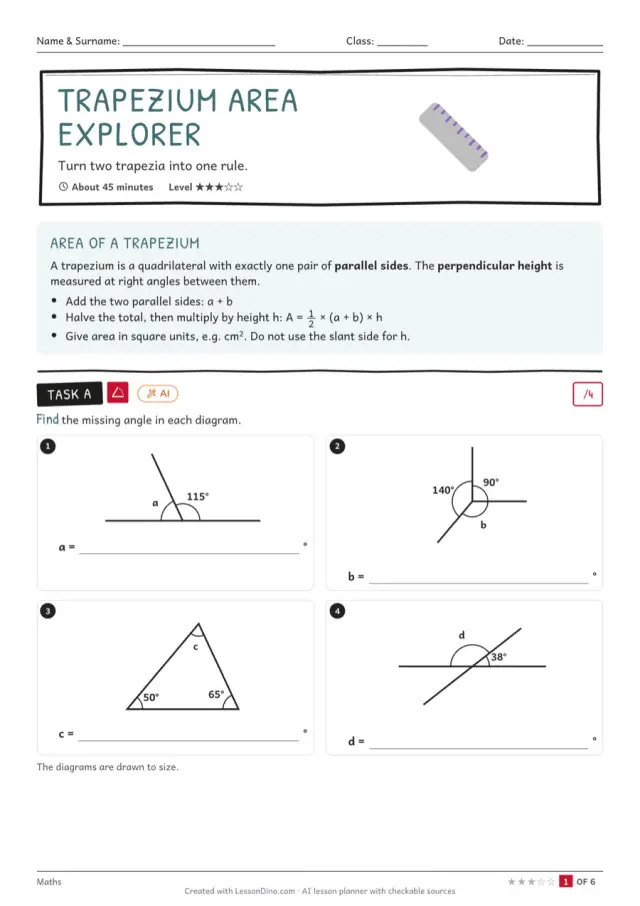
The worksheet
About this worksheet
Pupils learn that corresponding and alternate angles are equal on parallel lines. They find missing angles and give the angle reason each time. This Year 7 Maths worksheet gives students (ages 11–12) six pages of practice on angles in parallel lines, part of the geometry and measures unit. It goes with our free Angles in parallel lines lesson, which has the slides and a timed lesson plan.
What it covers
By the end, students should be able to:
- Students will recognise equal corresponding angles in F shapes on parallel lines.
- Students will recognise equal alternate angles in Z shapes on parallel lines.
- Students will find missing angles using alternate and corresponding angle facts.
How to use it
- Main activity (20 minutes): Hand out printed practice questions from Worksheet Task B and give one protractor and mini-whiteboard per pair.
- Support: Colour the target F or Z before calculating, and provide a reason bank with corresponding angles are equal and alternate angles are equal to choose from.
- Stretch: Chain two steps, such as alternate then angles on a straight line, to find an angle two moves away.
- The answer sheet is the last page, so you can print it on its own or let students check their own work.
Key vocabulary
- parallel lines: straight lines that stay the same distance apart and never meet
- transversal: a straight line that cuts across two or more other lines
- corresponding angles: pair in matching corners at each crossing that are the same size when lines never meet
- alternate angles: pair on opposite sides of the crossing line, inside the two lines, that are the same size
Mistakes to watch for
- Using F or Z equality without checking lines are parallel. Stop and check for matching parallel-line arrows before using equality; rules need the lines to be parallel, shown by arrows.
- Saying alternate angles add to 180 degrees. Re-trace the Z and stress alternate angles are equal; 180 degrees is for angles on a straight line or C-shape co-interior angles.
- Missing upside-down or back-to-front F and Z pairs. Rotate the sheet and re-trace; the F shape can be upside down or back to front and the Z can be back to front.
What's on the worksheet
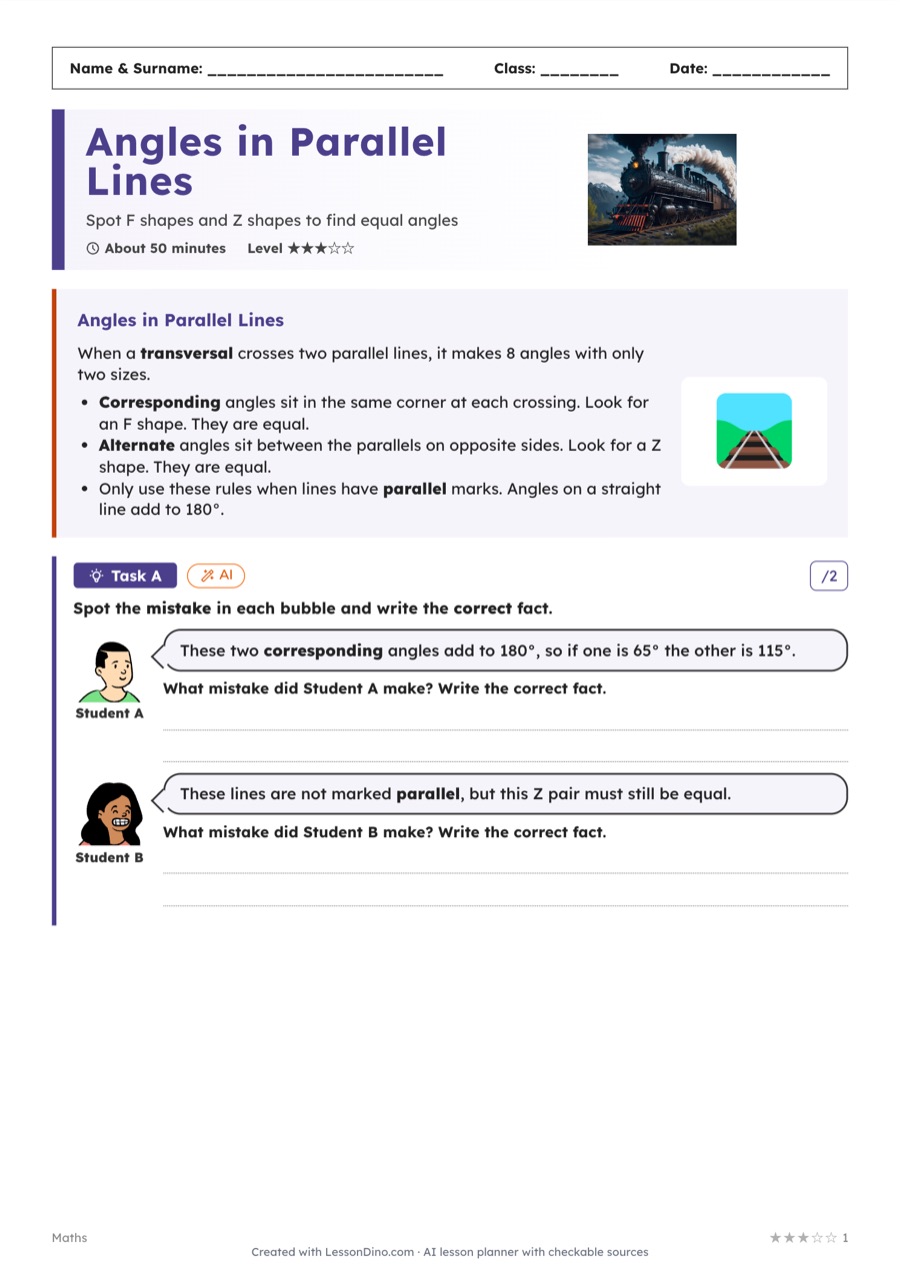
Learn the Rules
Learn the rules for angles in parallel lines.
Angles in Parallel Lines
- When a transversal crosses two parallel lines, it makes 8 angles with only two sizes.
- Corresponding angles sit in the same corner at each crossing. Look for an F shape. They are equal.
- Alternate angles sit between the parallels on opposite sides. Look for a Z shape. They are equal.
- Only use these rules when lines have parallel marks. Angles on a straight line add to 180°.
Spot the mistake in each bubble and write the correct fact.
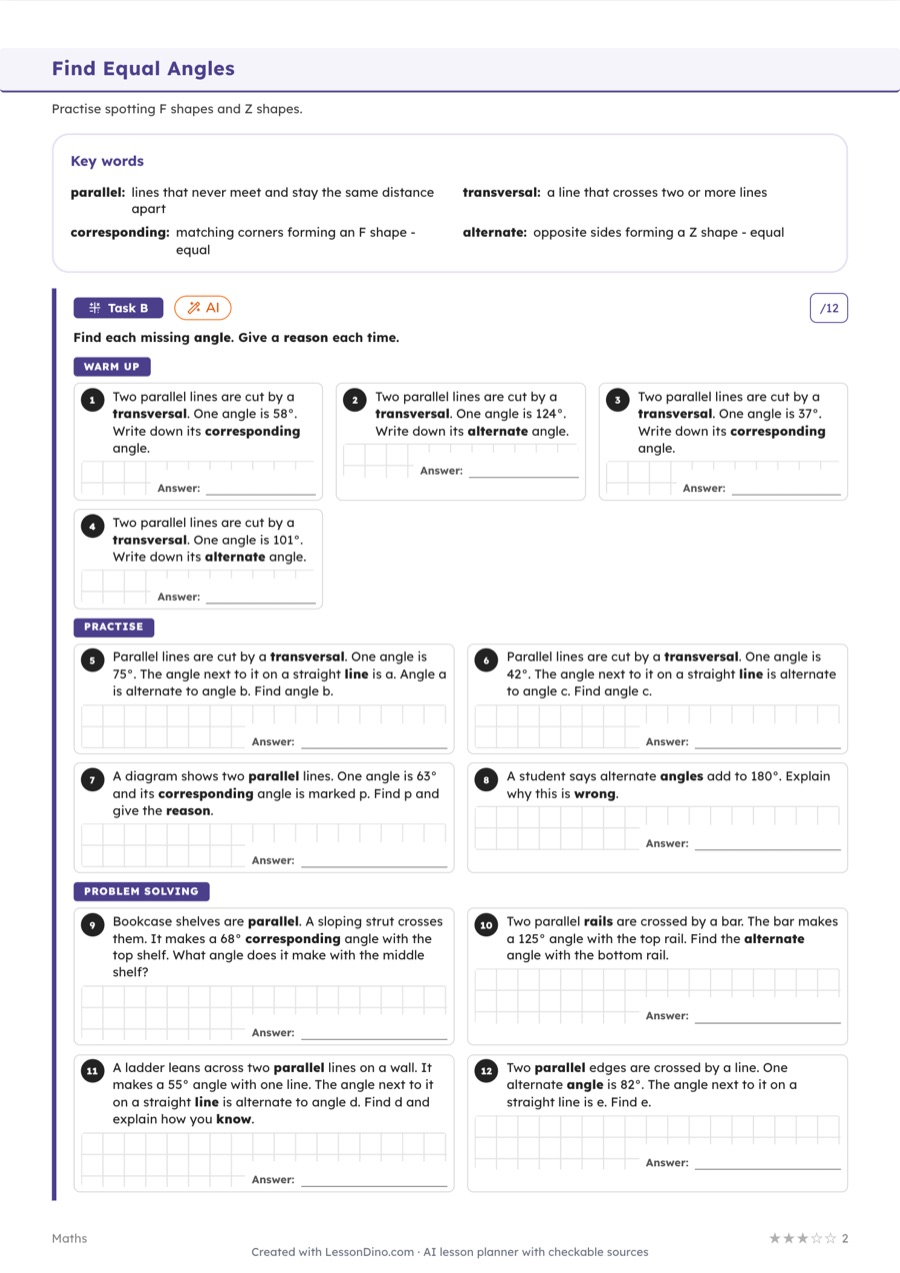
Find Equal Angles
Practise spotting F shapes and Z shapes.
| Word | Meaning |
|---|---|
| parallel | lines that never meet and stay the same distance apart |
| transversal | a line that crosses two or more lines |
| corresponding | matching corners forming an F shape - equal |
| alternate | opposite sides forming a Z shape - equal |
Find each missing angle. Give a reason each time.
Warm up
- Two parallel lines are cut by a transversal. One angle is 58°. Write down its corresponding angle.
- Two parallel lines are cut by a transversal. One angle is 124°. Write down its alternate angle.
- Two parallel lines are cut by a transversal. One angle is 37°. Write down its corresponding angle.
- Two parallel lines are cut by a transversal. One angle is 101°. Write down its alternate angle.
Practise
- Parallel lines are cut by a transversal. One angle is 75°. The angle next to it on a straight line is a. Angle a is alternate to angle b. Find angle b.
- Parallel lines are cut by a transversal. One angle is 42°. The angle next to it on a straight line is alternate to angle c. Find angle c.
- A diagram shows two parallel lines. One angle is 63° and its corresponding angle is marked p. Find p and give the reason.
- A student says alternate angles add to 180°. Explain why this is wrong.
Problem solving
- Bookcase shelves are parallel. A sloping strut crosses them. It makes a 68° corresponding angle with the top shelf. What angle does it make with the middle shelf?
- Two parallel rails are crossed by a bar. The bar makes a 125° angle with the top rail. Find the alternate angle with the bottom rail.
- A ladder leans across two parallel lines on a wall. It makes a 55° angle with one line. The angle next to it on a straight line is alternate to angle d. Find d and explain how you know.
- Two parallel edges are crossed by a line. One alternate angle is 82°. The angle next to it on a straight line is e. Find e.
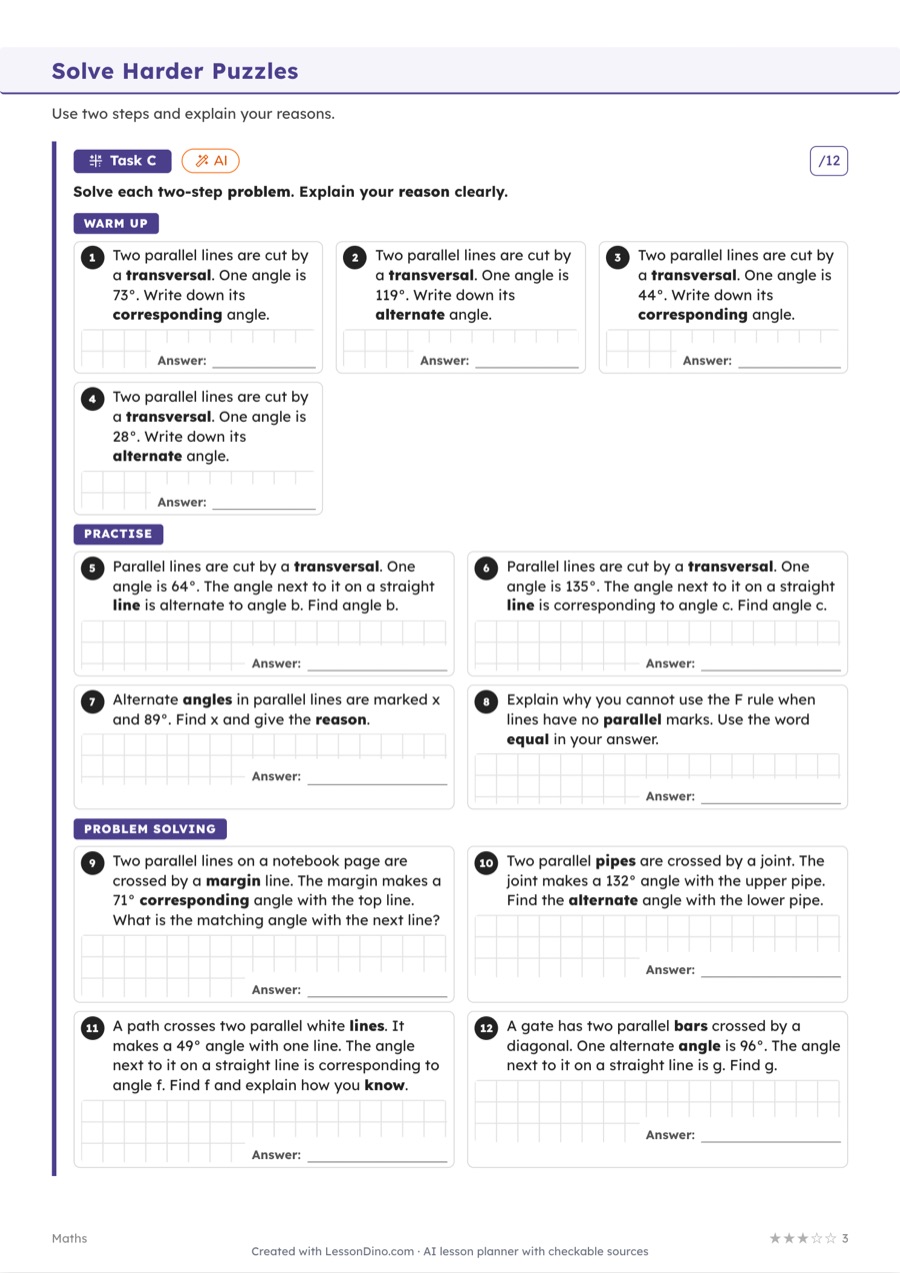
Solve Harder Puzzles
Use two steps and explain your reasons.
Solve each two-step problem. Explain your reason clearly.
Warm up
- Two parallel lines are cut by a transversal. One angle is 73°. Write down its corresponding angle.
- Two parallel lines are cut by a transversal. One angle is 119°. Write down its alternate angle.
- Two parallel lines are cut by a transversal. One angle is 44°. Write down its corresponding angle.
- Two parallel lines are cut by a transversal. One angle is 28°. Write down its alternate angle.
Practise
- Parallel lines are cut by a transversal. One angle is 64°. The angle next to it on a straight line is alternate to angle b. Find angle b.
- Parallel lines are cut by a transversal. One angle is 135°. The angle next to it on a straight line is corresponding to angle c. Find angle c.
- Alternate angles in parallel lines are marked x and 89°. Find x and give the reason.
- Explain why you cannot use the F rule when lines have no parallel marks. Use the word equal in your answer.
Problem solving
- Two parallel lines on a notebook page are crossed by a margin line. The margin makes a 71° corresponding angle with the top line. What is the matching angle with the next line?
- Two parallel pipes are crossed by a joint. The joint makes a 132° angle with the upper pipe. Find the alternate angle with the lower pipe.
- A path crosses two parallel white lines. It makes a 49° angle with one line. The angle next to it on a straight line is corresponding to angle f. Find f and explain how you know.
- A gate has two parallel bars crossed by a diagonal. One alternate angle is 96°. The angle next to it on a straight line is g. Find g.
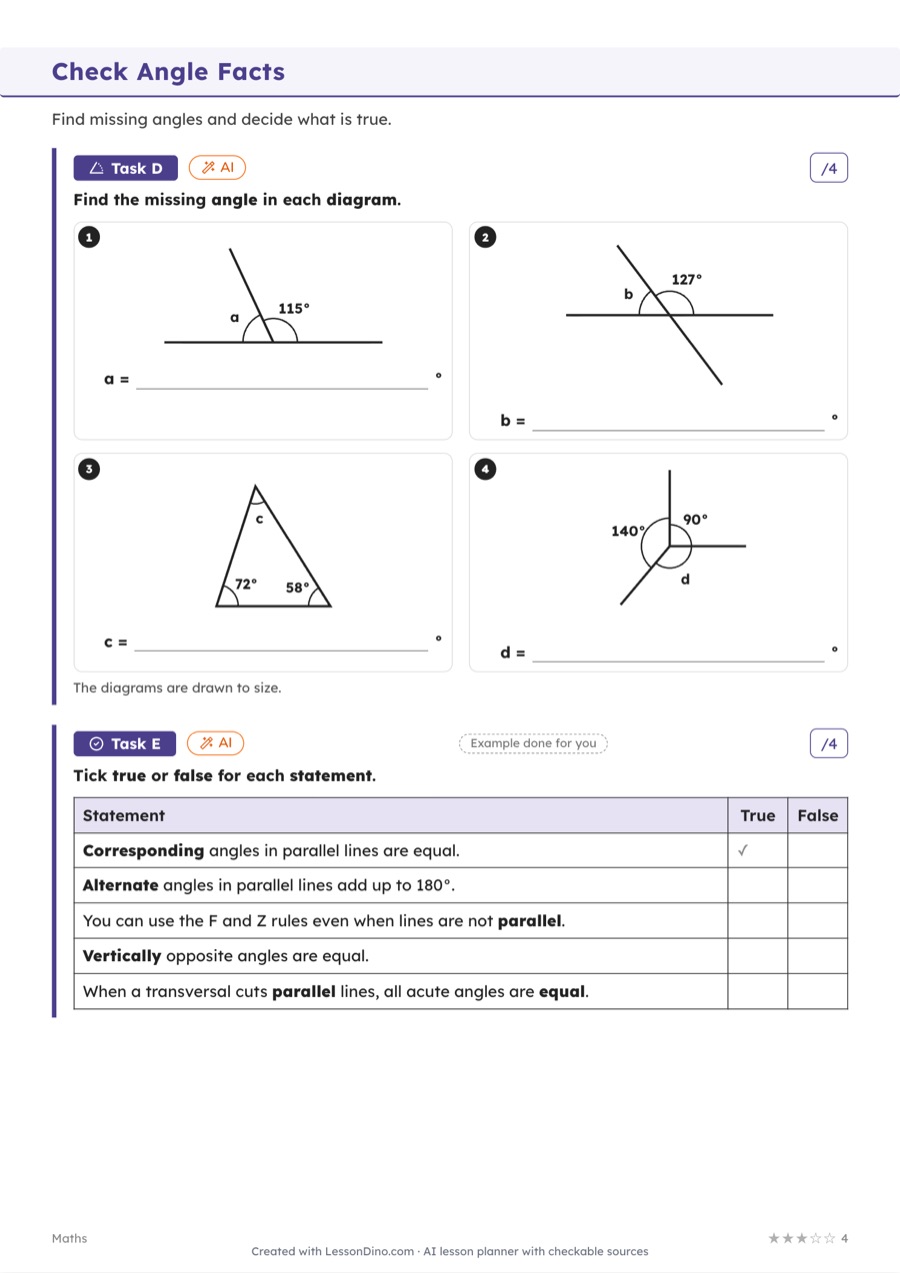
Check Angle Facts
Find missing angles and decide what is true.
Find the missing angle in each diagram.
Tick true or false for each statement.
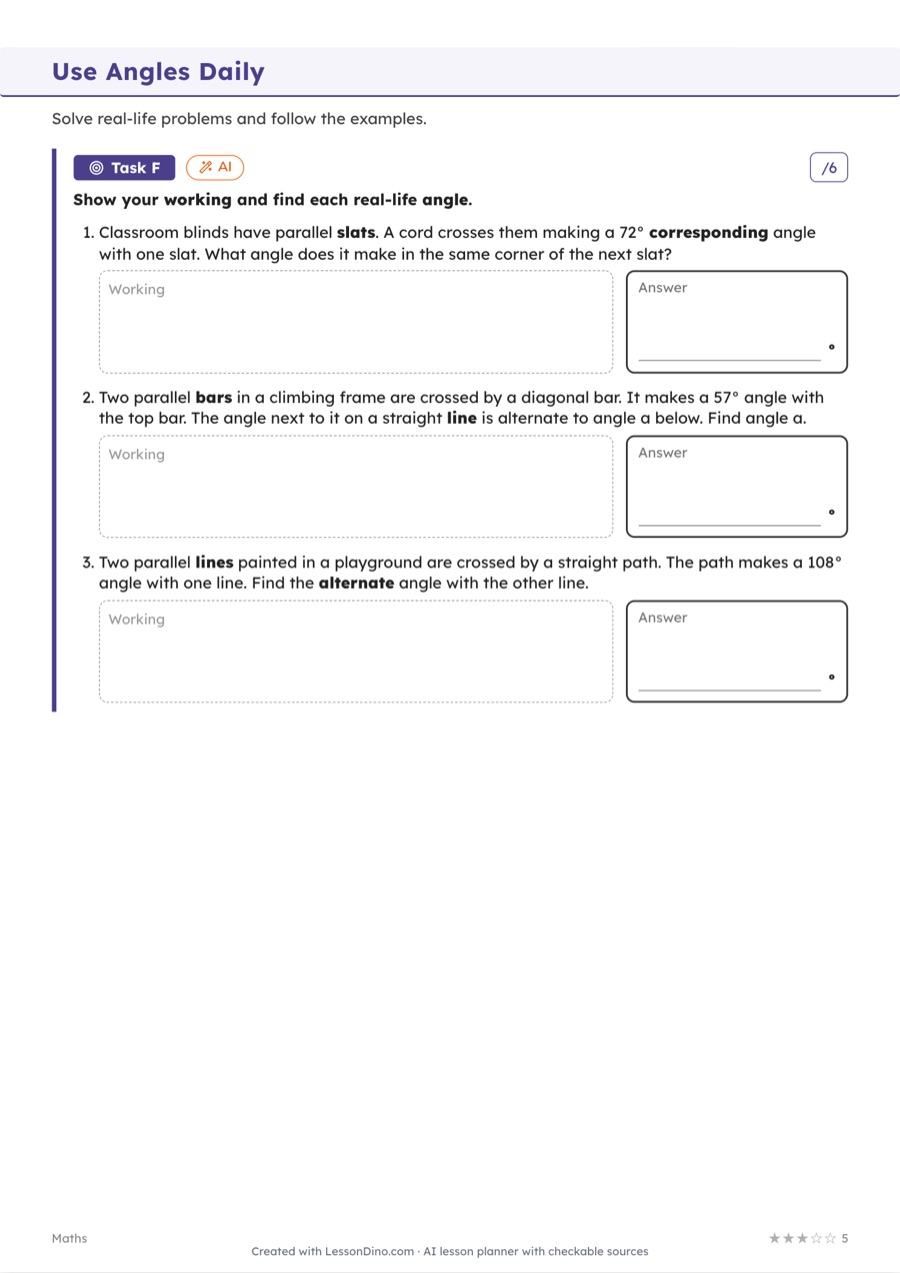
Use Angles Daily
Solve real-life problems and follow the examples.
Show your working and find each real-life angle.
Page 6
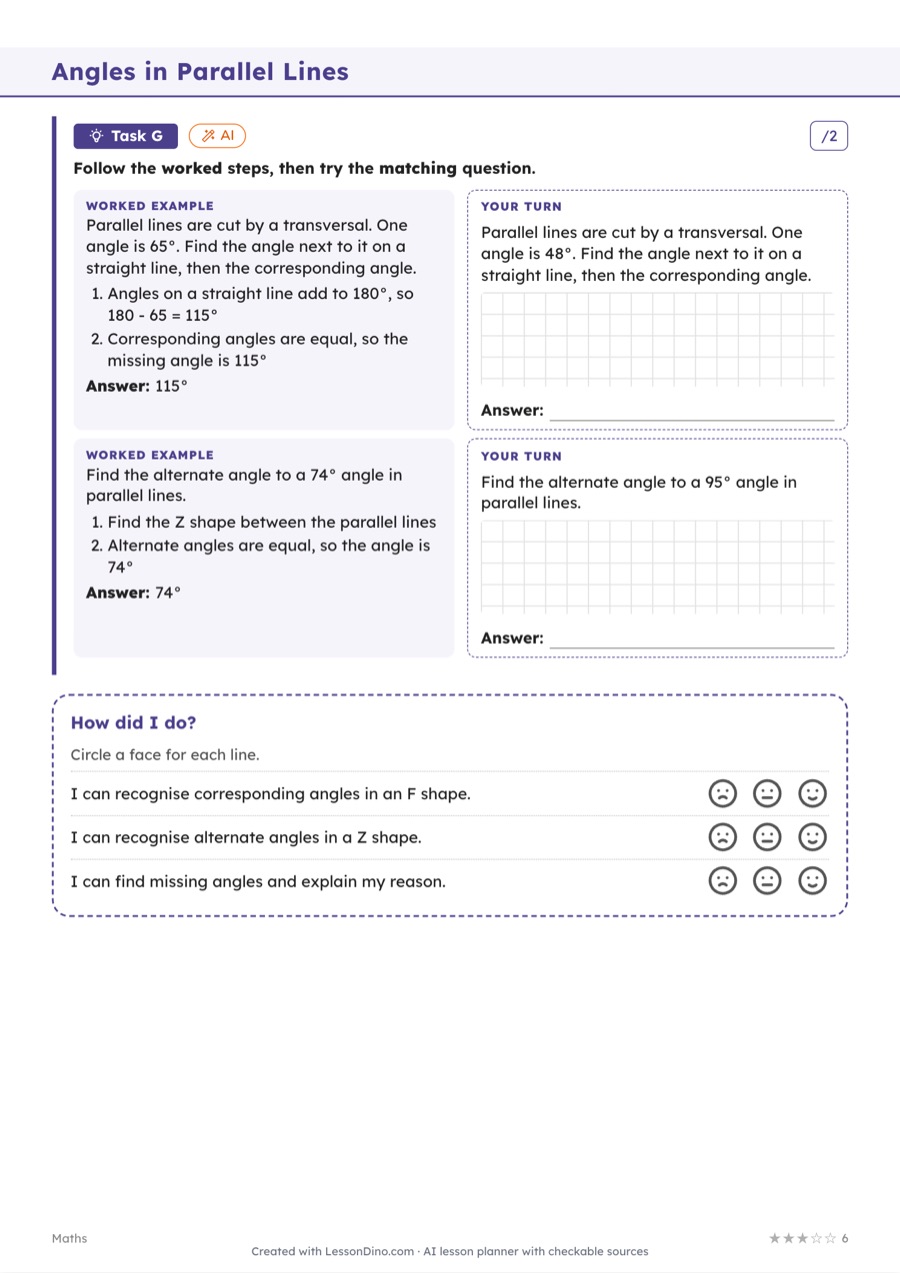
Follow the worked steps, then try the matching question.
Answers
Show the answers
- Two parallel lines are cut by a transversal. One angle is 58°. Write down its corresponding angle. 58°
- Two parallel lines are cut by a transversal. One angle is 124°. Write down its alternate angle. 124°
- Two parallel lines are cut by a transversal. One angle is 37°. Write down its corresponding angle. 37°
- Two parallel lines are cut by a transversal. One angle is 101°. Write down its alternate angle. 101°
- Parallel lines are cut by a transversal. One angle is 75°. The angle next to it on a straight line is a. Angle a is alternate to angle b. Find angle b. 105°
- Parallel lines are cut by a transversal. One angle is 42°. The angle next to it on a straight line is alternate to angle c. Find angle c. 138°
- A diagram shows two parallel lines. One angle is 63° and its corresponding angle is marked p. Find p and give the reason. 63° because corresponding angles are equal
- A student says alternate angles add to 180°. Explain why this is wrong. Alternate angles are equal. It is angles on a straight line that add to 180°.
- Bookcase shelves are parallel. A sloping strut crosses them. It makes a 68° corresponding angle with the top shelf. What angle does it make with the middle shelf? 68°
- Two parallel rails are crossed by a bar. The bar makes a 125° angle with the top rail. Find the alternate angle with the bottom rail. 125°
- A ladder leans across two parallel lines on a wall. It makes a 55° angle with one line. The angle next to it on a straight line is alternate to angle d. Find d and explain how you know. 125° because 180-55 = 125 and alternate angles are equal
- Two parallel edges are crossed by a line. One alternate angle is 82°. The angle next to it on a straight line is e. Find e. 98°
- Two parallel lines are cut by a transversal. One angle is 73°. Write down its corresponding angle. 73°
- Two parallel lines are cut by a transversal. One angle is 119°. Write down its alternate angle. 119°
- Two parallel lines are cut by a transversal. One angle is 44°. Write down its corresponding angle. 44°
- Two parallel lines are cut by a transversal. One angle is 28°. Write down its alternate angle. 28°
- Parallel lines are cut by a transversal. One angle is 64°. The angle next to it on a straight line is alternate to angle b. Find angle b. 116°
- Parallel lines are cut by a transversal. One angle is 135°. The angle next to it on a straight line is corresponding to angle c. Find angle c. 45°
- Alternate angles in parallel lines are marked x and 89°. Find x and give the reason. x = 89° because alternate angles are equal
- Explain why you cannot use the F rule when lines have no parallel marks. Use the word equal in your answer. You cannot be sure the angles are equal unless the lines are parallel.
- Two parallel lines on a notebook page are crossed by a margin line. The margin makes a 71° corresponding angle with the top line. What is the matching angle with the next line? 71°
- Two parallel pipes are crossed by a joint. The joint makes a 132° angle with the upper pipe. Find the alternate angle with the lower pipe. 132°
- A path crosses two parallel white lines. It makes a 49° angle with one line. The angle next to it on a straight line is corresponding to angle f. Find f and explain how you know. 131° because 180-49 = 131 and corresponding angles are equal
- A gate has two parallel bars crossed by a diagonal. One alternate angle is 96°. The angle next to it on a straight line is g. Find g. 84°
- Classroom blinds have parallel slats. A cord crosses them making a 72° corresponding angle with one slat. What angle does it make in the same corner of the next slat? 72°
- Two parallel bars in a climbing frame are crossed by a diagonal bar. It makes a 57° angle with the top bar. The angle next to it on a straight line is alternate to angle a below. Find angle a. 123°
- Two parallel lines painted in a playground are crossed by a straight path. The path makes a 108° angle with one line. Find the alternate angle with the other line. 108°
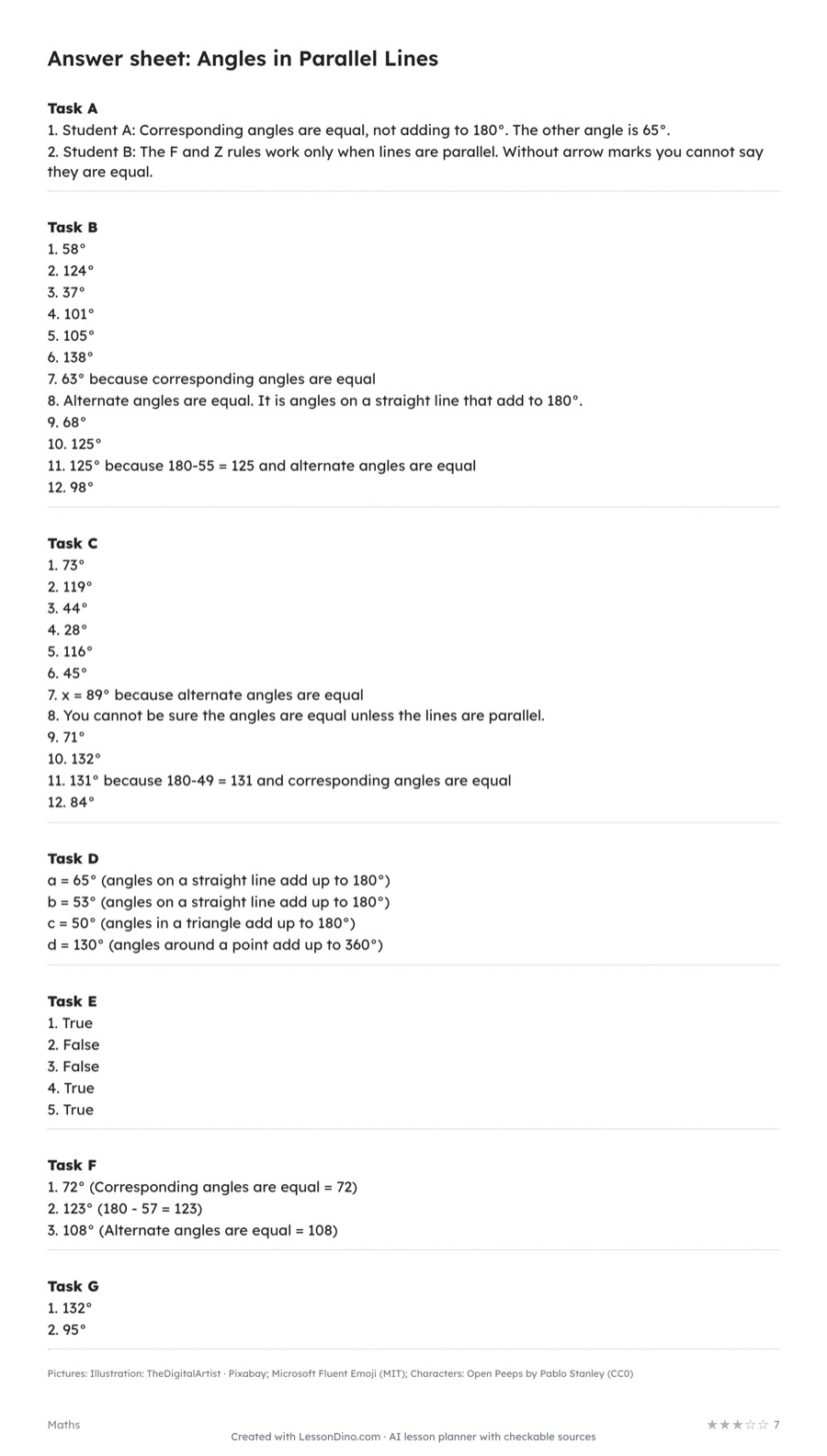
The answer sheet is the last picture above.
Curriculum
understand and use the relationship between parallel lines and alternate and corresponding angles
From National curriculum in England, Key Stage 3 mathematics.
Made with Lesson Dino's AI on 19 October 2026. AI can make mistakes, so check the answers and facts against the sources before you teach.