Slides
Lesson plan
Negatives in all four operations
Pupils calculate with negative integers, decimals, fractions and mixed numbers. They use formal written methods and solve lift, temperature and money problems.
Objectives
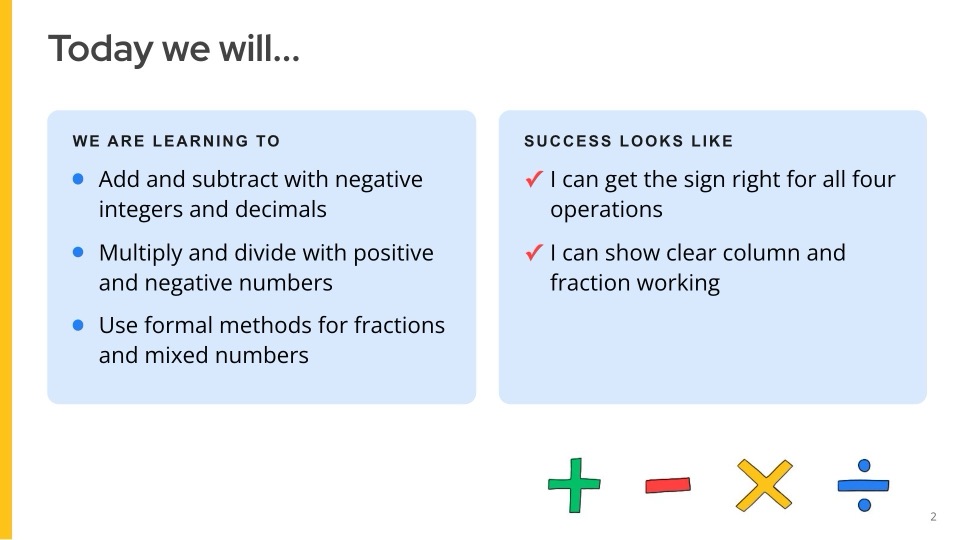
- Students will add and subtract negative integers, decimals and fractions correctly.
- Students will multiply and divide positive and negative numbers including mixed numbers.
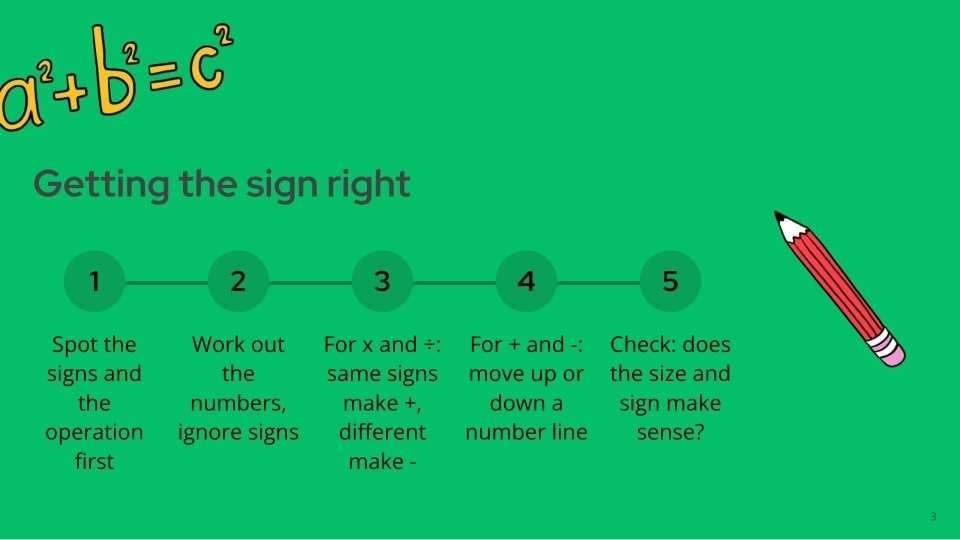
- Students will use formal written methods and decide the correct sign.
Success criteria
- I can add and subtract with negatives using a number line and columns.
- I can multiply and divide with negatives and explain the sign rule.
- I can use formal methods for decimals, fractions and mixed numbers.
Key words
| Word | Meaning |
|---|---|
| integer | a whole count that can be below zero, zero, or above zero |
| decimal | a value with a point dividing ones from tenths and hundredths |
| directed number | a value with a plus or minus sign showing its side of zero |
| common denominator | a shared bottom part that lets two parts be added or compared |
| mixed number | a whole count joined with a part of a whole, such as one and a half |
Timed plan (60 minutes)
| Time | Stage | What happens |
|---|---|---|
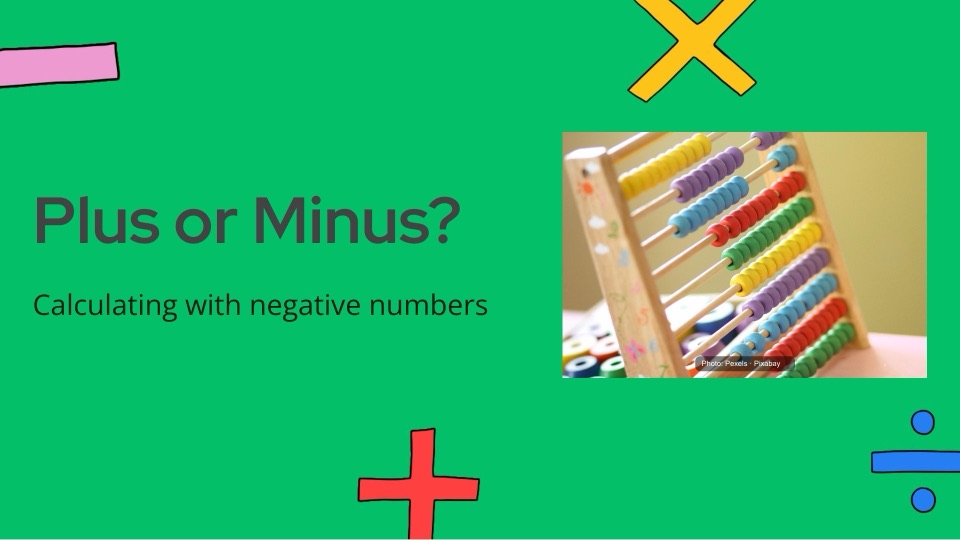
| 5 min | Starter | To hook pupils with a directed-number problem and recall ordering negatives. Show Slide 1 Plus or Minus? Calculating with negative numbers and Slide 2 objectives. Say the hook: The lift is on floor -2. It goes down 3, up 7, then down 5. Where does it stop? Ask pupils to write the journey as number sentences on mini-whiteboards. Take two answers and draw jumps on a floor number line below and above zero. |
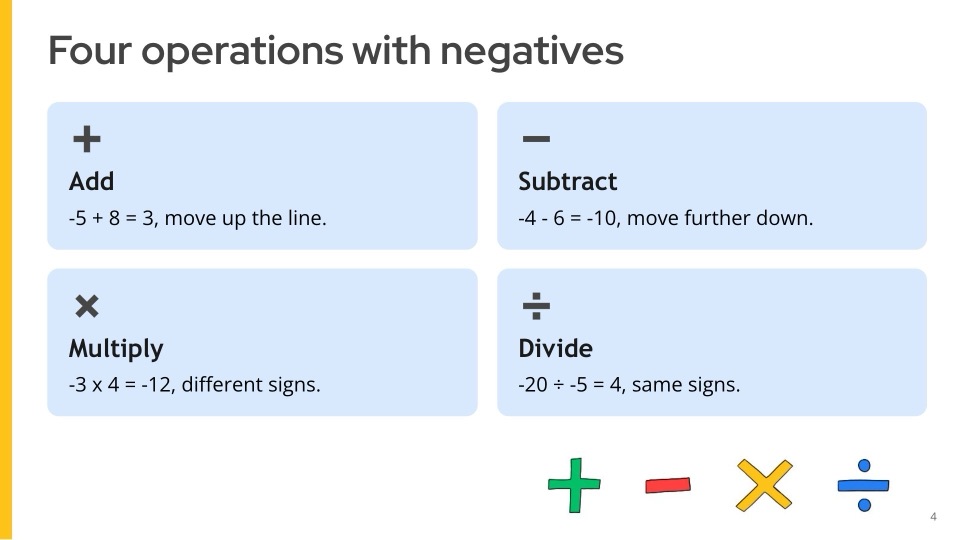
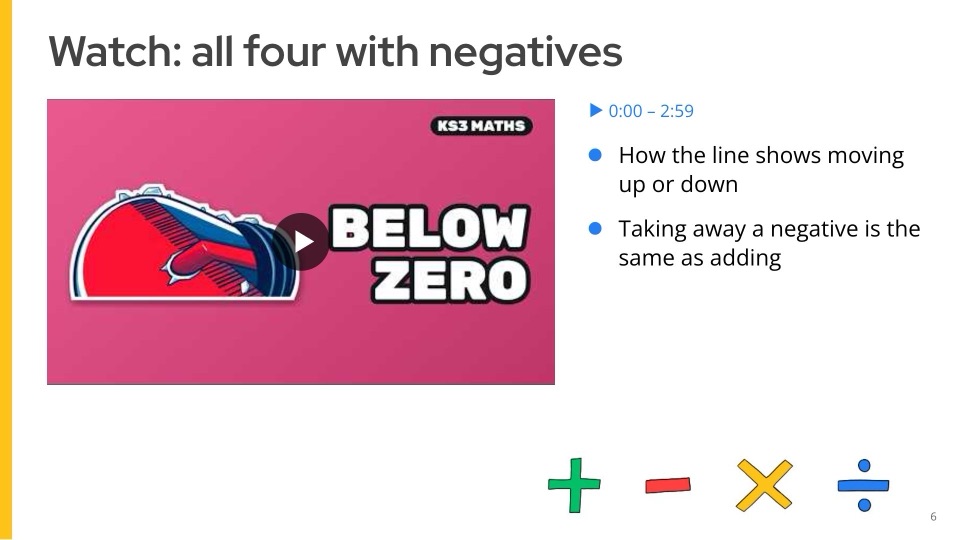
| 12 min | Teaching: add and subtract | To model adding and subtracting negative integers and decimals with formal methods. Show Slide 3 steps for spotting signs and operation first. Model Slide 4 examples -5 + 8 = 3 as move up and -4 - 6 = -10 as move further down. Play Video clip 1 (0:00–2:59) on Slide 6 about moving up or down and taking away a negative. Model column layout for -3.6 - 2.4 with decimal points lined up, then decide the sign. |
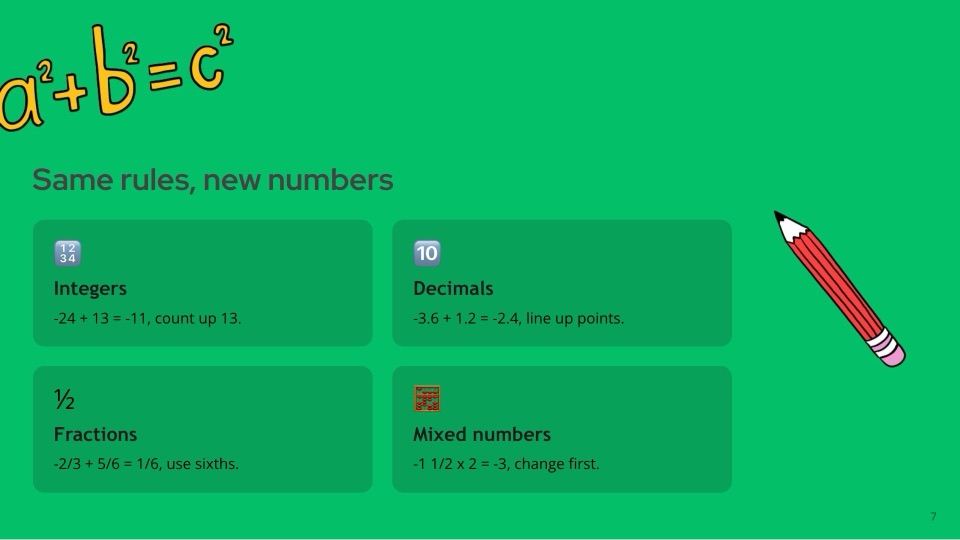
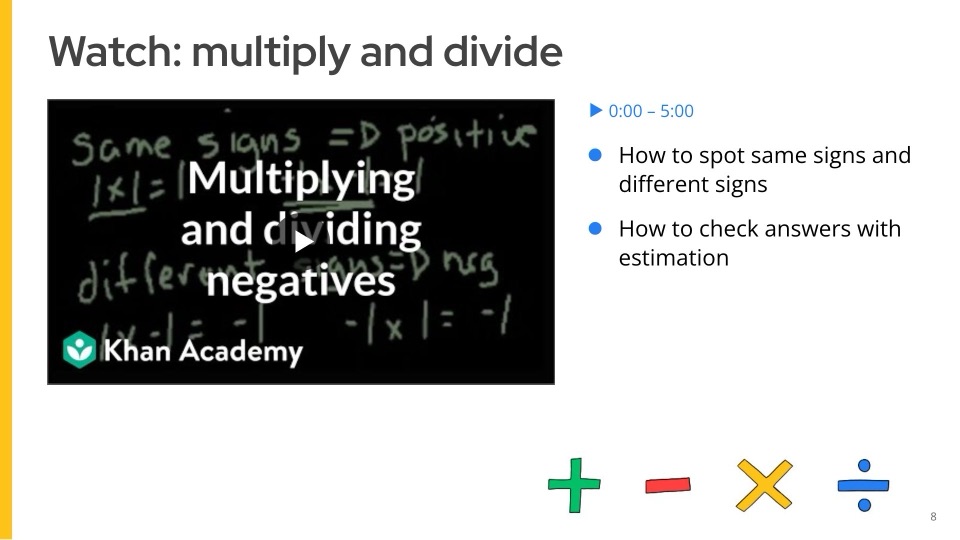
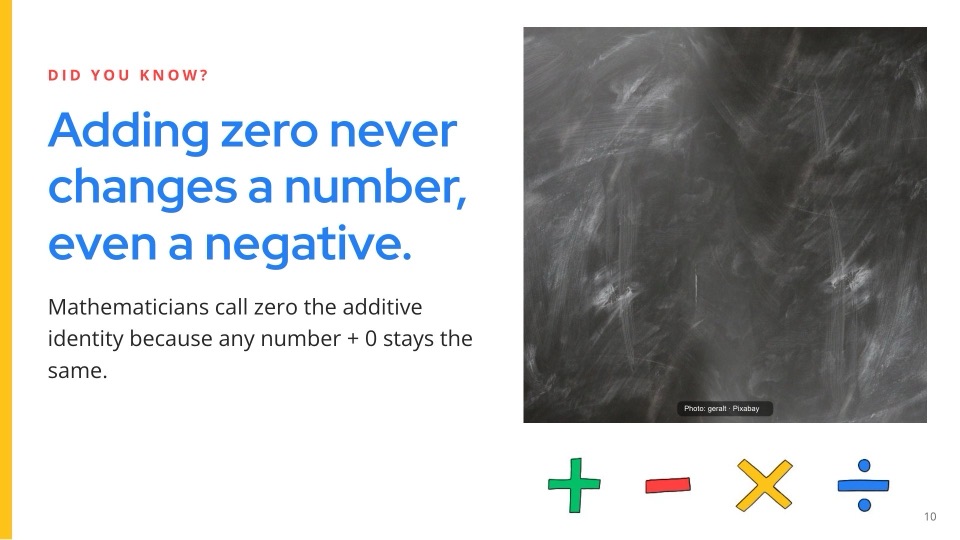
| 13 min | Teaching: multiply, divide and fractions | To teach sign rules for multiplication and division and extend them to fractions and mixed numbers. Show Slide 7 cards: -24 + 13 = -11, -3.6 + 1.2 = -2.4 and -2/3 + 5/6 = 1/6. Teach the sign rule: same signs make positive, different signs make negative for multiply and divide, linked to Year 7 Four Operations. Model -1 1/2 x 4 by changing to an improper fraction and using short multiplication. Show Slide 10 fact that adding zero never changes a number, called the additive identity. |
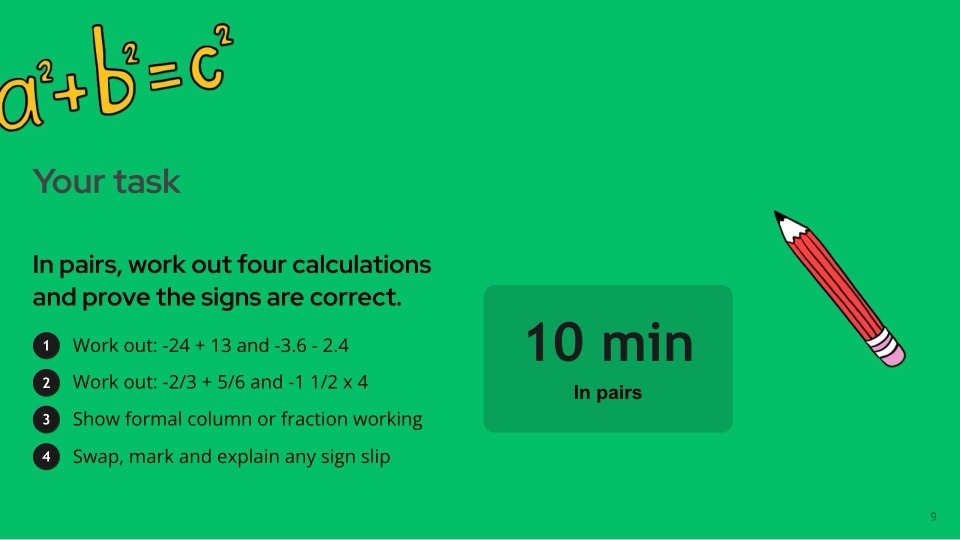
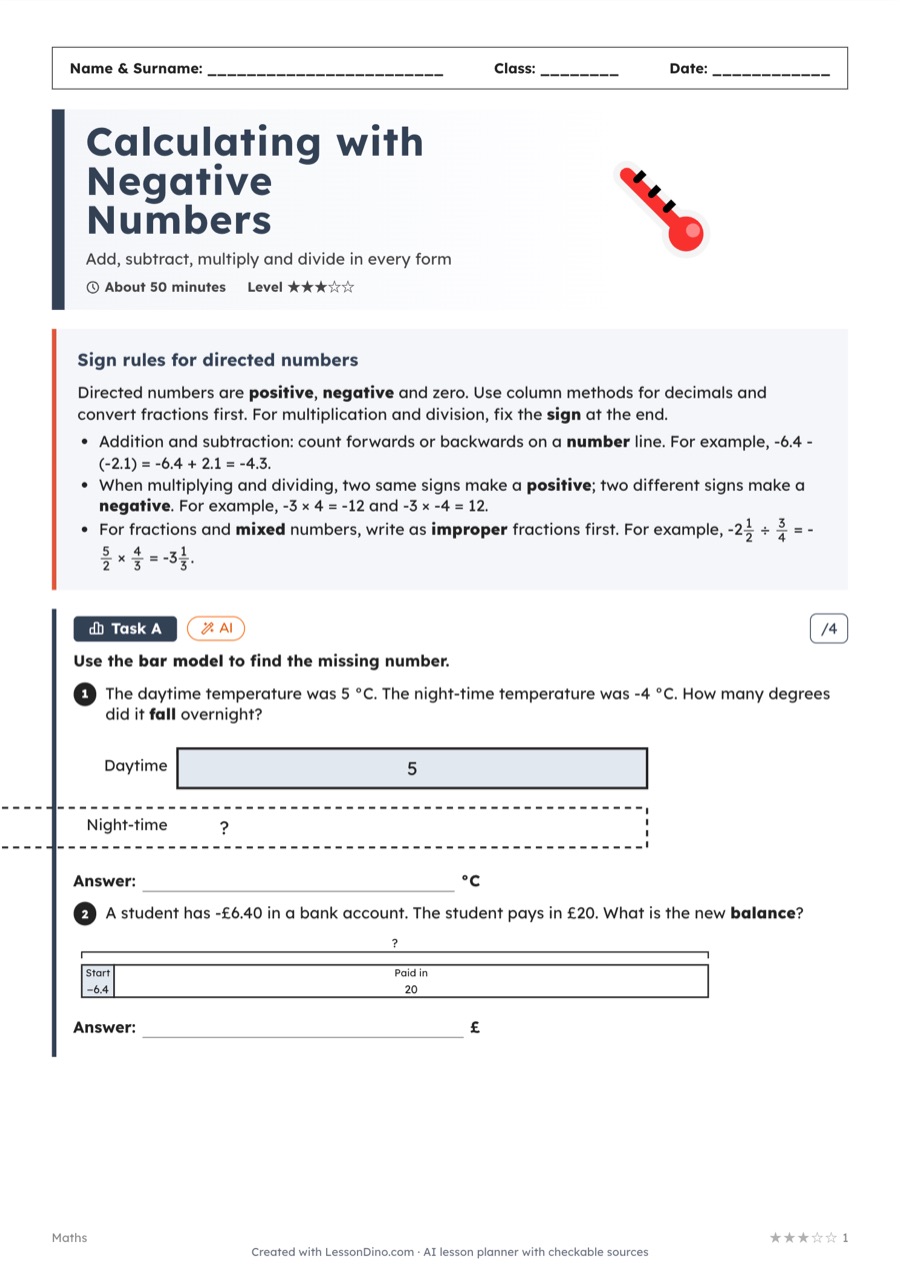
| 20 min | Main activity: Lift and Thermometer Challenge | To solve multi-step problems with negatives using formal written methods. Give out problem cards, thermometer sheets and Worksheet Tasks B and C for recording. Set the task: choose the operation for each lift floor, temperature change in °C and bank balance in pounds, show formal column or fraction working, then check sense on the line. Circulate, asking groups to read back working for -1.5 + (-2.5), -4 ÷ 2 and -1/2 - 3/4. Stop halfway to model one fraction solution with equivalent fractions and sign fix. |
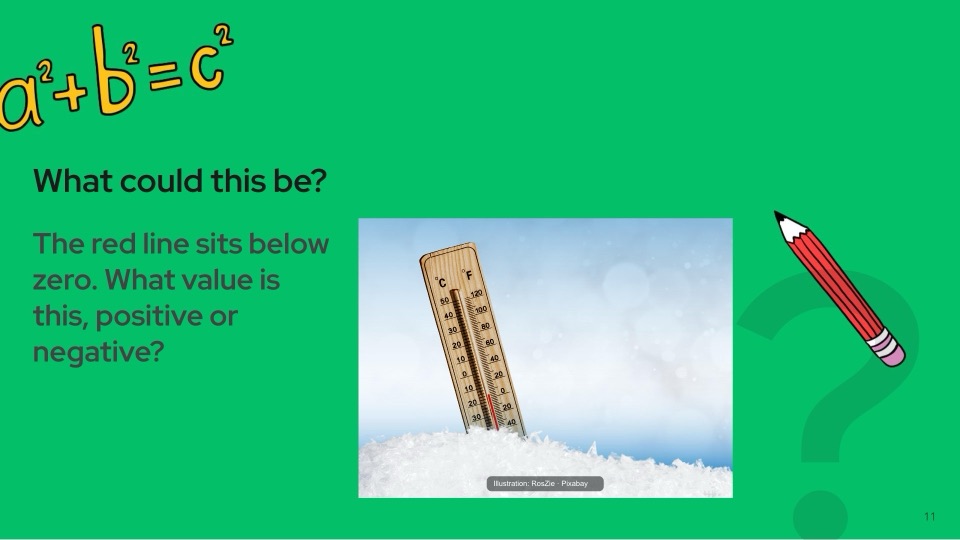
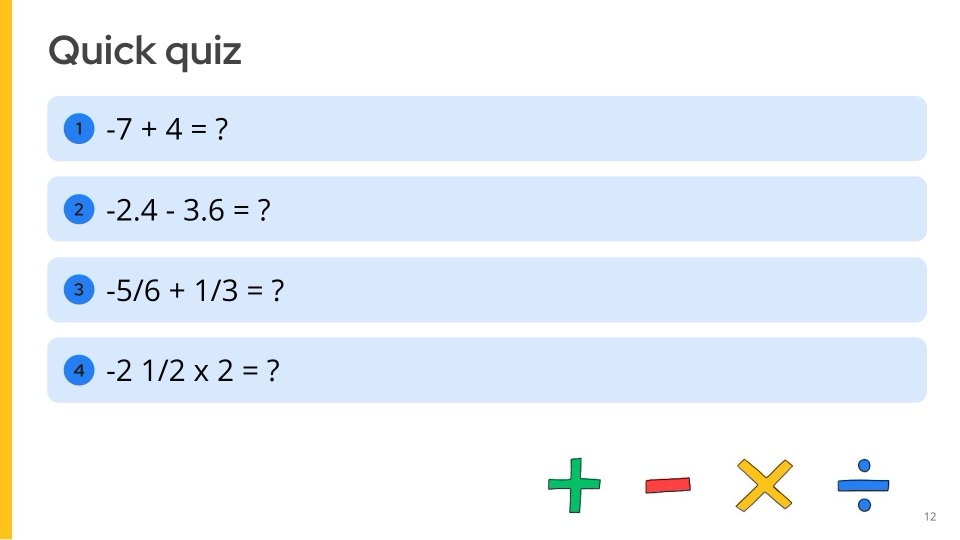
| 10 min | Plenary | To check fluency across integers, decimals and fractions and return to objectives. Show Slide 11 mystery: the red line sits below zero at -4 °C, 4 degrees below zero, so a negative number. Run Slide 12 quick quiz: -7 + 4, -2.4 - 3.6, -5/6 + 1/3 and -2 1/2 x 2. Ask pupils to show formal jottings for each and explain any sign slip. |
Common mistakes
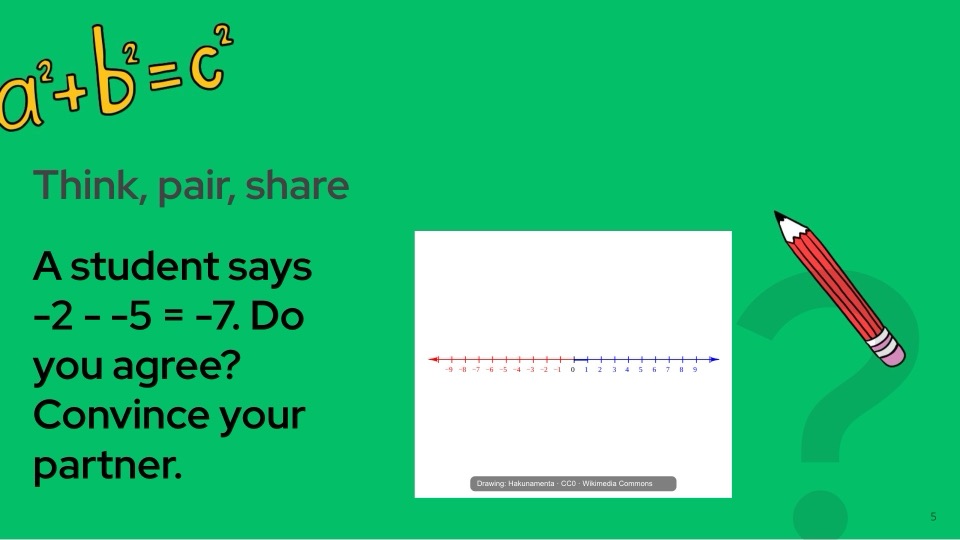
- Writing -2 - -5 = -7 instead of +3
How to spot it: Answer more negative after subtracting a negative
Show jump right on the line: take away a negative turns to add, so -2 + 5 = 3 - Giving a positive answer for different signs in multiplication
How to spot it: Says -3 x 4 = 12
Rehearse rule card: same signs make positive, different make negative, check with estimation - Adding fractions without a common denominator, e.g. -1/2 - 3/4 = -4/6
How to spot it: Bottom numbers added or unchanged halves and quarters mixed
Overlay fraction strips to see quarters needed: -2/4 - 3/4 = -5/4
Support
- Give a word bank for add, subtract, multiply and divide and start with integer-only cards.
- Use large -10 to 10 lines, place-value grids with £ and decimal point, and pre-shaded halves, quarters and eighths.
- Provide worked templates with boxes for whole number, top number and sign.
Stretch
- Give a problem with a mixed number temperature change, such as -2 1/2 degrees plus -3 1/4 degrees.
- Ask pupils to predict and test -9 + 4 - (-2) and three-factor products like -2 x 3 x -4.
- Set missing-digit columns like -3._4 + 1.2_ = -2.15 and divisions leaving a proper fraction.
Check questions
- -7 + 4 = ?
Answer: -3 - -2.4 - 3.6 = ?
Answer: -6.0 - -5/6 + 1/3 = ?
Answer: -1/2
Curriculum
use the 4 operations, including formal written methods, applied to integers, decimals, proper and improper fractions, and mixed numbers, all both positive and negative
From National curriculum in England, Key Stage 3 mathematics.
Video clips
Clips on YouTube, from the start and end times we chose. Check each one before you show it.
-
KS3 add, subtract, multiply, divide negatives from 0:00 to 2:59
happylearning: Negative Numbers Explained | KS3 Maths
Covers all four operations with number lines in KS3 language and pace perfect for 11-12-year-olds.
-
Multiplying and dividing negatives from 0:00 to 5:00
Khan Academy: Multiplying and dividing negative numbers | Pre-Algebra | Khan Academy
Khan Pre-Algebra explanation suits 11-12-year-olds and directly supports the multiply and divide part of the lesson.
Worksheet
Sources
- Year 7 Maths - Curriculum Map gosford-hill.oxon.sch.uk
- Year 7 Maths Curriculum Map - fishermore.lancs.sch.uk fishermore.lancs.sch.uk
- Natural number Wikipedia
- Calculator Wikipedia
- 0 Wikipedia
Picture credits
Made with Lesson Dino's AI on 19 October 2026. AI can make mistakes, so check facts against the sources before you teach.