Slides
Lesson plan
Percentages as multipliers, including over 100%
Pupils learn to read any percentage as a fraction, a decimal and a multiplier. They use this to compare scores and work out price increases.
Objectives
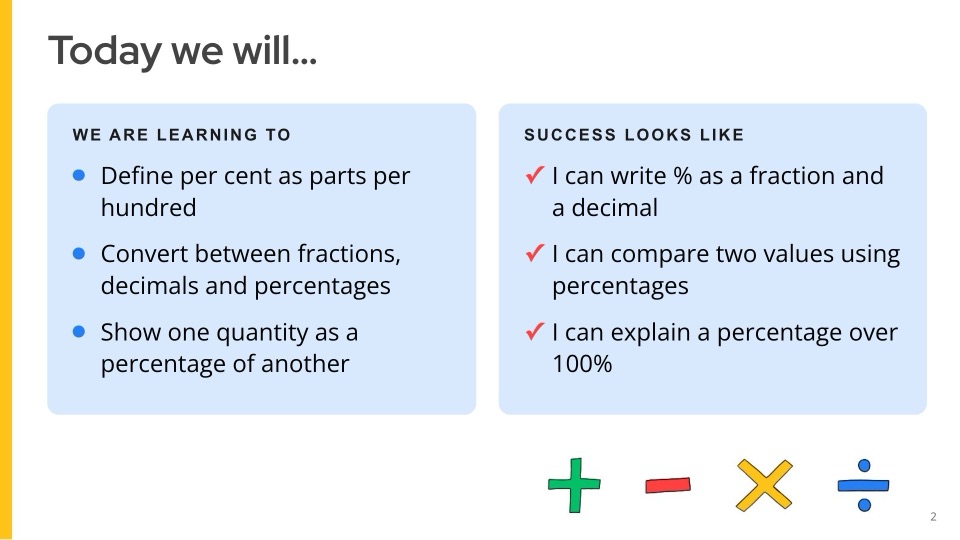
- Students will define per cent as parts per hundred and convert between FDP forms.
- Students will express one quantity as a percentage of another to compare two quantities.
- Students will interpret percentage changes as multipliers, including values over 100%.
Success criteria
- I can write a percentage as a fraction over 100 and as a decimal.
- I can write one amount as a percentage of another to decide which is larger.
- I can use a multiplier such as 1.25 for a 25% increase, even over 100%.
Key words
| Word | Meaning |
|---|---|
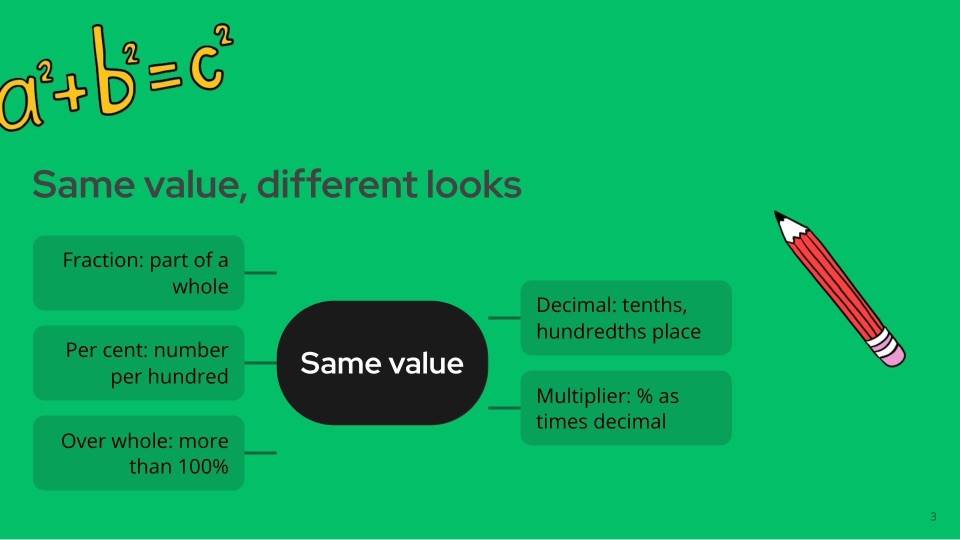
| per cent | a number of parts out of every hundred |
| fraction | a part of a whole written with a top number over a bottom number |
| decimal | a number that uses tenths and hundredths after a point |
| percentage | an amount written as a number of parts per hundred |
| multiplier | a number you times an amount by to find a new amount |
Timed plan (60 minutes)
| Time | Stage | What happens |
|---|---|---|
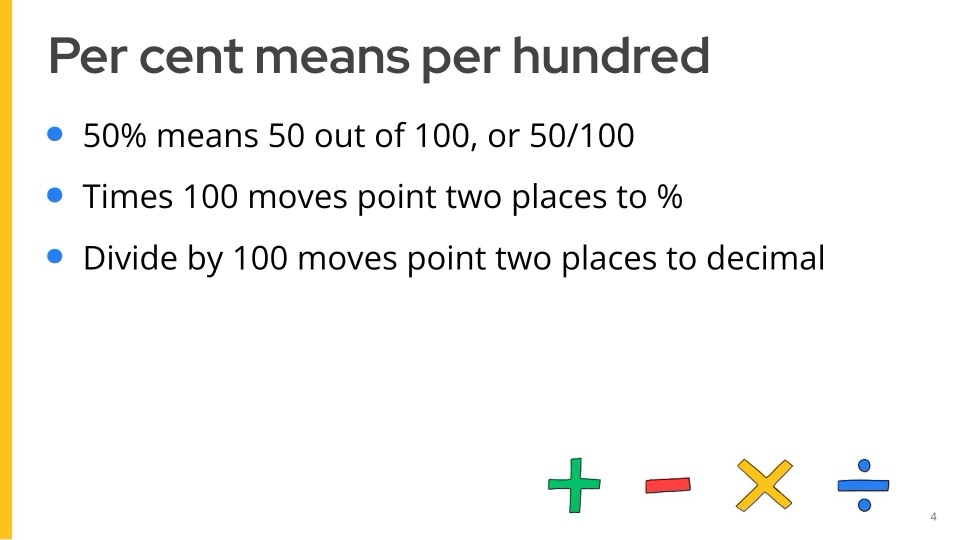
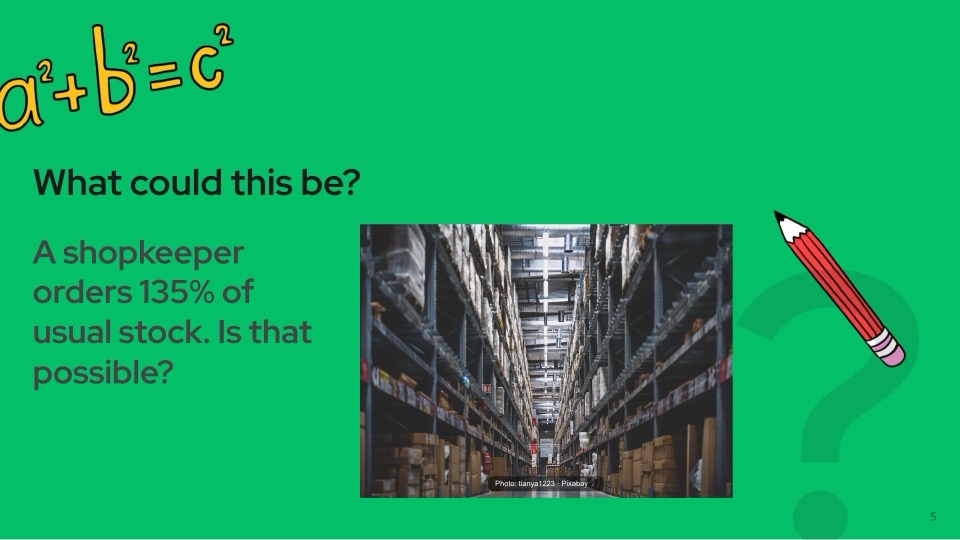
| 8 min | Starter | Recall what per cent means and raise the question of increases over 100%. Greet the class and show Slides 4–5 with the 100-square and mystery stock question. Say the hook question about the £40 toy and take quick predictions on adding or timesing. Ask pupils to show 50% as a fraction and decimal on mini-whiteboards. Confirm per cent means per hundred and that over 100% means more than one whole. |
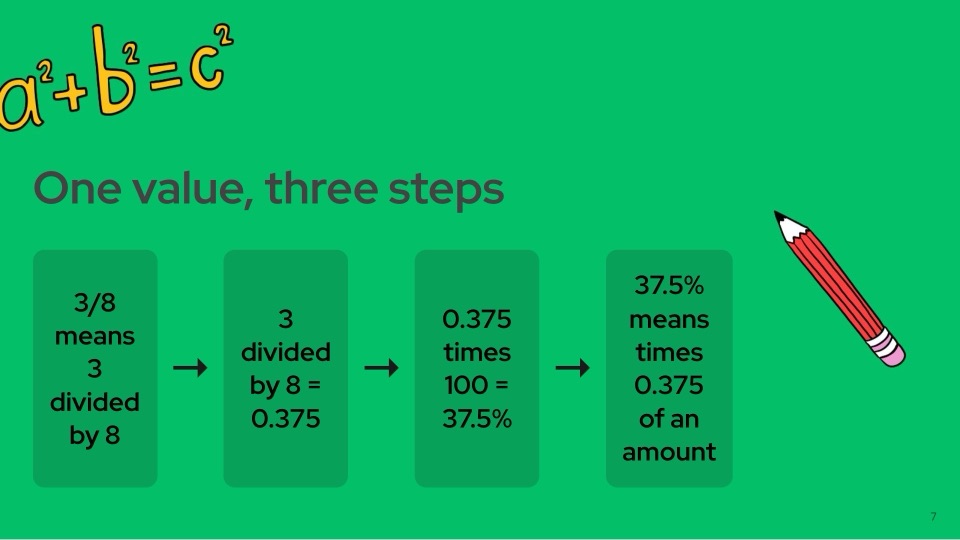
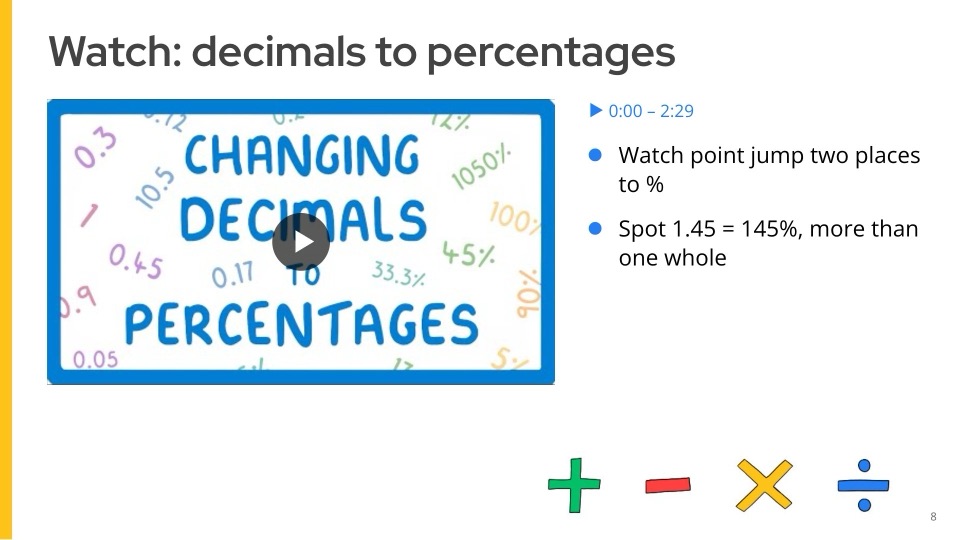
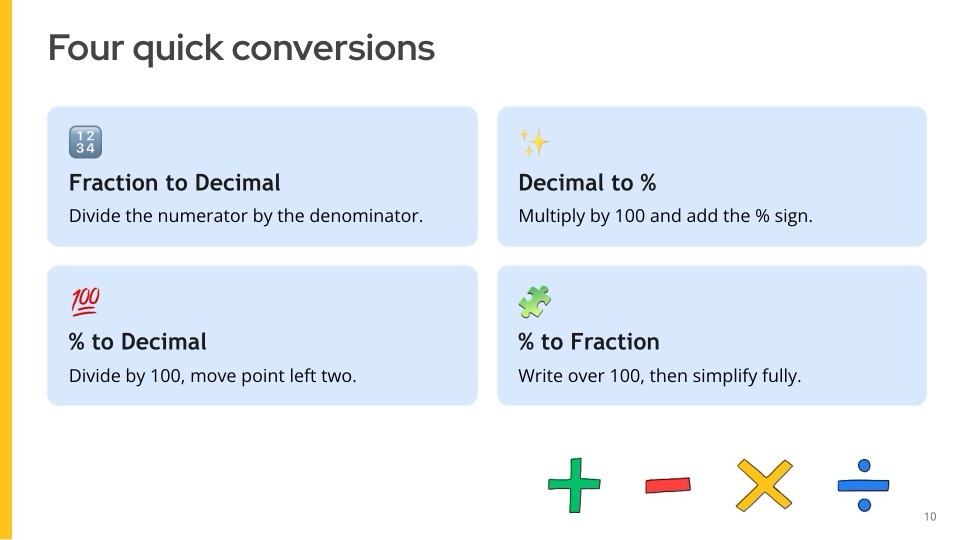
| 12 min | Teaching | Model how to turn a fraction into a decimal and percentage and read it as a multiplier. Show Slide 7 chain for 3/8 and think aloud through divide then times 100. Write 3 ÷ 8 = 0.375 on the board, because fraction to decimal is numerator divided by denominator. Write 0.375 × 100 = 37.5%, because decimal to percentage is multiply by 100, then add that 37.5% of an amount means times 0.375. Play Video clip 6 (0:00–2:29) on Slide 8 and pause to spot 1.45 = 145% as more than one whole. |
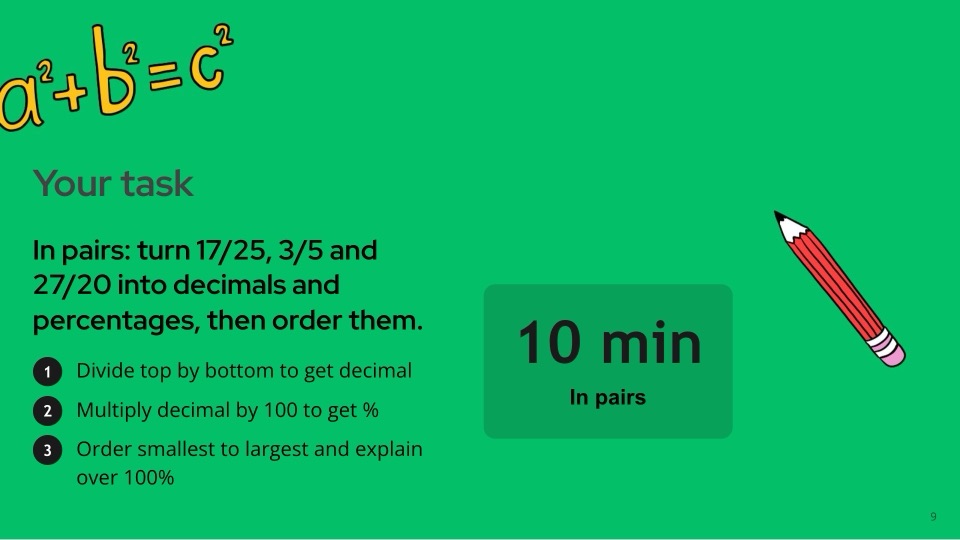
| 12 min | Paired practice | Practise writing quantities as percentages and ordering mixed FDP values. Show Slide 9 and set the pair task: turn 17/25, 3/5 and 27/20 into decimals and percentages. Remind pairs to divide top by bottom to get the decimal, then times by 100 to get the percentage. Hand out Worksheet Task B for extra conversion practice and circulate to mark. Stop the class to agree the order smallest to largest and the over-100% value. |
| 18 min | Main activity | Apply percentage multipliers to till receipts to find new prices after increases. Give each group a till receipt copy, a calculator and Worksheet Task C. Model with the Toy £40.00: 25% increase means 100% + 25% = 125% = 1.25, then £40.00 × 1.25. Set groups to find multipliers and new prices for 25% and 35% increases on their receipts. Ask each group to write its multiplier sentence, for example 35% means times 0.35, increase means times 1.35. |
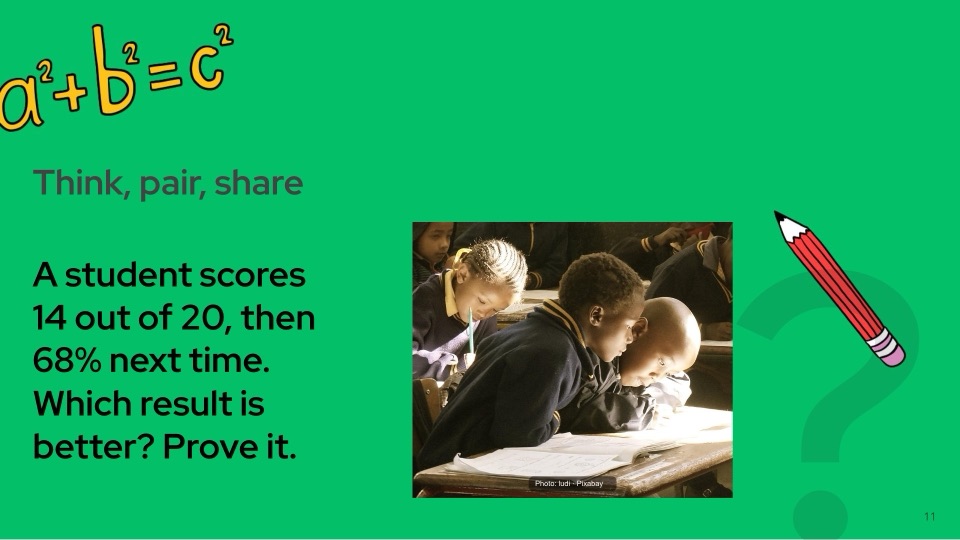
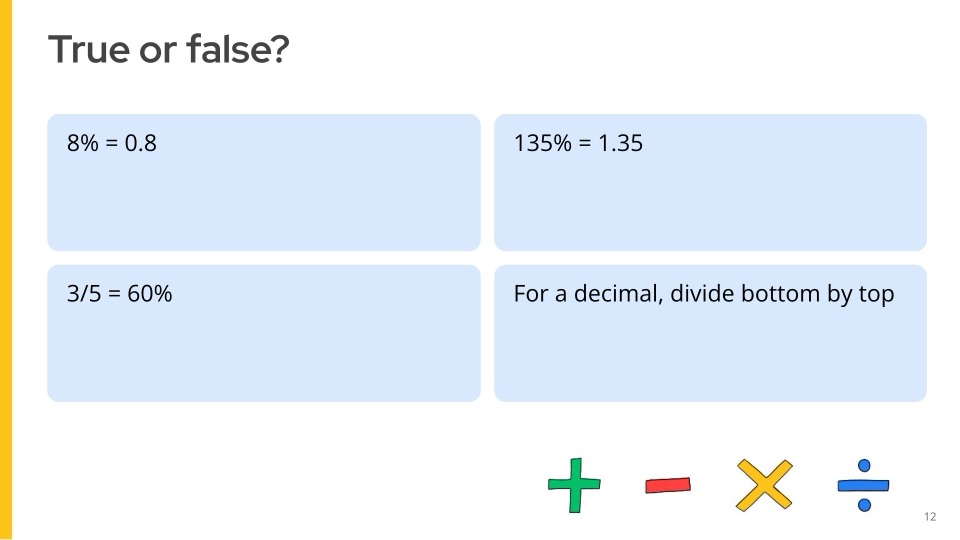
| 10 min | Plenary | Return to the objectives by comparing test scores and fixing key misconceptions. Show Slide 11 and ask pairs to prove which test result is better. Take answers and model 14/20 as 14 ÷ 20 = 0.7 = 70%, so 70% beats 68%. Show Slide 12 true or false cards and vote for 8% = 0.8, 135% = 1.35 and 3/5 = 60%. Link back to per cent as per hundred and multipliers, and set homework. |
Common mistakes
- Writing 8% as 0.8 instead of 0.08
How to spot it: Seeing 0.8 or 0.80 for single-digit percentages
Divide by 100 so the point moves two places left; 8 ÷ 100 = 0.08, fill the empty place with zero. - Dividing the wrong way to turn a fraction into a decimal
How to spot it: Working 20 ÷ 7 for 7/20 or getting an answer larger than expected
Remind that fraction to decimal is numerator divided by denominator; 7 ÷ 20 = 0.35, then 0.35 × 100 = 35%. - Thinking 100% is the largest possible percentage
How to spot it: Saying 135% is impossible or writing it as 0.135
Show two grids: 135/100 = 1.35; decimals greater than 1 are greater than 100%.
Support
- Provide 100-squares, a halves-quarters-tenths strip and place-value grids for ÷100 and ×100 moves.
- Use writing frames with a worked layout such as 40/100 simplifies to 2/5 to copy.
Stretch
- Order tricky near values such as 0.62, 3/5 and 63% by converting all to decimals.
- Work backwards from a new price and multiplier to find the starting price.
Check questions
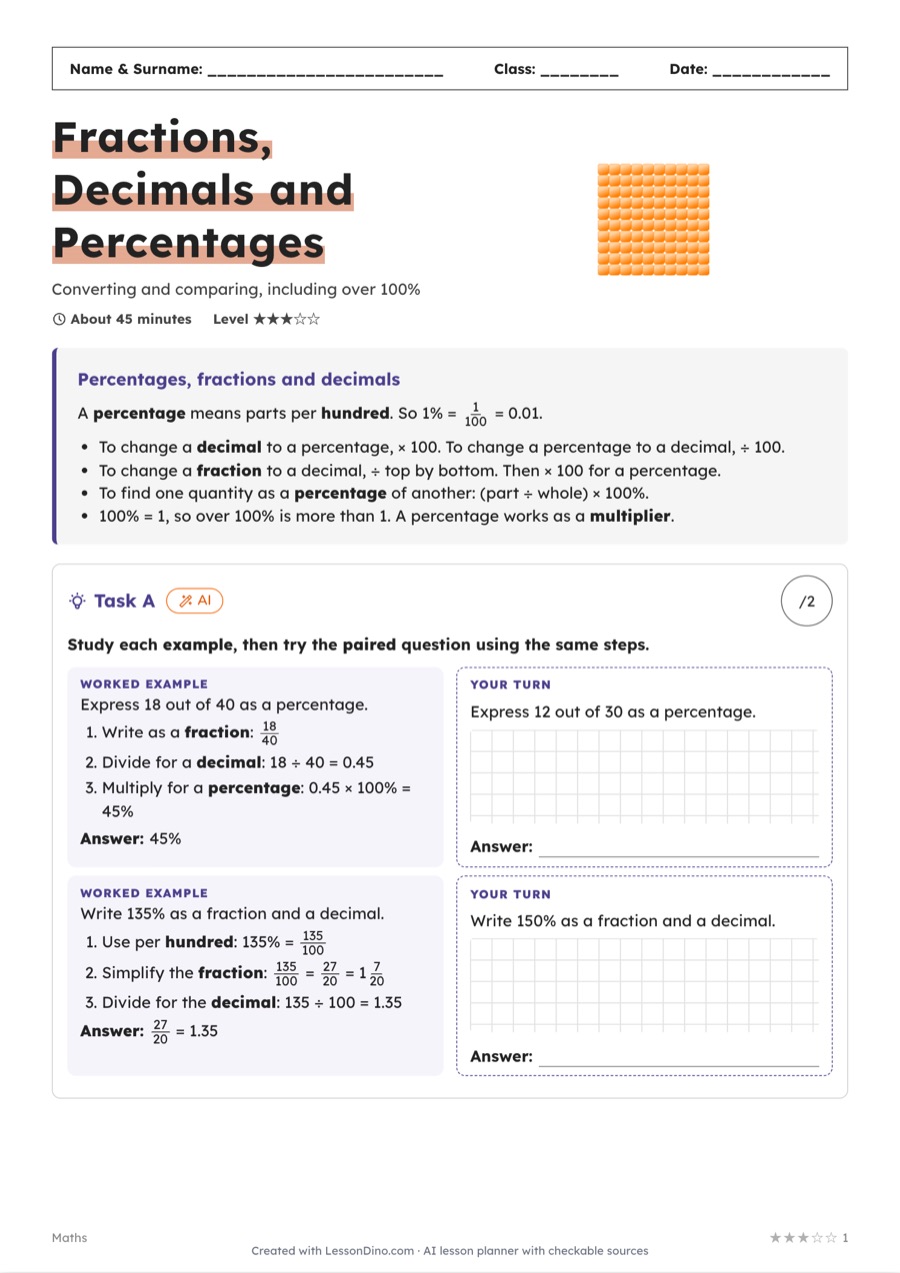
- Write 56% as a fraction in its simplest form and as a decimal.
Answer: 56/100 = 14/25 = 0.56. - A student scores 17 out of 25. What percentage is this?
Answer: 17 ÷ 25 = 0.68, 0.68 × 100 = 68%. - A £20 game rises by 35%. What is the multiplier and new price?
Answer: 135% = 1.35, £20 × 1.35 = £27.00.
Curriculum
define percentage as ‘number of parts per hundred’, interpret percentages and percentage changes as a fraction or a decimal, interpret these multiplicatively, express 1 quantity as a percentage of another, compare 2 quantities using percentages, and work with percentages greater than 100%
From National curriculum in England, Key Stage 3 mathematics.
Video clips
Clips on YouTube, from the start and end times we chose. Check each one before you show it.
-
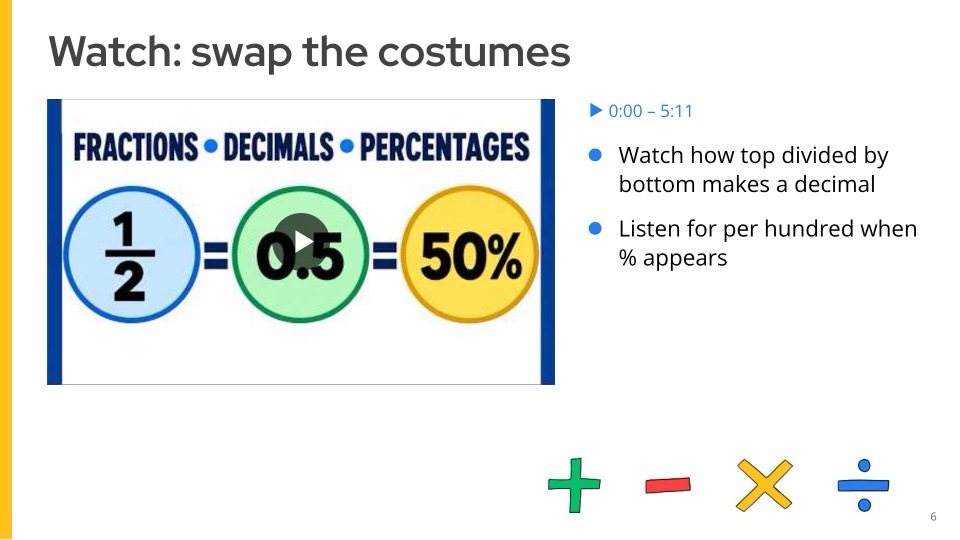
FDP conversions overview from 0:00 to 5:11
Maths with Mr Chow: Converting Fractions, Decimals and Percentages | Year 7–9 Maths
Made for Year 7-9 and covers all six conversions at the right pace and vocabulary for 11-12-year-olds.
-
Decimals to percentages from 0:00 to 2:29
Cognito: How to Convert Decimals to Percentages (Proportions part 4/6) (2026/27 exams)
UK Cognito clip for KS3 with worked examples at the right level for Year 7 aged 11-12.
Worksheet
Sources
- Year 7 Maths - Curriculum Map gosford-hill.oxon.sch.uk
- Year 7 Maths Curriculum Map - fishermore.lancs.sch.uk fishermore.lancs.sch.uk
- Converting fractions, decimals and percentages - York St John University yorksj.ac.uk
- Converting between fractions, decimals and percentages - BBC bbc.co.uk
- Converting fractions, decimals and percentages - BBC Bitesize bbc.co.uk
- Converting Fractions, Decimals and Percentages | MathsGenie mathsgenie.co.uk
- Converting Fractions, Decimals and Percentages - gcsemathsai.co.uk
- Converting Fractions, Decimals and Percentages - GCSE Maths Revision ... gcsemathsai.co.uk
- GCSE maths questions - Converting between fractions, decimals an… bbc.co.uk
- Converting Fractions, Decimals and Percentages | Math | EducaWeb educaweb.org
- Converting Fractions, Decimals and Percentages tes.com
- Converting Between Fractions, Decimals and Percentages mr-mathematics.com
- Decimals Lesson Starters and Online Activities - Transum transum.org
Picture credits
- AI illustration · Cloudflare
- Photo: tianya1223 · Pixabay
- Photo: ludi · Pixabay
- Drawing: Ezra Katz · Public domain · Wikimedia Commons
Made with Lesson Dino's AI on 19 October 2026. AI can make mistakes, so check facts against the sources before you teach.