The worksheet
About this worksheet
Pupils learn to read any percentage as a fraction, a decimal and a multiplier. They use this to compare scores and work out price increases. This Year 7 Maths worksheet gives students (ages 11–12) six pages of practice on converting fractions, decimals and percentages, part of the number unit. It goes with our free Converting fractions, decimals and percentages lesson, which has the slides and a timed lesson plan.
What it covers
By the end, students should be able to:
- Students will define per cent as parts per hundred and convert between FDP forms.
- Students will express one quantity as a percentage of another to compare two quantities.
- Students will interpret percentage changes as multipliers, including values over 100%.
How to use it
- Paired practice (12 minutes): Hand out Worksheet Task B for extra conversion practice and circulate to mark.
- Main activity (18 minutes): Give each group a till receipt copy, a calculator and Worksheet Task C.
- Support: Provide 100-squares, a halves-quarters-tenths strip and place-value grids for ÷100 and ×100 moves.
- Stretch: Order tricky near values such as 0.62, 3/5 and 63% by converting all to decimals.
- The answer sheet is the last page, so you can print it on its own or let students check their own work.
Key vocabulary
- per cent: a number of parts out of every hundred
- fraction: a part of a whole written with a top number over a bottom number
- decimal: a number that uses tenths and hundredths after a point
- percentage: an amount written as a number of parts per hundred
- multiplier: a number you times an amount by to find a new amount
Mistakes to watch for
- Writing 8% as 0.8 instead of 0.08. Divide by 100 so the point moves two places left; 8 ÷ 100 = 0.08, fill the empty place with zero.
- Dividing the wrong way to turn a fraction into a decimal. Remind that fraction to decimal is numerator divided by denominator; 7 ÷ 20 = 0.35, then 0.35 × 100 = 35%.
- Thinking 100% is the largest possible percentage. Show two grids: 135/100 = 1.35; decimals greater than 1 are greater than 100%.
What's on the worksheet
Parts Per Hundred
What percentages mean and how to change forms.
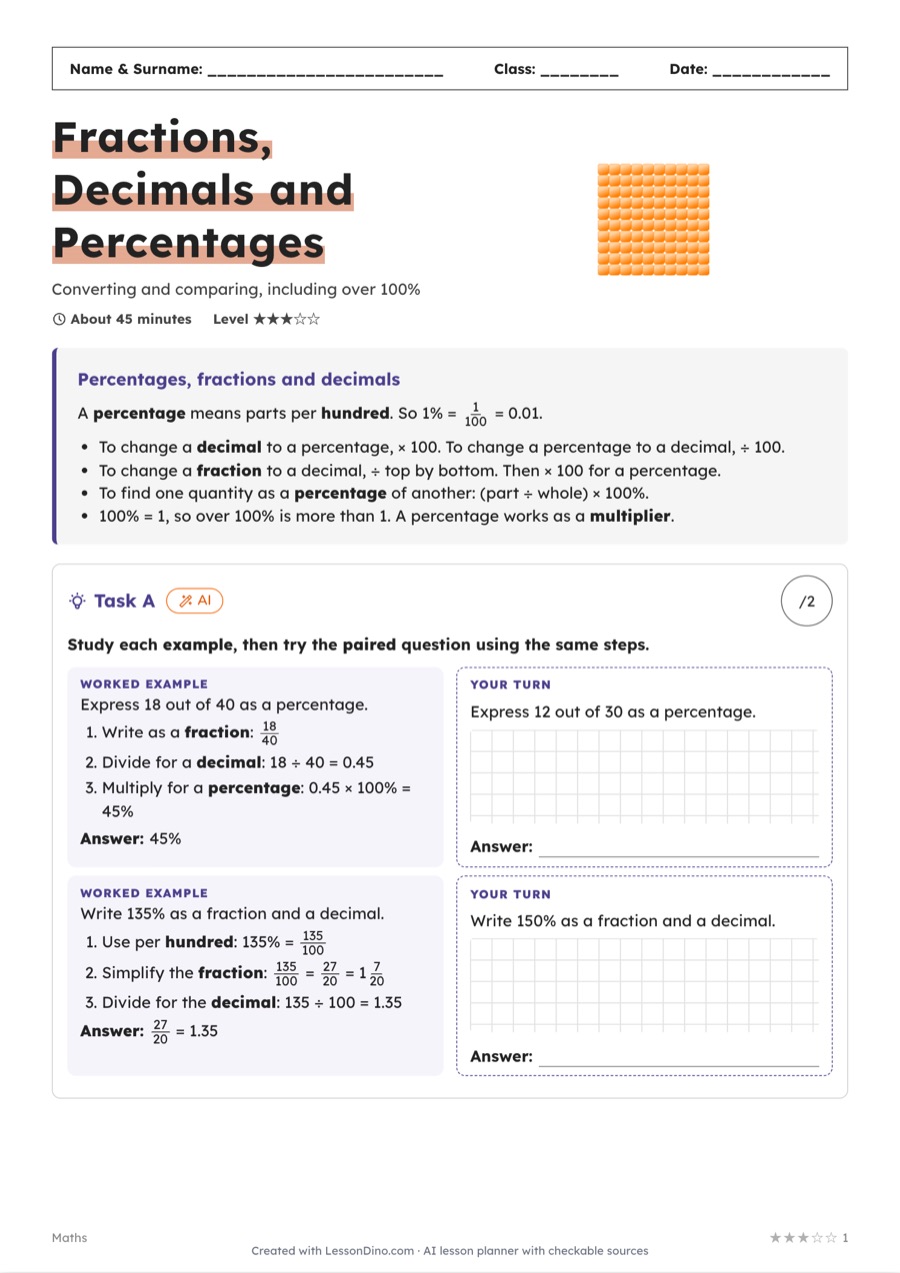
Percentages, fractions and decimals
- A percentage means parts per hundred. So 1% = 1/100 = 0.01.
- To change a decimal to a percentage, × 100. To change a percentage to a decimal, ÷ 100.
- To change a fraction to a decimal, ÷ top by bottom. Then × 100 for a percentage.
- To find one quantity as a percentage of another: (part ÷ whole) × 100%.
- 100% = 1, so over 100% is more than 1. A percentage works as a multiplier.
Study each example, then try the paired question using the same steps.
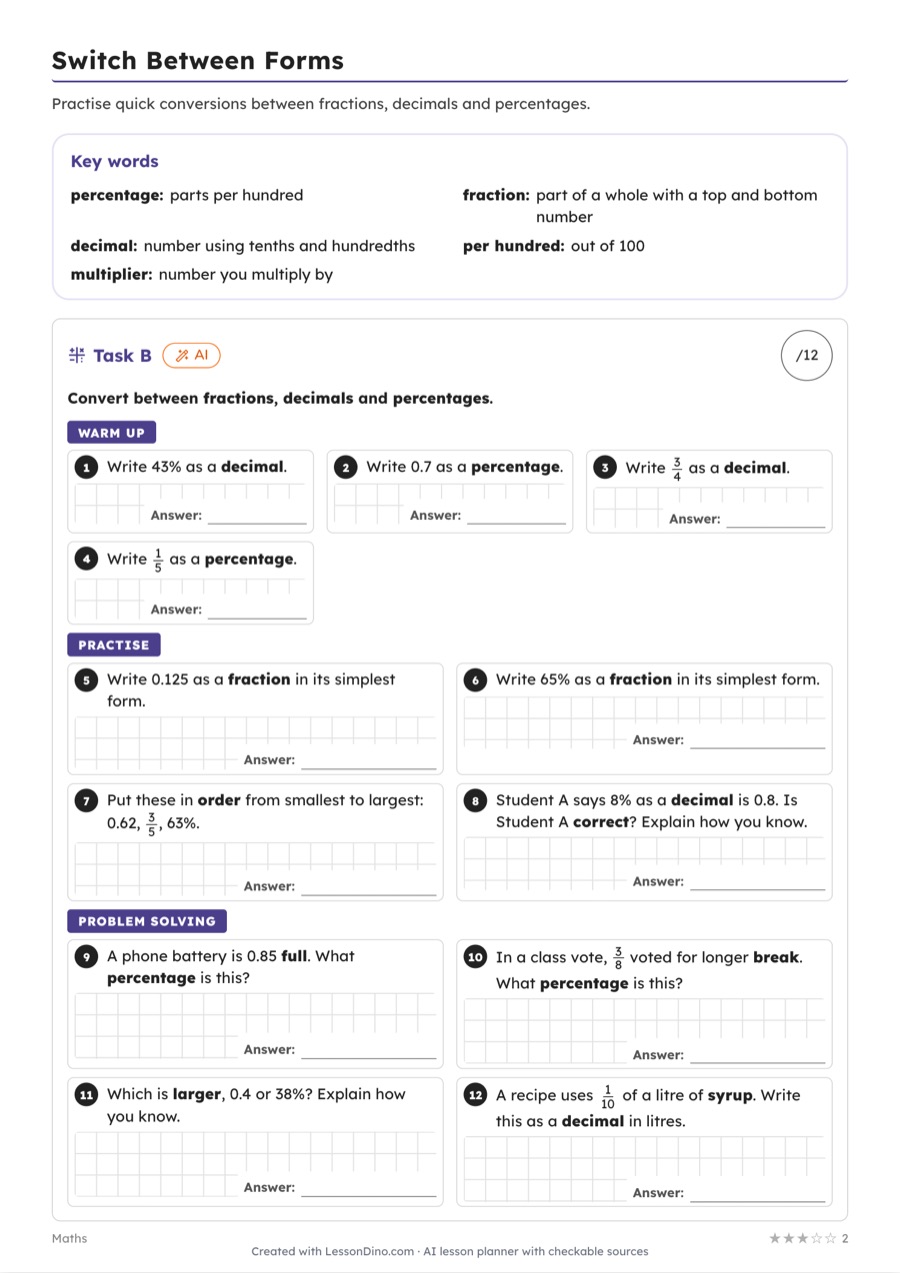
Switch Between Forms
Practise quick conversions between fractions, decimals and percentages.
| Word | Meaning |
|---|---|
| percentage | parts per hundred |
| fraction | part of a whole with a top and bottom number |
| decimal | number using tenths and hundredths |
| per hundred | out of 100 |
| multiplier | number you multiply by |
Convert between fractions, decimals and percentages.
Warm up
- Write 43% as a decimal.
- Write 0.7 as a percentage.
- Write 3/4 as a decimal.
- Write 1/5 as a percentage.
Practise
- Write 0.125 as a fraction in its simplest form.
- Write 65% as a fraction in its simplest form.
- Put these in order from smallest to largest: 0.62, 3/5, 63%.
- Student A says 8% as a decimal is 0.8. Is Student A correct? Explain how you know.
Problem solving
- A phone battery is 0.85 full. What percentage is this?
- In a class vote, 3/8 voted for longer break. What percentage is this?
- Which is larger, 0.4 or 38%? Explain how you know.
- A recipe uses 1/10 of a litre of syrup. Write this as a decimal in litres.
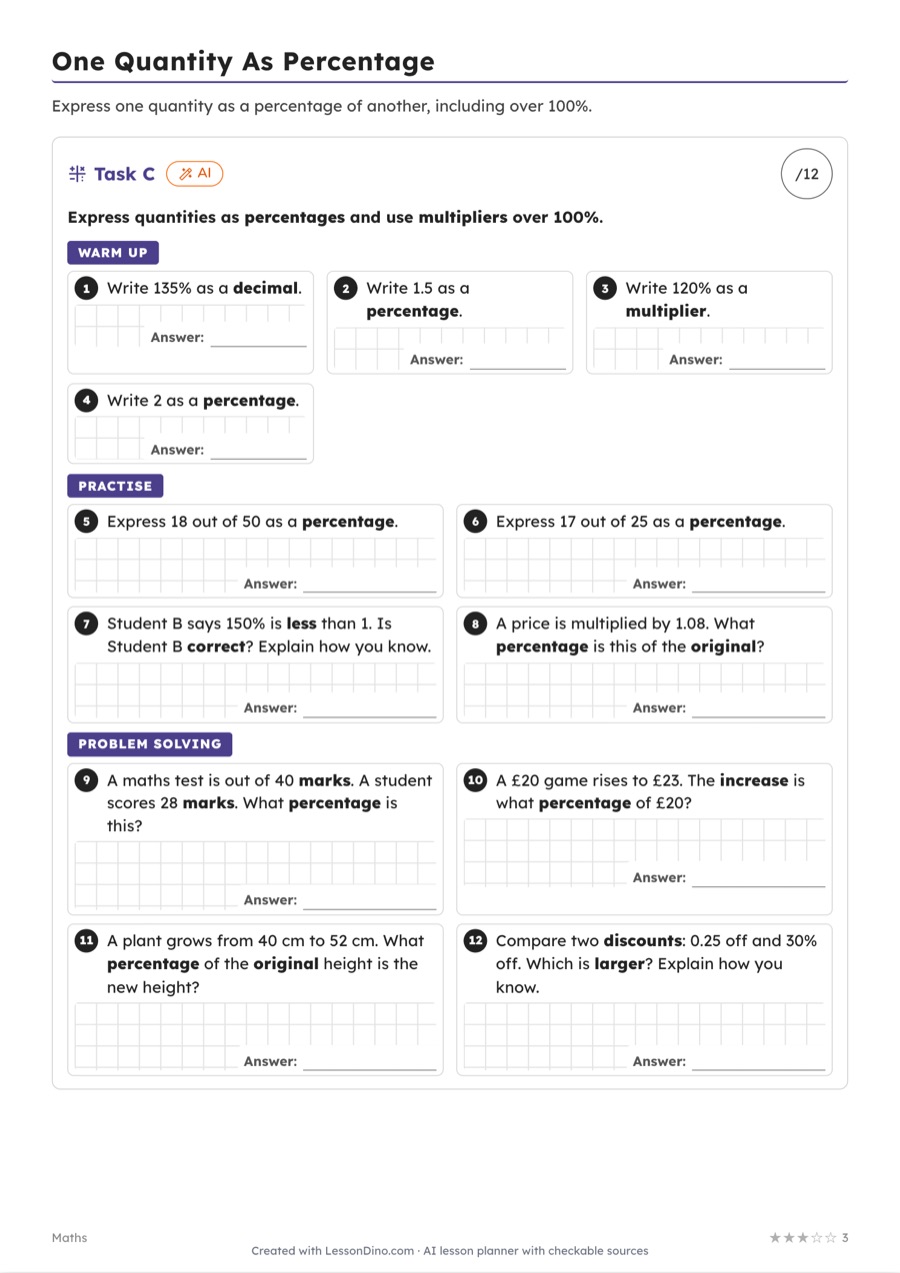
One Quantity As Percentage
Express one quantity as a percentage of another, including over 100%.
Express quantities as percentages and use multipliers over 100%.
Warm up
- Write 135% as a decimal.
- Write 1.5 as a percentage.
- Write 120% as a multiplier.
- Write 2 as a percentage.
Practise
- Express 18 out of 50 as a percentage.
- Express 17 out of 25 as a percentage.
- Student B says 150% is less than 1. Is Student B correct? Explain how you know.
- A price is multiplied by 1.08. What percentage is this of the original?
Problem solving
- A maths test is out of 40 marks. A student scores 28 marks. What percentage is this?
- A £20 game rises to £23. The increase is what percentage of £20?
- A plant grows from 40 cm to 52 cm. What percentage of the original height is the new height?
- Compare two discounts: 0.25 off and 30% off. Which is larger? Explain how you know.
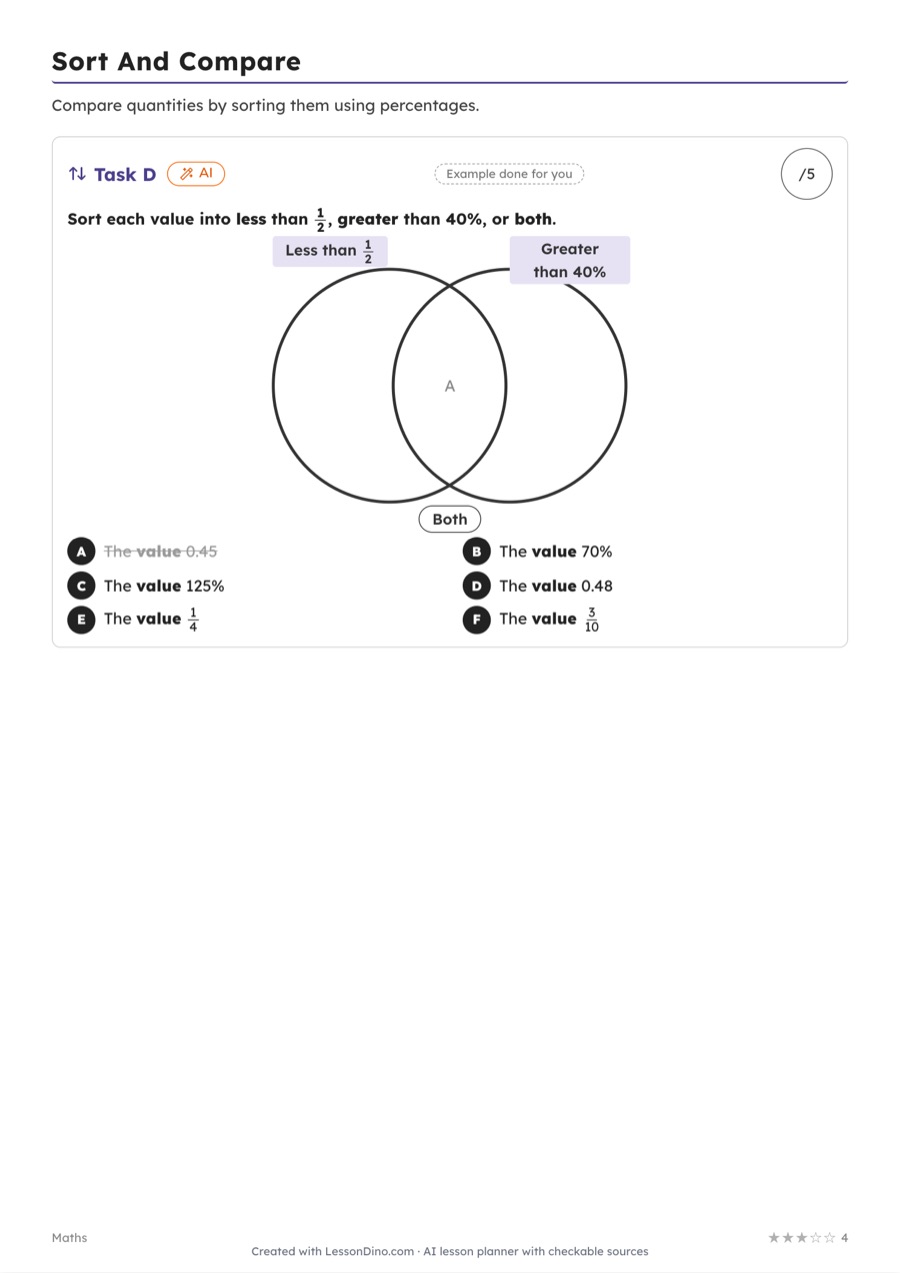
Sort And Compare
Compare quantities by sorting them using percentages.
Sort each value into less than 1/2, greater than 40%, or both.
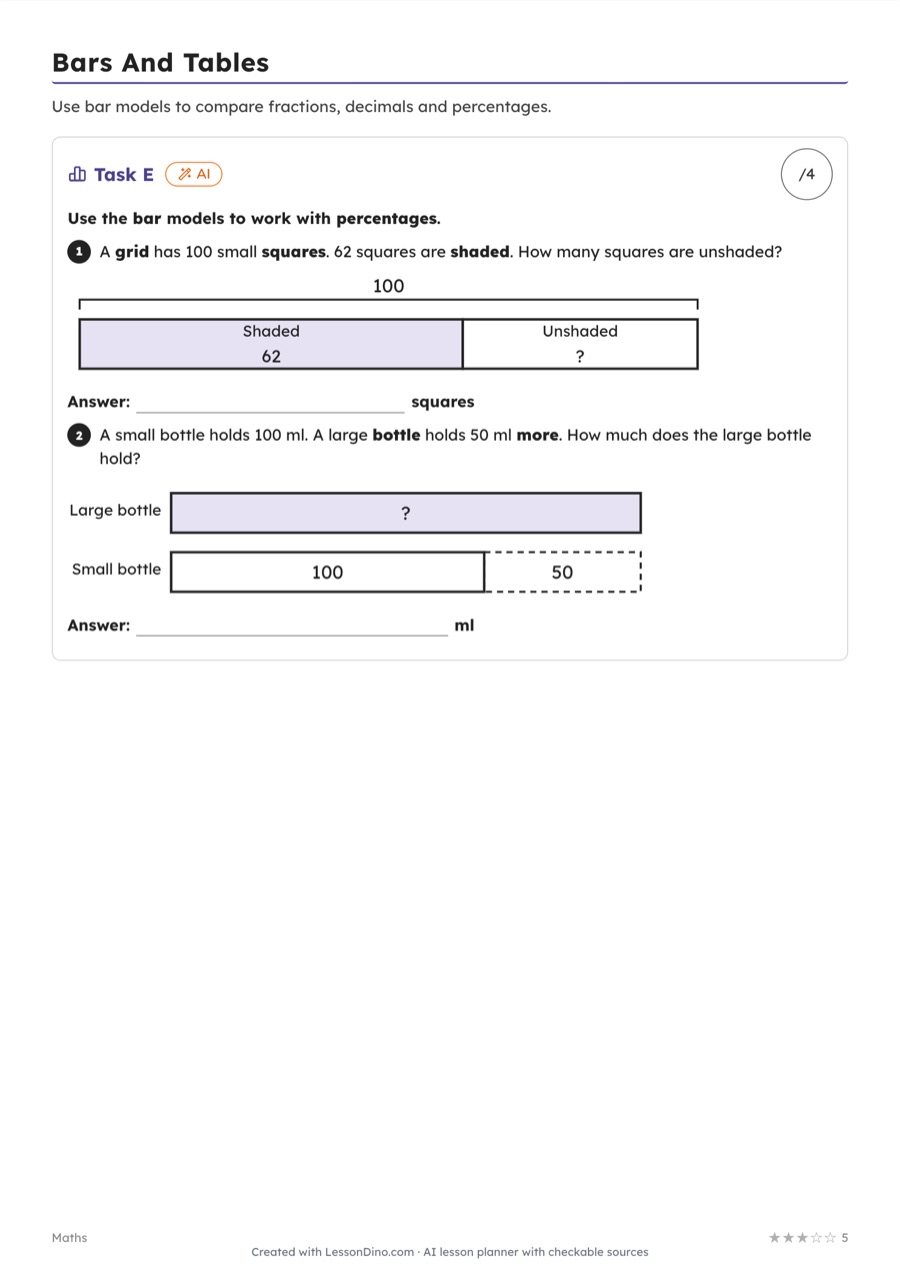
Bars And Tables
Use bar models to compare fractions, decimals and percentages.
Use the bar models to work with percentages.
Page 6
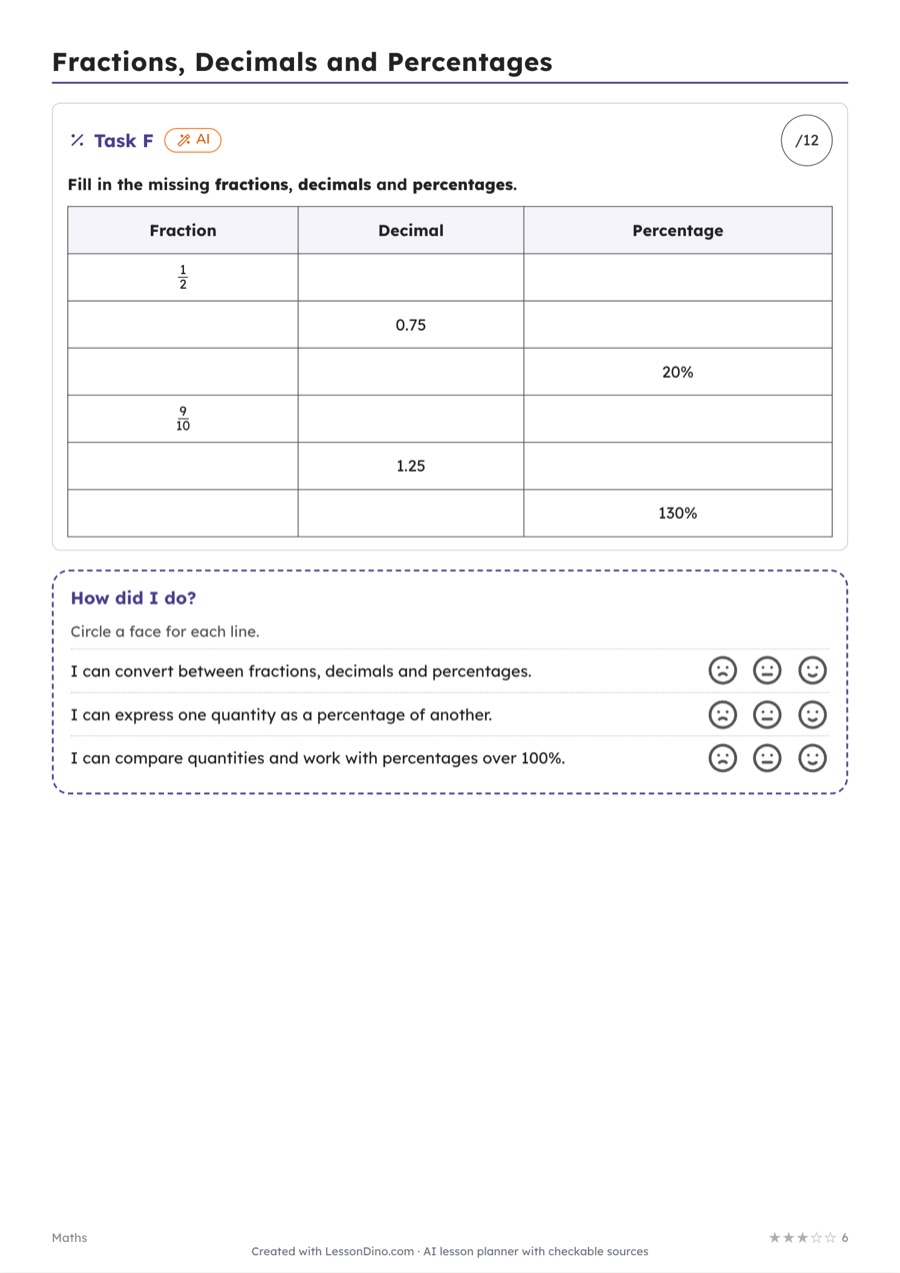
Fill in the missing fractions, decimals and percentages.
Answers
Show the answers
- Write 43% as a decimal. 0.43
- Write 0.7 as a percentage. 70%
- Write 3/4 as a decimal. 0.75
- Write 1/5 as a percentage. 20%
- Write 0.125 as a fraction in its simplest form. 1/8
- Write 65% as a fraction in its simplest form. 13/20
- Put these in order from smallest to largest: 0.62, 3/5, 63%. 3/5, 0.62, 63%
- Student A says 8% as a decimal is 0.8. Is Student A correct? Explain how you know. No, 8% = 0.08, not 0.8, because 8/100 = 0.08
- A phone battery is 0.85 full. What percentage is this? 85%
- In a class vote, 3/8 voted for longer break. What percentage is this? 37.5%
- Which is larger, 0.4 or 38%? Explain how you know. 0.4 is larger because 0.4 = 40% which is greater than 38%
- A recipe uses 1/10 of a litre of syrup. Write this as a decimal in litres. 0.1 litres
- Write 135% as a decimal. 1.35
- Write 1.5 as a percentage. 150%
- Write 120% as a multiplier. 1.2
- Write 2 as a percentage. 200%
- Express 18 out of 50 as a percentage. 36%
- Express 17 out of 25 as a percentage. 68%
- Student B says 150% is less than 1. Is Student B correct? Explain how you know. No, 150% = 1.5 which is greater than 1
- A price is multiplied by 1.08. What percentage is this of the original? 108%
- A maths test is out of 40 marks. A student scores 28 marks. What percentage is this? 70%
- A £20 game rises to £23. The increase is what percentage of £20? 15%
- A plant grows from 40 cm to 52 cm. What percentage of the original height is the new height? 130%
- Compare two discounts: 0.25 off and 30% off. Which is larger? Explain how you know. 30% is larger because 0.25 = 25% which is less than 30%
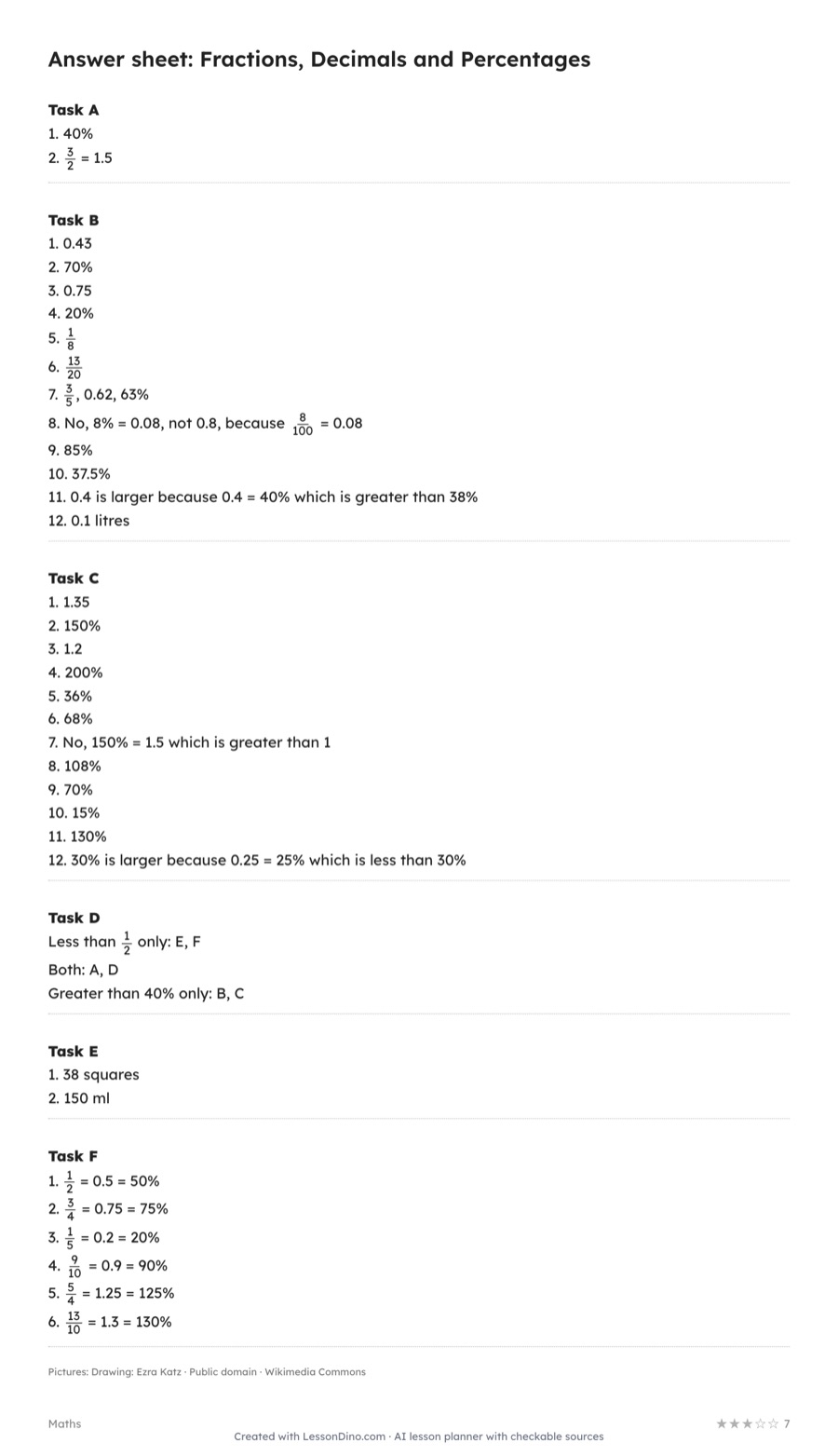
The answer sheet is the last picture above.
Curriculum
define percentage as ‘number of parts per hundred’, interpret percentages and percentage changes as a fraction or a decimal, interpret these multiplicatively, express 1 quantity as a percentage of another, compare 2 quantities using percentages, and work with percentages greater than 100%
From National curriculum in England, Key Stage 3 mathematics.
Made with Lesson Dino's AI on 19 October 2026. AI can make mistakes, so check the answers and facts against the sources before you teach.