The worksheet
About this worksheet
Pupils derive the trapezium area formula by joining two trapezia. They then apply it accurately using perpendicular height. This Year 7 Maths worksheet gives students (ages 11–12) six pages of practice on area of a trapezium, part of the geometry and measures unit. It goes with our free Area of a trapezium lesson, which has the slides and a timed lesson plan.
What it covers
By the end, students should be able to:
- Students will derive the trapezium area formula by doubling to a parallelogram.
- Students will calculate trapezium area using the average of parallel sides.
- Students will solve area problems using perpendicular height, not slant side.
How to use it
- Main activity (20 minutes): Circulate to check labels a, b and perpendicular h, then set Worksheet Task B.
- Support: Give pre-drawn trapezia on squared paper with parallel sides marked with arrows.
- Stretch: Try joining trick with right-angled trapezium and explain why it makes a rectangle.
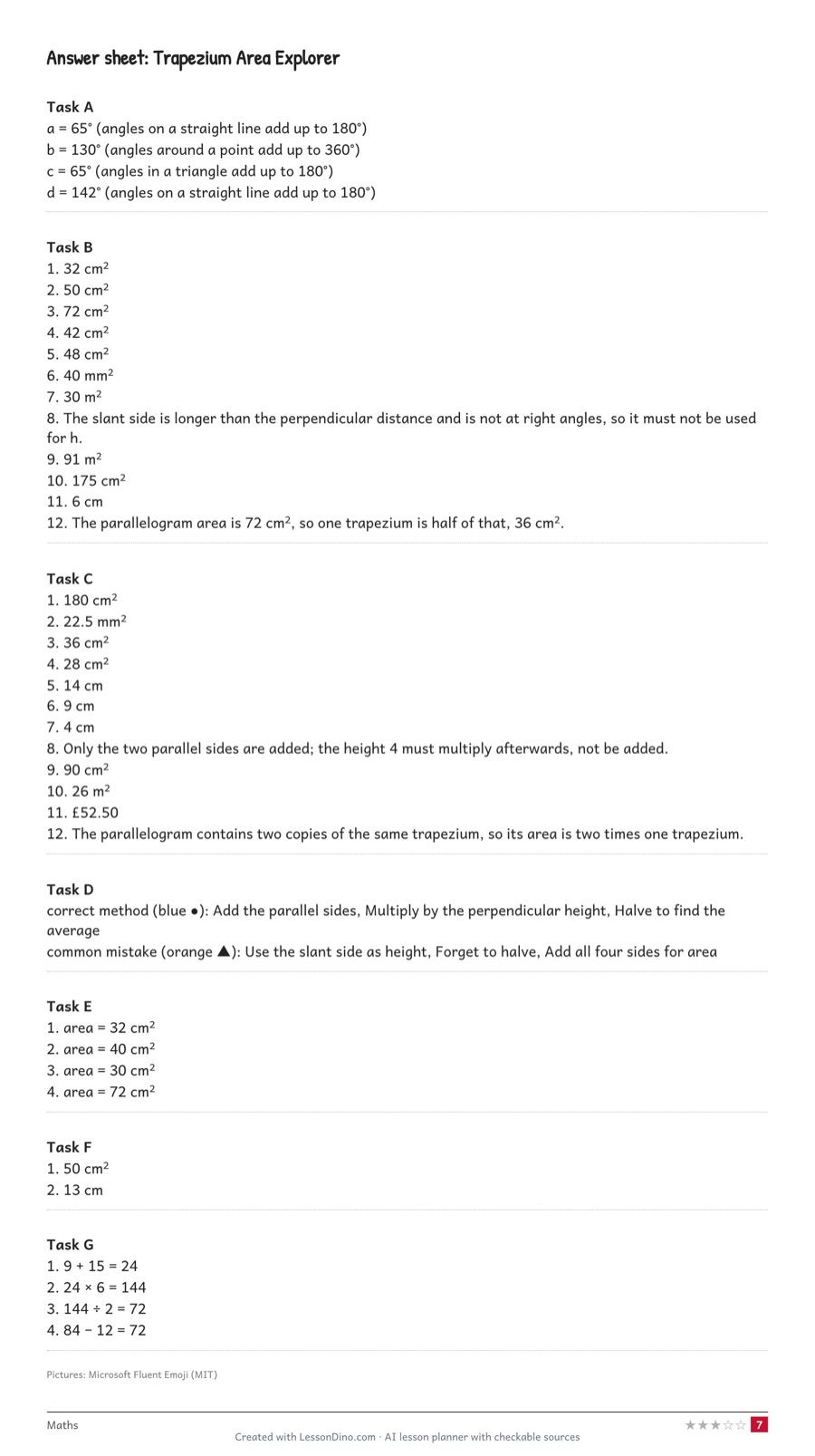
- The answer sheet is the last page, so you can print it on its own or let students check their own work.
Key vocabulary
- trapezium: a four-sided shape with one pair of sides that never meet
- parallel: lines that stay the same distance apart and never meet
- perpendicular height: the shortest gap between the two matching sides, meeting them at 90 degrees
- average: the middle value found by adding two numbers and halving the total
Mistakes to watch for
- Using slant side instead of perpendicular height. Circle height with right-angle symbol; height is the perpendicular gap between sides.
- Forgetting to halve. Always write A = ½(a + b) x h first; missing the half doubles the answer.
- Adding non-parallel sides into a + b. Find arrows for parallel sides first; only the two parallel sides go in.
What's on the worksheet
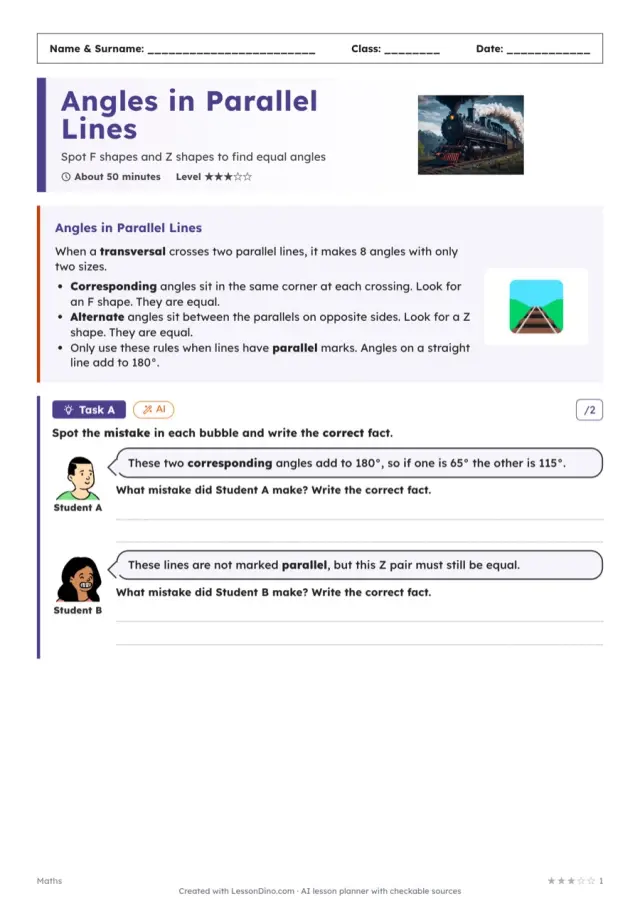
Discovering the Trapezium
See how two trapezia make a parallelogram.
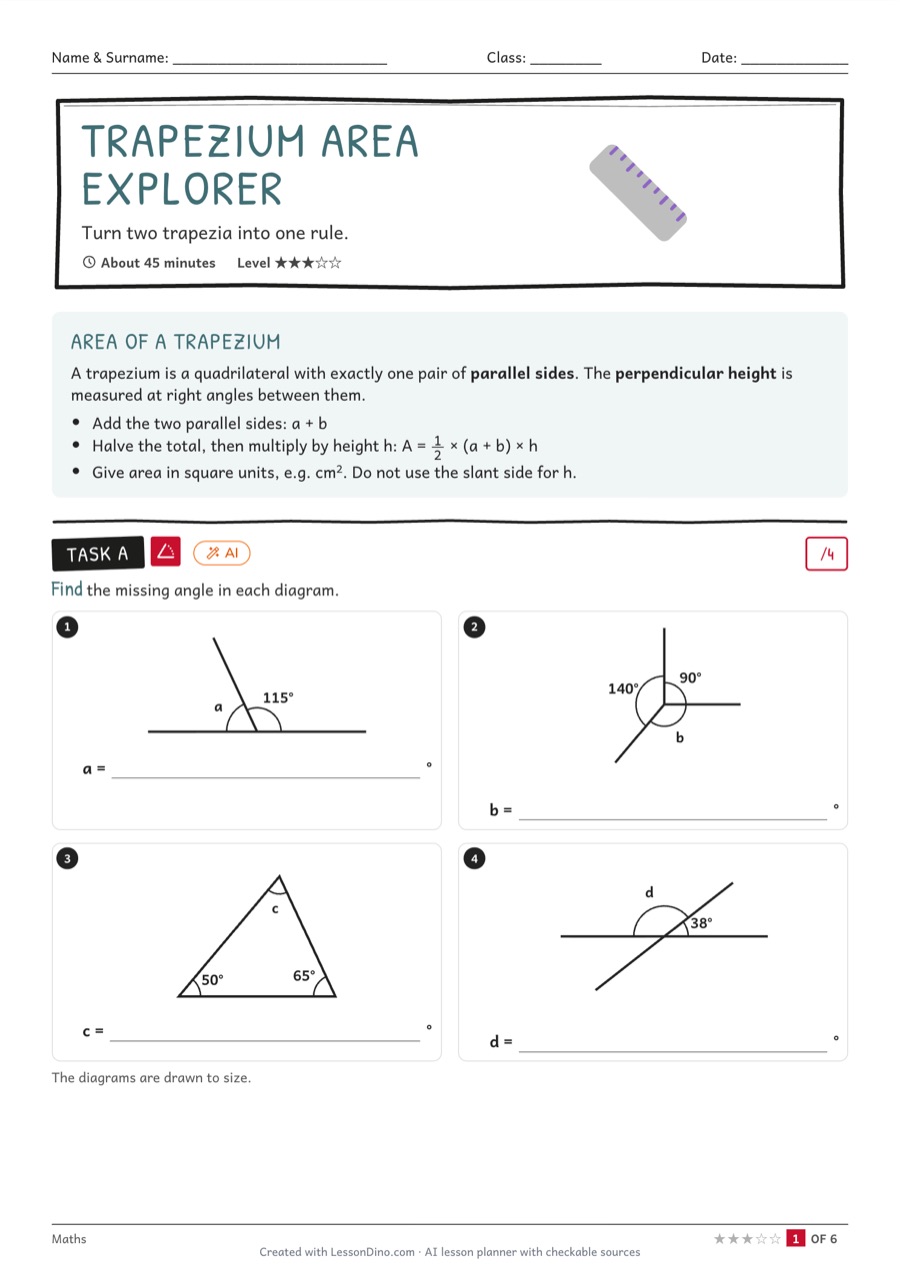
Area of a Trapezium
- A trapezium is a quadrilateral with exactly one pair of parallel sides. The perpendicular height is measured at right angles between them.
- Add the two parallel sides: a + b
- Halve the total, then multiply by height h: A = 1/2 × (a + b) × h
- Give area in square units, e.g. cm². Do not use the slant side for h.
Find the missing angle in each diagram.
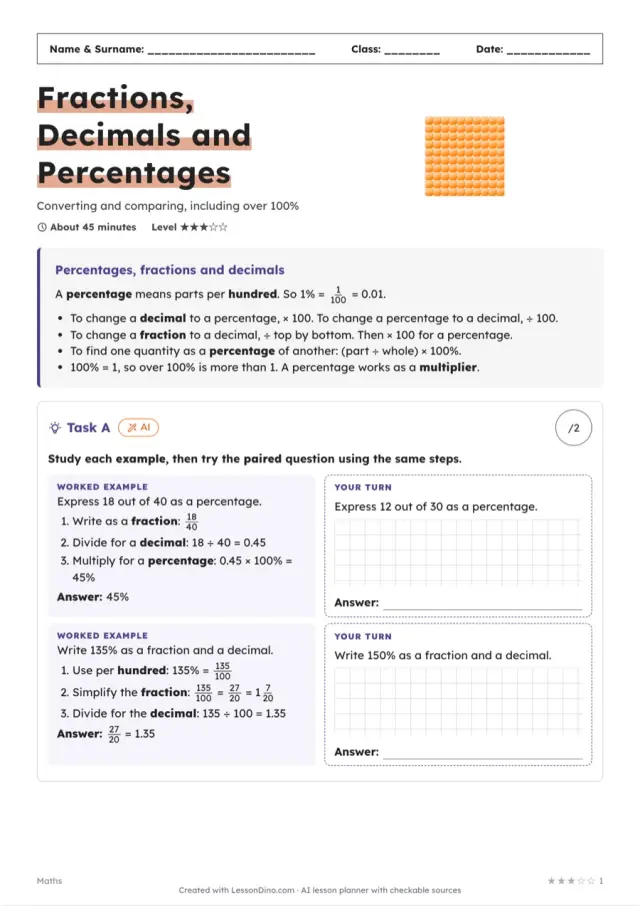
First Area Practice
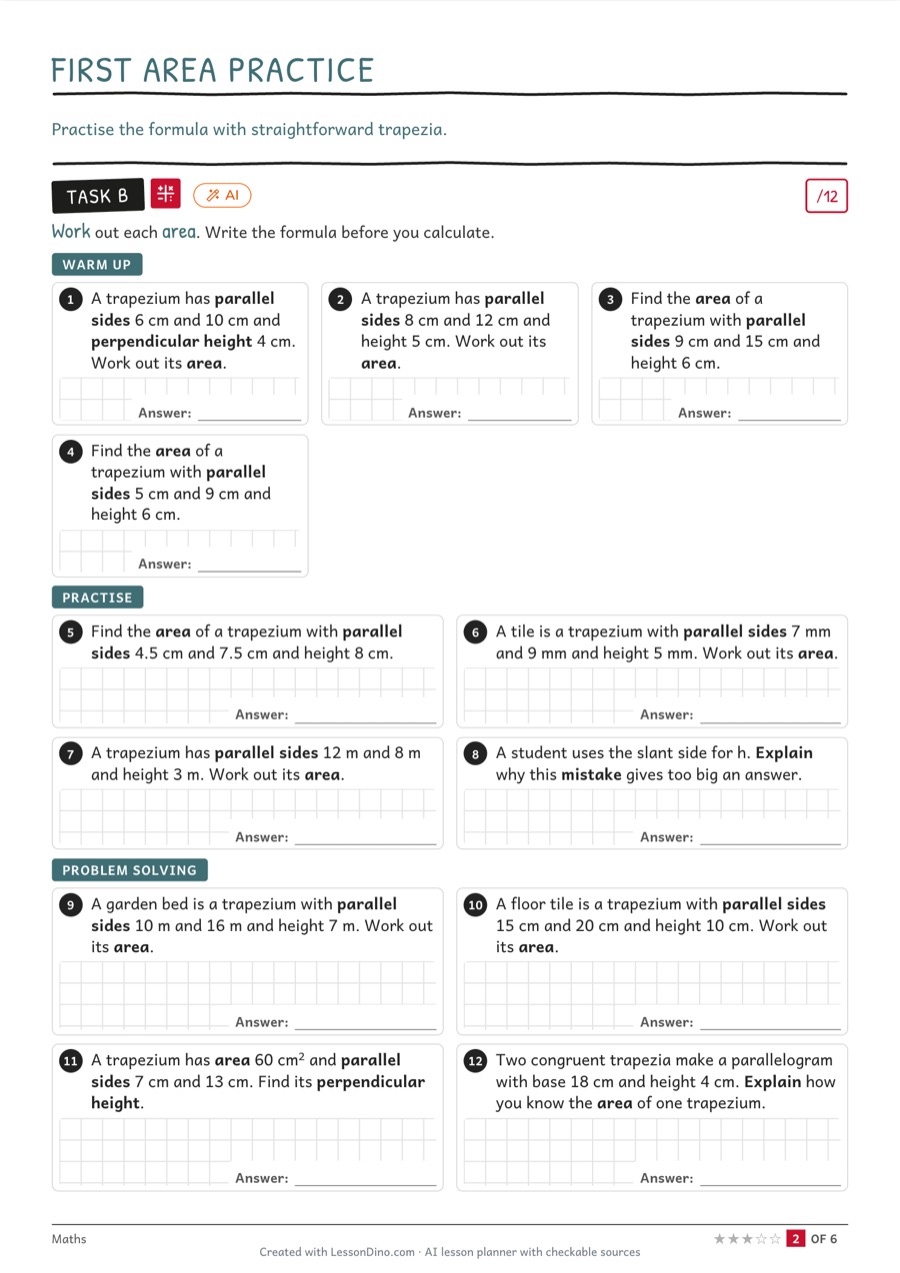
Practise the formula with straightforward trapezia.
Work out each area. Write the formula before you calculate.
Warm up
- A trapezium has parallel sides 6 cm and 10 cm and perpendicular height 4 cm. Work out its area.
- A trapezium has parallel sides 8 cm and 12 cm and height 5 cm. Work out its area.
- Find the area of a trapezium with parallel sides 9 cm and 15 cm and height 6 cm.
- Find the area of a trapezium with parallel sides 5 cm and 9 cm and height 6 cm.
Practise
- Find the area of a trapezium with parallel sides 4.5 cm and 7.5 cm and height 8 cm.
- A tile is a trapezium with parallel sides 7 mm and 9 mm and height 5 mm. Work out its area.
- A trapezium has parallel sides 12 m and 8 m and height 3 m. Work out its area.
- A student uses the slant side for h. Explain why this mistake gives too big an answer.
Problem solving
- A garden bed is a trapezium with parallel sides 10 m and 16 m and height 7 m. Work out its area.
- A floor tile is a trapezium with parallel sides 15 cm and 20 cm and height 10 cm. Work out its area.
- A trapezium has area 60 cm² and parallel sides 7 cm and 13 cm. Find its perpendicular height.
- Two congruent trapezia make a parallelogram with base 18 cm and height 4 cm. Explain how you know the area of one trapezium.
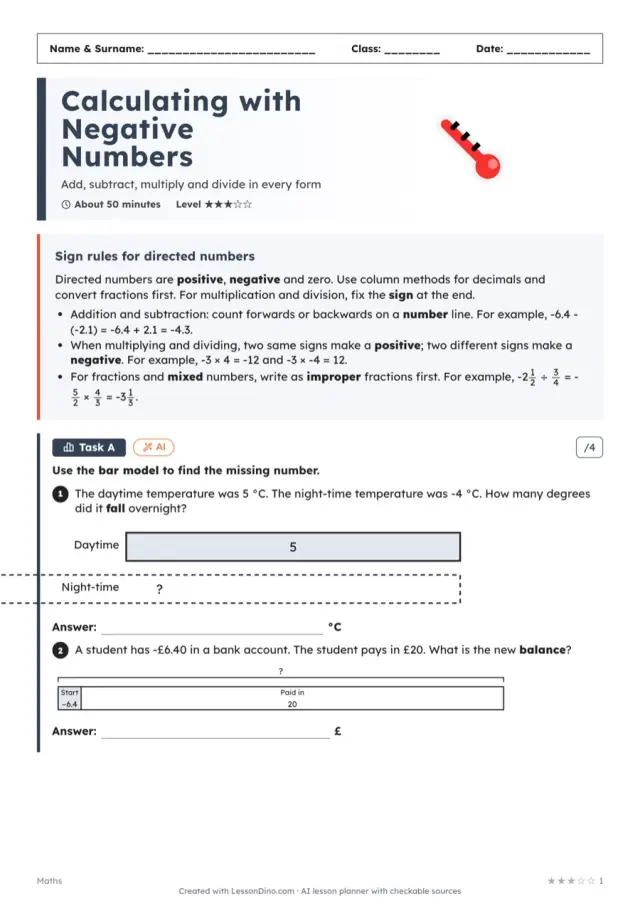
Missing Sides Solved
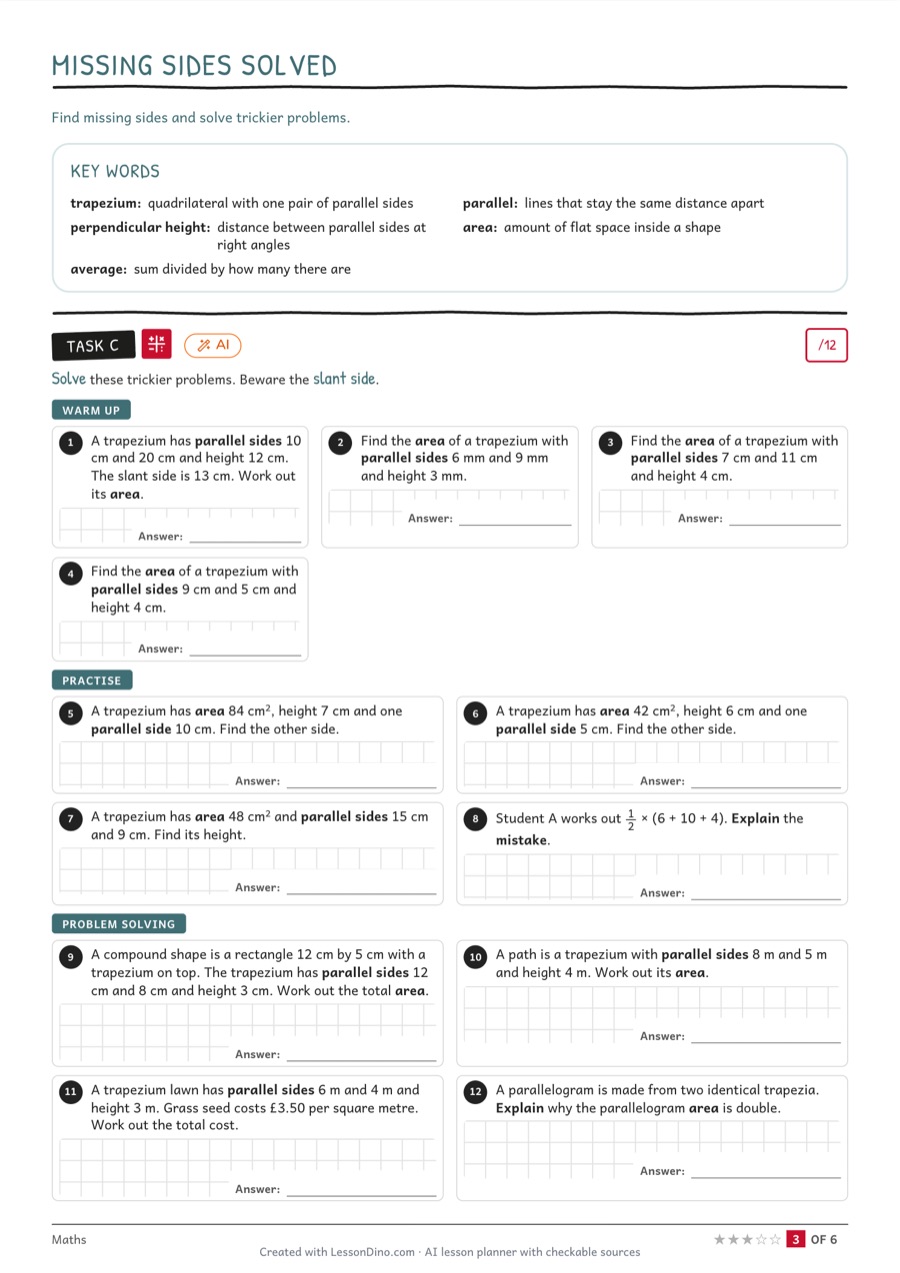
Find missing sides and solve trickier problems.
| Word | Meaning |
|---|---|
| trapezium | quadrilateral with one pair of parallel sides |
| parallel | lines that stay the same distance apart |
| perpendicular height | distance between parallel sides at right angles |
| area | amount of flat space inside a shape |
| average | sum divided by how many there are |
Solve these trickier problems. Beware the slant side.
Warm up
- A trapezium has parallel sides 10 cm and 20 cm and height 12 cm. The slant side is 13 cm. Work out its area.
- Find the area of a trapezium with parallel sides 6 mm and 9 mm and height 3 mm.
- Find the area of a trapezium with parallel sides 7 cm and 11 cm and height 4 cm.
- Find the area of a trapezium with parallel sides 9 cm and 5 cm and height 4 cm.
Practise
- A trapezium has area 84 cm², height 7 cm and one parallel side 10 cm. Find the other side.
- A trapezium has area 42 cm², height 6 cm and one parallel side 5 cm. Find the other side.
- A trapezium has area 48 cm² and parallel sides 15 cm and 9 cm. Find its height.
- Student A works out 1/2 × (6 + 10 + 4). Explain the mistake.
Problem solving
- A compound shape is a rectangle 12 cm by 5 cm with a trapezium on top. The trapezium has parallel sides 12 cm and 8 cm and height 3 cm. Work out the total area.
- A path is a trapezium with parallel sides 8 m and 5 m and height 4 m. Work out its area.
- A trapezium lawn has parallel sides 6 m and 4 m and height 3 m. Grass seed costs £3.50 per square metre. Work out the total cost.
- A parallelogram is made from two identical trapezia. Explain why the parallelogram area is double.
Spot Correct Methods
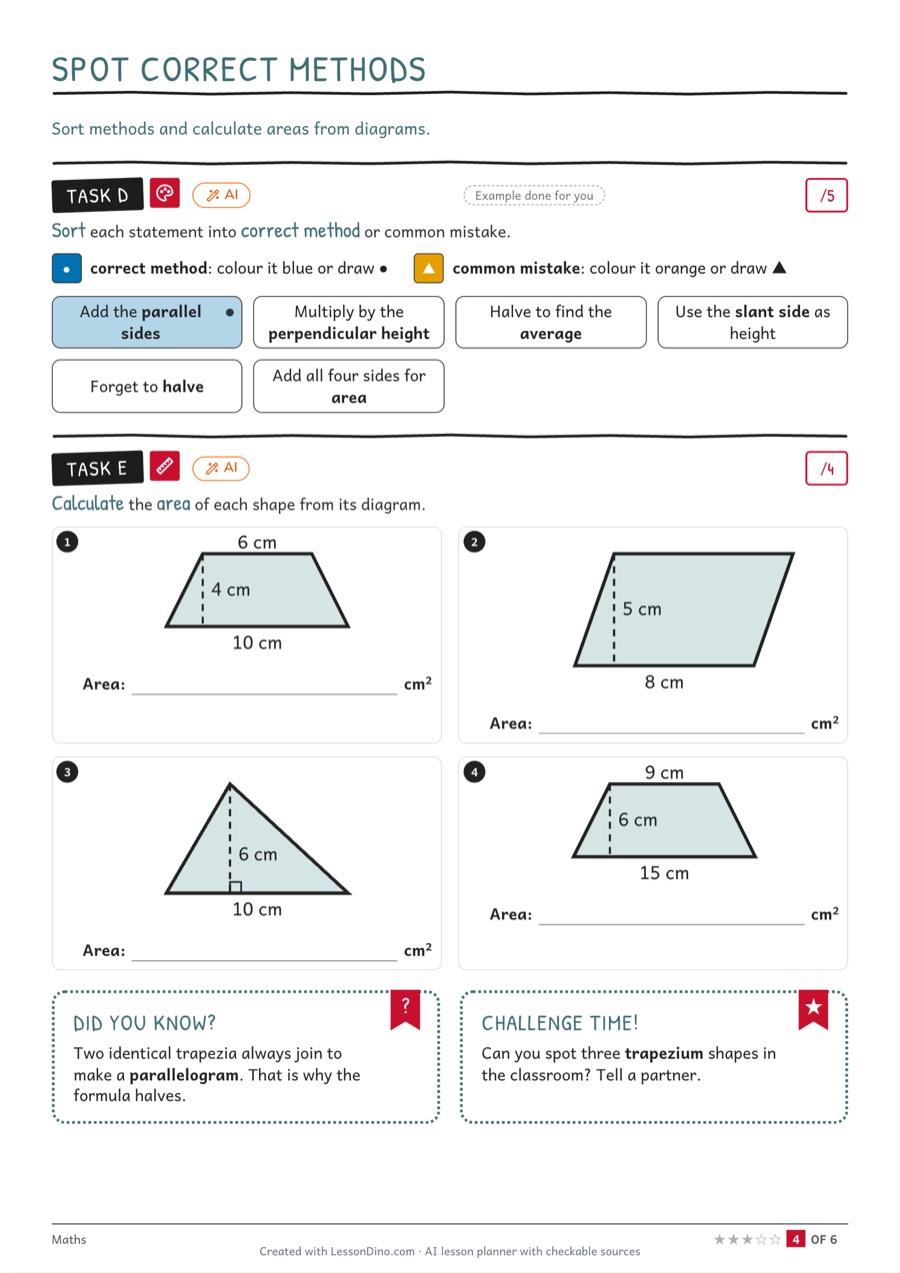
Sort methods and calculate areas from diagrams.
Sort each statement into correct method or common mistake.
Calculate the area of each shape from its diagram.
- Two identical trapezia always join to make a parallelogram. That is why the formula halves.
- Can you spot three trapezium shapes in the classroom? Tell a partner.
Worked Methods Compared
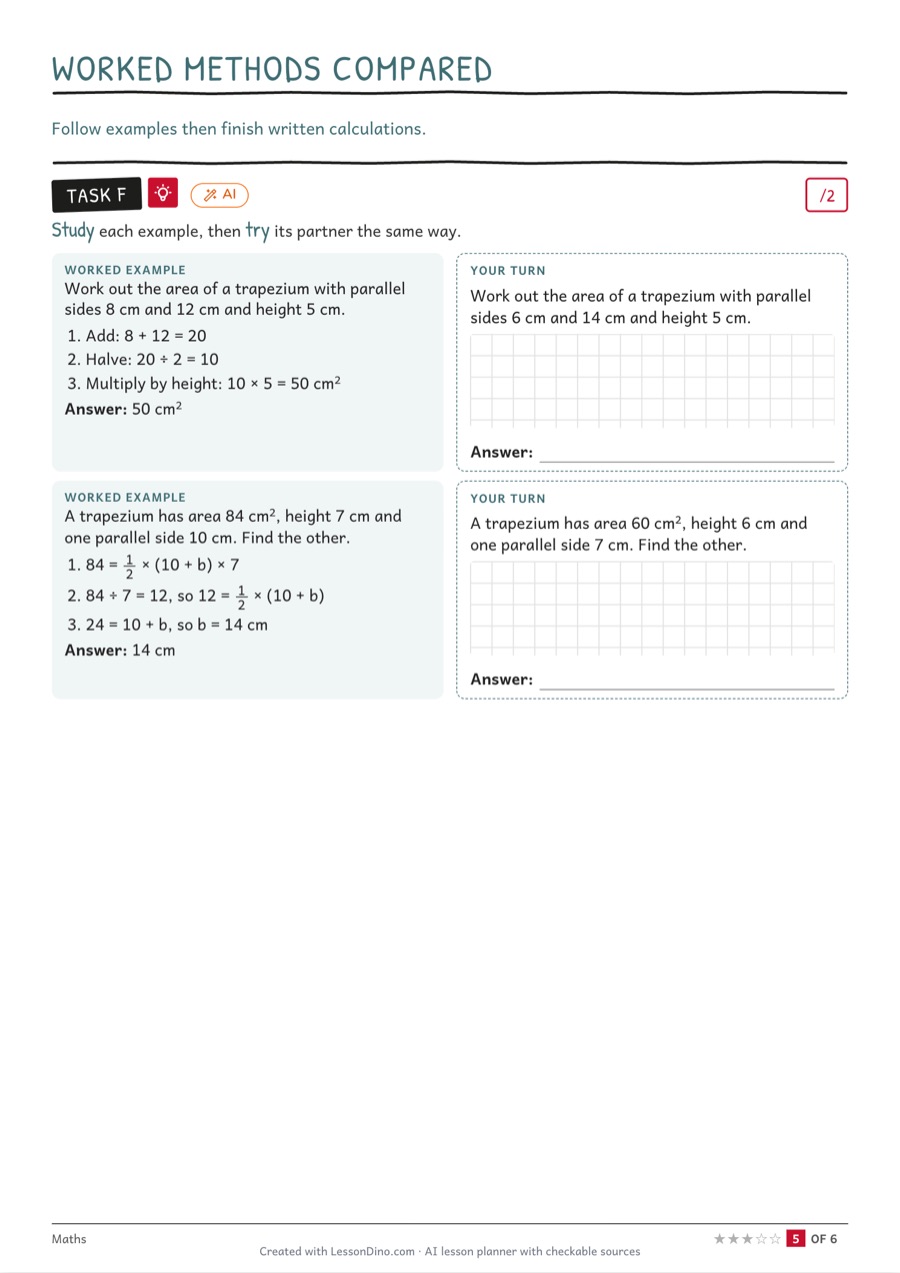
Follow examples then finish written calculations.
Study each example, then try its partner the same way.
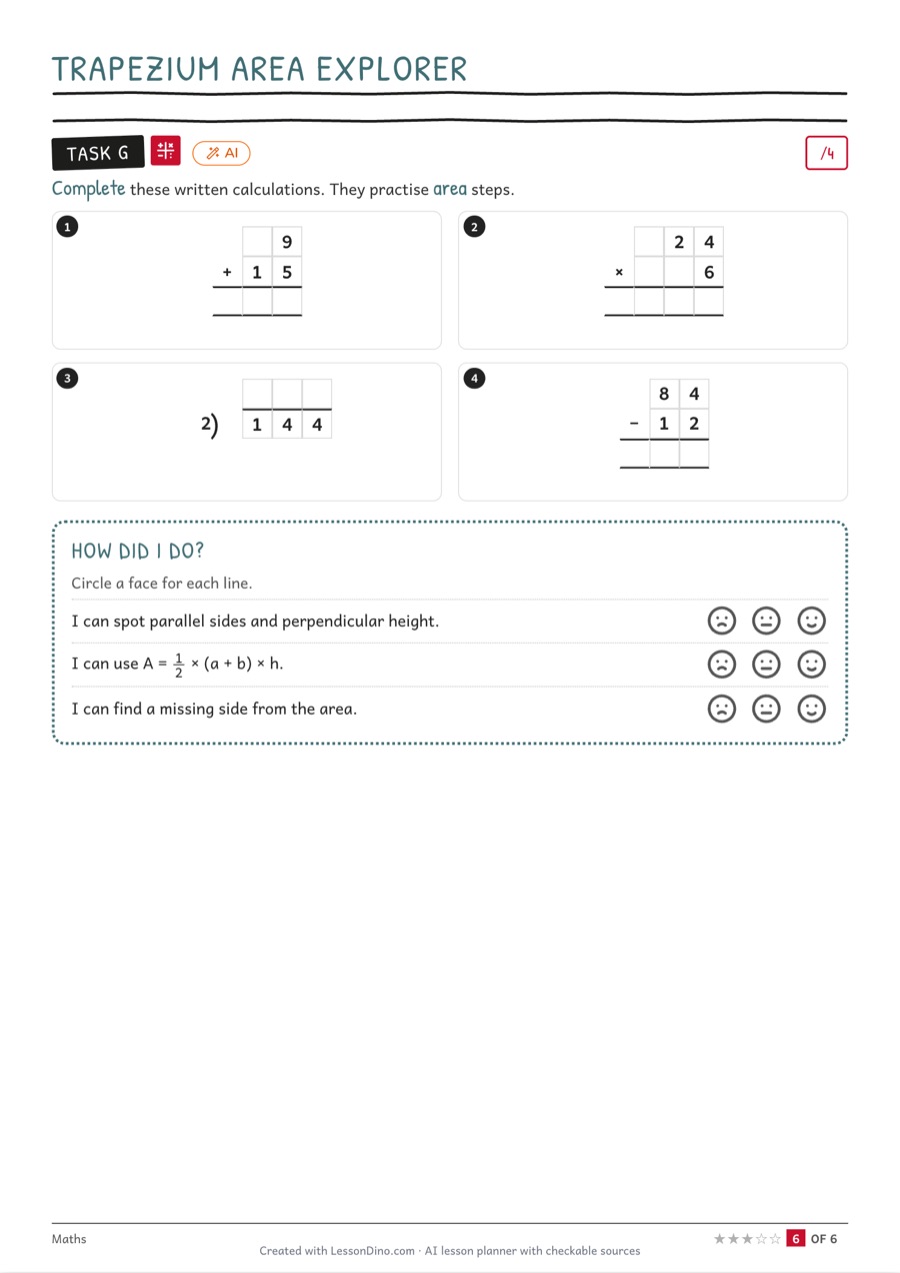
Page 6
Complete these written calculations. They practise area steps.
Answers
Show the answers
- A trapezium has parallel sides 6 cm and 10 cm and perpendicular height 4 cm. Work out its area. 32 cm²
- A trapezium has parallel sides 8 cm and 12 cm and height 5 cm. Work out its area. 50 cm²
- Find the area of a trapezium with parallel sides 9 cm and 15 cm and height 6 cm. 72 cm²
- Find the area of a trapezium with parallel sides 5 cm and 9 cm and height 6 cm. 42 cm²
- Find the area of a trapezium with parallel sides 4.5 cm and 7.5 cm and height 8 cm. 48 cm²
- A tile is a trapezium with parallel sides 7 mm and 9 mm and height 5 mm. Work out its area. 40 mm²
- A trapezium has parallel sides 12 m and 8 m and height 3 m. Work out its area. 30 m²
- A student uses the slant side for h. Explain why this mistake gives too big an answer. The slant side is longer than the perpendicular distance and is not at right angles, so it must not be used for h.
- A garden bed is a trapezium with parallel sides 10 m and 16 m and height 7 m. Work out its area. 91 m²
- A floor tile is a trapezium with parallel sides 15 cm and 20 cm and height 10 cm. Work out its area. 175 cm²
- A trapezium has area 60 cm² and parallel sides 7 cm and 13 cm. Find its perpendicular height. 6 cm
- Two congruent trapezia make a parallelogram with base 18 cm and height 4 cm. Explain how you know the area of one trapezium. The parallelogram area is 72 cm², so one trapezium is half of that, 36 cm².
- A trapezium has parallel sides 10 cm and 20 cm and height 12 cm. The slant side is 13 cm. Work out its area. 180 cm²
- Find the area of a trapezium with parallel sides 6 mm and 9 mm and height 3 mm. 22.5 mm²
- Find the area of a trapezium with parallel sides 7 cm and 11 cm and height 4 cm. 36 cm²
- Find the area of a trapezium with parallel sides 9 cm and 5 cm and height 4 cm. 28 cm²
- A trapezium has area 84 cm², height 7 cm and one parallel side 10 cm. Find the other side. 14 cm
- A trapezium has area 42 cm², height 6 cm and one parallel side 5 cm. Find the other side. 9 cm
- A trapezium has area 48 cm² and parallel sides 15 cm and 9 cm. Find its height. 4 cm
- Student A works out 1/2 × (6 + 10 + 4). Explain the mistake. Only the two parallel sides are added; the height 4 must multiply afterwards, not be added.
- A compound shape is a rectangle 12 cm by 5 cm with a trapezium on top. The trapezium has parallel sides 12 cm and 8 cm and height 3 cm. Work out the total area. 90 cm²
- A path is a trapezium with parallel sides 8 m and 5 m and height 4 m. Work out its area. 26 m²
- A trapezium lawn has parallel sides 6 m and 4 m and height 3 m. Grass seed costs £3.50 per square metre. Work out the total cost. £52.50
- A parallelogram is made from two identical trapezia. Explain why the parallelogram area is double. The parallelogram contains two copies of the same trapezium, so its area is two times one trapezium.
The answer sheet is the last picture above.
Curriculum
derive and apply formulae to calculate and solve problems involving: perimeter and area of triangles, parallelograms, trapezia, volume of cuboids (including cubes) and other prisms (including cylinders)
From National curriculum in England, Key Stage 3 mathematics.
Made with Lesson Dino's AI on 19 October 2026. AI can make mistakes, so check the answers and facts against the sources before you teach.