Slides
Lesson plan
Double It, Halve It: Area of a Trapezium
Pupils derive the trapezium area formula by joining two trapezia. They then apply it accurately using perpendicular height.
Objectives
- Students will derive the trapezium area formula by doubling to a parallelogram.
- Students will calculate trapezium area using the average of parallel sides.
- Students will solve area problems using perpendicular height, not slant side.
Success criteria
- I can explain why trapezium area is half of (a + b) x h.
- I can find trapezium area using parallel sides and perpendicular height.
- I can work backwards to find a missing parallel side from area.
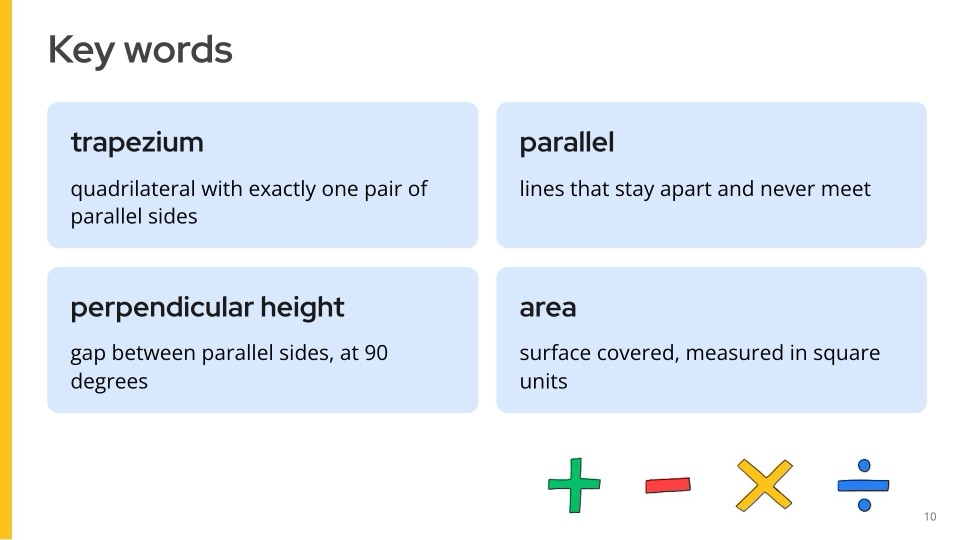
Key words
| Word | Meaning |
|---|---|
| trapezium | a four-sided shape with one pair of sides that never meet |
| parallel | lines that stay the same distance apart and never meet |
| perpendicular height | the shortest gap between the two matching sides, meeting them at 90 degrees |
| average | the middle value found by adding two numbers and halving the total |
Timed plan (60 minutes)
| Time | Stage | What happens |
|---|---|---|
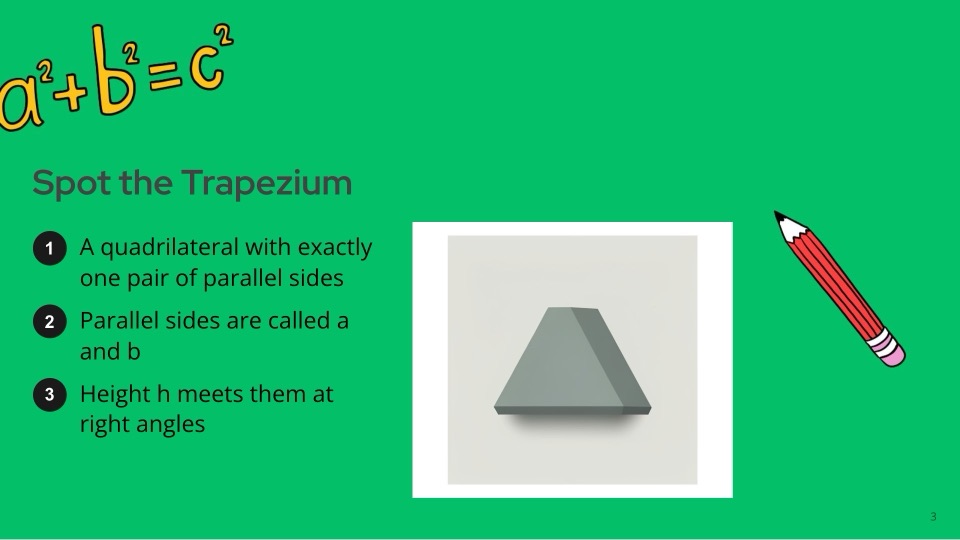
| 5 min | Starter | Recall parallel sides and perpendicular height and hook pupils into deriving the formula. Show Slides 2-3 with objectives and trapezium diagram. Use hook: I have got one wonky quadrilateral. If I give you two of them, can you make a shape you already know how to measure? Ask pupils to point out the pair of parallel sides and the height on whiteboards. Link to prior learning: area of parallelogram is base times perpendicular height. |
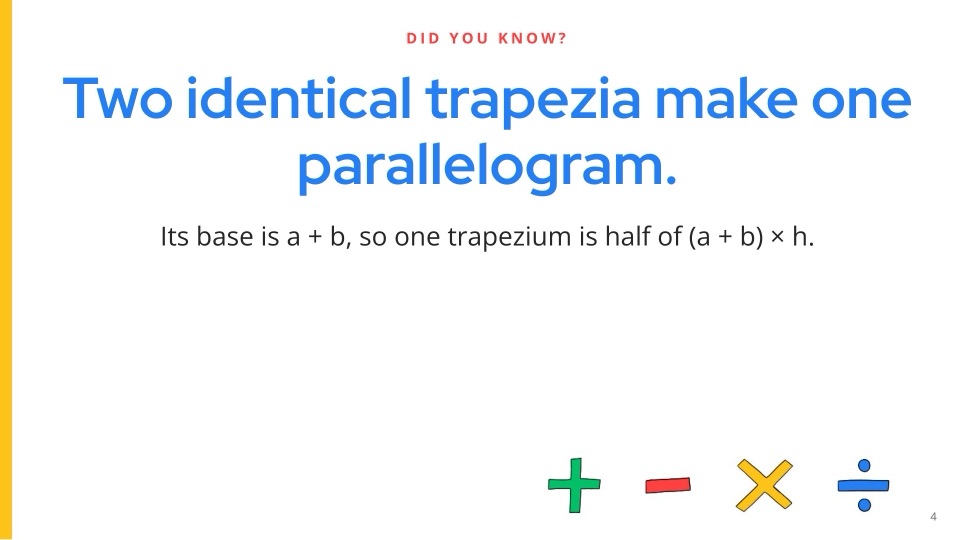
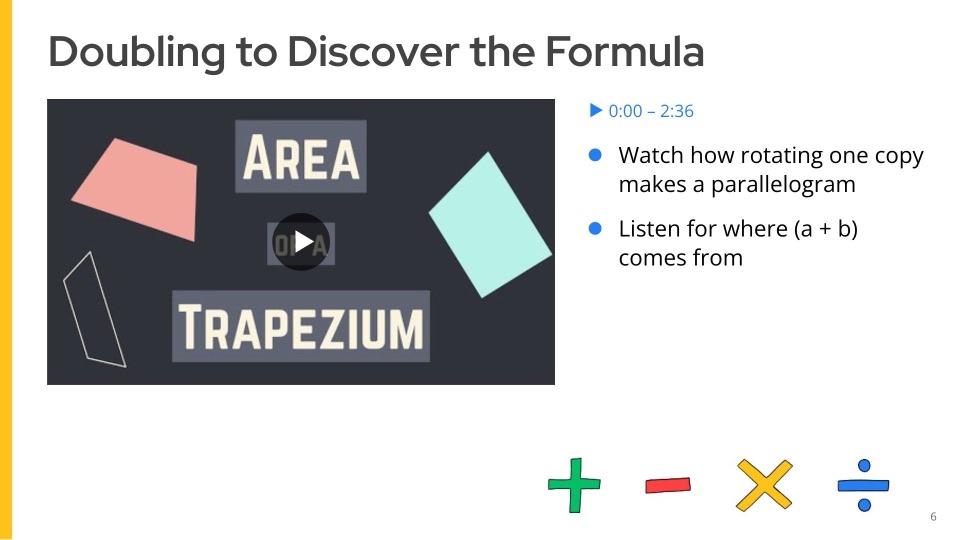
| 15 min | Teaching | Derive A = ½(a + b)h by joining two congruent trapezia into a parallelogram. Show Slide 4 and explain two identical trapezia make one parallelogram. Play Video clip 1 (0:00–2:36) on Slide 6 showing rotate one copy 180 degrees and join. Model with large cut-outs: colour parallel sides two colours, join, label base (a + b) and height h. Write formula under joined shape and explain halving for one trapezium. |
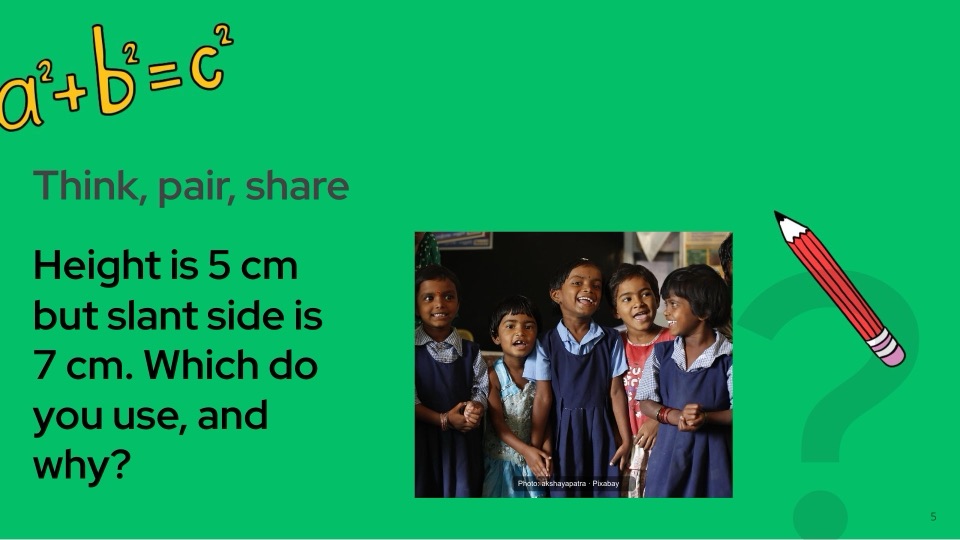
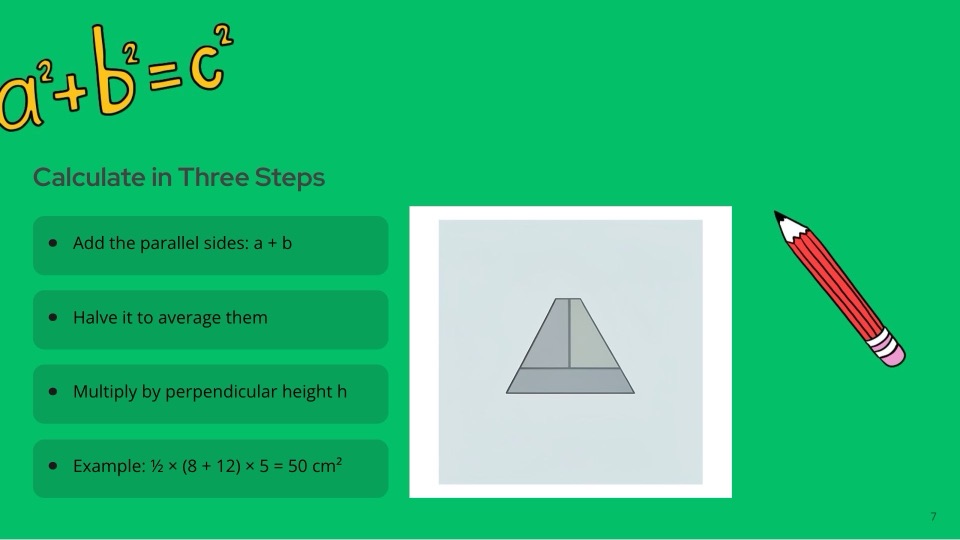
| 10 min | Guided practice | Practise the three-step method and learn to ignore the slant side. Show Slide 7 three steps: add parallel sides, halve to average them, multiply by h. Model ½ x (8 + 12) x 5 = 50 cm² stressing writing formula first. Show a diagram with a 7 cm slant side and 5 cm height and ask which to use. Introduce key words on Slide 10 and insist on square units. |
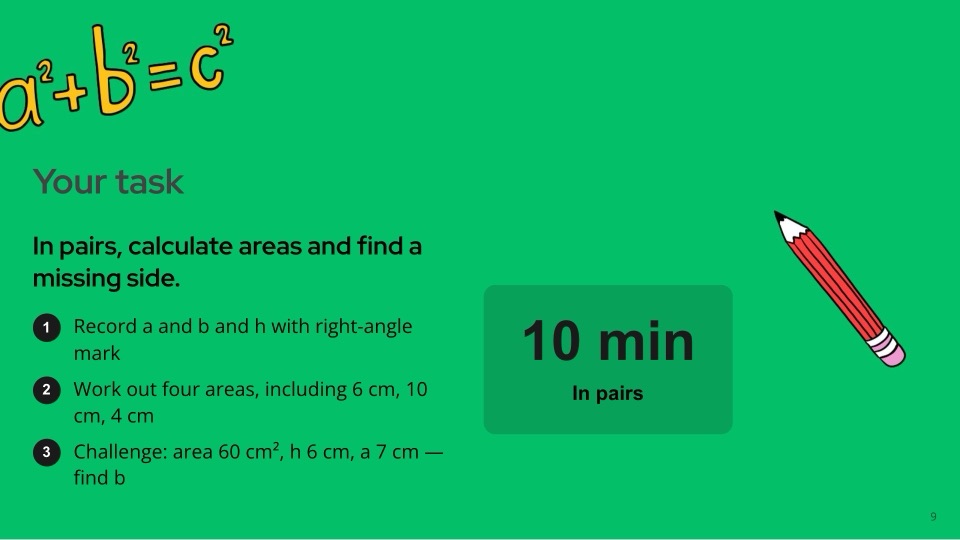
| 20 min | Main activity | Build the joined parallelogram and then calculate four trapezia independently. Hand out squared paper shapes, scissors and glue and show Slide 9 task. Direct pairs to cut two congruent trapezia, colour parallel sides, rotate one 180 degrees and stick as parallelogram. Circulate to check labels a, b and perpendicular h, then set Worksheet Task B. Stop for mid-point check on 6 cm, 10 cm, 4 cm question before challenge. |
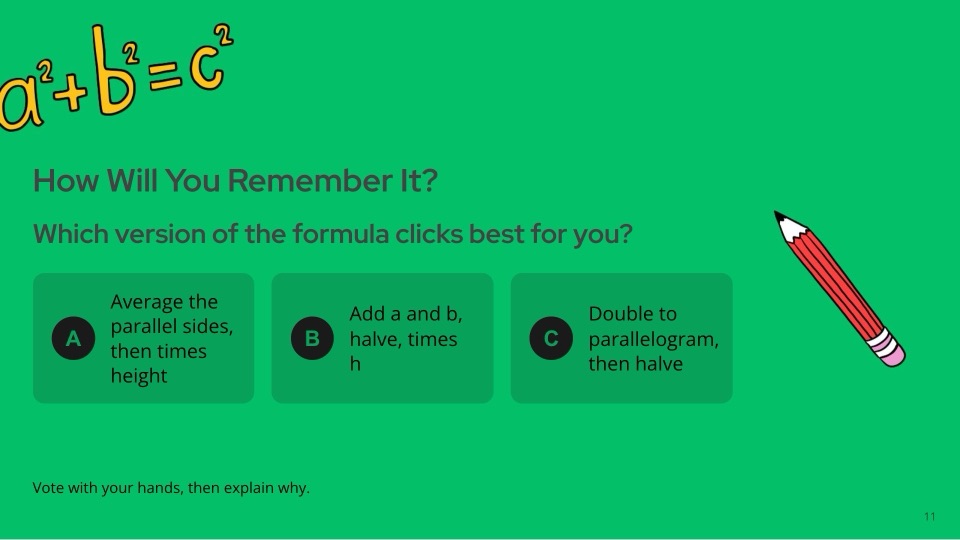
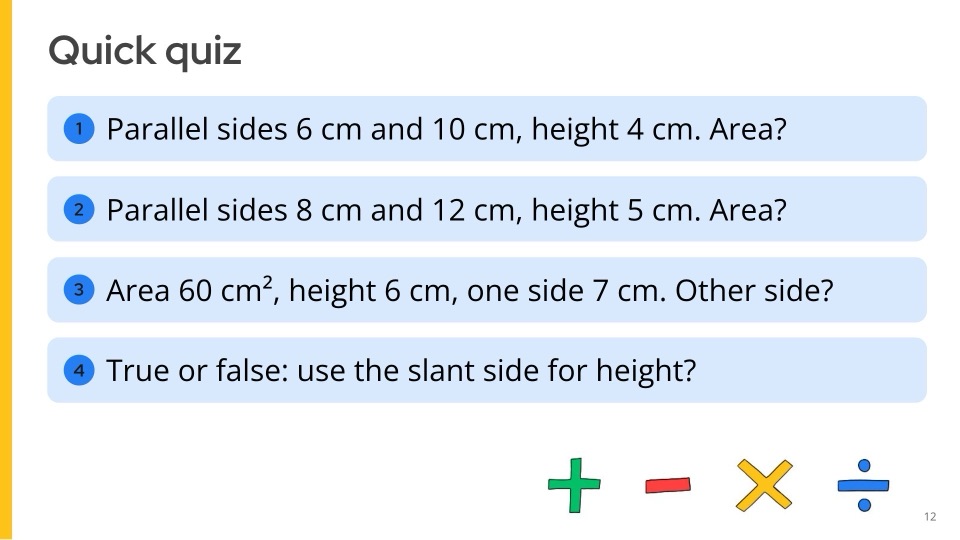
| 10 min | Plenary | Secure the formula, correct common errors and check who can apply it. Run Slide 11 vote on favourite version: average then times height or add, halve, times h. Show three error cards: slant height, wrong sides, forgotten half, and ask pairs to fix. Run Slide 12 quick quiz as exit ticket on whiteboards. Summarise against objectives and set homework. |
Common mistakes
- Using slant side instead of perpendicular height
How to spot it: Answer too big and working uses side without right-angle mark
Circle height with right-angle symbol; height is the perpendicular gap between sides. - Forgetting to halve
How to spot it: Answer exactly double, e.g. 64 cm² instead of 32 cm²
Always write A = ½(a + b) x h first; missing the half doubles the answer. - Adding non-parallel sides into a + b
How to spot it: Uses all four sides or the legs in the brackets
Find arrows for parallel sides first; only the two parallel sides go in.
Support
- Give pre-drawn trapezia on squared paper with parallel sides marked with arrows
- Use right-angle marks and formula cards with labelled a, b, h sketch
- Provide area ÷ h = average frame for missing-side work
Stretch
- Try joining trick with right-angled trapezium and explain why it makes a rectangle
- Solve sideways trapezium and decimal sides 4.5 cm and 7.5 cm with height 8 cm
- Create missing-side puzzles and compound rectangle-plus-trapezium totals
Check questions
- Parallel sides 6 cm and 10 cm, height 4 cm. Area?
Answer: 32 cm² - Parallel sides 8 cm and 12 cm, height 5 cm. Area?
Answer: 50 cm² - Area 60 cm², height 6 cm, one side 7 cm — find b.
Answer: 13 cm
Curriculum
derive and apply formulae to calculate and solve problems involving: perimeter and area of triangles, parallelograms, trapezia, volume of cuboids (including cubes) and other prisms (including cylinders)
From National curriculum in England, Key Stage 3 mathematics.
Video clips
Clips on YouTube, from the start and end times we chose. Check each one before you show it.
-
Visual trapezium to parallelogram from 0:00 to 2:36
Minity Maths: How To Find The Area Of A Trapezium
Clearly derives the Year 7 formula by doubling the trapezium and is paced and worded for 11-12 year olds.
-
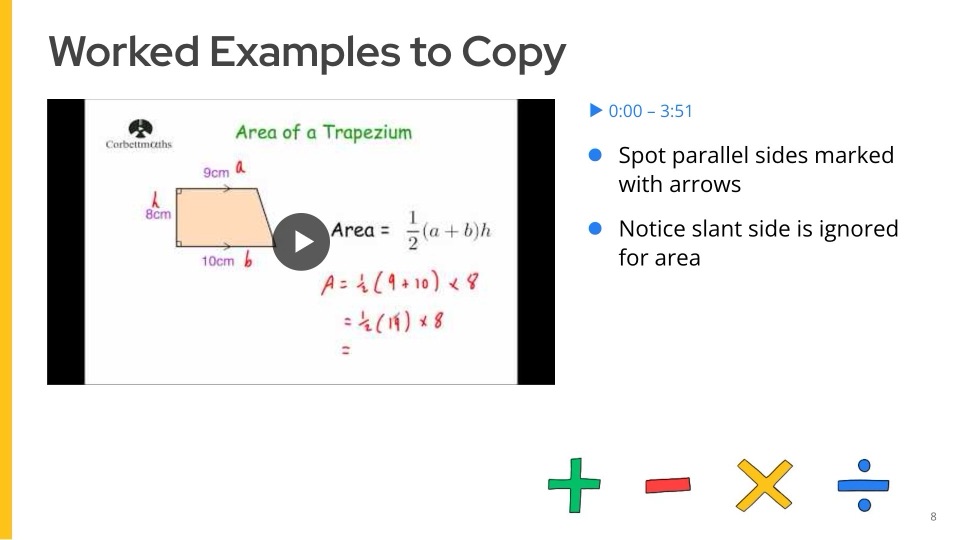
Corbettmaths area examples from 0:00 to 3:51
corbettmaths: Area of a Trapezium - Corbettmaths
UK Key Stage 3 explanation with three worked examples that suits Year 7 pace and maths vocabulary.
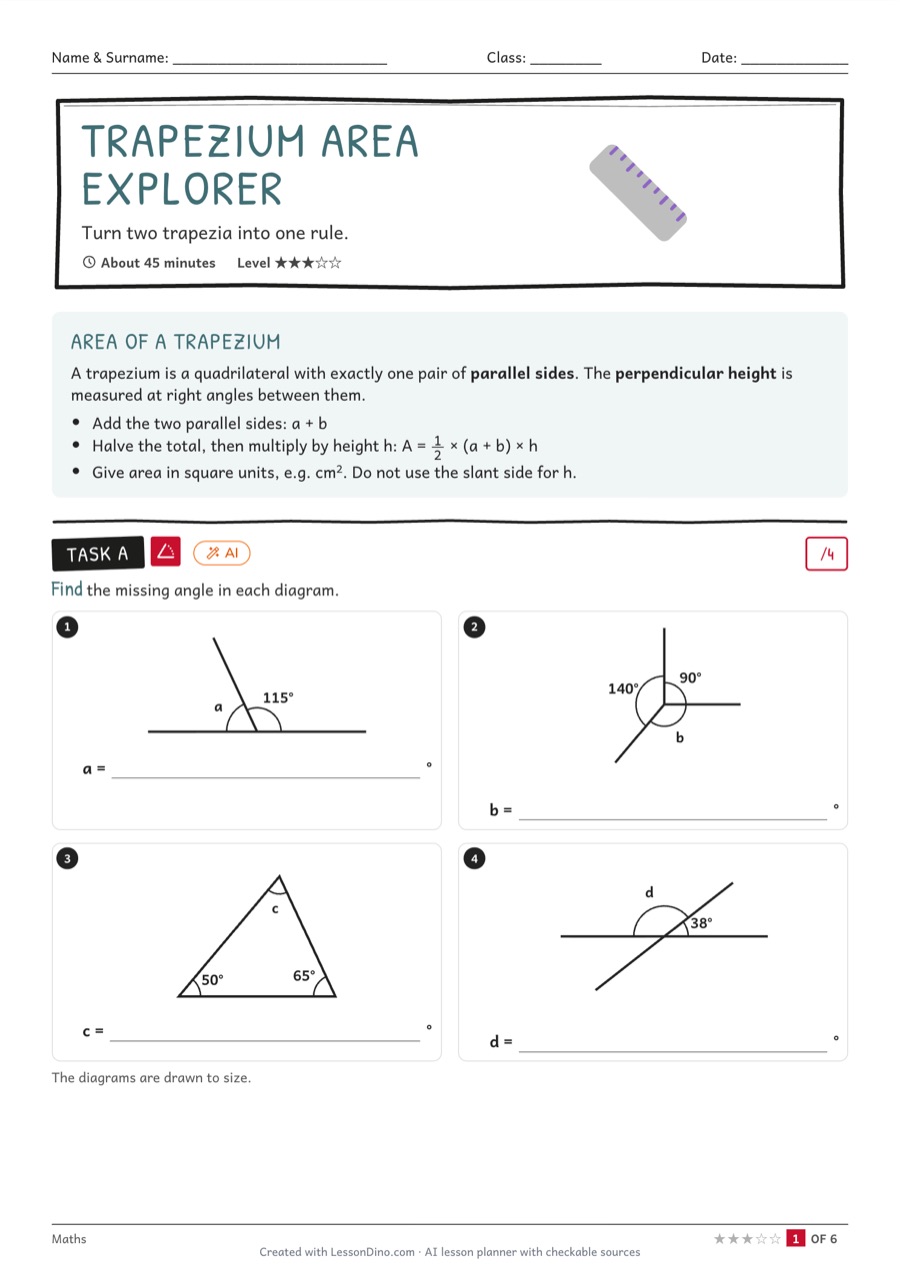
Worksheet
Sources
- Area of trapeziums - KS3 Maths - BBC Bitesize bbc.co.uk
- Area of a Trapezium - GCSE Maths Questions & Mark Scheme | Virtus Academy virtusacademy.co.uk
- Area of a Trapezium - GCSE Maths Revision Guide gcsemathsai.co.uk
- AREA OF A TRAPEZIUM - Milford Haven School milfordhavenschool.co.uk
- Area of a Trapezium - — GCSE Maths Formula Sheet | GCSEMaths gcsemathsai.co.uk
- Area of a trapezium KS3 | Y7 Maths | Lesson Resources thenational.academy
- How to show the formula for the area of a trapezium - BBC bbc.co.uk
- Lesson: Area of a trapezium | Oak National Academy thenational.academy
- Maths Area of a trapezium - api.thenational.academy api.thenational.academy
- Area of Trapezium (Trapezoid) - Formula, Interactives and ... flexbooks.ck12.org
- Area of a Trapezium transum.org
- Area Of Trapezium – Definition, Examples | EDU.COM edu.com
- Area of a Trapezium | Formula, Derivation, Examples geeksforgeeks.org
- Area of Trapezium | Definition, Formula, Examples and Quiz workybooks.com
- Area of a Trapezium - Free Worksheet for Kids - SKOOLGO skoolgo.com
- BYJU'S Online learning Programs For K3, K10, K12, NEET, JEE ... byjus.com
- Area of a Trapezium - Video, Quiz and Flashcards maths-angel.com
- Trapezium Calculator - Area & Perimeter Calculator with Steps eguruchela.com
- H15 trapezium area 2 gcsemaths.b-cdn.net
- Area of a Trapezium - The Engineering Mindset theengineeringmindset.com
- Area of a Trapezium Worksheet - Twinkl twinkl.com
Picture credits
- Photo: monicore · Pixabay
- AI illustration · Cloudflare
- Photo: akshayapatra · Pixabay
- Microsoft Fluent Emoji (MIT)
Made with Lesson Dino's AI on 19 October 2026. AI can make mistakes, so check facts against the sources before you teach.