The worksheet
About this worksheet
Pupils calculate with negative integers, decimals, fractions and mixed numbers. They use formal written methods and solve lift, temperature and money problems. This Year 7 Maths worksheet gives students (ages 11–12) six pages of practice on calculating with negative numbers, part of the number unit. It goes with our free Calculating with negative numbers lesson, which has the slides and a timed lesson plan.
What it covers
By the end, students should be able to:
- Students will add and subtract negative integers, decimals and fractions correctly.
- Students will multiply and divide positive and negative numbers including mixed numbers.
- Students will use formal written methods and decide the correct sign.
How to use it
- Main activity: Lift and Thermometer Challenge (20 minutes): Give out problem cards, thermometer sheets and Worksheet Tasks B and C for recording.
- Support: Give a word bank for add, subtract, multiply and divide and start with integer-only cards.
- Stretch: Give a problem with a mixed number temperature change, such as -2 1/2 degrees plus -3 1/4 degrees.
- The answer sheet is the last page, so you can print it on its own or let students check their own work.
Key vocabulary
- integer: a whole count that can be below zero, zero, or above zero
- decimal: a value with a point dividing ones from tenths and hundredths
- directed number: a value with a plus or minus sign showing its side of zero
- common denominator: a shared bottom part that lets two parts be added or compared
- mixed number: a whole count joined with a part of a whole, such as one and a half
Mistakes to watch for
- Writing -2 - -5 = -7 instead of +3. Show jump right on the line: take away a negative turns to add, so -2 + 5 = 3.
- Giving a positive answer for different signs in multiplication. Rehearse rule card: same signs make positive, different make negative, check with estimation.
- Adding fractions without a common denominator, e.g. -1/2 - 3/4 = -4/6. Overlay fraction strips to see quarters needed: -2/4 - 3/4 = -5/4.
What's on the worksheet
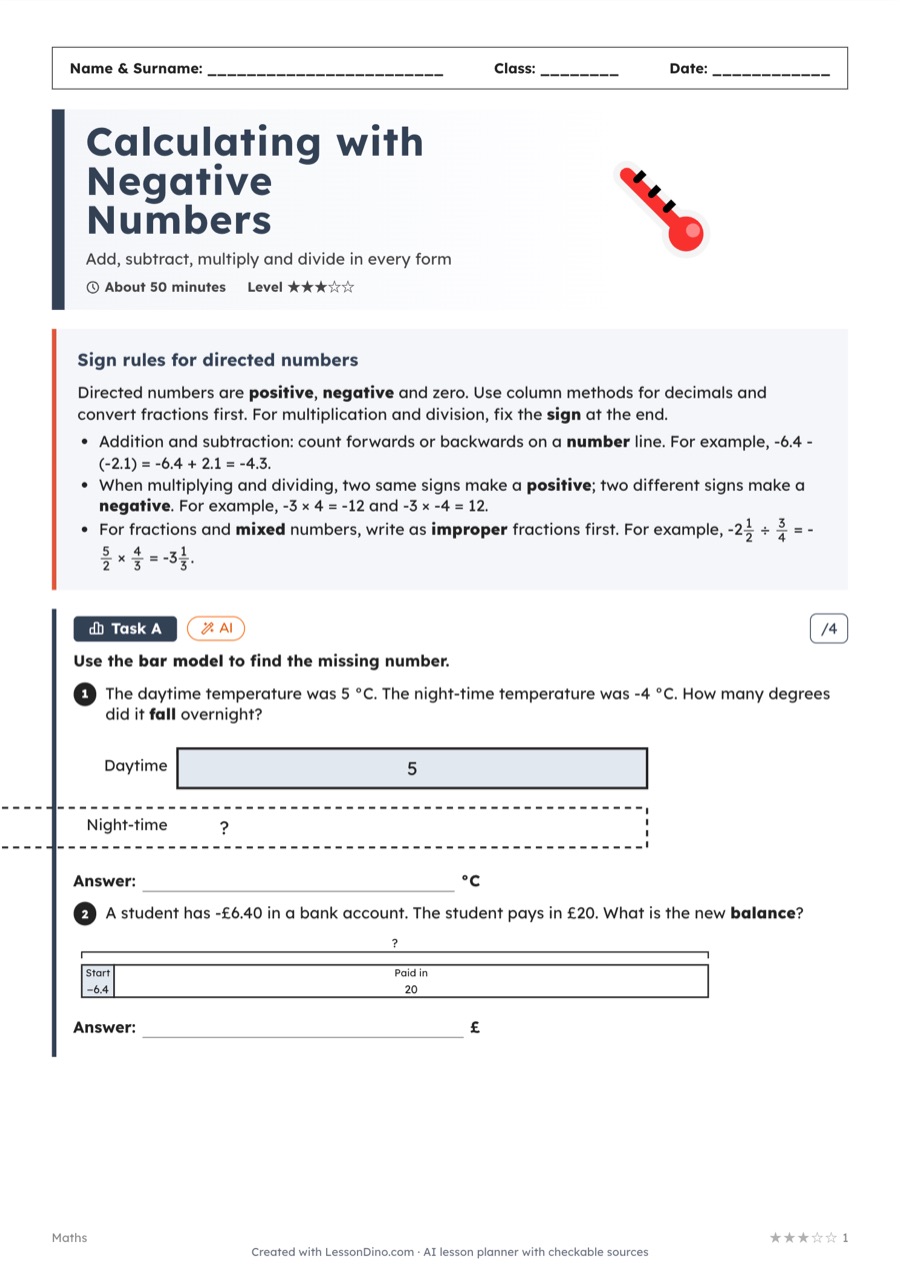
Sign Rules First
Learn the sign rules for adding, subtracting, multiplying and dividing.
Sign rules for directed numbers
- Directed numbers are positive, negative and zero. Use column methods for decimals and convert fractions first. For multiplication and division, fix the sign at the end.
- Addition and subtraction: count forwards or backwards on a number line. For example, -6.4 - (-2.1) = -6.4 + 2.1 = -4.3.
- When multiplying and dividing, two same signs make a positive; two different signs make a negative. For example, -3 × 4 = -12 and -3 × -4 = 12.
- For fractions and mixed numbers, write as improper fractions first. For example, -2 1/2 ÷ 3/4 = -5/2 × 4/3 = -3 1/3.
Use the bar model to find the missing number.
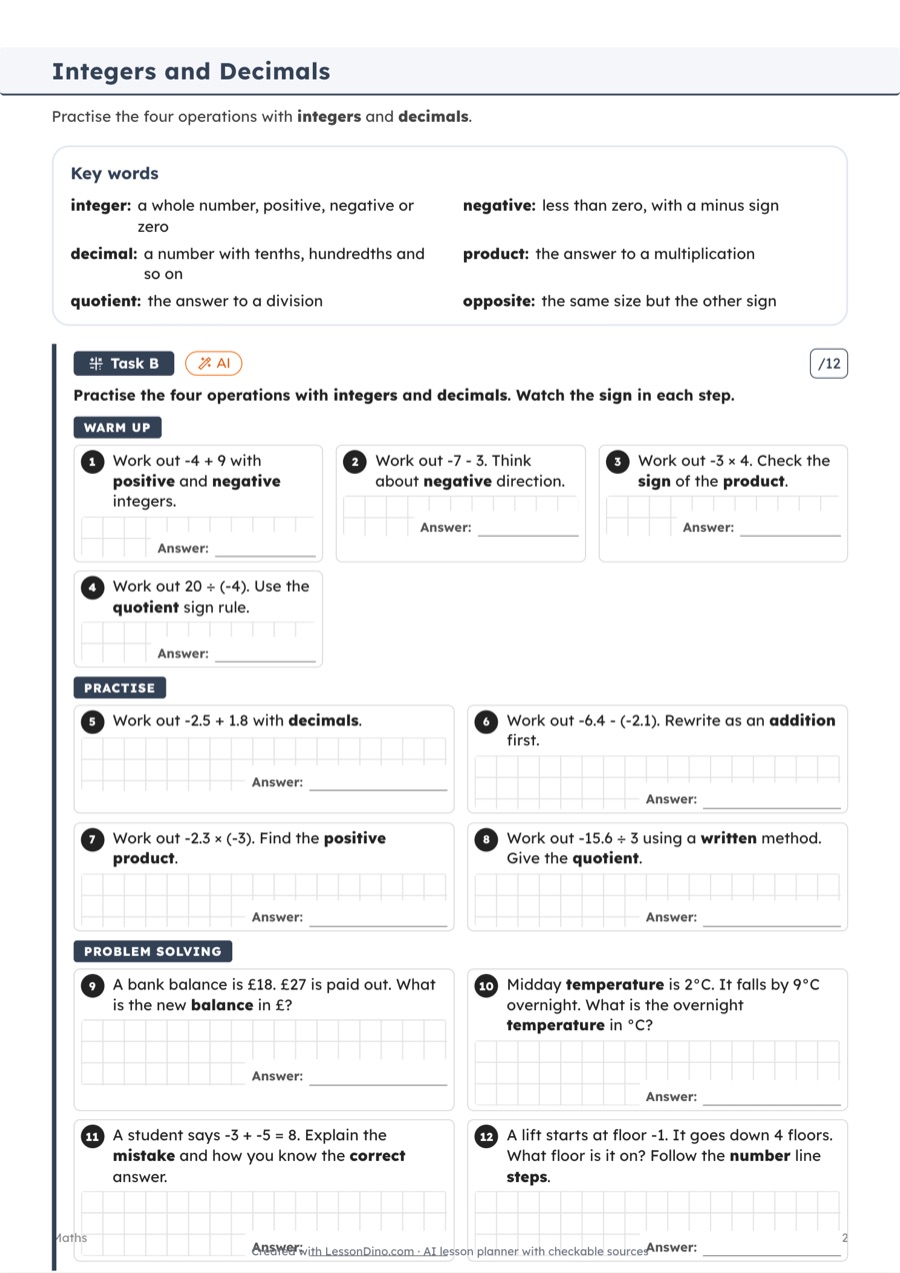
Integers and Decimals
Practise the four operations with integers and decimals.
| Word | Meaning |
|---|---|
| integer | a whole number, positive, negative or zero |
| negative | less than zero, with a minus sign |
| decimal | a number with tenths, hundredths and so on |
| product | the answer to a multiplication |
| quotient | the answer to a division |
| opposite | the same size but the other sign |
Practise the four operations with integers and decimals. Watch the sign in each step.
Warm up
- Work out -4 + 9 with positive and negative integers.
- Work out -7 - 3. Think about negative direction.
- Work out -3 × 4. Check the sign of the product.
- Work out 20 ÷ (-4). Use the quotient sign rule.
Practise
- Work out -2.5 + 1.8 with decimals.
- Work out -6.4 - (-2.1). Rewrite as an addition first.
- Work out -2.3 × (-3). Find the positive product.
- Work out -15.6 ÷ 3 using a written method. Give the quotient.
Problem solving
- A bank balance is £18. £27 is paid out. What is the new balance in £?
- Midday temperature is 2°C. It falls by 9°C overnight. What is the overnight temperature in °C?
- A student says -3 + -5 = 8. Explain the mistake and how you know the correct answer.
- A lift starts at floor -1. It goes down 4 floors. What floor is it on? Follow the number line steps.
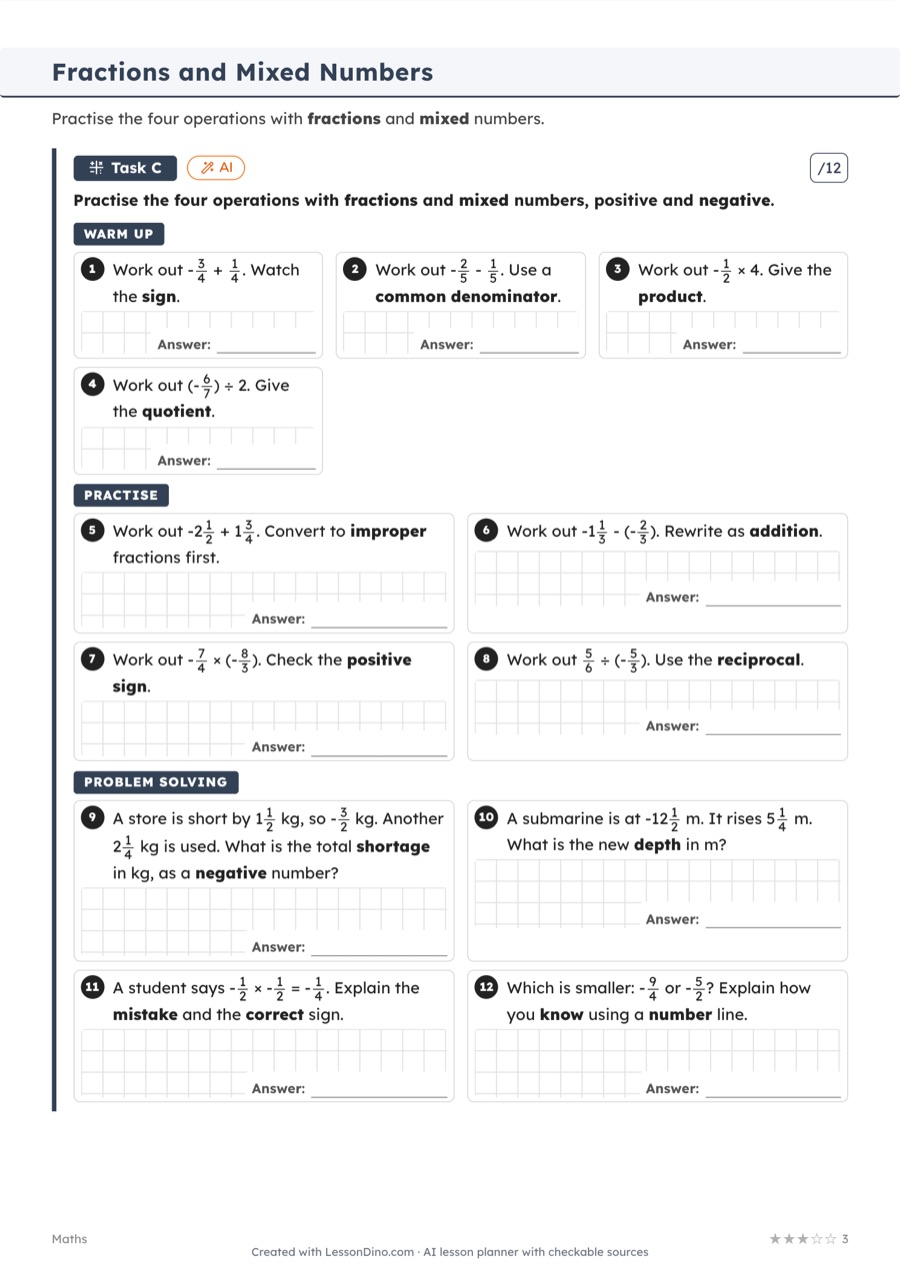
Fractions and Mixed Numbers
Practise the four operations with fractions and mixed numbers.
Practise the four operations with fractions and mixed numbers, positive and negative.
Warm up
- Work out -3/4 + 1/4. Watch the sign.
- Work out -2/5 - 1/5. Use a common denominator.
- Work out -1/2 × 4. Give the product.
- Work out (-6/7) ÷ 2. Give the quotient.
Practise
- Work out -2 1/2 + 1 3/4. Convert to improper fractions first.
- Work out -1 1/3 - (-2/3). Rewrite as addition.
- Work out -7/4 × (-8/3). Check the positive sign.
- Work out 5/6 ÷ (-5/3). Use the reciprocal.
Problem solving
- A store is short by 1 1/2 kg, so -3/2 kg. Another 2 1/4 kg is used. What is the total shortage in kg, as a negative number?
- A submarine is at -12 1/2 m. It rises 5 1/4 m. What is the new depth in m?
- A student says -1/2 × -1/2 = -1/4. Explain the mistake and the correct sign.
- Which is smaller: -9/4 or -5/2? Explain how you know using a number line.
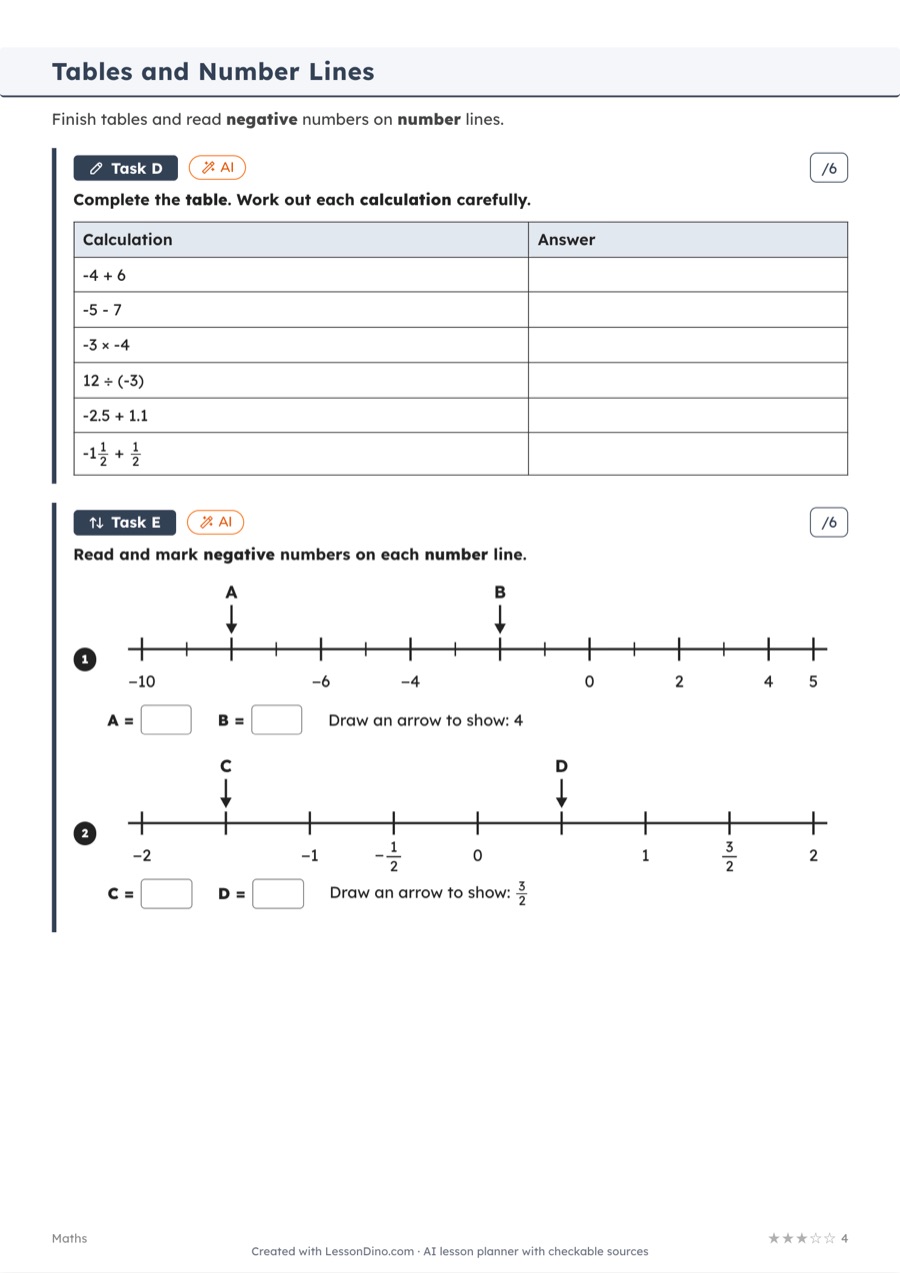
Tables and Number Lines
Finish tables and read negative numbers on number lines.
Complete the table. Work out each calculation carefully.
Read and mark negative numbers on each number line.
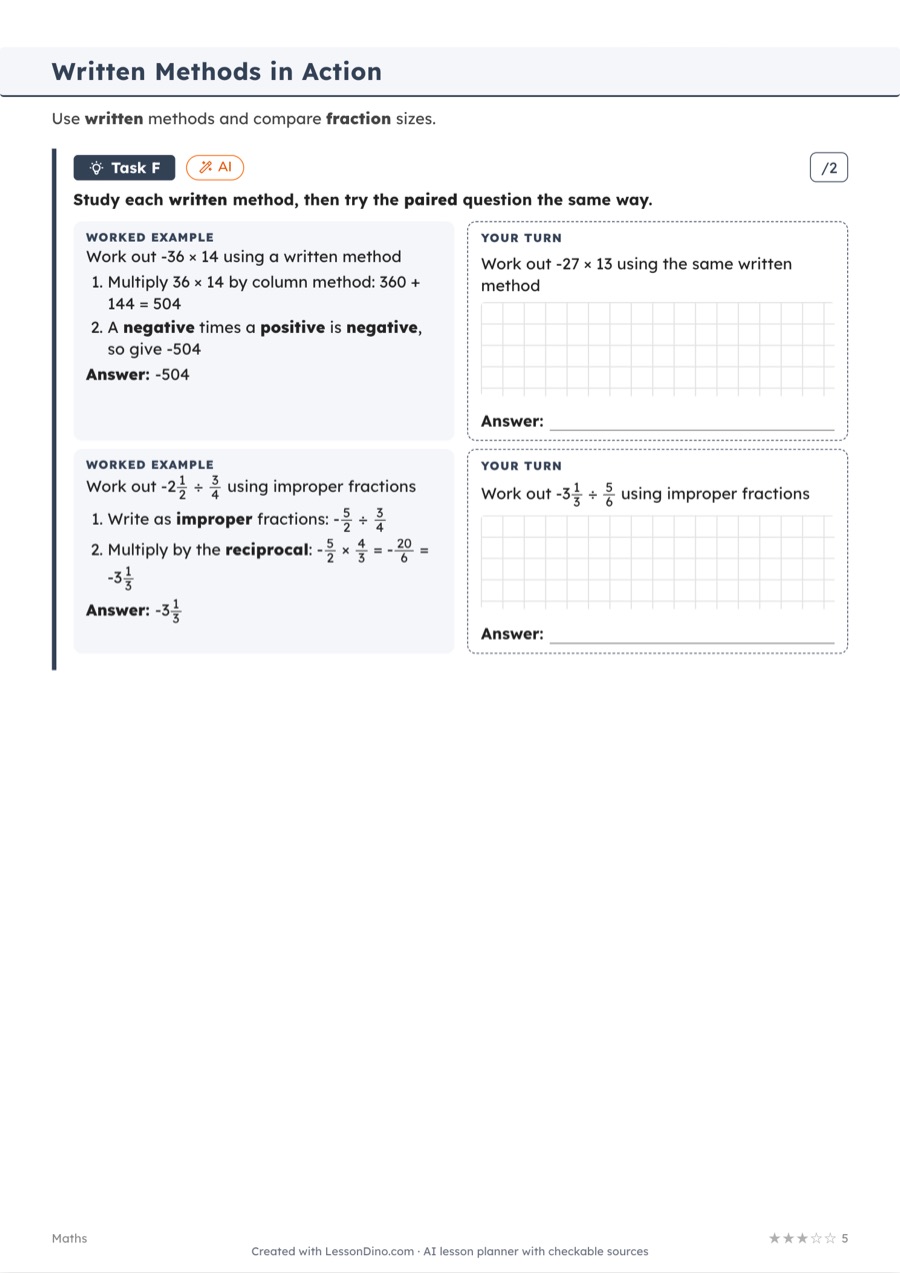
Written Methods in Action
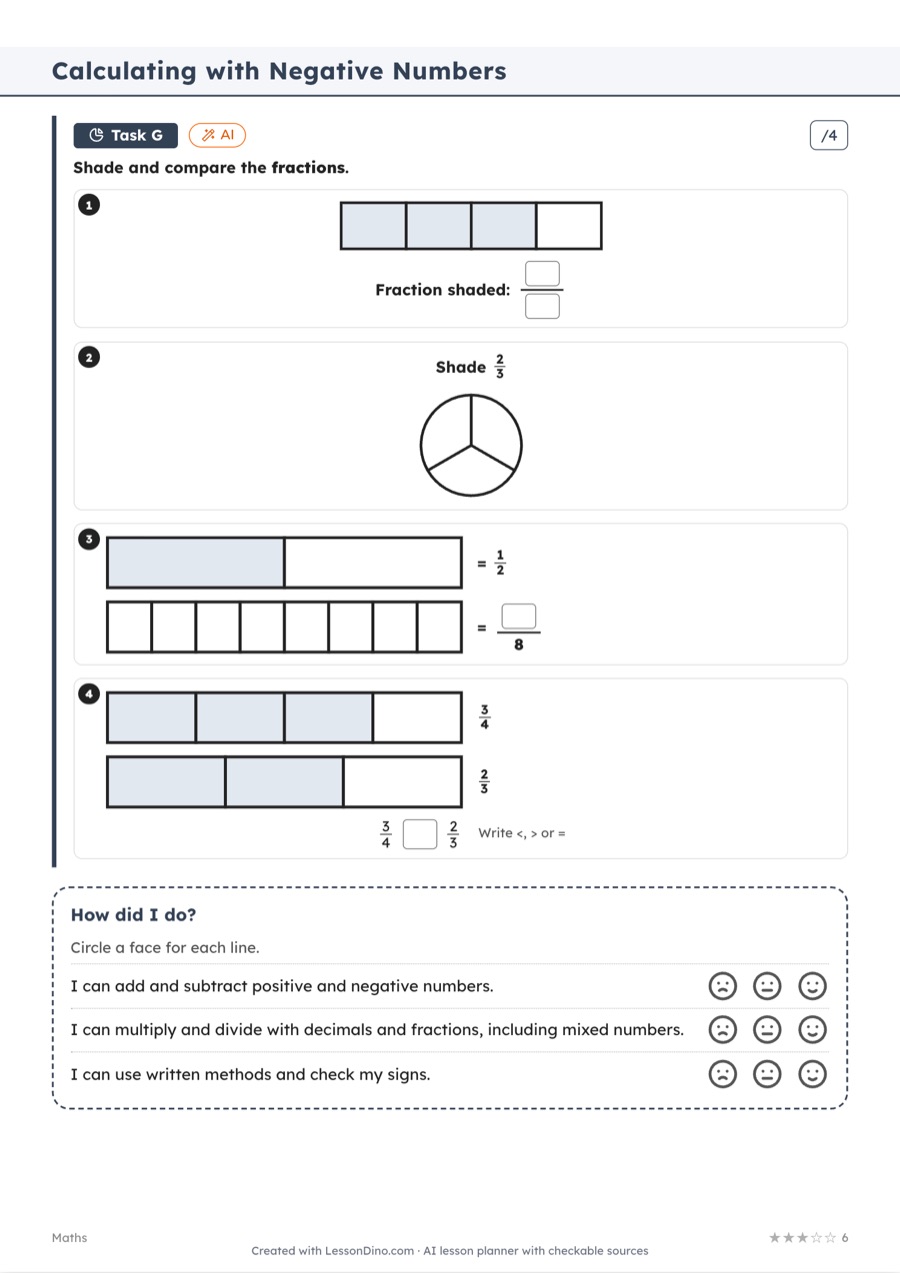
Use written methods and compare fraction sizes.
Study each written method, then try the paired question the same way.
Page 6
Shade and compare the fractions.
Answers
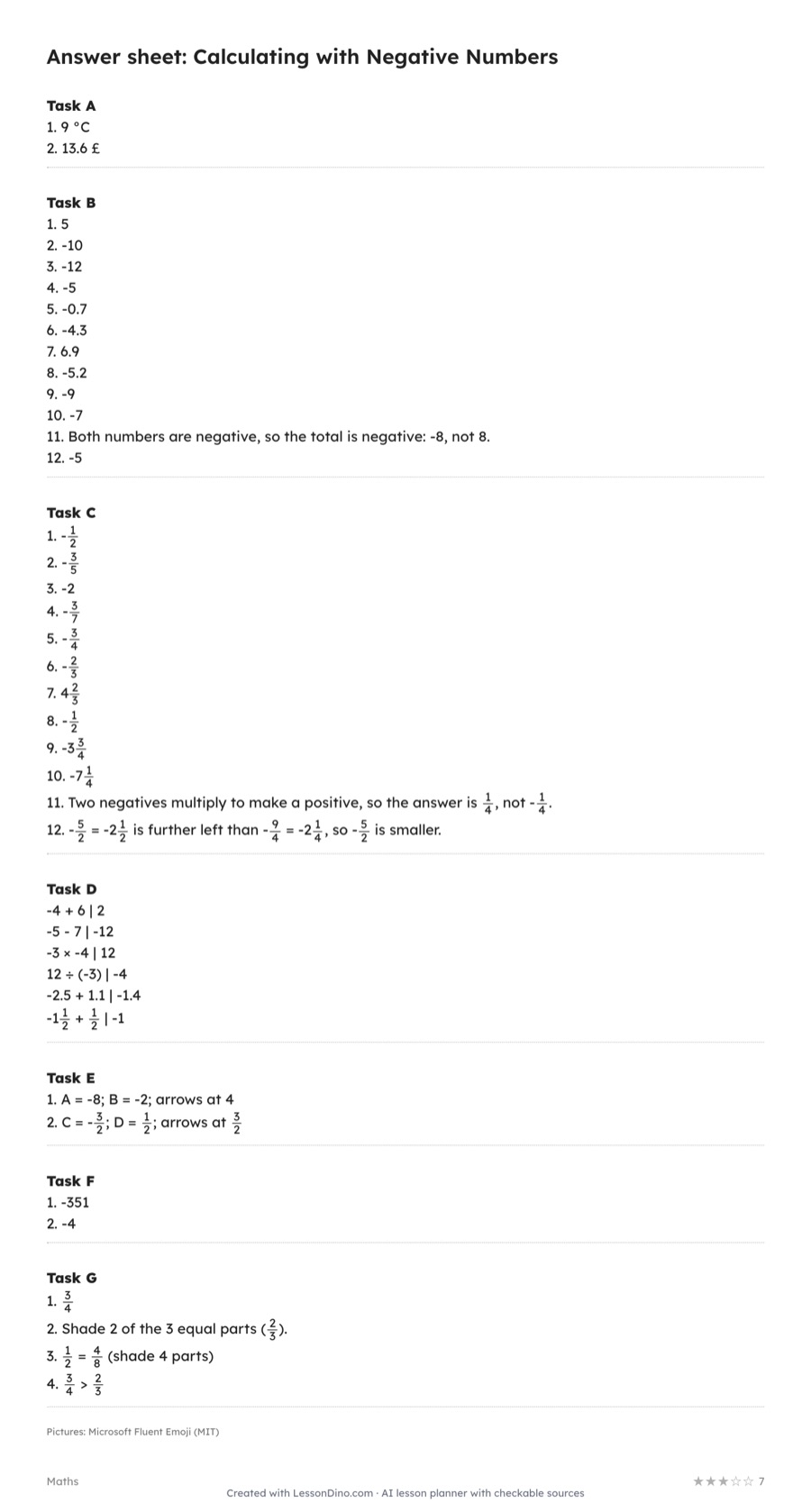
Show the answers
- Work out -4 + 9 with positive and negative integers. 5
- Work out -7 - 3. Think about negative direction. -10
- Work out -3 × 4. Check the sign of the product. -12
- Work out 20 ÷ (-4). Use the quotient sign rule. -5
- Work out -2.5 + 1.8 with decimals. -0.7
- Work out -6.4 - (-2.1). Rewrite as an addition first. -4.3
- Work out -2.3 × (-3). Find the positive product. 6.9
- Work out -15.6 ÷ 3 using a written method. Give the quotient. -5.2
- A bank balance is £18. £27 is paid out. What is the new balance in £? -9
- Midday temperature is 2°C. It falls by 9°C overnight. What is the overnight temperature in °C? -7
- A student says -3 + -5 = 8. Explain the mistake and how you know the correct answer. Both numbers are negative, so the total is negative: -8, not 8.
- A lift starts at floor -1. It goes down 4 floors. What floor is it on? Follow the number line steps. -5
- Work out -3/4 + 1/4. Watch the sign. -1/2
- Work out -2/5 - 1/5. Use a common denominator. -3/5
- Work out -1/2 × 4. Give the product. -2
- Work out (-6/7) ÷ 2. Give the quotient. -3/7
- Work out -2 1/2 + 1 3/4. Convert to improper fractions first. -3/4
- Work out -1 1/3 - (-2/3). Rewrite as addition. -2/3
- Work out -7/4 × (-8/3). Check the positive sign. 4 2/3
- Work out 5/6 ÷ (-5/3). Use the reciprocal. -1/2
- A store is short by 1 1/2 kg, so -3/2 kg. Another 2 1/4 kg is used. What is the total shortage in kg, as a negative number? -3 3/4
- A submarine is at -12 1/2 m. It rises 5 1/4 m. What is the new depth in m? -7 1/4
- A student says -1/2 × -1/2 = -1/4. Explain the mistake and the correct sign. Two negatives multiply to make a positive, so the answer is 1/4, not -1/4.
- Which is smaller: -9/4 or -5/2? Explain how you know using a number line. -5/2 = -2 1/2 is further left than -9/4 = -2 1/4, so -5/2 is smaller.
The answer sheet is the last picture above.
Curriculum
use the 4 operations, including formal written methods, applied to integers, decimals, proper and improper fractions, and mixed numbers, all both positive and negative
From National curriculum in England, Key Stage 3 mathematics.
Made with Lesson Dino's AI on 19 October 2026. AI can make mistakes, so check the answers and facts against the sources before you teach.