Slides
Lesson plan
Find the F and the Z to Find Missing Angles
Pupils learn that corresponding and alternate angles are equal on parallel lines. They find missing angles and give the angle reason each time.
Objectives
- Students will recognise equal corresponding angles in F shapes on parallel lines.
- Students will recognise equal alternate angles in Z shapes on parallel lines.
- Students will find missing angles using alternate and corresponding angle facts.
Success criteria
- I can spot F pairs and Z pairs where a transversal cuts parallel lines.
- I can find a missing angle and say why it is equal.
- I can check parallel arrows before I use the equal-angle rules.
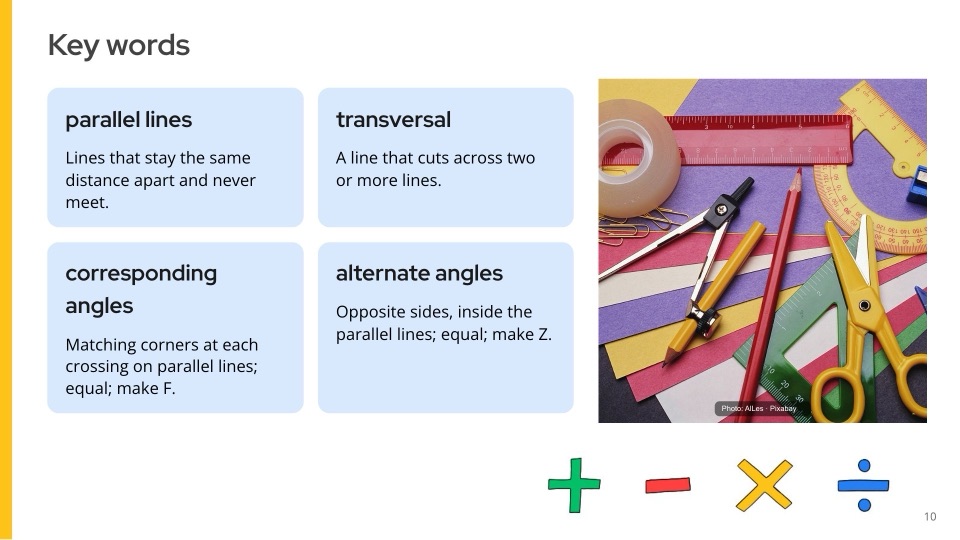
Key words
| Word | Meaning |
|---|---|
| parallel lines | straight lines that stay the same distance apart and never meet |
| transversal | a straight line that cuts across two or more other lines |
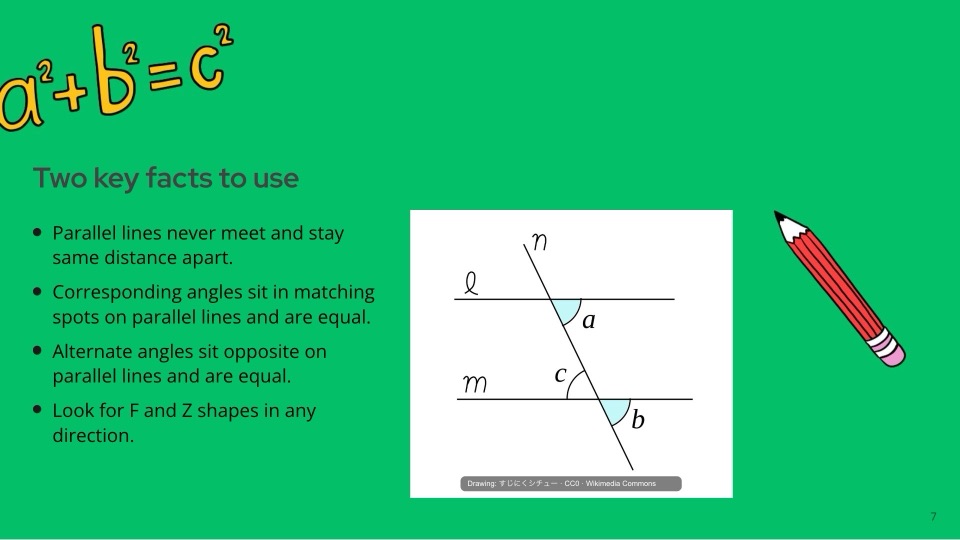
| corresponding angles | pair in matching corners at each crossing that are the same size when lines never meet |
| alternate angles | pair on opposite sides of the crossing line, inside the two lines, that are the same size |
Timed plan (60 minutes)
| Time | Stage | What happens |
|---|---|---|
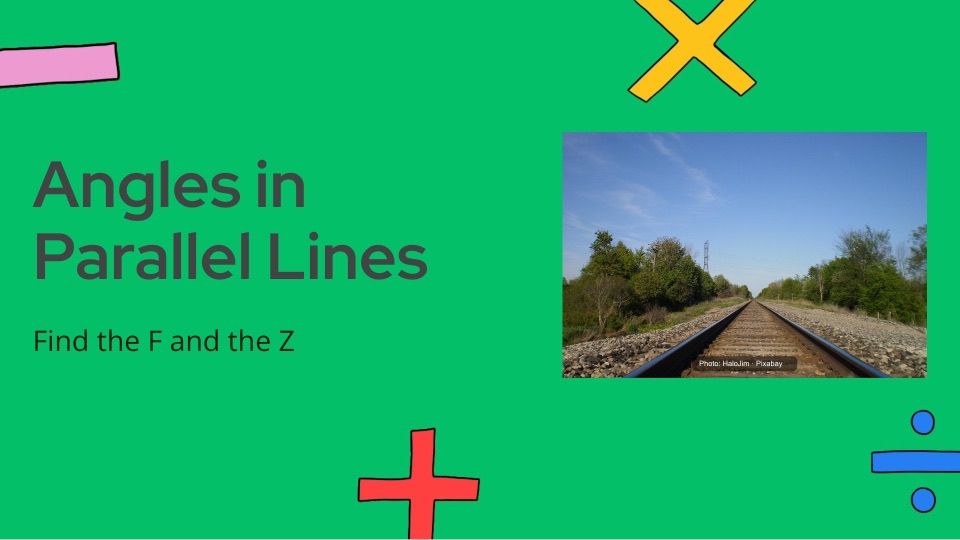
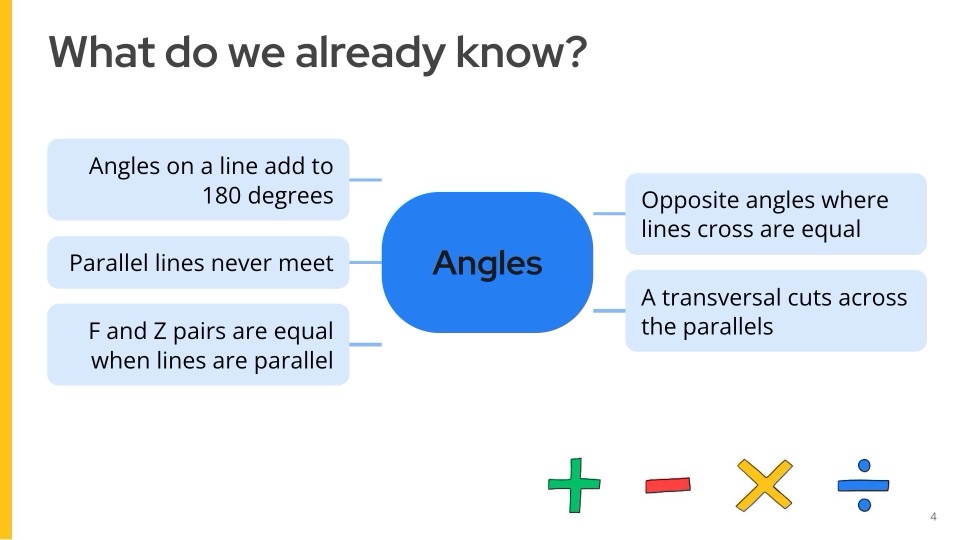
| 10 min | Starter | Recall basic angle facts and create curiosity about finding angles without measuring. Show Slide 1 Angles in Parallel Lines [title]: Find the F and the Z and say the hook: I am given one angle of 53 degrees and I can tell you three others without measuring — watch. Show Slide 4 What do we already know? mindmap and elicit: angles on a line add to 180 degrees, opposite angles where lines cross are equal, parallel lines never meet. Do a 2-minute check: draw one 53-degree angle on parallel lines cut by a transversal and ask pupils to show on mini-whiteboards what other angles they could work out. Share the lesson goal: we will calculate missing angles using alternate and corresponding facts and always give the reason. |
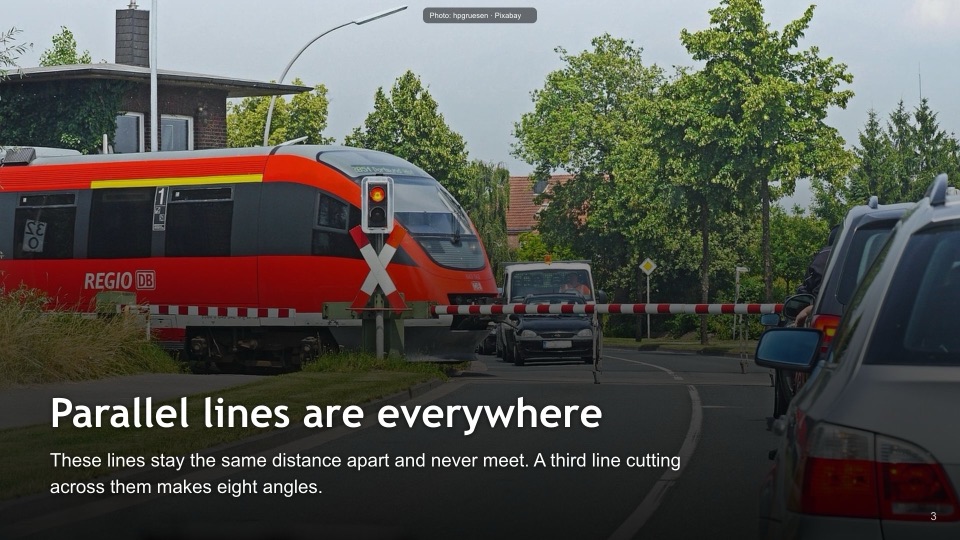
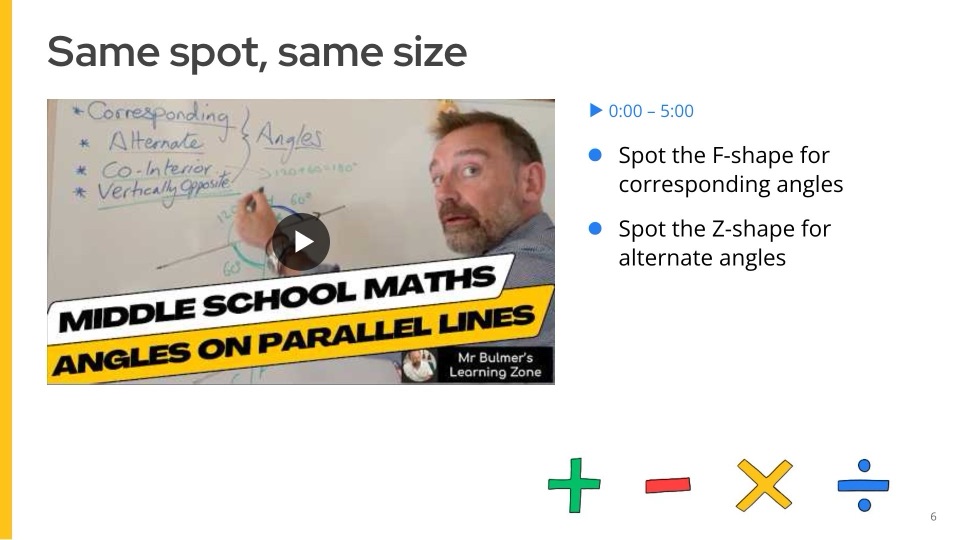
| 12 min | Teaching | Model how F shapes show equal corresponding angles and Z shapes show equal alternate angles. Define parallel lines as lines that stay the same distance apart and never meet, marked with matching arrows, and a transversal as a line which crosses the parallel lines. Play Video clip 2 alternate and corresponding step-by-step on Slide 6, pausing to trace the F-shape for corresponding angles and Z-shape for alternate angles. Model a worked example on the board using Slide 7 Two key facts to use, stressing you must check for matching parallel-line arrows before using equality. Insist on full reasons each time, since mark schemes award a mark for the correct reason as well as the correct value. |
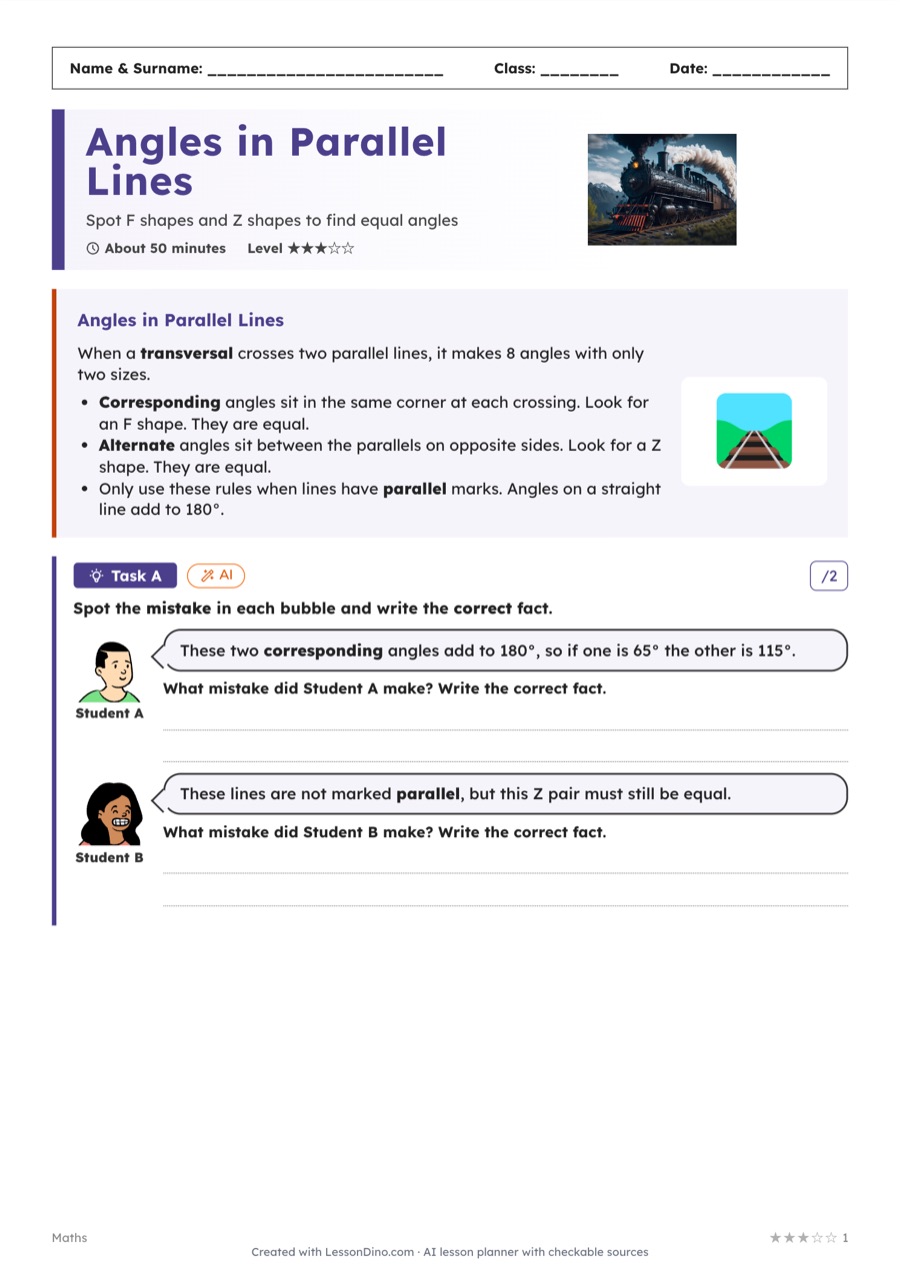
| 20 min | Main activity | Practise calculating missing angles on parallel lines with correct F and Z reasons. Hand out printed practice questions from Worksheet Task B and give one protractor and mini-whiteboard per pair. Direct pairs to first colour the target F or Z, then write size plus reason, for example 53 degrees because corresponding angles are equal. Circulate, asking pupils to point to parallel arrows and name F for equal corresponding angles or Z for equal alternate angles. Stop the class once for a two-step demo: alternate then angles on a straight line to find an angle two moves away. |
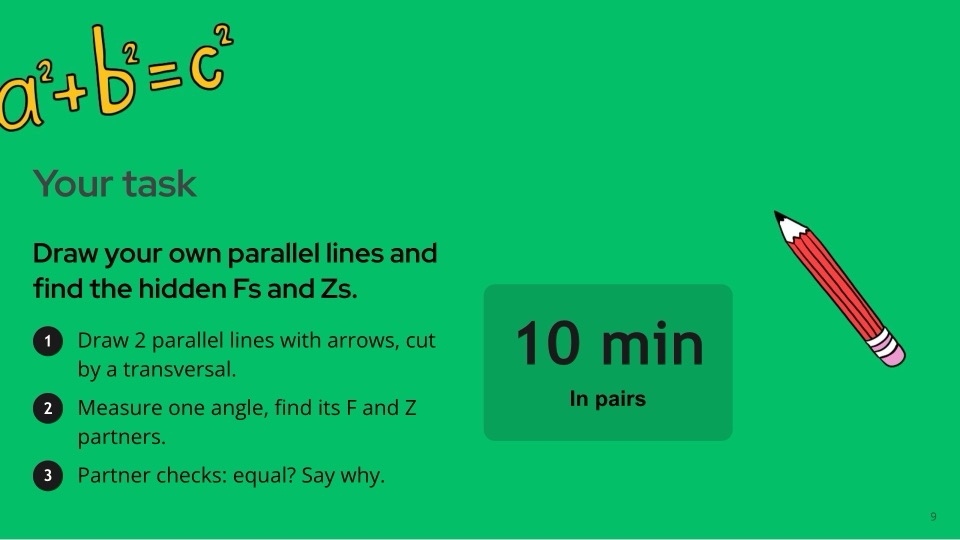
| 10 min | Draw and check | Secure understanding by drawing accurate parallels and proving pairs match by measuring. Show Slide 9 Your task: draw 2 parallel lines with arrows, cut by a transversal, measure one angle, find its F and Z partners. Remind pupils that a transversal creates eight angles with the parallel lines and F can be upside down or back to front. Direct partner checks: measure both angles in the pair - are they equal and can you say why? Pick two good drawings to display and narrate the F and Z reasons. |
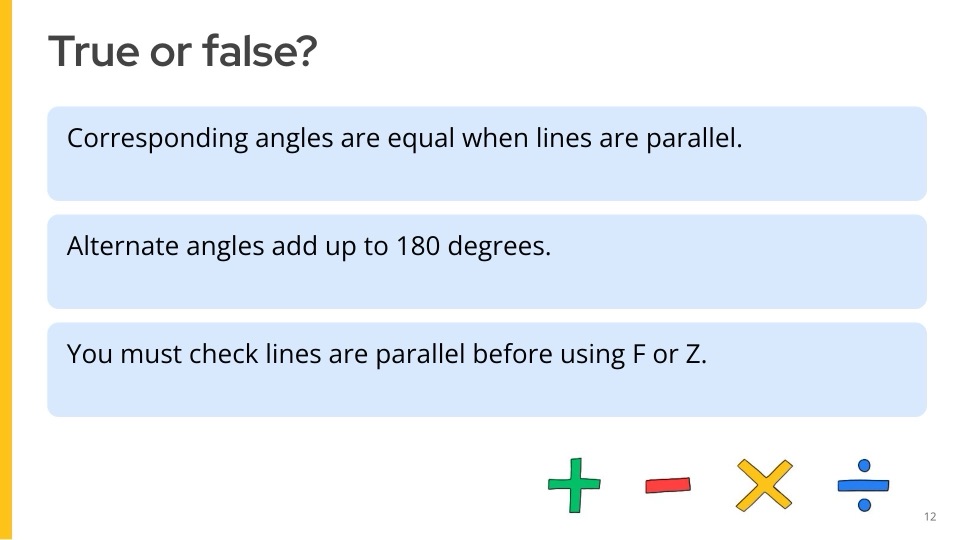
| 8 min | Plenary | Check the two key facts and correct the idea that equal rules work without parallel lines. Show Slide 12 True or false? and read each statement: corresponding equal when parallel, F positions, alternate add to 180, alternate equal. Ask pupils to vote true or false on mini-whiteboards and justify with F, Z or arrows. Stress the non-parallel trap: both pictures can have a Z shape but pairs are only certainly equal when lines are parallel, shown by arrows. Link back to success criteria and set homework. |
Common mistakes
- Using F or Z equality without checking lines are parallel
How to spot it: Pupil writes corresponding/alternate are equal on a diagram with no arrows or with lines that would meet
Stop and check for matching parallel-line arrows before using equality; rules need the lines to be parallel, shown by arrows. - Saying alternate angles add to 180 degrees
How to spot it: Pupil writes 180 minus the angle for a Z pair
Re-trace the Z and stress alternate angles are equal; 180 degrees is for angles on a straight line or C-shape co-interior angles. - Missing upside-down or back-to-front F and Z pairs
How to spot it: Pupil only finds upright F or Z and says there are no others
Rotate the sheet and re-trace; the F shape can be upside down or back to front and the Z can be back to front.
Support
- Colour the target F or Z before calculating, and provide a reason bank with corresponding angles are equal and alternate angles are equal to choose from.
- Give squared paper with the two parallel lines already drawn with arrows, so pupils only add the transversal.
- Use faint F and Z outlines to trace while learning matching positions at each intersection.
Stretch
- Chain two steps, such as alternate then angles on a straight line, to find an angle two moves away.
- Find a second, upside-down or back-to-front F or Z on the same diagram and explain why it still counts.
- Draw a second transversal at a different angle and compare how the alternate pair changes but stays equal.
Check questions
- Two parallel lines cut by a transversal. One angle is 70 degrees. What is its corresponding angle and why?
Answer: 70 degrees because corresponding angles are equal. - Two parallel lines cut by a transversal. One angle is 115 degrees. What is its alternate angle and why?
Answer: 115 degrees because alternate angles are equal. - A diagram shows a Z shape but the two lines have no parallel arrows. Can you say the angles are equal? Why?
Answer: No - check for matching arrows first; the equal rules need the lines to be parallel.
Curriculum
understand and use the relationship between parallel lines and alternate and corresponding angles
From National curriculum in England, Key Stage 3 mathematics.
Video clips
Clips on YouTube, from the start and end times we chose. Check each one before you show it.
-
alternate and corresponding step-by-step from 0:00 to 5:00
Mr Bulmer's Learning Zone: Angles on Parallel Lines – Explained Step-by-Step | Middle School Maths
Made for middle school so explanations are clear and unhurried for 11-12 year olds meeting these rules for the first time.
-
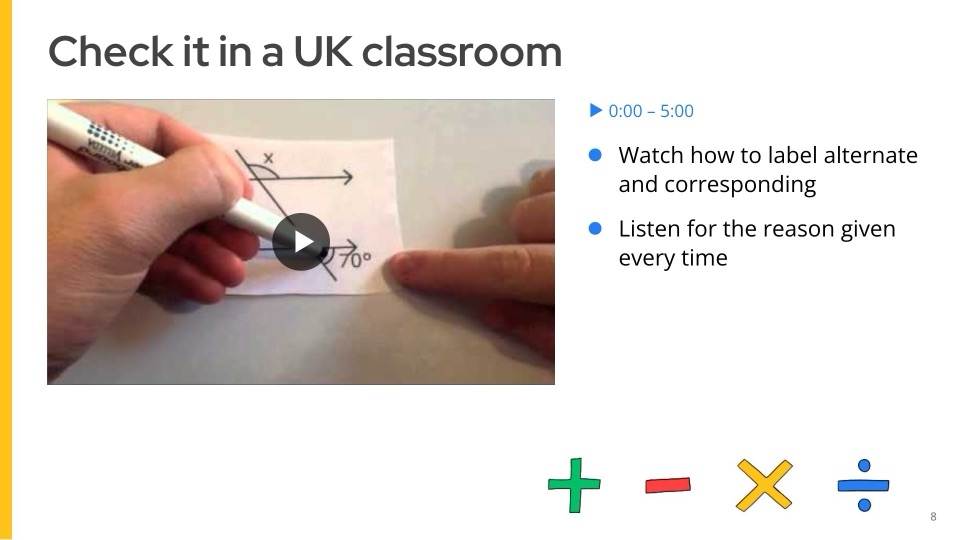
Corbettmaths alternate and corresponding from 0:00 to 5:00
corbettmaths: Angles parallel lines - Corbettmaths
UK classroom style familiar to Year 7, with pace and examples that suit 11-12 year olds.
Worksheet
Sources
- Year 7 Maths - Curriculum Map gosford-hill.oxon.sch.uk
- Year 7 Maths Curriculum Map - fishermore.lancs.sch.uk fishermore.lancs.sch.uk
- How to calculate angle in parallel lines - BBC Bitesize bbc.co.uk
- Angles made by parallel lines - Finding angles between lines - 3rd ... bbc.co.uk
- Angles in Parallel Lines: Definition & Examples | GCSE Maths revisionlibrary.co.uk
- Name: GCSE (1 - 9) Angles in Parallel Lines assets.mathsgenie.co.uk
- Angles in Parallel Lines - Virtus Academy virtusacademy.co.uk
- Angles in Parallel lines - Study Rocket studyrocket.co.uk
- Parallel lines & corresponding angles proof - Khan Academy khanacademy.org
- Angles and Parallel Lines | Flexi Homework help & answers | CK-12 Foundation ck12.org
- Angles with Parallel Lines - Transum transum.org
- Identifying parallel and intersecting lines - Khan Academy khanacademy.org
- Lines and angles - Year 3 Maths - BBC Bitesize bbc.co.uk
- Parallel Lines and Transversal - Properties, Angles, Interactives and ... flexbooks.ck12.org
- Angle en.wikipedia.org
- Angles Associated with Parallel Lines (examples, solutions, videos ... onlinemathlearning.com
- Angles in Parallel Lines Worksheets | Grades 7-8 cazoommaths.com
- Angle Relationships in Parallel Lines - Video and Quiz maths-angel.com
- Angles in Parallel Lines Practice Problems & Solutions tutorela.com
- Revision Notes Properties of Angles and Lines - Including Parallel - Class 6 edurev.in
- Angles GCSE | KS4 | Y10 Maths Foundation | Lesson Resources thenational.academy
- Angles in Parallel Lines Worksheets - Algebra911 algebra911.com
- Parallel Lines and Transversals - learnmath.org learnmath.org
- Angles on Parallel Lines (GGB) - Interactive Maths interactive-maths.com
- Parallel Lines, and Pairs of Angles - Math is Fun mathsisfun.com
Picture credits
Made with Lesson Dino's AI on 19 October 2026. AI can make mistakes, so check facts against the sources before you teach.