Slides
Lesson plan
Prime Codes, Shared Factors and Meeting Multiples
Pupils build numbers from primes and write them with indices. They sort prime cards in a Venn diagram to find HCF and LCM.
Objectives
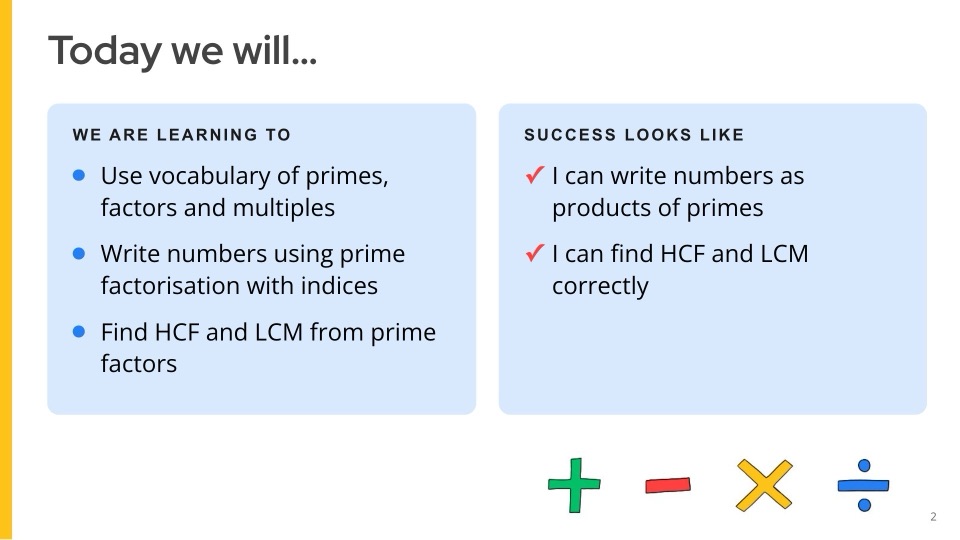
- Students will use vocabulary of primes, factors, multiples and common factors and multiples.
- Students will write prime factorisation using product notation and index form.
- Students will find HCF and LCM from prime factors using Venn diagrams.
Success criteria
- I can identify primes and list factors, multiples and common factors and multiples.
- I can write a number as a product of primes with indices.
- I can find HCF and LCM from prime factors in a Venn diagram.
Key words
| Word | Meaning |
|---|---|
| prime number | a whole number above 1 with only two exact divisors, 1 and itself |
| factor | a whole number that goes into another number exactly with nothing left over |
| multiple | a number in the times table of another number |
| highest common factor | the biggest number that divides two numbers exactly, found in the Venn overlap |
| lowest common multiple | the smallest number found in the times tables of two numbers |
| prime factorisation | writing a number using only × with numbers that cannot be split further, using powers for repeats |
Timed plan (60 minutes)
| Time | Stage | What happens |
|---|---|---|
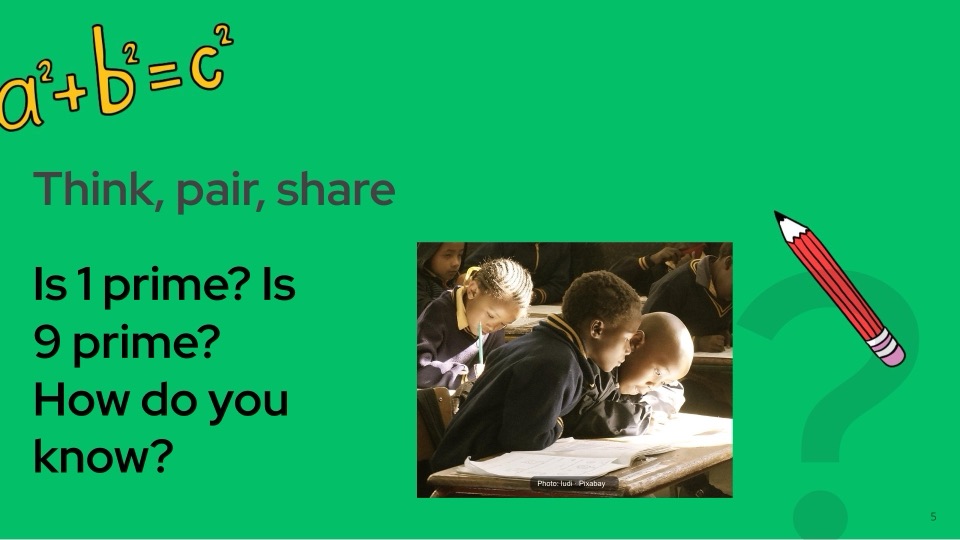
| 8 min | Starter | Recall primes, factors and multiples and hook pupils into shared primes. Show Slides 1–2 to share the lesson title and objectives for the 60 minutes. Say the hook: Two numbers are heading into the Venn rings — only the primes they share get to stand in the middle! Show Slide 5 Think, pair, share question: Is 1 prime? Is 9 prime? How do you know? Take answers and agree that primes have only 1 and itself as divisors. |
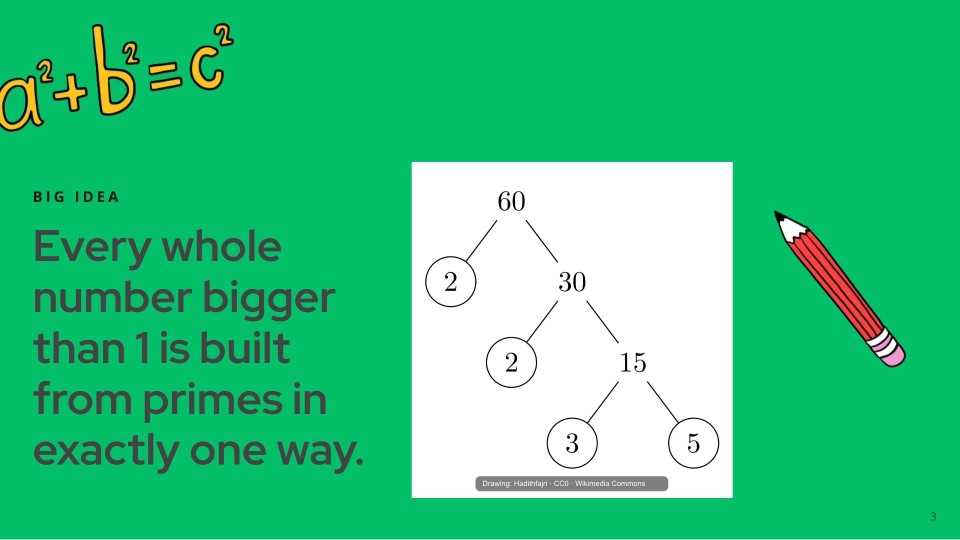
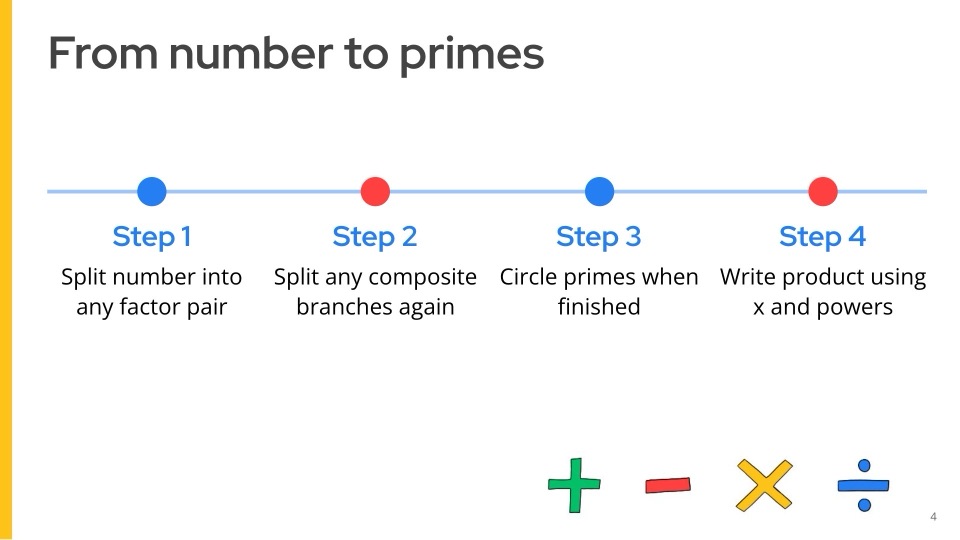
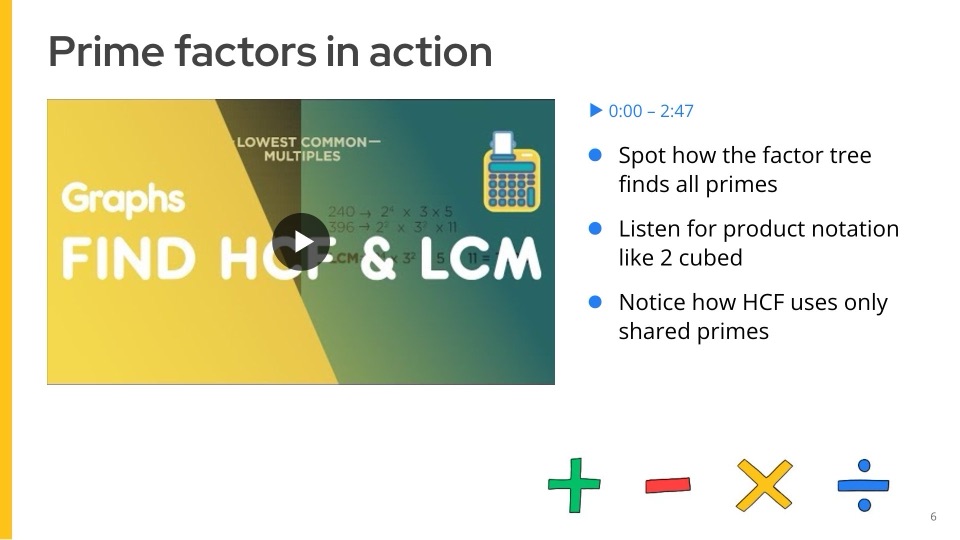
| 12 min | Teaching: factor trees | Model splitting a number to primes and writing product notation with indices. Show Slide 3 big idea and Slide 4 timeline for splitting into factor pairs. Model 60 on the board: 60 into 10 and 6, then 10 into 2 and 5, 6 into 2 and 3, circling primes. Play Video clip 1 (0:00–2:47) on Slide 6 and point out product notation like 2 cubed. Write the final line in expanded and index form and stress finishing only at primes. |
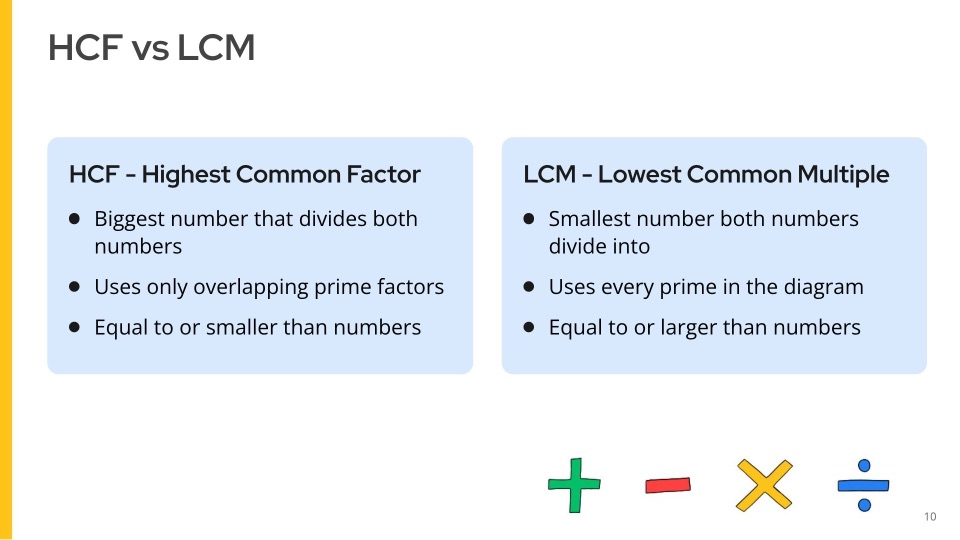
| 10 min | Teaching: Venn for HCF and LCM | Show how the overlap gives HCF and the whole diagram gives LCM. Write 18 = 2 × 3 × 3 and 30 = 2 × 3 × 5 on cards. Sort cards into the Venn rings, placing shared primes 2 and 3 in the overlap. Model HCF as the product of the overlap and LCM as the product of all numbers in the diagram. Link to Slide 10 compare: HCF divides both numbers, LCM is shared in both times tables. |
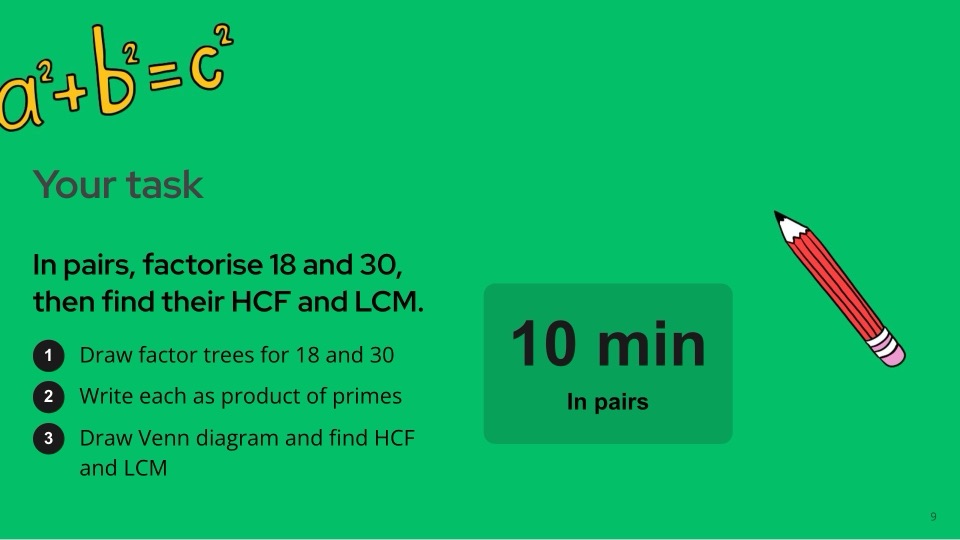
| 20 min | Main activity: Venn Winners | Practise finding HCF and LCM from prime factors using a Venn diagram. Hand out hoops or show circles, sets of number cards and mini-whiteboards. Direct pairs to draw trees for 18 and 30, write each as a product of primes, then sort cards into the Venn. Circulate, asking pairs to state HCF as product of overlap and LCM as product of whole diagram. Give stretch cards 50 = 2 × 5 × 5 and 16 = 2 × 2 × 2 × 2 for early finishers. |
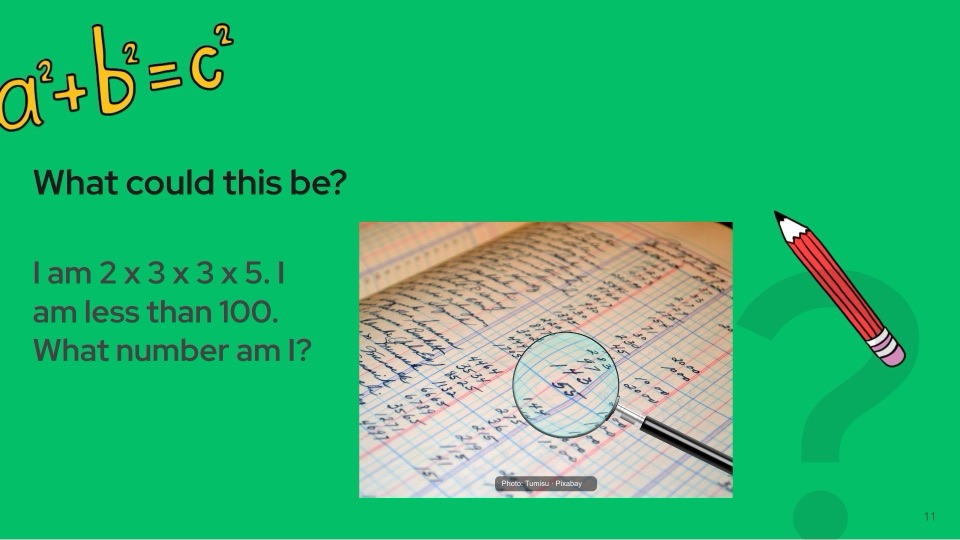
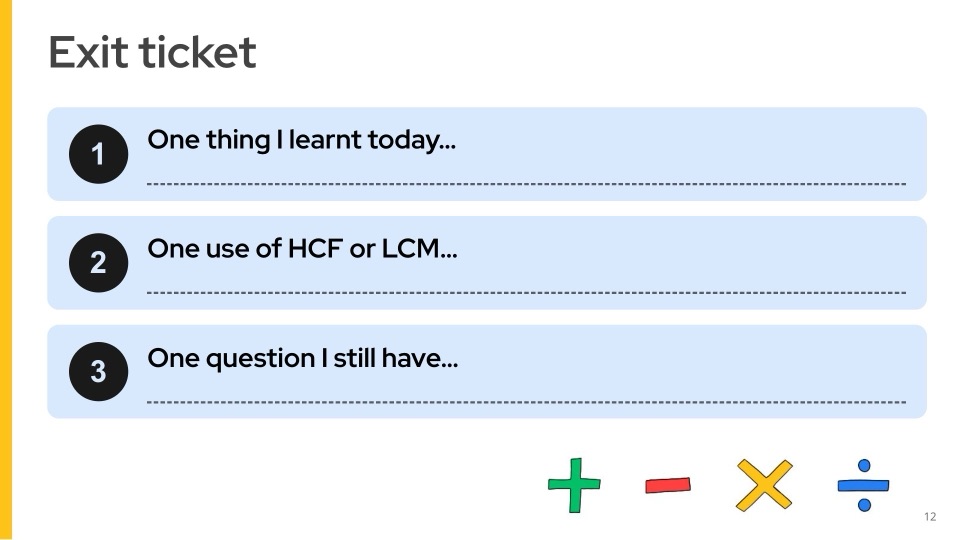
| 10 min | Plenary | Secure unique factorisation and HCF versus LCM before the exit check. Show Slide 11 mystery: I am 2 × 3 × 3 × 5, less than 100, what number am I? Agree answer 90 and stress every integer greater than 1 has a unique prime factorisation. Use Slide 10 to contrast HCF as biggest divider and LCM as first shared times-table number. Show Slide 12 exit ticket and collect three answers on whiteboards. |
Common mistakes
- Stopping a factor tree at composite numbers such as 10 or 6
How to spot it: Product line still contains 10, 6 or 9 instead of only primes
Split every composite branch again until only circled primes remain, then write the product. - Confusing factors with multiples
How to spot it: Pupil lists 36 as a factor of 18 or 3 as a multiple of 18
Check: factors divide the number exactly; multiples are in its times table. - Omitting repeated primes and using all factors for HCF
How to spot it: Writes 18 as 2 × 3 and gives HCF of 18 and 30 as 90
Keep every repeat and multiply only the overlap for HCF, all cards for LCM; HCF uses minimum powers, LCM maximum powers.
Support
- Hand out the prime cards already written out so students only have to sort and multiply.
- Give half-started trees and index frames such as 2^__ × 3^__ × 5^__.
- Keep a multiplication grid to test if a number really divides exactly.
Stretch
- Challenge pairs with 50 = 2 × 5 × 5 and 16 = 2 × 2 × 2 × 2 to find a much larger LCM.
- Ask for LCM of three numbers in prime form and for 90 = 2 × 3² × 5 in both forms.
- Ask why 1 cannot be in the prime code and to write a sneaky wrong solution to detect.
Check questions
- Write 18 as a product of primes using indices.
Answer: 18 = 2 × 3 × 3 = 2 × 3² - Find the HCF of 18 and 30 from prime factors.
Answer: HCF = 2 × 3 = 6 from the overlap - Find the LCM of 18 and 30 from prime factors.
Answer: LCM = 3 × 2 × 3 × 5 = 90 from all numbers in the diagram
Curriculum
use the concepts and vocabulary of prime numbers, factors (or divisors), multiples, common factors, common multiples, highest common factor, lowest common multiple, prime factorisation, including using product notation and the unique factorisation property
From National curriculum in England, Key Stage 3 mathematics.
Video clips
Clips on YouTube, from the start and end times we chose. Check each one before you show it.
-
Prime factorisation to HCF and LCM from 0:00 to 2:47
FuseSchool - Global Education: Prime Factorisation To Find HCF & LCM | Numbers | Maths | FuseSchool
Short, clear UK explanation using HCF, LCM and product of primes at an ideal pace for 11-12-year-olds.
-
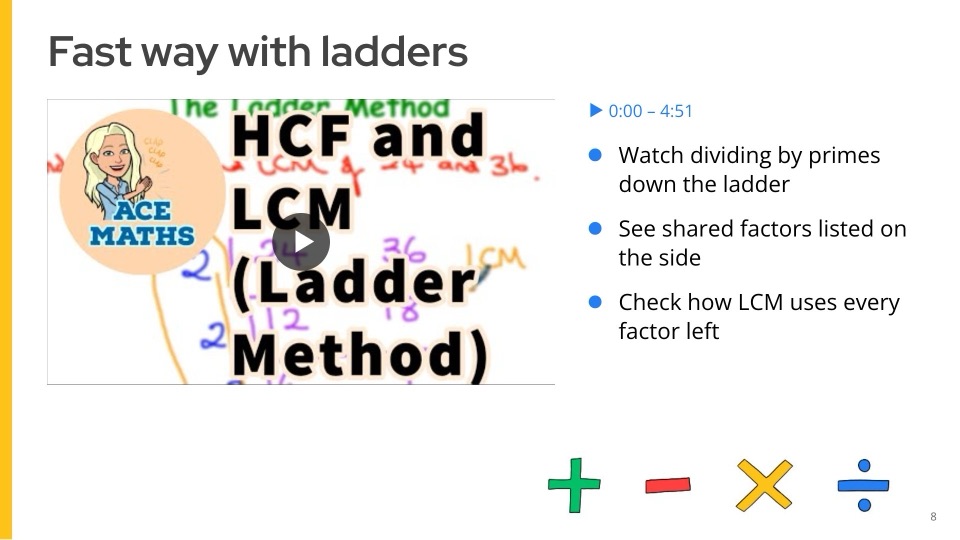
KS3 ladder method for HCF and LCM from 0:00 to 4:51
Ace Maths: KS3 Maths - Finding HCF and LCM using the Ladder Method
Explicitly made for KS3 so vocabulary and pace are perfect for 11-12-year-olds in Year 7.
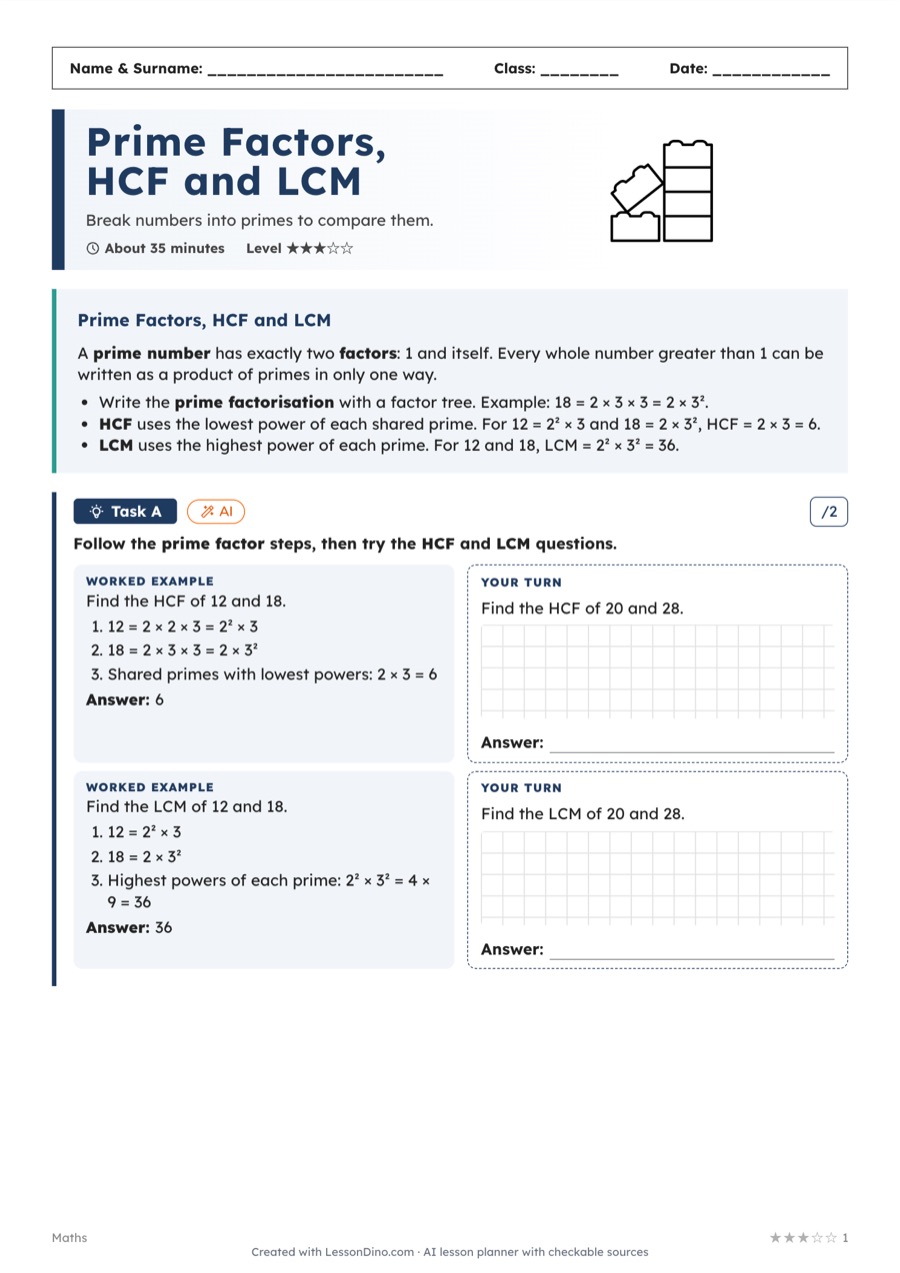
Worksheet
Sources
- Year 7 Maths - Curriculum Map gosford-hill.oxon.sch.uk
- Year 7 Maths Curriculum Map - fishermore.lancs.sch.uk fishermore.lancs.sch.uk
- Finding LCM and HCF from prime factors - BBC bbc.co.uk
- Prime Factors HCF and LCM Lessons mastermathstutoring.co.uk
- LCM and HCF Worksheets | Factor Trees | MME mmerevise.co.uk
Picture credits
- Photo: F1Digitals · Pixabay
- Drawing: Hadithfajri · CC0 · Wikimedia Commons
- Photo: ludi · Pixabay
- Photo: Edward Betts · Public domain · Wikimedia Commons
- Photo: Tumisu · Pixabay
- Drawing: Made by Made · CC BY 3.0 · Wikimedia Commons
- Drawing: David Eppstein · CC0 · Wikimedia Commons
- Drawing: Morn · GFDL · Wikimedia Commons
Made with Lesson Dino's AI on 19 October 2026. AI can make mistakes, so check facts against the sources before you teach.