The worksheet
About this worksheet
Pupils learn to find missing values in 2-part ratios. They build and scale a colour mix using times-table facts. This Year 6 Maths worksheet gives students (ages 10–11) five pages of practice on ratio problems, part of the ratio and proportion unit. It goes with our free Ratio problems lesson, which has the slides and a timed lesson plan.
What it covers
By the end, students should be able to:
- Students will find missing values in 2-part ratios using integer multiplication and division.
- Students will scale both parts of a ratio equally to keep relative sizes unchanged.
How to use it
- Practice (12 minutes): Show Slides 10 cards and hand out Worksheet Task B.
- Support: Give a pre-built base mix of 3 red cubes to 2 blue cubes with a times-table grid for x3 and x4 facts.
- Stretch: Challenge pupils to scale the same mix to 30 red cubes and explain the method in two sentences.
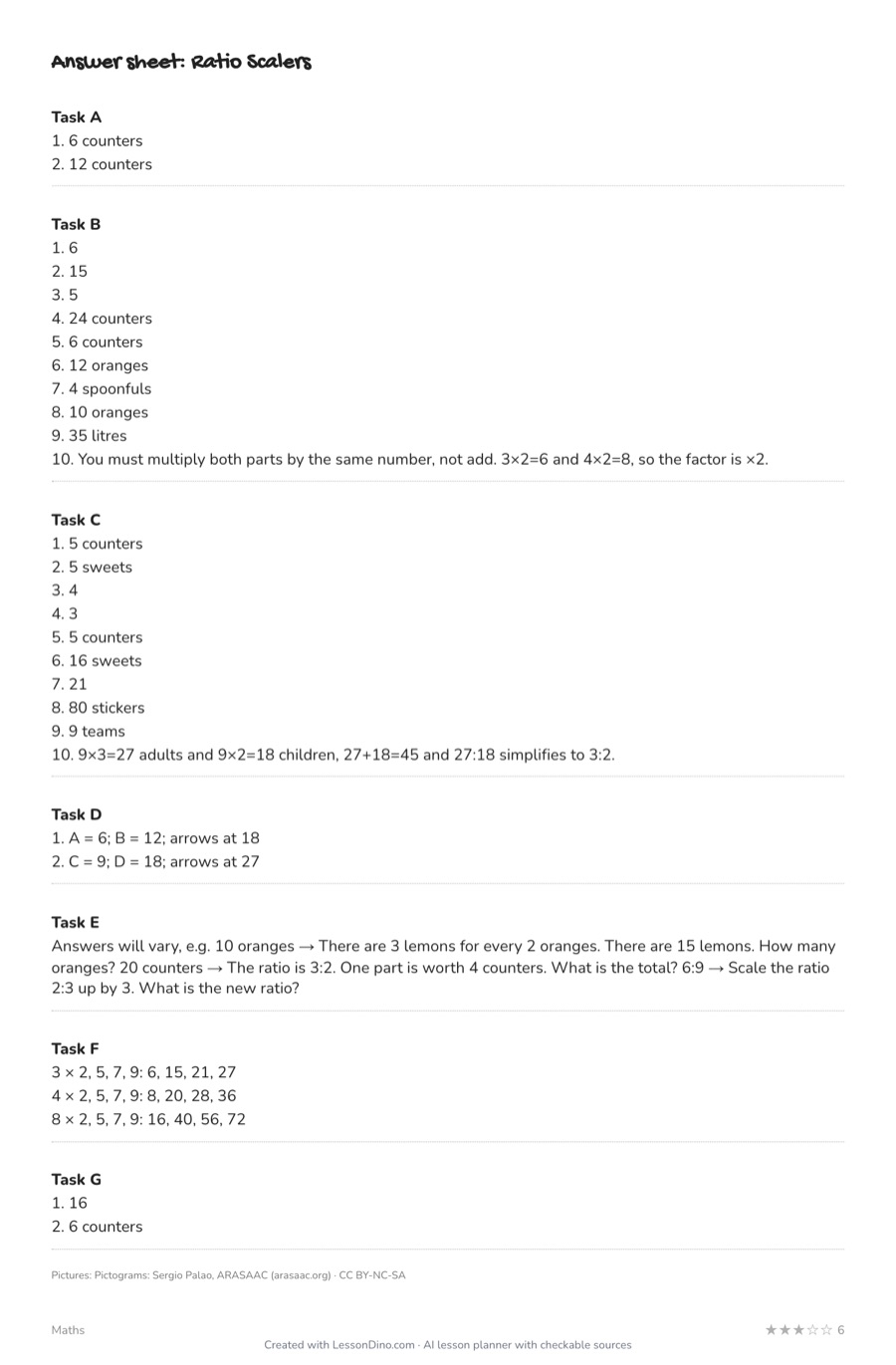
- The answer sheet is the last page, so you can print it on its own or let students check their own work.
Key vocabulary
- ratio: a comparison that shows how much of one thing there is for every bit of another
- for every: linking words that tell how many of a second amount go with a first amount
- scale factor: the whole number you multiply both sides by to make a larger matching pair
- equivalent ratio: two pairs that show the same comparison, though the numbers are bigger or smaller
Mistakes to watch for
- Adding the same number to both parts instead of multiplying, for example turning 3:2 into 9:8 by adding 6. Cover and show that to scale up a ratio, you have to multiply both numbers by the same factor; test 3:2 with cubes repeated 3 times.
- Multiplying only one side, for example 3:2 becomes 9:2. Ask what happened to the other side and insist both columns get the same arrow, then check by dividing back to base.
What's on the worksheet
Scale With Ratio
Learn to scale ratios, then use bar models.
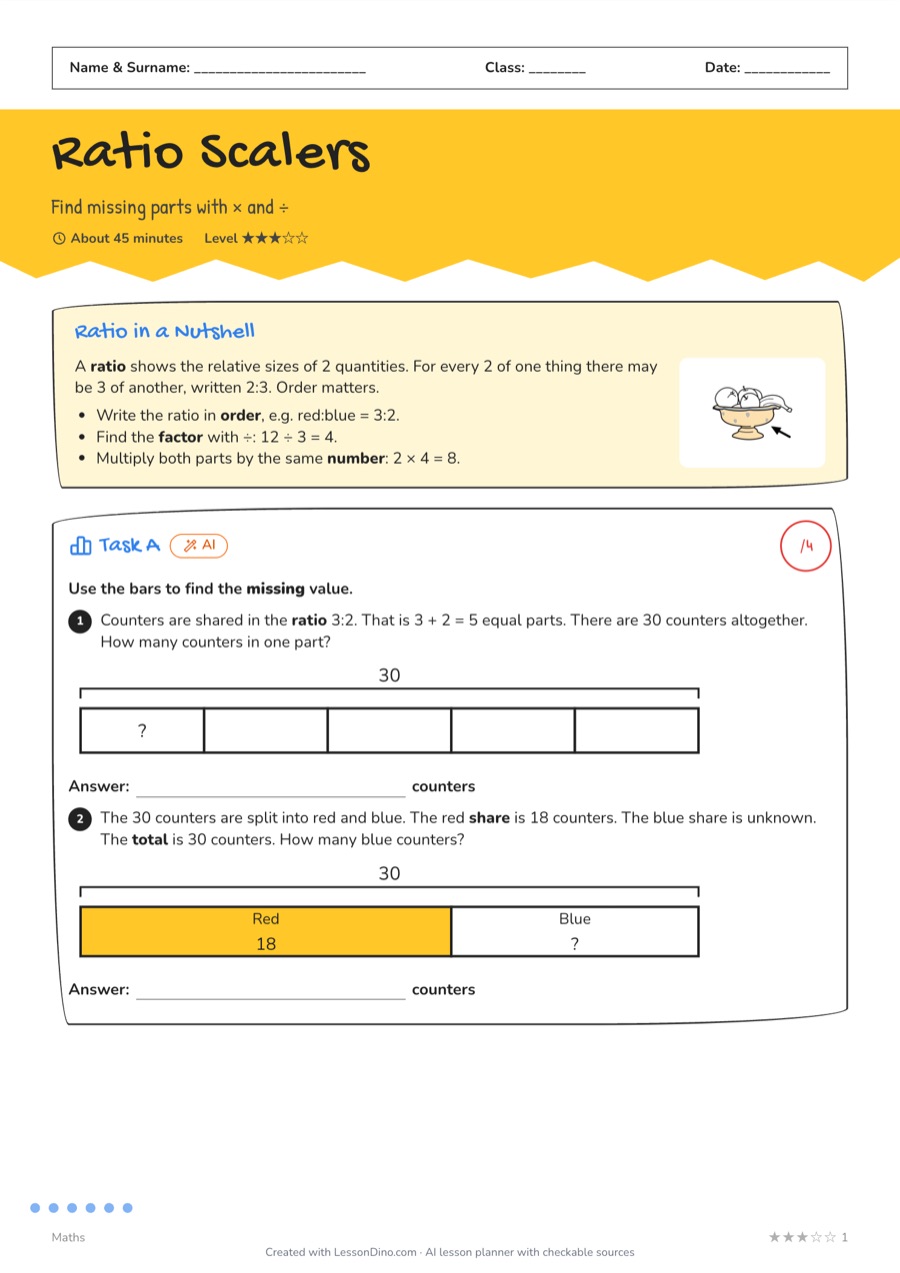
Ratio in a Nutshell
- A ratio shows the relative sizes of 2 quantities. For every 2 of one thing there may be 3 of another, written 2:3. Order matters.
- Write the ratio in order, e.g. red:blue = 3:2.
- Find the factor with ÷: 12 ÷ 3 = 4.
- Multiply both parts by the same number: 2 × 4 = 8.
Use the bars to find the missing value.
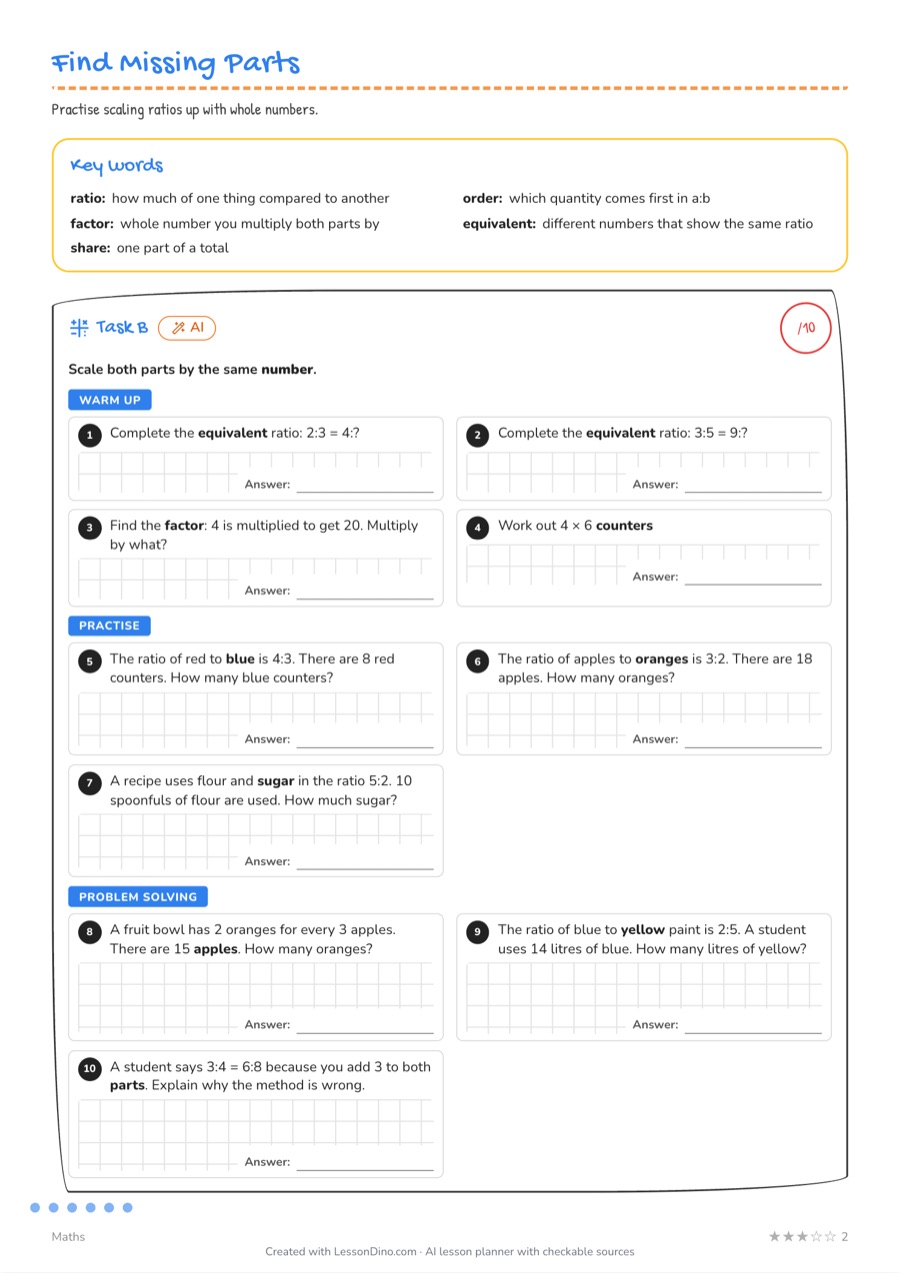
Find Missing Parts
Practise scaling ratios up with whole numbers.
| Word | Meaning |
|---|---|
| ratio | how much of one thing compared to another |
| order | which quantity comes first in a:b |
| factor | whole number you multiply both parts by |
| equivalent | different numbers that show the same ratio |
| share | one part of a total |
Scale both parts by the same number.
Warm up
- Complete the equivalent ratio: 2:3 = 4:?
- Complete the equivalent ratio: 3:5 = 9:?
- Find the factor: 4 is multiplied to get 20. Multiply by what?
- Work out 4 × 6 counters
Practise
- The ratio of red to blue is 4:3. There are 8 red counters. How many blue counters?
- The ratio of apples to oranges is 3:2. There are 18 apples. How many oranges?
- A recipe uses flour and sugar in the ratio 5:2. 10 spoonfuls of flour are used. How much sugar?
Problem solving
- A fruit bowl has 2 oranges for every 3 apples. There are 15 apples. How many oranges?
- The ratio of blue to yellow paint is 2:5. A student uses 14 litres of blue. How many litres of yellow?
- A student says 3:4 = 6:8 because you add 3 to both parts. Explain why the method is wrong.
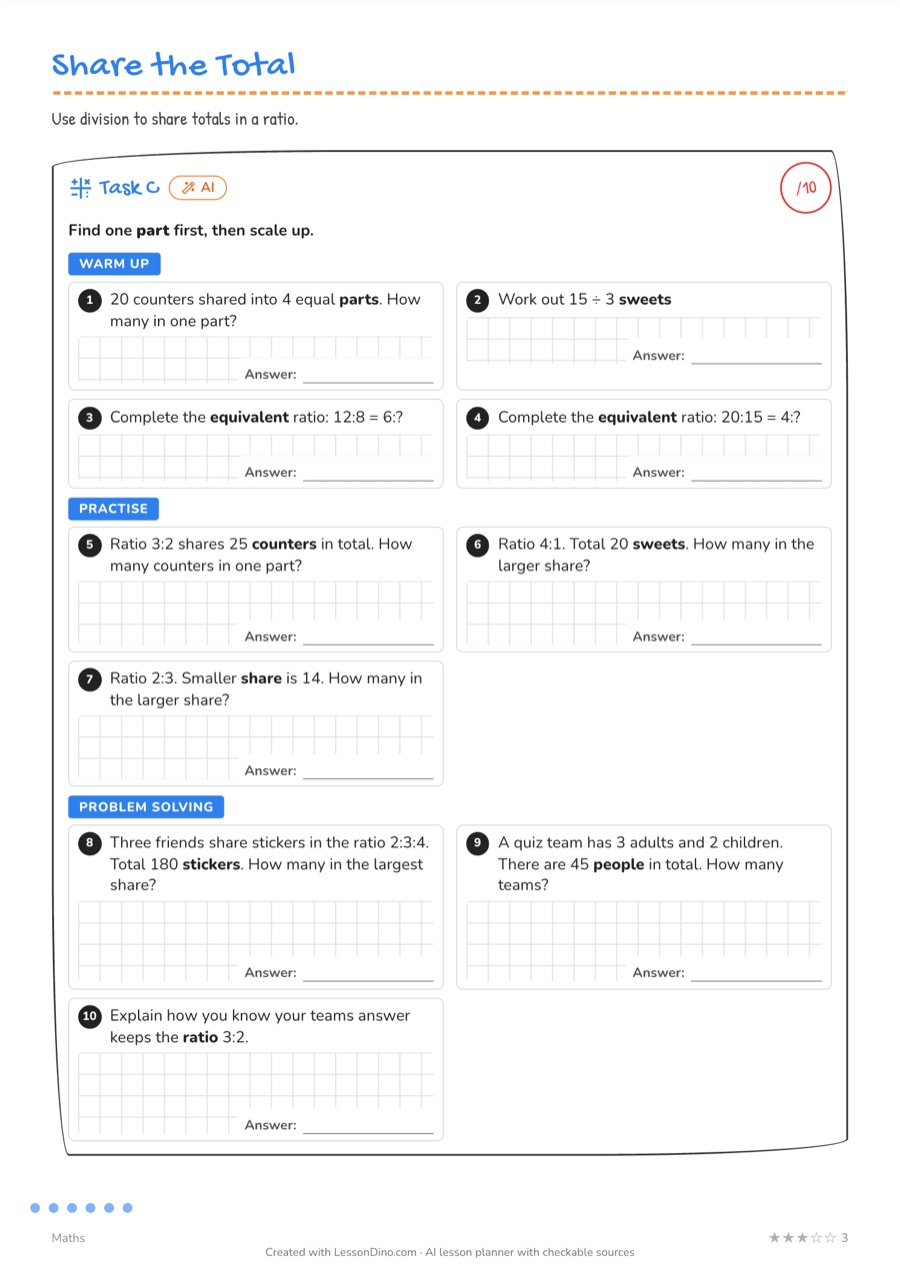
Share the Total
Use division to share totals in a ratio.
Find one part first, then scale up.
Warm up
- 20 counters shared into 4 equal parts. How many in one part?
- Work out 15 ÷ 3 sweets
- Complete the equivalent ratio: 12:8 = 6:?
- Complete the equivalent ratio: 20:15 = 4:?
Practise
- Ratio 3:2 shares 25 counters in total. How many counters in one part?
- Ratio 4:1. Total 20 sweets. How many in the larger share?
- Ratio 2:3. Smaller share is 14. How many in the larger share?
Problem solving
- Three friends share stickers in the ratio 2:3:4. Total 180 stickers. How many in the largest share?
- A quiz team has 3 adults and 2 children. There are 45 people in total. How many teams?
- Explain how you know your teams answer keeps the ratio 3:2.
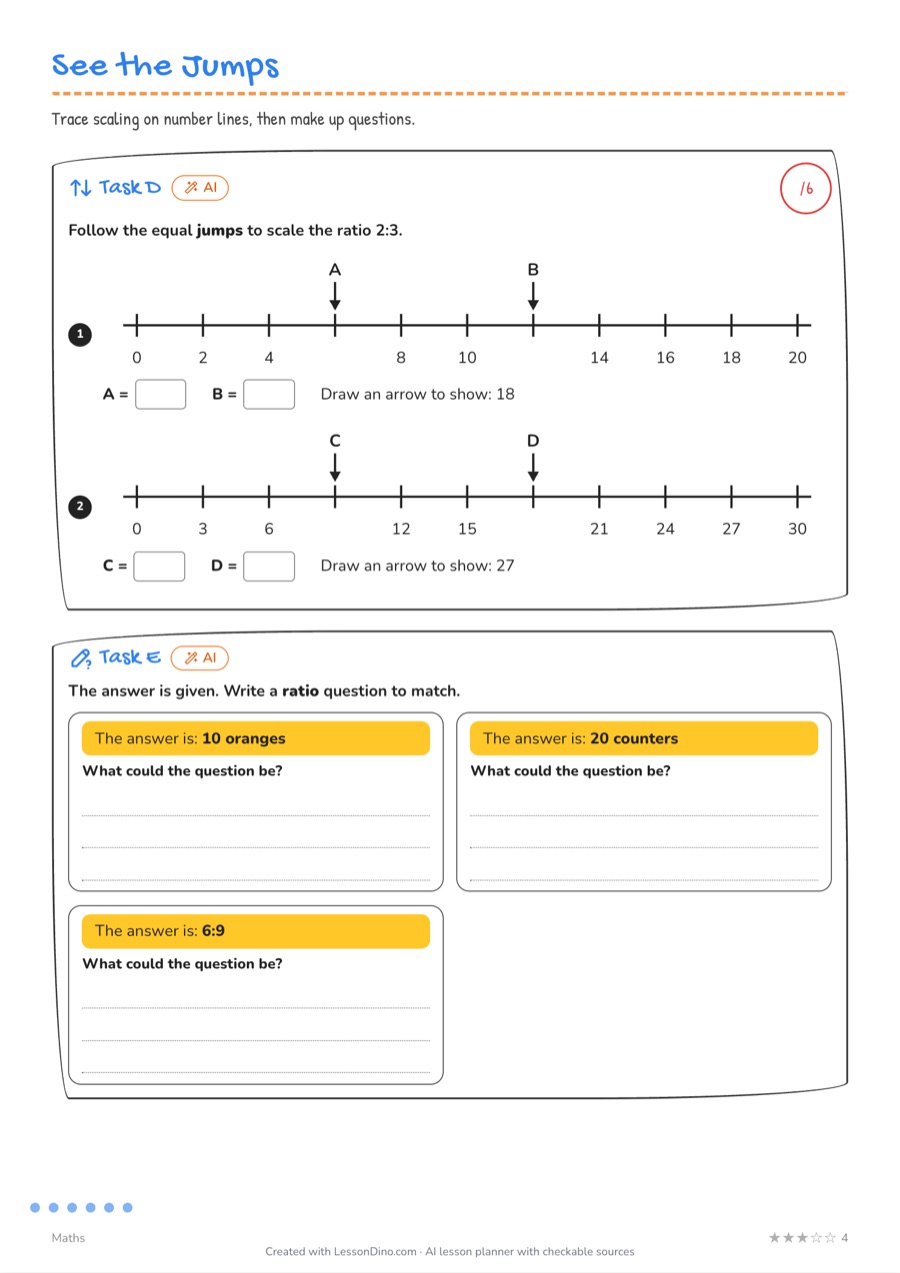
See the Jumps
Trace scaling on number lines, then make up questions.
Follow the equal jumps to scale the ratio 2:3.
The answer is given. Write a ratio question to match.
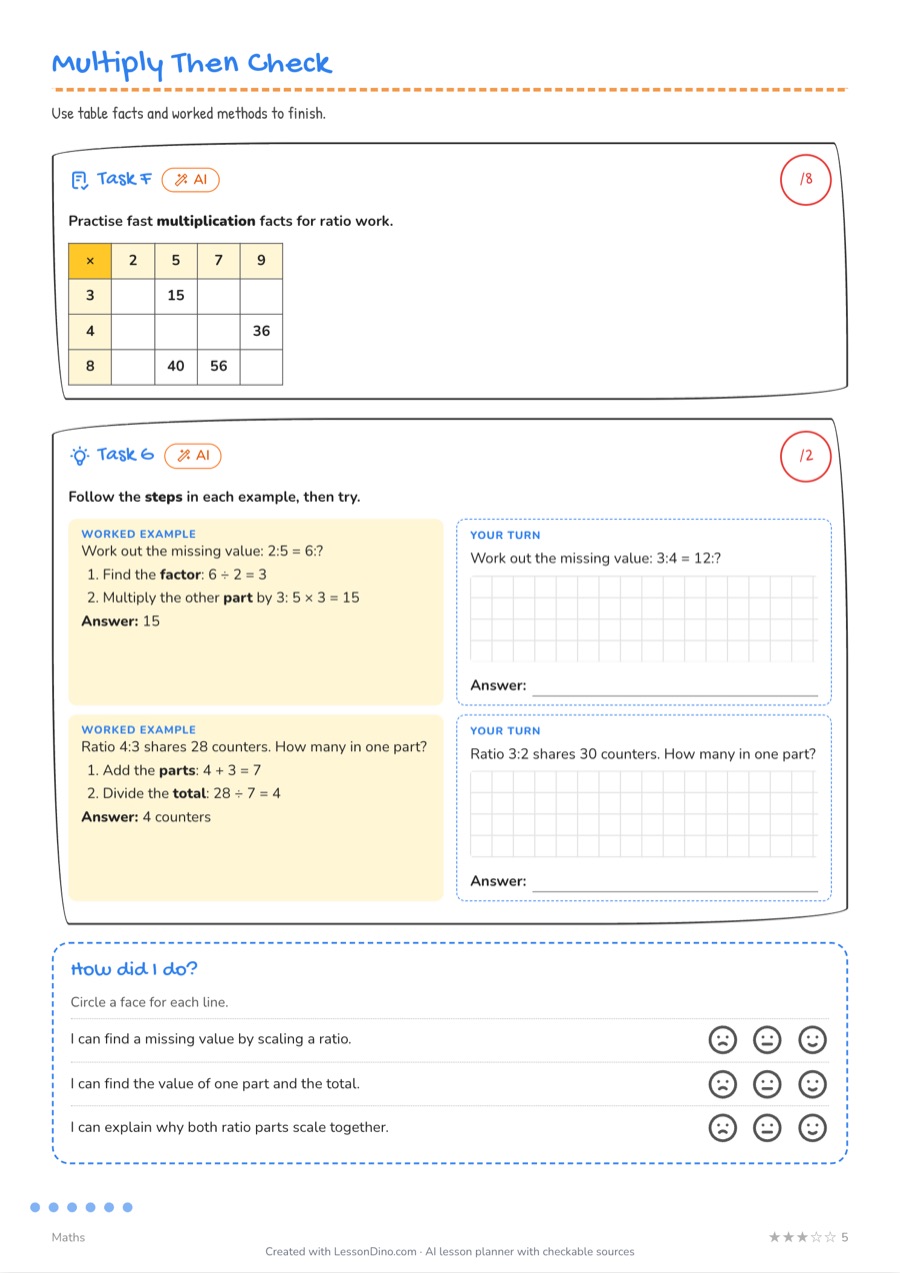
Multiply Then Check
Use table facts and worked methods to finish.
Practise fast multiplication facts for ratio work.
Follow the steps in each example, then try.
Answers
Show the answers
- Complete the equivalent ratio: 2:3 = 4:? 6
- Complete the equivalent ratio: 3:5 = 9:? 15
- Find the factor: 4 is multiplied to get 20. Multiply by what? 5
- Work out 4 × 6 counters 24 counters
- The ratio of red to blue is 4:3. There are 8 red counters. How many blue counters? 6 counters
- The ratio of apples to oranges is 3:2. There are 18 apples. How many oranges? 12 oranges
- A recipe uses flour and sugar in the ratio 5:2. 10 spoonfuls of flour are used. How much sugar? 4 spoonfuls
- A fruit bowl has 2 oranges for every 3 apples. There are 15 apples. How many oranges? 10 oranges
- The ratio of blue to yellow paint is 2:5. A student uses 14 litres of blue. How many litres of yellow? 35 litres
- A student says 3:4 = 6:8 because you add 3 to both parts. Explain why the method is wrong. You must multiply both parts by the same number, not add. 3×2=6 and 4×2=8, so the factor is ×2.
- 20 counters shared into 4 equal parts. How many in one part? 5 counters
- Work out 15 ÷ 3 sweets 5 sweets
- Complete the equivalent ratio: 12:8 = 6:? 4
- Complete the equivalent ratio: 20:15 = 4:? 3
- Ratio 3:2 shares 25 counters in total. How many counters in one part? 5 counters
- Ratio 4:1. Total 20 sweets. How many in the larger share? 16 sweets
- Ratio 2:3. Smaller share is 14. How many in the larger share? 21
- Three friends share stickers in the ratio 2:3:4. Total 180 stickers. How many in the largest share? 80 stickers
- A quiz team has 3 adults and 2 children. There are 45 people in total. How many teams? 9 teams
- Explain how you know your teams answer keeps the ratio 3:2. 9×3=27 adults and 9×2=18 children, 27+18=45 and 27:18 simplifies to 3:2.
The answer sheet is the last picture above.
Curriculum
solve problems involving the relative sizes of 2 quantities where missing values can be found by using integer multiplication and division facts
Made with Lesson Dino's AI on 17 October 2026. AI can make mistakes, so check the answers and facts against the sources before you teach.