Slides


Lesson plan
Triangles Are Half Parallelograms
Students learn to calculate the area of parallelograms and triangles. They cut shapes to prove the rules and solve area problems.
Objectives
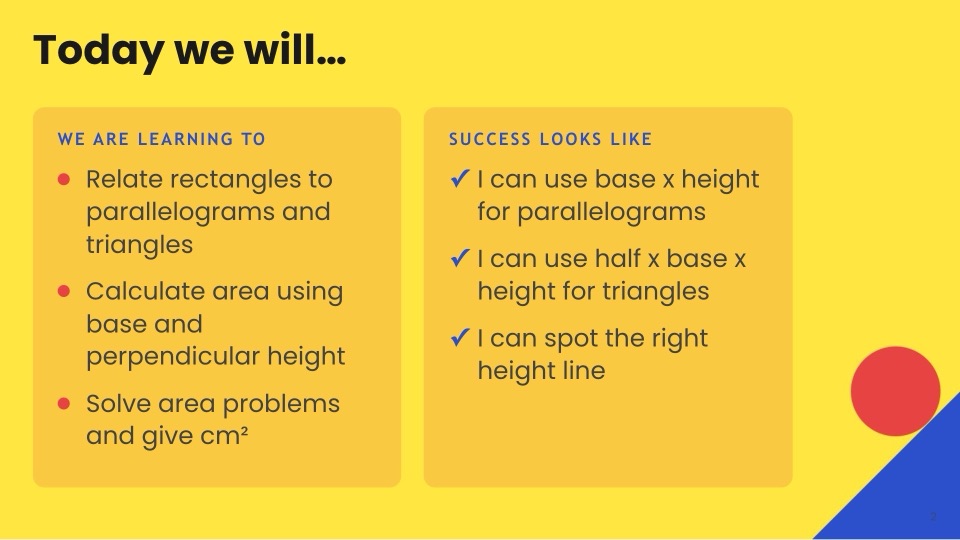
- Students will relate rectangles to parallelograms and triangles by dissection.
- Students will calculate the area of parallelograms using base times height.
- Students will calculate the area of triangles using half times base times height.
Success criteria
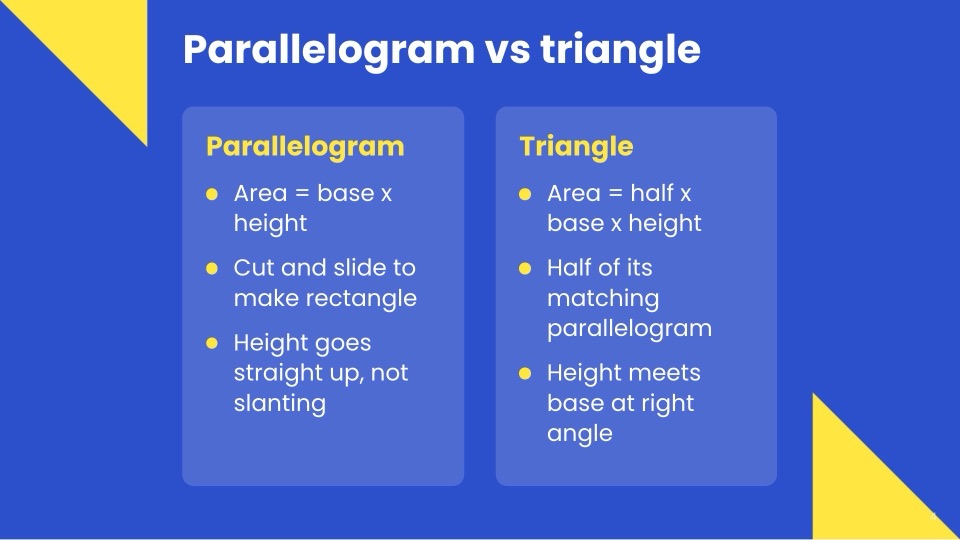
- I can find parallelogram area using base times perpendicular height.
- I can find triangle area as half of its matching parallelogram.
- I can choose the correct height and give answers in cm².
Key words
| Word | Meaning |
|---|---|
| base | the side chosen to start measuring from when working out size |
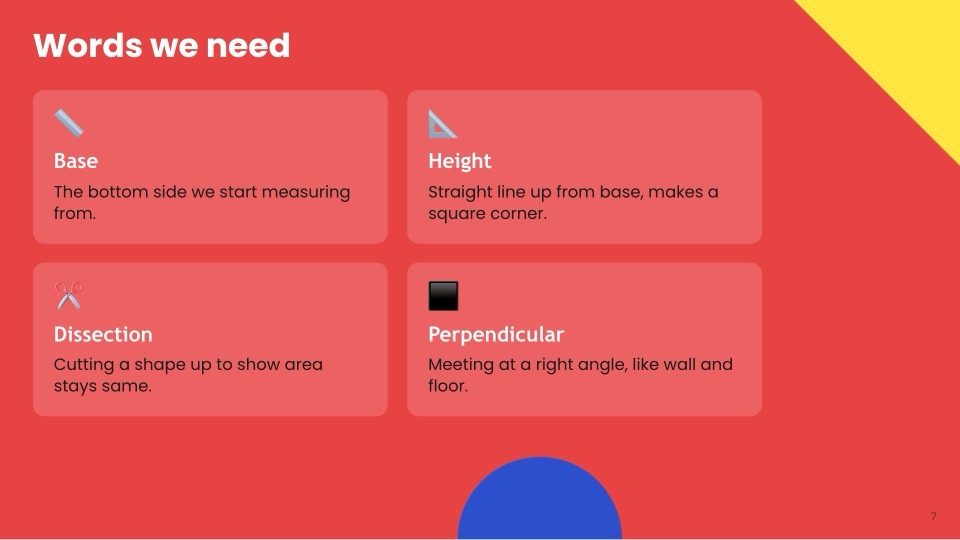
| height | the straight line from the starting side to the opposite side that meets it at a square corner |
| area | the amount of flat space inside a shape, measured in square units such as cm² |
| parallelogram | a four-sided shape with both pairs of opposite sides running the same way |
| triangle | a shape with three straight sides and three corners, always half its matching four-sided shape |
| dissection | cutting a shape up and putting the parts back together to show how size is linked |
Timed plan (60 minutes)
| Time | Stage | What happens |
|---|---|---|
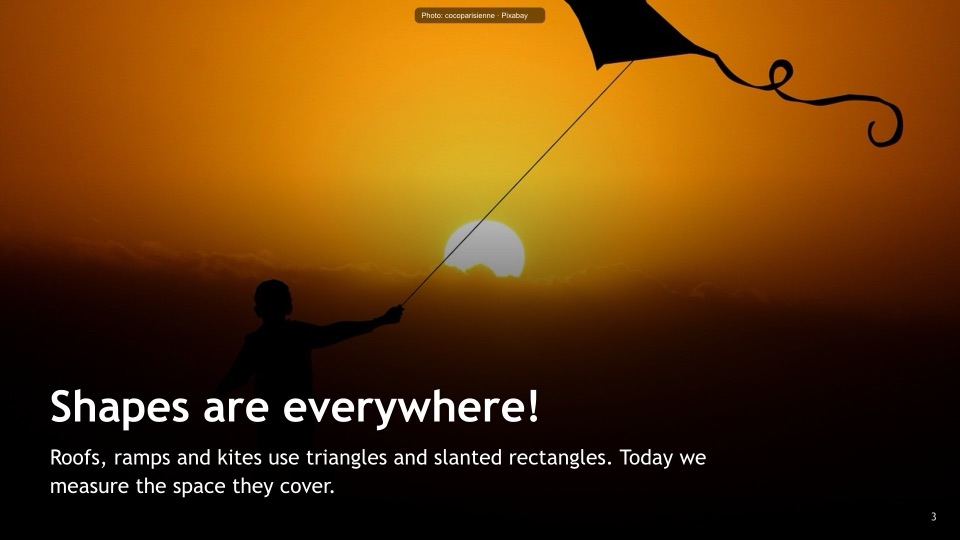
| 5 min | Starter | To recall rectangle area and spark curiosity about cutting parallelograms into triangles. Welcome the class and show the title and photo of roofs, ramps and kites. Ask students to find the area of a 5 cm by 3 cm rectangle on mini whiteboards. Hold up a paper parallelogram and say the hook question to invite predictions. Share the lesson goals: link rectangles to new shapes and calculate their areas. |
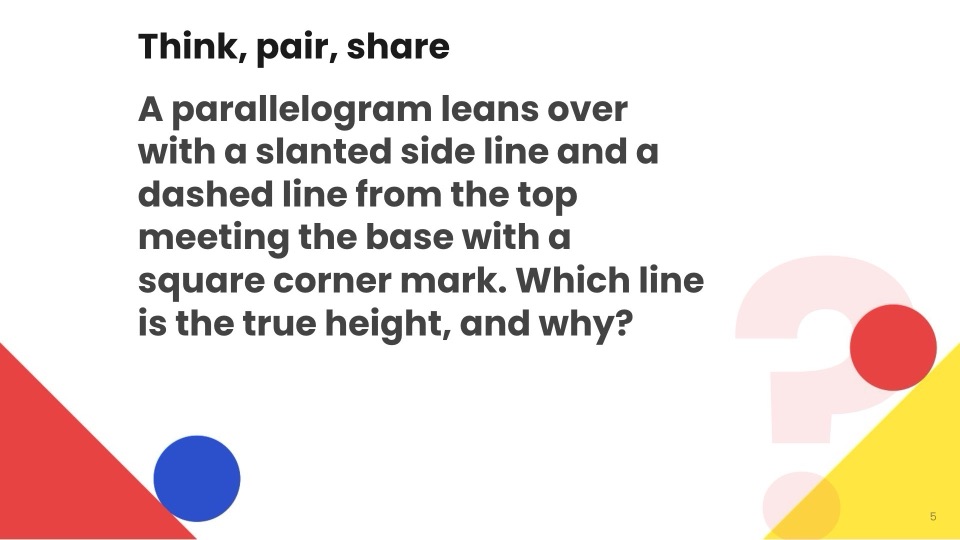
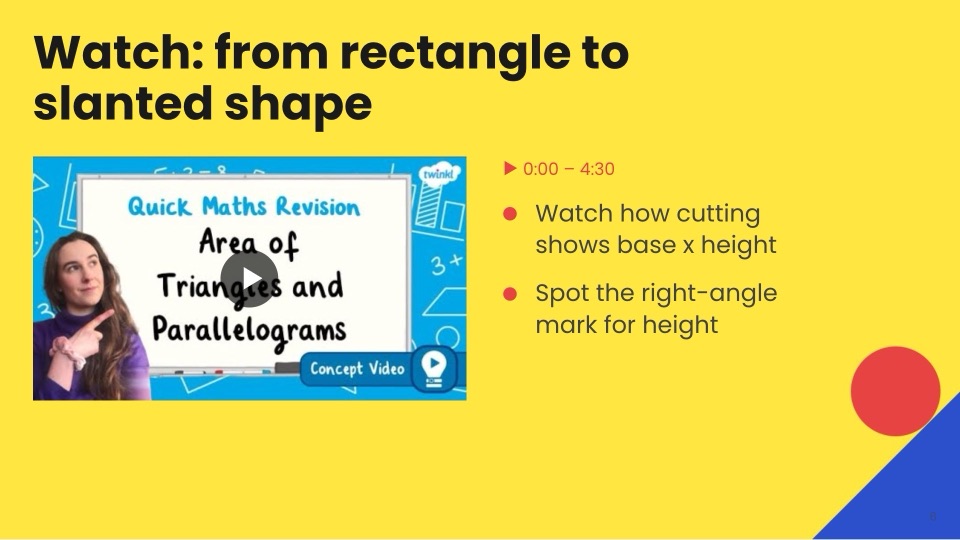
| 10 min | Teaching | To show that a parallelogram has the same area as its rectangle by cut and slide. Display a parallelogram with labelled base, dashed height with square-corner mark, and slanted side. Play the video showing cutting a triangle off one end and sliding it to make a rectangle. Model labelling the base and checking the height is the perpendicular distance from the base to the opposite side. Model the calculation using Area of a parallelogram = base × height, crossing out the slanted side. |
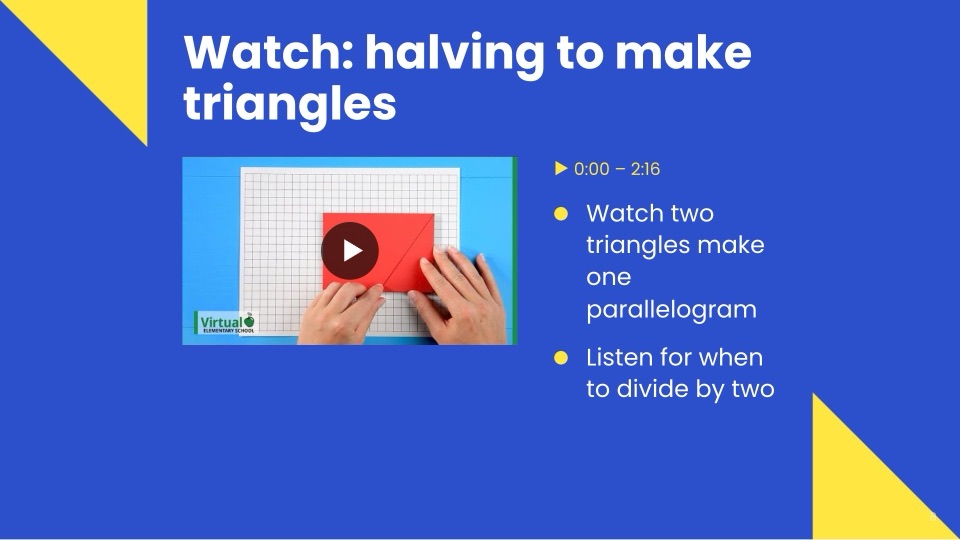
| 10 min | Teaching | To show that a triangle is half its matching parallelogram with the same base and height. Show base, height and dissection cards and read their short meanings together. Play the video showing two triangles making one parallelogram and when to divide by two. Cut the 6 cm by 4 cm parallelogram along its diagonal to show two identical triangles. Model the triangle calculation using Area of a triangle = 1/2 × base × height, where height is perpendicular distance. |
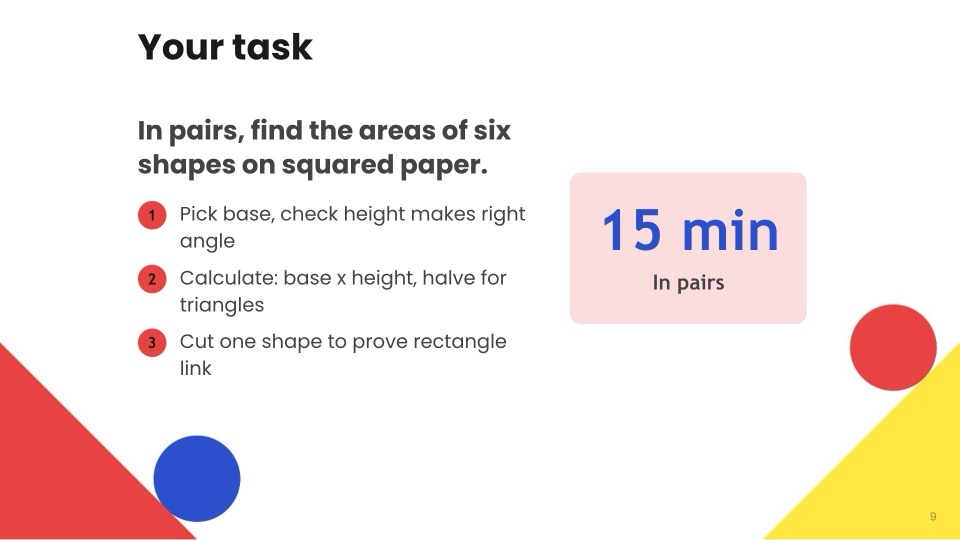
| 25 min | Main activity | To prove by dissection that triangle area is half parallelogram area and practise calculations. Give out squared paper, scissors and rulers and show the task steps on the board. Demonstrate drawing a parallelogram, cutting it out, then cutting along the diagonal into two triangles. Ask pairs to lay the triangles back on the outline, label base and perpendicular height, and write both area calculations underneath. Hand out Worksheet Task B for pairs to find each area using the perpendicular height. |
| 10 min | Plenary | To correct height errors and confirm students can use both area rules. Show the fact that with the same base and same height, halve the area every time. Do one Worksheet Task C error together: spot use of slanted side or forgotten halving. Ask pairs to correct the working and give the right area in cm². Finish with the exit ticket prompts about one rule, one area and one question. |
Common mistakes
- Using the slanted side length as the height
How to spot it: Answer too large and working multiplies by the sloping edge
Test with a right-angle card; height is the perpendicular distance from the base to the opposite side. - Forgetting to halve for triangles
How to spot it: Triangle answer equals the parallelogram answer for same base and height
Remind that two equal triangles make one parallelogram, so use 1/2 × base × height. - Writing cm instead of cm² or mixing units
How to spot it: Length units on an area or no units at all
Practise saying we count squares: lengths in cm, areas in cm².
Support
- Start with right-angled triangles where the base and height meet at a corner of a square on the grid.
- Give pre-drawn parallelograms with the base highlighted and perpendicular height marked.
Stretch
- Challenge students to draw a different triangle with the same base and height and show it must have the same area.
- Ask students to measure the slanted side and explain in writing why it is not used.
Check questions
- A parallelogram has base 7 cm and perpendicular height 5 cm. What is its area?
Answer: 35 cm² because 7 × 5 = 35. - A triangle has base 10 cm and perpendicular height 6 cm. What is its area?
Answer: 30 cm² because 1/2 × 10 × 6 = 30. - Why must height be perpendicular to the base?
Answer: Because area counts straight-up rows of squares; the slanted side is longer and would give too big an answer.
Curriculum
calculate the area of parallelograms and triangles
Video clips
Clips on YouTube, from the start and end times we chose. Check each one before you show it.
-
KS2 triangles and parallelograms from 0:00 to 4:30
Twinkl Educational Publishing: How Do You Calculate the Area of Triangles and Parallelograms? | KS2 Maths Concept for Kids
Made for KS2 pupils aged 7-11 so vocabulary and pace are perfect for Year 6 and it covers both shapes.
-
Grade 6 parallelogram and triangle from 0:00 to 2:16
Virtual Elementary School: Grade 6 Math: Area of a Parallelogram and a Triangle
Made for Grade 6 pupils aged about 11 so age fit is excellent and it teaches both formulae clearly.
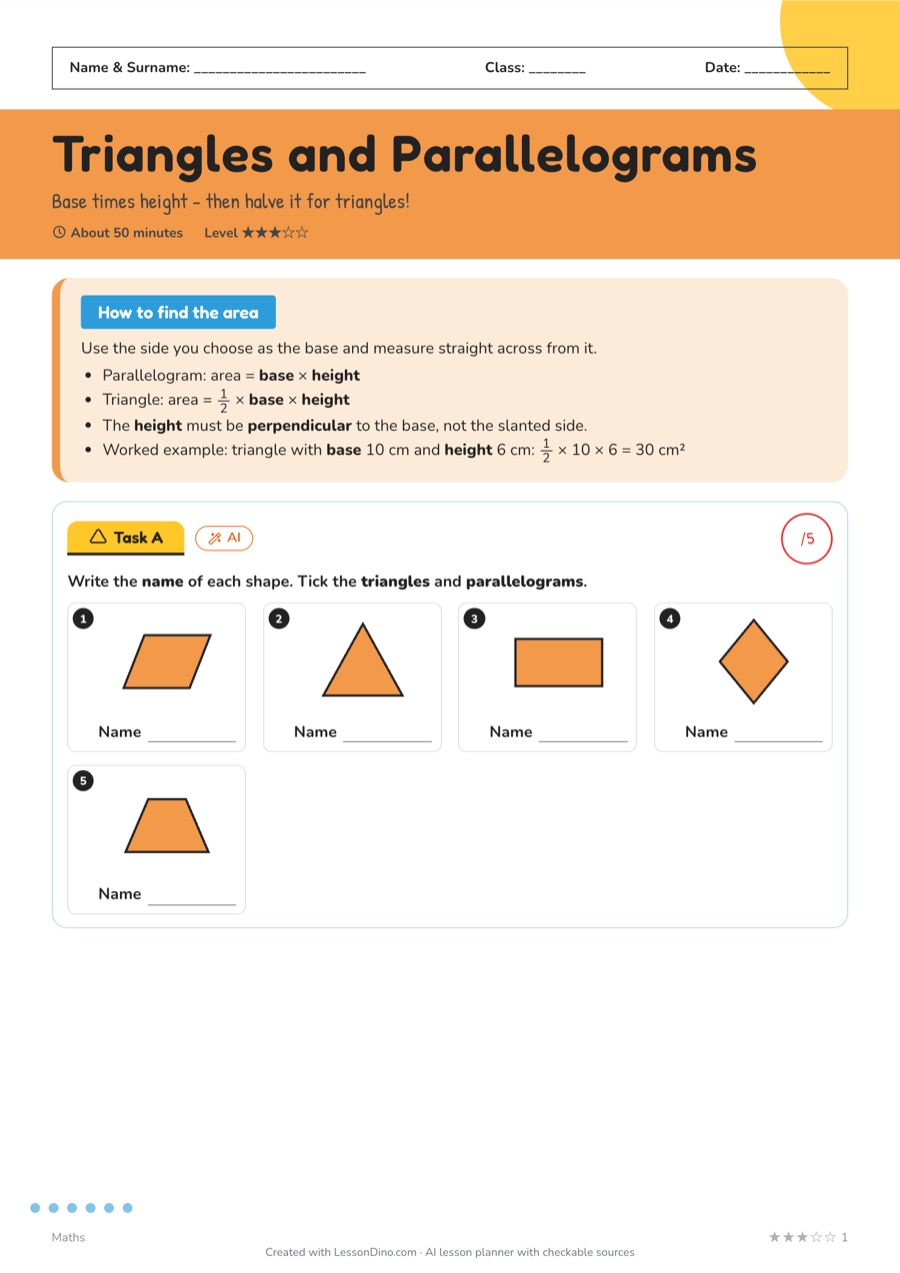
Worksheet
Sources
- National curriculum in England: mathematics programmes of ... gov.uk
- Area of triangles, parallelograms and trapeziums - Perimeter ... bbc.co.uk
- Areas of Triangles and Parallelograms Proportional to Base - Pro… proofwiki.org
- Areas of Parallelograms and Triangles - Kidz Math kidz-math.com
- Areas of Parallelograms Triangles - Theorems, Questions (with proofs) teachoo.com
- Areas Of Parallelograms And Triangles Worksheet - Printable Writing Worksheets www3.designindaba.com
- Area of parallelograms and triangles - Math Mammoth mathmammoth.com
Picture credits
Made with Lesson Dino's AI on 17 October 2026. AI can make mistakes, so check facts against the sources before you teach.