Slides
Lesson plan
Long Division Masters: Two-Digit Divisors
Pupils learn to divide up to 4-digit numbers by two-digit numbers. They practise neat long division in pairs on squared paper.
Objectives
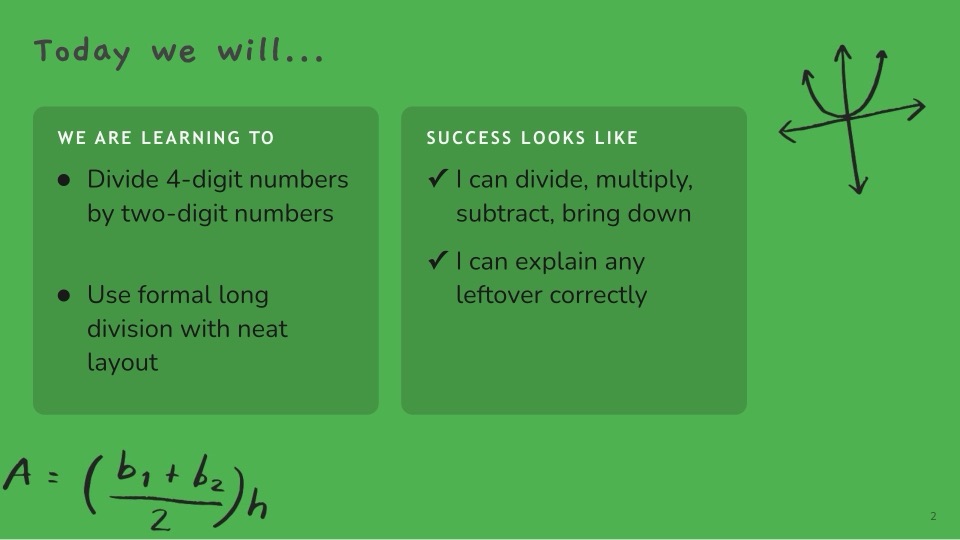
- Students will divide up to 4-digit numbers by two-digit numbers using long division.
- Students will set out calculations neatly with aligned digits and multiples lists.
- Students will interpret remainders for context and check answers by multiplication.
Success criteria
- I can work the divide, multiply, subtract, bring down loop in order.
- I can divide 4-digit numbers by two-digit numbers neatly and accurately.
- I can explain any leftover correctly and check by multiplying back.
Key words
| Word | Meaning |
|---|---|
| dividend | the large total inside the bracket that is shared out |
| divisor | the number outside the bracket that you share by |
| quotient | the answer written above the bracket |
| remainder | the amount left over after the last subtract that cannot be shared equally |
| multiple | the result of multiplying the outside number by 1, 2, 3 and so on |
Timed plan (60 minutes)
| Time | Stage | What happens |
|---|---|---|
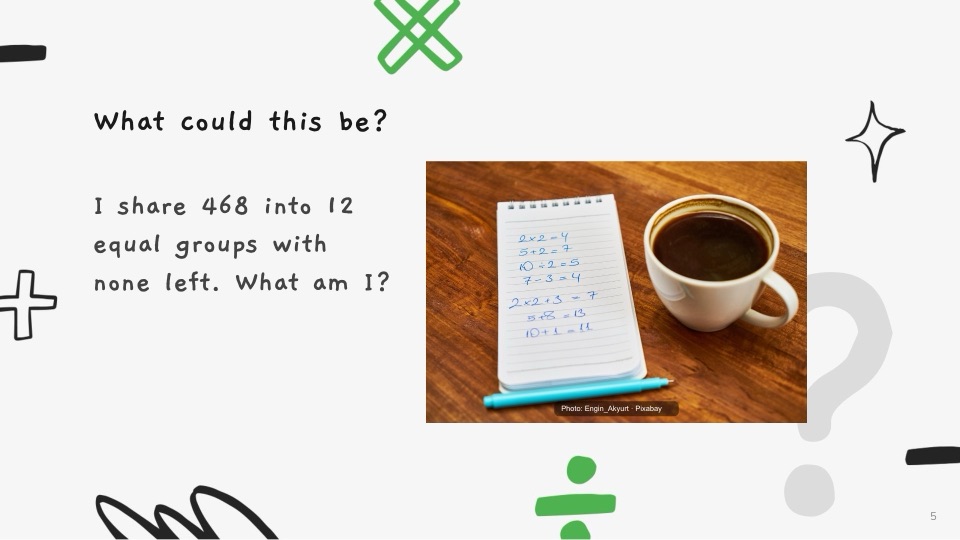
| 8 min | Starter | Hook pupils and recall multiplication facts and the bracket layout for long division. Welcome the class and say the hook, then show Slides 1-2 with the title and objectives. Quick-fire the 12 times table and ask where the total and the sharing number sit in the layout. Show Slide 5 mystery of 468 divided by 12 and take estimates on whiteboards. Agree that guessing is slow and that a neat loop will give the exact answer. |
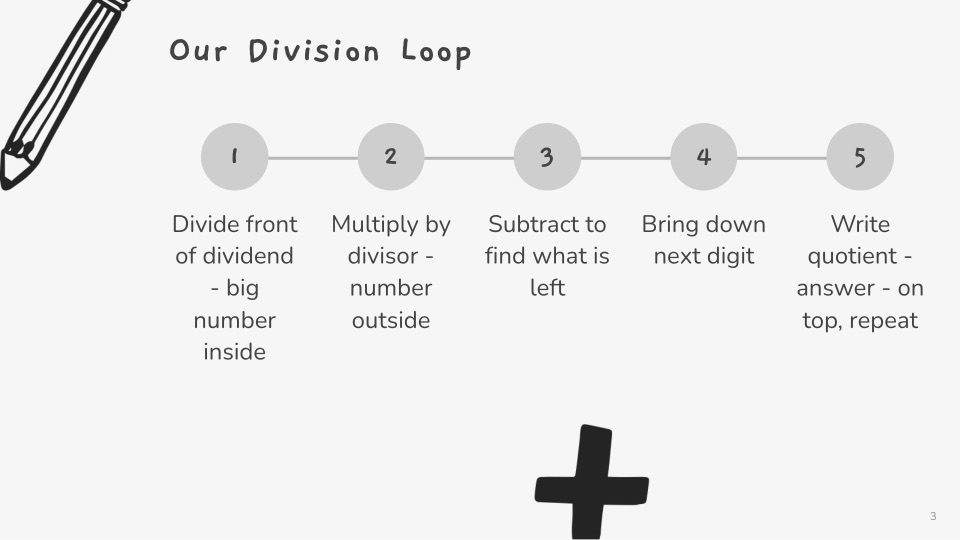
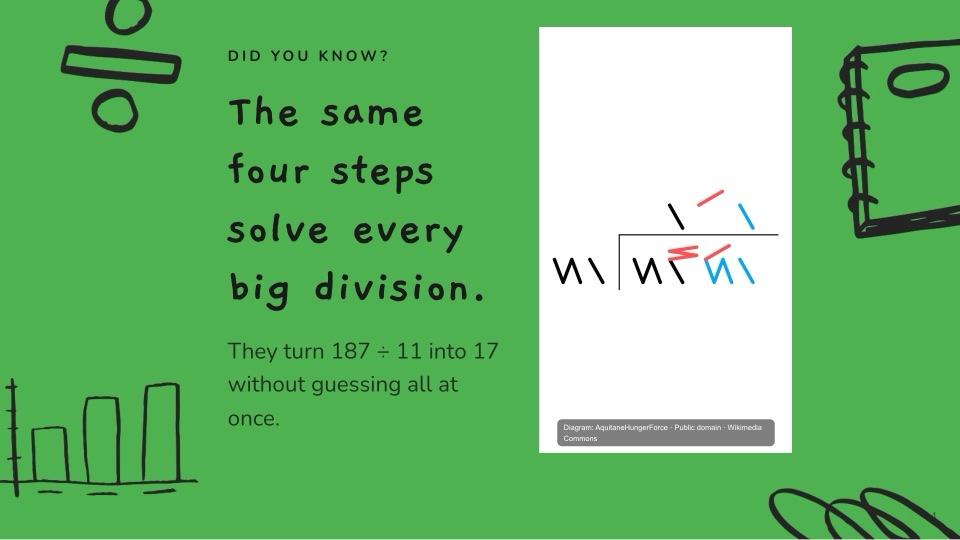
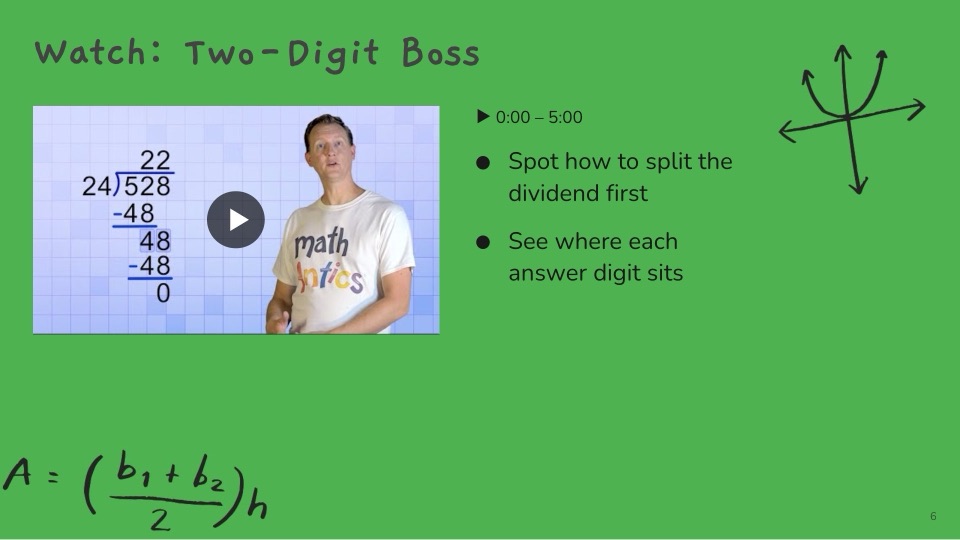
| 12 min | Teaching | Model the divide, multiply, subtract, bring down loop for a two-digit divisor. Show Slides 3-4 and name the loop: divide, multiply, subtract, bring down until digits run out. Play Video clip 1 (0:00-5:00) on Slide 6 and ask pupils to spot where each answer digit sits. Model 468 divided by 12 on squared paper, one digit per square with straight columns. Think aloud the multiples choice and the final check by multiplying back. |
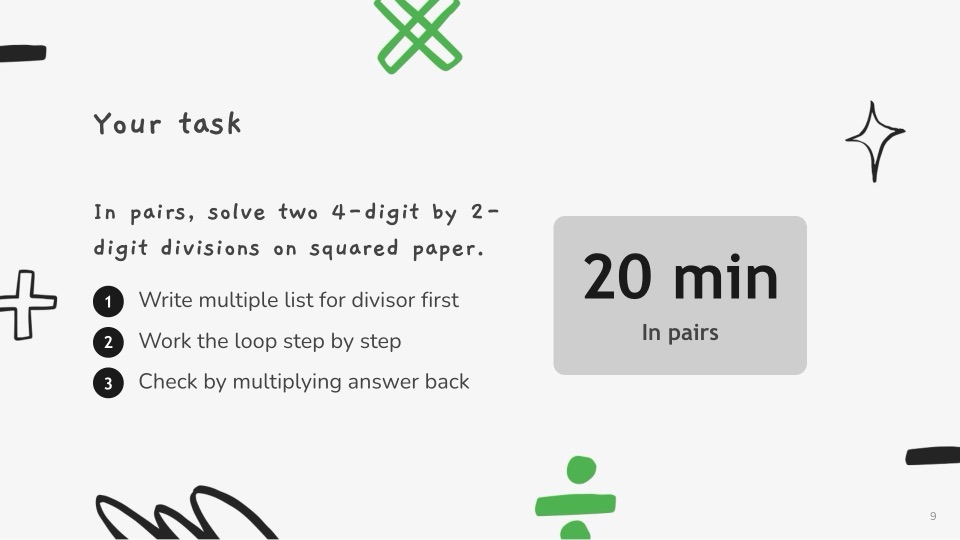
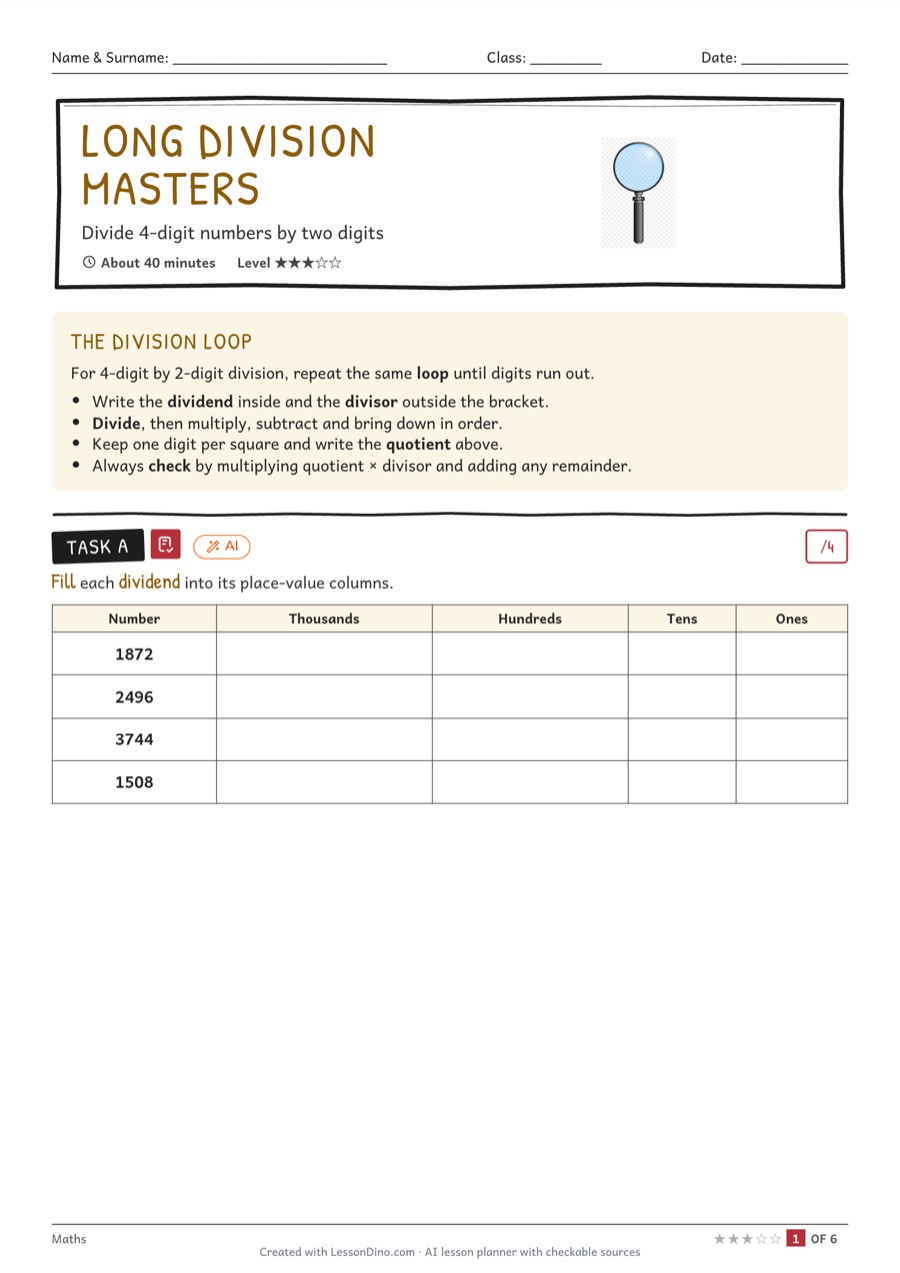
| 20 min | Main activity | Solve two 4-digit by 2-digit divisions neatly in pairs using the loop and a check. Show Slide 9, pair pupils as Student A and Student B and give out squared paper and rulers. Direct pairs to write the multiples list for the divisor first, then work the loop step by step. Circulate to check one digit per square, quotient digits above the correct columns and tidy subtraction. Stop the class midway to fix lining-up and remind pairs to check by multiplying the quotient by the divisor. |
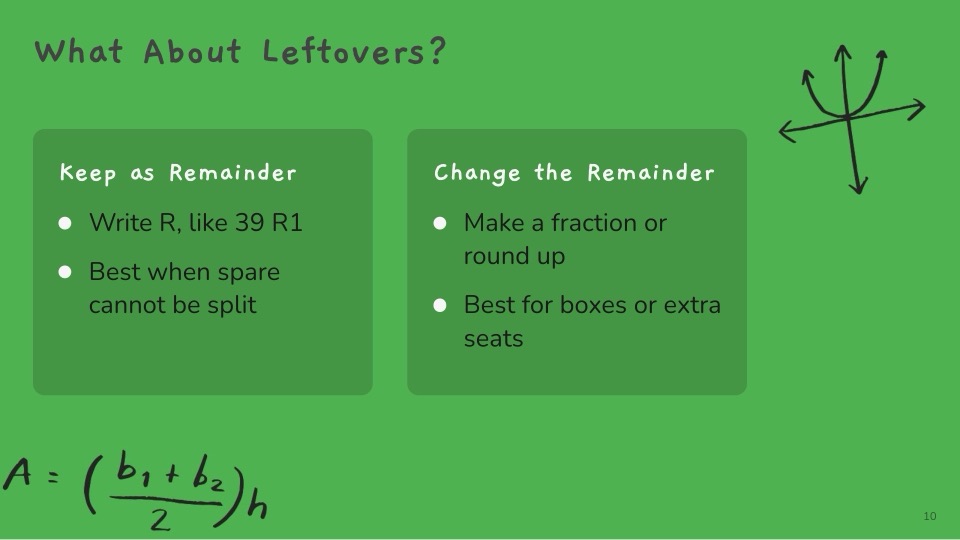
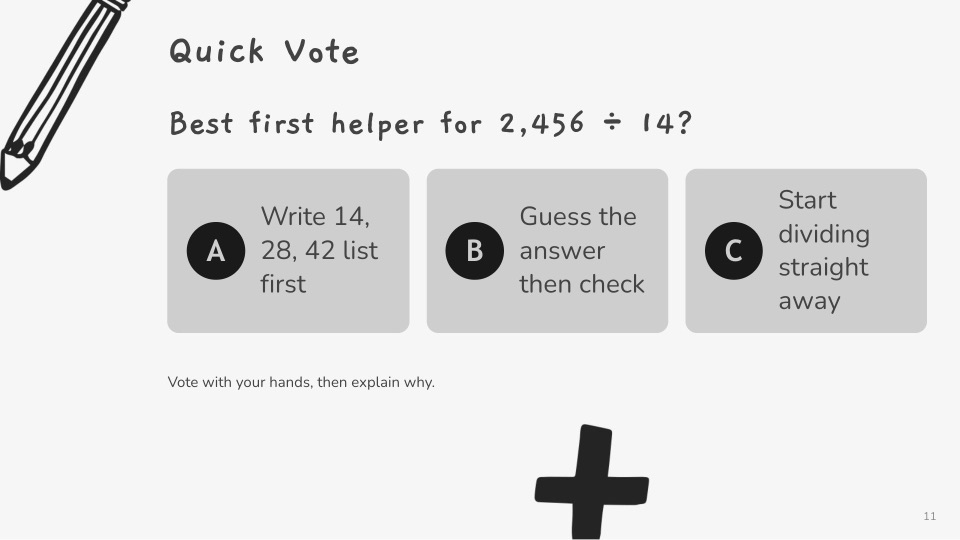
| 12 min | Remainder Roundtable | Decide whether a leftover stays as a remainder, becomes a fraction or needs rounding. Show Slide 10 and model a final subtraction that ends with zero compared with one that leaves a leftover. Explain that answers can be shown as whole number remainders, fractions, or by rounding, as appropriate for the context. Give three short contexts for Worksheet Task E sorting, for example spare pencils, extra minibus seats and money. Use Slide 11 to ask which first helper is best for 2,456 ÷ 14 before pairs justify their sort. |
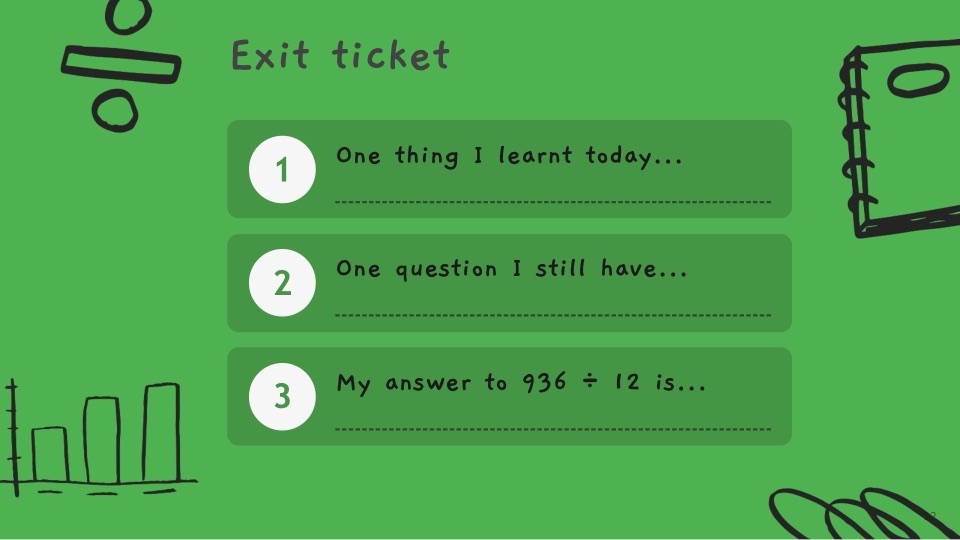
| 8 min | Plenary | Return to the objectives and check accurate neat division and remainder choices. Revisit the loop and neat columns: line up digits and the method never gets lost. Take answers for 936 ÷ 12 and model the check 78 x 12 = 936 on the board. Show Slide 12 exit ticket and collect one thing learnt and one question. Praise straight columns and correct zero placeholders and set the homework. |
Common mistakes
- Missing a zero in the quotient when the divisor does not fit
How to spot it: Answer looks ten times too small and a column has no digit above it
Write 0 above that digit before bringing down, because every position needs a digit. - Messy columns so digits drift and place value is lost
How to spot it: Subtraction is wrong even though times tables are right
Use one square per digit and keep straight columns, as most errors are lining-up errors. - Skipping bring down or choosing the multiple by guessing
How to spot it: Remainder larger than divisor or step order muddled
Say divide, multiply, subtract, bring down each loop and check the multiples list first.
Support
- Give pre-drawn empty brackets with faint column guides and a completed multiples strip for the divisor.
- Let pupils keep a times-table chart nearby while they build multiples lists.
- Show a zero-ending subtraction next to a leftover-ending subtraction to make remainder visual.
Stretch
- Solve a division that needs a zero placeholder in the quotient and explain why the zero cannot be missed.
- Solve 4,680 divided by 12 and explain the extra zero in 390.
- Rewrite a remainder answer as a fraction and explain when that would be more useful.
Check questions
- My answer to 936 ÷ 12 is...
Answer: 78 - Write the four long division steps in order.
Answer: Divide, multiply, subtract, bring down - Buses take 14 pupils. For 2,456 pupils with 6 left over, how many buses?
Answer: 176, round up so no one is left without a seat
Curriculum
divide numbers up to 4 digits by a two-digit whole number using the formal written method of long division
Video clips
Clips on YouTube, from the start and end times we chose. Check each one before you show it.
-
2-digit divisors worked example from 0:00 to 5:00
mathantics: Math Antics - Long Division with 2-Digit Divisors
Shows exactly the lesson objective of long division by a two-digit divisor at the right pace and vocabulary for age 10-11.
-
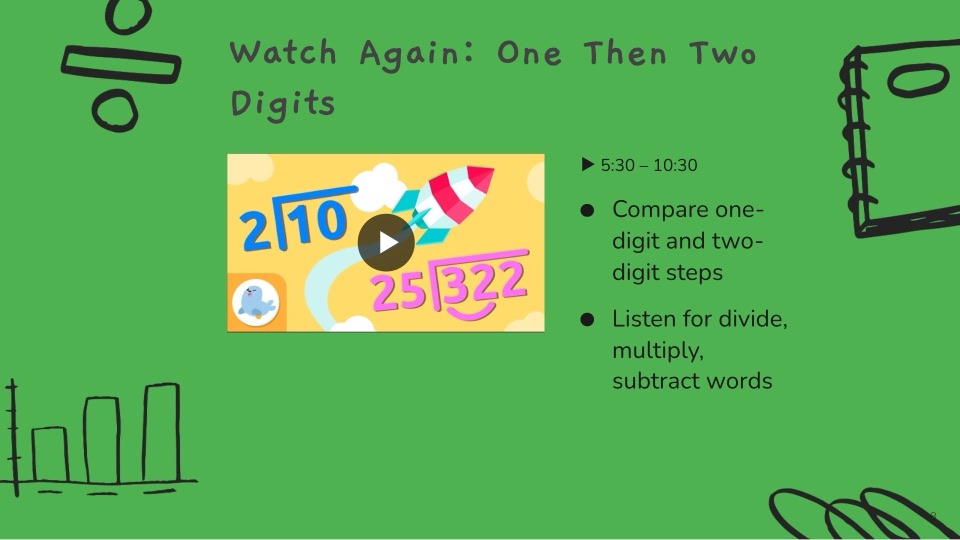
One- and two-digit division compilation from 5:30 to 10:30
Smile and Learn - English: LONG DIVISION ➗ One and two digit division 👩🏻🚀 Math for Kids 🚀 Compilation
Covers division by one-digit then two-digit divisors with clear visuals that suit age 10-11, though the cartoon style is a little young for Year 6.
Worksheet
Sources
- National curriculum in England: mathematics programmes of ... gov.uk
- Understanding Long Division: Mastering Basic Math Skills themathtutor.co.uk
- Year 6 Maths: Long Division | KSL - Key Stage Learning keystagelearning.co.uk
- Square Root By Long Division solipsys.co.uk
- Kids Math: Long Division - Ducksters ducksters.com
- Long division Facts for Kids kids.kiddle.co
- Polynomial long division - Wikipedia en.wikipedia.org
- Flexi answers - How is long division performed? | CK-12 Foundation ck12.org
- Long division can be easy! (Module 5) | young.2341's Blog u.osu.edu
- Division (mathematics) Facts for Kids kids.kiddle.co
- long division planetmath.org
- Long Division Explained: A Simple Step-by-Step Method ... mathsheetfree.com
- Long Division - Math is Fun mathsisfun.com
- Step-by-Step Guide to Long Division for Kids - emc.school emc.school
- Introduction to Long Division – A video • Teacha! teacharesources.com
- Kids Math: Division Tips and Tricks - Ducksters ducksters.com
Picture credits
Made with Lesson Dino's AI on 17 October 2026. AI can make mistakes, so check facts against the sources before you teach.