Slides
Lesson plan
Ratio Rescue: Scaling Up to Find Missing Values
Pupils learn to find missing values in 2-part ratios. They build and scale a colour mix using times-table facts.
Objectives
- Students will find missing values in 2-part ratios using integer multiplication and division.
- Students will scale both parts of a ratio equally to keep relative sizes unchanged.
Success criteria
- I can write a ratio as a:b and find the scale factor.
- I can multiply both parts equally to find a missing value.
- I can check my answer by dividing back to the base ratio.
Key words
| Word | Meaning |
|---|---|
| ratio | a comparison that shows how much of one thing there is for every bit of another |
| for every | linking words that tell how many of a second amount go with a first amount |
| scale factor | the whole number you multiply both sides by to make a larger matching pair |
| equivalent ratio | two pairs that show the same comparison, though the numbers are bigger or smaller |
Timed plan (60 minutes)
| Time | Stage | What happens |
|---|---|---|
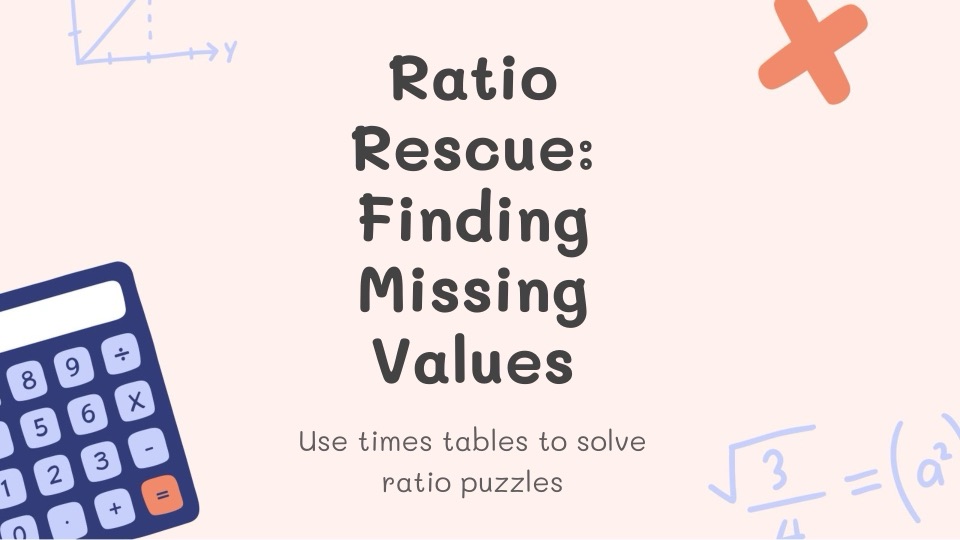
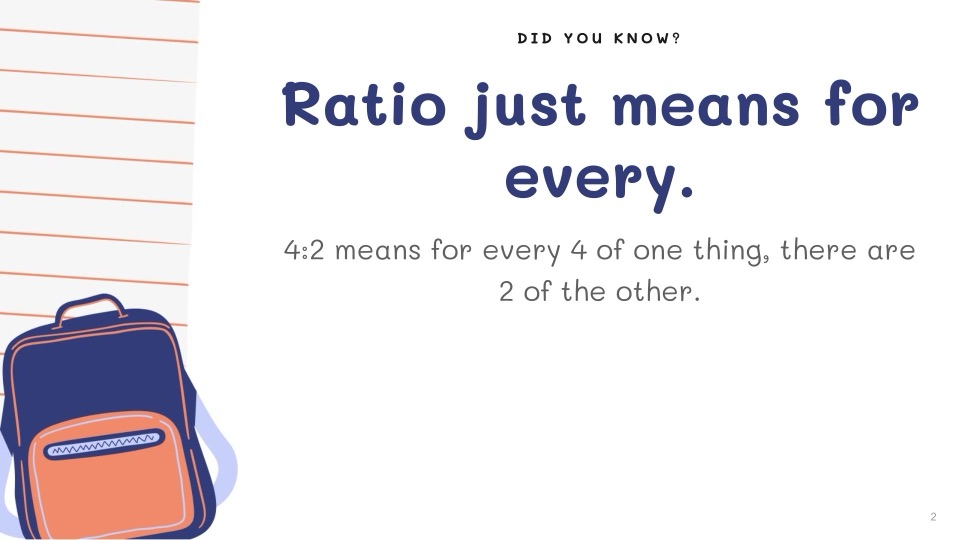
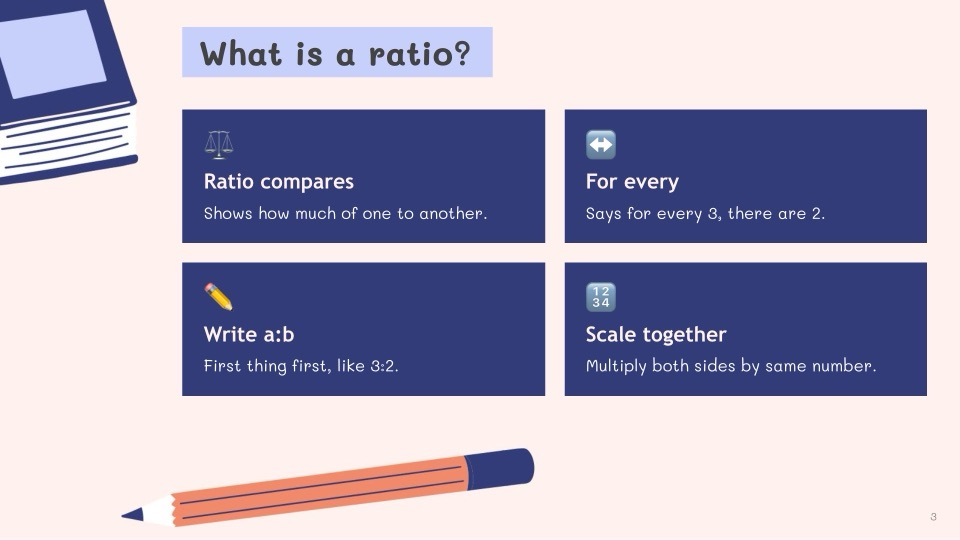
| 10 min | Starter | To recall multiplication facts and introduce ratio as for every. Show Slides 1-2: Ratio Rescue: Finding Missing Values with Use times tables to solve ratio puzzles. Hold up one tiny cup and say the hook: this recipe makes one tiny pot of purple paint, but we need enough for the whole class. Teach Slide 2 fact: Ratio just means for every. 4:2 means for every 4 of one thing, there are 2 of the other. Quick-fire x3 and x4 facts on whiteboards to warm up for finding scale factors. |
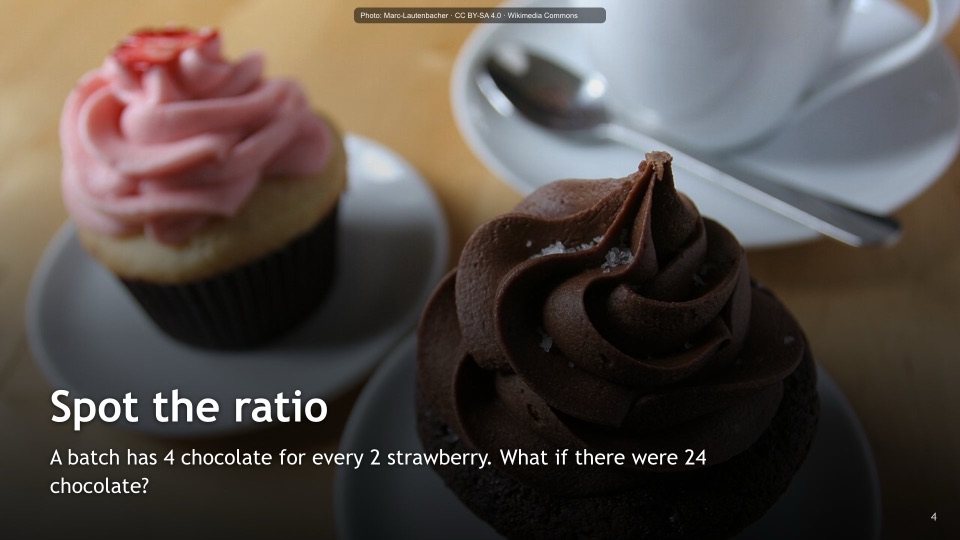
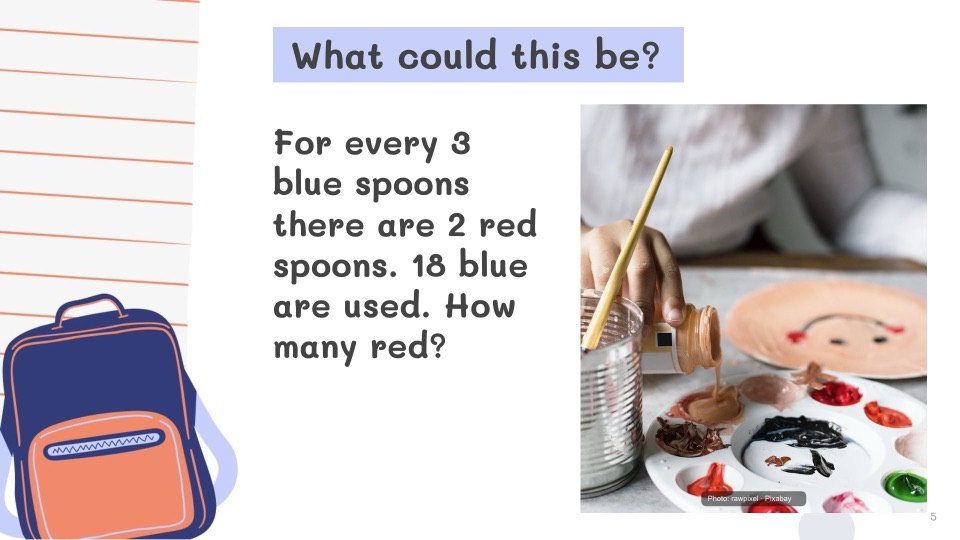
| 10 min | Teaching | To model finding a missing value by dividing then multiplying. Show Slides 3-5 and point out a ratio can be written in the form a:b. Present the photo problem in its exact words: A batch has 4 chocolate for every 2 strawberry. What if there were 24 chocolate? Model the solver: 24 divided by 4 = 6 to find the multiplier, then 2 x 6 = 12, because to scale up a ratio, you have to multiply both numbers by the same factor. Repeat with Slide 5 mystery in its exact words: For every 3 blue spoons there are 2 red spoons. 18 blue are used. How many red? |
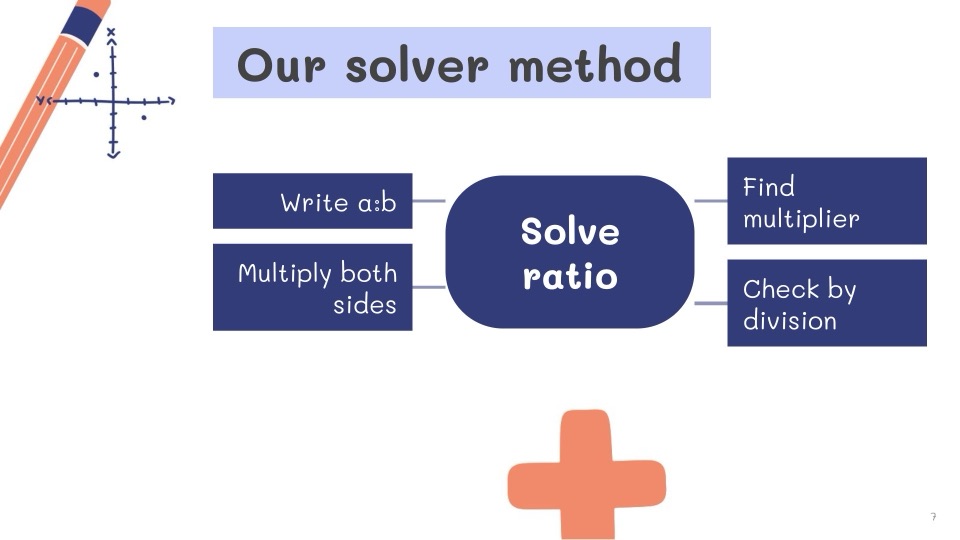
| 20 min | Main activity | To scale the 3:2 colour mix to find missing amounts. Show Slides 7 solver steps and give each pair 3 red cubes, 2 blue cubes, cups and a recording sheet. Direct pairs to build the base mix of 3 red cubes to 2 blue cubes and write 3:2. Set the challenge: 12 red cubes are needed, find the blue cubes by 12 ÷ 3 = 4, then 2 × 4 = 8, because division and multiplication can be used to solve ratio problems. Circulate, ask pairs to read out both calculations and check by dividing back. |
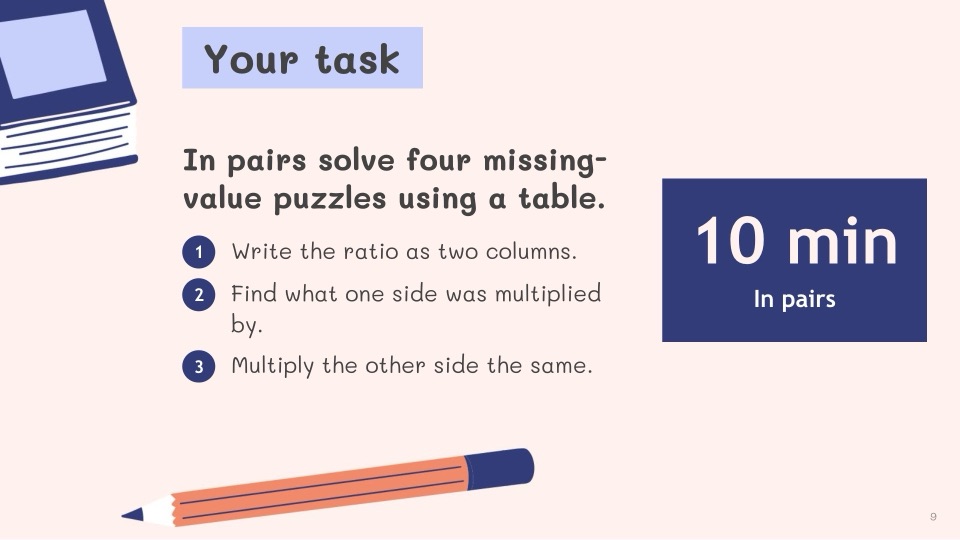
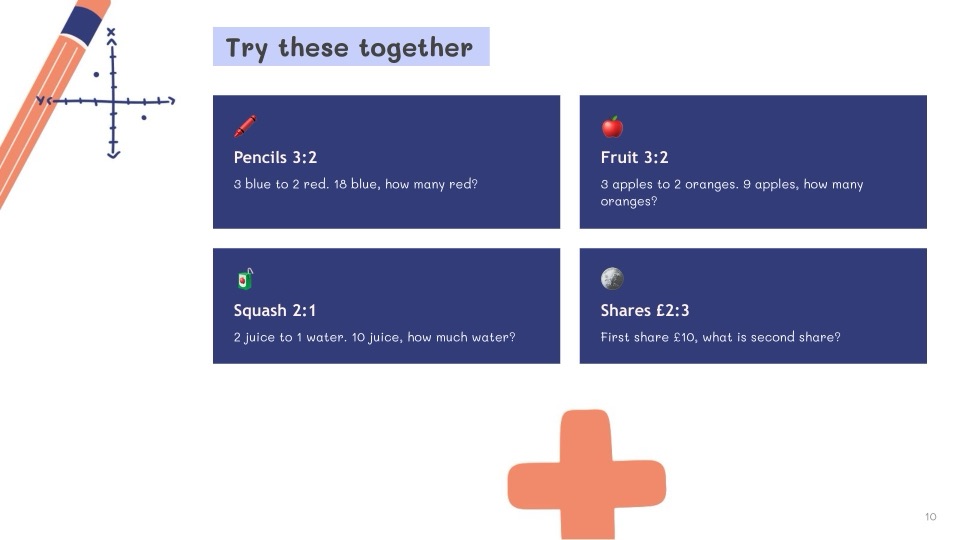
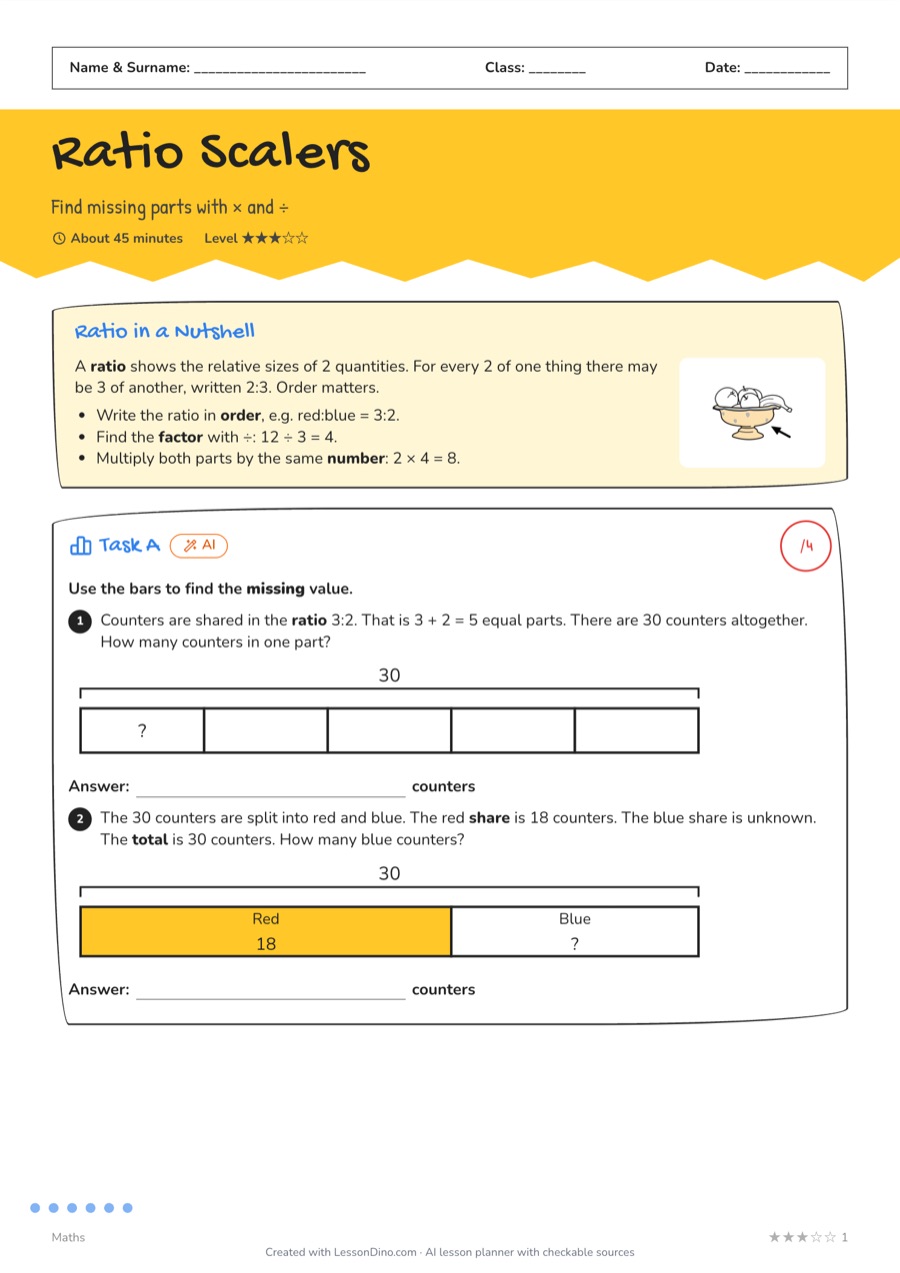
| 12 min | Practice | To solve four missing-value puzzles in pairs using tables. Show Slides 10 cards and hand out Worksheet Task B. Model one card: 3 apples to 2 oranges. 9 apples, how many oranges? 9 ÷ 3 = 3, so 2 × 3 = 6. Send pairs to complete Task B: Practice questions: Scale both parts by the same number, using two-column tables. Stop after 9 minutes to compare answers and stress that a bar model may help to clarify the structure of the problem. |
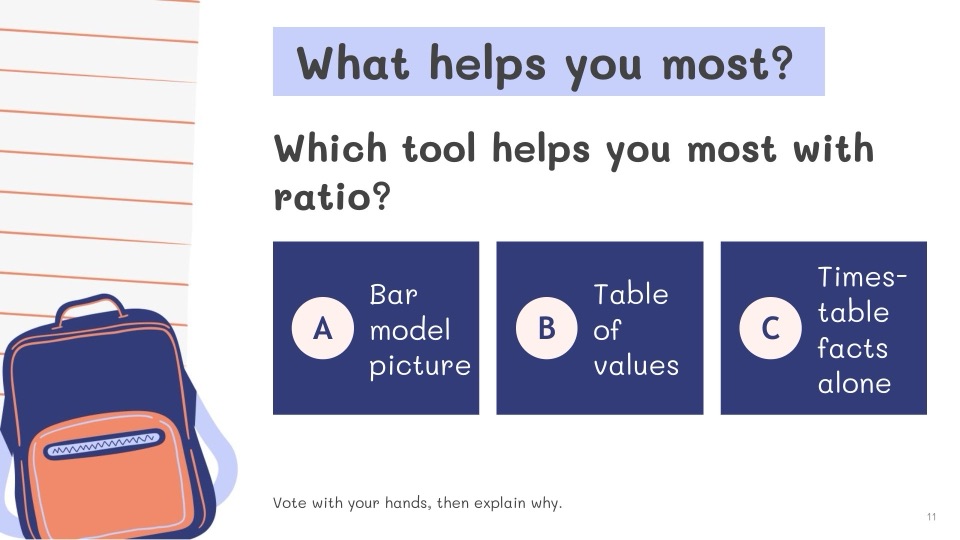
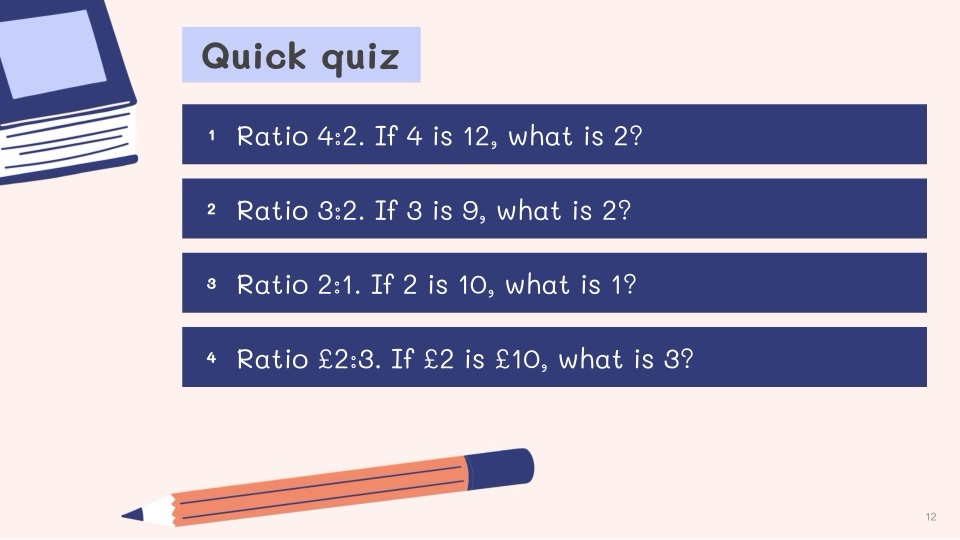
| 8 min | Plenary | To check pupils can find missing values and explain the method. Show Slides 12 quiz and cover answers for think time. Take answers on whiteboards for all three: 4:2 to 12, 3:2 to 9, 2:1 to 10. Ask pupils to say the division then multiplication each time and vote which tool helped most. Link back to success criteria and set homework. |
Common mistakes
- Adding the same number to both parts instead of multiplying, for example turning 3:2 into 9:8 by adding 6.
How to spot it: See +6 on both sides or mismatched arrows in the table.
Cover and show that to scale up a ratio, you have to multiply both numbers by the same factor; test 3:2 with cubes repeated 3 times. - Multiplying only one side, for example 3:2 becomes 9:2.
How to spot it: One column has a ×3 arrow and the other has none.
Ask what happened to the other side and insist both columns get the same arrow, then check by dividing back to base.
Support
- Give a pre-built base mix of 3 red cubes to 2 blue cubes with a times-table grid for x3 and x4 facts
- Highlight the known-column arrow and label bar pictures so pupils find the division step first
Stretch
- Challenge pupils to scale the same mix to 30 red cubes and explain the method in two sentences
- Ask pupils to work backwards by dividing to return to the base ratio and prove the check
Check questions
- Ratio 4:2. If 4 is 12, what is 2?
Answer: 6, because x3, so 2 x 3 - Ratio 3:2. If 3 is 9, what is 2?
Answer: 6, because x3, so 2 x 3 - Ratio 2:1. If 2 is 10, what is 1?
Answer: 5, because x5, so 1 x 5
Curriculum
solve problems involving the relative sizes of 2 quantities where missing values can be found by using integer multiplication and division facts
Video clips
Clips on YouTube, from the start and end times we chose. Check each one before you show it.
-
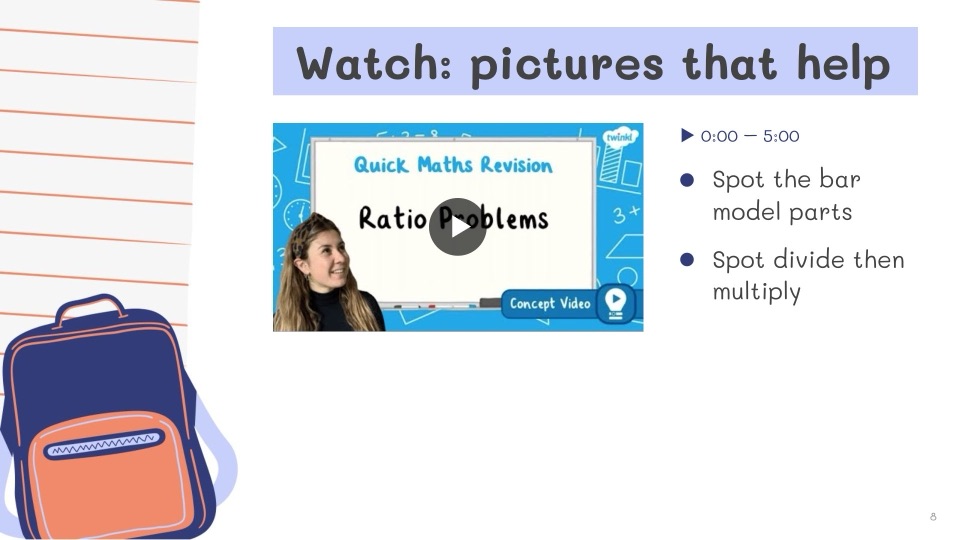
Year 6 intro to ratio from 0:00 to 5:00
The Maths Guy!: Intro to RATIO | Year 6 maths
Made for Year 6 maths and shows missing-value ratio problems at the right pace for 10-11-year-olds.
-
Solving KS2 ratio problems from 0:00 to 5:00
Twinkl Educational Publishing: How Do I Solve Ratio Problems? | KS2 Maths Concept for Kids
Made for KS2 pupils aged 7-11 and models solving relative-size problems with integer multiplication facts.
Worksheet
Sources
- National curriculum in England: mathematics programmes of study gov.uk
- Year 6 Maths Curriculum map 2023-2024 - westend.lancs.sch.uk westend.lancs.sch.uk
- Solving ratio problems - KS3 Maths - BBC Bitesize bbc.co.uk
- Solving problems with ratio - BBC Bitesize bbc.co.uk
- How to Solve Ratio Practice Problems - Question Examples wikijob.co.uk
- Ratio Problems — GCSE Mathematics Revision | PrepWise prepwise.uk
- Solving Ratio Problems - Reginald Mitchell reginaldmitchell.co.uk
- Solve problems involving ratio KS2 | Y6 Maths | Lesson Resources thenational.academy
- Ratio Worded Problems Worksheet - Best Worksheet worksheetserp.concejomunicipaldechinu.gov.co
- Ratio - KS3 Maths - BBC Bitesize bbc.co.uk
- Part to whole ratio word problem using tables - Khan Academy khanacademy.org
- Ratio Word Problems with Step-by-Step Solutions | MathPal Blog mathpal.study
- Ratio Word Problems Worksheets - Math Worksheets 4 Kids mathworksheets4kids.com
- Ratio Proportion Word Problems (examples, solutions, videos) onlinemathlearning.com
- Kids Math: Ratios - Ducksters ducksters.com
- Kids Math: Ratios, Fractions, and Percentages - Ducksters ducksters.com
- Ratio - KS2 Maths - BBC Bitesize bbc.co.uk
Picture credits
- Photo: geralt · Pixabay
- Photo: Marc-Lautenbacher · CC BY-SA 4.0 · Wikimedia Commons
- Photo: rawpixel · Pixabay
- Pictograms: Sergio Palao, ARASAAC (arasaac.org) · CC BY-NC-SA
Made with Lesson Dino's AI on 17 October 2026. AI can make mistakes, so check facts against the sources before you teach.