The worksheet
About this worksheet
Pupils learn to divide up to 4-digit numbers by two-digit numbers. They practise neat long division in pairs on squared paper. This Year 6 Maths worksheet gives students (ages 10–11) six pages of practice on long division, part of the multiplication and division unit. It goes with our free Long division lesson, which has the slides and a timed lesson plan.
What it covers
By the end, students should be able to:
- Students will divide up to 4-digit numbers by two-digit numbers using long division.
- Students will set out calculations neatly with aligned digits and multiples lists.
- Students will interpret remainders for context and check answers by multiplication.
How to use it
- Remainder Roundtable (12 minutes): Give three short contexts for Worksheet Task E sorting, for example spare pencils, extra minibus seats and money.
- Support: Give pre-drawn empty brackets with faint column guides and a completed multiples strip for the divisor.
- Stretch: Solve a division that needs a zero placeholder in the quotient and explain why the zero cannot be missed.
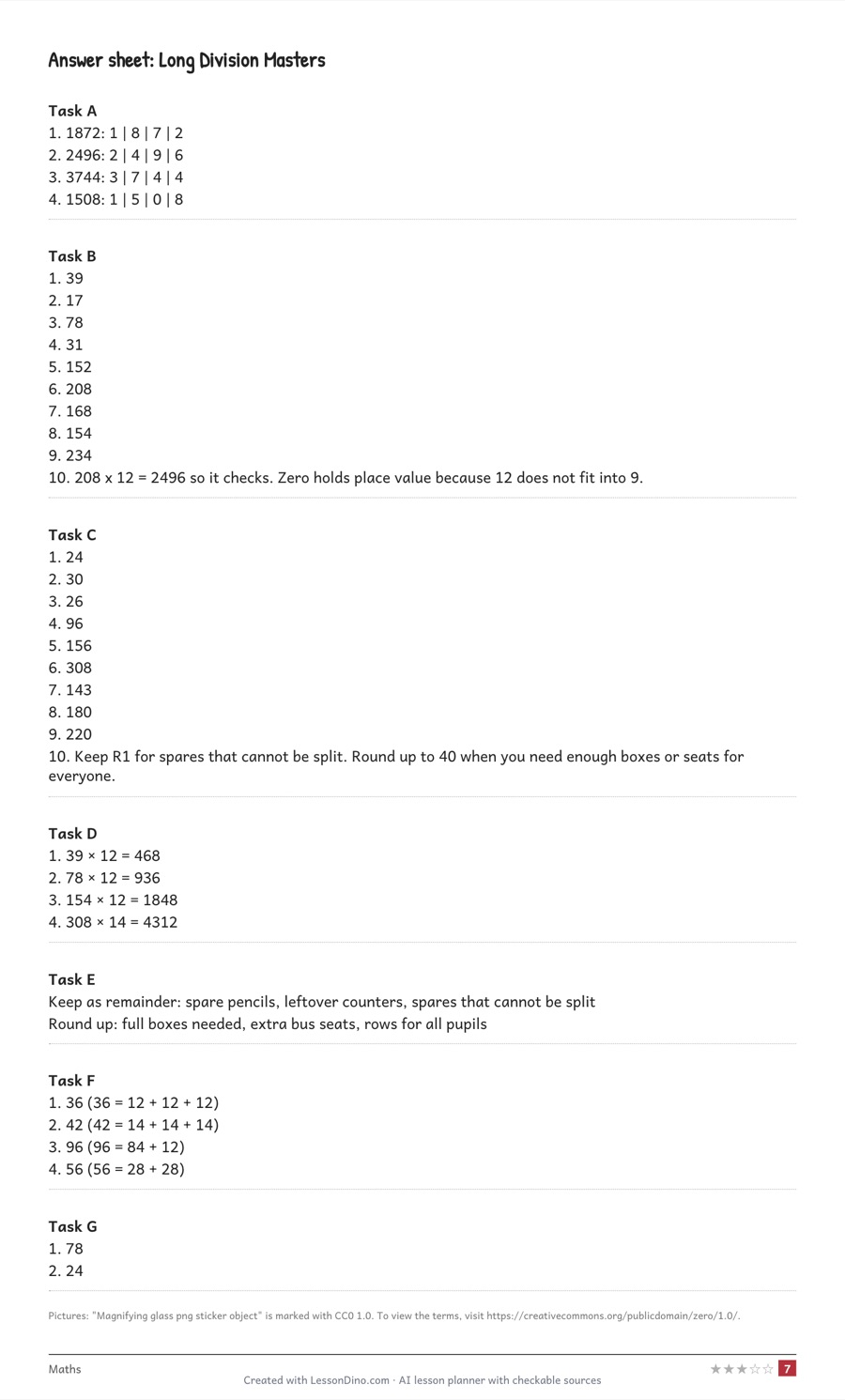
- The answer sheet is the last page, so you can print it on its own or let students check their own work.
Key vocabulary
- dividend: the large total inside the bracket that is shared out
- divisor: the number outside the bracket that you share by
- quotient: the answer written above the bracket
- remainder: the amount left over after the last subtract that cannot be shared equally
- multiple: the result of multiplying the outside number by 1, 2, 3 and so on
Mistakes to watch for
- Missing a zero in the quotient when the divisor does not fit. Write 0 above that digit before bringing down, because every position needs a digit.
- Messy columns so digits drift and place value is lost. Use one square per digit and keep straight columns, as most errors are lining-up errors.
- Skipping bring down or choosing the multiple by guessing. Say divide, multiply, subtract, bring down each loop and check the multiples list first.
What's on the worksheet
Master the Loop
Learn the long-division steps for two-digit divisors.
The Division Loop
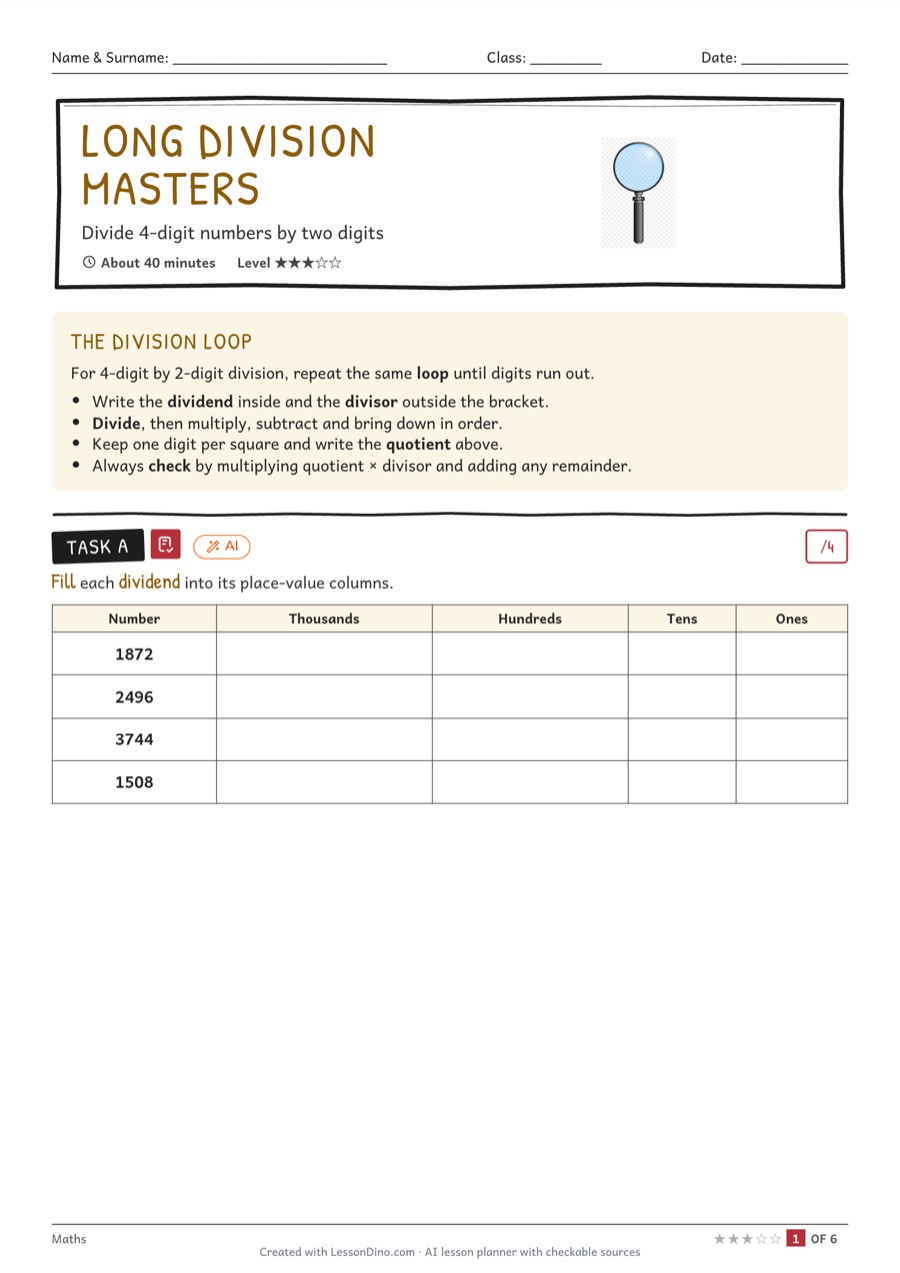
- For 4-digit by 2-digit division, repeat the same loop until digits run out.
- Write the dividend inside and the divisor outside the bracket.
- Divide, then multiply, subtract and bring down in order.
- Keep one digit per square and write the quotient above.
- Always check by multiplying quotient × divisor and adding any remainder.
Fill each dividend into its place-value columns.
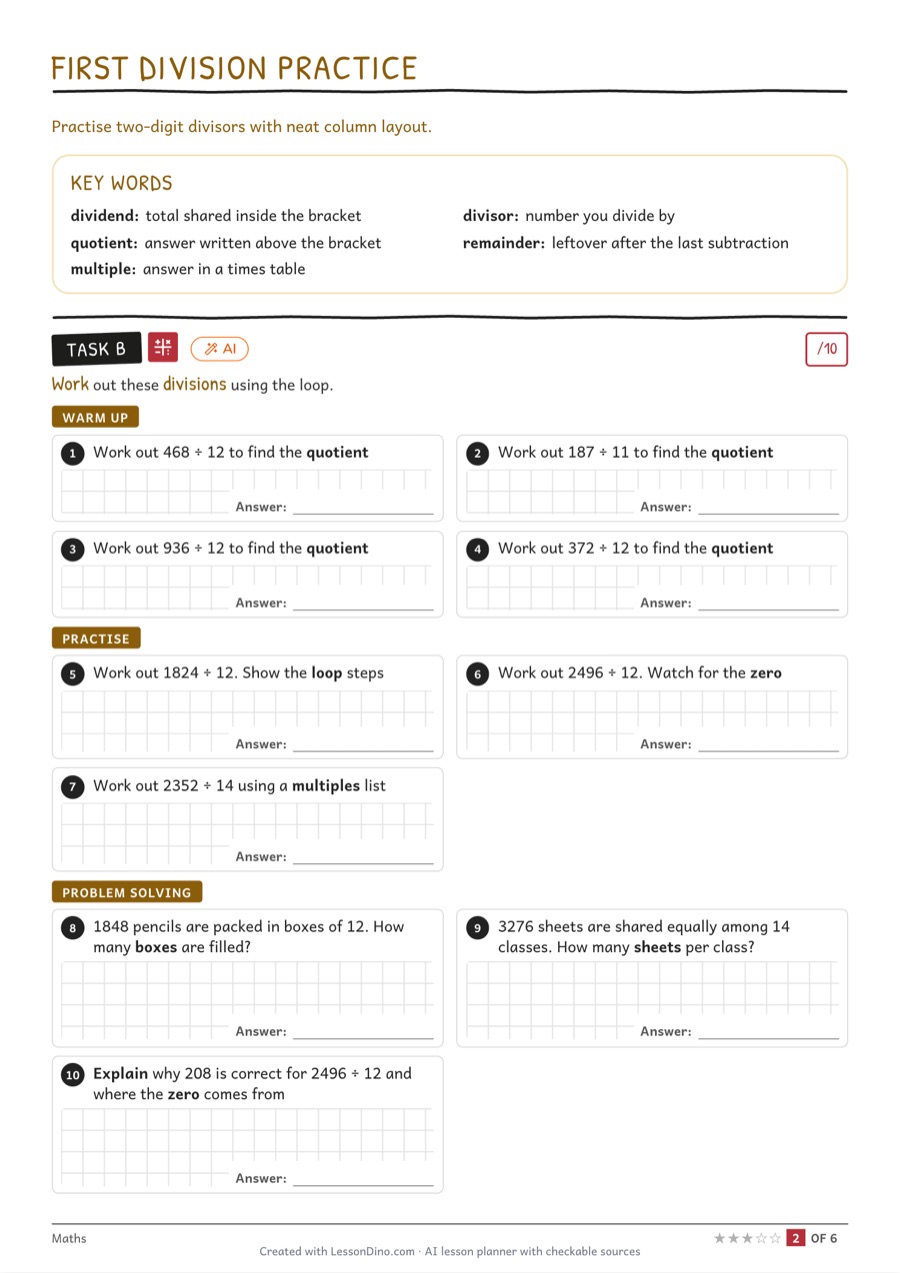
First Division Practice
Practise two-digit divisors with neat column layout.
| Word | Meaning |
|---|---|
| dividend | total shared inside the bracket |
| divisor | number you divide by |
| quotient | answer written above the bracket |
| remainder | leftover after the last subtraction |
| multiple | answer in a times table |
Work out these divisions using the loop.
Warm up
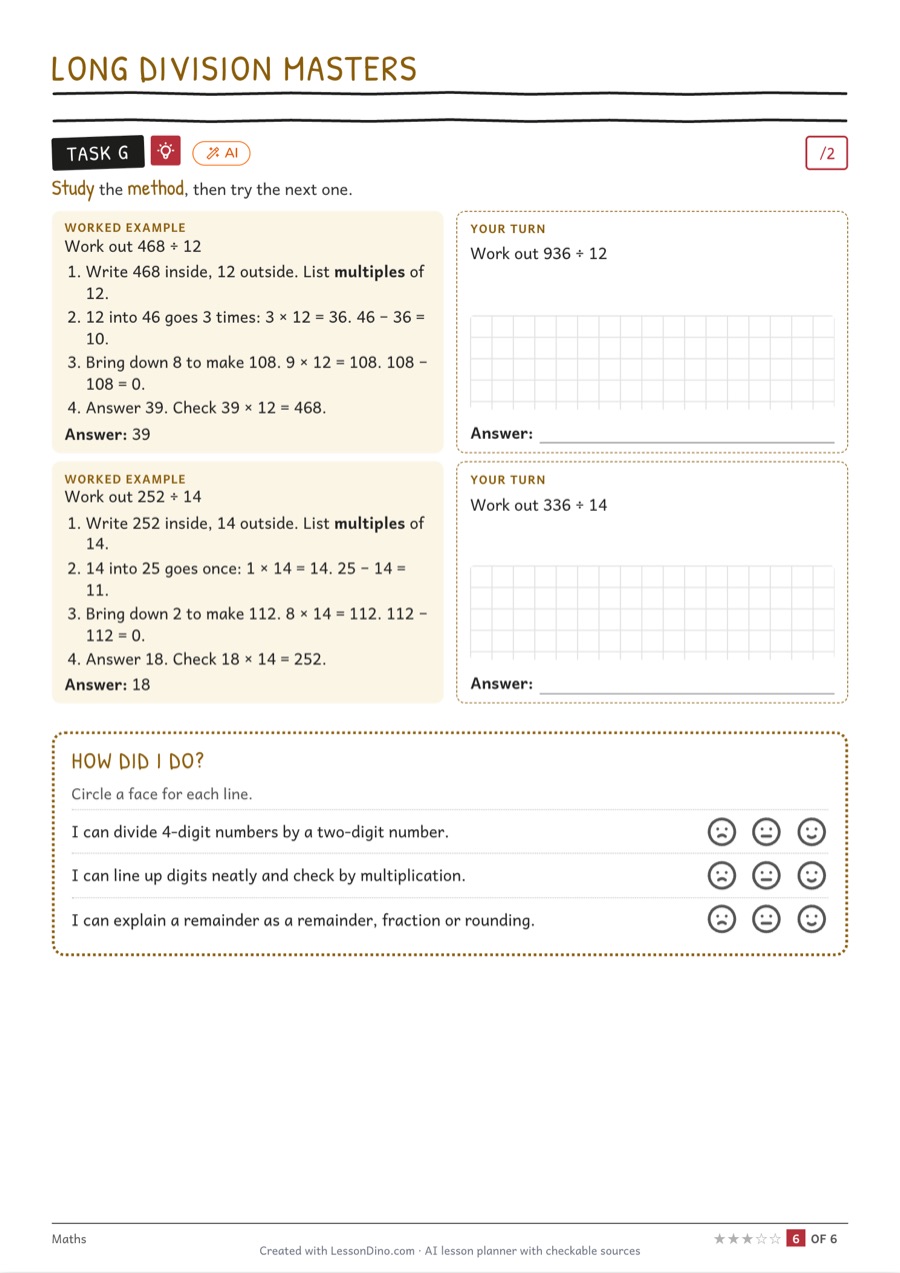
- Work out 468 ÷ 12 to find the quotient
- Work out 187 ÷ 11 to find the quotient
- Work out 936 ÷ 12 to find the quotient
- Work out 372 ÷ 12 to find the quotient
Practise
- Work out 1824 ÷ 12. Show the loop steps
- Work out 2496 ÷ 12. Watch for the zero
- Work out 2352 ÷ 14 using a multiples list
Problem solving
- 1848 pencils are packed in boxes of 12. How many boxes are filled?
- 3276 sheets are shared equally among 14 classes. How many sheets per class?
- Explain why 208 is correct for 2496 ÷ 12 and where the zero comes from
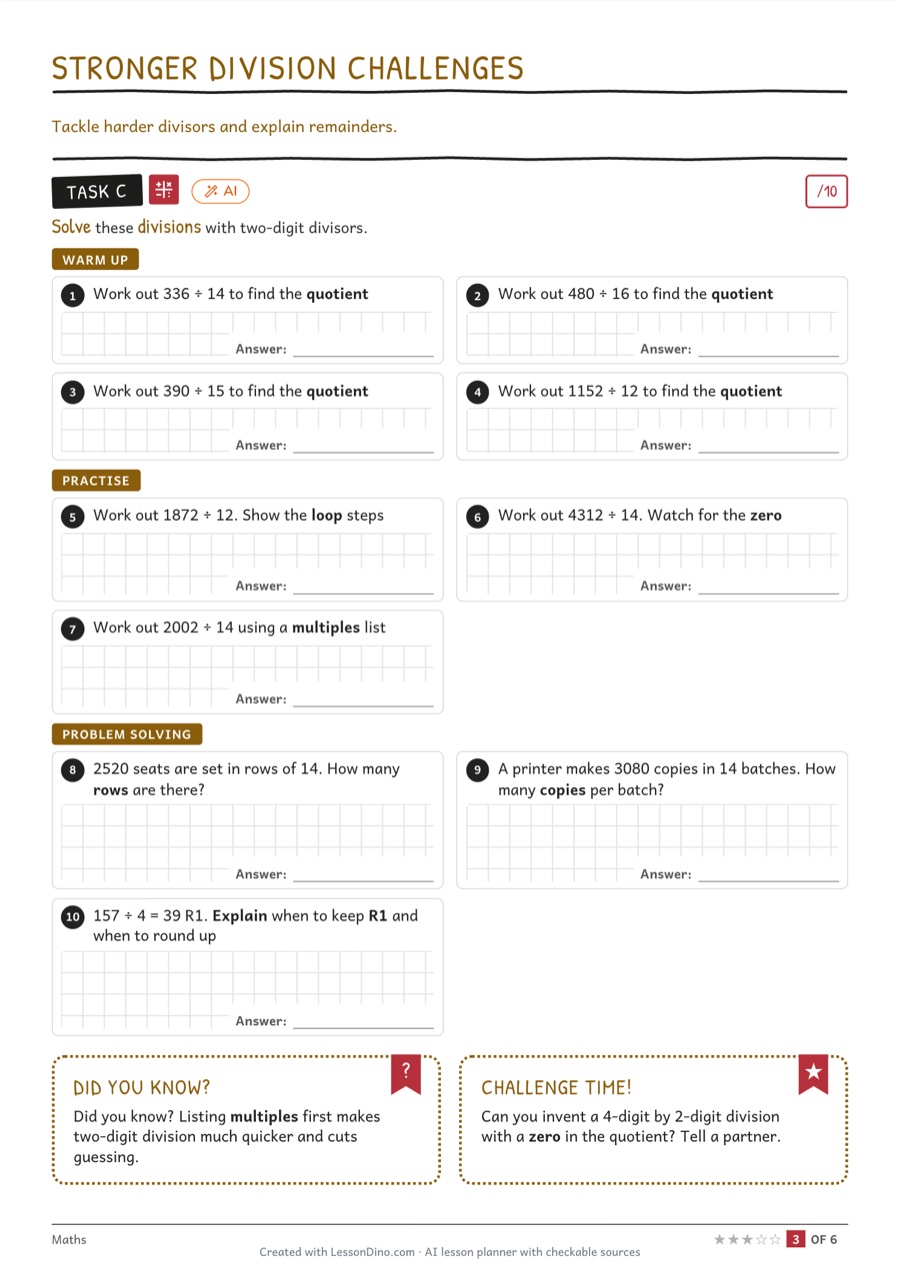
Stronger Division Challenges
Tackle harder divisors and explain remainders.
Solve these divisions with two-digit divisors.
Warm up
- Work out 336 ÷ 14 to find the quotient
- Work out 480 ÷ 16 to find the quotient
- Work out 390 ÷ 15 to find the quotient
- Work out 1152 ÷ 12 to find the quotient
Practise
- Work out 1872 ÷ 12. Show the loop steps
- Work out 4312 ÷ 14. Watch for the zero
- Work out 2002 ÷ 14 using a multiples list
Problem solving
- 2520 seats are set in rows of 14. How many rows are there?
- A printer makes 3080 copies in 14 batches. How many copies per batch?
- 157 ÷ 4 = 39 R1. Explain when to keep R1 and when to round up
- Did you know? Listing multiples first makes two-digit division much quicker and cuts guessing.
- Can you invent a 4-digit by 2-digit division with a zero in the quotient? Tell a partner.
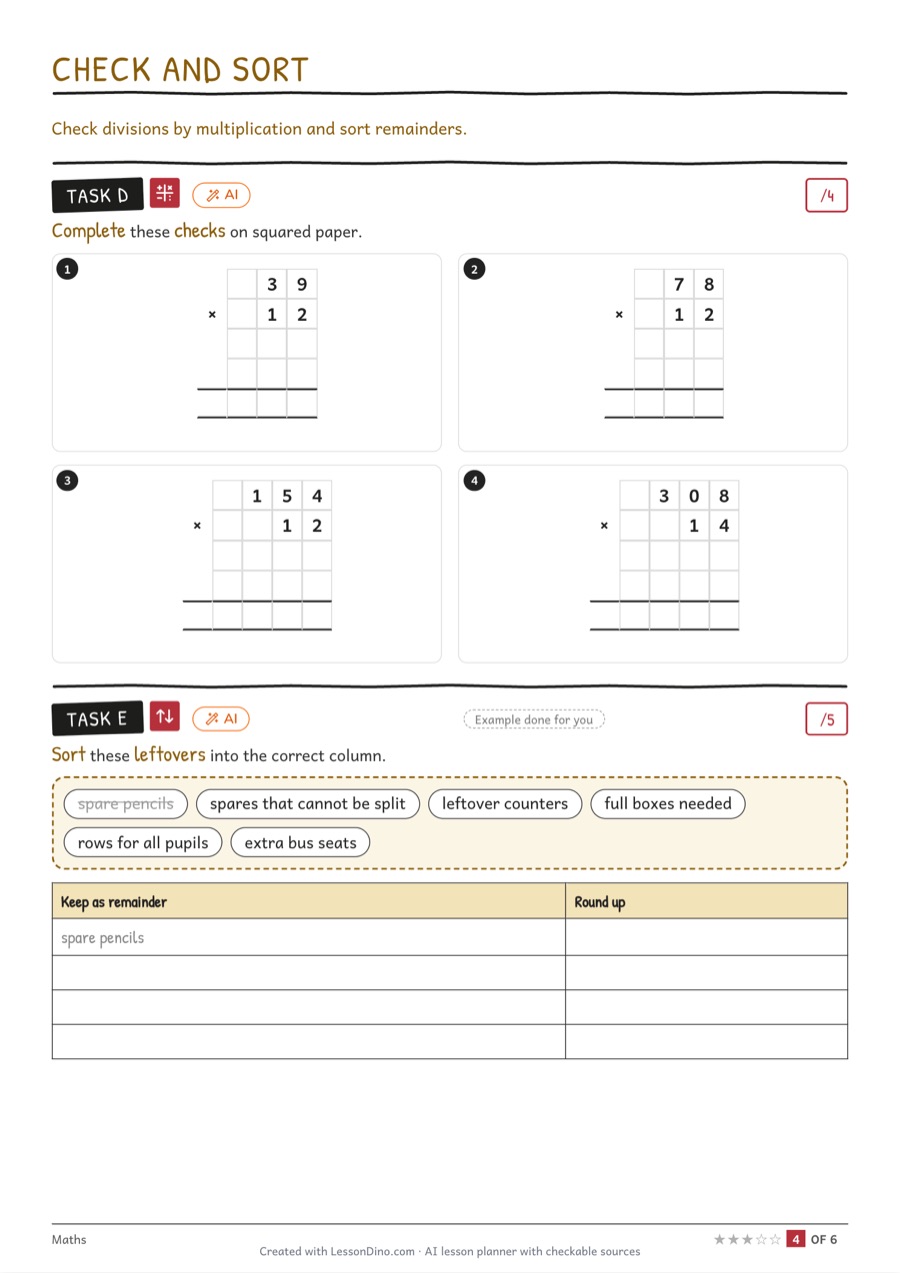
Check and Sort
Check divisions by multiplication and sort remainders.
Complete these checks on squared paper.
Sort these leftovers into the correct column.
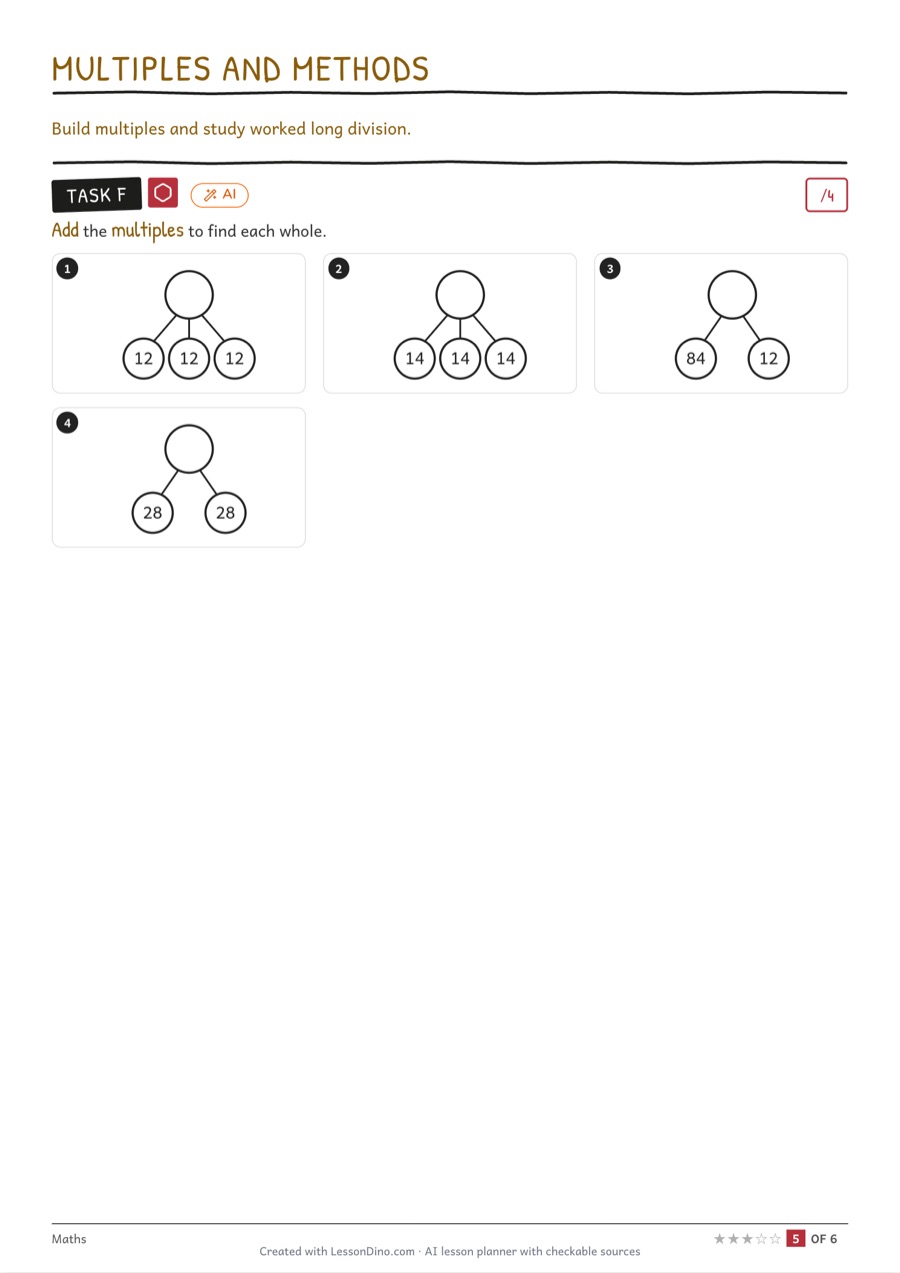
Multiples and Methods
Build multiples and study worked long division.
Add the multiples to find each whole.
Page 6
Study the method, then try the next one.
Answers
Show the answers
- Work out 468 ÷ 12 to find the quotient 39
- Work out 187 ÷ 11 to find the quotient 17
- Work out 936 ÷ 12 to find the quotient 78
- Work out 372 ÷ 12 to find the quotient 31
- Work out 1824 ÷ 12. Show the loop steps 152
- Work out 2496 ÷ 12. Watch for the zero 208
- Work out 2352 ÷ 14 using a multiples list 168
- 1848 pencils are packed in boxes of 12. How many boxes are filled? 154
- 3276 sheets are shared equally among 14 classes. How many sheets per class? 234
- Explain why 208 is correct for 2496 ÷ 12 and where the zero comes from 208 x 12 = 2496 so it checks. Zero holds place value because 12 does not fit into 9.
- Work out 336 ÷ 14 to find the quotient 24
- Work out 480 ÷ 16 to find the quotient 30
- Work out 390 ÷ 15 to find the quotient 26
- Work out 1152 ÷ 12 to find the quotient 96
- Work out 1872 ÷ 12. Show the loop steps 156
- Work out 4312 ÷ 14. Watch for the zero 308
- Work out 2002 ÷ 14 using a multiples list 143
- 2520 seats are set in rows of 14. How many rows are there? 180
- A printer makes 3080 copies in 14 batches. How many copies per batch? 220
- 157 ÷ 4 = 39 R1. Explain when to keep R1 and when to round up Keep R1 for spares that cannot be split. Round up to 40 when you need enough boxes or seats for everyone.
The answer sheet is the last picture above.
Curriculum
divide numbers up to 4 digits by a two-digit whole number using the formal written method of long division
Made with Lesson Dino's AI on 17 October 2026. AI can make mistakes, so check the answers and facts against the sources before you teach.