The worksheet
About this worksheet
Students learn to calculate the area of parallelograms and triangles. They cut shapes to prove the rules and solve area problems. This Year 6 Maths worksheet gives students (ages 10–11) six pages of practice on area of triangles and parallelograms, part of the measurement unit. It goes with our free Area of triangles and parallelograms lesson, which has the slides and a timed lesson plan.
What it covers
By the end, students should be able to:
- Students will relate rectangles to parallelograms and triangles by dissection.
- Students will calculate the area of parallelograms using base times height.
- Students will calculate the area of triangles using half times base times height.
How to use it
- Main activity (25 minutes): Hand out Worksheet Task B for pairs to find each area using the perpendicular height.
- Plenary (10 minutes): Do one Worksheet Task C error together: spot use of slanted side or forgotten halving.
- Support: Start with right-angled triangles where the base and height meet at a corner of a square on the grid.
- Stretch: Challenge students to draw a different triangle with the same base and height and show it must have the same area.
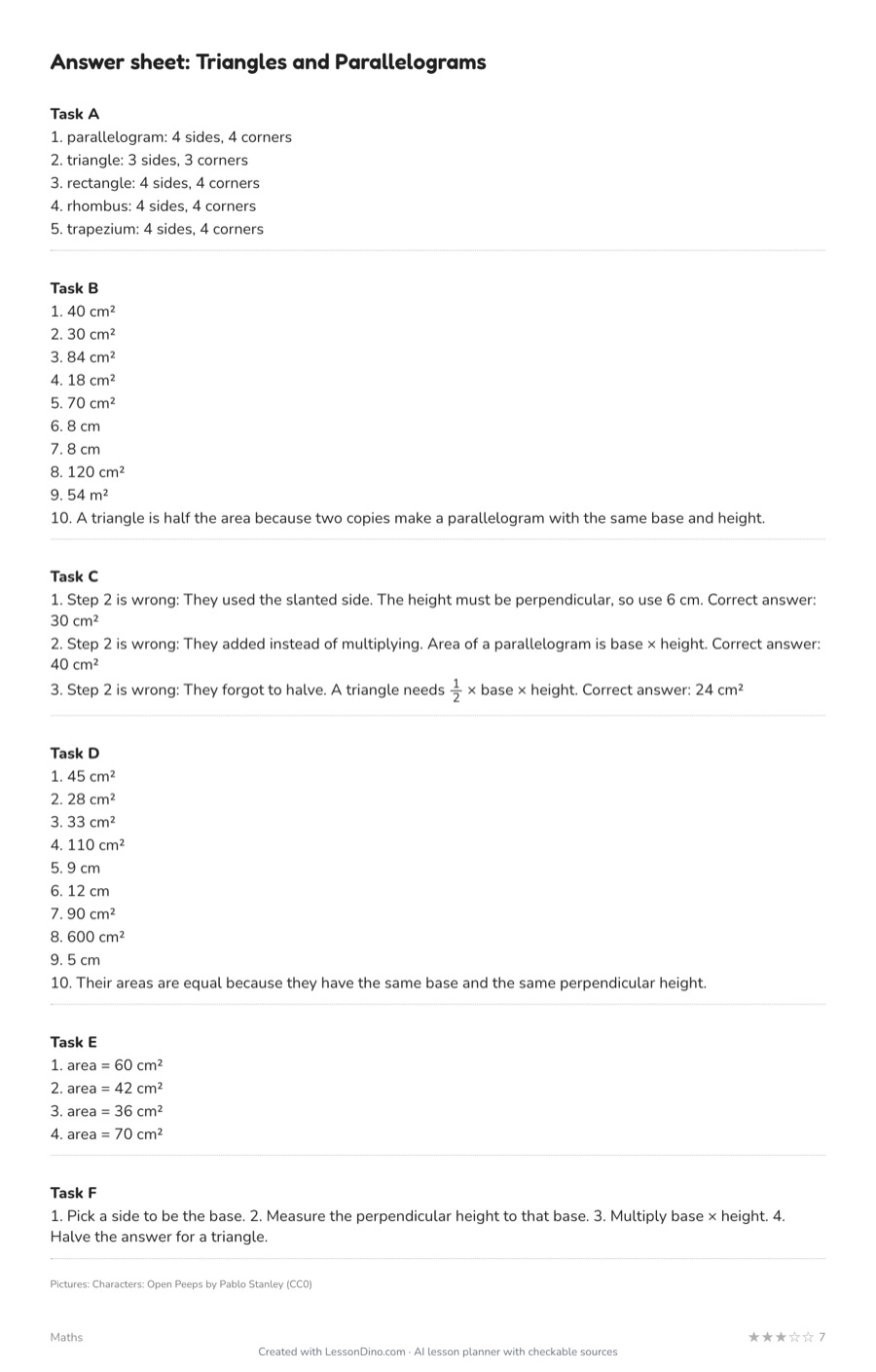
- The answer sheet is the last page, so you can print it on its own or let students check their own work.
Key vocabulary
- base: the side chosen to start measuring from when working out size
- height: the straight line from the starting side to the opposite side that meets it at a square corner
- area: the amount of flat space inside a shape, measured in square units such as cm²
- parallelogram: a four-sided shape with both pairs of opposite sides running the same way
- triangle: a shape with three straight sides and three corners, always half its matching four-sided shape
- dissection: cutting a shape up and putting the parts back together to show how size is linked
Mistakes to watch for
- Using the slanted side length as the height. Test with a right-angle card; height is the perpendicular distance from the base to the opposite side.
- Forgetting to halve for triangles. Remind that two equal triangles make one parallelogram, so use 1/2 × base × height.
- Writing cm instead of cm² or mixing units. Practise saying we count squares: lengths in cm, areas in cm².
What's on the worksheet
Spot the shapes
Remember the area rules and get to know the shapes.
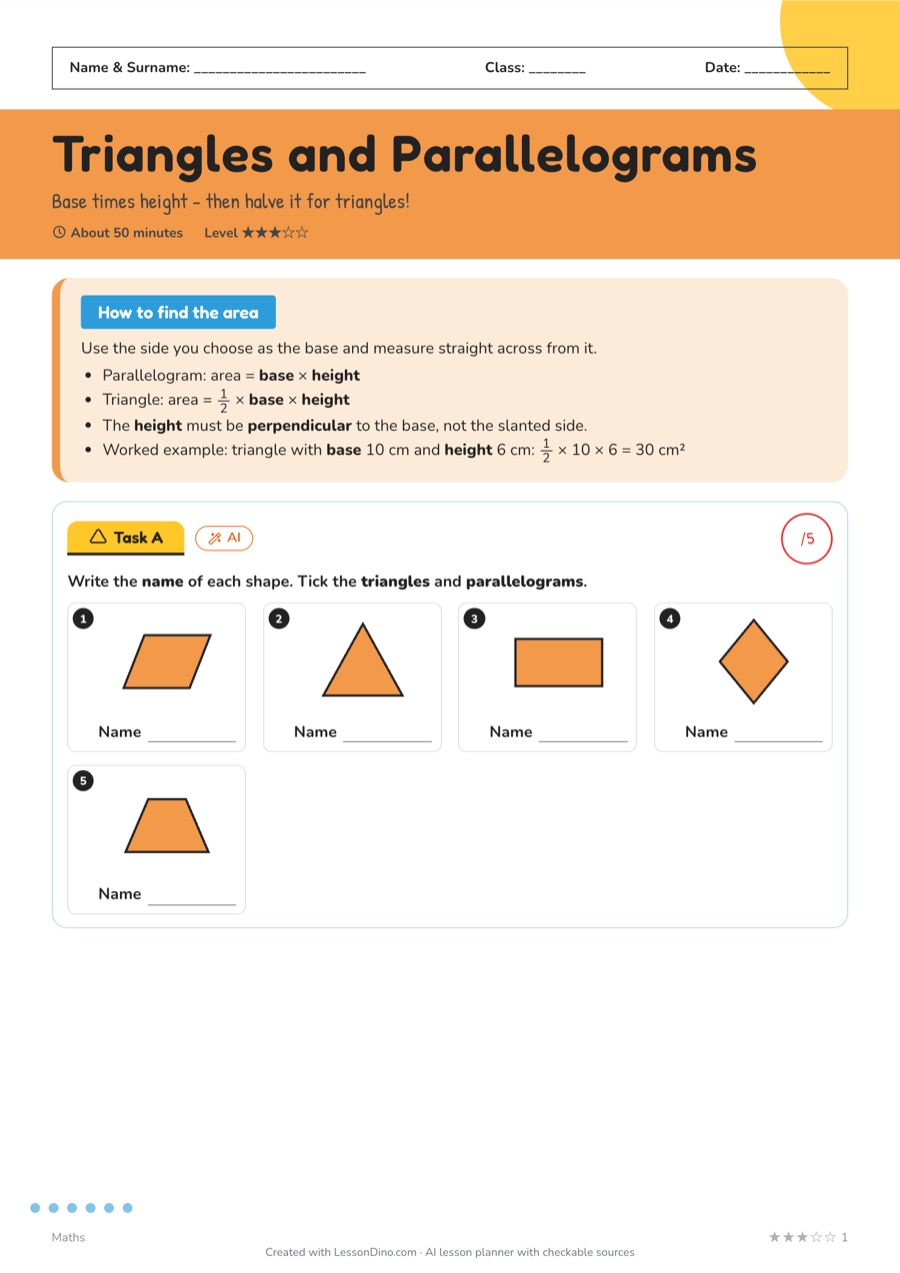
How to find the area
- Use the side you choose as the base and measure straight across from it.
- Parallelogram: area = base × height
- Triangle: area = 1/2 × base × height
- The height must be perpendicular to the base, not the slanted side.
- Worked example: triangle with base 10 cm and height 6 cm: 1/2 × 10 × 6 = 30 cm²
Write the name of each shape. Tick the triangles and parallelograms.
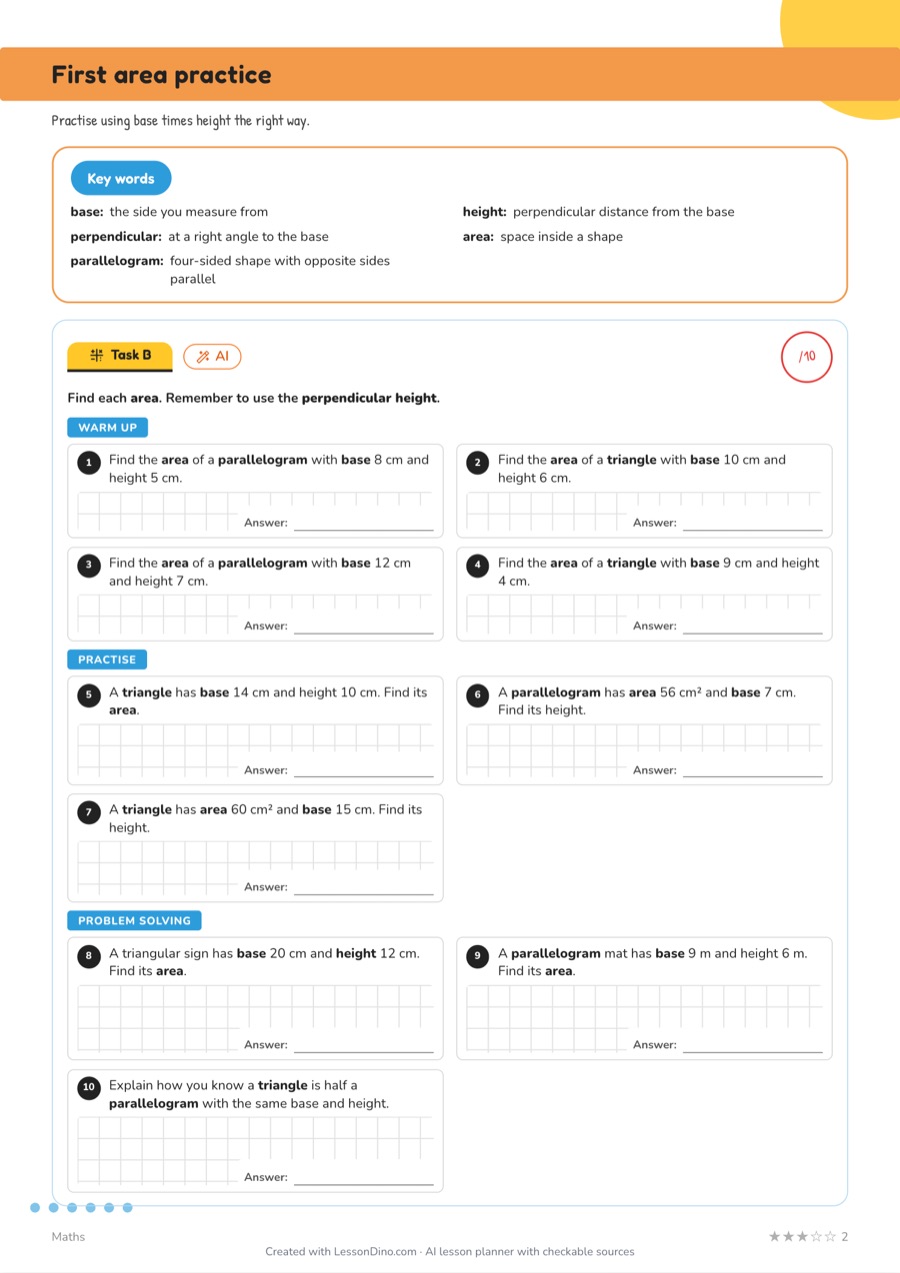
First area practice
Practise using base times height the right way.
| Word | Meaning |
|---|---|
| base | the side you measure from |
| height | perpendicular distance from the base |
| perpendicular | at a right angle to the base |
| area | space inside a shape |
| parallelogram | four-sided shape with opposite sides parallel |
Find each area. Remember to use the perpendicular height.
Warm up
- Find the area of a parallelogram with base 8 cm and height 5 cm.
- Find the area of a triangle with base 10 cm and height 6 cm.
- Find the area of a parallelogram with base 12 cm and height 7 cm.
- Find the area of a triangle with base 9 cm and height 4 cm.
Practise
- A triangle has base 14 cm and height 10 cm. Find its area.
- A parallelogram has area 56 cm² and base 7 cm. Find its height.
- A triangle has area 60 cm² and base 15 cm. Find its height.
Problem solving
- A triangular sign has base 20 cm and height 12 cm. Find its area.
- A parallelogram mat has base 9 m and height 6 m. Find its area.
- Explain how you know a triangle is half a parallelogram with the same base and height.
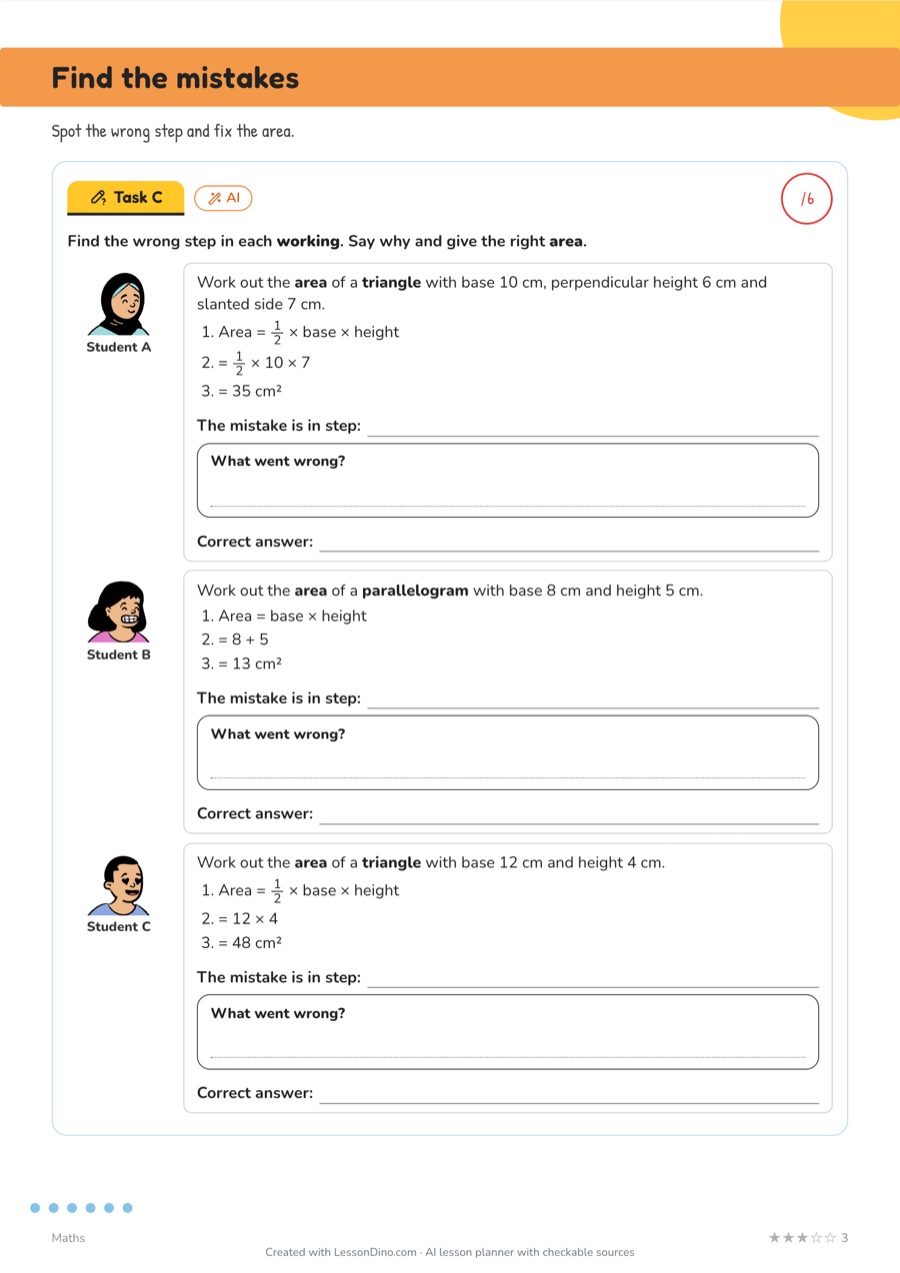
Find the mistakes
Spot the wrong step and fix the area.
Find the wrong step in each working. Say why and give the right area.
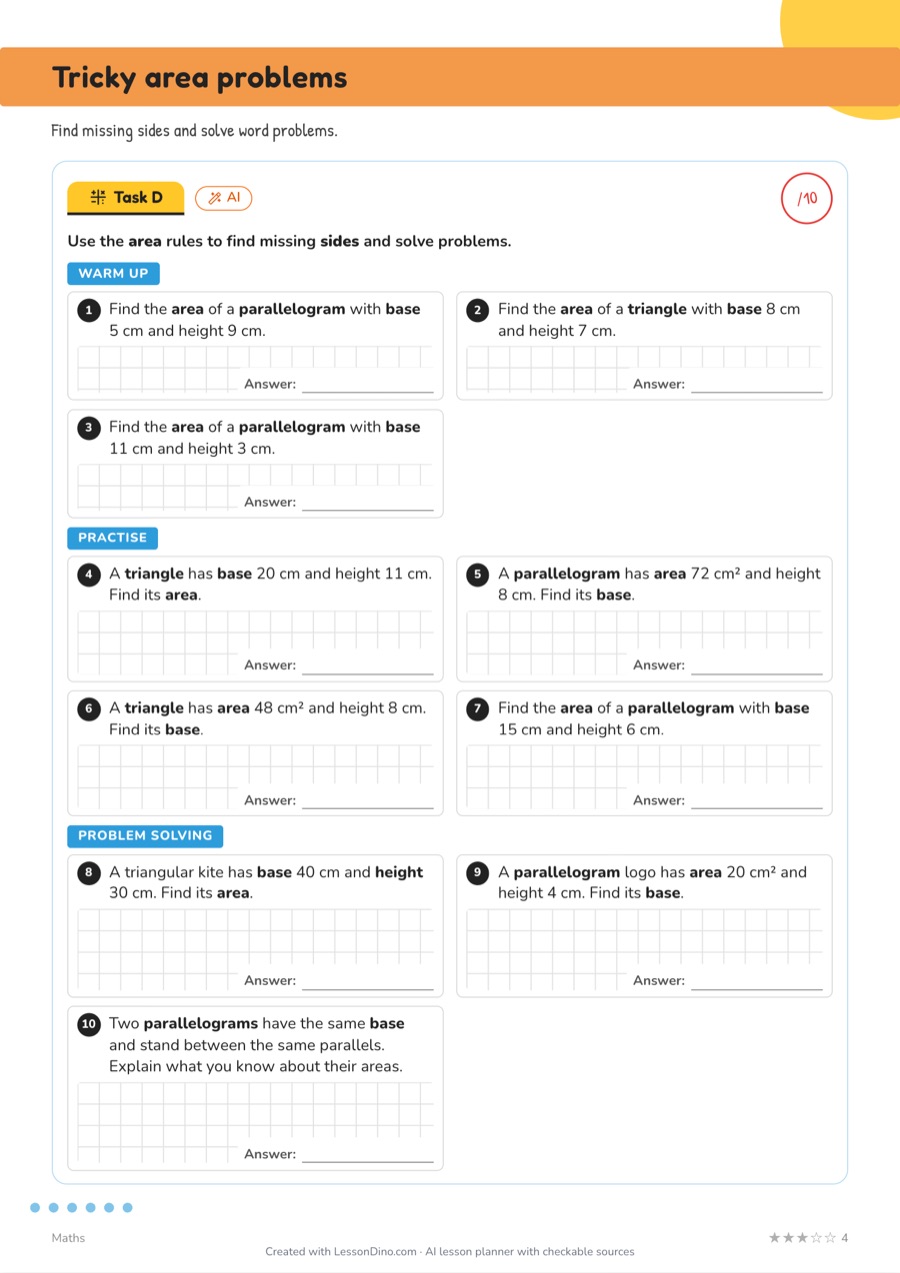
Tricky area problems
Find missing sides and solve word problems.
Use the area rules to find missing sides and solve problems.
Warm up
- Find the area of a parallelogram with base 5 cm and height 9 cm.
- Find the area of a triangle with base 8 cm and height 7 cm.
- Find the area of a parallelogram with base 11 cm and height 3 cm.
Practise
- A triangle has base 20 cm and height 11 cm. Find its area.
- A parallelogram has area 72 cm² and height 8 cm. Find its base.
- A triangle has area 48 cm² and height 8 cm. Find its base.
- Find the area of a parallelogram with base 15 cm and height 6 cm.
Problem solving
- A triangular kite has base 40 cm and height 30 cm. Find its area.
- A parallelogram logo has area 20 cm² and height 4 cm. Find its base.
- Two parallelograms have the same base and stand between the same parallels. Explain what you know about their areas.
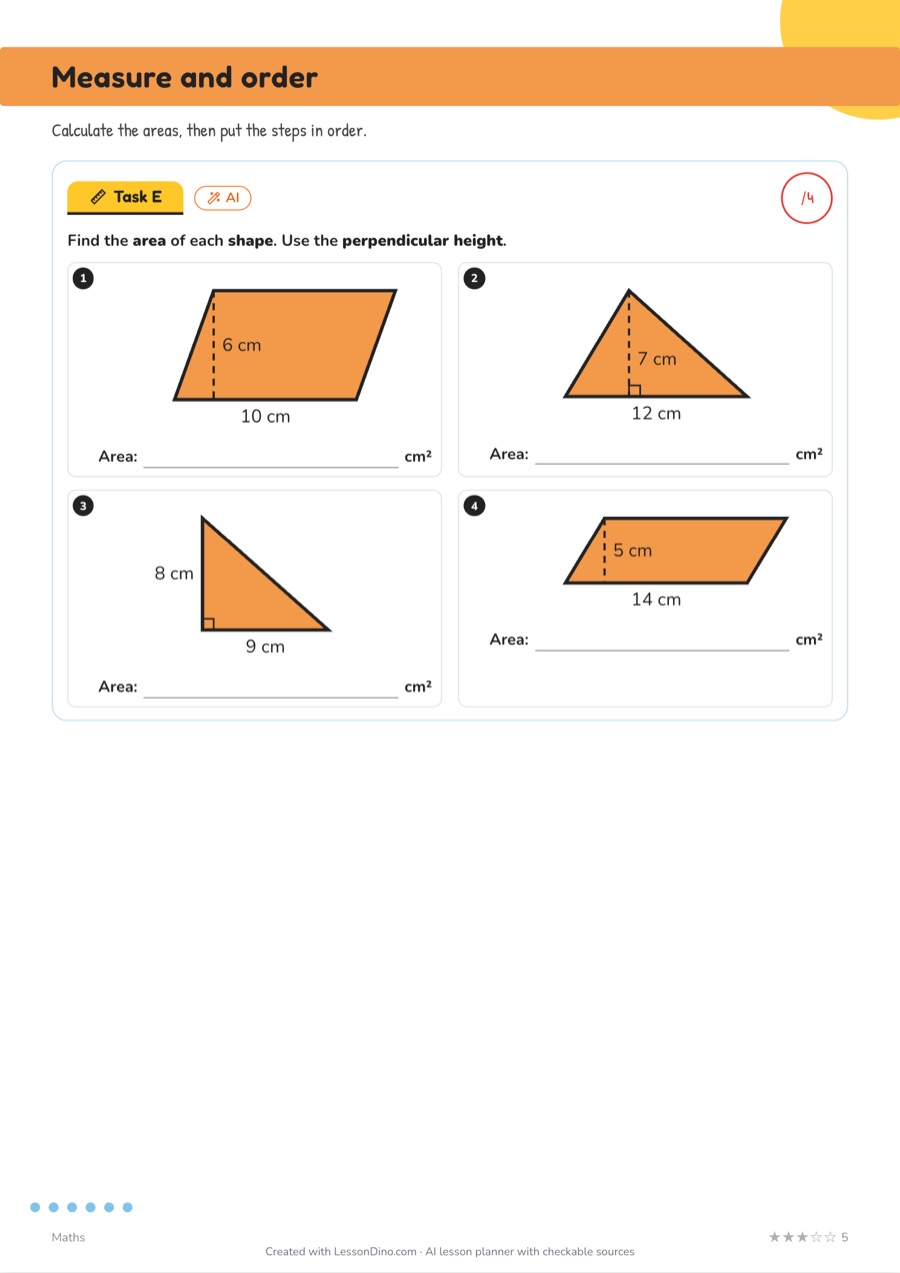
Measure and order
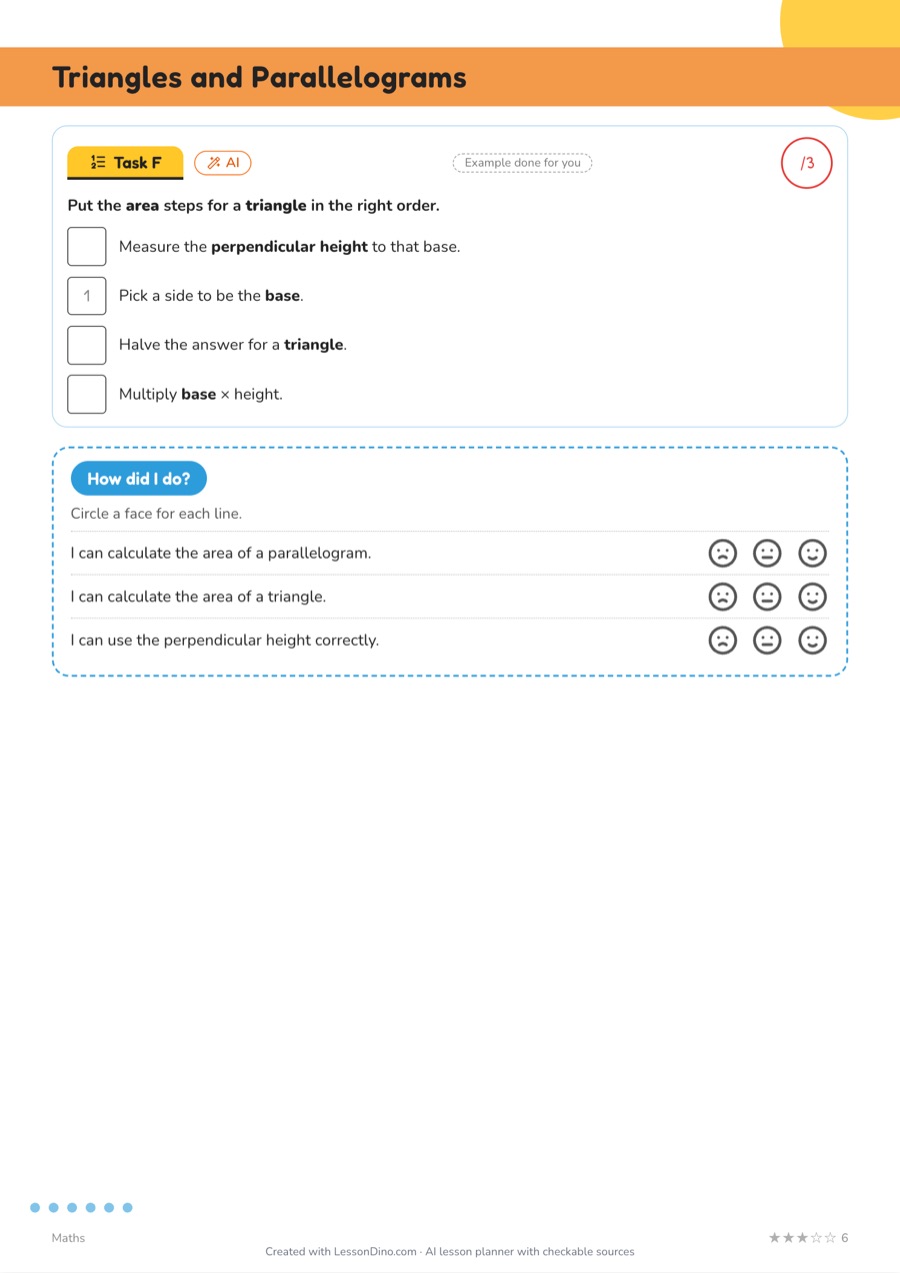
Calculate the areas, then put the steps in order.
Find the area of each shape. Use the perpendicular height.
Page 6
Put the area steps for a triangle in the right order.
Answers
Show the answers
- Find the area of a parallelogram with base 8 cm and height 5 cm. 40 cm²
- Find the area of a triangle with base 10 cm and height 6 cm. 30 cm²
- Find the area of a parallelogram with base 12 cm and height 7 cm. 84 cm²
- Find the area of a triangle with base 9 cm and height 4 cm. 18 cm²
- A triangle has base 14 cm and height 10 cm. Find its area. 70 cm²
- A parallelogram has area 56 cm² and base 7 cm. Find its height. 8 cm
- A triangle has area 60 cm² and base 15 cm. Find its height. 8 cm
- A triangular sign has base 20 cm and height 12 cm. Find its area. 120 cm²
- A parallelogram mat has base 9 m and height 6 m. Find its area. 54 m²
- Explain how you know a triangle is half a parallelogram with the same base and height. A triangle is half the area because two copies make a parallelogram with the same base and height.
- Find the area of a parallelogram with base 5 cm and height 9 cm. 45 cm²
- Find the area of a triangle with base 8 cm and height 7 cm. 28 cm²
- Find the area of a parallelogram with base 11 cm and height 3 cm. 33 cm²
- A triangle has base 20 cm and height 11 cm. Find its area. 110 cm²
- A parallelogram has area 72 cm² and height 8 cm. Find its base. 9 cm
- A triangle has area 48 cm² and height 8 cm. Find its base. 12 cm
- Find the area of a parallelogram with base 15 cm and height 6 cm. 90 cm²
- A triangular kite has base 40 cm and height 30 cm. Find its area. 600 cm²
- A parallelogram logo has area 20 cm² and height 4 cm. Find its base. 5 cm
- Two parallelograms have the same base and stand between the same parallels. Explain what you know about their areas. Their areas are equal because they have the same base and the same perpendicular height.
The answer sheet is the last picture above.
Curriculum
calculate the area of parallelograms and triangles
Made with Lesson Dino's AI on 17 October 2026. AI can make mistakes, so check the answers and facts against the sources before you teach.