Slides
Lesson plan
Two Parts Make Ten
Pupils learn bonds to 10 and matching take-aways linked to 20. They split cubes on part-part-whole mats and write the four sentences.
Objectives
- Students will represent bonds to 10 using cubes, drawings and number sentences.
- Students will use bonds to 10 to add and subtract within 20.
Success criteria
- I can show 10 split into two parts and say the bond.
- I can write additions and take-aways that match bonds to 20.
Key words
| Word | Meaning |
|---|---|
| number bond | two small counts that join to make a total, here ten |
| part | one small group that joins with another to make the total |
| whole | the big total made when the two small groups join |
| take away | finding what is left when some are removed from the total |
Timed plan (60 minutes)
| Time | Stage | What happens |
|---|---|---|
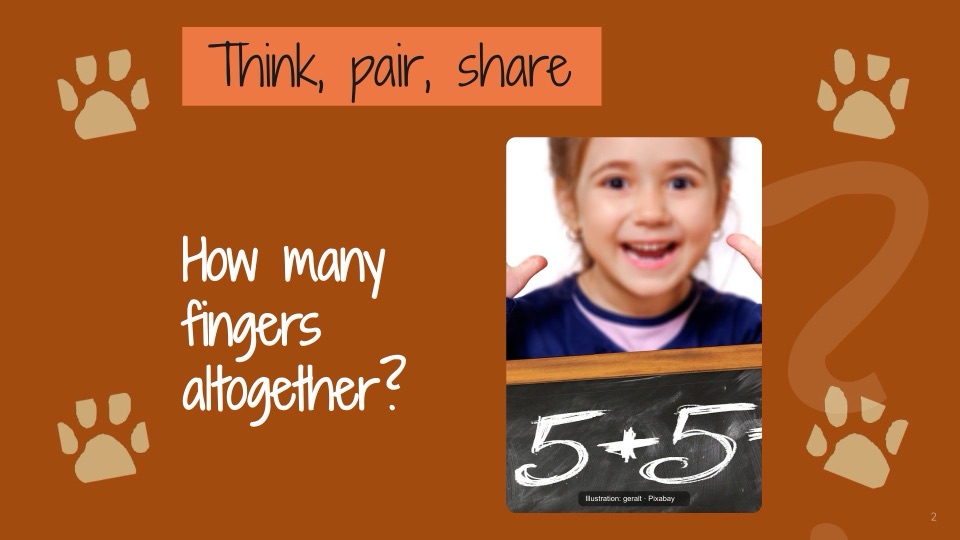
| 5 min | Starter | To hook pupils and recall that two parts join to make ten. Draw three empty circles joined by lines on the board. Ask: what whole number shall we split into two parts today? Show Slide 1: Number Bonds to 10 [title]: Two parts make ten! Show Slide 2: Think, pair, share [question]: How many fingers altogether? Pupils hold up ten fingers and count. Show Slide 3: Big idea [statement]: Two parts join to make ten. |
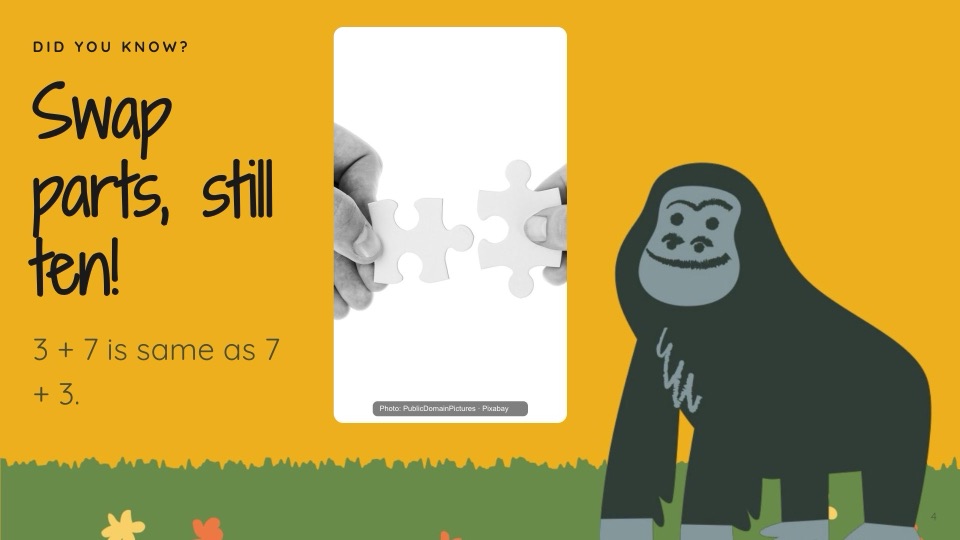
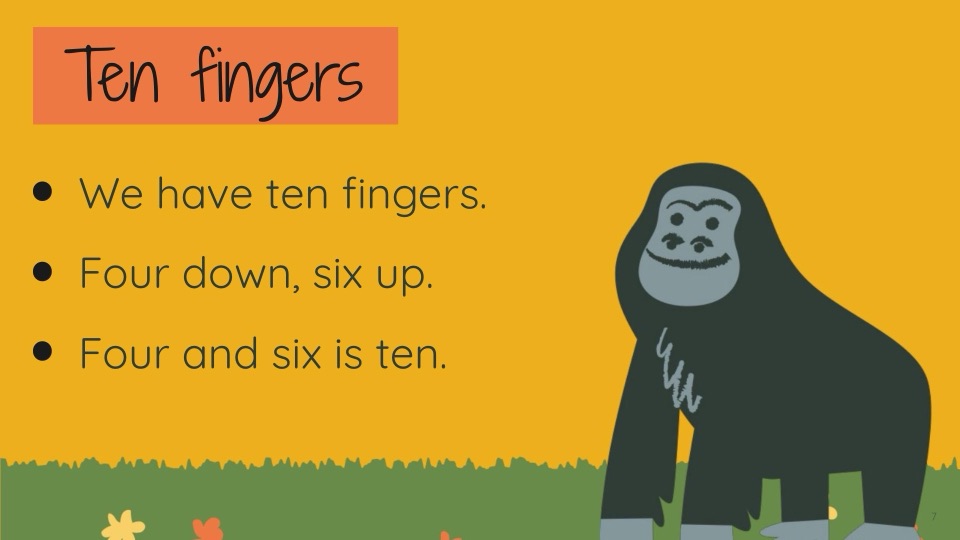
| 10 min | Teaching | To model a bond to 10 on a part-part-whole mat with matching sentences. Put 10 cubes in the whole circle of a large mat and explain a number bond consists of a minimum of three circles connected by lines, with the whole written in the first circle and its parts written in the adjoining circles. Split the 10 cubes into 7 and 3, because the parts when added together will then equal the whole. Show Slide 7: Ten fingers [bullets]: We have ten fingers. · Four down, six up. · Four and six is ten. Model fold down 4 fingers and 6 are still up, so 4 and 6 make 10. Show Slide 4: Did you know? [fact]: Swap parts, still ten! · 3 + 7 is same as 7 + 3. Explain it does not matter which order you add numbers together, the total amount is the same. |
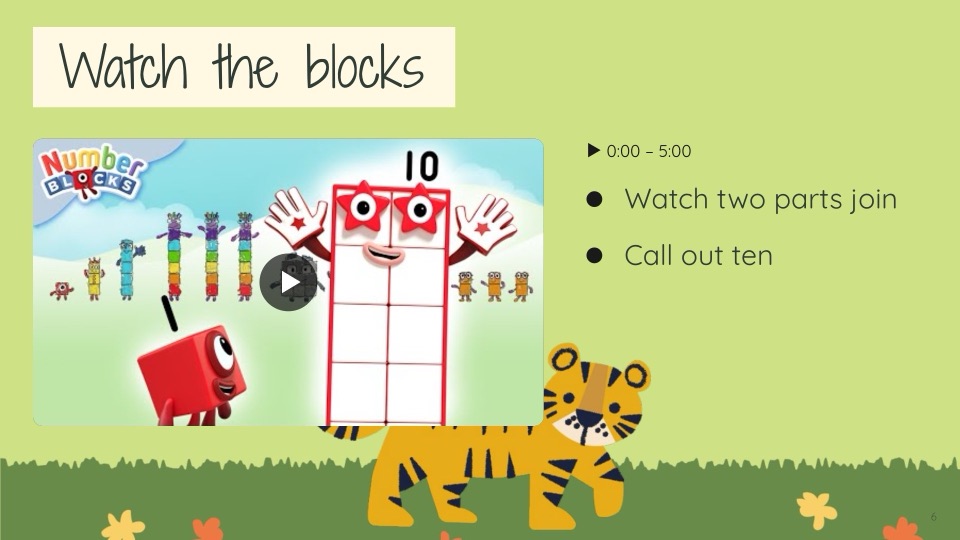
| 10 min | Sing and show | To practise recalling pairs to 10 together with movement and song. Show Slide 6: Watch the blocks [video]: Watch two parts join · Call out ten. Play Video clip 2 (0:00-5:00) and pause for pupils to call out each ten. Show Slide 8: Sing the bonds [video]: Listen for pairs to ten · Sing and show fingers. Play Video clip 4 (0:00-2:00) and lead finger shows for each pair. |
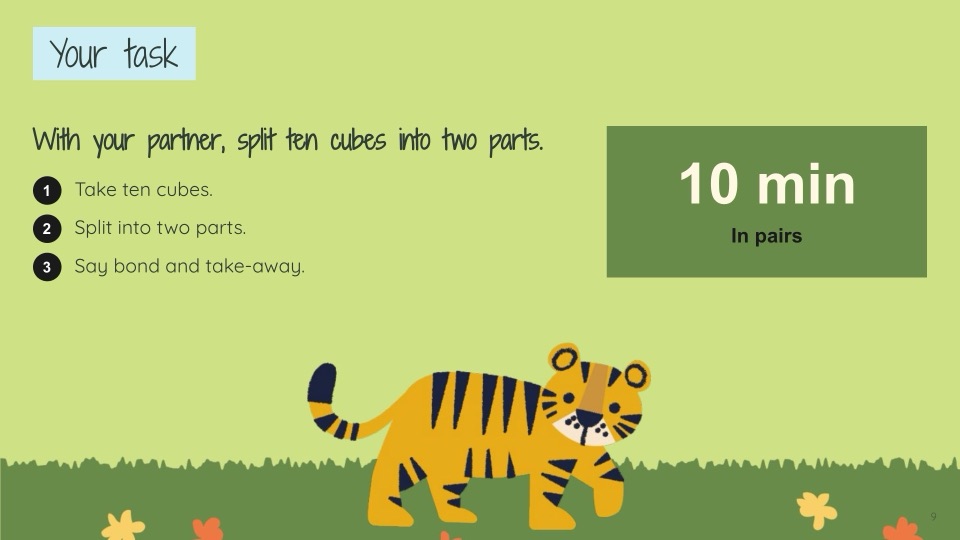
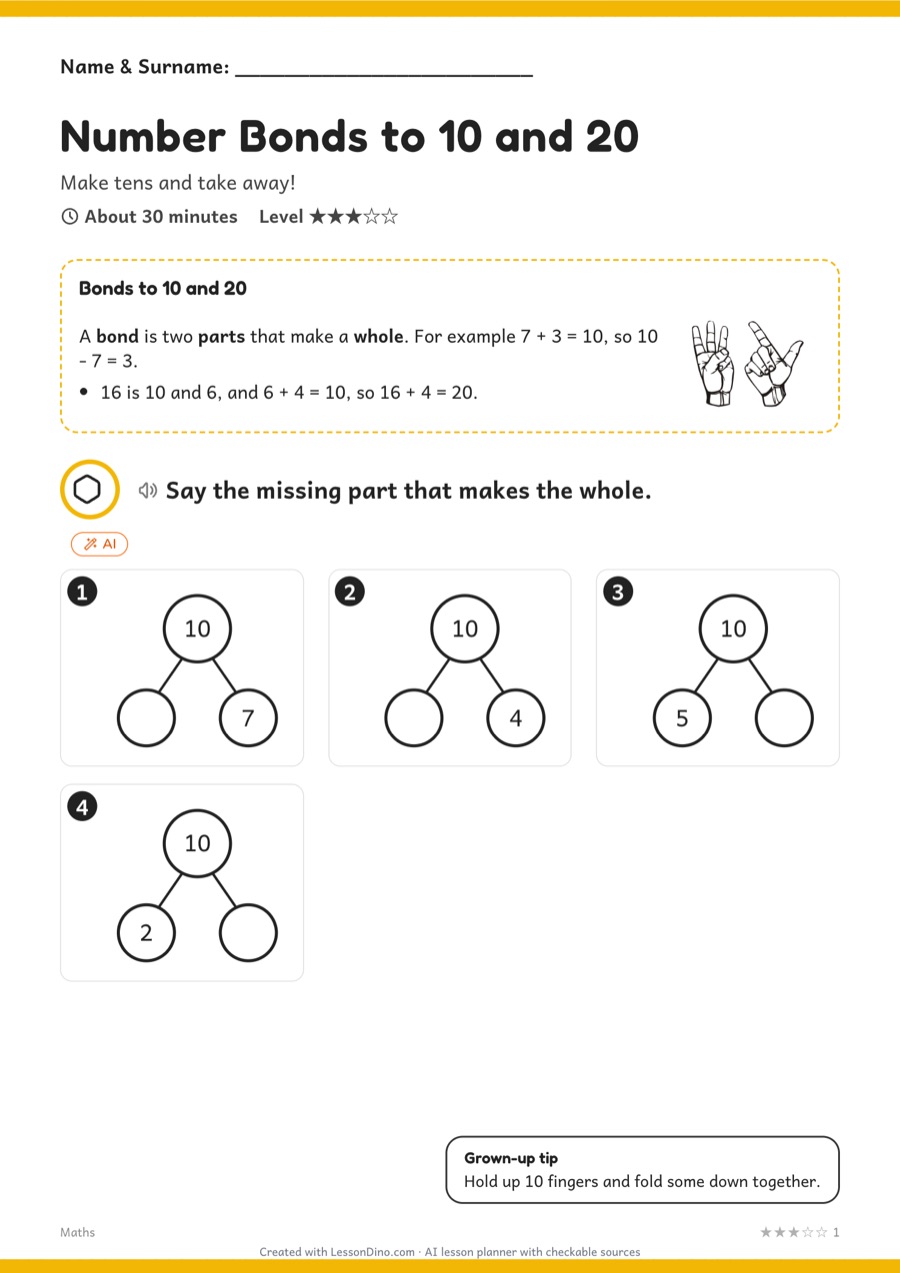
| 25 min | Main activity | To represent bonds to 10 on mats and write matching additions and take-aways. Show Slide 9: Your task [activity]: Take ten cubes. · Split into two parts. · Say bond and take-away. · With your partner, split ten cubes into two parts. · 10 · In pairs. Give each pair a mat, 10 cubes and a whiteboard; model splitting 10 into 4 and 6 and writing four sentences. Send pairs to split, record and re-split with new pairs, using one bond to represent four number sentences. Give out Worksheet page 1: Number bonds: Say the missing part that makes the whole for pupils to complete when mats are tidy. |
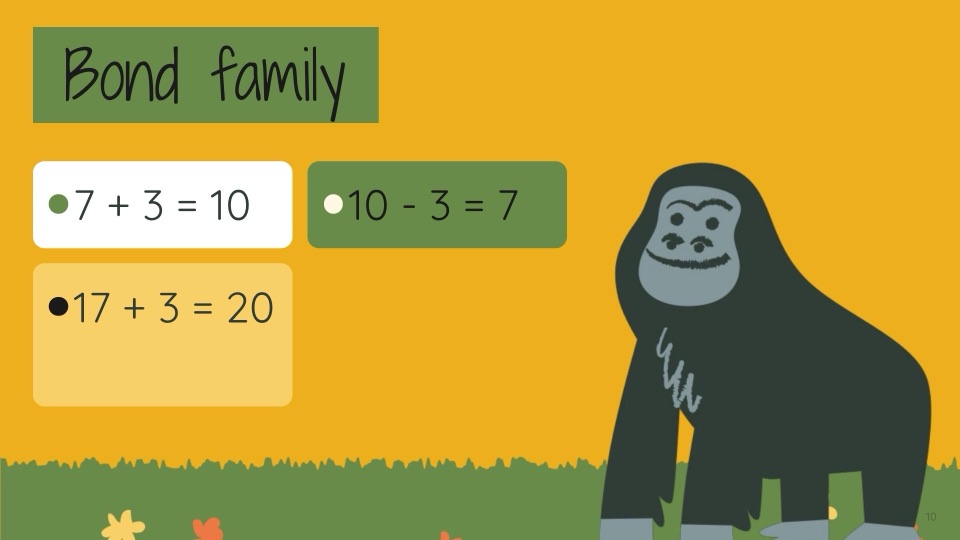
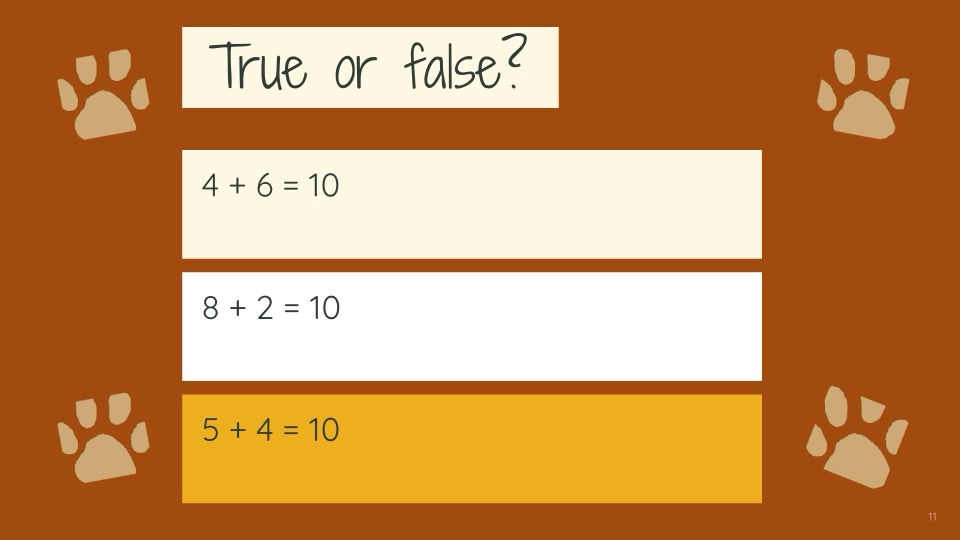
| 10 min | Plenary | To check bonds to 10 and link them to bonds to 20. Show Slide 10: Bond family [bullets]: 7 + 3 = 10 · 10 - 3 = 7 · 17 + 3 = 20. Model 16 as a group of 10 and 6 more, recall 6 and 4 make a number bond to 10, so you need to add 4 more to 16 to make two complete groups of 10. Model 13 as one ten and three ones, then add 7 more to make 20, because you can use your knowledge of number bonds to 10 to find number bonds to 20. Show Slide 11: True or false? [truefalse]: 4 + 6 = 10 · Four and six join to ten. · 8 + 2 = 10 · Eight needs two for ten. · 5 + 4 = 10 · Five needs five, not four. Vote true or false. |
Common mistakes
- Thinking 3 + 7 and 7 + 3 give different totals.
How to spot it: Pupil says one is 10 and the other is not.
Swap two colour groups left to right to show it does not matter which order you add numbers together, the total is the same. - Counting the whole again instead of the missing part.
How to spot it: For 8 steps climbed, pupil says 8 left instead of 2.
Count up from 8 as 9, 10, which is two steps, so 8 and 2 make 10.
Support
- Use ten-frames, finger lifts and mats marked with 10 to show empty spaces.
- Count on slowly from the known part to 10 to find the missing part.
Stretch
- Write all four sentences for each bond and explain the swap pattern.
- Use bonds to 10 to find what to add to 13, 16 and 17 to make 20.
Check questions
- 4 + ___ = 10
Answer: 6 - 10 - 3 = ___
Answer: 7 - 17 + ___ = 20
Answer: 3
Curriculum
represent and use number bonds and related subtraction facts within 20
Video clips
Clips on YouTube, from the start and end times we chose. Check each one before you show it.
-
Numberblocks bonds one to ten from 0:00 to 5:00
Numberblocks: @Numberblocks | Maths Bonds Skills | Let's look at Number Bonds One to Ten!
Numberblocks is perfect for ages 5-6 with slow visuals showing bonds to 10.
-
Monster number bonds song from 0:00 to 2:00
Teach Your Monster: Teach Your Monster Number Skills | The Number Bonds Song Music Video
Cheerful song made for ages 5-6 to sing and learn bonds to 10.
Worksheet
Sources
- What are number bonds? - Year 2 - BBC Bitesize bbc.co.uk
- Number Bonds to 10 | Math | EducaWeb educaweb.org
- Number Bonds to 10 (solutions, examples, songs, videos, workshee… onlinemathlearning.com
- Number Bonds to 10 Egg Game - The Imagination Tree theimaginationtree.com
- Number Bonds Worksheets for Kids Online - SplashLearn splashlearn.com
- What are number bonds up to 10? – Tonyajoy.com tonyajoy.com
- Number Bonds - hackinghat.com hackinghat.com
- Number Bonds to 10 Online Trivia | Numbers for Kids | 10 Questio… funtrivia.com
- Margaret Bonds en.wikipedia.org
- Fixit Maths - Number Bond Cards fixitmaths.com
Picture credits
- Photo: Alexandra_Koch · Pixabay
- Illustration: geralt · Pixabay
- Photo: PublicDomainPictures · Pixabay
- Drawing: Abalg · Public domain · Wikimedia Commons
- Pictograms: Sergio Palao, ARASAAC (arasaac.org) · CC BY-NC-SA
Made with Lesson Dino's AI on 17 October 2026. AI can make mistakes, so check facts against the sources before you teach.