Slides
Lesson plan
Bundle Up Tens and Ones
Students learn what each digit in a two-digit number is worth. They bundle sticks into tens and write numbers as tens plus ones.
Objectives
- Students will recognise how many tens and ones make a two-digit number.
- Students will explain what each digit in a two-digit number is worth.
- Students will write a two-digit number as tens plus ones using bundles.
Success criteria
- I can say how many tens and ones are in a number.
- I can say what each digit in my number is worth.
- I can write my number as tens plus ones.
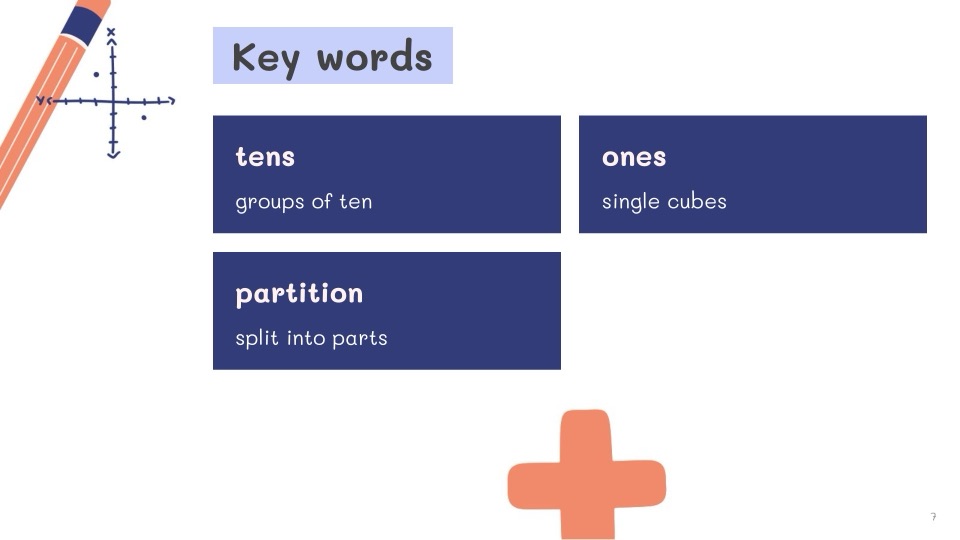
Key words
| Word | Meaning |
|---|---|
| tens | a bundle made of 10 joined together |
| ones | loose cubes counted on their own |
| partition | to split a whole up into parts |
| place value | what a digit is worth because of where it sits |
Timed plan (60 minutes)
| Time | Stage | What happens |
|---|---|---|
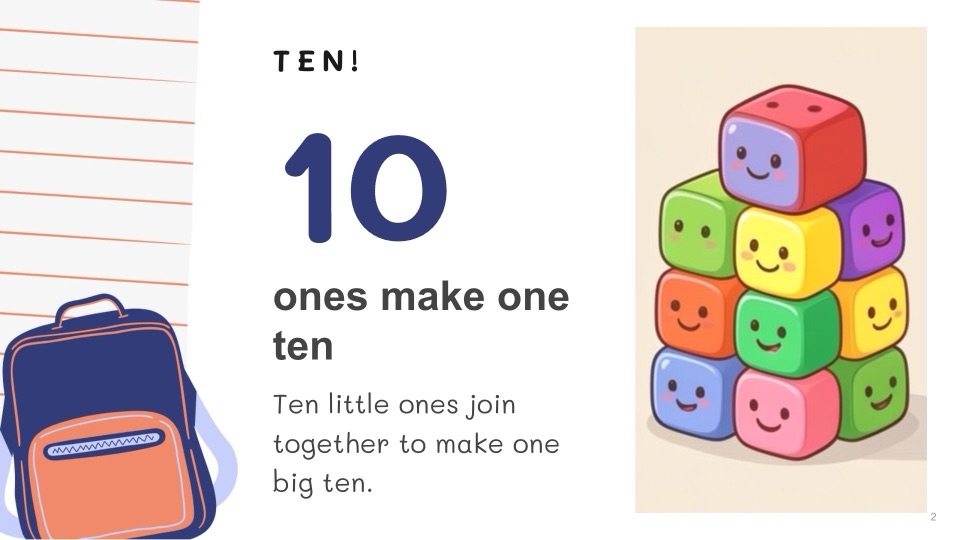
| 10 min | Starter | To spark ideas about fast counting and recall that ten ones make one ten. Tip a pot of counting sticks onto the carpet to set the scene. Say the hook and invite ideas for tidying and counting fast. Gather 12 sticks and wrap 10 with a rubber band, counting aloud. Show the bundle and 2 loose sticks and ask what changed. |
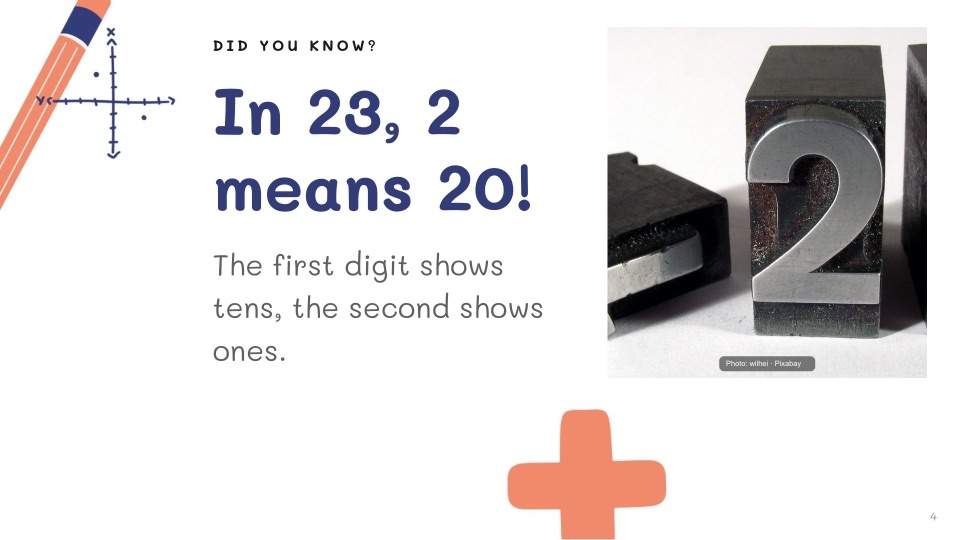
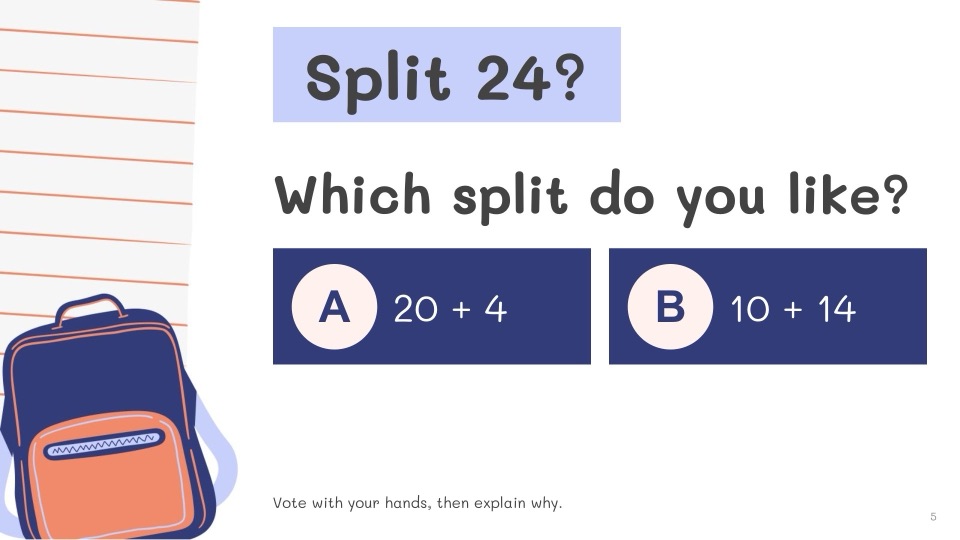
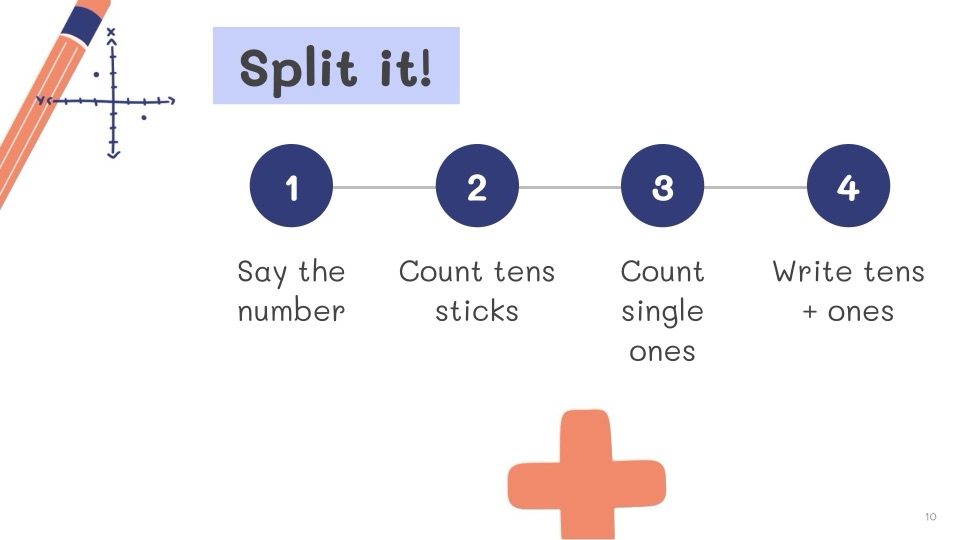
| 10 min | Teaching | To teach tens, ones and partition using bundles and charts. Show bundles of sticks and base-ten rods on a place value chart. Model 34 as 3 tens and 4 ones and write 30 + 4. Teach key words tens, ones and partition with actions. Compare 42 and 24 to show digit order changes value. |
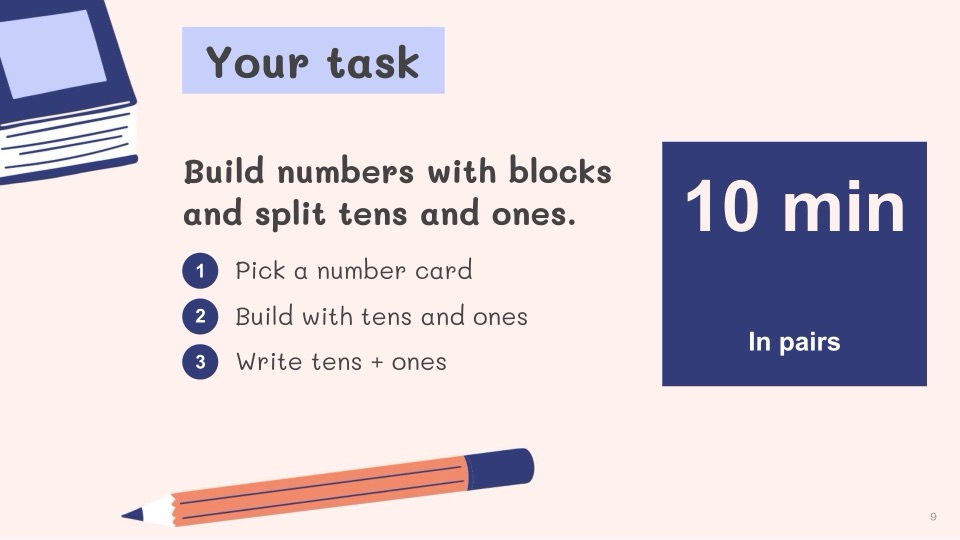
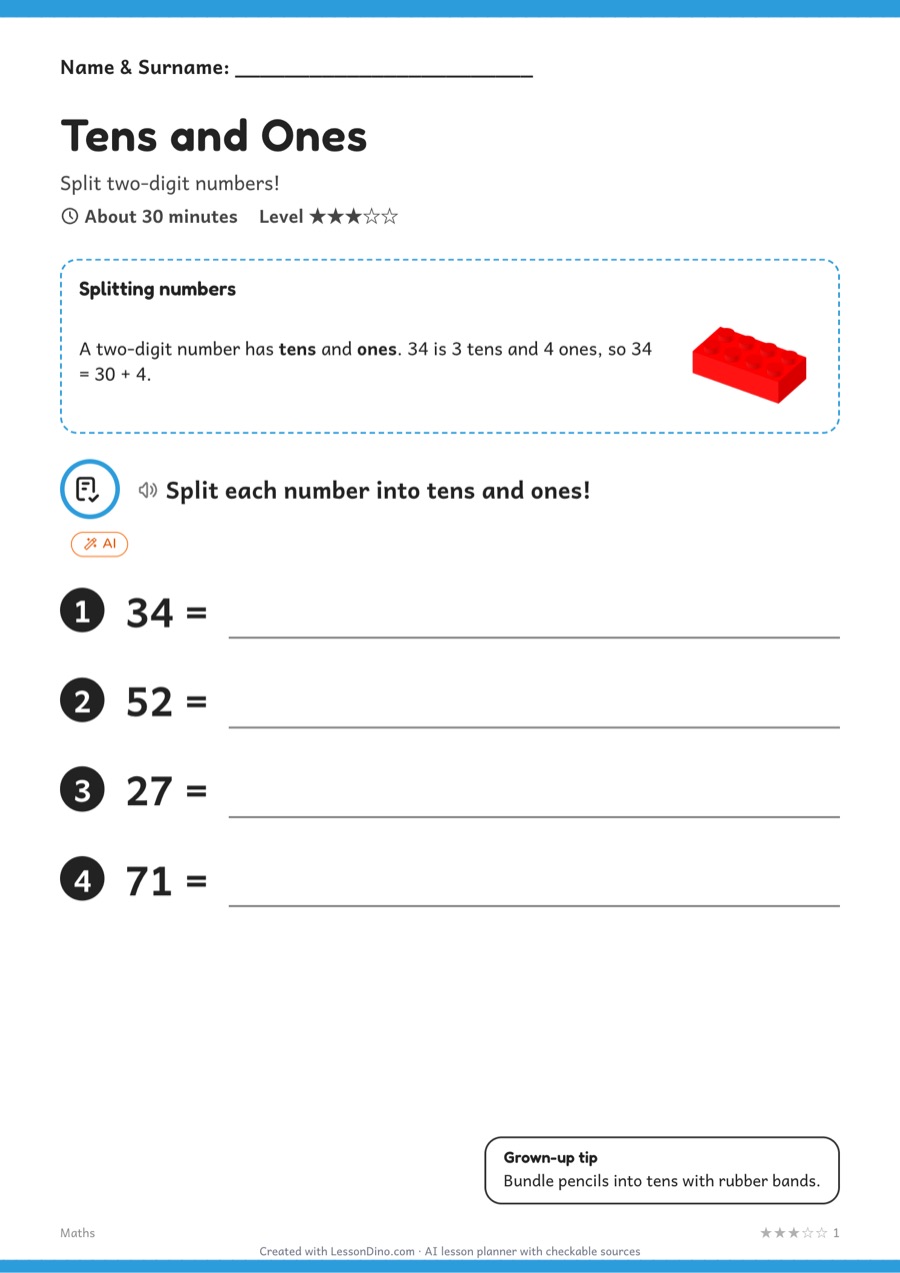
| 25 min | Main activity | To build two-digit numbers with bundles and record them as tens plus ones. Demo grabbing a handful, wrapping every ten and laying bundles on the tens side. Hand out sticks, bands, mats and Worksheet page 1 for recording. Circulate, ask pairs to say and write their partition. Stop the class halfway to share one strong example. |
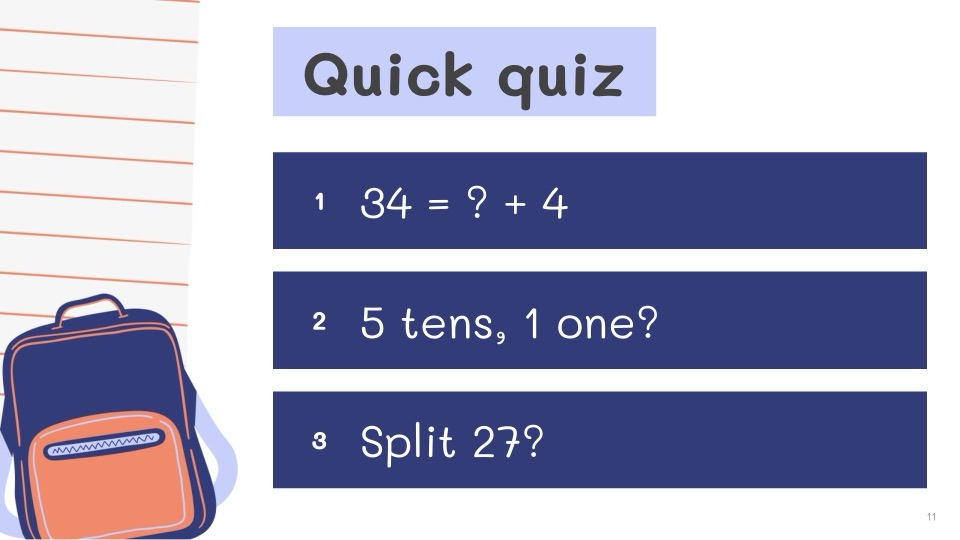
| 15 min | Plenary | To check everyone can match numbers to their tens and ones partitions. Run the quick quiz, asking pairs to write each answer on whiteboards. Confirm each partition by rebuilding it fast with base-ten blocks. Hand out Worksheet page 5 for pairs to draw matching lines. Close by linking answers back to the success criteria. |
Common mistakes
- Writes 34 as 3 + 4 instead of 30 + 4.
How to spot it: Partition adds to 7, not 34, on Worksheet page 1.
Rebuild 3 tens rods to show 3 tens = 30, so 21 is the same as 20 + 1. - Thinks 42 and 24 are the same because they use 4 and 2.
How to spot it: Builds both numbers the same way or orders them wrong.
Build both with blocks and compare place value of each digit in a two-digit number (10s, 1s). - Ignores 0 in numbers like 30, saying it shows nothing.
How to spot it: Says 30 is just 3 or writes 3 + 0.
Show 3 tens with no ones and explain 0 holds the ones place as a place holder.
Support
- Start with handfuls under 20 and match each bundle to base-ten equipment on a place value chart.
- Keep a finished bundle of 10 on tables to check against when wrapping.
Stretch
- Try a larger handful and work out the total from the bundles first, without counting every stick.
- Write partitions in a different order, such as 4 + 20 for 24.
Check questions
- How many tens and ones in 46?
Answer: 4 tens and 6 ones. - Write 46 as tens plus ones.
Answer: 40 + 6 = 46. - What does the 4 mean in 42?
Answer: 40, four tens.
Curriculum
recognise the place value of each digit in a two-digit number (10s, 1s)
Video clips
Clips on YouTube, from the start and end times we chose. Check each one before you show it.
-
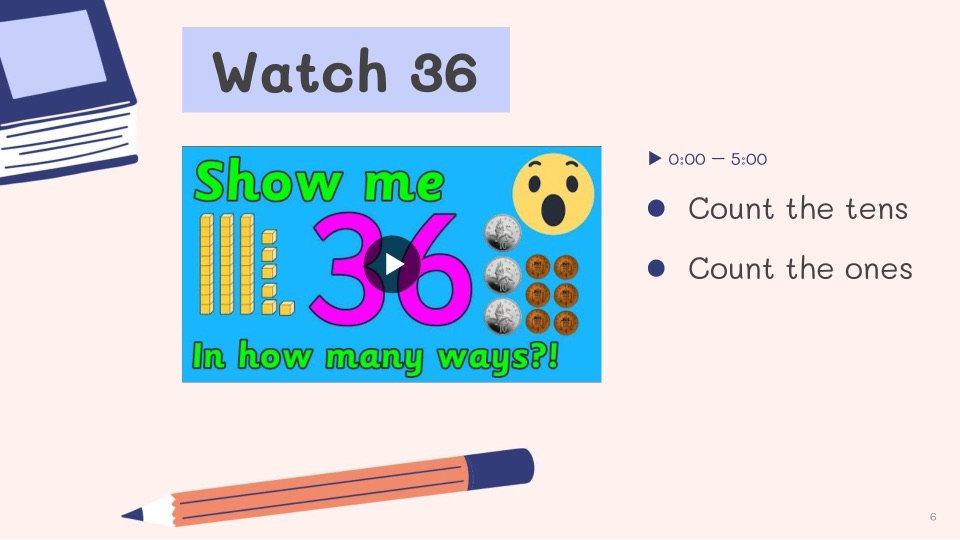
36 in lots of ways from 0:00 to 5:00
Love2Learn with Miss Ellis: PLACE VALUE | Tens and Ones | Making 2 Digit Numbers in LOTS of Ways | Miss Ellis #placevalue
Models partitioning 36 into tens and ones with dienes, numicon and part-whole, ideal pace and vocabulary for 6-7-year-olds learning place value.
-
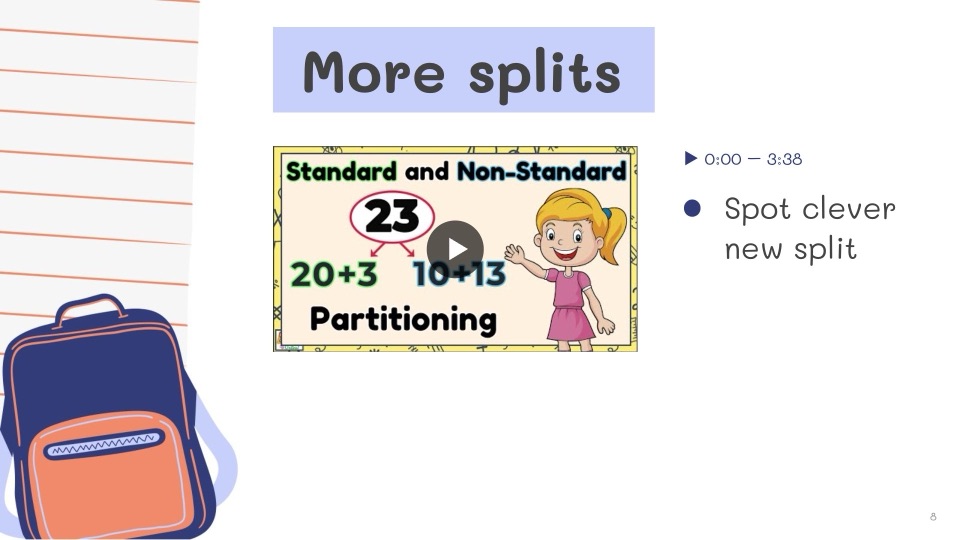
Standard and non-standard partition from 0:00 to 3:38
Learn and Play Online!: Partitioning Numbers: Standard and Non-Standard Forms
Teaches standard and non-standard partitioning of two-digit numbers clearly for 6-7-year-olds recognising tens and ones.
Worksheet
Sources
- National curriculum in England: mathematics programmes of study gov.uk
- Partitioning Two-Digit Numbers st-thomasheaton.stockport.sch.uk
- How can partitioning help me add two digit numbers? - BBC bbc.co.uk
- Partition 2-digit numbers in different ways KS1 | Y2 Maths | Lesson ... thenational.academy
- Written Subtraction 1: use place value partitioning two-digit numbers – TalkTogetherLondon talktogetherlondon.org
- Subtracting Two-Digit Numbers by Partitioning - Solvent Learning solventlearning.com
- Understanding Numbers: Partitioning two-digit numbers - ABC ... abc.net.au
- How to partition a number - KS2 Maths resources for Year 3 - BBC bbc.co.uk
Picture credits
- Photo: FeeLoona · Pixabay
- AI illustration · Cloudflare
- Photo: wilhei · Pixabay
- Drawing: CC BY-SA 3.0 · Wikimedia Commons
Made with Lesson Dino's AI on 19 October 2026. AI can make mistakes, so check facts against the sources before you teach.