The worksheet
About this worksheet
Pupils learn to infer feelings, thoughts and motives from actions. They match impressions to evidence and justify ideas with quotations. This Year 6 English worksheet gives students (ages 10–11) five pages of practice on reading comprehension: inference, part of the reading comprehension unit. It goes with our free Reading comprehension: inference lesson, which has the slides and a timed lesson plan.
What it covers
By the end, students should be able to:
- Students will infer feelings, thoughts and motives from what is said and done.
- Students will justify inferences with precise text evidence and clear reasoning.
How to use it
- Use it for practice after the teaching part of the lesson, once students have seen the worked examples on the slides.
- Support: Feelings word bank with happy, anxious, excited, angry, sad and sentence starters throughout.
- Stretch: Add second possible motive and argue which evidence fits best.
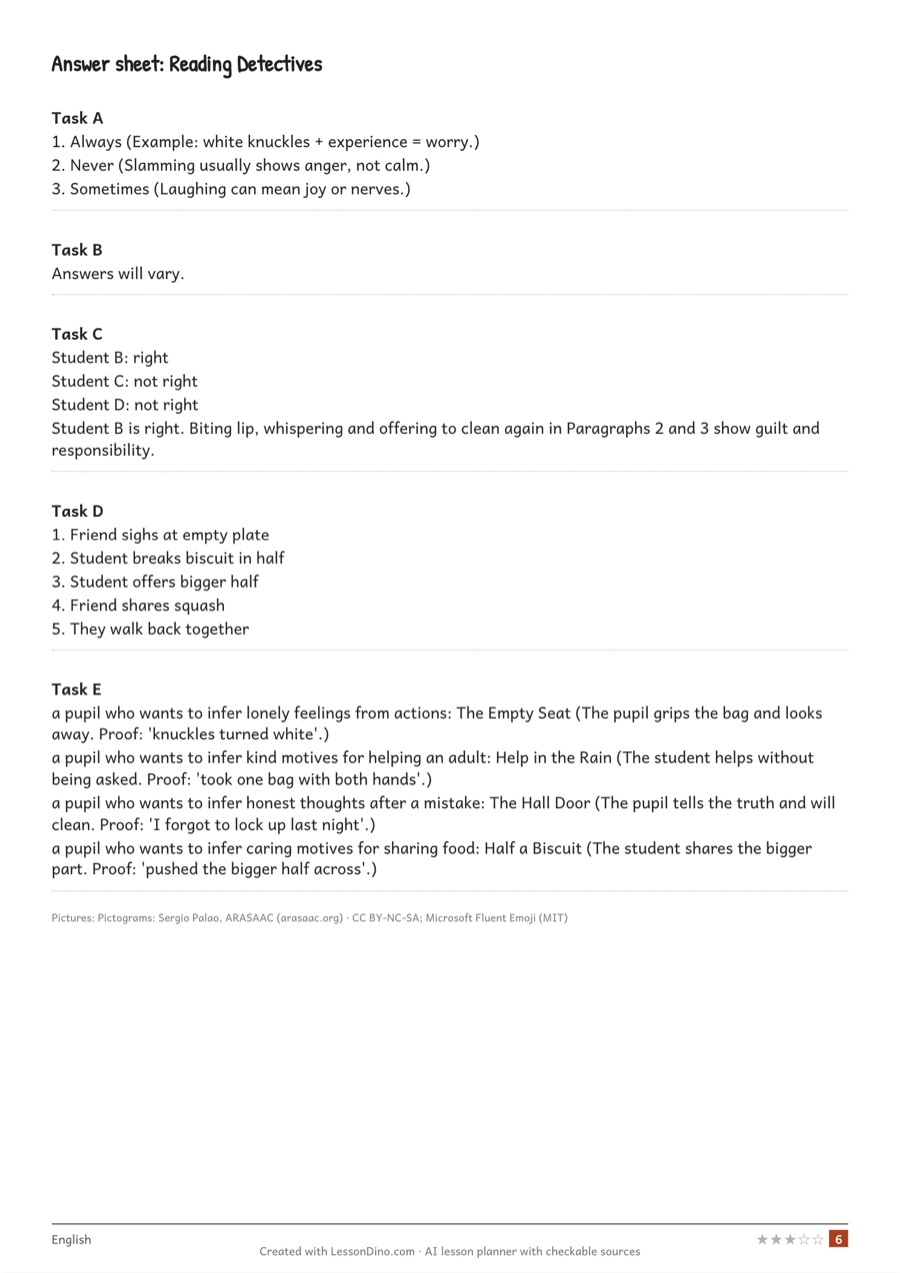
- The answer sheet is the last page, so you can print it on its own or let students check their own work.
Key vocabulary
- inference: reading between the lines to work out hidden information using clues
- evidence: exact words or actions from the text that prove an idea
- motive: the reason why someone does something
- impression: a one-word idea about how a character feels, for example sad or nervous
- suggests: shows that something is true without saying it directly
Mistakes to watch for
- Saying a stated feeling is an inference, for example the text says sad so I inferred sad. Teach that inference is reading between the lines for hidden information; if stated it is retrieval, inference needs an action clue plus proof.
- Giving an impression with no evidence or vague evidence like because they were upset. Insist on point plus proof using quotations for illustration; model I infer... because the text says... This suggests...
- Mixing up thought and motive, for example saying the motive is sad. Recall motive means the reason they act; ask Why did they do it and link to what was said and done.
What's on the worksheet
Clues Tell Feelings
Learn what an inference is and how to prove it.
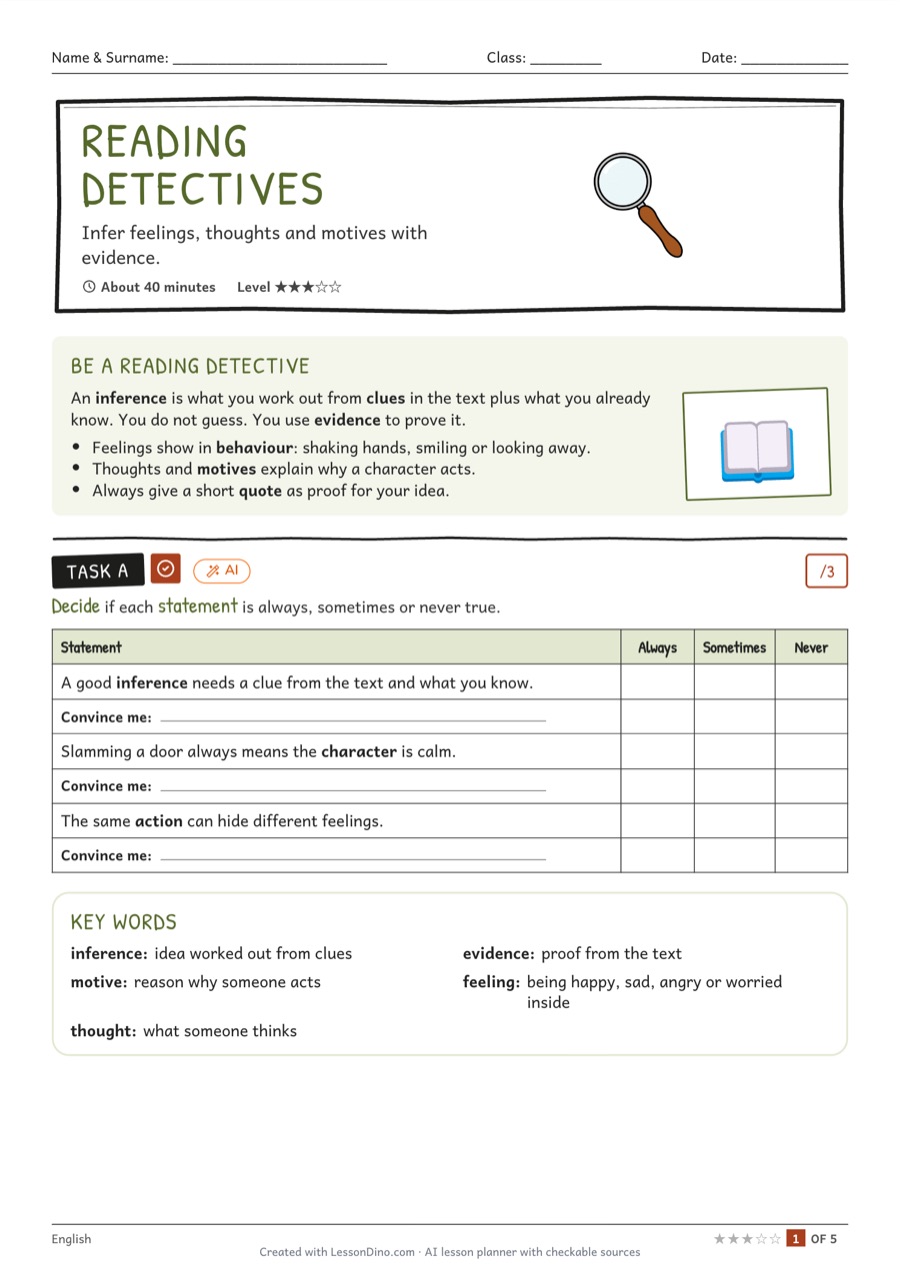
Be a Reading Detective
- An inference is what you work out from clues in the text plus what you already know. You do not guess. You use evidence to prove it.
- Feelings show in behaviour: shaking hands, smiling or looking away.
- Thoughts and motives explain why a character acts.
- Always give a short quote as proof for your idea.
Decide if each statement is always, sometimes or never true.
| Word | Meaning |
|---|---|
| inference | idea worked out from clues |
| evidence | proof from the text |
| motive | reason why someone acts |
| feeling | being happy, sad, angry or worried inside |
| thought | what someone thinks |
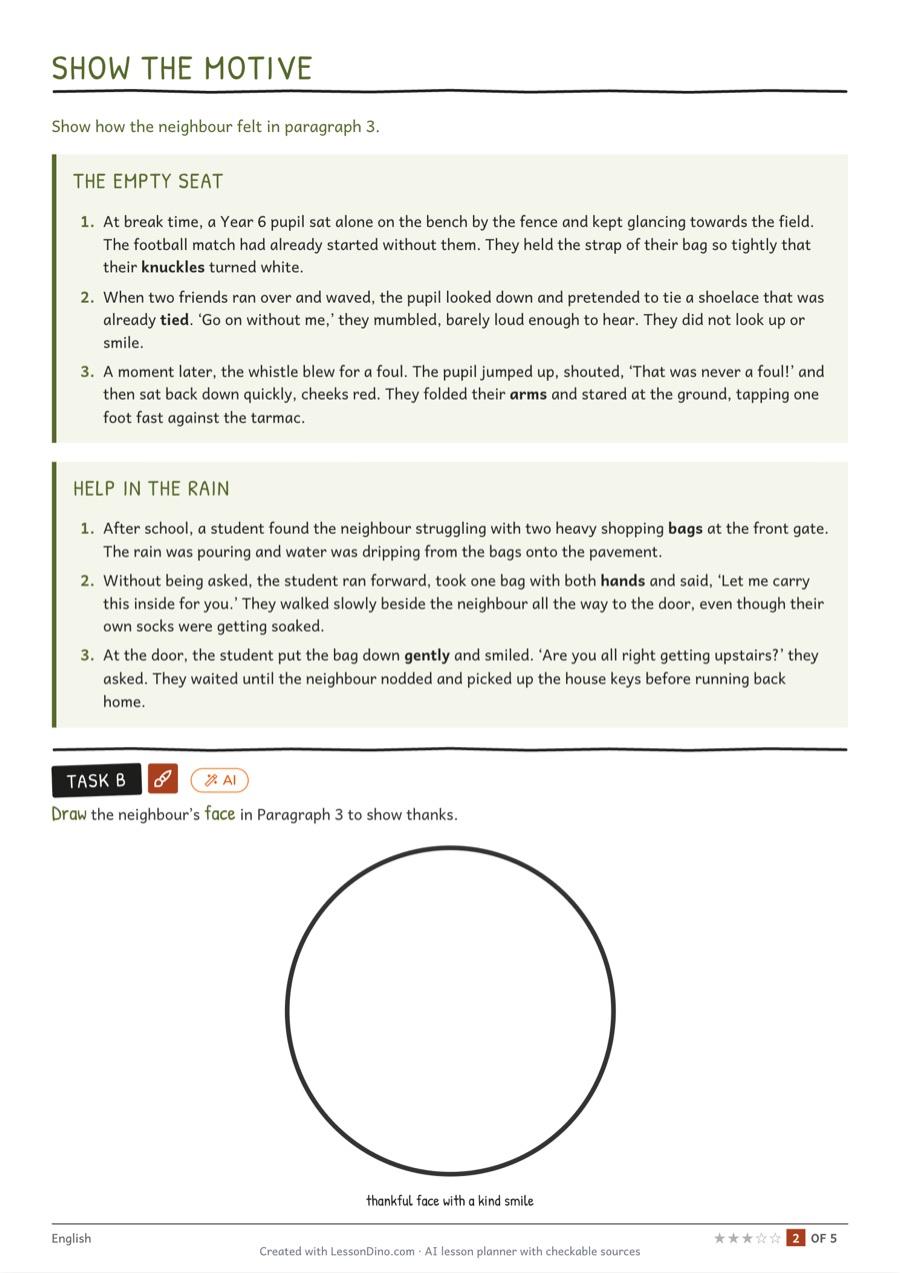
Show The Motive
Show how the neighbour felt in paragraph 3.
The Empty Seat
Help in the Rain
Draw the neighbour’s face in Paragraph 3 to show thanks.
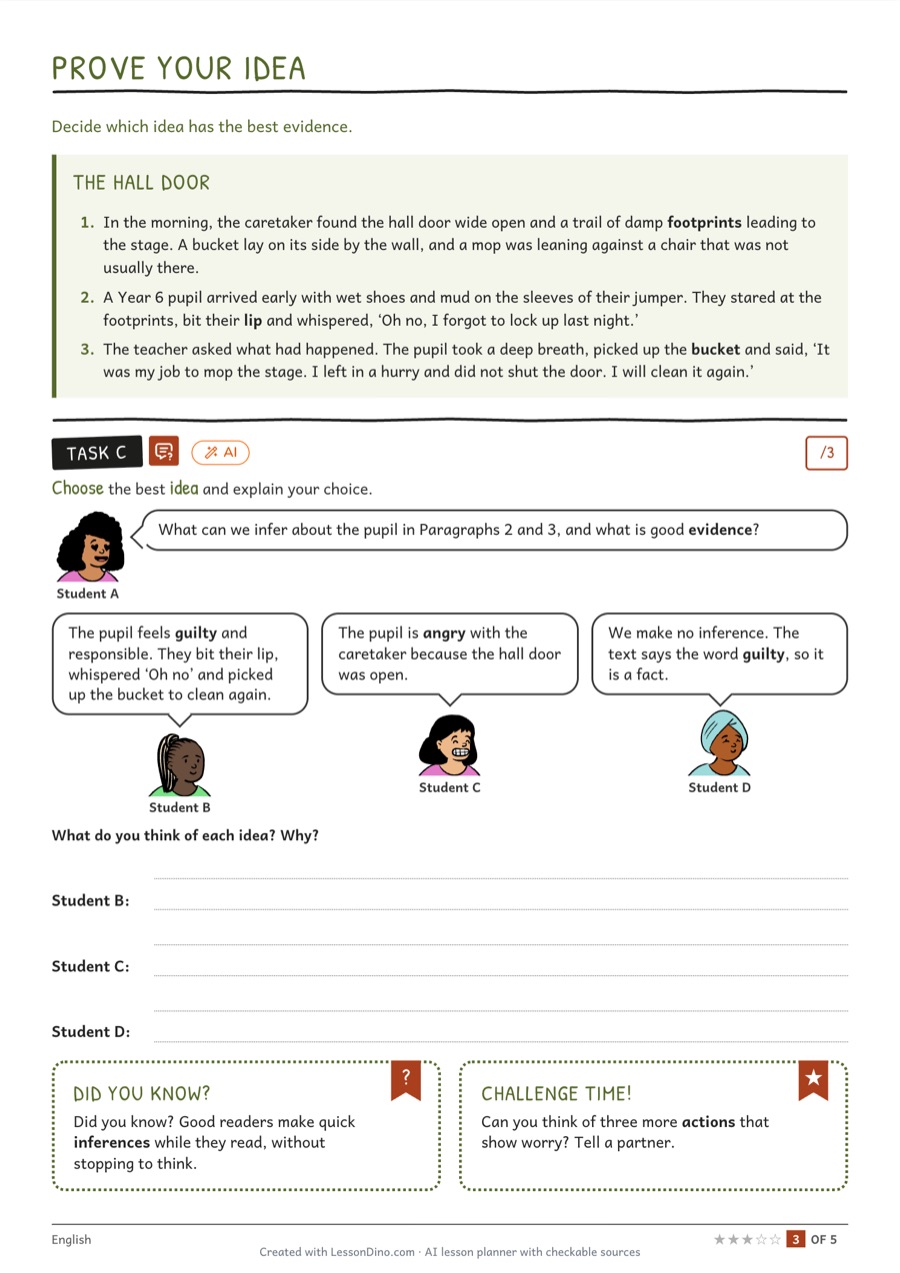
Prove Your Idea
Decide which idea has the best evidence.
The Hall Door
Choose the best idea and explain your choice.
- Did you know? Good readers make quick inferences while they read, without stopping to think.
- Can you think of three more actions that show worry? Tell a partner.
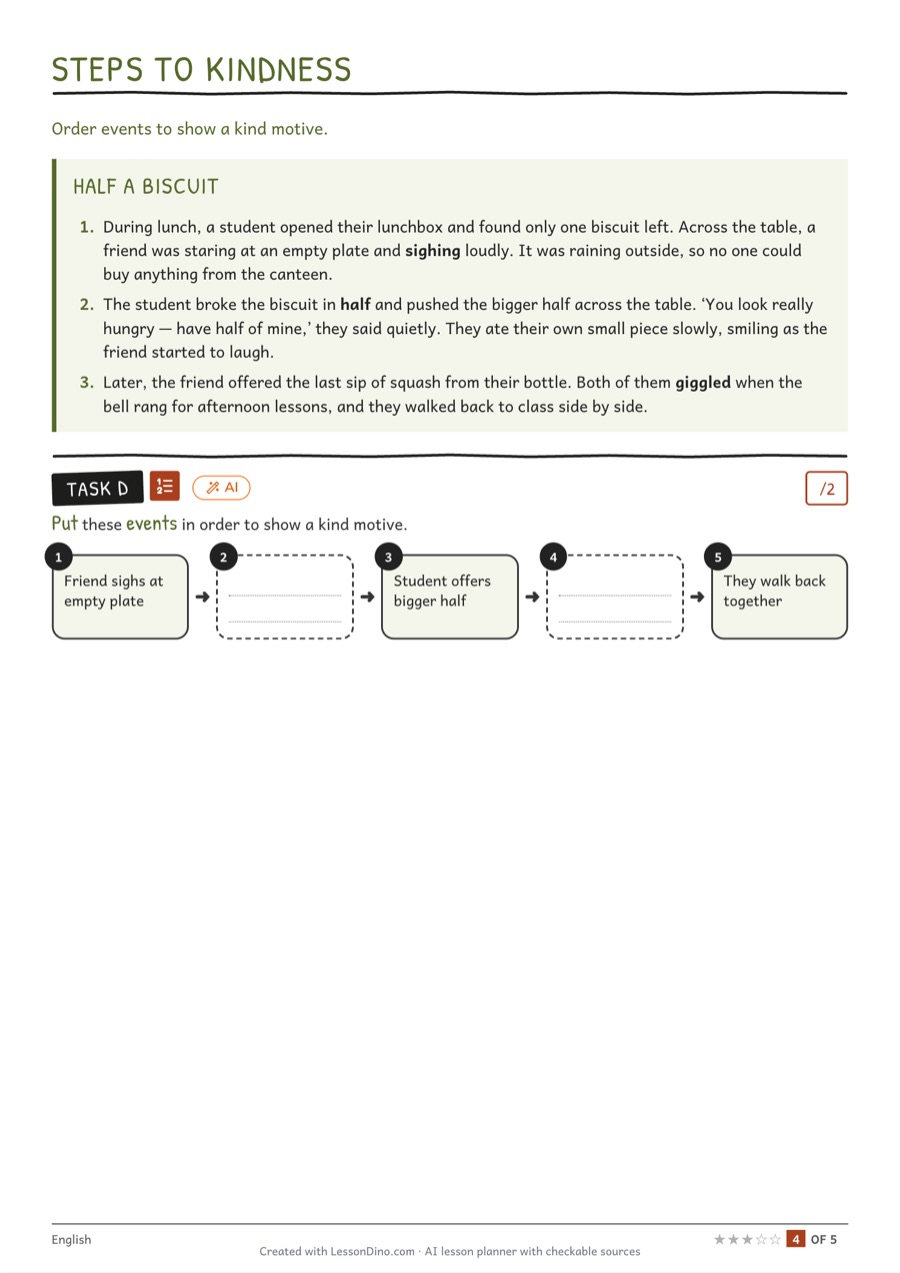
Steps To Kindness
Order events to show a kind motive.
Half a Biscuit
Put these events in order to show a kind motive.
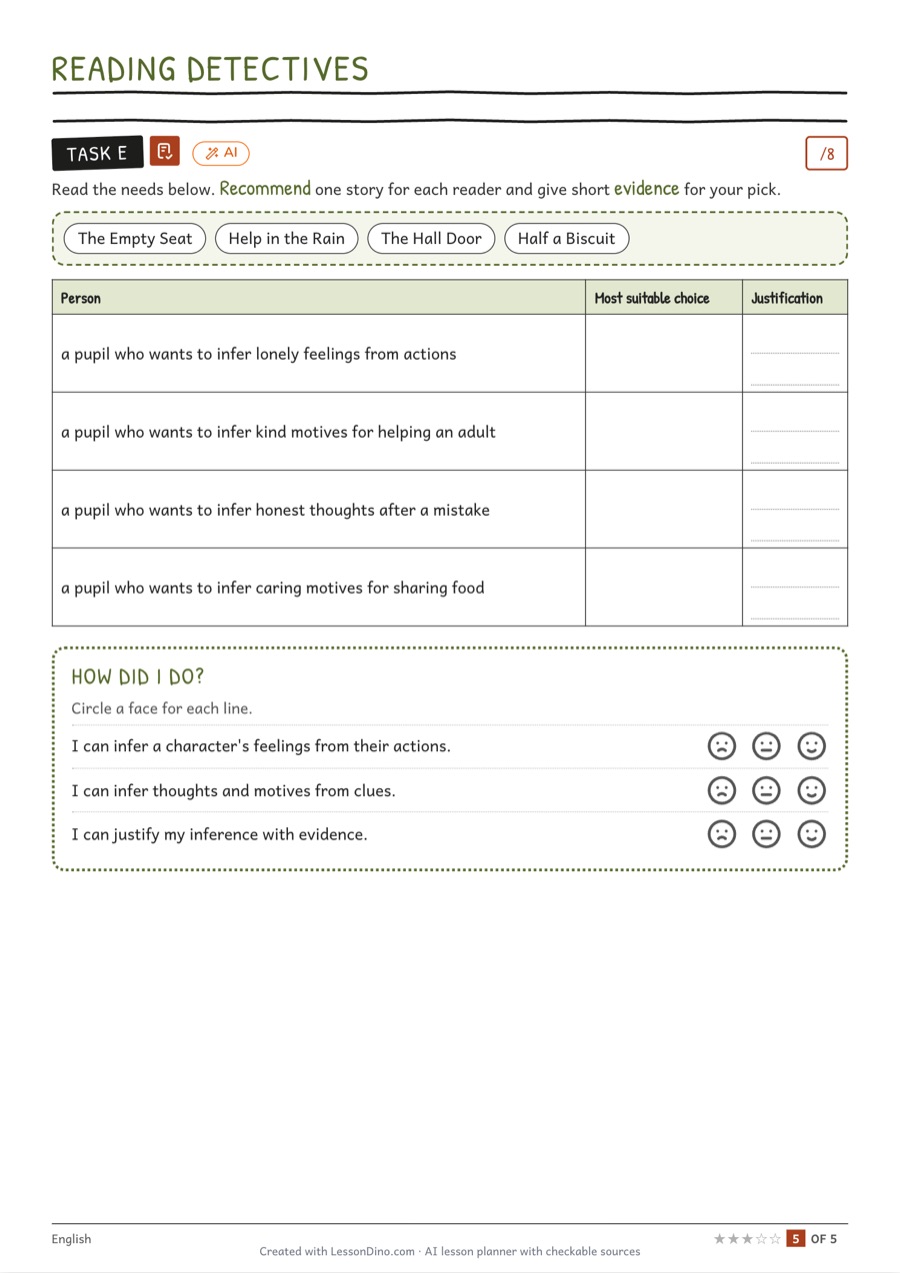
Page 5
Read the needs below. Recommend one story for each reader and give short evidence for your pick.
Answers
Show the answers
The answers are on the answer sheet, the last picture above.
Curriculum
drawing inferences such as inferring characters’ feelings, thoughts and motives from their actions, and justifying inferences with evidence
Made with Lesson Dino's AI on 17 October 2026. AI can make mistakes, so check the answers and facts against the sources before you teach.