Slides
Lesson plan
Joining Full Sentences with ; : and –
Pupils learn to join independent clauses with semicolons, colons and dashes. They build, compare and proofread joined sentences in pairs.
Objectives
- Students will join two independent clauses with a semicolon, colon or dash.
- Students will choose the mark to show equal link, explanation or chatty break.
- Students will proofread boundaries and explain why each mark was chosen.
Success criteria
- I can join two full sentences with ; : or –.
- I can pick the best mark for link, explanation or chatty surprise.
- I can check both sides stand alone and explain my choice.
Key words
| Word | Meaning |
|---|---|
| independent clause | a group of words that can stand alone as a sentence |
| semicolon | the mark ; that links two close, equal complete thoughts |
| colon | the mark : that tells the reader an explanation is coming next |
| dash | the mark – that makes a casual, sudden break for surprise |
| boundary | the place where one complete thought ends and the next begins |
Timed plan (60 minutes)
| Time | Stage | What happens |
|---|---|---|
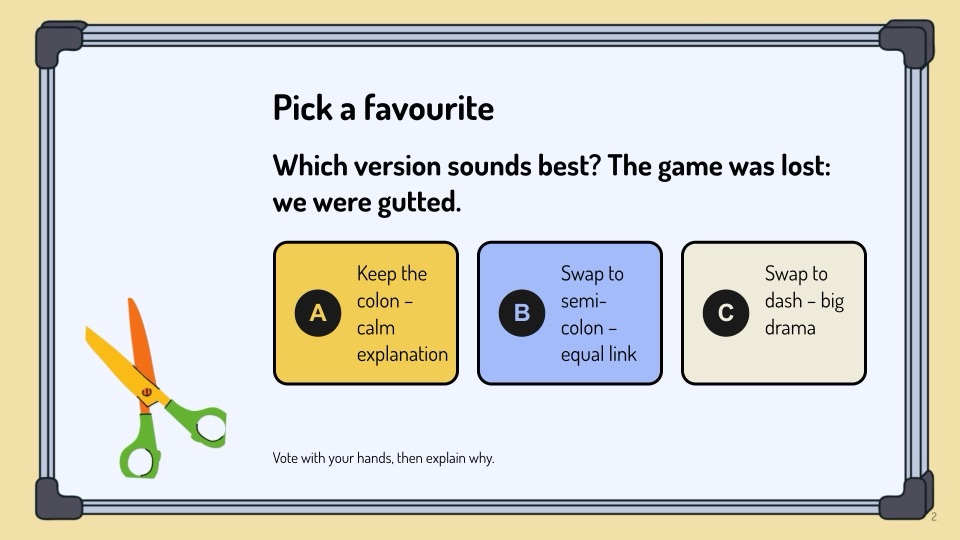
| 5 min | Starter | To hook pupils and recall what counts as a full sentence. Hold up two strips: It rained. and The game stopped. Say the hook: I have two complete sentences in my hands. No joining word allowed. Who can glue them together with just a mark? Show Slide 1 title, then Slide 2 vote with The game was lost: we were gutted. Take a quick vote: keep the colon for calm explanation, swap to semicolon for equal link, or swap to dash for big drama. Link votes to learning goal: today we will join two independent clauses with a semicolon, colon or dash. |
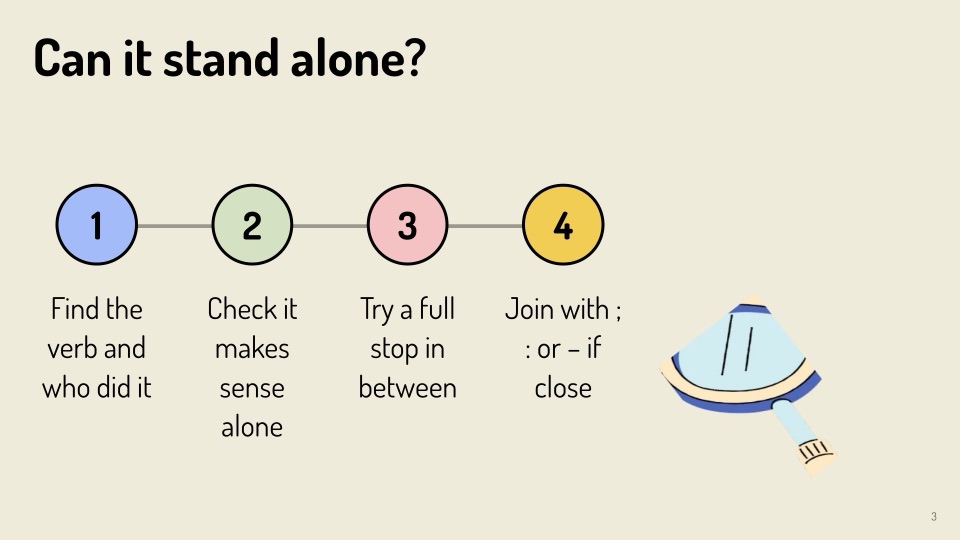
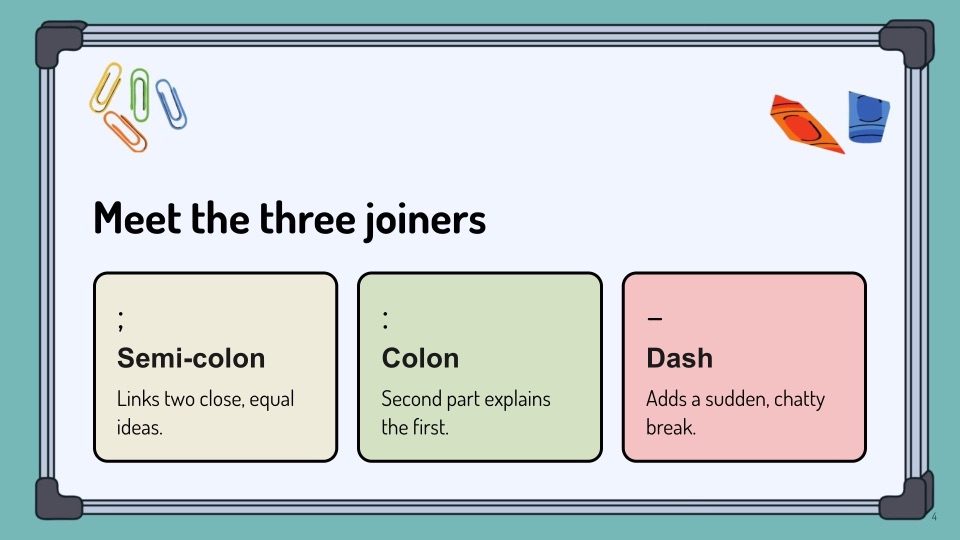
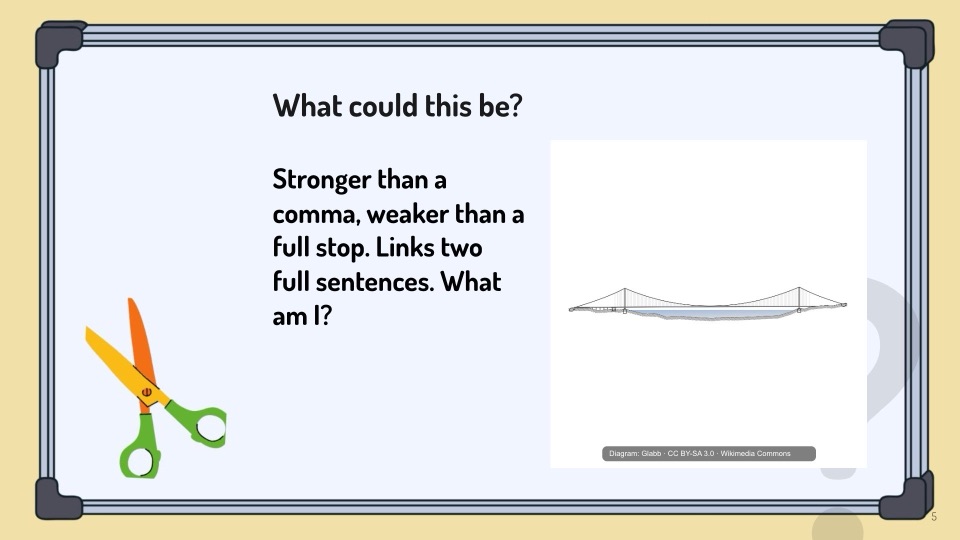
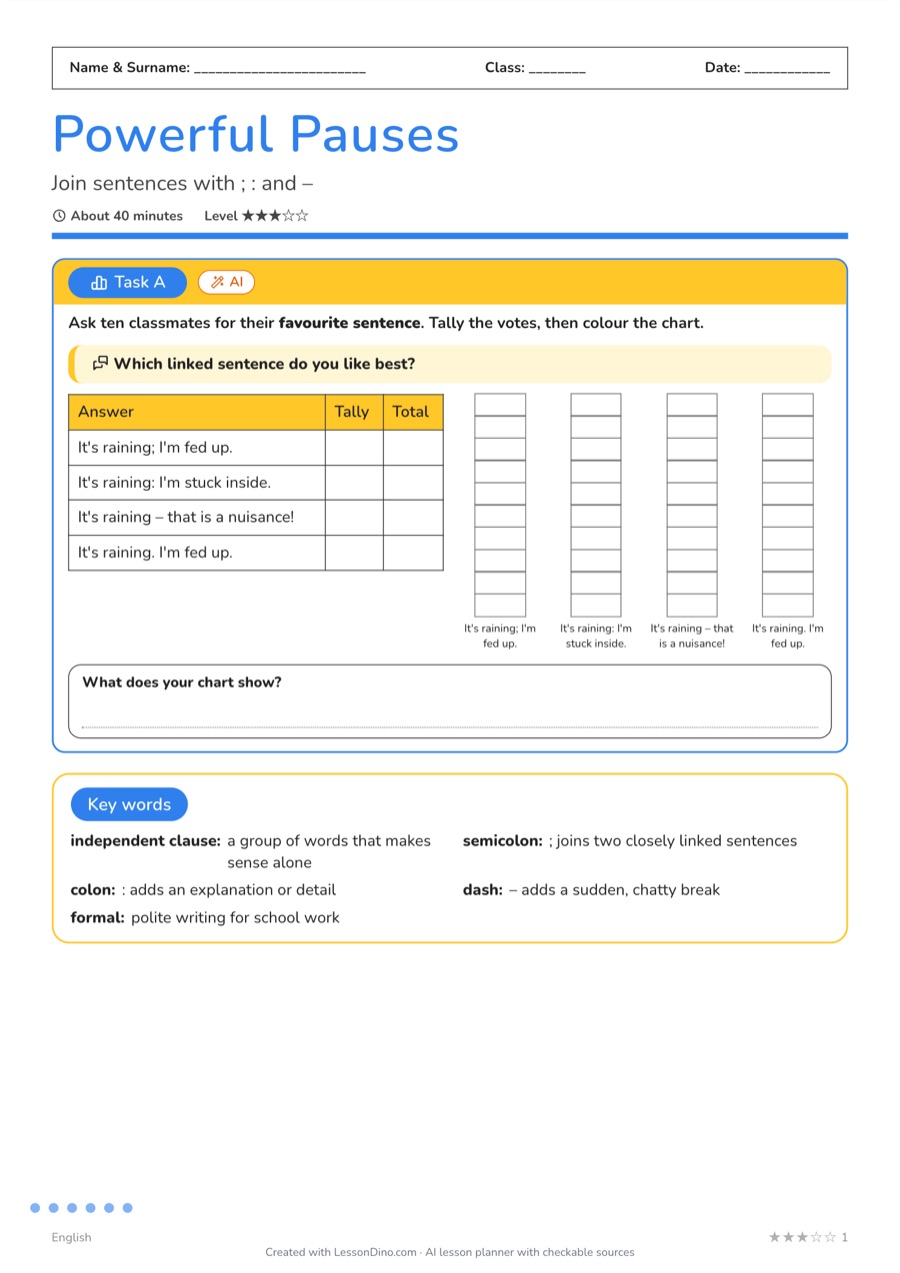
| 12 min | Teaching | To teach what each mark does between two independent clauses. Teach independent clause as a group of words that can stand alone as a sentence and always has a subject and verb, using Slide 3 steps. Show Slide 4 cards: semicolon links two close, equal ideas; colon means second part explains the first; dash adds a sudden, chatty break and is often used in less formal writing. Use Slide 5 mystery to reveal the semicolon with It's raining; I'm fed up. Model the full stop test: cover each side in turn to check it stands alone. |
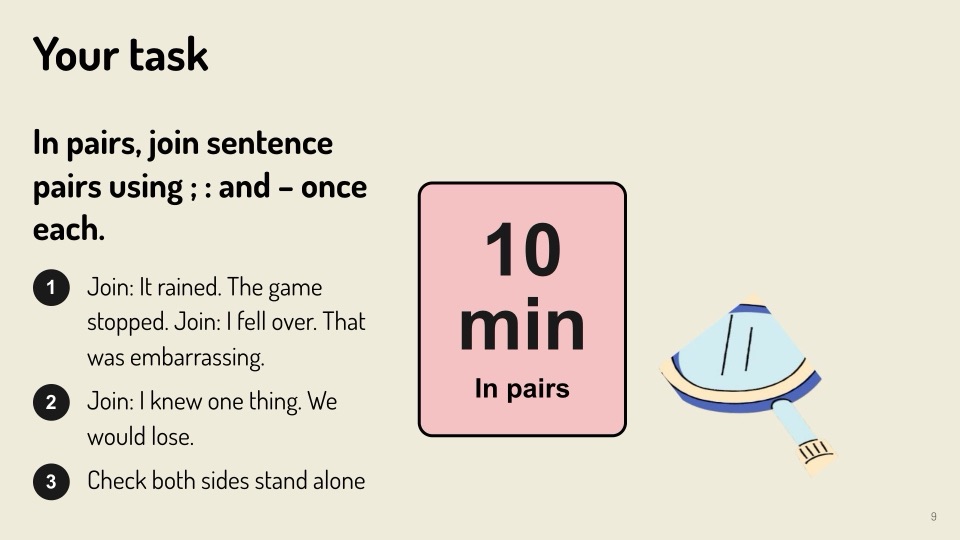
| 20 min | Main activity | To practise joining pairs of independent clauses with the best mark. Give pairs sentence-strip cards cut in two, for example It’s raining / I’m fed up, It rained. / The game stopped., I fell over. / That was embarrassing., I knew one thing. / We would lose. Remind class a semicolon can separate two closely related independent clauses, a colon is used where the second clause explains more about the first, and a dash works like a less formal semicolon. Ask pairs to test ; : and – in the gap, check both halves still make sense alone, then choose one large mark. Lead show-back: pairs hold up their chosen large mark and read the joined sentence aloud with a clear pause at the boundary. |
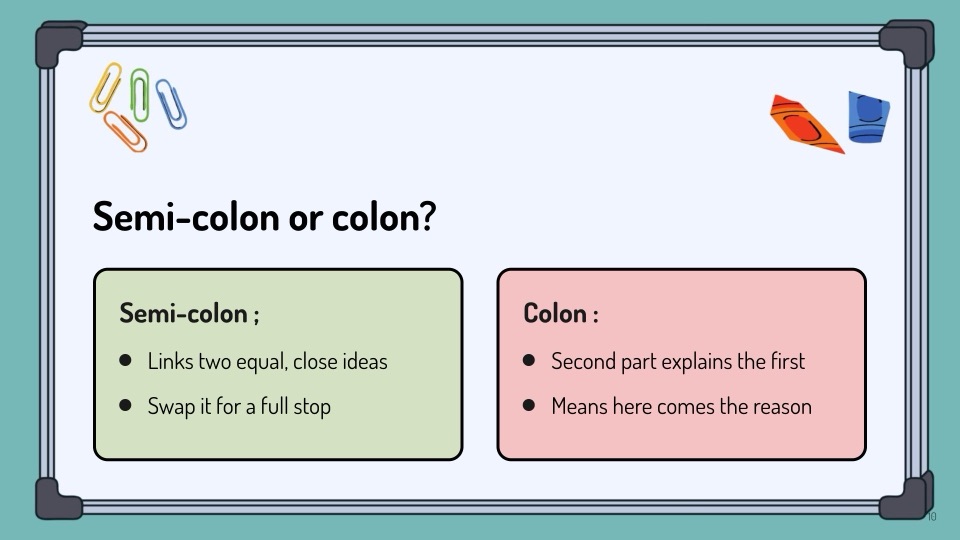
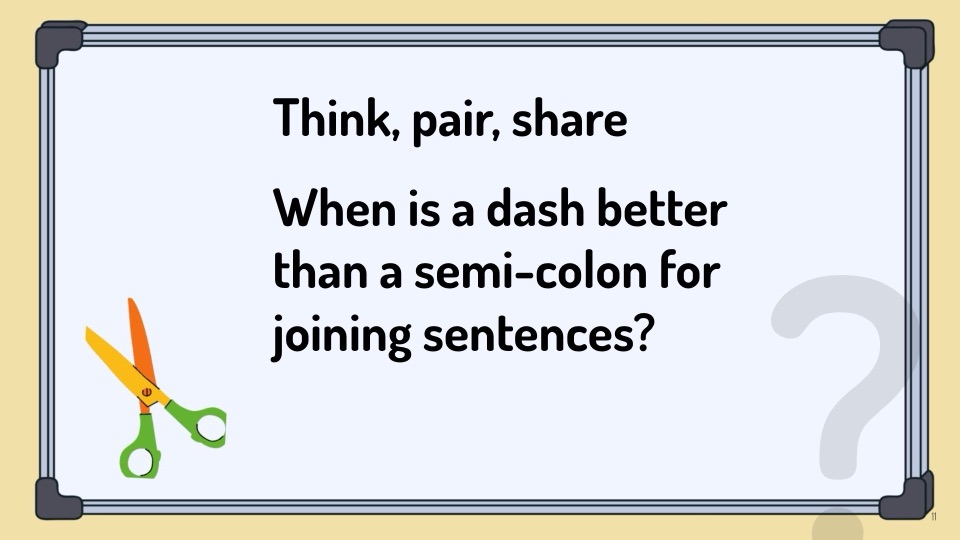
| 13 min | Consolidate | To compare marks and explain why a writer chose one. Play Video clip 2 (0:00–3:45) on Slide 8. Ask pupils to spot semicolon, colon and dash and decide which fits each gap. Show Slide 10 compare: semicolon links two equal, close ideas and can swap for a full stop; colon means here comes the reason and the second part explains the first. Pose Slide 11 in talk pairs: When is a dash better than a semicolon for joining sentences? Collect answers: dash for chatty, punchy, informal writing; semicolon for neat, formal equal link. |
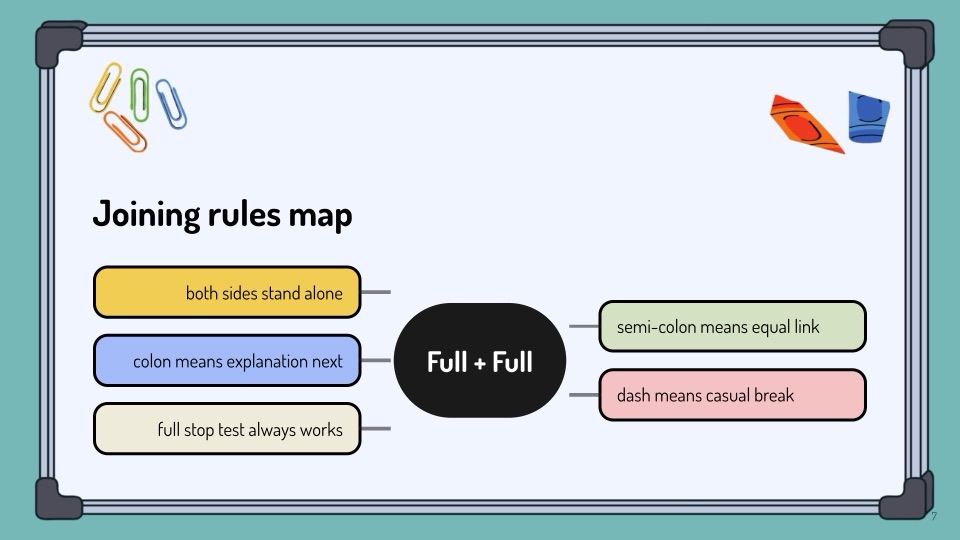
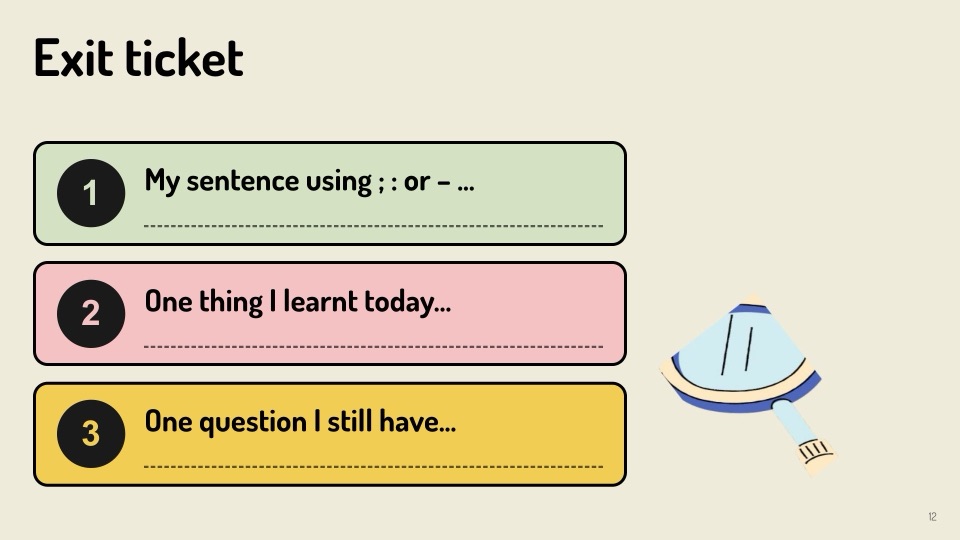
| 10 min | Plenary | To review the rules and check pupils can use all three marks. Recap with Slide 7 mindmap: both sides stand alone, semicolon means equal link, colon means explanation next, dash means casual break, full stop test always works. Ask pairs to turn one full stop pair into three versions and say how the tone shifts from formal to chatty. Set Slide 12 exit ticket: write one sentence using ; : or –, one thing learnt, one question. |
Common mistakes
- Joining two full sentences with a comma instead of ; : or –.
How to spot it: Long sentence with two verbs and a comma pause in the middle.
Split with a full stop to test each side stands alone, then rejoin with semicolon for a close link. - Using a colon when the second part does not explain the first.
How to spot it: Colon used for two equal ideas with no reason or expansion after it.
Ask: does it explain? The phrase after a colon usually explains or expands on what came before. If not, use a semicolon. - Putting ; : or – next to a fragment that cannot stand alone.
How to spot it: One side has no verb or does not make sense covered up.
Cover each side and check it has a subject and verb and makes sense alone. Fix the fragment first.
Support
- Give pre-matched pairs using the same starter, so pupils only choose the mark.
- Highlight the verb in each half so pupils can see two complete thoughts.
- Provide sentence frames for explaining: The mark is ___ because the second part ___.
Stretch
- Ask pupils to write the rule they used in one sentence: related, explains, or informal pause.
- Challenge pupils to re-punctuate with a full stop and discuss what link is lost.
- Challenge pupils to keep the same first clause but change the mark to shift tone from formal to chatty.
Check questions
- Join these: It rained. The game stopped. using a semicolon.
Answer: It rained; the game stopped. - Which mark fits? I knew one thing: ___ We would lose. Why?
Answer: Colon, because the second clause explains the first. - True or false: both sides of ; : or – must stand alone as sentences?
Answer: True – each side must be an independent clause.
Curriculum
using semicolons, colons or dashes to mark boundaries between independent clauses
Video clips
Clips on YouTube, from the start and end times we chose. Check each one before you show it.
-
linking sentences with dashes and colons from 0:00 to 4:10
Discovery Education UK: Punctuation: Using dashes, semi-colons & colons to link sentences (KS2)
Made for KS2 pupils so vocabulary and pace suit Year 6 aged 10-11 and it directly teaches dashes, semicolons and colons to link independent clauses.
-
where to use all three marks from 0:00 to 3:45
Spagtastic: SPaG - Where to use colons, semi-colons and dashes.
Made as SPaG for UK primary pupils so style suits Year 6 aged 10-11 and it covers colons, semicolons and dashes for sentence boundaries.
Worksheet
Sources
- English appendix 2 gov.uk
- Year 6 English Curriculum lenham.kent.sch.uk
- Semicolons, Colons and Dashes - levens.cumbria.sch.uk levens.cumbria.sch.uk
- Semicolons, colons, and dashes – The Writing Center writingcenter.unc.edu
- lesson 1 colons dashes and semicolons 1 assets.quill.org
- PPT - Using Semicolons, Colons or Dashes to mark boundaries between independent clauses. PowerPoint Presentation - ID:8725451 slideserve.com
- SAT Punctuation Power Moves: Semicolons, Colons & Dashes for Instant SEC Points | Pursu pursu.io
- What are colons and semicolons? - BBC Bitesize bbc.co.uk
- Colon (punctuation) Facts for Kids kids.kiddle.co
Picture credits
- Photo: ludi · Pixabay
- Diagram: Glabb · CC BY-SA 3.0 · Wikimedia Commons
- Pictograms: Sergio Palao, ARASAAC (arasaac.org) · CC BY-NC-SA
Made with Lesson Dino's AI on 17 October 2026. AI can make mistakes, so check facts against the sources before you teach.