Slides
Lesson plan
Convince Me: Audience, Purpose and Form
Pupils learn to match persuasive writing to its reader and job. They plan a letter, poster or speech using a model text.
Objectives
- Students will identify the audience and purpose before planning persuasive writing.
- Students will select the best persuasive form for the audience and purpose.
- Students will use a model text to plan structure, vocabulary and layout.
Success criteria
- I can name the audience and what I want them to do.
- I can choose letter, poster or speech and explain why.
- I can borrow a structure and opener from a model text.
Key words
| Word | Meaning |
|---|---|
| audience | the reader or readers your writing is trying to convince |
| purpose | the job the writing must do and what you want the reader to think or do |
| form | the type of writing you choose, such as a letter, poster or speech |
| persuasive | trying to get someone to agree with you or to act |
| model | a good example you copy the shape and word patterns from, not the words |
Timed plan (60 minutes)
| Time | Stage | What happens |
|---|---|---|
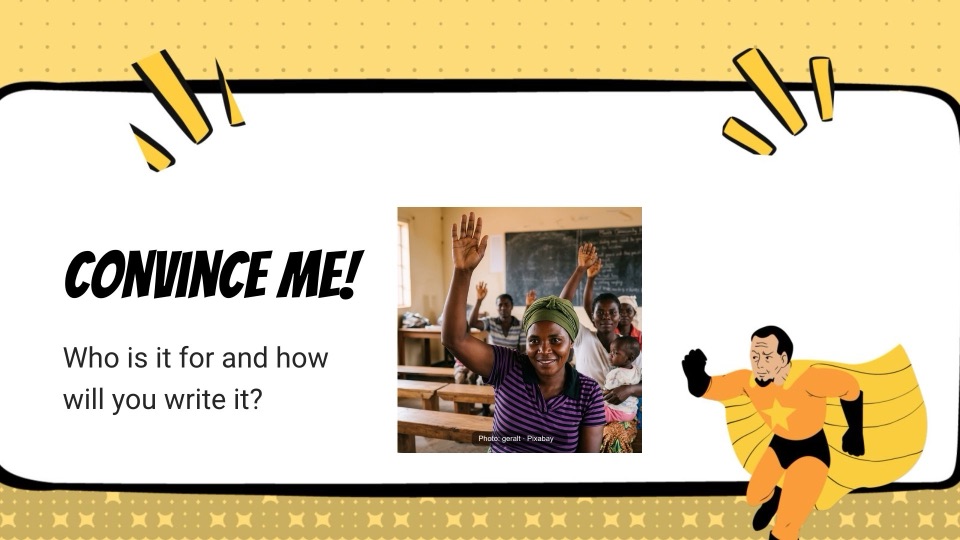
| 5 min | Starter | To hook pupils and recall that persuasive writing changes for its reader. Show Slide 1: Convince Me! [title]: Who is it for and how will you write it? Say the hook and show Slide 2 fact about adverts, letters and speeches. Read two one-line requests for more library books: friendly to a friend ("Can we get loads more comics in the library?") and formal to the headteacher ("Please could the library buy more books for our class?"). Ask pupils to spot which words changed and why. |
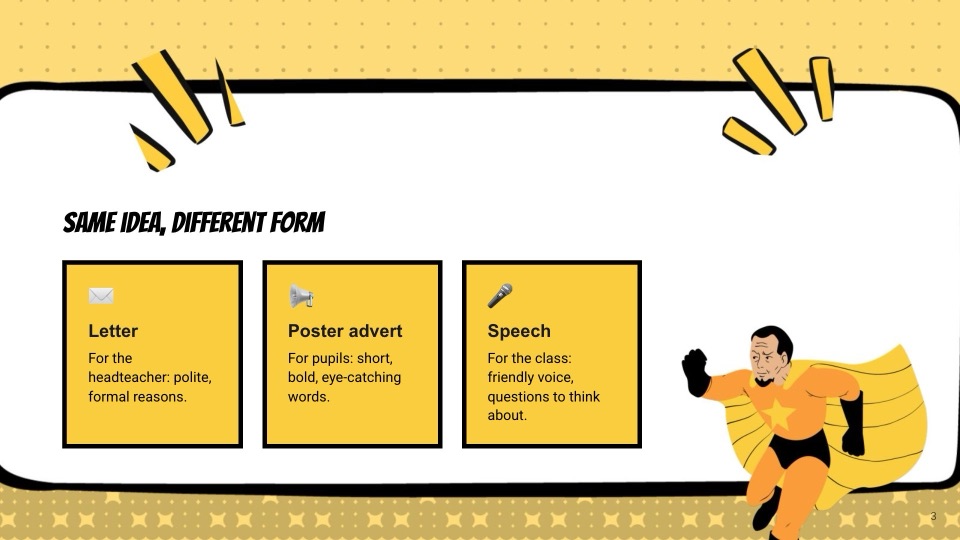
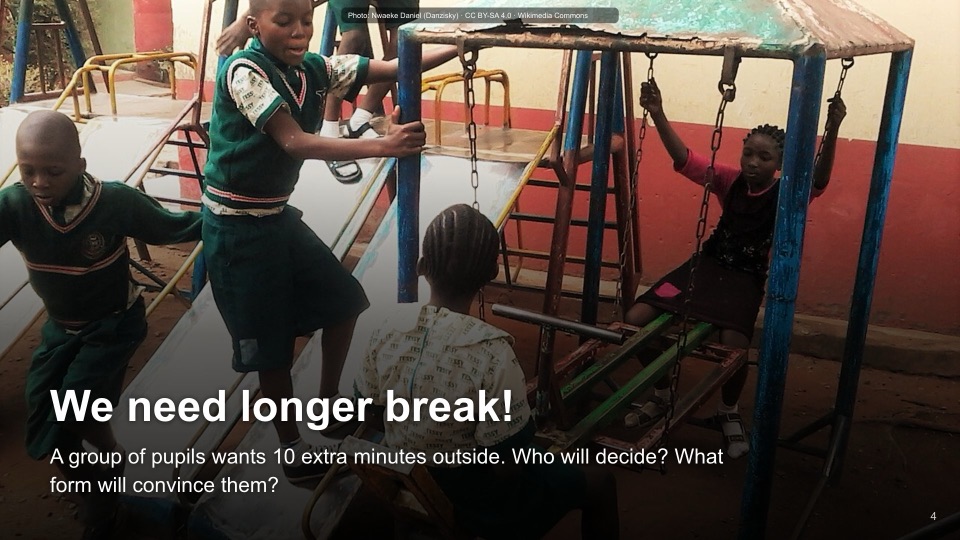
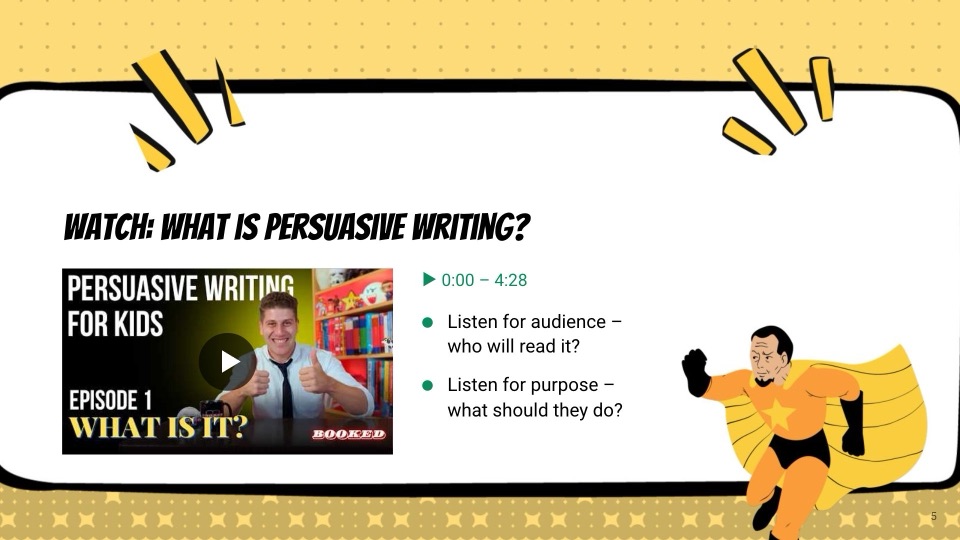
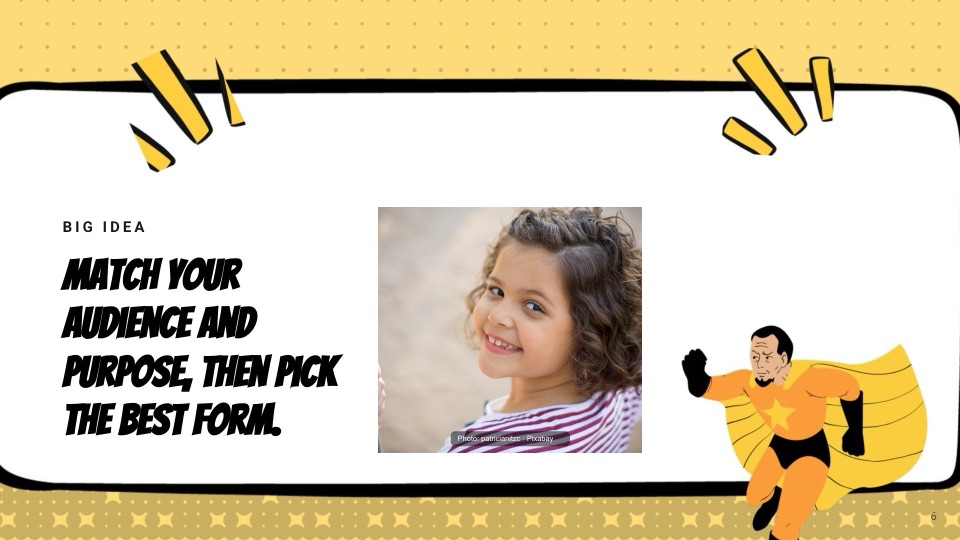
| 12 min | Teaching | To teach that audience and purpose decide the best persuasive form. Show Slide 3 cards about Letter, Poster advert and Speech and how each suits a different reader. Show Slide 4 photo task: 10 extra minutes outside. Ask who decides and what form would convince them. Play Slide 5 Video clip 1 (0:00–4:28) and ask pupils to listen for who will read it and what they must do. Teach Slide 6 Big idea: match audience and purpose, then pick the best form. |
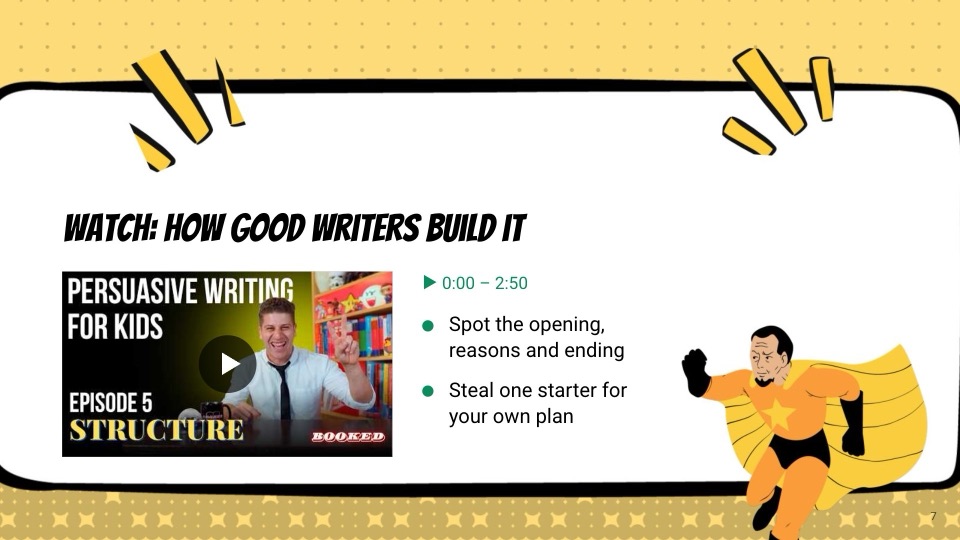
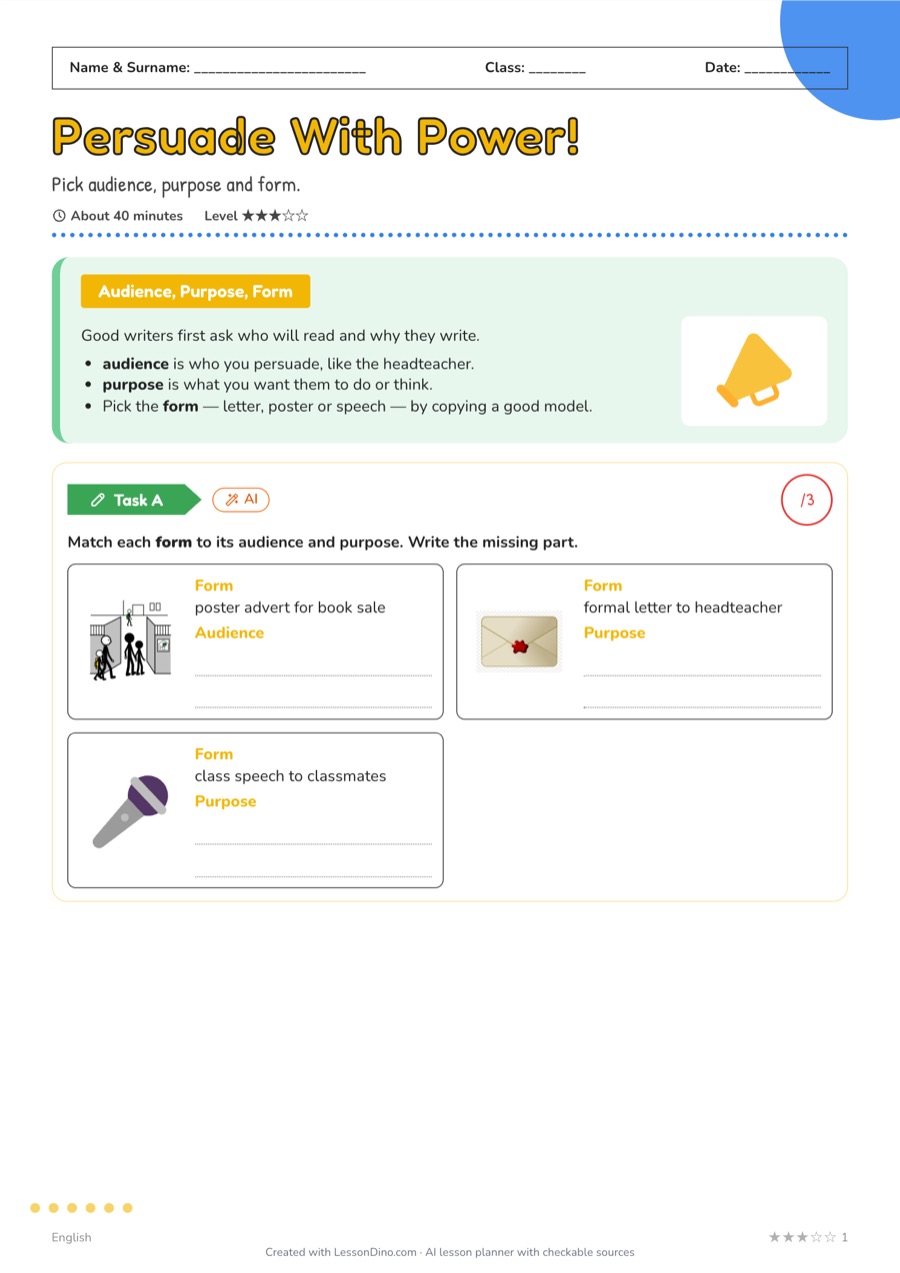
| 13 min | Model detectives | To learn structure, vocabulary and grammar from similar persuasive models. Play Slide 7 Video clip 4 (0:00–2:50) about opening, reasons and ending. Model how to steal structure, not words: greeting or headline, reasons with because, closing call to action. Give out Worksheet Task A and read the directions together. Check one match together, then pairs complete the rest. |
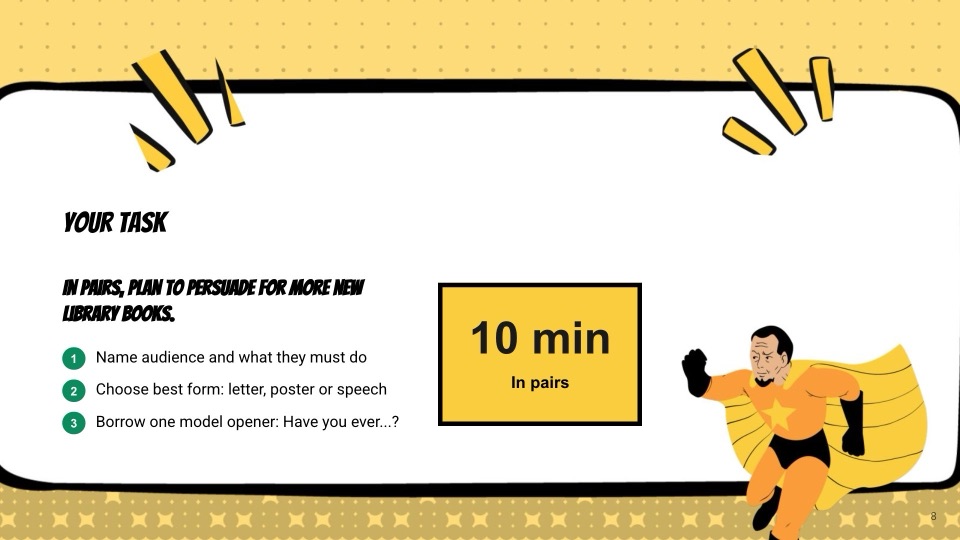
| 20 min | Main activity | To plan audience, purpose, form and model features for a class issue. Show Slide 8 task and give each pupil a four-box sheet: Audience, Purpose, Form, Model to steal from. Model one box set for tidier cloakroom, thinking aloud about audience and form fit. Let pupils plan an everyday issue such as tidier cloakroom or more playground equipment. Stop for threes to check: does the form suit the audience and purpose? |
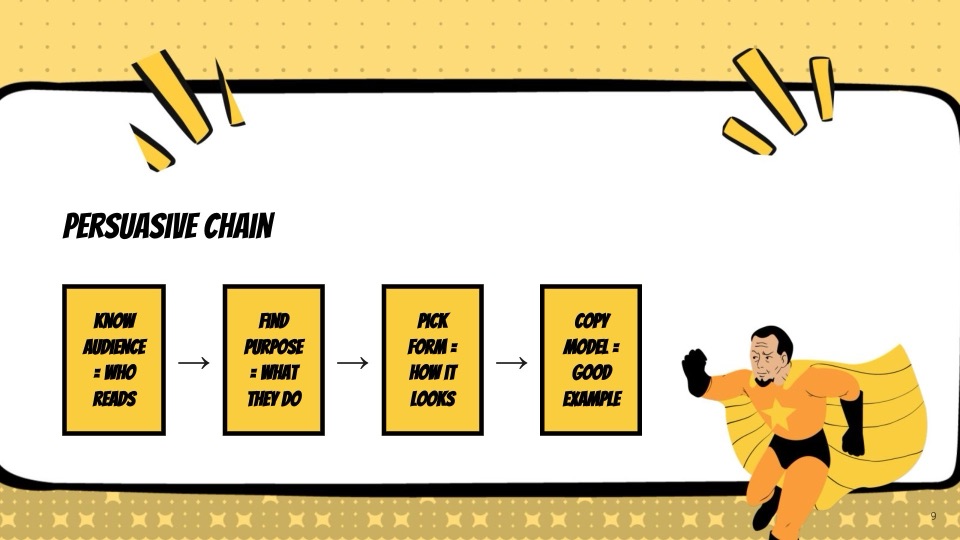
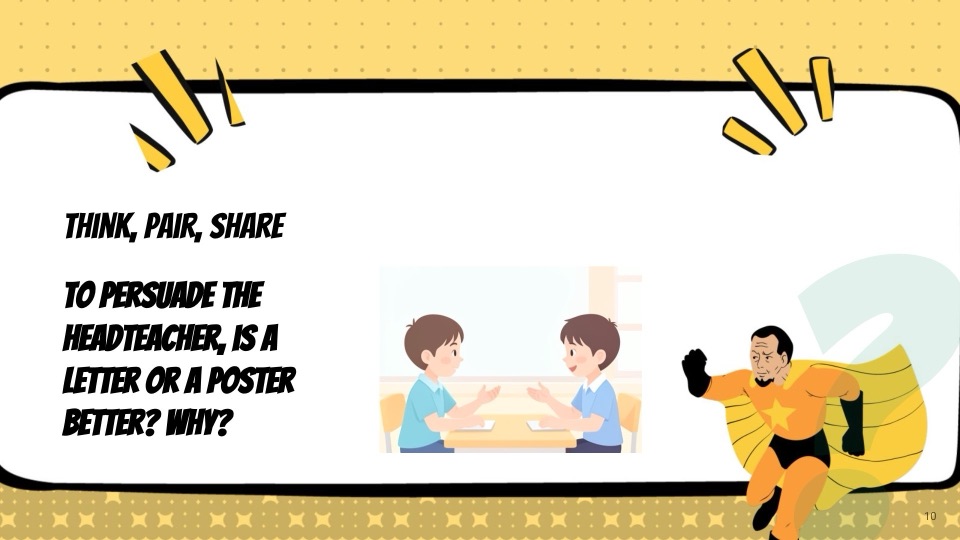
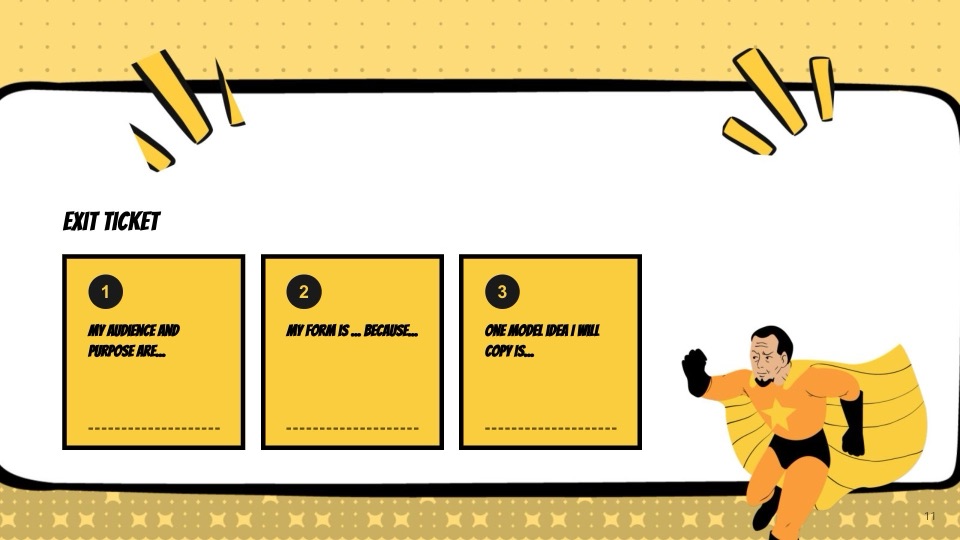
| 10 min | Plenary | To check choices and lock in the audience-purpose-form-model chain. Show Slide 9 chain: Know audience, Find purpose, Pick form, Copy model. Run Slide 10 Think, pair, share: To persuade the headteacher, is a letter or a poster better? Why? Take votes and ask pupils who switched after hearing reasons to explain why. Show Slide 11 Exit ticket and have pupils write three lines. |
Common mistakes
- Writing the topic instead of the purpose, e.g. Our purpose is the playground.
How to spot it: Purpose box has a thing, not an action the reader must do.
Rewrite as: Our purpose is to persuade the headteacher to agree to tidy the playground. - Choosing any form without linking it to the reader, e.g. poster for the headteacher.
How to spot it: Form choice has no because linked to who decides.
Ask: Who decides? Match form to reader, e.g. letter for formal decision, poster for many pupils. - Copying the model words instead of the pattern.
How to spot it: Plan uses the same coats, pegs and sentences as the example.
Cover the model and keep only the bones: opener question, two because reasons, please ending.
Support
- Use frames, word banks of formal and friendly words, and a completed example plan to copy layout from.
- Rehearse sentences orally with a partner before writing.
Stretch
- Predict the audience objection and add a counter-argument with because.
- Swap one sentence for a rhetorical question and check it still fits the structure.
Check questions
- My audience and purpose are...?
Answer: E.g. My audience is the headteacher and my purpose is to persuade them to give us more bins. - My form is ... because...?
Answer: E.g. My form is a letter because it is formal and suits a decision-maker. - One model idea I will copy is...?
Answer: E.g. The opener Have you ever...? and because reasons with a Please ending.
Curriculum
identifying the audience for and purpose of the writing, selecting the appropriate form and using other similar writing as models for their own
Video clips
Clips on YouTube, from the start and end times we chose. Check each one before you show it.
-
What is persuasive writing? from 0:00 to 4:28
BOOKED: What Is Persuasive Writing? | Persuasive Writing for Kids (Ep 1)
Explains purpose and real-world audiences in clear vocabulary and pace ideal for 10-11-year-olds.
-
Structure of a persuasive text from 0:00 to 2:50
BOOKED: How to Structure a Persuasive Text | Persuasive Writing for Kids (Ep 5)
Gives a clear model structure to help Year 6 pupils select and organise the appropriate form.
Worksheet
Sources
- National curriculum in England: English programmes of study gov.uk
- Year 6 English Curriculum lenham.kent.sch.uk
- S3 Persuasive Writing lenzieacademy.e-dunbarton.sch.uk
- Persuasive writing - Shottermill Junior School shottermill-jun.surrey.sch.uk
- Exploring persuasive writing - English - Learning with BBC Bitesize bbc.co.uk
- Writing to persuade guide for KS3 English students - BBC bbc.co.uk
- Persuasive Writing Guide - ThinkLit thinklit.co.uk
- Persuasive Writing | Free Study Notes Library | StudentNotes.co.uk studentnotes.co.uk
- Persuasive writing - Wikipedia en.wikipedia.org
- why we should get a good allowance – Renee @ Rāwhiti School rwsrenees.edublogs.org
- Mastering Persuasive Writing for Kids: A Friendly Guide to ... theenglishtoday.com
- Persuasive Writing - Night Zookeeper nightzookeeper.com
- How to Teach Kids Persuasive Writing: Books & Teaching Tips imaginationsoup.net
- Persuasive Writing Techniques for Content Entrepreneurs: 10 Smar… copyblogger.com
- Persuasive Writing: Introduction Educational Resources K12 Learning, Writing, English / Language Arts Lesson Plans, Activities, Experiments, Homeschool Help elephango.com
- Persuasive Writing: How to harness the power of words - Frederick, Peter: 9780273746133 - AbeBooks abebooks.com
- Persuasive Writing - Reading Rockets readingrockets.org
- The Three Acid Tests of Persuasive Writing ubiquity.acm.org
- persuasive-writing Tutors in edinburgh - United Kingdom | Varsity Tutors | Varsity Tutors jobs.varsitytutors.com
Picture credits
- Photo: geralt · Pixabay
- Photo: PublicDomainPictures · Pixabay
- Photo: Nwaeke Daniel (Danzisky) · CC BY-SA 4.0 · Wikimedia Commons
- Photo: patricianitzc · Pixabay
- AI illustration · Cloudflare
- Microsoft Fluent Emoji (MIT)
- Pictograms: Sergio Palao, ARASAAC (arasaac.org) · CC BY-NC-SA
- Picture: unknown · CC0 · rawpixel via Openverse
Made with Lesson Dino's AI on 19 October 2026. AI can make mistakes, so check facts against the sources before you teach.