The worksheet
About this worksheet
Pupils learn the parts of a simple series circuit and what each part does. They build a bulb circuit, then swap the bulb for a buzzer and test a switch. This Year 4 Science worksheet gives students (ages 8–9) five pages of practice on electrical circuits, part of the electricity unit. It goes with our free Electrical circuits lesson, which has the slides and a timed lesson plan.
What it covers
By the end, students should be able to:
- Students will build a simple series circuit with cell, wires, bulb and switch.
- Students will name cells, wires, bulbs, switches and buzzers and say their jobs.
- Students will swap a bulb for a buzzer and use a switch to open and close circuit.
How to use it
- Main activity (25 minutes): Give out kits and Worksheet Task B and tell pairs to join cell, wires and bulb in one loop until the bulb lights.
- Plenary (10 minutes): Do Worksheet Task F matching together: read each part and match it to what it does.
- Support: Leave one working bulb circuit made up as a model, so students can copy the wire connections exactly before swapping.
- Stretch: Ask students to try a circuit with a bulb and a buzzer together and describe what happens to each.
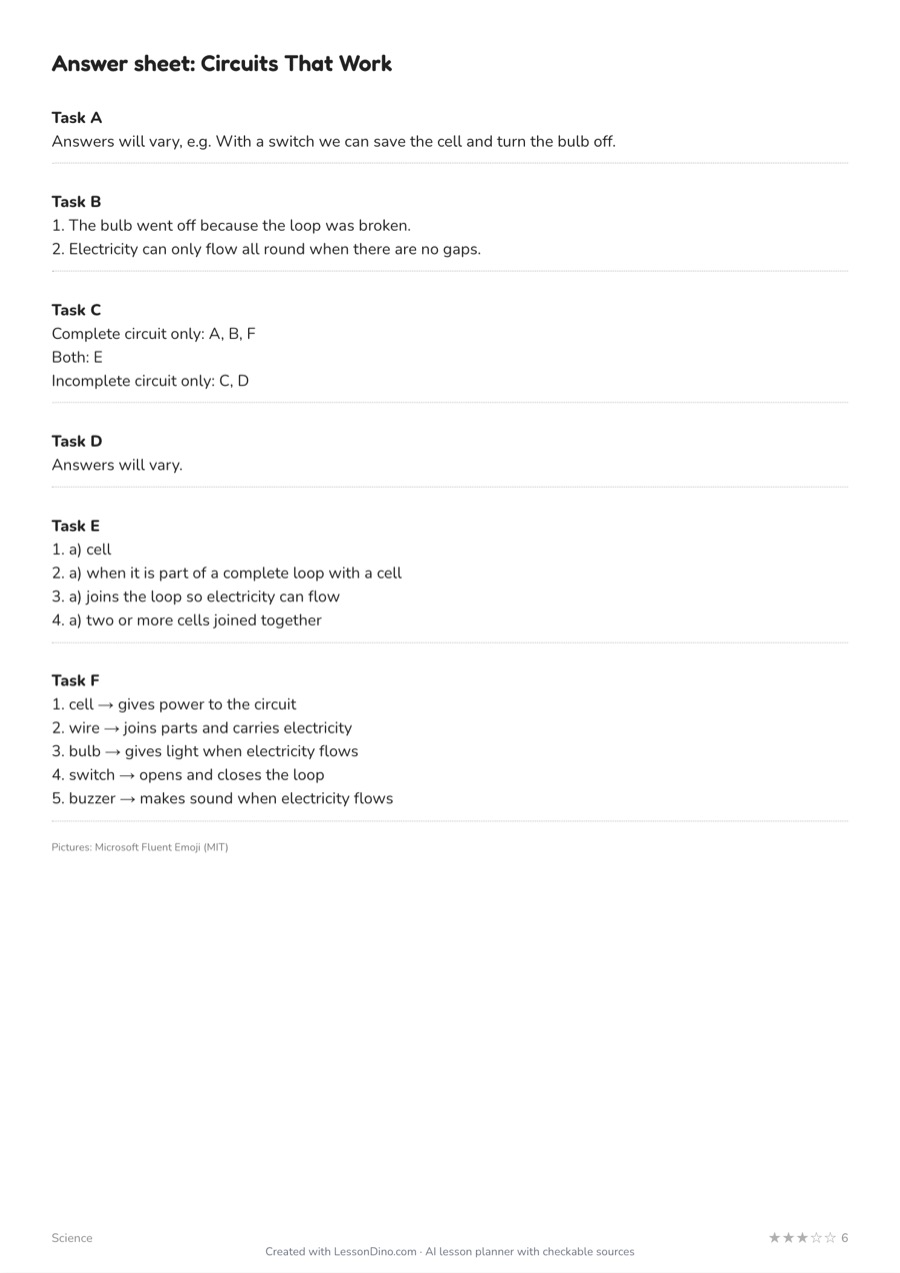
- The answer sheet is the last page, so you can print it on its own or let students check their own work.
Key vocabulary
- cell: a small power unit that gives the push to move electricity
- wire: a metal path covered in plastic that joins the loop together
- bulb: a part that changes electricity into light
- switch: a part that opens a gap or closes the join to turn things on or off
- buzzer: a part that changes electricity into sound
Mistakes to watch for
- Pupils leave a gap but expect the bulb to light. Trace the loop with a finger and close any gap, because the lamp only lights as part of a complete loop with a battery.
- Pupils think an open switch means on. Practise flicking: open makes a gap so off, closed joins the loop so on, because a switch opens and closes a circuit.
- Pupils mix up cell and battery words. Show one cell and two cells together: a single battery is actually called a cell; a battery is made of two or more cells.
What's on the worksheet
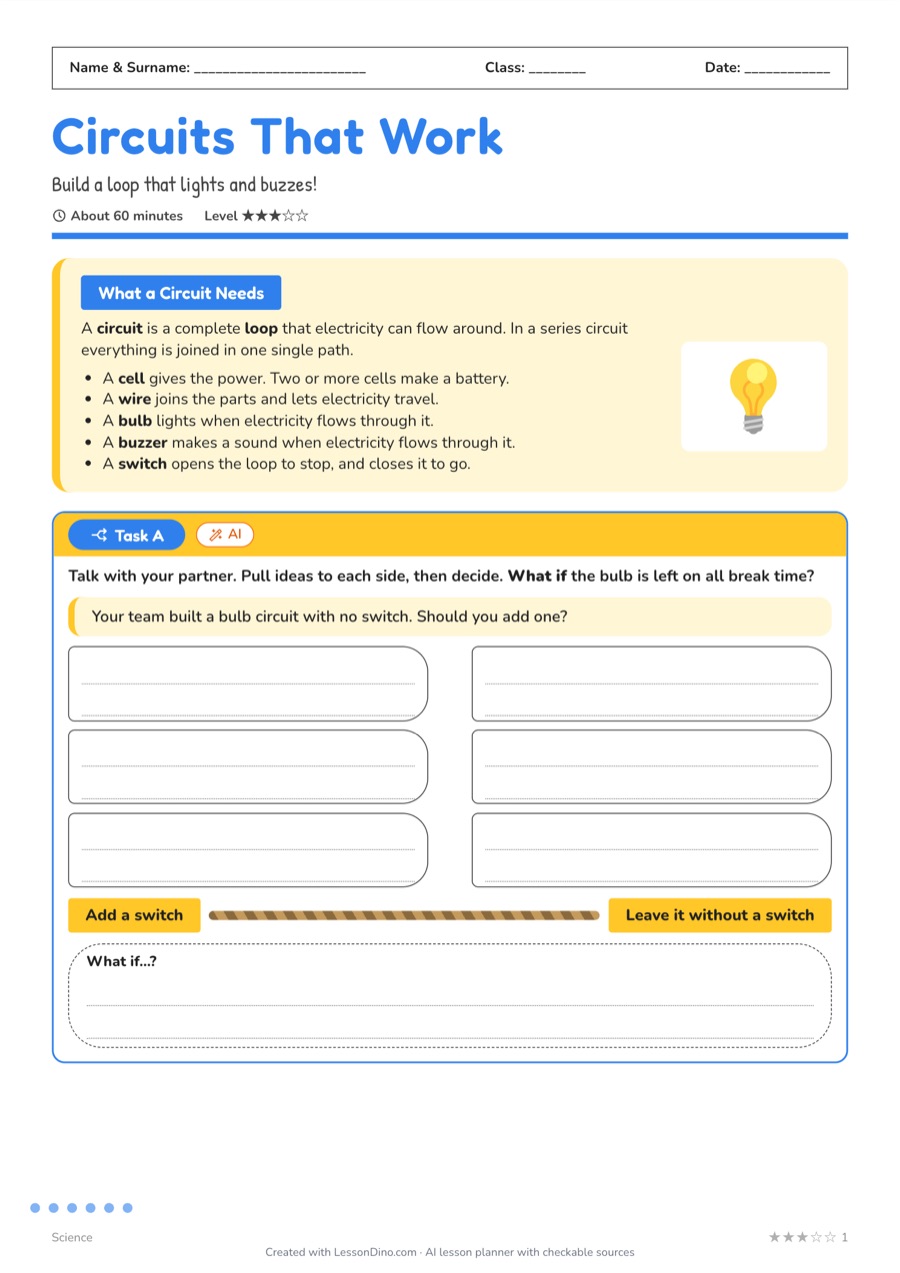
Power in Loops
Find out what a simple series circuit needs.
What a Circuit Needs
- A circuit is a complete loop that electricity can flow around. In a series circuit everything is joined in one single path.
- A cell gives the power. Two or more cells make a battery.
- A wire joins the parts and lets electricity travel.
- A bulb lights when electricity flows through it.
- A buzzer makes a sound when electricity flows through it.
- A switch opens the loop to stop, and closes it to go.
Talk with your partner. Pull ideas to each side, then decide. What if the bulb is left on all break time?
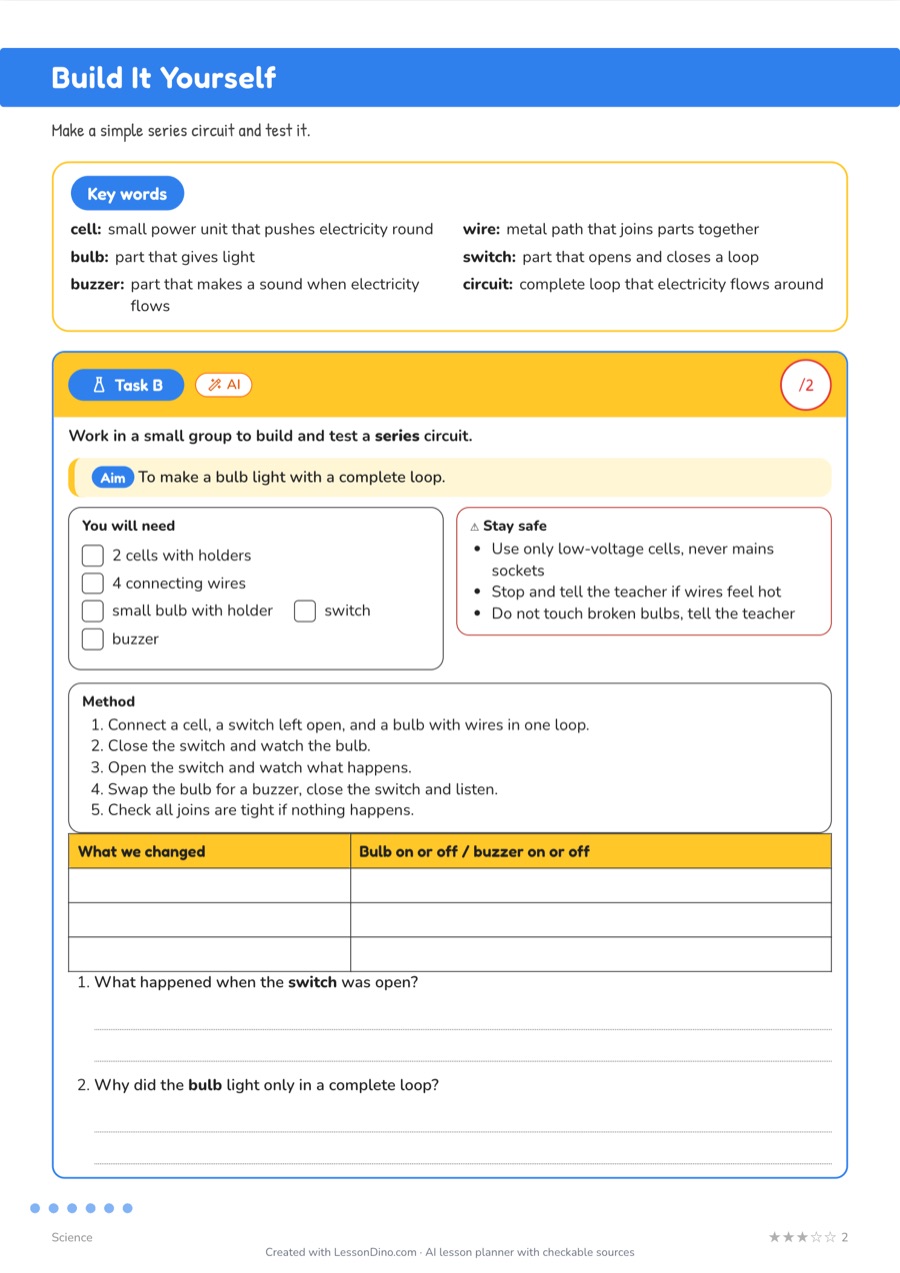
Build It Yourself
Make a simple series circuit and test it.
| Word | Meaning |
|---|---|
| cell | small power unit that pushes electricity round |
| wire | metal path that joins parts together |
| bulb | part that gives light |
| switch | part that opens and closes a loop |
| buzzer | part that makes a sound when electricity flows |
| circuit | complete loop that electricity flows around |
Work in a small group to build and test a series circuit.
- What happened when the switch was open?
- Why did the bulb light only in a complete loop?
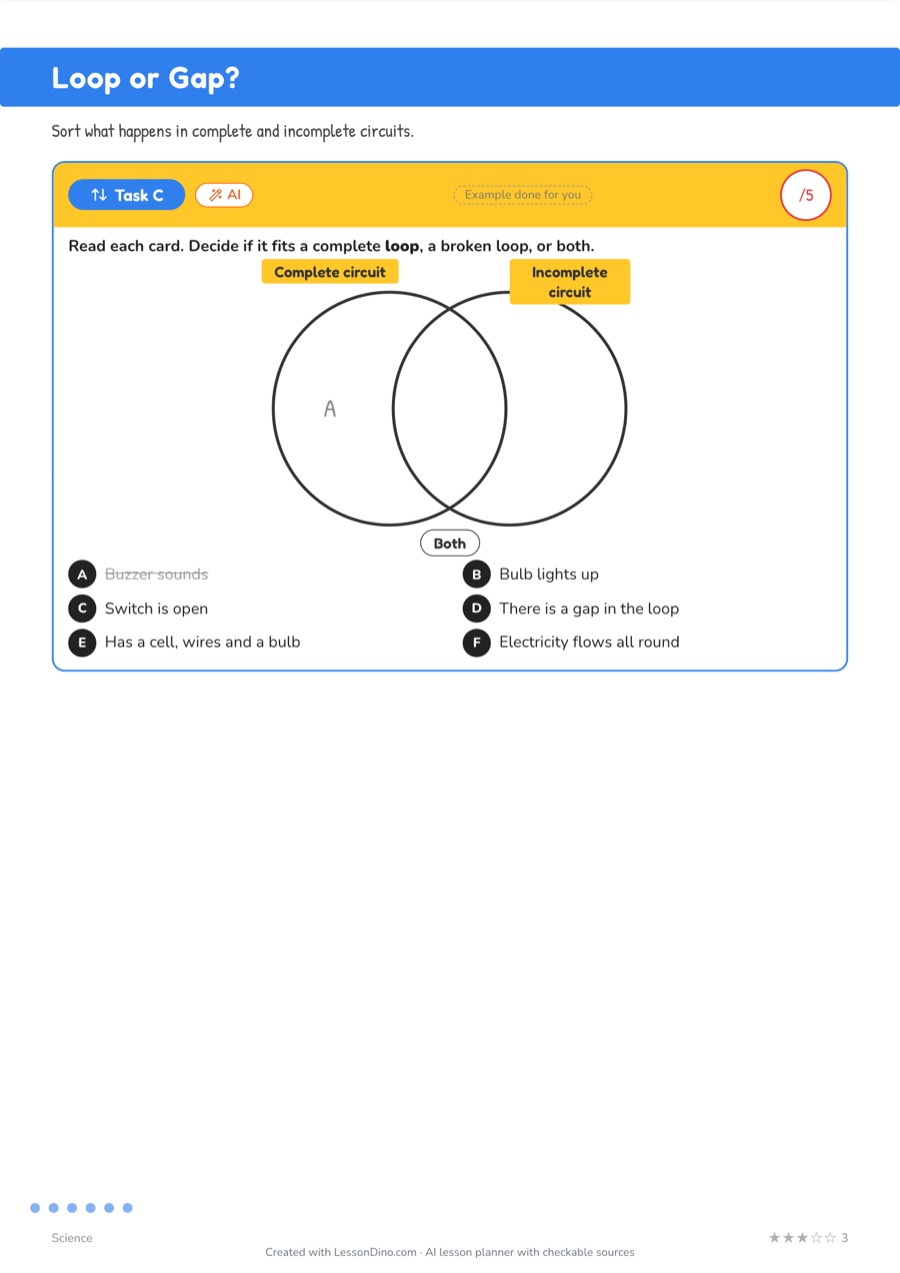
Loop or Gap?
Sort what happens in complete and incomplete circuits.
Read each card. Decide if it fits a complete loop, a broken loop, or both.
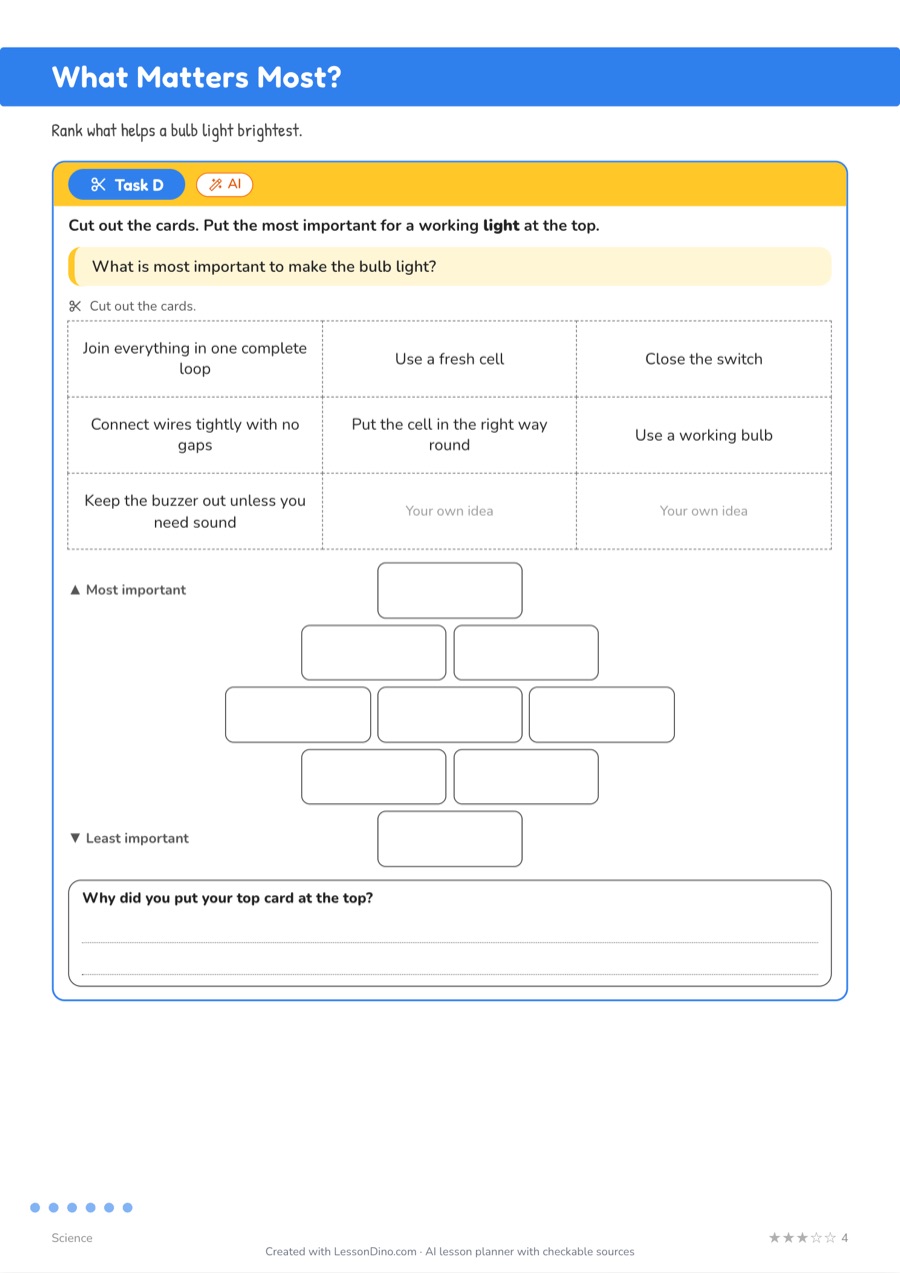
What Matters Most?
Rank what helps a bulb light brightest.
Cut out the cards. Put the most important for a working light at the top.
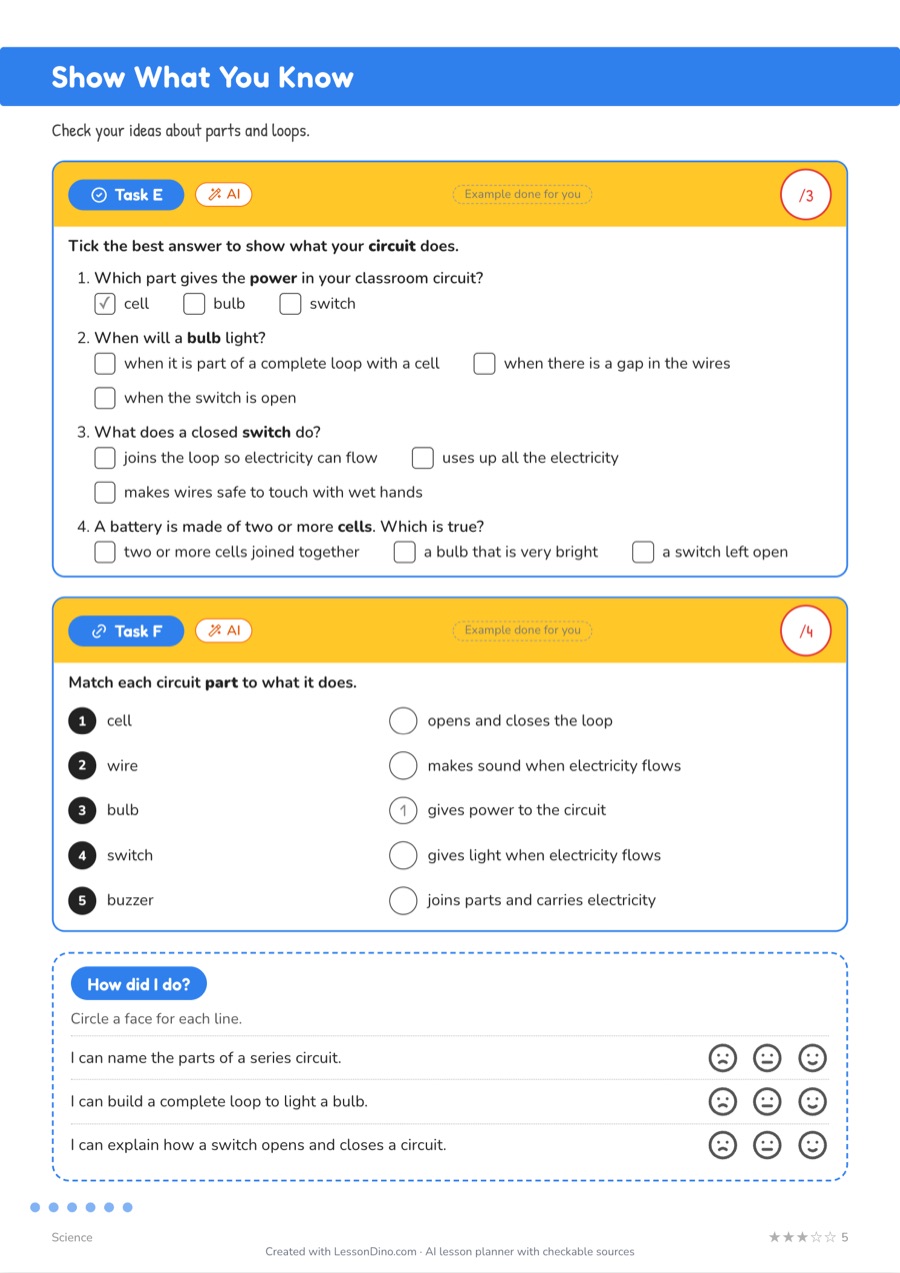
Show What You Know
Check your ideas about parts and loops.
Tick the best answer to show what your circuit does.
- Which part gives the power in your classroom circuit?
- When will a bulb light?
- What does a closed switch do?
- A battery is made of two or more cells. Which is true?
Match each circuit part to what it does.
Answers
Show the answers
- What happened when the switch was open? The bulb went off because the loop was broken.
- Why did the bulb light only in a complete loop? Electricity can only flow all round when there are no gaps.
The answer sheet is the last picture above.
Curriculum
construct a simple series electrical circuit, identifying and naming its basic parts, including cells, wires, bulbs, switches and buzzers
Made with Lesson Dino's AI on 17 October 2026. AI can make mistakes, so check the answers and facts against the sources before you teach.