Slides
Lesson plan
Find the Shake You Can Hear
Pupils learn that every sound starts with something vibrating. They watch, feel and draw what shook to make drum, bell and clap sounds.
Objectives
- Students will identify how sounds are made by something vibrating.
- Students will label the vibrating part that made a sound.
Success criteria
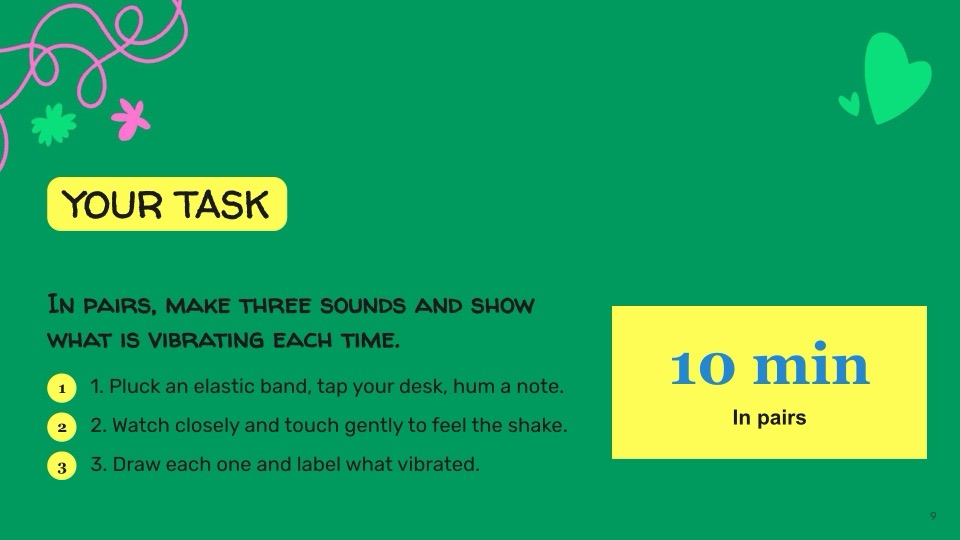
- I can say what vibrated to make a drum, bell or clap sound.
- I can label the shaking part on my drawing.
Key words
| Word | Meaning |
|---|---|
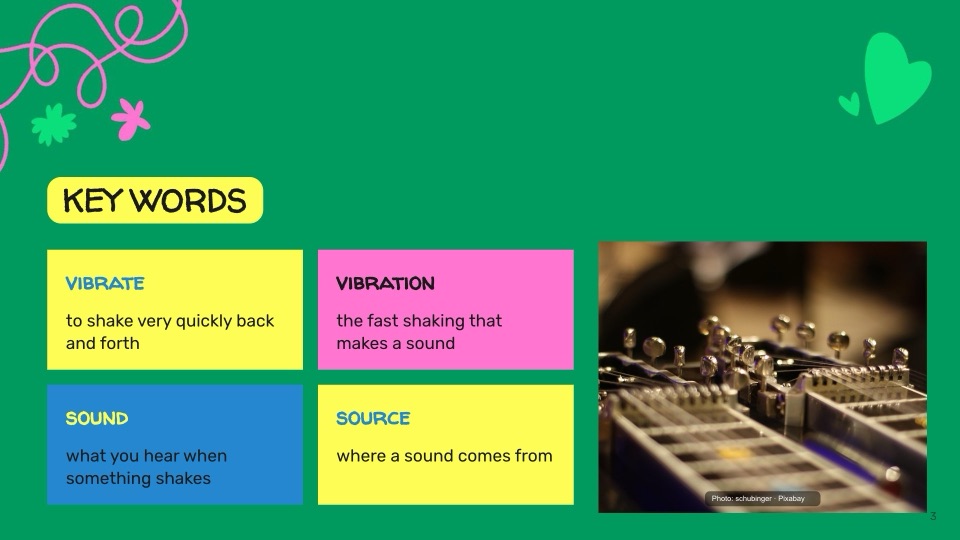
| vibrate | to shake very quickly back and forth |
| vibration | the fast shaking that starts a sound |
| sound | what you hear when something shakes fast |
| source | the place or thing where a sound starts |
Timed plan (60 minutes)
| Time | Stage | What happens |
|---|---|---|
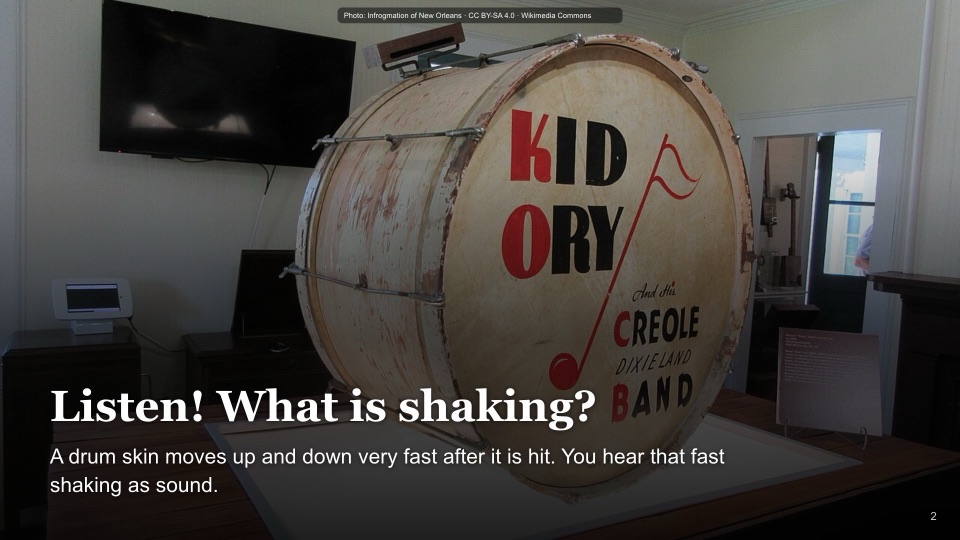
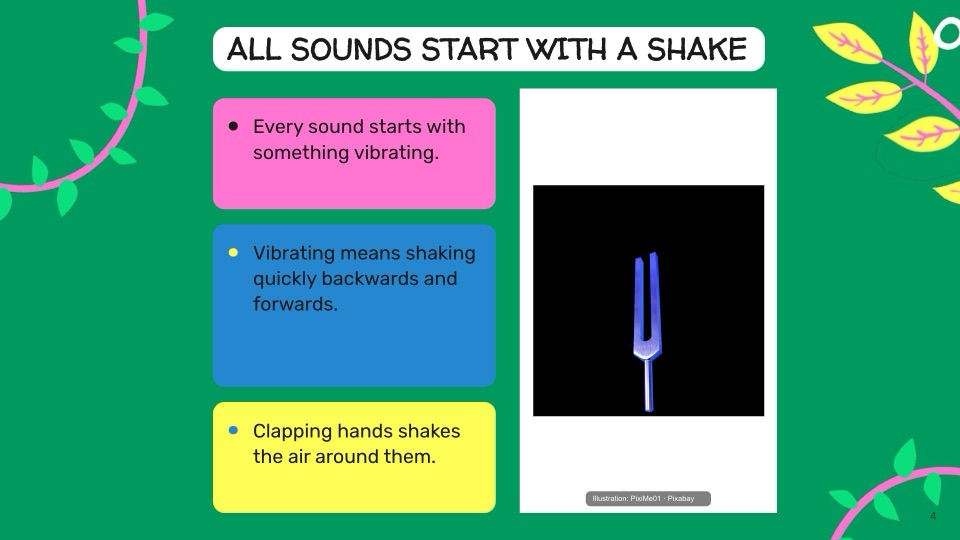
| 5 min | Starter | Hook pupils and recall that sounds must come from somewhere. Show the title and drum photo and explain that a drum skin moves up and down very fast after it is hit. Use the hook and ask how we could draw an invisible sound. Clap once loudly, then hold hands still and explain that when you clap your hands, the air around your hands shakes. Tell pupils their job today is to find the shake you can hear in every sound. |
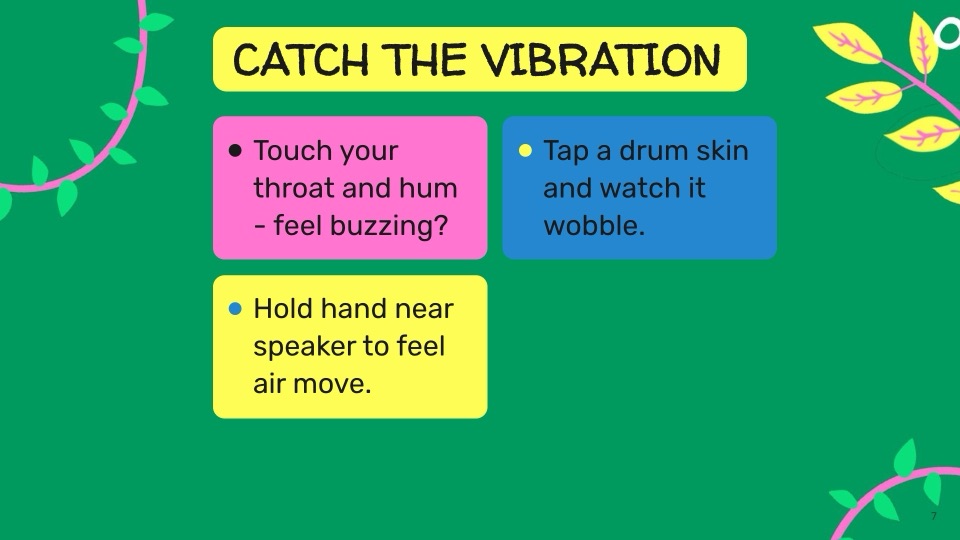
| 10 min | Teaching | Explain that every sound starts with something vibrating. Show the key words and read vibrate, vibration, sound and source with the class. Model a slow clap and explain that vibrating means shaking quickly backwards and forwards. Tap the drum and point to the skin wobbling, explaining that when a person hits a drum the object vibrates. Ring the bell and hold it up shaking, explaining that all sounds are made by vibrations of molecules. |
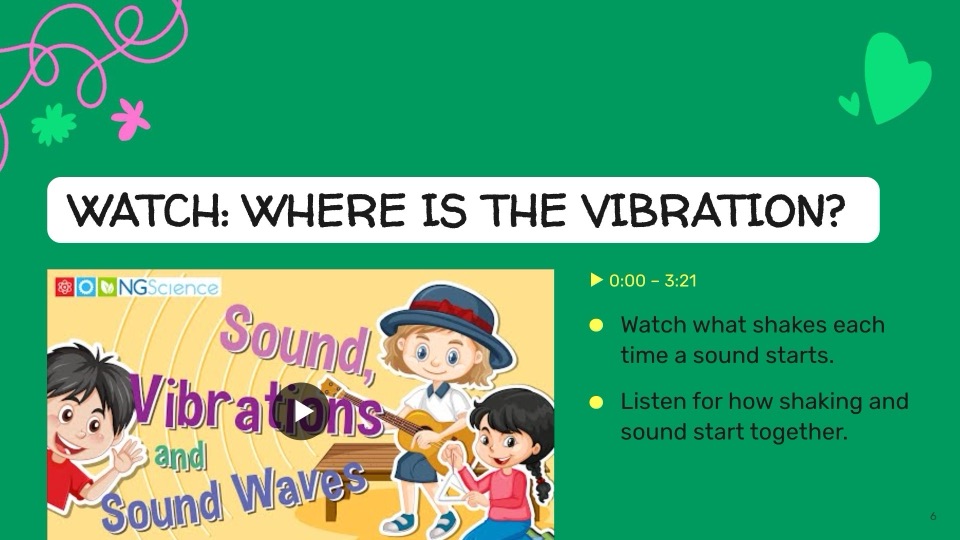
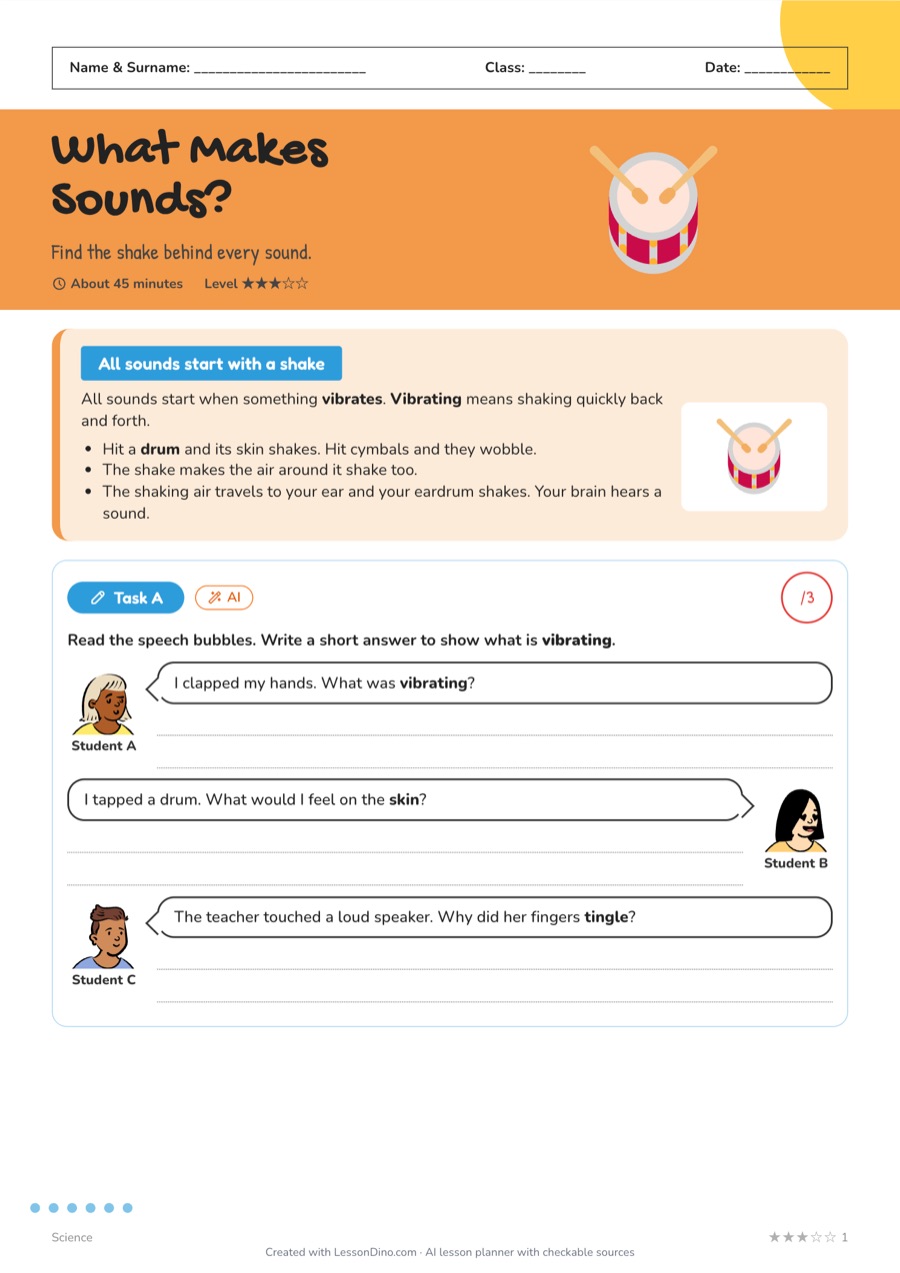
| 10 min | Guided practice | See that shaking and sound start together in different makers. Play the video and pause when each maker sounds to ask what shook. Point out that these vibrations make air molecules move. Hand out Task A and read the instructions together. Model the first speech bubble by naming what vibrated and writing a short answer. |
| 20 min | Main activity | Draw and label the vibrating part for three everyday sounds. Tap the drum, ring the bell and clap in turn, pausing so pupils see each wobble. Explain that when a person hits a drum or a cymbal the object vibrates and vibrating means to shake quickly back and forth. Model drawing the drum with wobbly lines round the skin and an arrow labelled drumskin vibrated. Give out paper, coloured pencils and outlines and ask pupils to draw and label all three makers. Walk round, asking each pupil what vibrated and prompting for arrows and labels. |
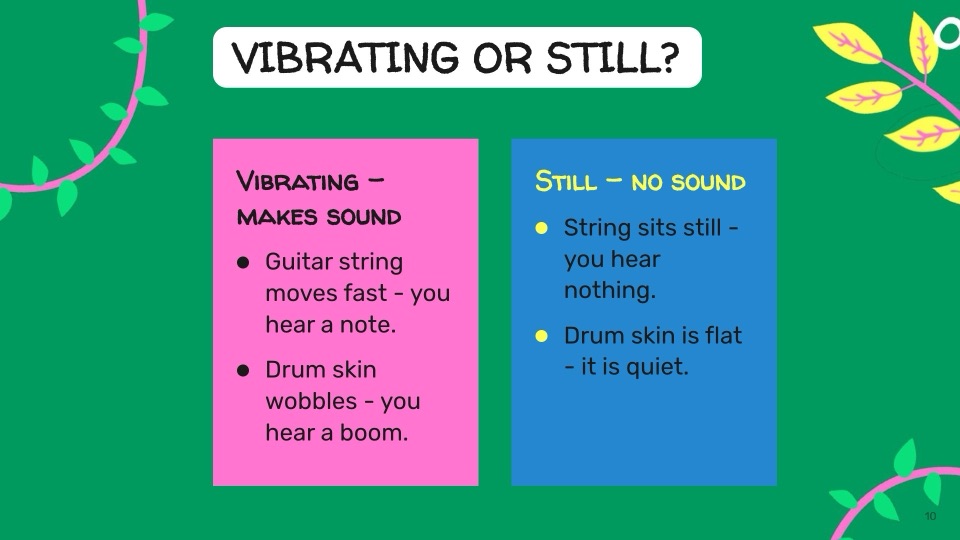
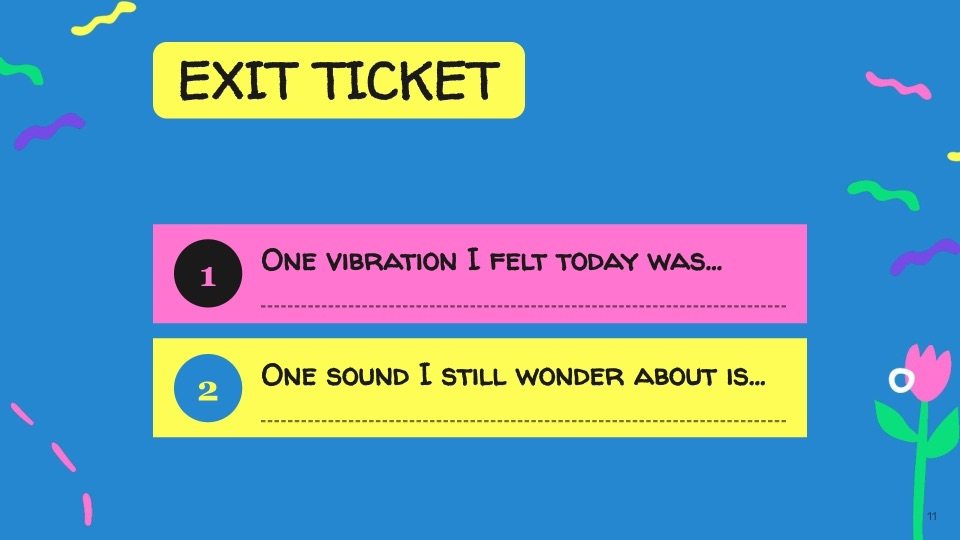
| 15 min | Plenary | Check pupils can sort vibrating sounds from still silence. Show the compare and sort examples into vibrating - makes sound and still - no sound. Hand out Task E and read each statement together for pupils to tick true or false. Correct false ones by asking what really vibrated, noting that when a person hits a drum or a cymbal the object vibrates. Show the exit ticket and ask pupils to complete the two sentences. |
Common mistakes
- Sound can happen with nothing moving.
How to spot it: Pupil says the clap or bell sound comes from nowhere, or names the sound but not a shaker.
Clap again slowly and hold the bell still, then ring it. Show hands meeting shakes the air and every sound starts with something vibrating, so no shake means no sound. - Only big or loud makers vibrate.
How to spot it: Pupil labels the drum but says humming or a soft tap has no vibration.
Let pupils feel the throat buzz when humming and watch a soft tap wobble. Explain people can make very complex sounds for speech and even small fast shakes count as vibration. - Sound carries on after shaking stops.
How to spot it: Pupil draws wobble lines on a still bell or says holding the bell still still makes sound.
Ring the bell, then touch it still to stop the wobble and hear the sound stop. Explain sound waves move away from where they came from, but no new sound is made once vibration stops.
Support
- Provide outlines of a drum, bell and hands so pupils only add wobble lines.
- Give a word bank with vibrate, shake and buzz and sentence starters for labelling.
- Let pupils feel the throat buzz while humming together slowly.
Stretch
- Add a second picture showing the same object still and silent with no wobble lines.
- Compare a soft tap and a hard tap and describe the change in look and sound.
Check questions
- What must happen for any sound to be made?
Answer: Something must shake very quickly back and forth. - What vibrated to make the drum sound today?
Answer: The drum skin moving up and down fast. - You hold a ringing bell still and the sound stops. Why?
Answer: Because the vibration stopped, so no new sound is made.
Curriculum
identify how sounds are made, associating some of them with something vibrating
Video clips
Clips on YouTube, from the start and end times we chose. Check each one before you show it.
-
Sound, Vibrations and Waves from 0:00 to 3:21
Next Generation Science: Sound, Vibrations and Sound Waves
Matches the lesson objective exactly and uses vocabulary and visuals ideal for ages 8-9.
-
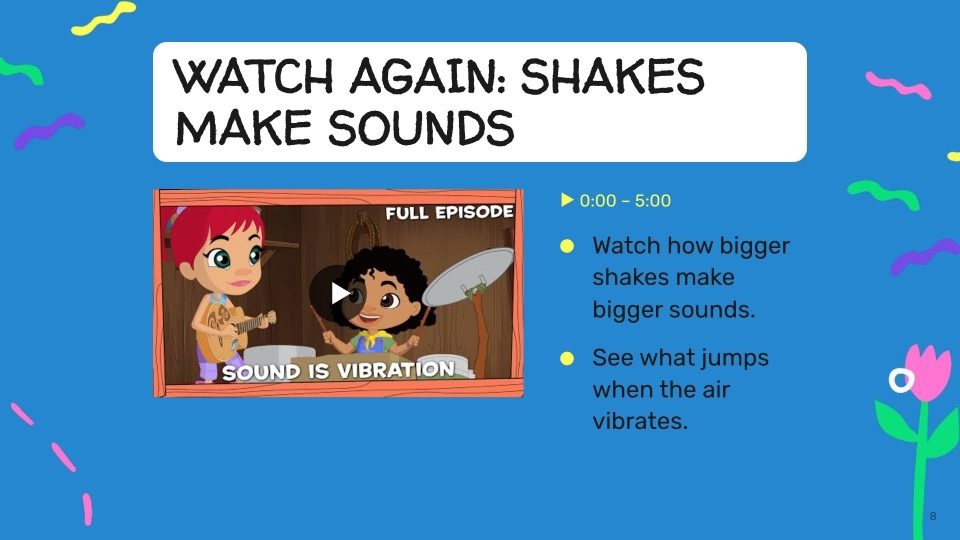
Sound Is Vibration from 0:00 to 5:00
Darwin and Newts | Craft and Science for Kids: Darwin and Newts | Sound is Vibration
Demonstrates vibrations making sounds step by step at a practical pace that is perfect for ages 8-9.
Worksheet
Sources
- Science Curriculum Year 4 queenshill.norfolk.sch.uk
- BBC Sounds - Music. Radio. Podcasts bbc.co.uk
- How is Sound made Power Point newportjuniorschool.org.uk
- How man-made sounds are affecting life deep in the ocean - BBC N… bbc.com
- Sound - Simple English Wikipedia, the free encyclopedia simple.wikipedia.org
Picture credits
- Illustration: geralt · Pixabay
- Photo: Infrogmation of New Orleans · CC BY-SA 4.0 · Wikimedia Commons
- Photo: schubinger · Pixabay
- Illustration: PixiMe01 · Pixabay
- Microsoft Fluent Emoji (MIT)
- Pictograms: Sergio Palao, ARASAAC (arasaac.org) · CC BY-NC-SA
Made with Lesson Dino's AI on 17 October 2026. AI can make mistakes, so check facts against the sources before you teach.