Slides
Lesson plan
The Great Food Journey
Pupils learn the basic parts of the digestive system and what each part does. They act out the journey of food from mouth to anus.
Objectives
- Students will name the basic parts of the digestive system in order.
- Students will describe in simple words what each digestive part does to food.
Success criteria
- I can order the parts from mouth to anus.
- I can say what each part does to food.
- I can explain why food must become tiny bits.
Key words
| Word | Meaning |
|---|---|
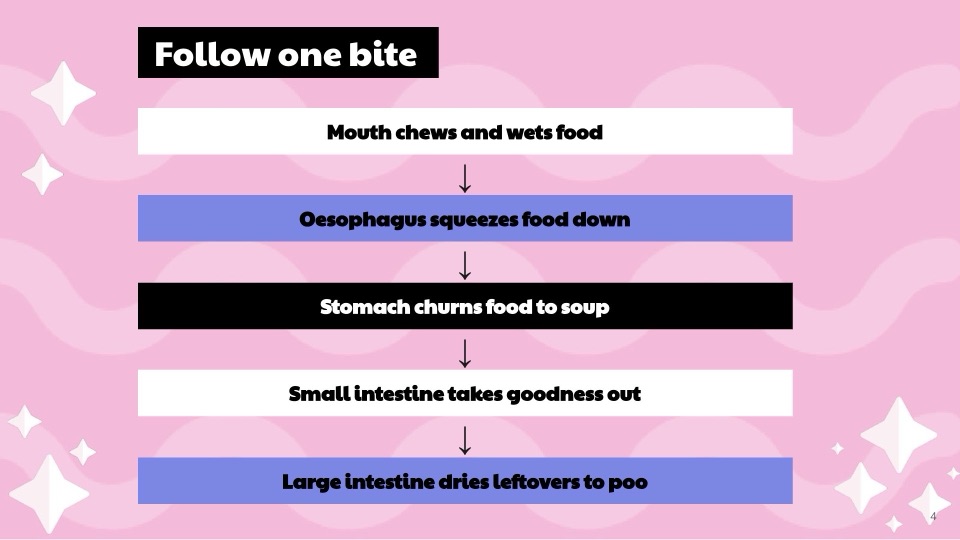
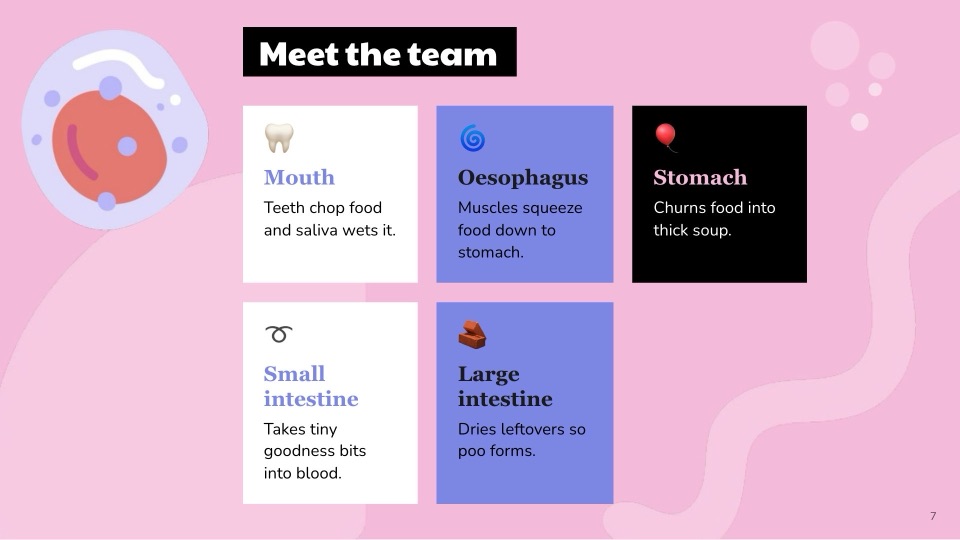
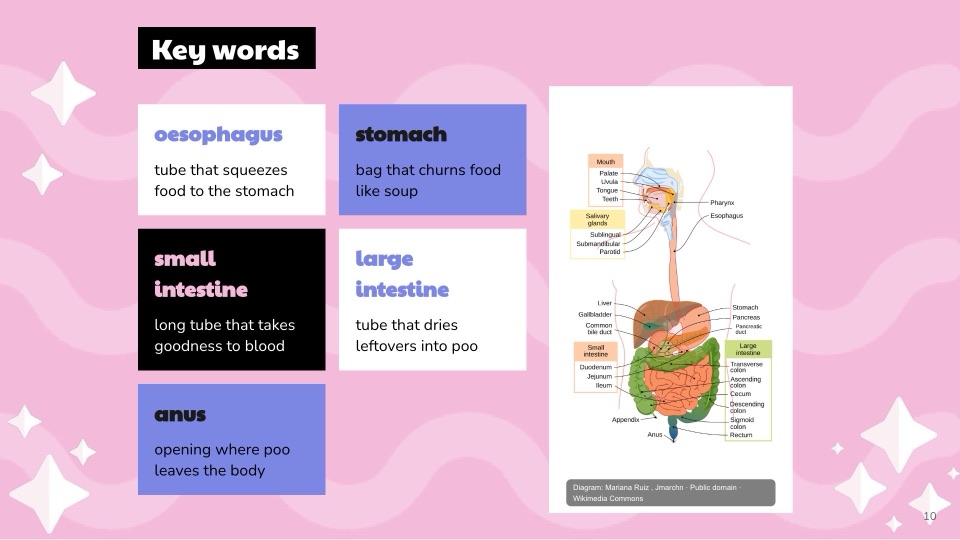
| mouth | opening where teeth cut food and spit wets it for swallowing |
| oesophagus | muscular food tube in the chest that squeezes food down to the stomach |
| stomach | stretchy bag that mixes food into thick soup |
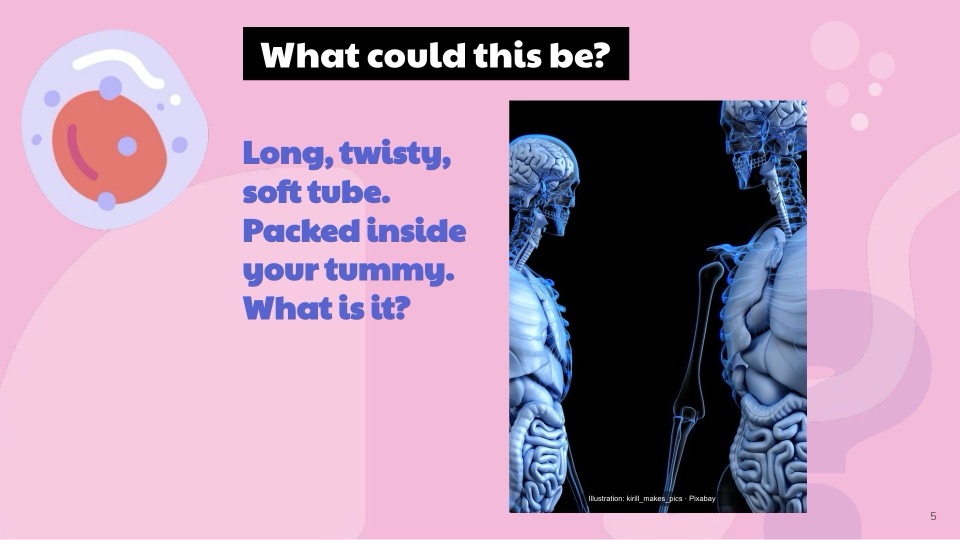
| small intestine | long twisty tube that takes goodness from food into the blood |
| large intestine | wider tube that dries leftovers and packs them into poo |
Timed plan (60 minutes)
| Time | Stage | What happens |
|---|---|---|
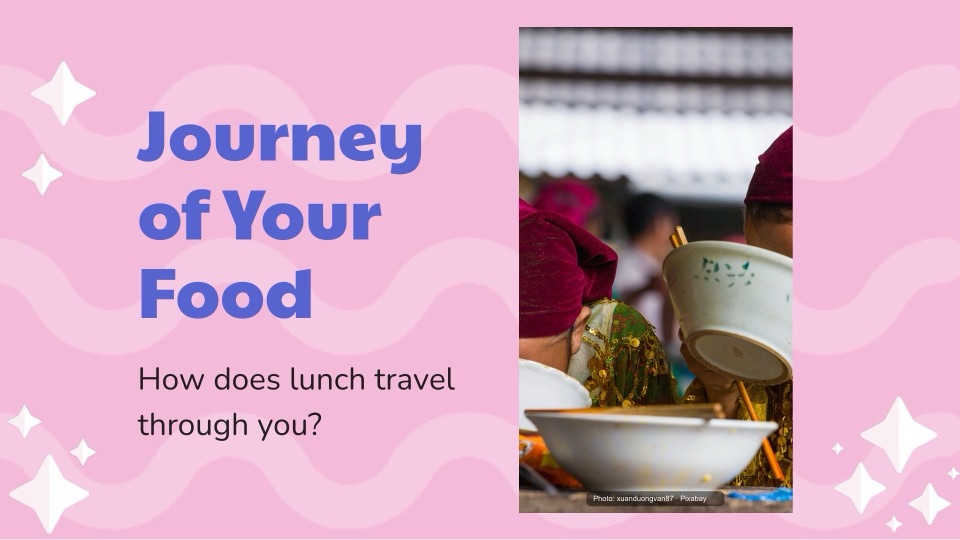
| 5 min | Starter | To hook pupils and recall what happens to food after swallowing. Welcome the class and show Slide 1 title question. Say the hook and invite hands up for who wants each role. Ask pupils to tell a partner one idea about where food goes. Show Slide 2 objectives and read the two I can statements together. |
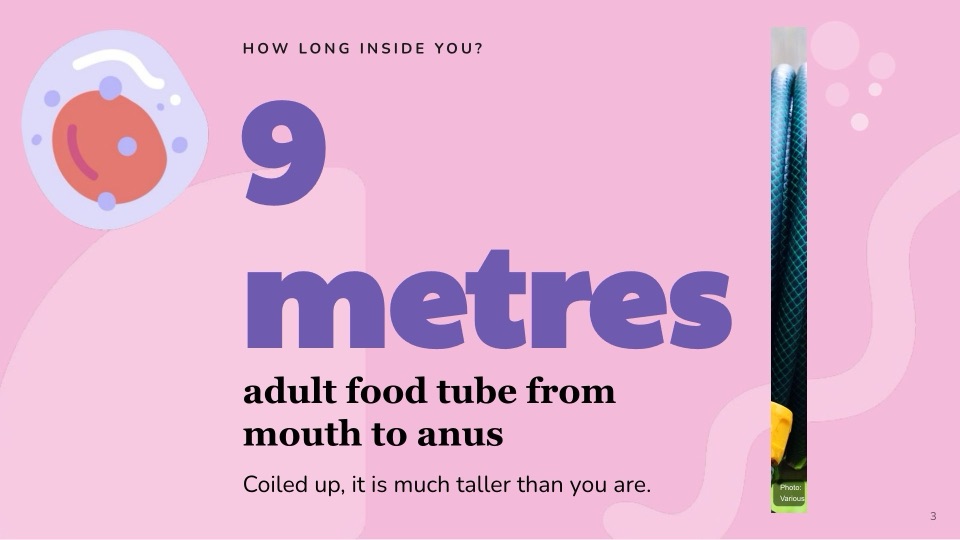
| 10 min | Teaching | To name the food tube and order the basic parts from mouth to anus. Show Slide 3 and stretch arms to show 9 metres is much taller than a pupil. Explain the long tube is called the alimentary canal and runs from the mouth to the anus. Show Slide 4 chain and point mouth to anus in order while pupils repeat each name. Model the jobs with a hand move for chop, squeeze, churn, take goodness, dry leftovers. |
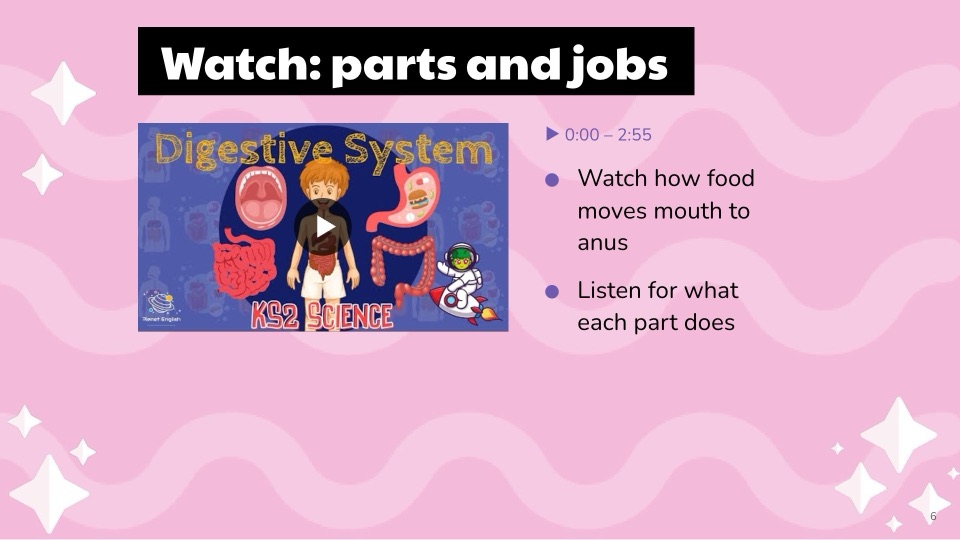
| 10 min | Video and model | To see and hear what chewing, squeezing and churning do to food. Show Slide 6 and set the listening job: whisper each part name when you hear it. Play Video clip 1 (0:00-2:55) right through. Show Slide 7 cards and model each job sentence with voice and move. Lead a quick echo: teacher does move and job, class copies. |
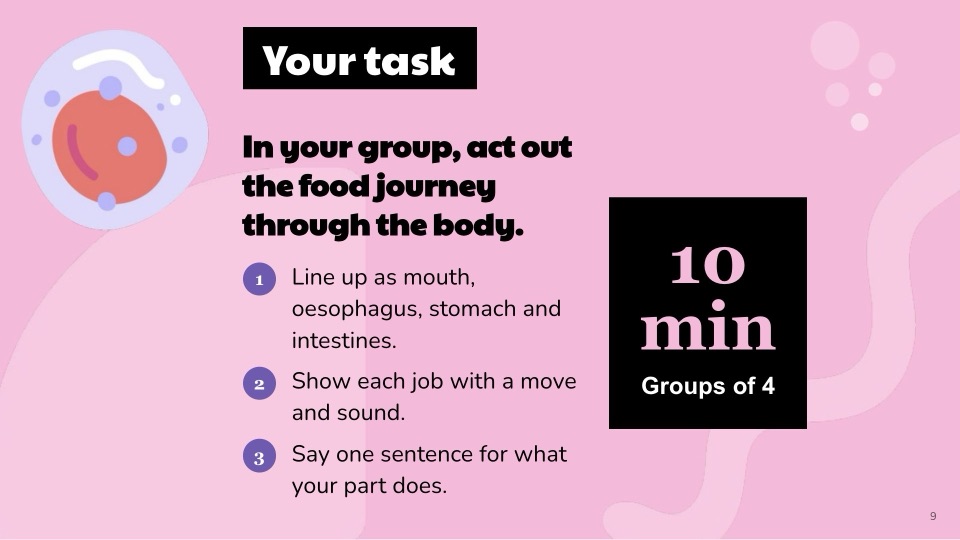
| 20 min | Main activity | To act out the parts in order and say what each part does. Show Slide 9 task and split the class into five groups along a clear line. Give each group an organ role card and place the soft toy pea at the mouth. Lead the first pass slowly: cue each group to do its move and shout its job. Time a second run and remind groups to pass gently with space between them. |
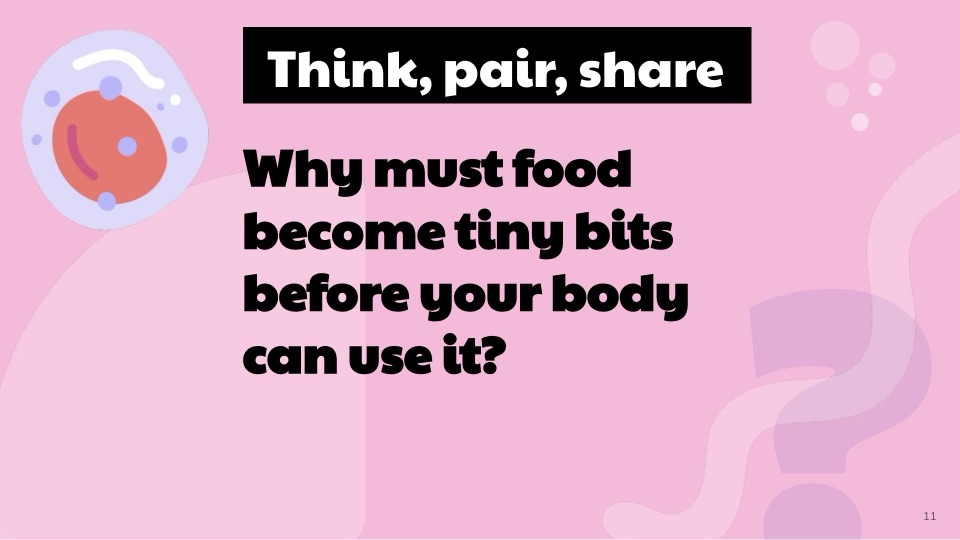
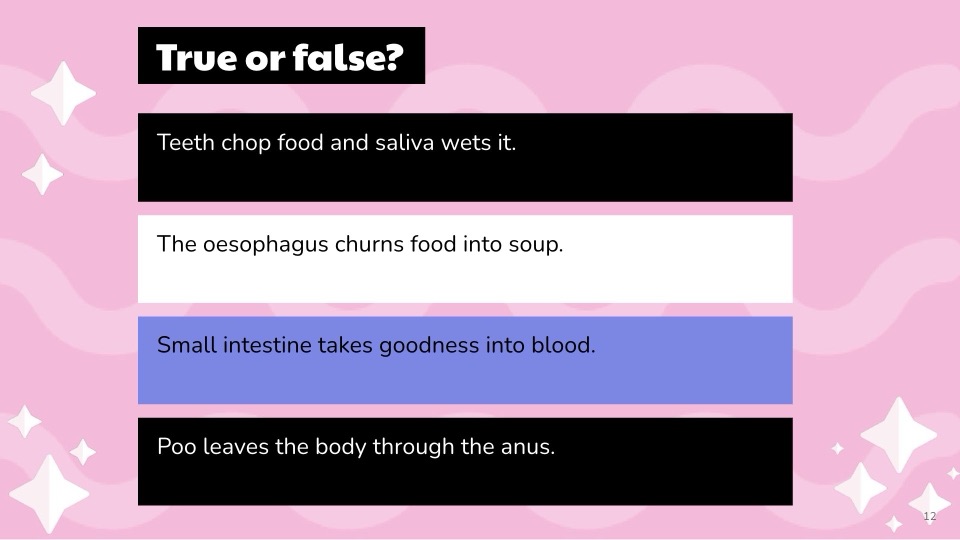
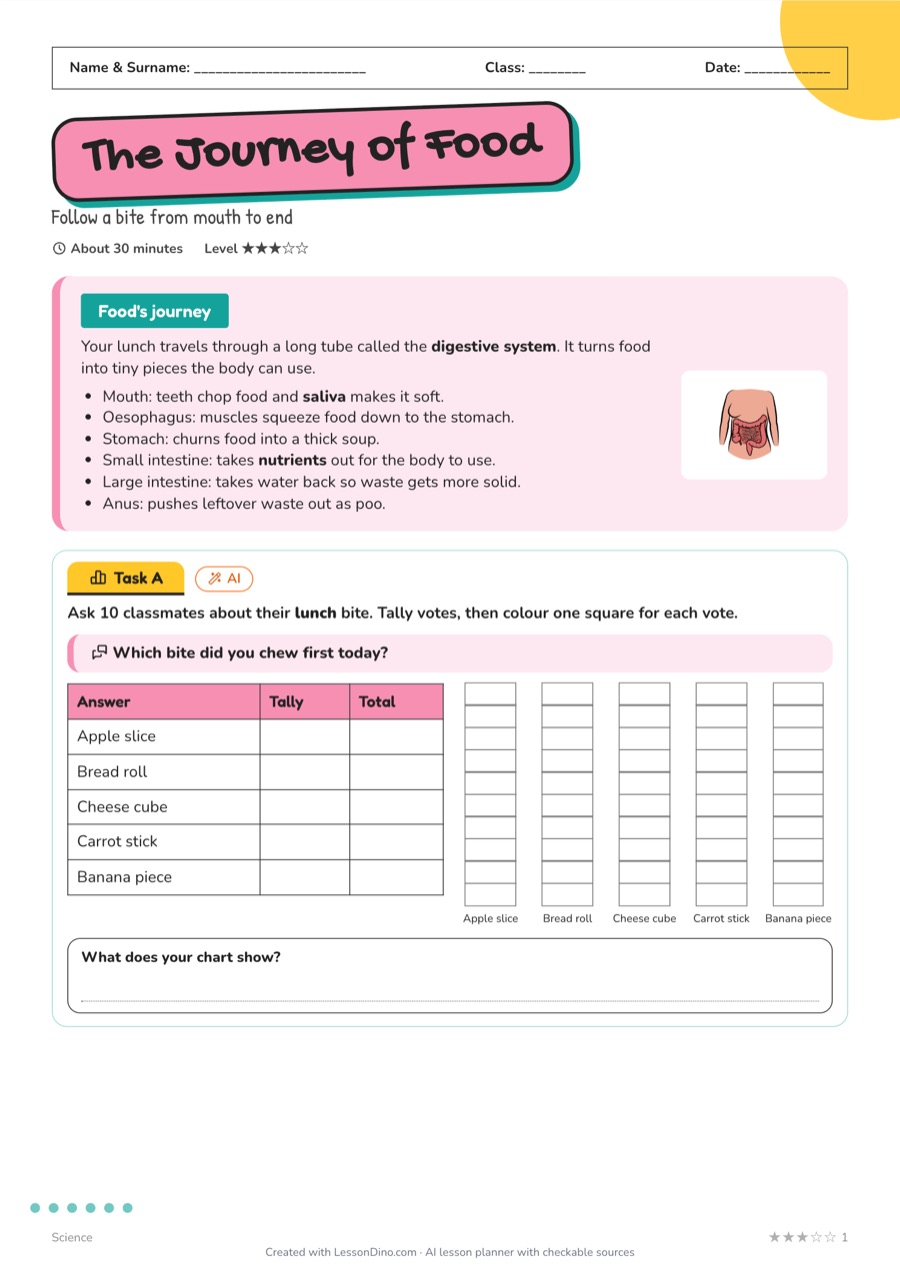
| 15 min | Plenary | To check part jobs and explain why food must become tiny bits. Show Slide 10 key words and read each job together. Lead Slide 11 think, pair, share about why food must become tiny bits. Give out Worksheet Task G and let pupils fill each missing job in a few words. Finish with Slide 12 true or false, asking pupils to stand for true, sit for false. |
Common mistakes
- Food just falls down to the stomach by gravity.
How to spot it: Pupils point straight down and say it drops.
Remind them you can swallow upside down; waves of muscle squeezes called peristalsis force food down the oesophagus to the stomach. Practise the squeeze move. - Mixing up oesophagus and stomach jobs.
How to spot it: Pupils say the oesophagus churns food into soup.
Contrast tube that squeezes with bag that churns; oesophagus squeezes food down, stomach churns and intestines break food down. - Thinking all food becomes poo.
How to spot it: Pupils say everything eaten leaves as waste.
Sort goodness and waste: nutrients give cells energy and are absorbed, only waste parts leave as faeces through the anus.
Support
- Use role cards with pictures and one sentence to read aloud.
- Keep Slide 4 chain and Slide 10 key words visible for ordering.
Stretch
- Run the human chain faster without cards in the correct order.
- Explain where absorbed goodness goes to help running, thinking and keeping warm.
Check questions
- List the basic parts in order from mouth to anus.
Answer: Mouth, oesophagus, stomach, small intestine, large intestine, anus. - What do the mouth and oesophagus each do?
Answer: Mouth chops and wets food; oesophagus squeezes food to the stomach. - What do the stomach and intestines do?
Answer: Stomach churns food to soup; small intestine takes goodness to blood, large intestine dries leftovers into poo.
Curriculum
describe the simple functions of the basic parts of the digestive system in humans
Video clips
Clips on YouTube, from the start and end times we chose. Check each one before you show it.
-
KS2 digestive system overview from 0:00 to 2:55
Explore Planet English: The Digestive System | KS2 Science | STEM and Beyond
Made for UK KS2 and exactly matches Year 4 vocabulary and pace for basic parts and jobs.
-
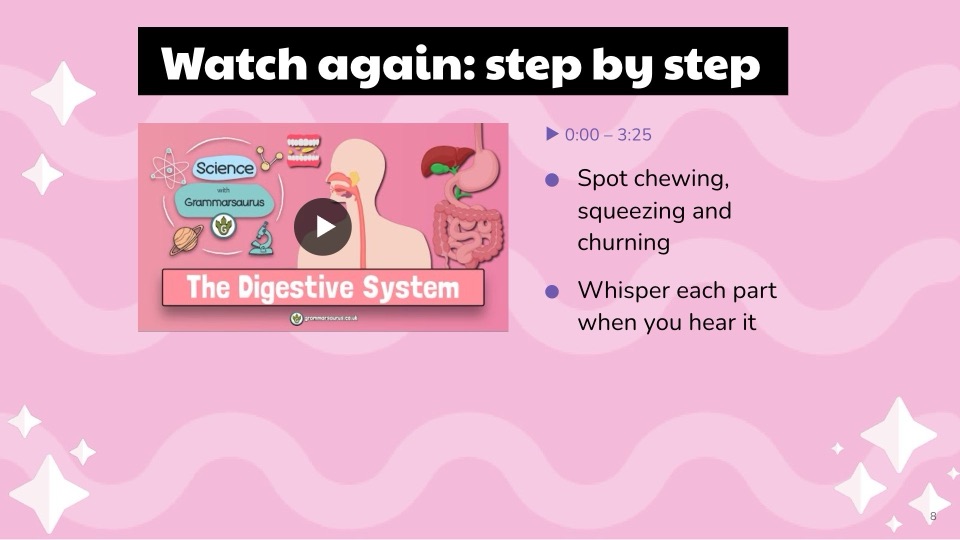
Simple parts and jobs from 0:00 to 3:25
Grammarsaurus: Science with Grammarsaurus - The Digestive System
Made for UK primary Year 4 style with clear, simple language about what each part does.
Worksheet
Sources
- Science Curriculum Year 4 queenshill.norfolk.sch.uk
- The digestive System | Staff | Imperial College London imperial.ac.uk
- Digestive System (for Teens) - Barbara Bush Children's Hospital kidshealth.org
- digestive system reference guide difedu-cf835.firebaseapp.com
- Digestive system - CreationWiki, the encyclopedia of creation sc… creationwiki.org
Picture credits
Made with Lesson Dino's AI on 17 October 2026. AI can make mistakes, so check facts against the sources before you teach.