Slides
Lesson plan
Solid, Liquid or Gas? Sorting Materials
Pupils learn how to tell solids, liquids and gases apart. They run, sort and explain which hoop each material belongs in.
Objectives
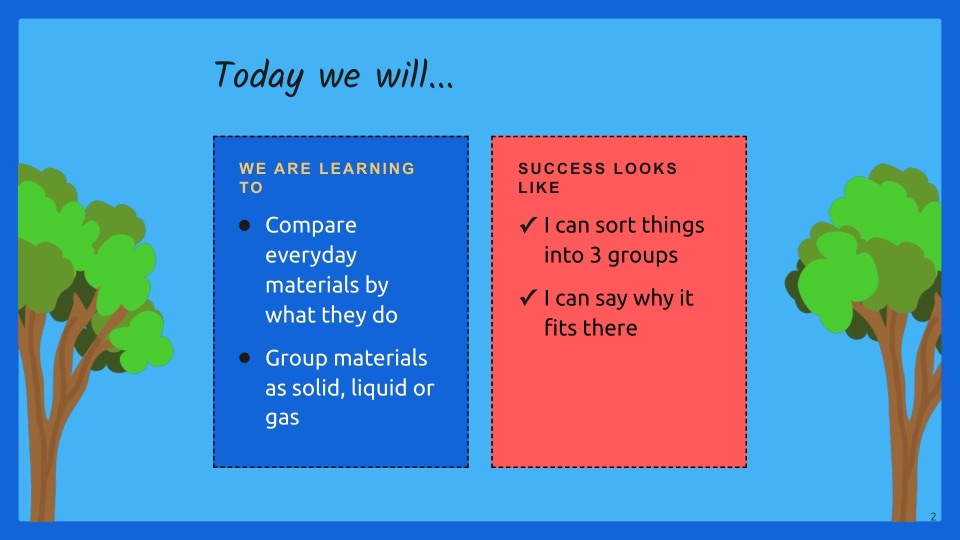
- Students will compare everyday materials by shape, flow and spreading out.
- Students will group materials as solids, liquids or gases with reasons.
Success criteria
- I can sort things into solid, liquid and gas groups.
- I can say why a material fits in its group.
Key words
| Word | Meaning |
|---|---|
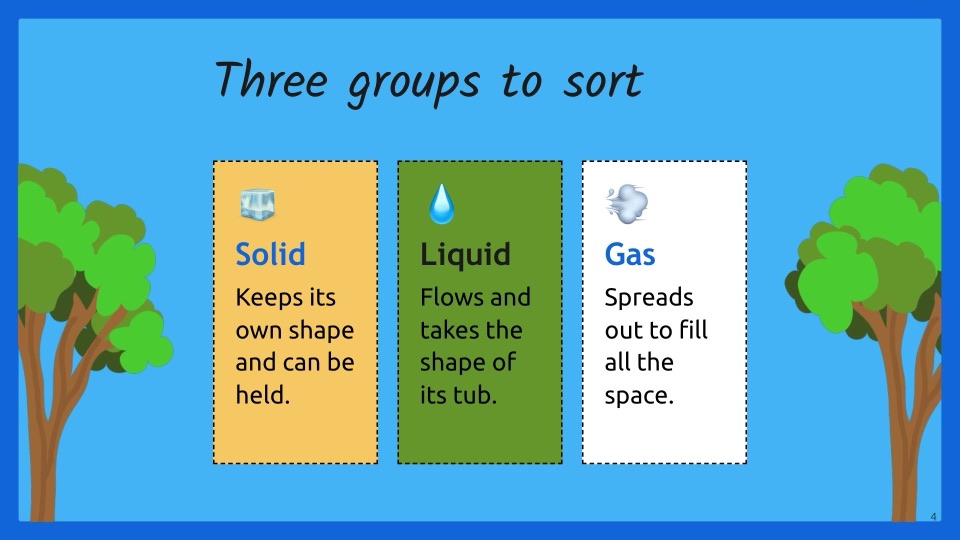
| solid | something that keeps its own shape and can be picked up and held |
| liquid | something that flows and takes the shape of its tub or cup |
| gas | something that spreads out to fill all the space around it |
| container | a tub, bottle or other holder that keeps things inside |
Timed plan (60 minutes)
| Time | Stage | What happens |
|---|---|---|
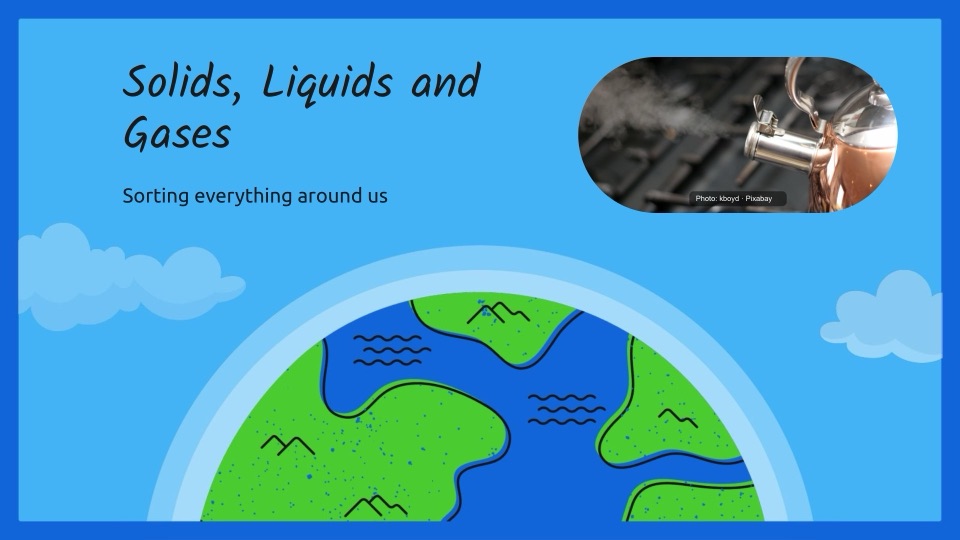
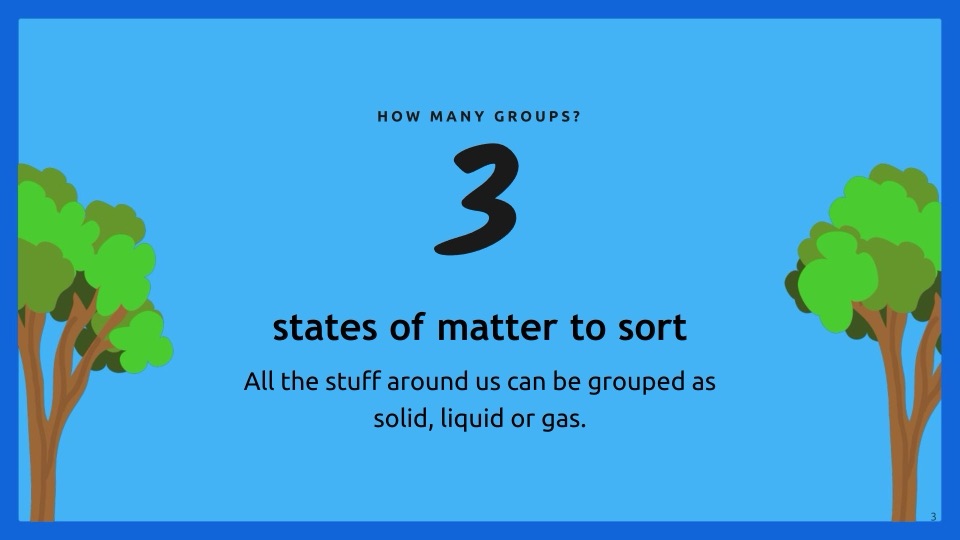
| 8 min | Starter | To hook pupils and set up the sorting goal for solids, liquids and gases. Welcome the class and show Slide 1 Solids, Liquids and Gases, then Slide 2 Today we will. Say the hook and get a physical vote: ask pupils to stand still like a thud for solid or wobble like a splish for liquid. Show Slide 3 and explain that all the stuff around us can be grouped as solid, liquid or gas. Share the two I can statements and keep them on the board. |
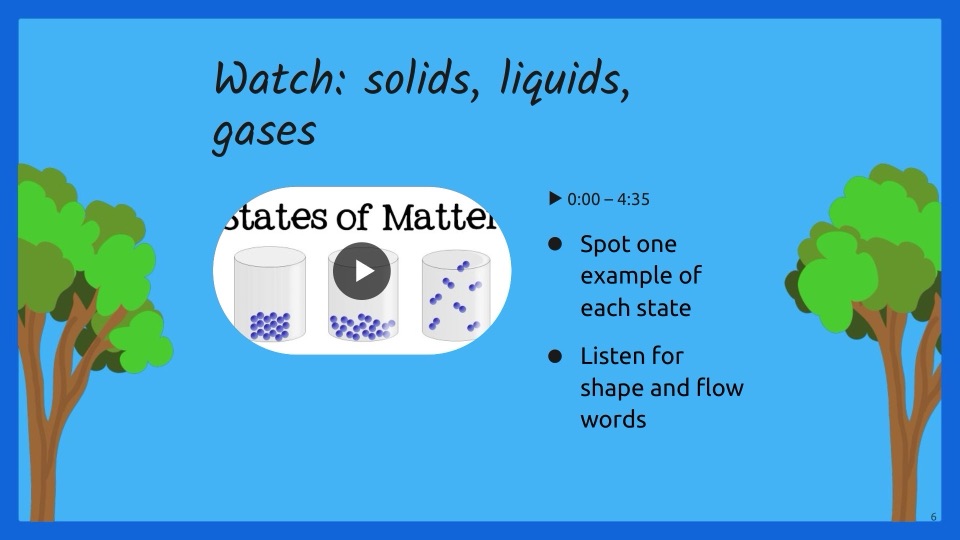
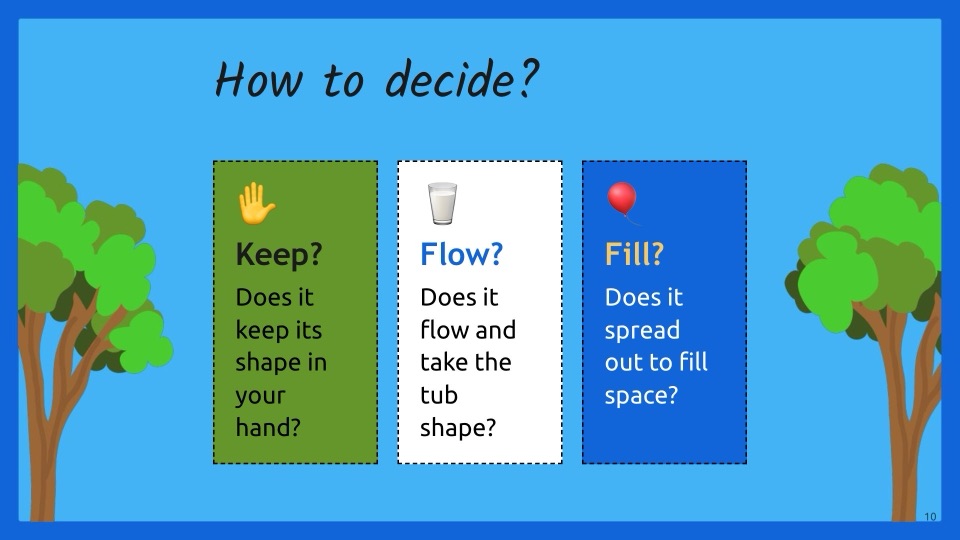
| 12 min | Teaching | To explain the keep shape, flow and fill tests for each state. Show Slide 4 Three groups to sort and model each test with a real thing. Play Video clip 1 on Slide 6 from 0:00-4:35 and ask pupils to spot one example of each state. Pause to recap: solids stay in one place and can be held and keep their shape and do not spread out like gases. Recap liquids and gases: liquids can flow or be poured easily and change their shape depending on the container they are in, gases spread out and change their shape and volume to fill up whatever container they are in. |
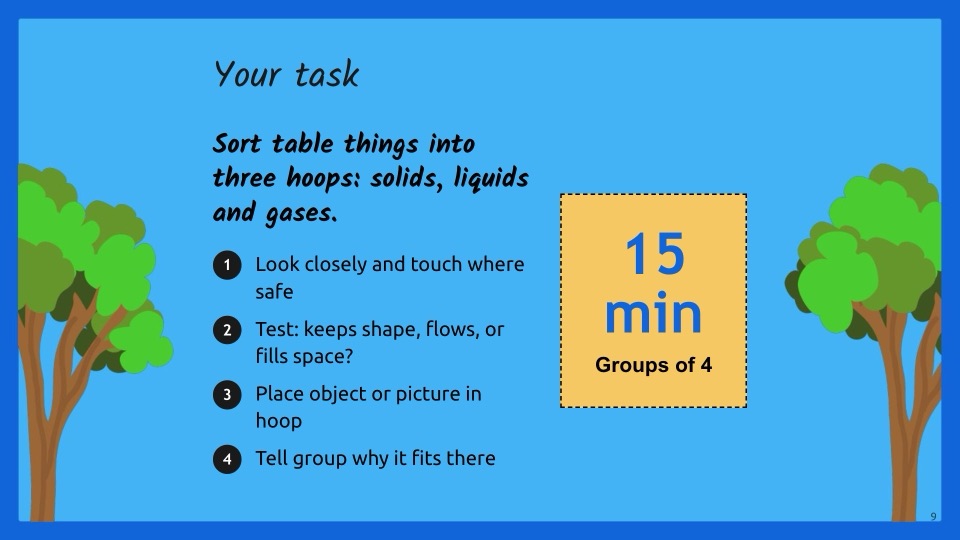
| 20 min | Main activity | To compare and group everyday materials as solids, liquids or gases. Set out 3 hoops with labels and show Slide 9 Your task and Slide 10 How to decide. Hold up cards one at a time, easy ones then tricky ones, and send groups to the matching hoop. Ask each group to say why they chose that hoop, using keep shape, flow or spread out ideas. Remind them that solids keep their shape and do not spread out like gases and liquids change shape but still take up the same amount of space. |
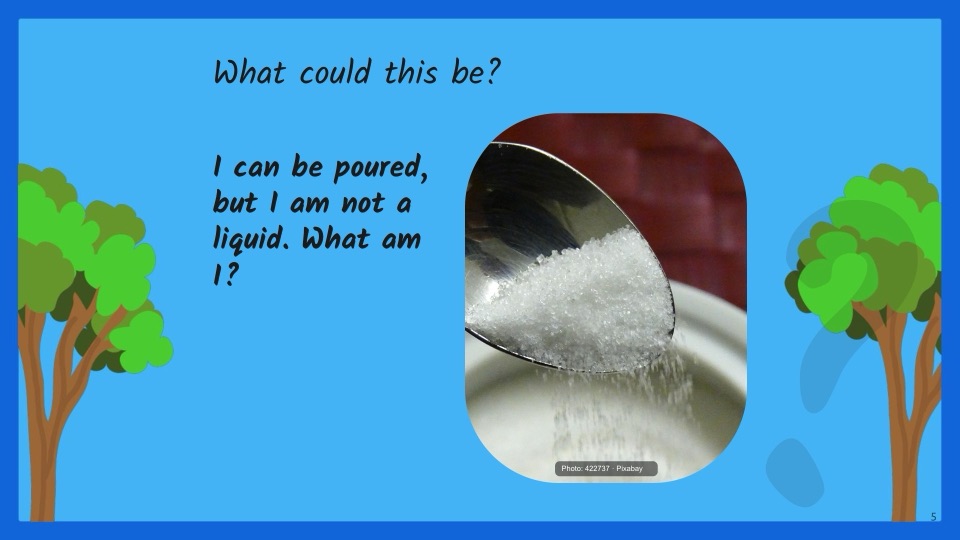
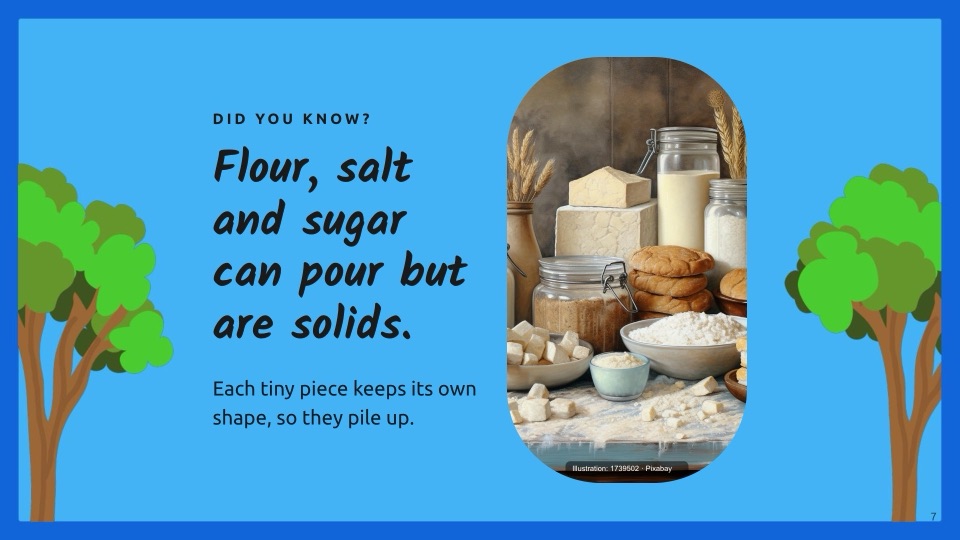
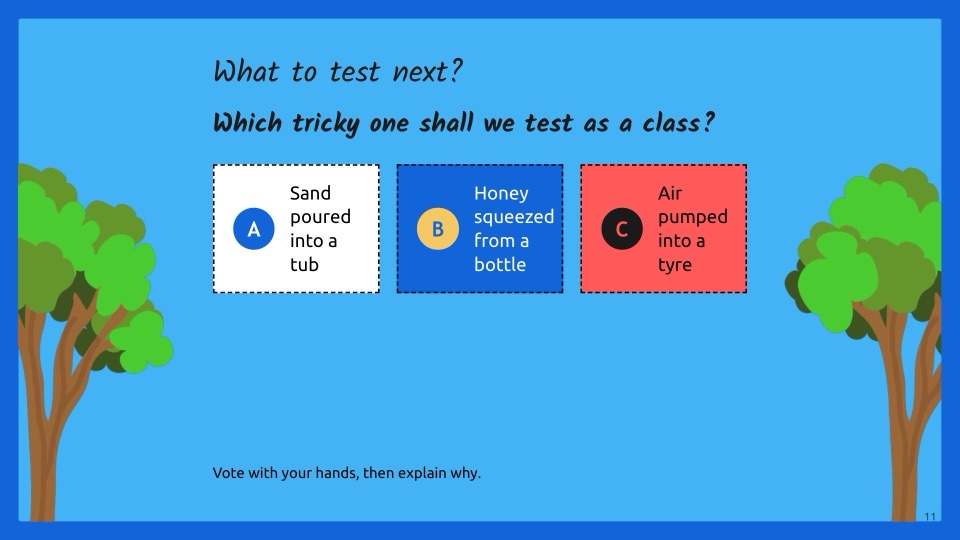
| 10 min | Tricky sort | To explain why powders that pour are still grouped as solids. Show Slide 5 mystery: I can be poured, but I am not a liquid. What am I? Reveal the answer and show Slide 7 that flour, salt and sugar can pour but are solids. Explain that solids hold their shape and liquids form a pool not a pile, and each particle of salt keeps the same shape and volume. Hand out Worksheet Task E and ask pairs to place each material on the line from keeps its shape to spreads out. |
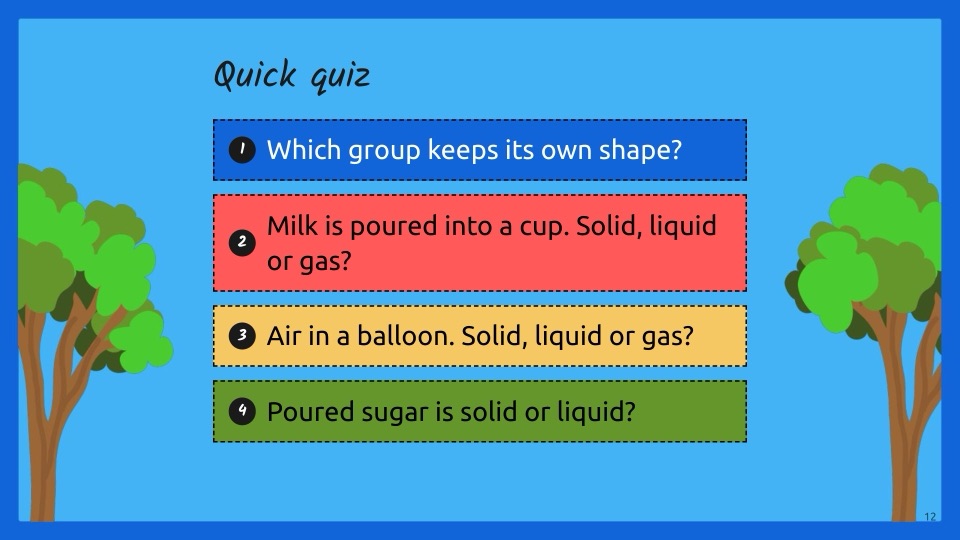
| 10 min | Plenary | To check pupils can sort and explain solids, liquids and gases. Show Slide 12 Quick quiz and read each question aloud. Ask pupils to answer on mini whiteboards and hold up together. Go through answers using the keep, flow, fill tests and link back to the I can statements. |
Common mistakes
- Thinking anything that can be poured is a liquid, such as sugar, salt, flour or sand.
How to spot it: Pupil puts powder card in liquid hoop or calls a pile a pool.
Compare pile and pool: solids hold their shape and liquids form a pool not a pile. Show that even though they can be poured, sugar, salt and flour are all solids and each grain keeps shape. - Thinking gases are nothing because they cannot be seen.
How to spot it: Pupil says classroom air or balloon air is not a group or leaves gas hoop empty.
Feel air escaping and show it fills and takes the balloon shape. Stress that gases spread out and change shape and volume to fill the container and escape from an unsealed container. - Mixing up shape change and amount of space for liquids.
How to spot it: Pupil says water in a tall beaker is more water than in a wide dish.
Pour 200 ml between tubs to show level changes but amount stays. Repeat that even when liquids change shape, they always take up the same amount of space, as do solids.
Support
- Use picture cards with tick list tests and word bank pile, pool, flow, keep shape.
- Work in mixed pairs so pupils hear reasons aloud before running to hoops.
Stretch
- Add sugar, salt, flour and sand cards to defend as solids that pour.
- Challenge pupils to add two classroom examples per hoop and explain the test used.
Check questions
- Which group keeps its own shape and can be held?
Answer: Solids. - Juice is poured into a beaker and takes the beaker shape. Which group?
Answer: Liquid, because it flows and takes the shape of its container. - Sugar is poured from a spoon and makes a pile. Solid, liquid or gas, and why?
Answer: Solid, because each grain keeps its shape and it piles, not a pool.
Curriculum
compare and group materials together, according to whether they are solids, liquids or gases
Video clips
Clips on YouTube, from the start and end times we chose. Check each one before you show it.
-
Three states explained from 0:00 to 4:35
Free School: 3 States of Matter for Kids (Solid, Liquid, Gas): Science for Children - FreeSchool
Explains solid, liquid and gas with everyday examples using vocabulary and pace ideal for 8-9-year-olds.
-
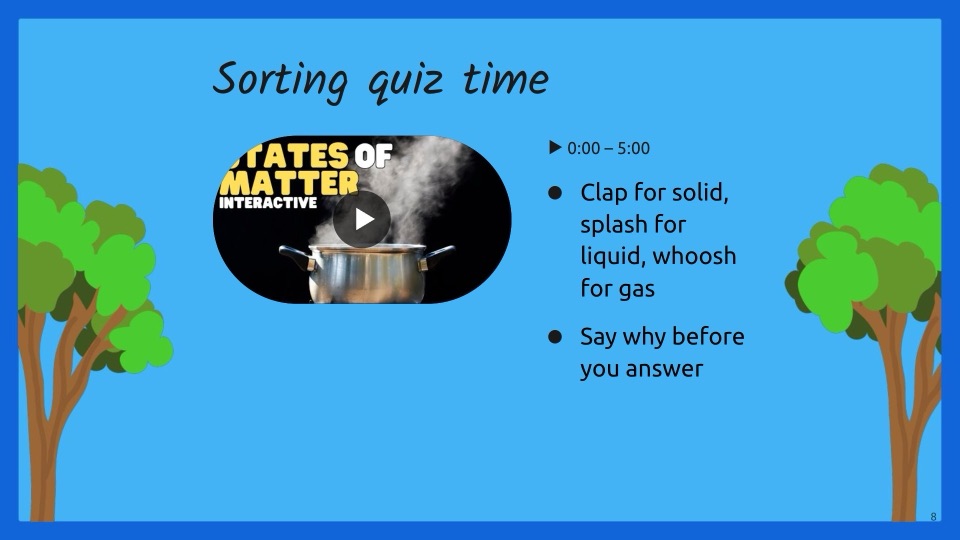
Interactive states quiz from 0:00 to 5:00
Learn Bright: States of Matter | Interactive | Learn about solids, liquids, and gases
Interactive sorting style is perfect for 8-9-year-olds to practise comparing and grouping solids, liquids and gases.
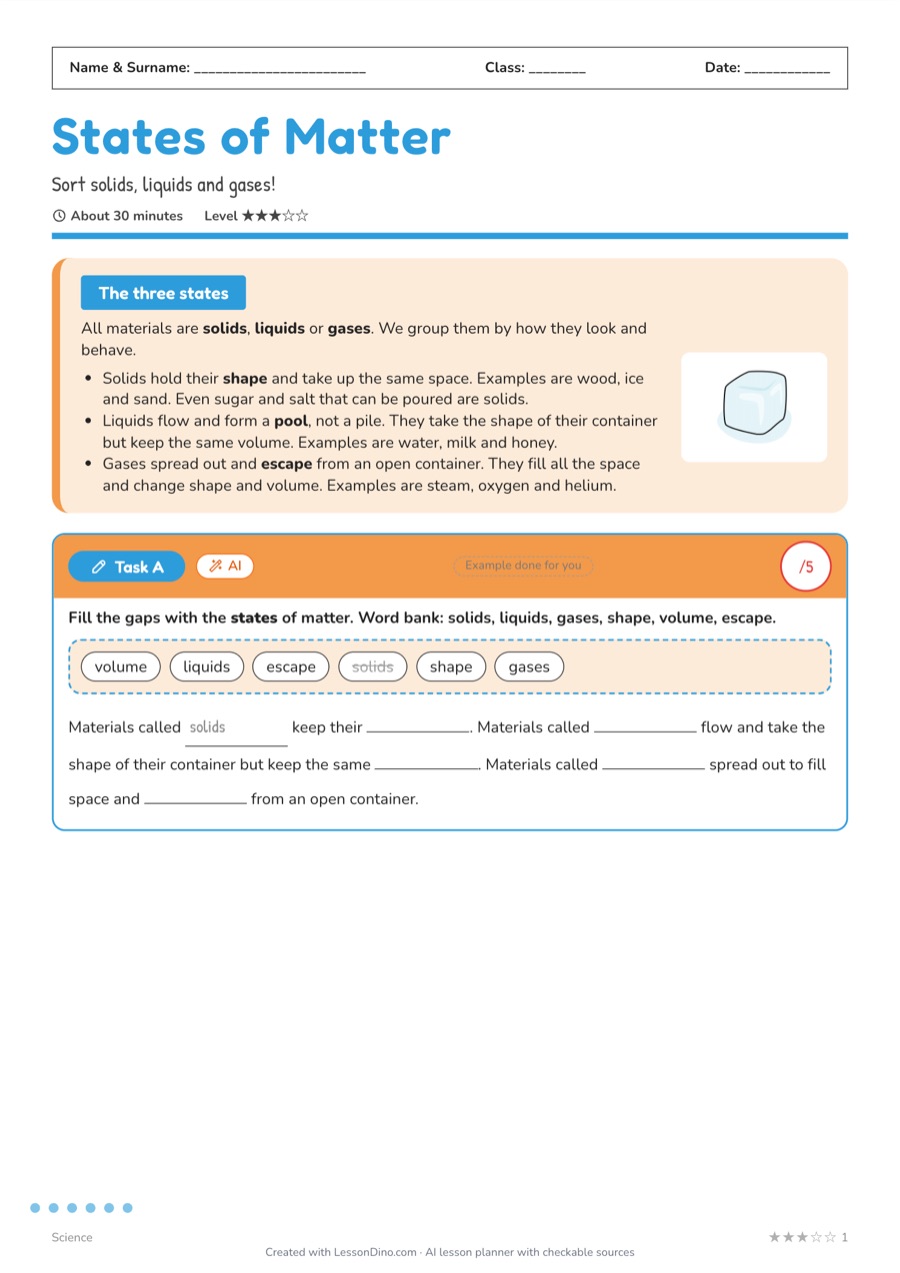
Worksheet
Sources
- Science programmes of study: key stages 1 and 2 - GOV.UK assets.publishing.service.gov.uk
- Science Curriculum Year 4 queenshill.norfolk.sch.uk
- What are the states of matter? - BBC Bitesize bbc.co.uk
- Solids, liquids and gases - The three states of matter - AQA ... bbc.co.uk
- States of matter - Creative Chemistry creative-chemistry.org.uk
- States of Matter | GCSE Chemistry Revision | KS4 revisescience.org.uk
- pdf eli10.co.uk
- State of matter Facts for Kids kids.kiddle.co
- States of matter - KS2 Science - BBC Bitesize bbc.co.uk
- matter: states of matter - Kids | Britannica Kids | Homework Help kids.britannica.com
- matter - Kids | Britannica Kids | Homework Help kids.britannica.com
- [1710.02304] Exotic states of matter with polariton chains arxiv.org
- Chem4Kids.com: Matter: States of Matter web.archive.org
- States of Matter: Solids, Liquids, and Gases for Kids whatihavelearnedteaching.com
- State of Matter For KIds - 3 States of Matter Solid Liquid Gas smartclass4kids.com
- States of Matter Explained for Kids: Story, Facts ... mystorypie.com
- States of Matter for Kids (Free Worksheets & Easy Experiments) littlebinsforlittlehands.com
- States of Matter Explained for Kids | Solid, Liquid, Gas welearnscience.com
- States of Matter for Kids | Changing States | Facts About ... k8schoollessons.com
- New State of Matter Discovered: Both Solid and Liquid at Once! - Glass Almanac glassalmanac.com
- Scientists at University of Edinburgh discovers chain-melted state of matter – GKToday gktoday.in
- States of Matter - ABCya! abcya.com
- States of Matter Lesson | Science4Us - ExploreLearning science4us.explorelearning.com
Picture credits
- Photo: kboyd · Pixabay
- Photo: 422737 · Pixabay
- Illustration: 1739502 · Pixabay
- Pictograms: Sergio Palao, ARASAAC (arasaac.org) · CC BY-NC-SA
- Drawing: Delapouite · CC BY 3.0 · Wikimedia Commons
Made with Lesson Dino's AI on 17 October 2026. AI can make mistakes, so check facts against the sources before you teach.