The worksheet
About this worksheet
Pupils learn to recall 3, 4 and 8 facts and use them for division. They build arrays, double 4s to make 8s and explain fact families. This Year 3 Maths worksheet gives students (ages 7–8) six pages of practice on the 3, 4 and 8 times tables, part of the multiplication and division unit. It goes with our free The 3, 4 and 8 times tables lesson, which has the slides and a timed lesson plan.
What it covers
By the end, students should be able to:
- Students will recall multiplication facts for the 3, 4 and 8 tables quickly.
- Students will double 4 times-table facts to recall matching 8 times-table facts.
- Students will use known multiplication facts to solve matching division facts.
How to use it
- Practice (12 minutes): Hand out Worksheet Task C Practice questions: Solve these facts. Use doubling from 4 to 8 to help.
- Support: Keep one array made from counters in view so pupils can see the rows as divisions, since arrays show groups or rows of objects for multiplication.
- Stretch: Ask pupils to spot and explain a second fact family that gives the same answer.
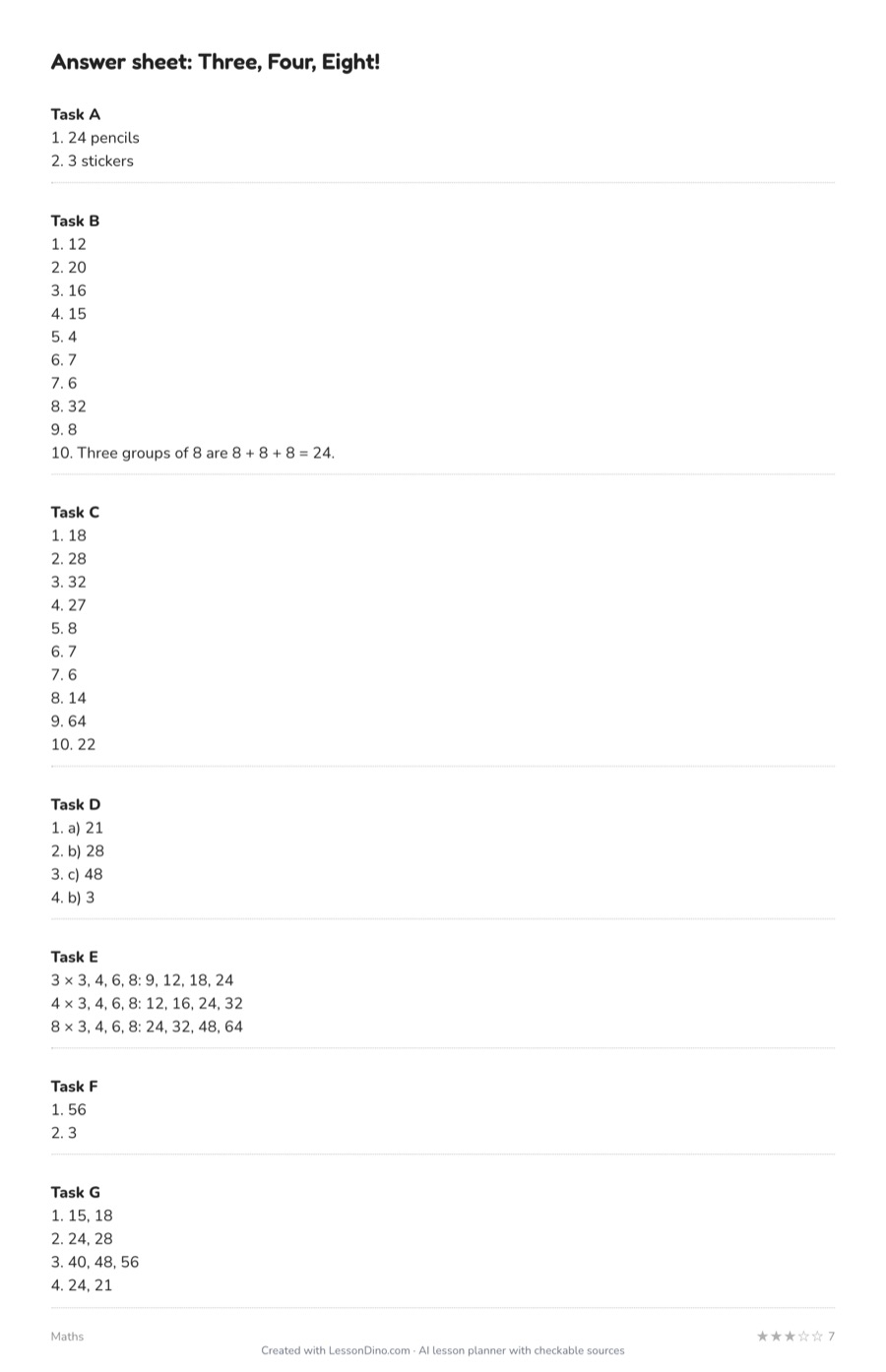
- The answer sheet is the last page, so you can print it on its own or let students check their own work.
Key vocabulary
- multiplication: joining equal groups to find how many there are altogether
- division: splitting a total into equal groups to find how many in each group
- array: rows and columns of objects that show equal groups
- multiple: a number you say when you count in equal steps, like 12, 16, 20 in fours
- double: to add a number to itself to make twice as many
Mistakes to watch for
- Saying 8 x 6 = 24, mixing the 4s and 8s answers. Rebuild 4 x 6 = 24 then double to 48, stressing 8s products are double 4s products.
- Treating division as separate from multiplication. Split the 8 by 4 array into rows to show 32 ÷ 8 = 4 and 32 ÷ 4 = 8.
- Losing place when skip-counting in 3s, 4s or 8s. Mark landings on a number line with equal jumps and chant 8, 16, 24, 32, 40 aloud.
What's on the worksheet
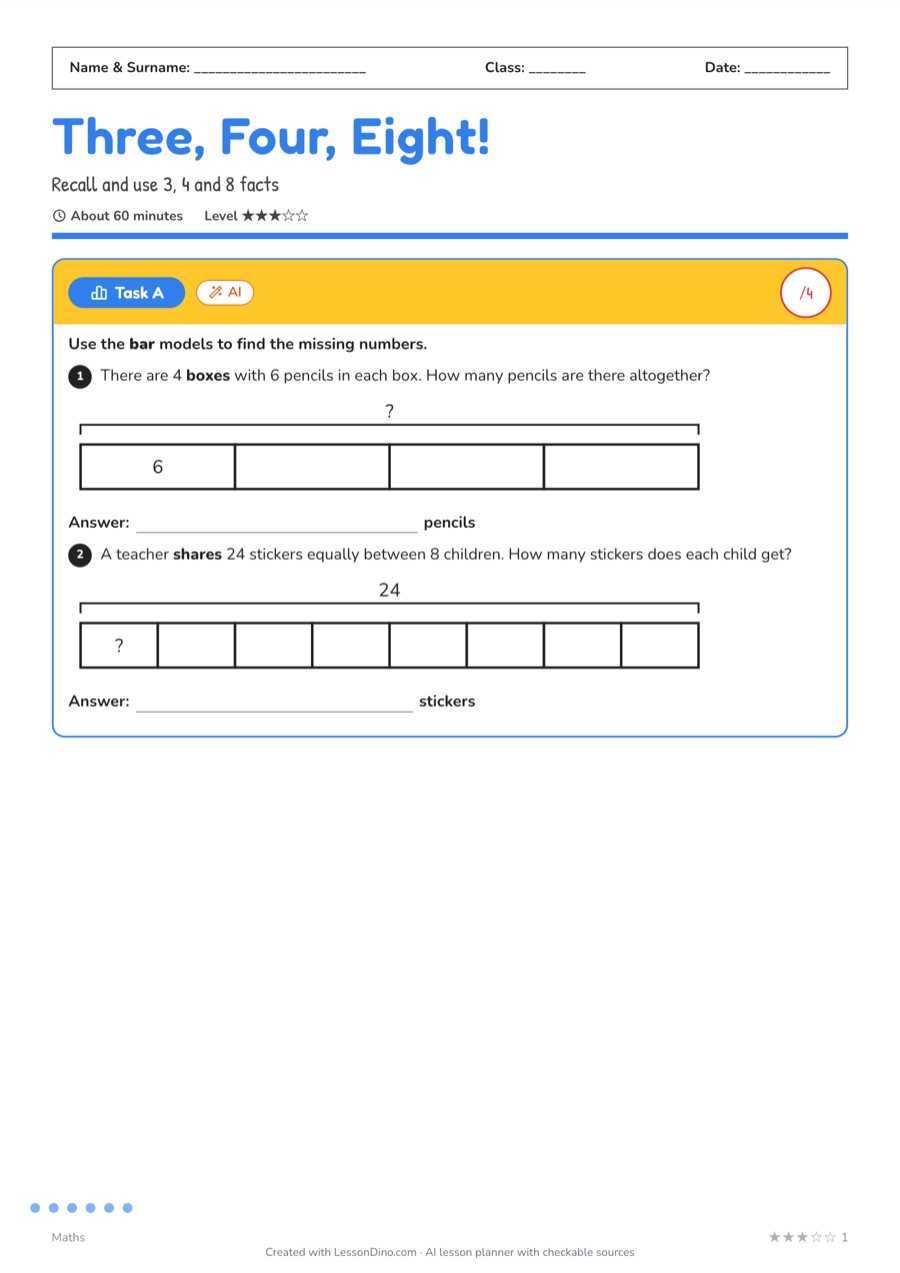
Double and Recall!
Remember 3, 4 and 8 facts and see how 4 and 8 link.
Use the bar models to find the missing numbers.
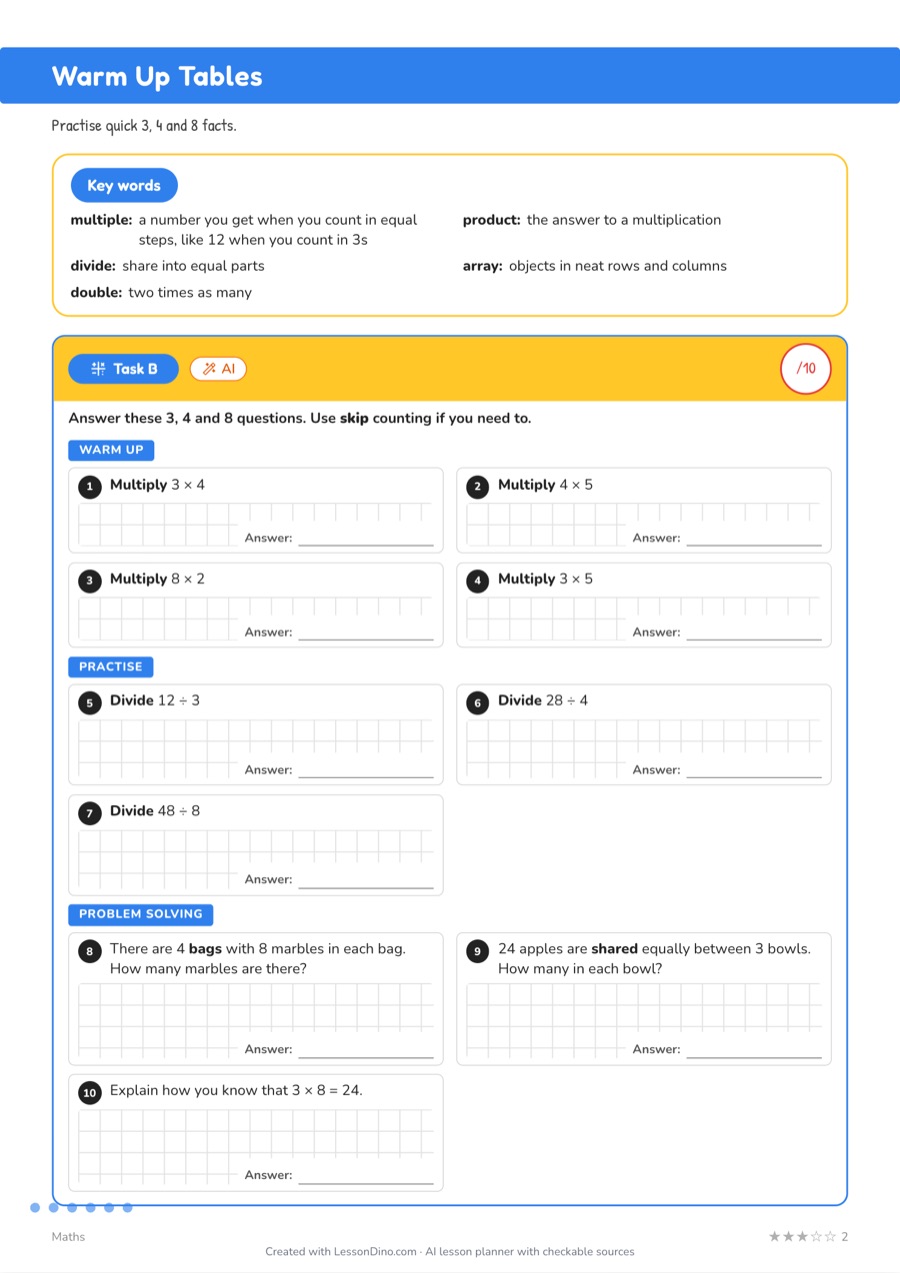
Warm Up Tables
Practise quick 3, 4 and 8 facts.
| Word | Meaning |
|---|---|
| multiple | a number you get when you count in equal steps, like 12 when you count in 3s |
| product | the answer to a multiplication |
| divide | share into equal parts |
| array | objects in neat rows and columns |
| double | two times as many |
Answer these 3, 4 and 8 questions. Use skip counting if you need to.
Warm up
- Multiply 3 × 4
- Multiply 4 × 5
- Multiply 8 × 2
- Multiply 3 × 5
Practise
- Divide 12 ÷ 3
- Divide 28 ÷ 4
- Divide 48 ÷ 8
Problem solving
- There are 4 bags with 8 marbles in each bag. How many marbles are there?
- 24 apples are shared equally between 3 bowls. How many in each bowl?
- Explain how you know that 3 × 8 = 24.
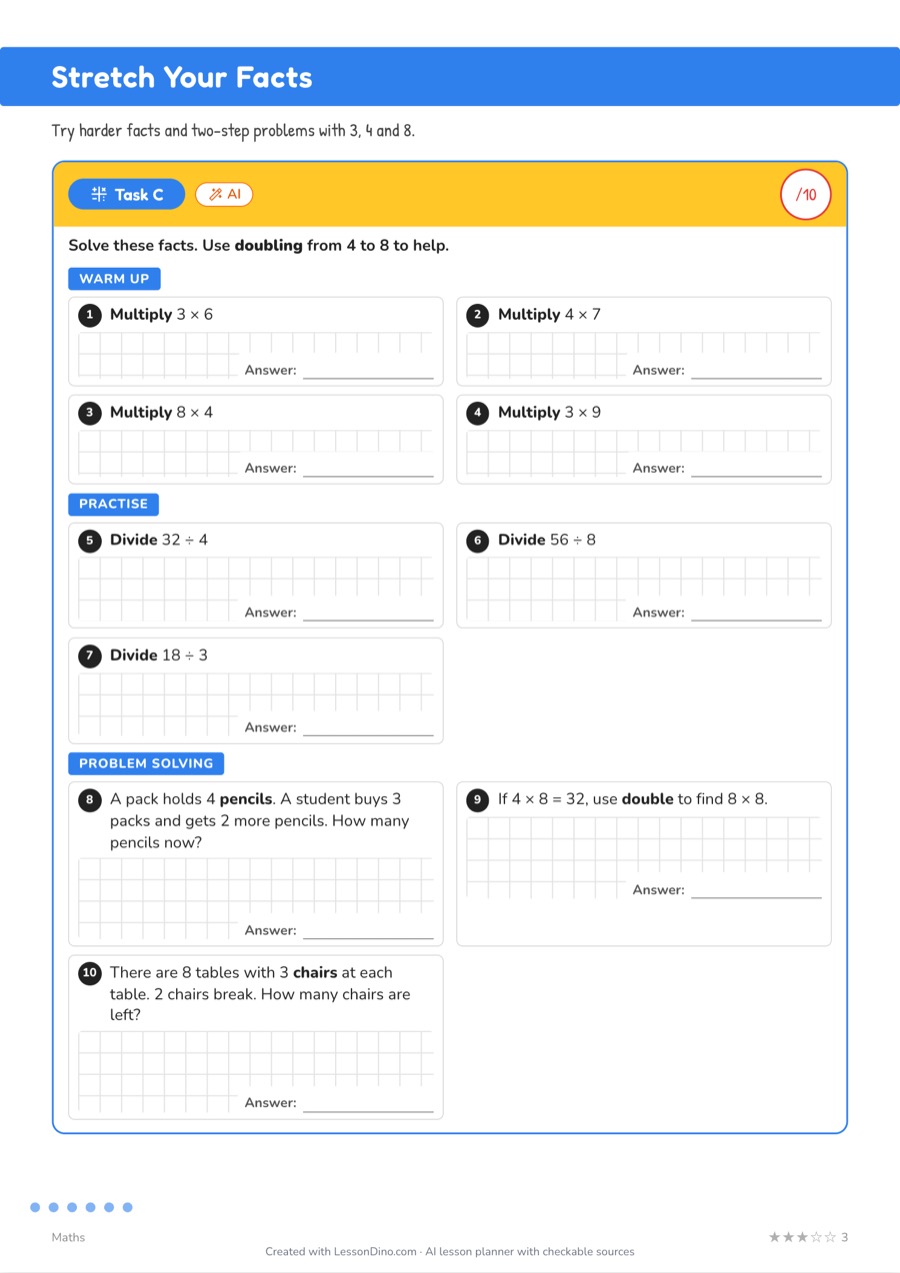
Stretch Your Facts
Try harder facts and two-step problems with 3, 4 and 8.
Solve these facts. Use doubling from 4 to 8 to help.
Warm up
- Multiply 3 × 6
- Multiply 4 × 7
- Multiply 8 × 4
- Multiply 3 × 9
Practise
- Divide 32 ÷ 4
- Divide 56 ÷ 8
- Divide 18 ÷ 3
Problem solving
- A pack holds 4 pencils. A student buys 3 packs and gets 2 more pencils. How many pencils now?
- If 4 × 8 = 32, use double to find 8 × 8.
- There are 8 tables with 3 chairs at each table. 2 chairs break. How many chairs are left?
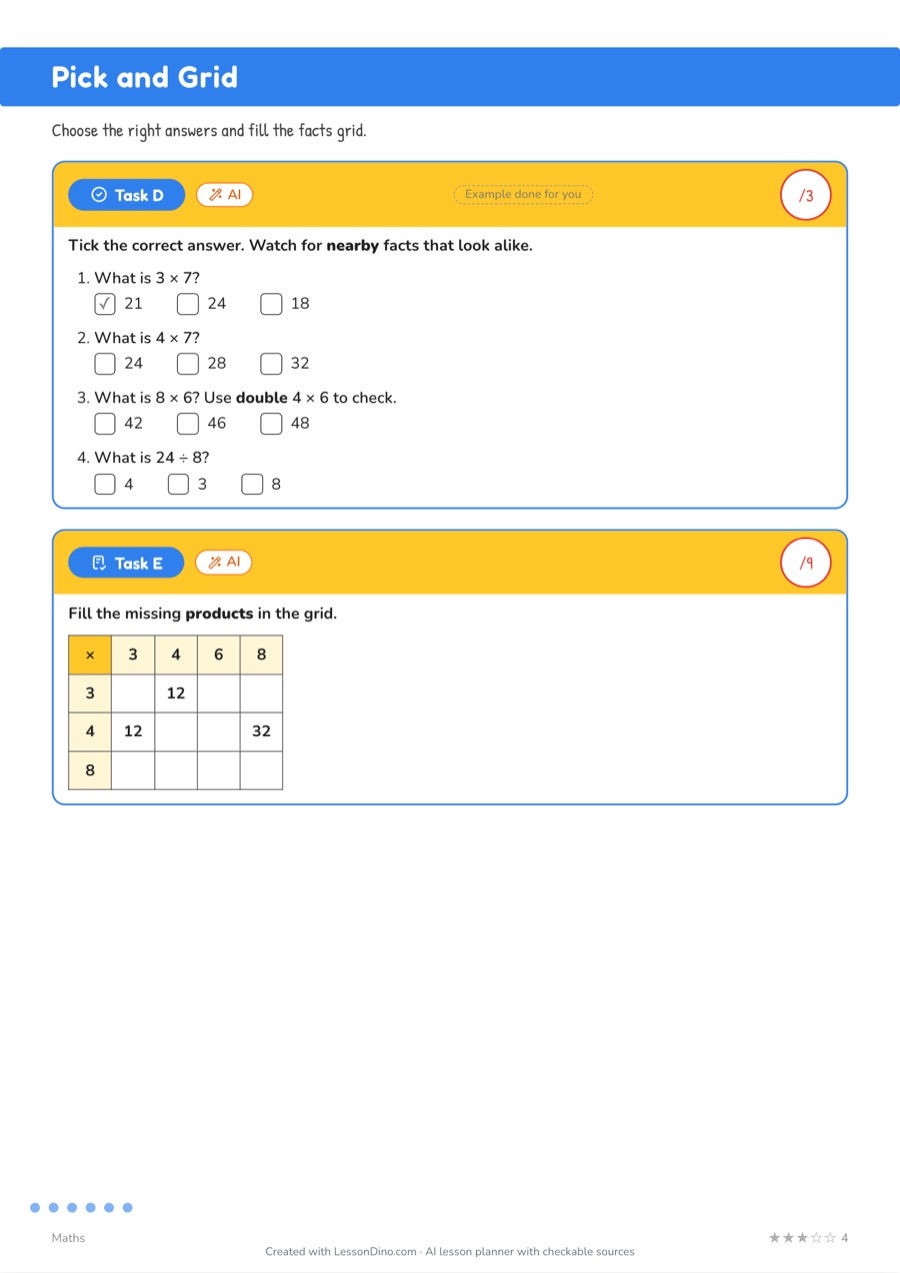
Pick and Grid
Choose the right answers and fill the facts grid.
Tick the correct answer. Watch for nearby facts that look alike.
- What is 3 × 7?
- What is 4 × 7?
- What is 8 × 6? Use double 4 × 6 to check.
- What is 24 ÷ 8?
Fill the missing products in the grid.
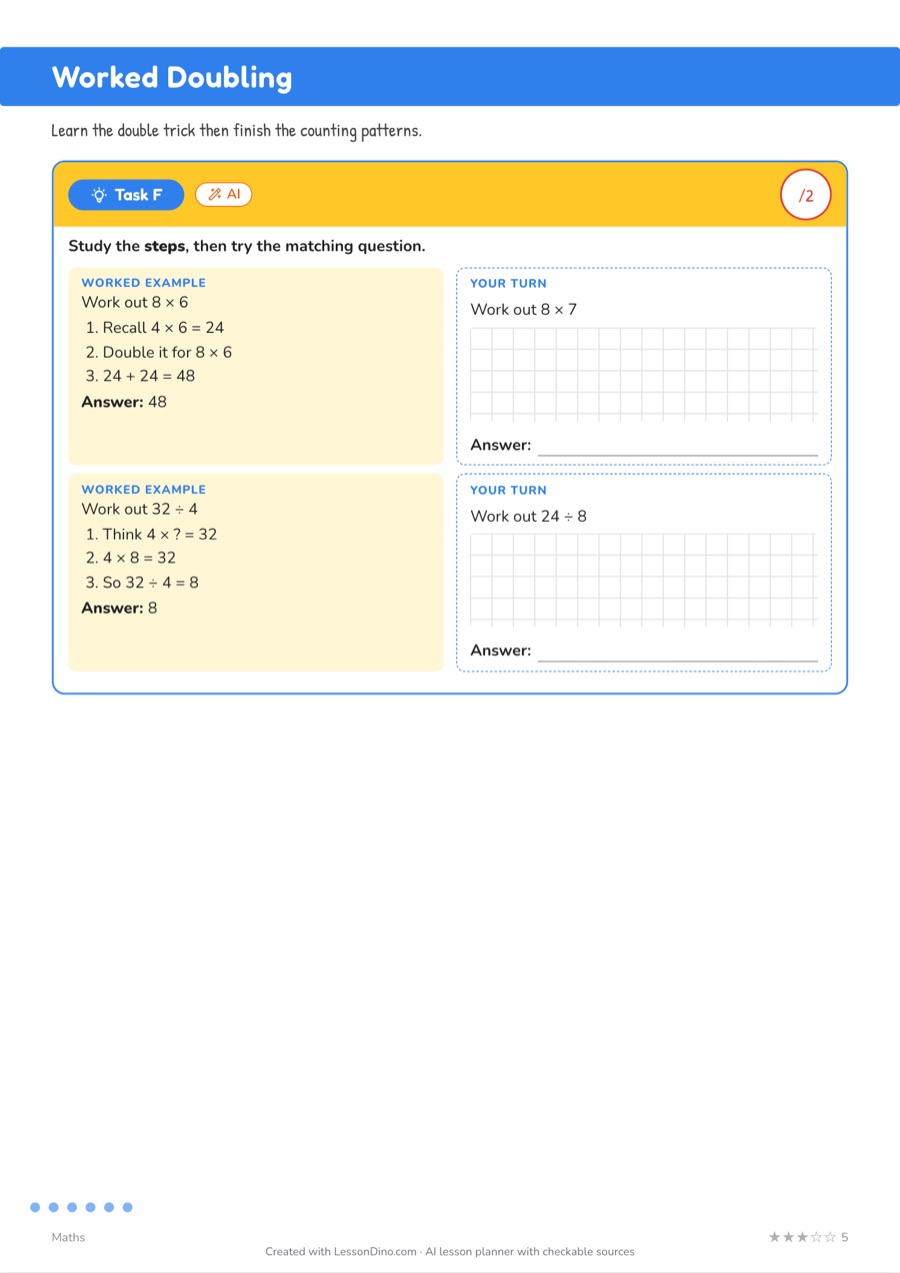
Worked Doubling
Learn the double trick then finish the counting patterns.
Study the steps, then try the matching question.
Page 6
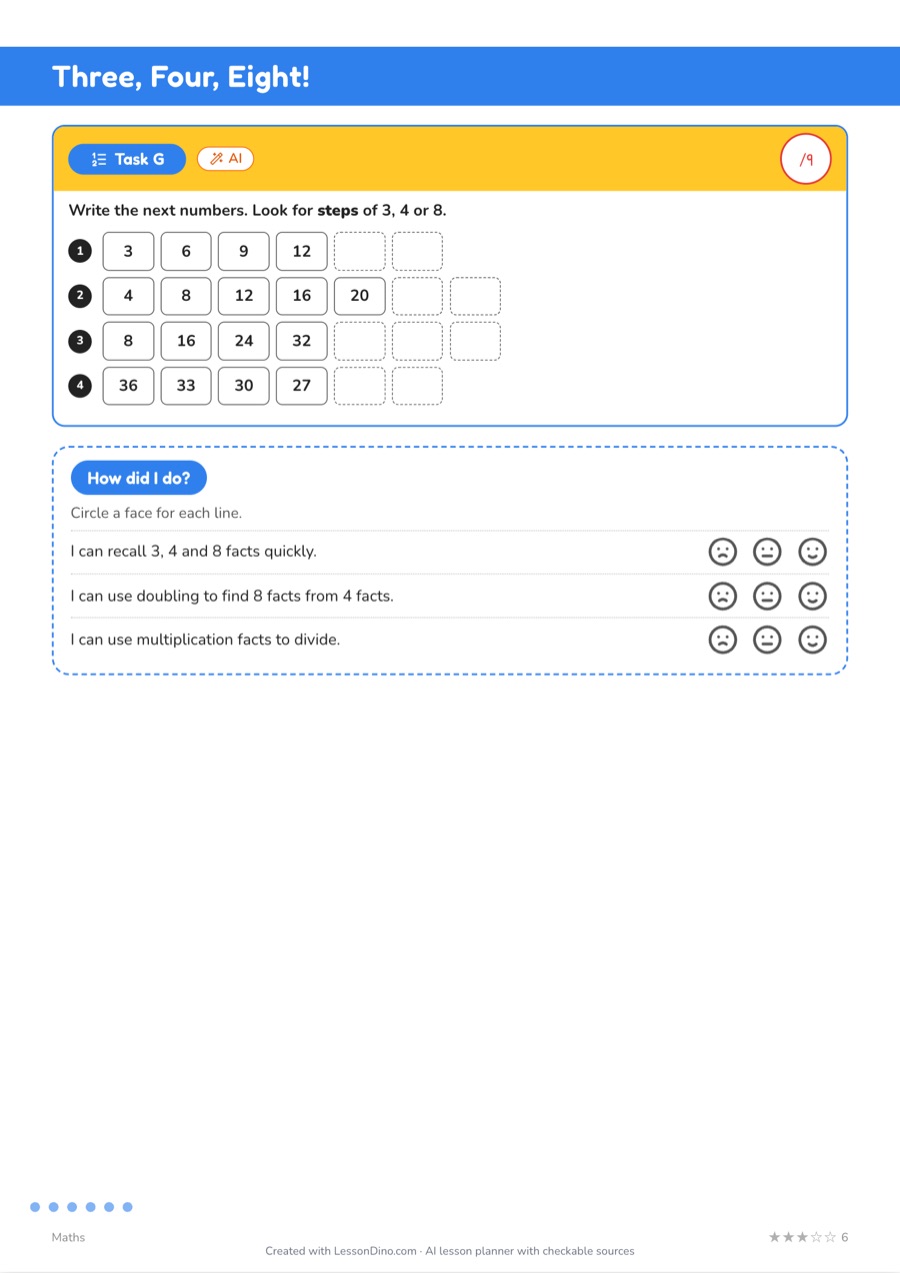
Write the next numbers. Look for steps of 3, 4 or 8.
Answers
Show the answers
- Multiply 3 × 4 12
- Multiply 4 × 5 20
- Multiply 8 × 2 16
- Multiply 3 × 5 15
- Divide 12 ÷ 3 4
- Divide 28 ÷ 4 7
- Divide 48 ÷ 8 6
- There are 4 bags with 8 marbles in each bag. How many marbles are there? 32
- 24 apples are shared equally between 3 bowls. How many in each bowl? 8
- Explain how you know that 3 × 8 = 24. Three groups of 8 are 8 + 8 + 8 = 24.
- Multiply 3 × 6 18
- Multiply 4 × 7 28
- Multiply 8 × 4 32
- Multiply 3 × 9 27
- Divide 32 ÷ 4 8
- Divide 56 ÷ 8 7
- Divide 18 ÷ 3 6
- A pack holds 4 pencils. A student buys 3 packs and gets 2 more pencils. How many pencils now? 14
- If 4 × 8 = 32, use double to find 8 × 8. 64
- There are 8 tables with 3 chairs at each table. 2 chairs break. How many chairs are left? 22
The answer sheet is the last picture above.
Curriculum
recall and use multiplication and division facts for the 3, 4 and 8 multiplication tables
Made with Lesson Dino's AI on 17 October 2026. AI can make mistakes, so check the answers and facts against the sources before you teach.