Slides
Lesson plan
Knowing 3, 4 and 8 Facts and Fact Families
Pupils learn to recall 3, 4 and 8 facts and use them for division. They build arrays, double 4s to make 8s and explain fact families.
Objectives
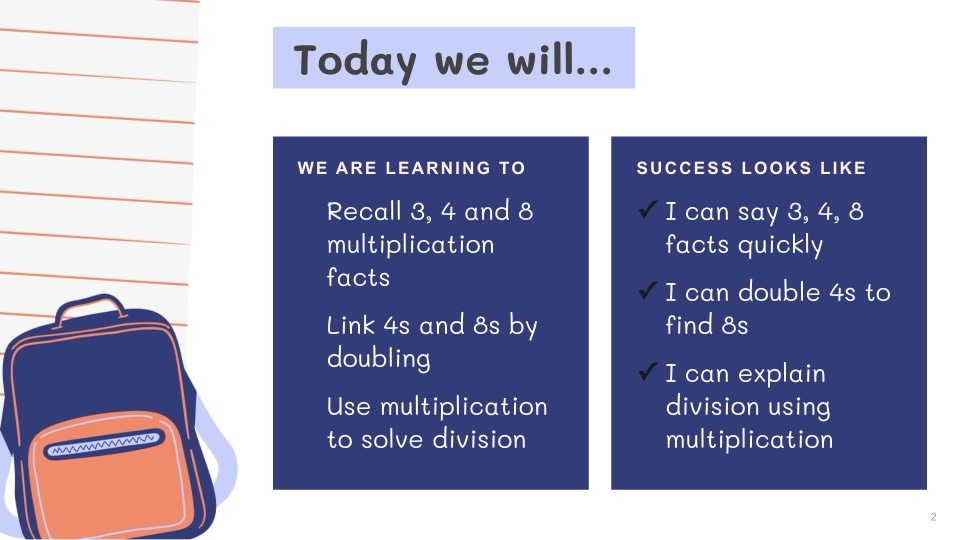
- Students will recall multiplication facts for the 3, 4 and 8 tables quickly.
- Students will double 4 times-table facts to recall matching 8 times-table facts.
- Students will use known multiplication facts to solve matching division facts.
Success criteria
- I can say 3, 4 and 8 multiplication facts quickly.
- I can double a 4s fact to find the 8s fact.
- I can explain a division fact using its multiplication fact.
Key words
| Word | Meaning |
|---|---|
| multiplication | joining equal groups to find how many there are altogether |
| division | splitting a total into equal groups to find how many in each group |
| array | rows and columns of objects that show equal groups |
| multiple | a number you say when you count in equal steps, like 12, 16, 20 in fours |
| double | to add a number to itself to make twice as many |
Timed plan (60 minutes)
| Time | Stage | What happens |
|---|---|---|
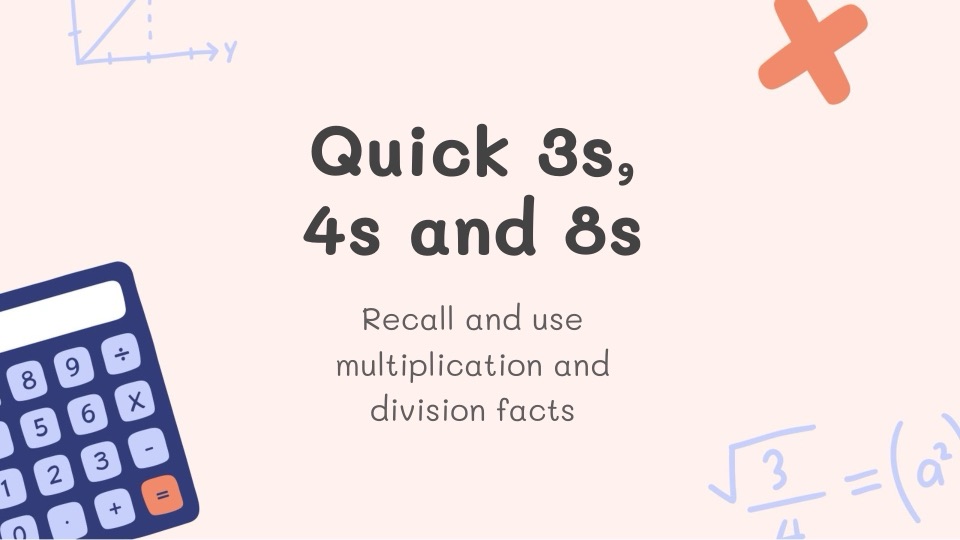
| 8 min | Starter | Brings back quick 3, 4 and 8 recall and hooks pupils with the division question. Display Slide 1 Quick 3s, 4s and 8s and Slide 2 Today we will, and read the objectives together. Lead a quick chant of first multiples: 3, 6, 9, 12 and 4, 8, 12, 16 with claps. Pose the hook: If you know the multiplication, do you already know the division? Take quick hands-up answers for 3 x 4 = 12 and ask how a partner could prove it. |
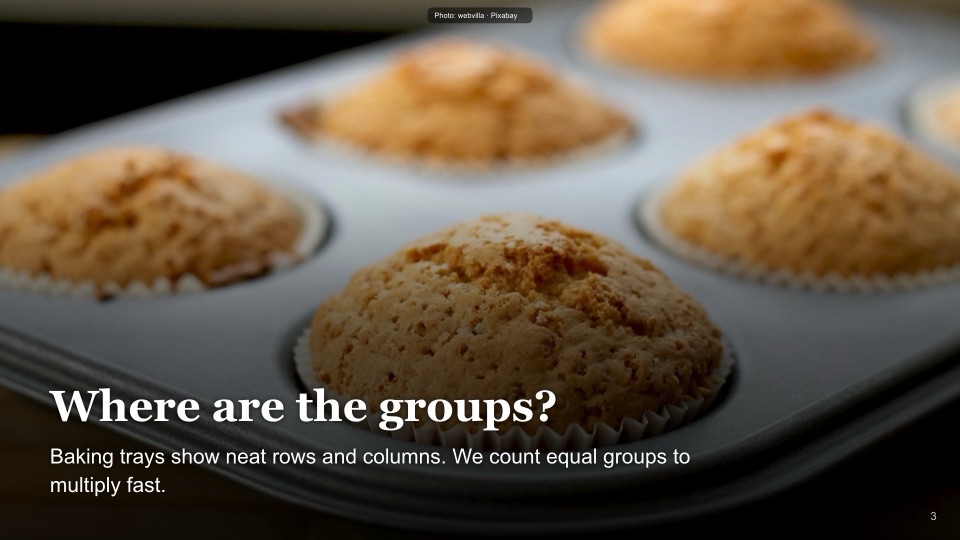
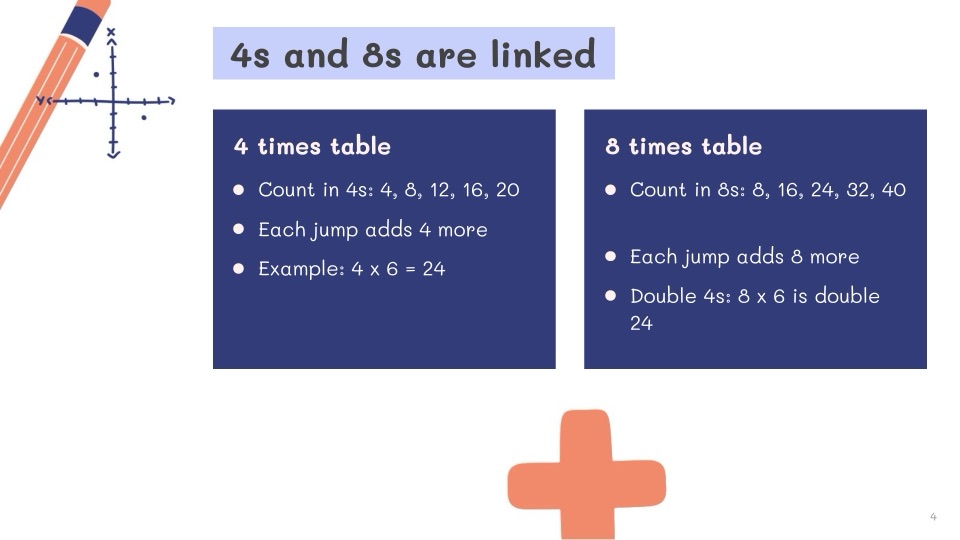
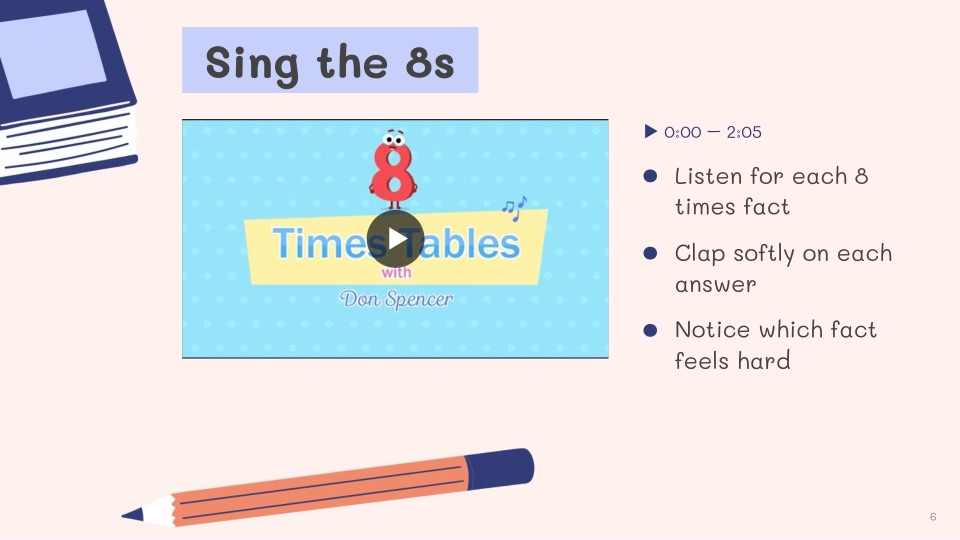
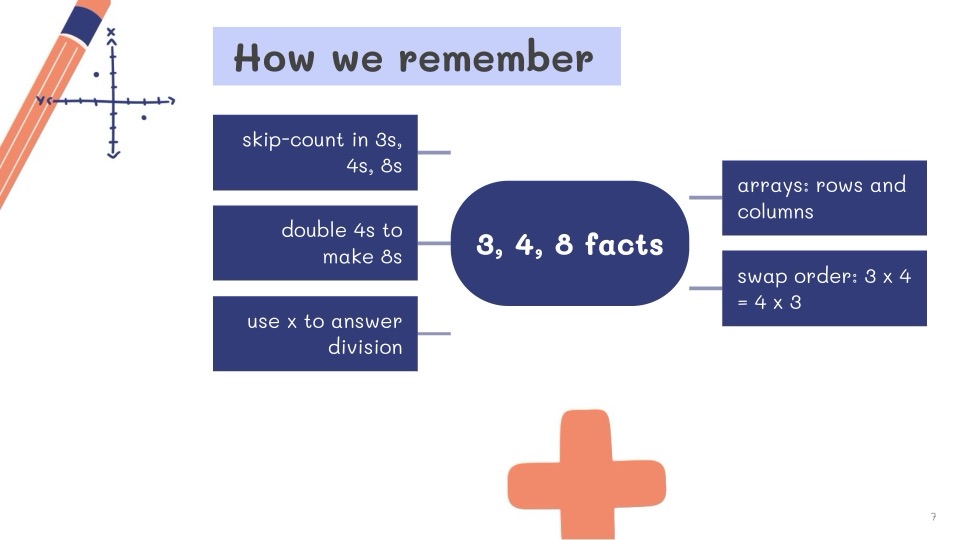
| 12 min | Teaching | Models arrays and doubling so pupils link 4s facts to 8s facts. Display Slide 3 Where are the groups? and point out neat rows and columns for equal groups. Display Slide 4 4s and 8s are linked and read Count in 4s: 4, 8, 12, 16, 20 and Count in 8s: 8, 16, 24, 32, 40. Model doubling with counters: 4 x 6 = 24, so double it to get 8 x 6 = 48, because products in the eight times table are double the products in the four times table. Play Slide 6 Video clip 1 Eight times table song (0:00-2:05), pupils clap softly on each answer and notice which fact feels hard. |
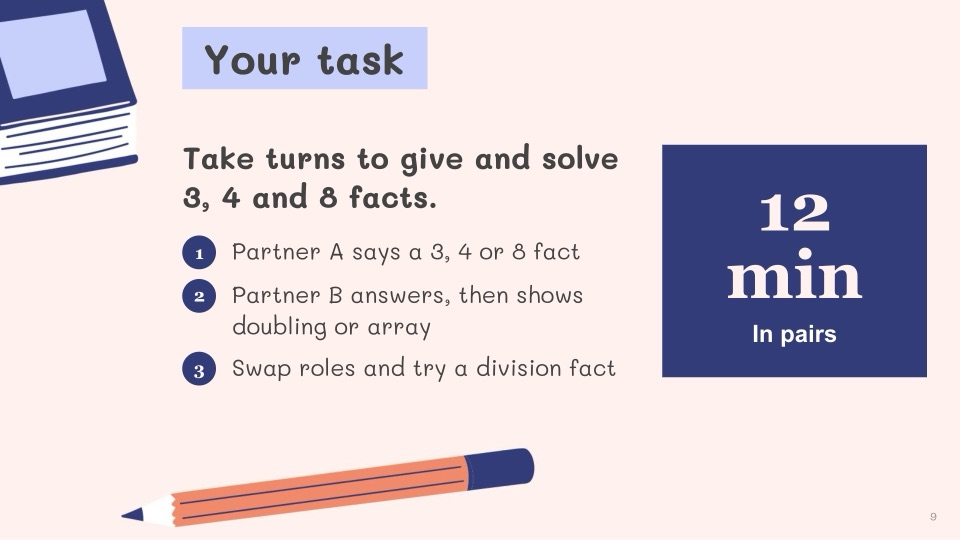
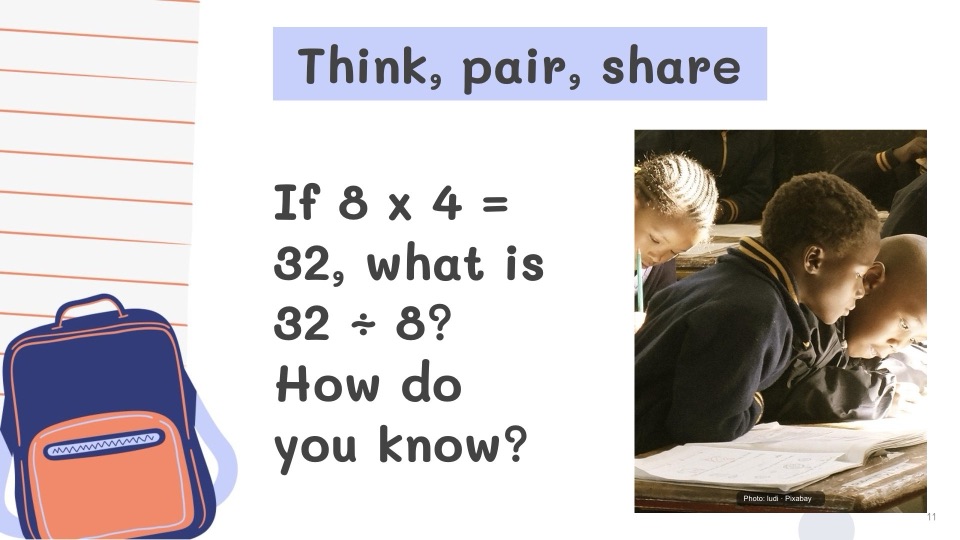
| 20 min | Main activity | Builds fact families so pupils explain division facts using known multiplications. Display Slide 9 Your task and set roles: Partner A says a 3, 4 or 8 fact, Partner B answers then shows doubling or array. Model with large fact card 8 x 4 = 32 and write the matching multiplications and divisions together. Display Slide 11 Think, pair, share: If 8 x 4 = 32, what is 32 ÷ 8? How do you know? Circulate, keep one array in view, and ask pairs to prove 32 ÷ 8 = 4 with counters. |
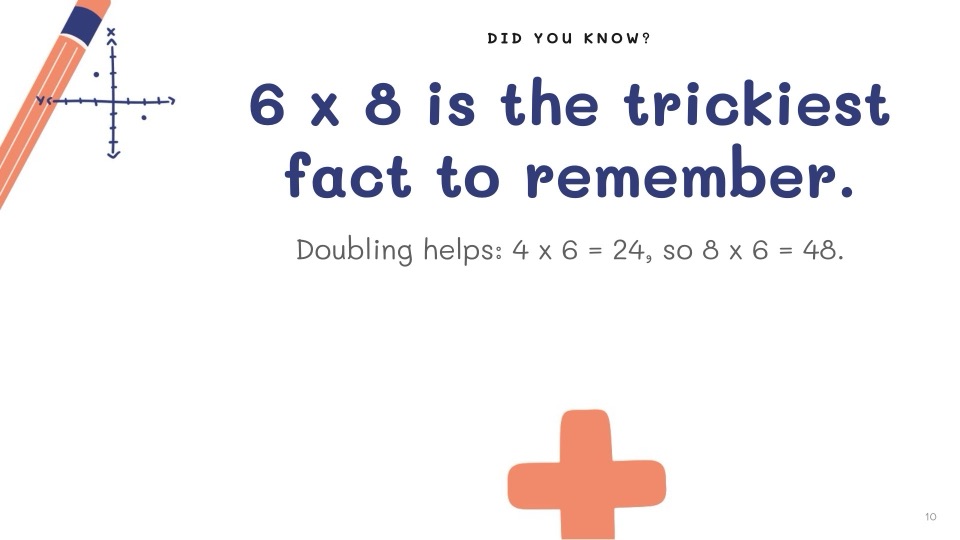
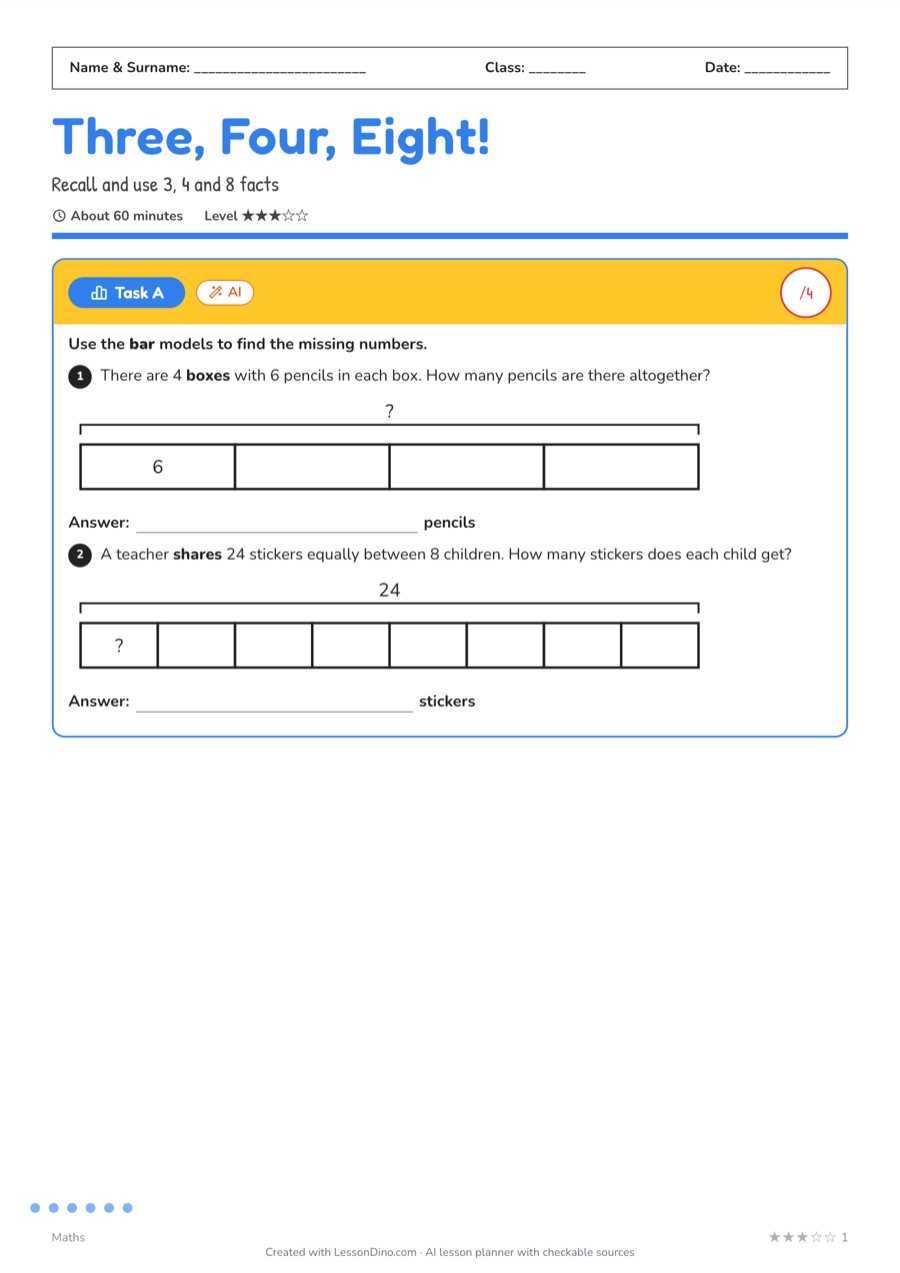
| 12 min | Practice | Practises recalling 4s to 8s by doubling and spotting near facts. Display Slide 10 Did you know? 6 x 8 is the trickiest fact to remember and read Doubling helps: 4 x 6 = 24, so 8 x 6 = 48. Hand out Worksheet Task C Practice questions: Solve these facts. Use doubling from 4 to 8 to help. Remind pupils to use the times tables grid, which is a handy way of quickly viewing all the tables, only to check. Collect in work and note who still counts every step instead of doubling. |
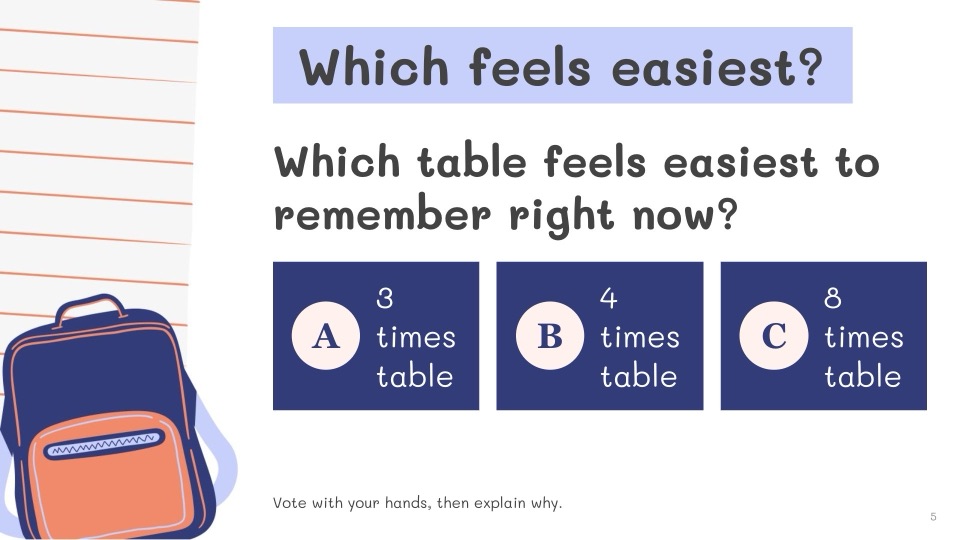
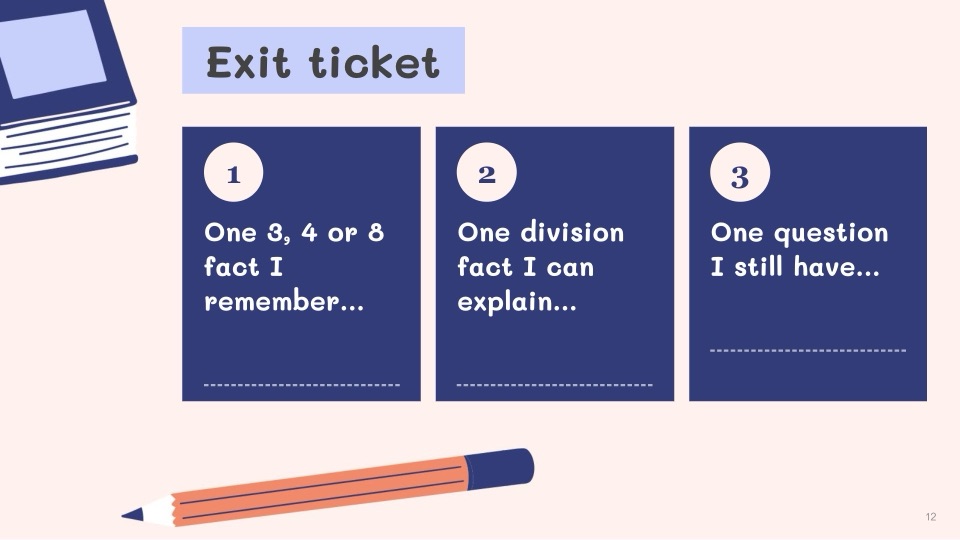
| 8 min | Plenary | Returns to the objectives and checks confident recall and division use. Display Slide 5 Which feels easiest? and take a quick vote for 3, 4 or 8 tables. Ask two pupils to perform one fact and its division, class checks against the printed grid. Display Slide 12 Exit ticket and read One 3, 4 or 8 fact I remember, One division fact I can explain. Collect exit lines and link back to Slide 2 objectives. |
Common mistakes
- Saying 8 x 6 = 24, mixing the 4s and 8s answers.
How to spot it: Pupil gives the 4s product for an 8s question on whiteboard or Task C.
Rebuild 4 x 6 = 24 then double to 48, stressing 8s products are double 4s products. - Treating division as separate from multiplication.
How to spot it: Pupil knows 8 x 4 = 32 but cannot answer 32 ÷ 8.
Split the 8 by 4 array into rows to show 32 ÷ 8 = 4 and 32 ÷ 4 = 8. - Losing place when skip-counting in 3s, 4s or 8s.
How to spot it: Sequence jumps wrongly, e.g. 8, 16, 24, 31 instead of 32.
Mark landings on a number line with equal jumps and chant 8, 16, 24, 32, 40 aloud.
Support
- Keep one array made from counters in view so pupils can see the rows as divisions, since arrays show groups or rows of objects for multiplication.
- Use number lines, printed grids and short fact strips with repeated addition like 4 + 4 + 4 = 12.
Stretch
- Ask pupils to spot and explain a second fact family that gives the same answer.
- Predict next multiples and perform facts mixed up, explaining doubling from 4 to 8.
Check questions
- What is 4 x 6 and what is 8 x 6? How are they linked?
Answer: 24 and 48; 48 is double 24 because 8s are double 4s. - If 8 x 4 = 32, what is 32 ÷ 8?
Answer: 4. - What is 3 x 5 and what division does it give?
Answer: 15; 15 ÷ 3 = 5 or 15 ÷ 5 = 3.
Curriculum
recall and use multiplication and division facts for the 3, 4 and 8 multiplication tables
Video clips
Clips on YouTube, from the start and end times we chose. Check each one before you show it.
-
Eight times table song from 0:00 to 2:05
ABC Kids Music: Don Spencer - Eight Times Tables (Official Animated Video)
Animated song covering the 8 times table with clear language and pace ideal for 7-8-year-olds building recall.
-
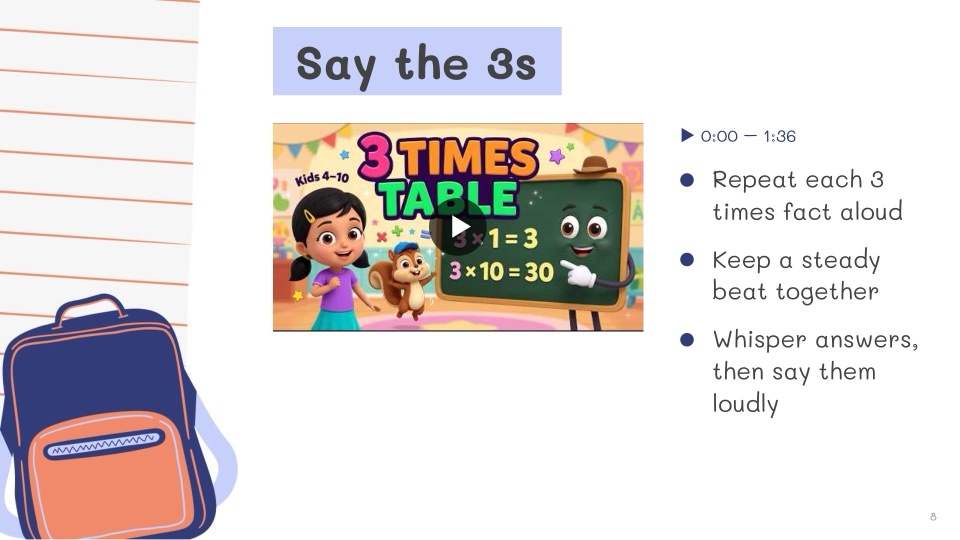
Three times table repeat from 0:00 to 1:36
Amit Sharma: 3 Times Table in English | Learn Multiplication Table of 3 | Fun Maths for Kids #kids #rhymes
Repeat-after-me practice of the 3 times table at a steady pace that suits 7-8-year-olds building recall.
Worksheet
Sources
- Learning Times Tables solipsys.co.uk
- Age 8 guide to 3 4 and 8 times tables - Xtables xtables.co.uk
- Times tables grid - Timestables.co.uk timestables.co.uk
- Times tables: 2, 4 and 8, and the relationship between them ncetm.org.uk
- Times tables games - Timestables.co.uk timestables.co.uk
- 2, 4, 8 times tables - NCETM ncetm.org.uk
- Times tables games and songs 1-12 - BBC Bitesize bbc.co.uk
- Numberblocks – Times tables - KS2 Maths - BBC Bitesize bbc.co.uk
- Multiplication table Facts for Kids kids.kiddle.co
- 2, 4 and 8 times tables: using times tables to solve problems thenational.academy
- Times Tables Shifts nrich.maths.org
- Year 3 3, 4 and 8 Times Tables Teaching Guide | Hands-On ... hands-oneducation.com
- Times Tables Games 2️⃣ ️3️⃣ - Times Tables Kids timestablekids.com
- 2 times table - KS1 Maths - BBC Bitesize bbc.co.uk
- How to Learn Your 3 Times Table | DoodleLearning doodlelearning.com
- Recall Multiplication and Division Facts for the 3, 4 and 8 ... edplace.com
- 3, 4 and 8 Times Tables | Year 3 Maths Games schoolmaths.org
- Times Tables Games for 5 to 7 year olds - Topmarks topmarks.co.uk
Picture credits
Made with Lesson Dino's AI on 17 October 2026. AI can make mistakes, so check facts against the sources before you teach.