The worksheet
About this worksheet
Students learn that different fractions can show the same amount. They make and compare bar diagrams to find matching pairs. This Year 3 Maths worksheet gives students (ages 7–8) six pages of practice on equivalent fractions, part of the number - fractions unit. It goes with our free Equivalent fractions lesson, which has the slides and a timed lesson plan.
What it covers
By the end, students should be able to:
- Students will recognise equivalent fractions with small denominators as the same amount.
- Students will make same-size bar models to show equivalent fraction pairs.
- Students will explain why different fractions can show the same shaded part.
How to use it
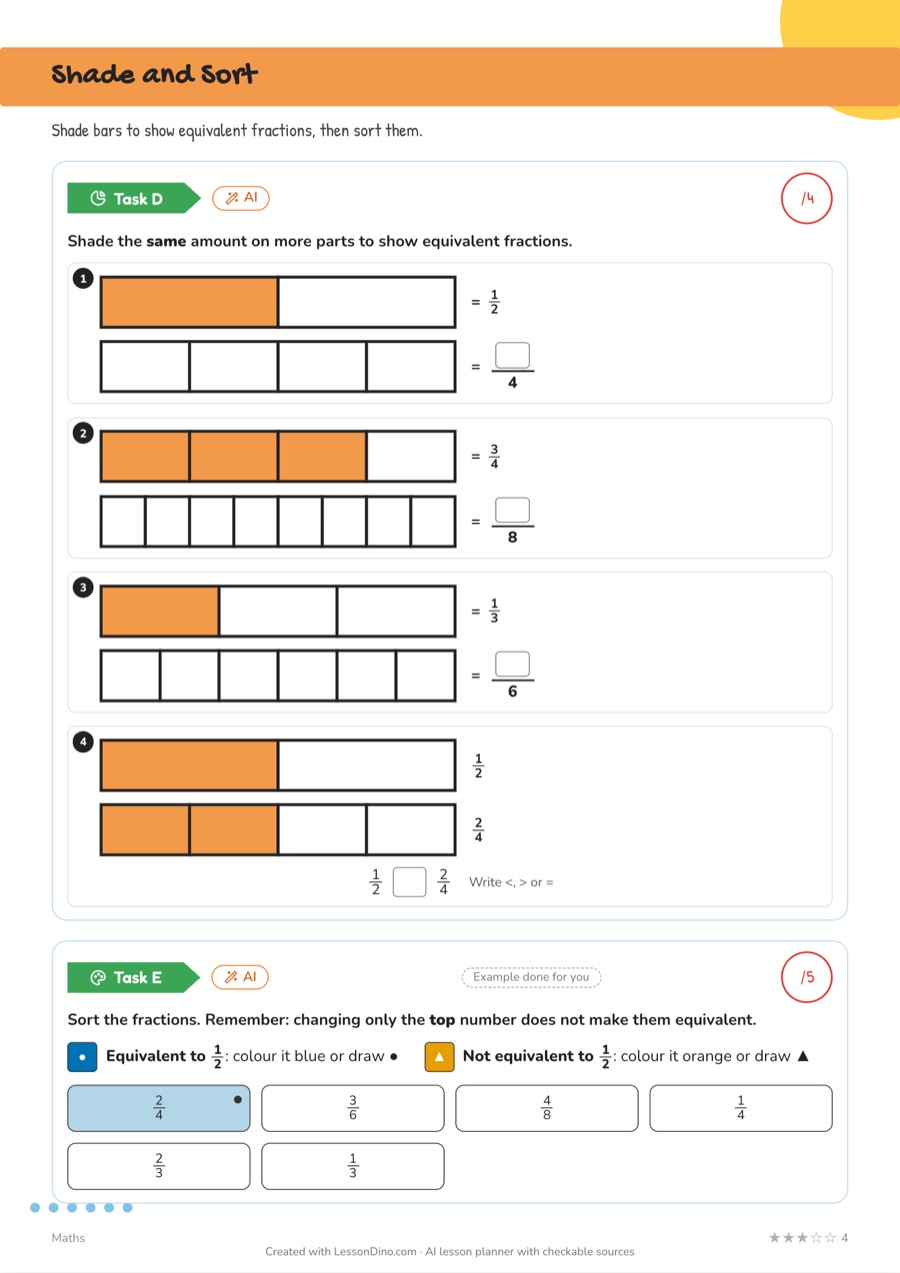
- Main activity (25 minutes): Give Worksheet Task D for students to shade the same amount on more parts.
- Support: Provide rectangles already split into halves and quarters so students focus on colouring the correct number of parts.
- Stretch: Make a third rectangle to show 3/6 or 4/8 as another twin for 1/2.
- The answer sheet is the last page, so you can print it on its own or let students check their own work.
Key vocabulary
- equivalent: having the same amount or value as something else
- numerator: top number in a fraction that counts parts used
- denominator: bottom number that tells how many equal parts the full shape has
- bar model: long rectangle picture used to show a fraction amount
- whole: one full shape before it is cut into equal parts
Mistakes to watch for
- Thinking 1/2 and 1/4 match because both have 1 on top. Line up same-size bars and compare coloured length; different size means not equivalent.
- Changing only the top or only the bottom number to make a match. Remind: whatever you do to the numerator, you must also do to the denominator; you only multiply or divide, never add or subtract, to get an equivalent fraction.
- Thinking more pieces always means a bigger amount. Show the shaded area remains the same, but each model has been divided into a different number of parts.
What's on the worksheet
Same Amount Party
See how different fractions can show the same amount.
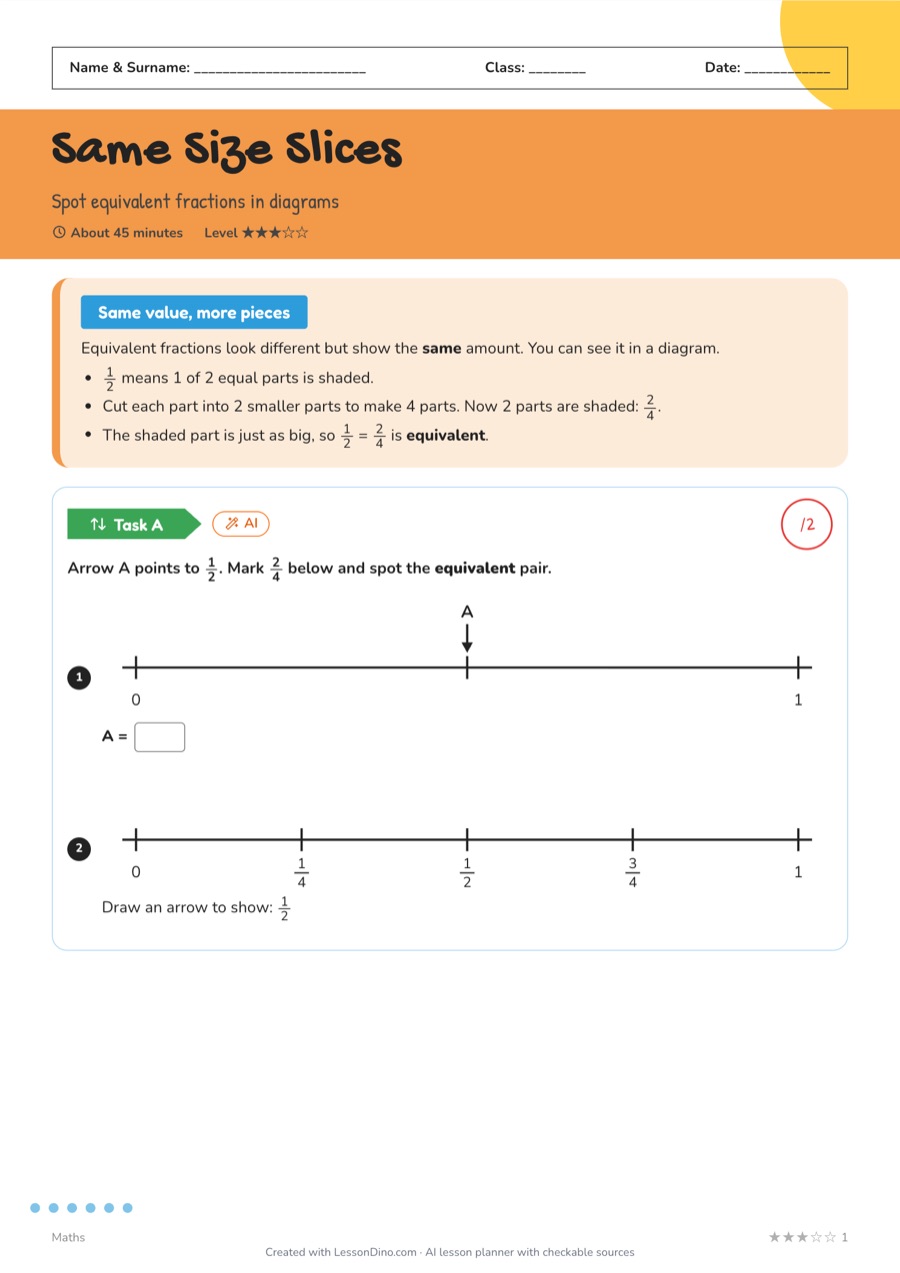
Same value, more pieces
- Equivalent fractions look different but show the same amount. You can see it in a diagram.
- 1/2 means 1 of 2 equal parts is shaded.
- Cut each part into 2 smaller parts to make 4 parts. Now 2 parts are shaded: 2/4.
- The shaded part is just as big, so 1/2 = 2/4 is equivalent.
Arrow A points to 1/2. Mark 2/4 below and spot the equivalent pair.
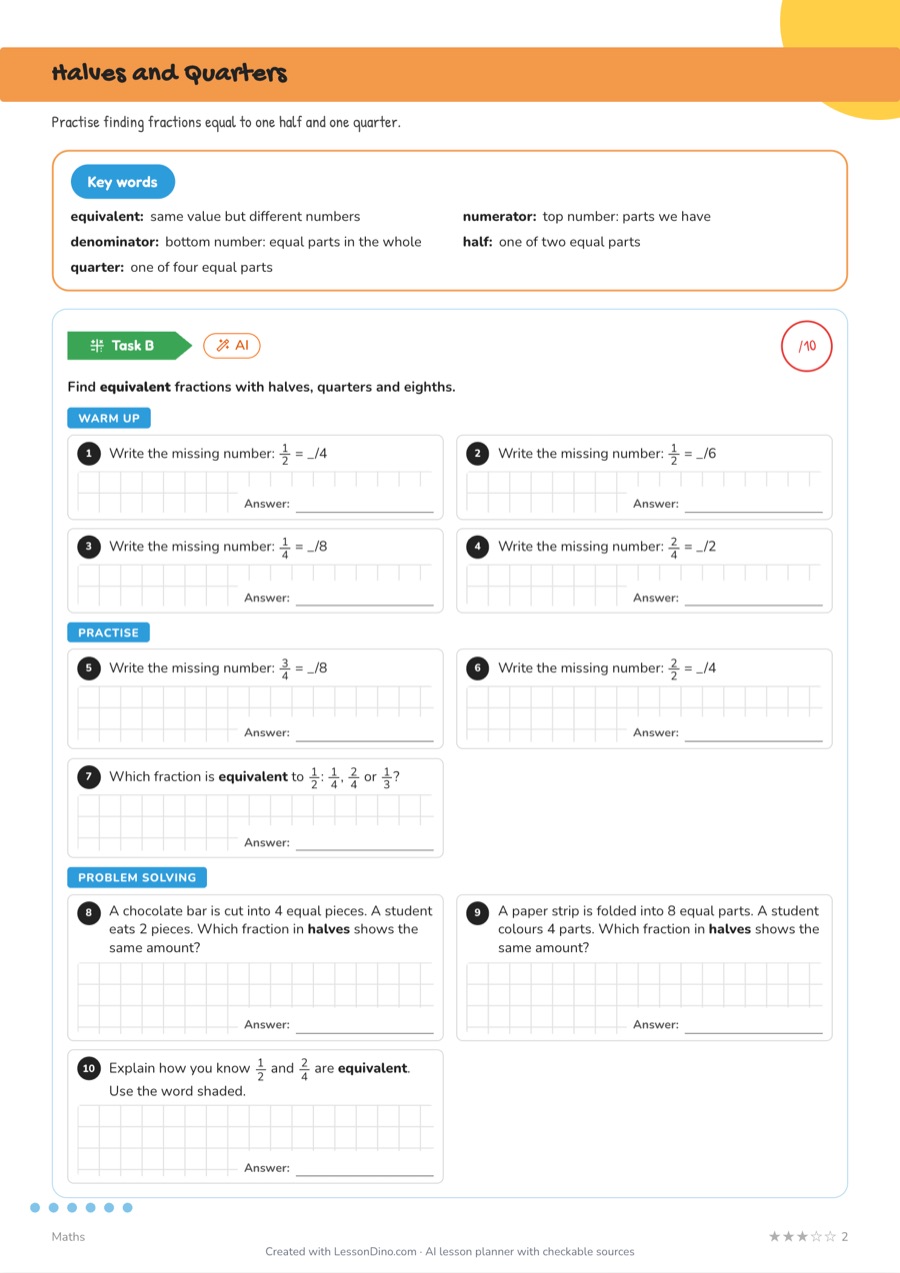
Halves and Quarters
Practise finding fractions equal to one half and one quarter.
| Word | Meaning |
|---|---|
| equivalent | same value but different numbers |
| numerator | top number: parts we have |
| denominator | bottom number: equal parts in the whole |
| half | one of two equal parts |
| quarter | one of four equal parts |
Find equivalent fractions with halves, quarters and eighths.
Warm up
- Write the missing number: 1/2 = _/4
- Write the missing number: 1/2 = _/6
- Write the missing number: 1/4 = _/8
- Write the missing number: 2/4 = _/2
Practise
- Write the missing number: 3/4 = _/8
- Write the missing number: 2/2 = _/4
- Which fraction is equivalent to 1/2: 1/4, 2/4 or 1/3?
Problem solving
- A chocolate bar is cut into 4 equal pieces. A student eats 2 pieces. Which fraction in halves shows the same amount?
- A paper strip is folded into 8 equal parts. A student colours 4 parts. Which fraction in halves shows the same amount?
- Explain how you know 1/2 and 2/4 are equivalent. Use the word shaded.
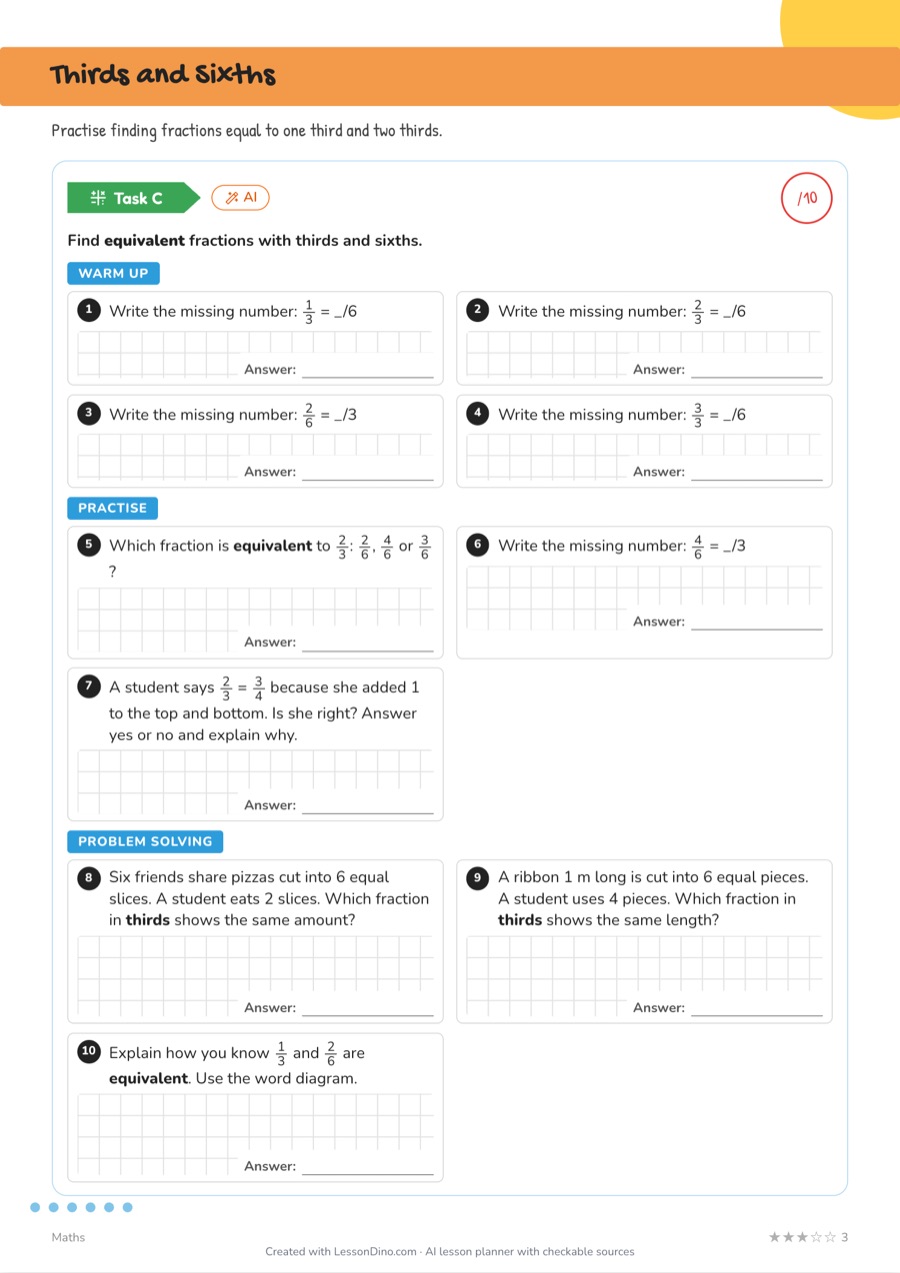
Thirds and Sixths
Practise finding fractions equal to one third and two thirds.
Find equivalent fractions with thirds and sixths.
Warm up
- Write the missing number: 1/3 = _/6
- Write the missing number: 2/3 = _/6
- Write the missing number: 2/6 = _/3
- Write the missing number: 3/3 = _/6
Practise
- Which fraction is equivalent to 2/3: 2/6, 4/6 or 3/6?
- Write the missing number: 4/6 = _/3
- A student says 2/3 = 3/4 because she added 1 to the top and bottom. Is she right? Answer yes or no and explain why.
Problem solving
- Six friends share pizzas cut into 6 equal slices. A student eats 2 slices. Which fraction in thirds shows the same amount?
- A ribbon 1 m long is cut into 6 equal pieces. A student uses 4 pieces. Which fraction in thirds shows the same length?
- Explain how you know 1/3 and 2/6 are equivalent. Use the word diagram.
Shade and Sort
Shade bars to show equivalent fractions, then sort them.
Shade the same amount on more parts to show equivalent fractions.
Sort the fractions. Remember: changing only the top number does not make them equivalent.
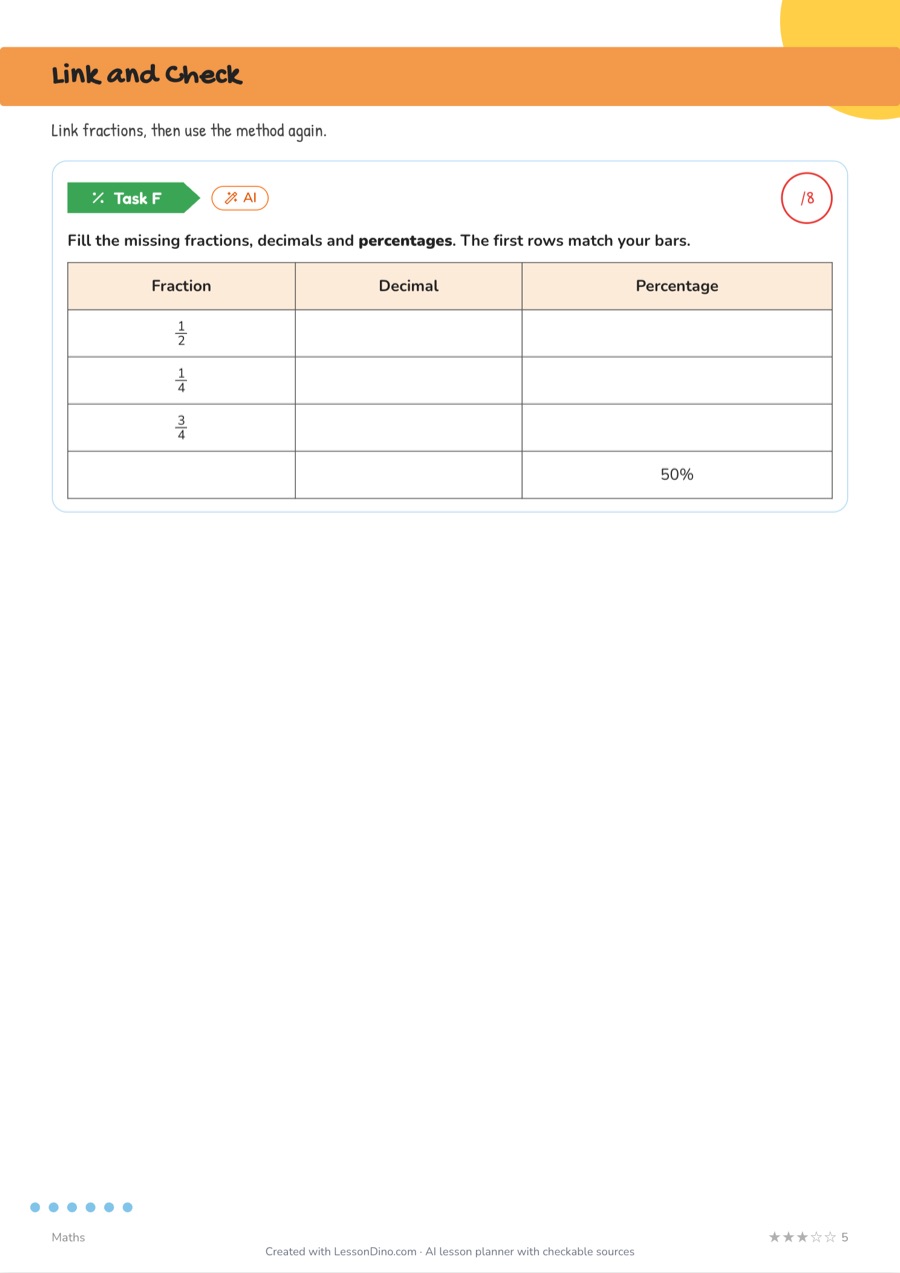
Link and Check
Link fractions, then use the method again.
Fill the missing fractions, decimals and percentages. The first rows match your bars.
Page 6
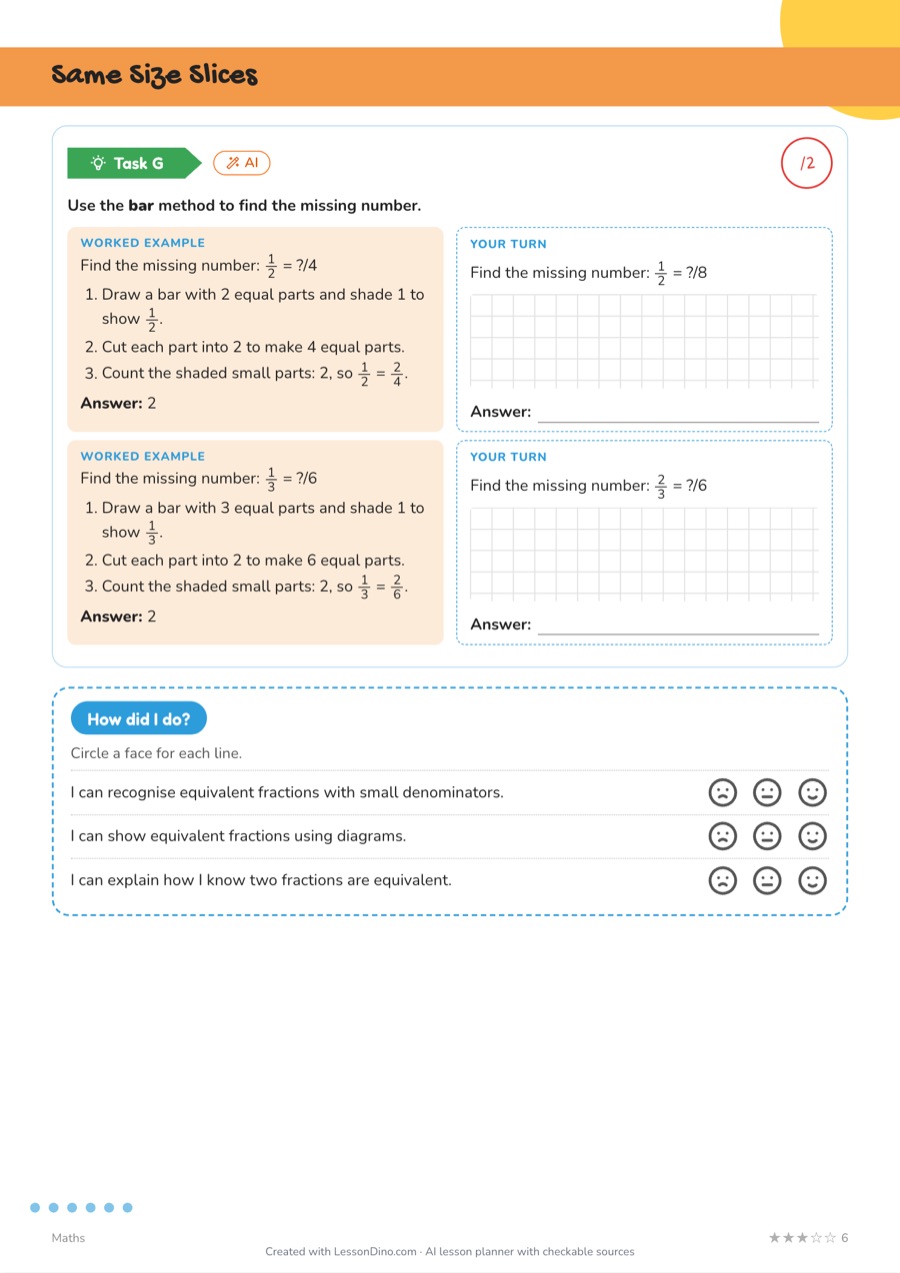
Use the bar method to find the missing number.
Answers
Show the answers
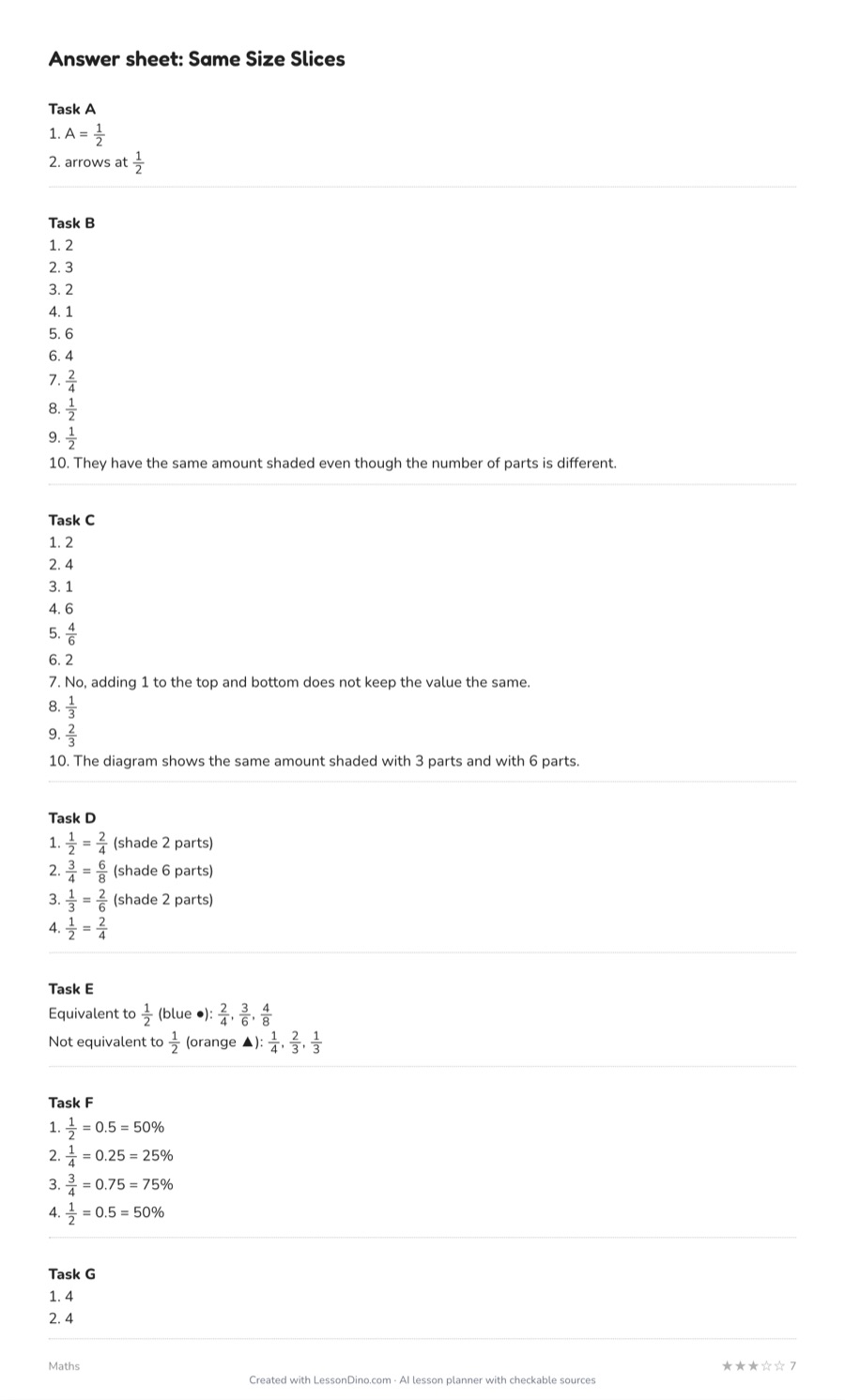
- Write the missing number: 1/2 = _/4 2
- Write the missing number: 1/2 = _/6 3
- Write the missing number: 1/4 = _/8 2
- Write the missing number: 2/4 = _/2 1
- Write the missing number: 3/4 = _/8 6
- Write the missing number: 2/2 = _/4 4
- Which fraction is equivalent to 1/2: 1/4, 2/4 or 1/3? 2/4
- A chocolate bar is cut into 4 equal pieces. A student eats 2 pieces. Which fraction in halves shows the same amount? 1/2
- A paper strip is folded into 8 equal parts. A student colours 4 parts. Which fraction in halves shows the same amount? 1/2
- Explain how you know 1/2 and 2/4 are equivalent. Use the word shaded. They have the same amount shaded even though the number of parts is different.
- Write the missing number: 1/3 = _/6 2
- Write the missing number: 2/3 = _/6 4
- Write the missing number: 2/6 = _/3 1
- Write the missing number: 3/3 = _/6 6
- Which fraction is equivalent to 2/3: 2/6, 4/6 or 3/6? 4/6
- Write the missing number: 4/6 = _/3 2
- A student says 2/3 = 3/4 because she added 1 to the top and bottom. Is she right? Answer yes or no and explain why. No, adding 1 to the top and bottom does not keep the value the same.
- Six friends share pizzas cut into 6 equal slices. A student eats 2 slices. Which fraction in thirds shows the same amount? 1/3
- A ribbon 1 m long is cut into 6 equal pieces. A student uses 4 pieces. Which fraction in thirds shows the same length? 2/3
- Explain how you know 1/3 and 2/6 are equivalent. Use the word diagram. The diagram shows the same amount shaded with 3 parts and with 6 parts.
The answer sheet is the last picture above.
Curriculum
recognise and show, using diagrams, equivalent fractions with small denominators
Made with Lesson Dino's AI on 17 October 2026. AI can make mistakes, so check the answers and facts against the sources before you teach.