Slides
Lesson plan
Fences Right Round Shapes
Pupils learn that perimeter is the distance round a shape. They measure sides in centimetres and add them to find it.
Objectives
- Students will measure each straight side of simple 2-D shapes in centimetres.
- Students will add all side lengths together to find the perimeter.
- Students will explain perimeter as the distance all round a shape.
Success criteria
- I can measure each side to the nearest centimetre.
- I can add all the sides to find the perimeter.
- I can say perimeter is the distance round a shape.
Key words
| Word | Meaning |
|---|---|
| perimeter | the distance all round the outside of a shape |
| centimetre | a small unit for measuring length, written as cm |
| side | one straight edge round a shape |
| rectangle | a shape with four corners where opposite edges are equal |
| square | a shape with four edges that are all the same length |
Timed plan (60 minutes)
| Time | Stage | What happens |
|---|---|---|
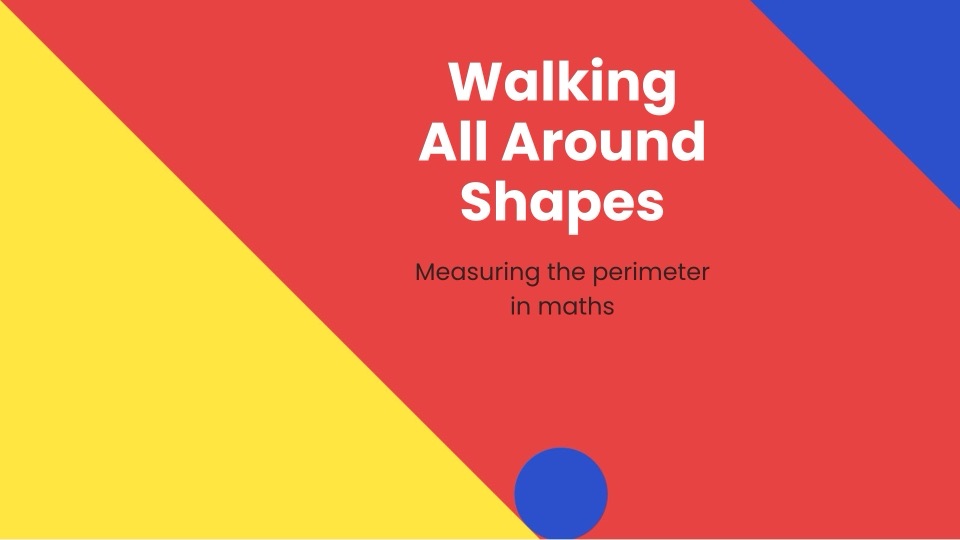
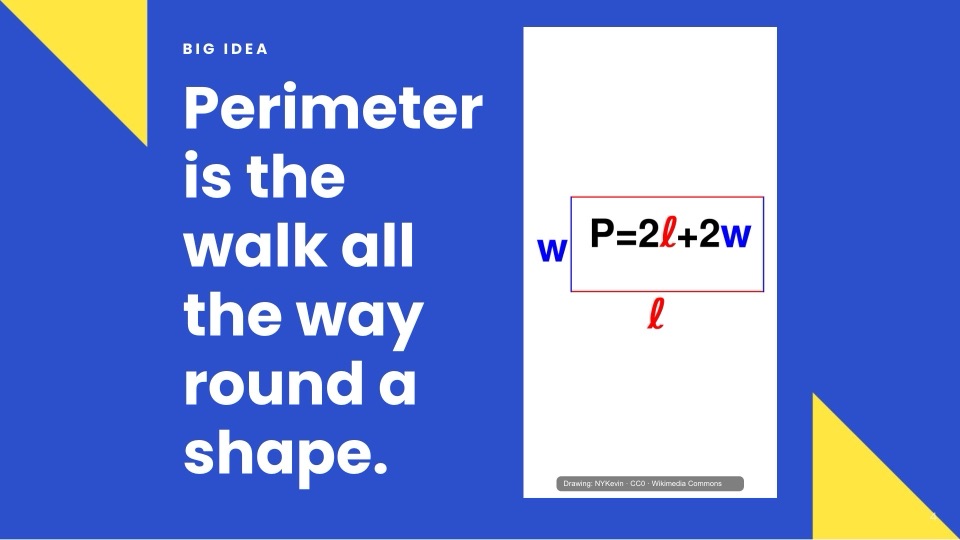
| 10 min | Starter | To hook pupils with the fence idea and recall that perimeter is the way round. Hold up a card rectangle with string round its edge and ask the hook question. Show Slide 1, then Slide 4 and trace a finger right round the shape. Ask pupils to trace the edge in the air while you say the big idea. Take quick answers on what we are measuring when we go all round. |
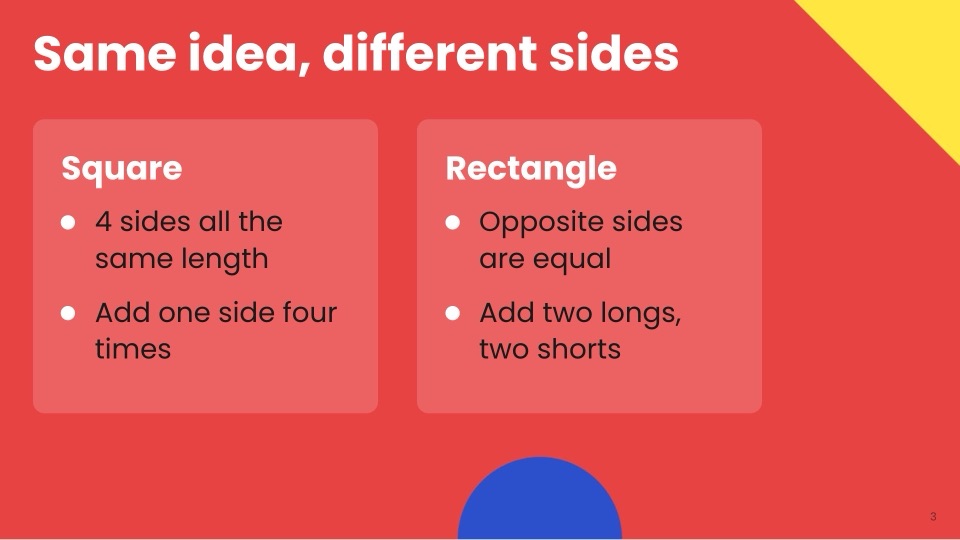
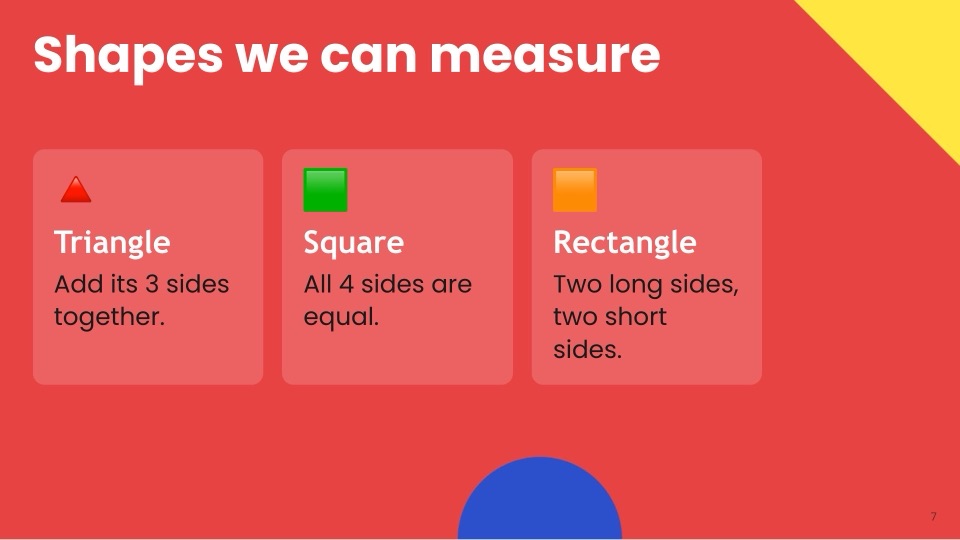
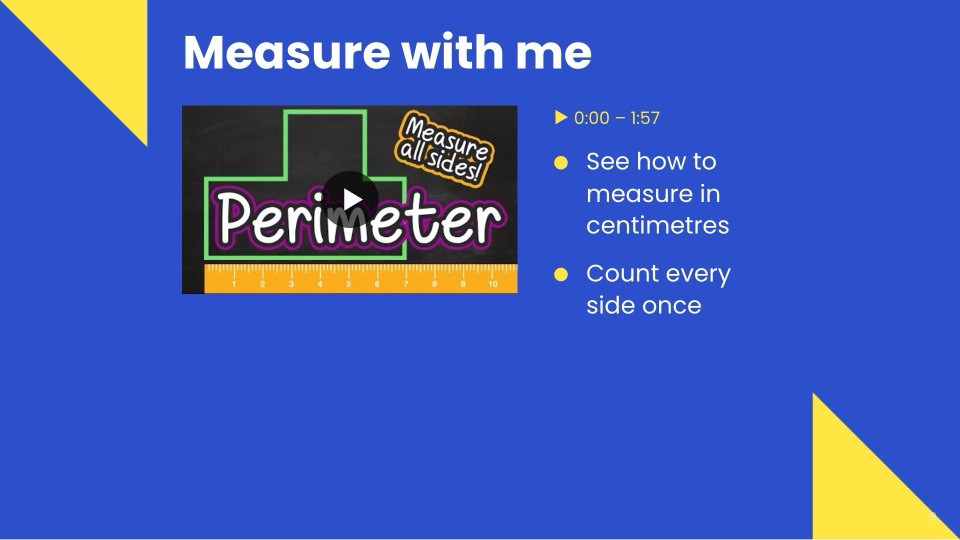
| 10 min | Teaching | To model how to measure each side in centimetres and add them for perimeter. Show Slide 2 and explain peri means around and metron means measure. Show Slide 3 and Slide 7 to compare square, rectangle and triangle sides. Play Video clip 3 (0:00–1:57) on Slide 8 to show ruler start and counting every side once. Model measuring a rectangle and adding the four sides on the whiteboard. |
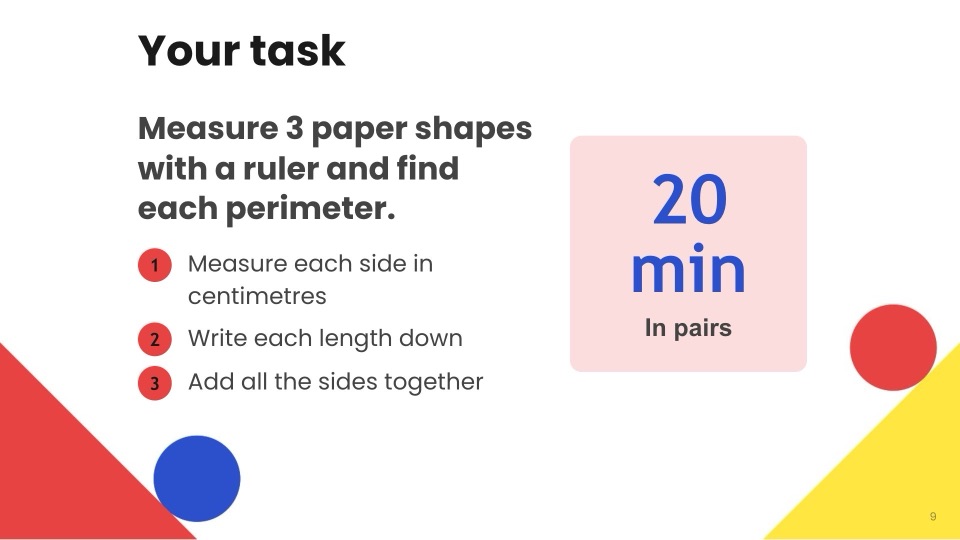
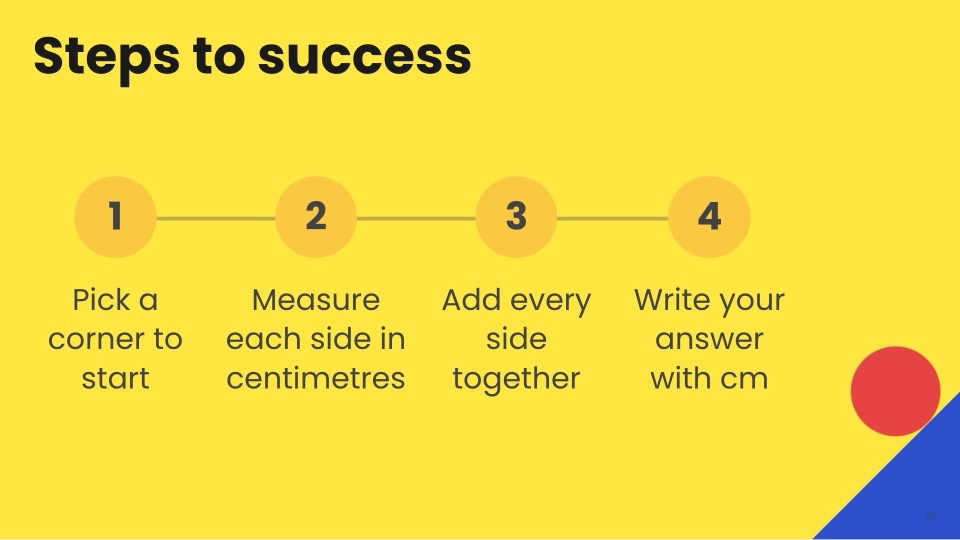
| 20 min | Main activity | To measure card shapes in centimetres and add the sides to find each perimeter. Show Slide 9 and Slide 10 and read the steps to success together. Give each pair card rectangles, triangles and squares, string, ruler and pencil. Remind pairs to wrap string round, then measure each straight side to nearest cm. Circulate, checking ruler starts at 0 and every side is added once. |
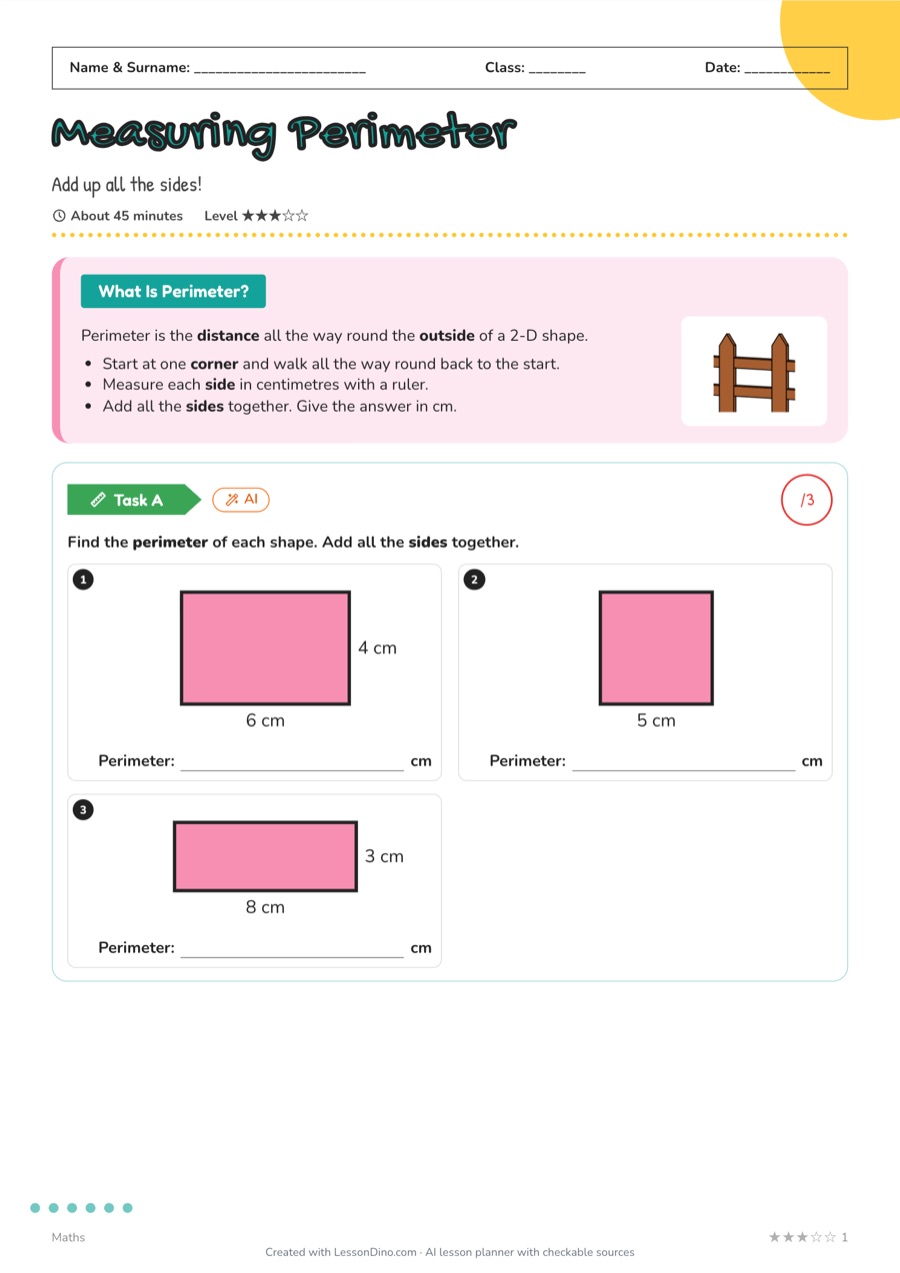
| 12 min | Worksheet practice | To practise adding given side lengths accurately with correct units. Hand out Worksheet Task B and read the instruction together. Remind pupils to write cm each time and add every side. Let pupils work alone for 9 minutes on the perimeters. Spot-check books for full number sentences and units. |
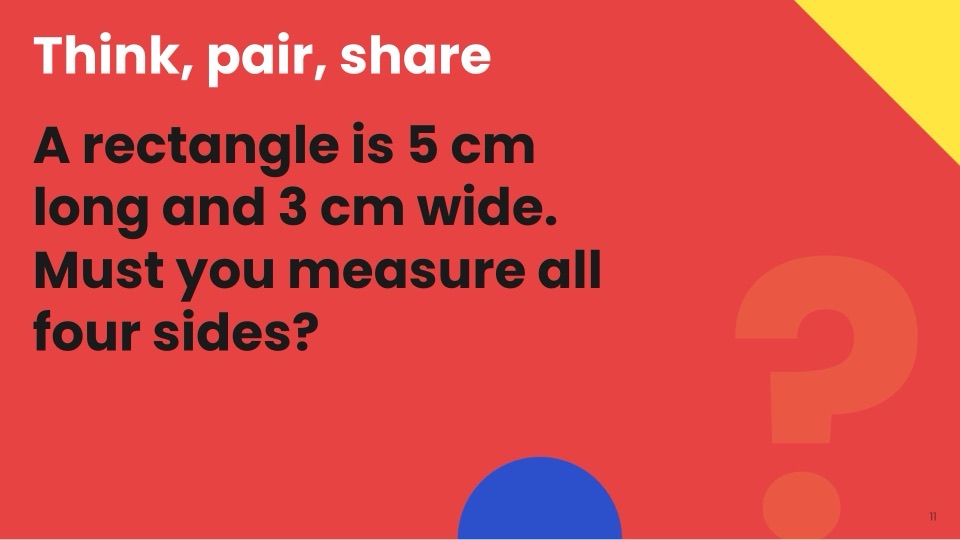
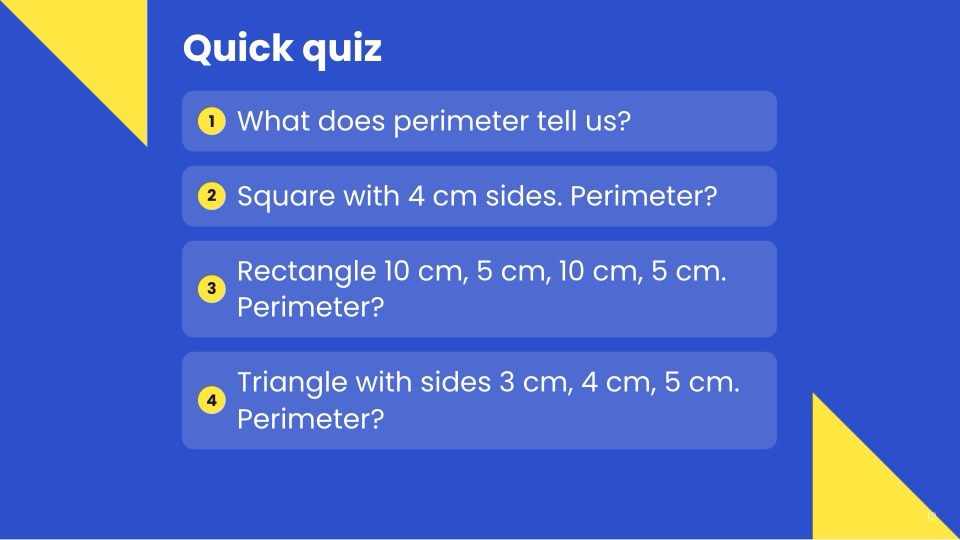
| 8 min | Plenary | To correct the missing-sides mistake and confirm what perimeter tells us. Show Slide 11: a rectangle 5 cm long and 3 cm wide and ask if all four sides are needed. Draw out that you must include the length of every side and show 5+3+5+3=16 cm. Use Slide 12 quick quiz to check meaning and two calculations. Link back to success criteria and set homework. |
Common mistakes
- Adding only the two labelled sides, for example 6 cm + 3 cm = 9 cm for a rectangle.
How to spot it: Total is about half the expected string length and only two numbers are written.
Touch and number sides 1 to 4 and remember to include the length of every side. - Writing the total without units, for example 18 instead of 18 cm.
How to spot it: Number sentence has no cm after the numbers.
Insist on cm each time because perimeter is a length measured in centimetres and metres. - Measuring from the 1 cm mark or skipping a side when counting round.
How to spot it: String total and added total do not match, or one side has no tick.
Start the ruler at 0 at the dot, tick each side once, and go around the whole shape back to the start.
Support
- Give shapes with whole centimetre sides and only three or four sides, with start dots marked for where to place the ruler.
- Let pupils tick off each side as they measure it and use an addition frame with cm.
Stretch
- Ask pupils to predict the last side before measuring, using what they notice about the other sides.
- Challenge pupils to draw two different rectangles that both have the same perimeter.
Check questions
- What is perimeter?
Answer: The distance all around the outside of a 2D shape. - Triangle sides 4 cm, 4 cm, 3 cm. What is the perimeter?
Answer: 4 cm + 4 cm + 3 cm = 11 cm. - Square side 5 cm. What is the perimeter and how do you know?
Answer: 20 cm, because 5 cm + 5 cm + 5 cm + 5 cm = 20 cm and all four sides are equal.
Curriculum
measure the perimeter of simple 2-D shapes
Video clips
Clips on YouTube, from the start and end times we chose. Check each one before you show it.
-
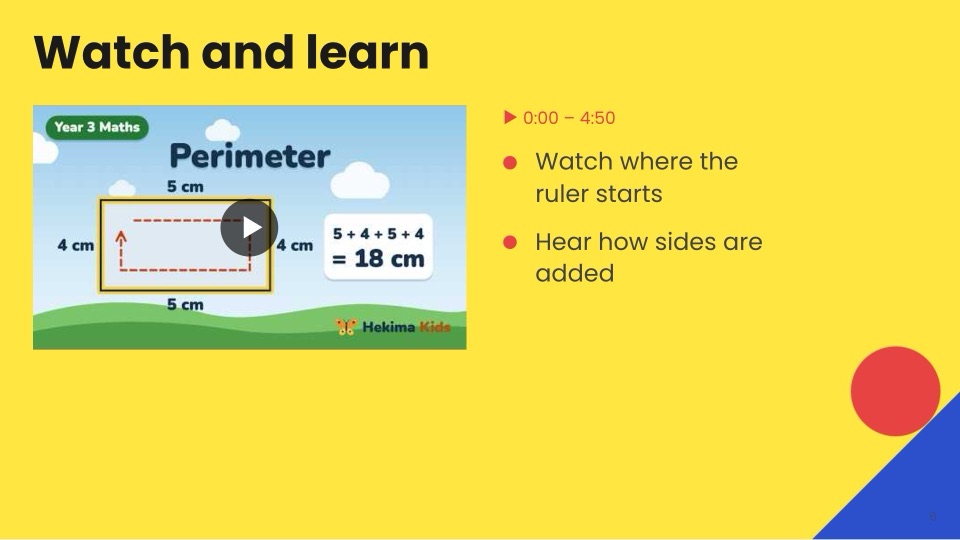
Year 3 perimeter from 0:00 to 4:50
Hekima Kids: Perimeter | Year 3 Maths | Hekima Kids
Labelled for Year 3 and explains measuring simple shapes at the right level for 7-8-year-olds.
-
Measure the sides from 0:00 to 1:57
Star Toaster: Perimeter Video for Kids: How to Measure the Sides of a Shape | Star Toaster
Shows exactly how to measure each side and add them, ideal for 7-8-year-olds learning to measure.
Worksheet
Sources
- National curriculum in England: mathematics programmes of study gov.uk
- Year 3 Maths Curriculum map 2023-2024 westend.lancs.sch.uk
- Measuring Perimeter gaytonj.derby.sch.uk
- What is the perimeter of a 2D shape? - BBC Bitesize bbc.co.uk
- Perimeter - BBC Bitesize bbc.co.uk
- About Us - The Perimeter theperimeter.co.uk
- Perimeter Calculator | aCalculator.co.uk acalculator.co.uk
- Maths Genie • Area and Perimeter old.mathsgenie.co.uk
- Perimeter - KS3 Maths - BBC Bitesize bbc.co.uk
- Kids Math: Perimeter - Ducksters ducksters.com
- Perimeter Facts for Kids kids.kiddle.co
- Flexi answers - How to find perimeter of a shape? | CK-12 Foundation ck12.org
- Area and perimeter | Geometry (all content) | Math | Khan Academy khanacademy.org
- Area and Perimeter | Math Concepts for Kids kidsworldfun.com
- Perimeter Explained for Kids: Story, Facts & Activities ... mystorypie.com
- Perimeter - Class Playground classplayground.com
- What Is Area and Perimeter? - Explained for Kids smartonlinegames.com
- Perimeter of Different Shapes Worksheet - Math Salamanders math-salamanders.com
- Perimeter - Definition, Examples | How to Find Perimeter? - Cuemath cuemath.com
- Perimeter of Polygons Worksheets - Math Worksheets 4 Kids mathworksheets4kids.com
- Area and Perimeter - GeeksforGeeks geeksforgeeks.org
- Perimeter and Area Poster - Teach Starter teachstarter.com
- Perimeter = Distance Around OUTSIDE! Educational Resources K12 Learning, Measurement and Data, Math Lesson Plans, Activities, Experiments, Homeschool Help elephango.com
- Perimeter and Circumference – Mathematics for Elementary Education II openwa.pressbooks.pub
- What Is Perimeter? A Kid-Friendly Math Definition mathnasium.com
Picture credits
- Drawing: NYKevin · CC0 · Wikimedia Commons
- Photo: RaniRamli · Pixabay
- Pictograms: Sergio Palao, ARASAAC (arasaac.org) · CC BY-NC-SA
Made with Lesson Dino's AI on 17 October 2026. AI can make mistakes, so check facts against the sources before you teach.