Slides
Lesson plan
Same Amount, Different Fractions
Students learn that different fractions can show the same amount. They make and compare bar diagrams to find matching pairs.
Objectives
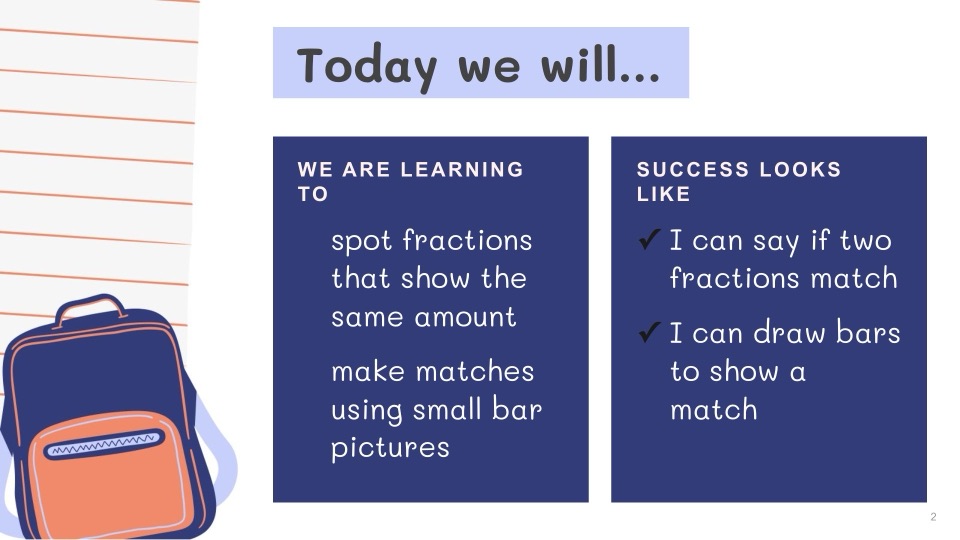
- Students will recognise equivalent fractions with small denominators as the same amount.
- Students will make same-size bar models to show equivalent fraction pairs.
- Students will explain why different fractions can show the same shaded part.
Success criteria
- I can say if two fractions match by comparing shaded amounts.
- I can draw bars to show a match like 1/2 equals 2/4.
- I can explain what is the same and what is different.
Key words
| Word | Meaning |
|---|---|
| equivalent | having the same amount or value as something else |
| numerator | top number in a fraction that counts parts used |
| denominator | bottom number that tells how many equal parts the full shape has |
| bar model | long rectangle picture used to show a fraction amount |
| whole | one full shape before it is cut into equal parts |
Timed plan (60 minutes)
| Time | Stage | What happens |
|---|---|---|
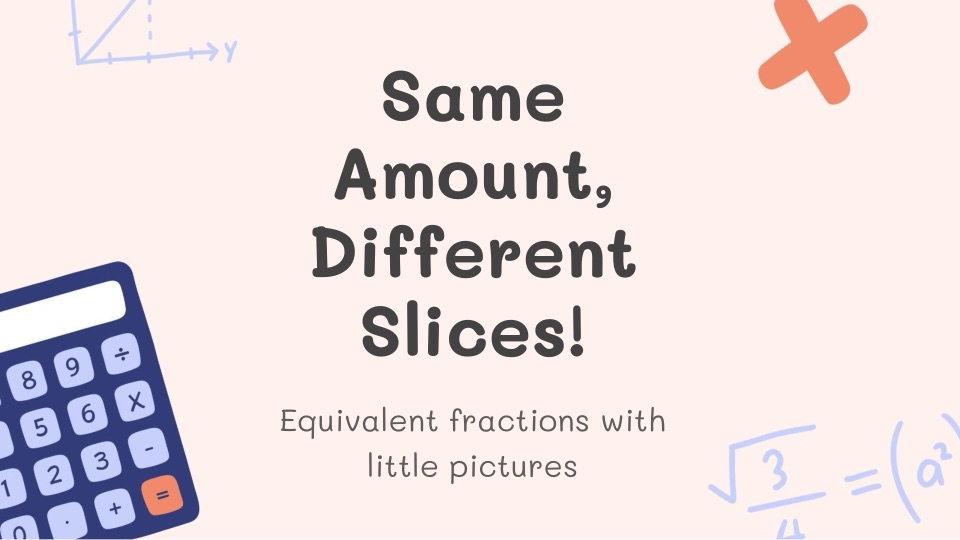
| 5 min | Starter | To recall halves and hook students into spotting same-amount fractions. Show Slide 1: Same Amount, Different Slices! and read the title together. Give the hook: You are going to be fraction artists — same coloured amount, totally different fractions. Show Slide 2: Today we will… and read the objectives together. Hold up a bar with 1/2 shaded and ask what fraction it shows. |
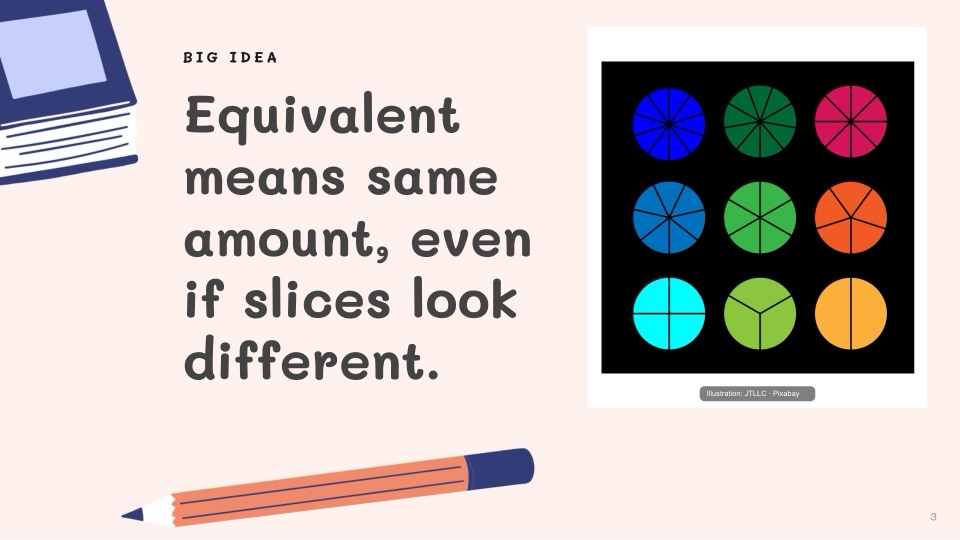
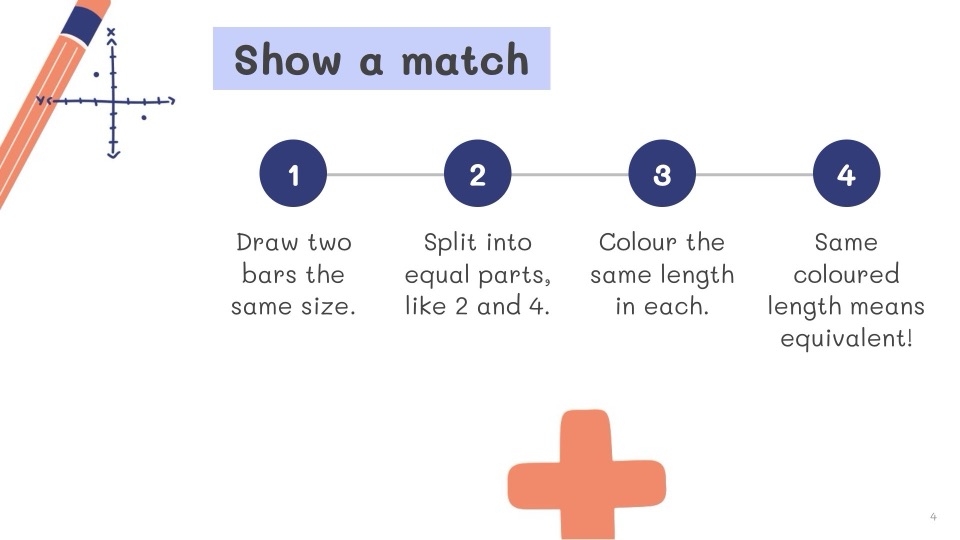
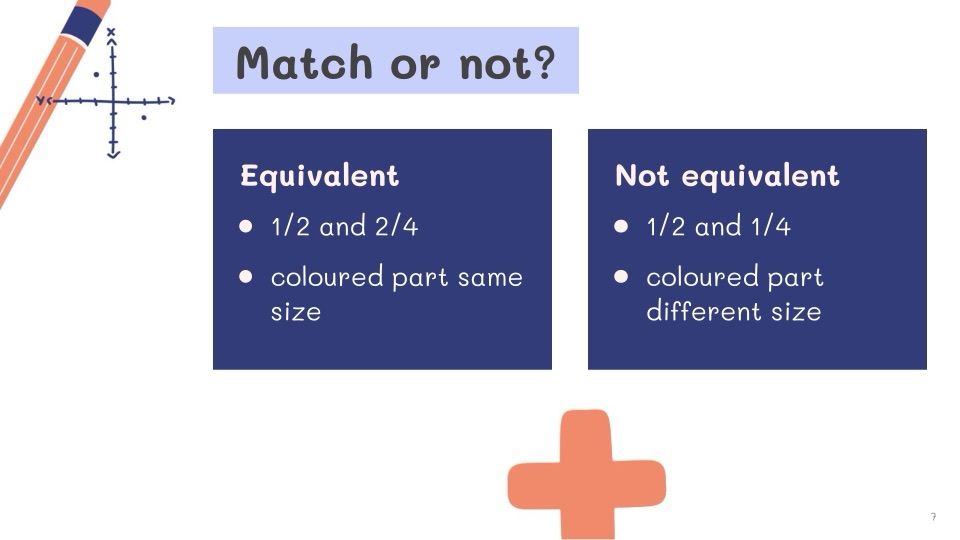
| 12 min | Teaching | To model that equivalent fractions have the same shaded length in same-size bars. Show Slide 3 and read: Equivalent means same amount, even if slices look different. Show Slide 4 steps and draw two same-size bars, splitting one into 2 and one into 4 equal parts. Colour 1/2 on one and 2/4 on the other, then line them up to show the coloured length matches. Show Slide 7 to compare 1/2 and 2/4 with 1/2 and 1/4. |
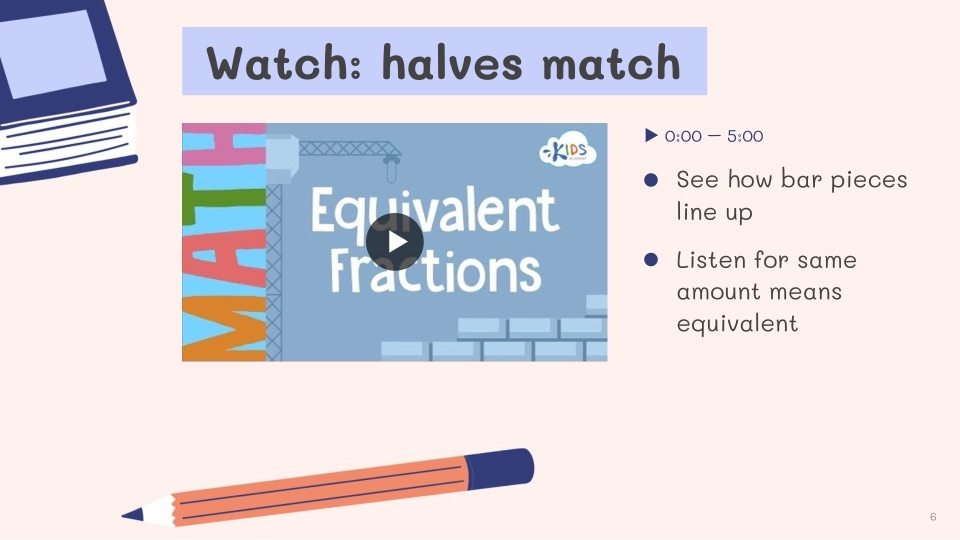
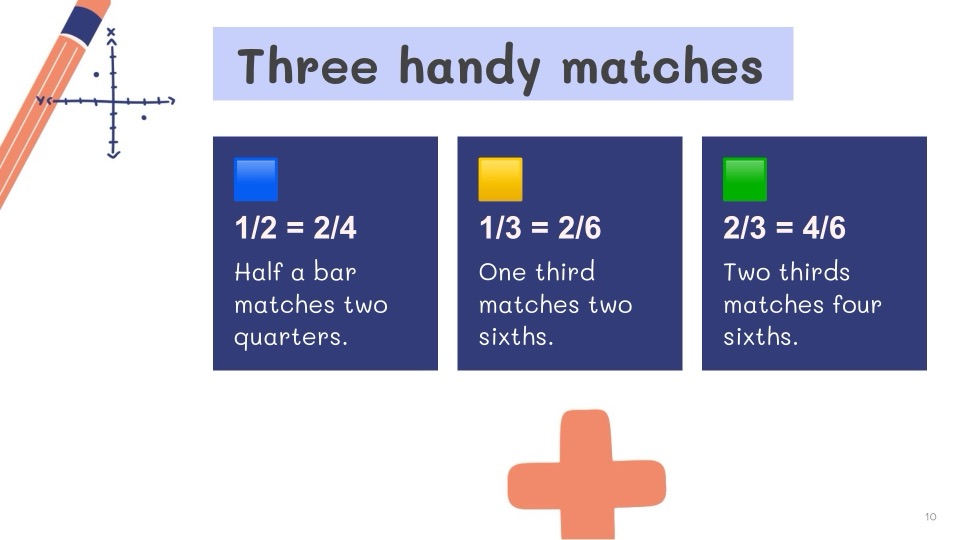
| 8 min | Video spotter | To see more same-size bar pieces lining up as equivalent pairs. Show Slide 6 and explain: See how bar pieces line up. Play Video clip 1 (0:00–5:00) and pause once to point to matching shaded lengths. Show Slide 10 and read the three pairs: 1/2 = 2/4, 1/3 = 2/6, 2/3 = 4/6. Ask students to say which shaded sizes match and which have more parts. |
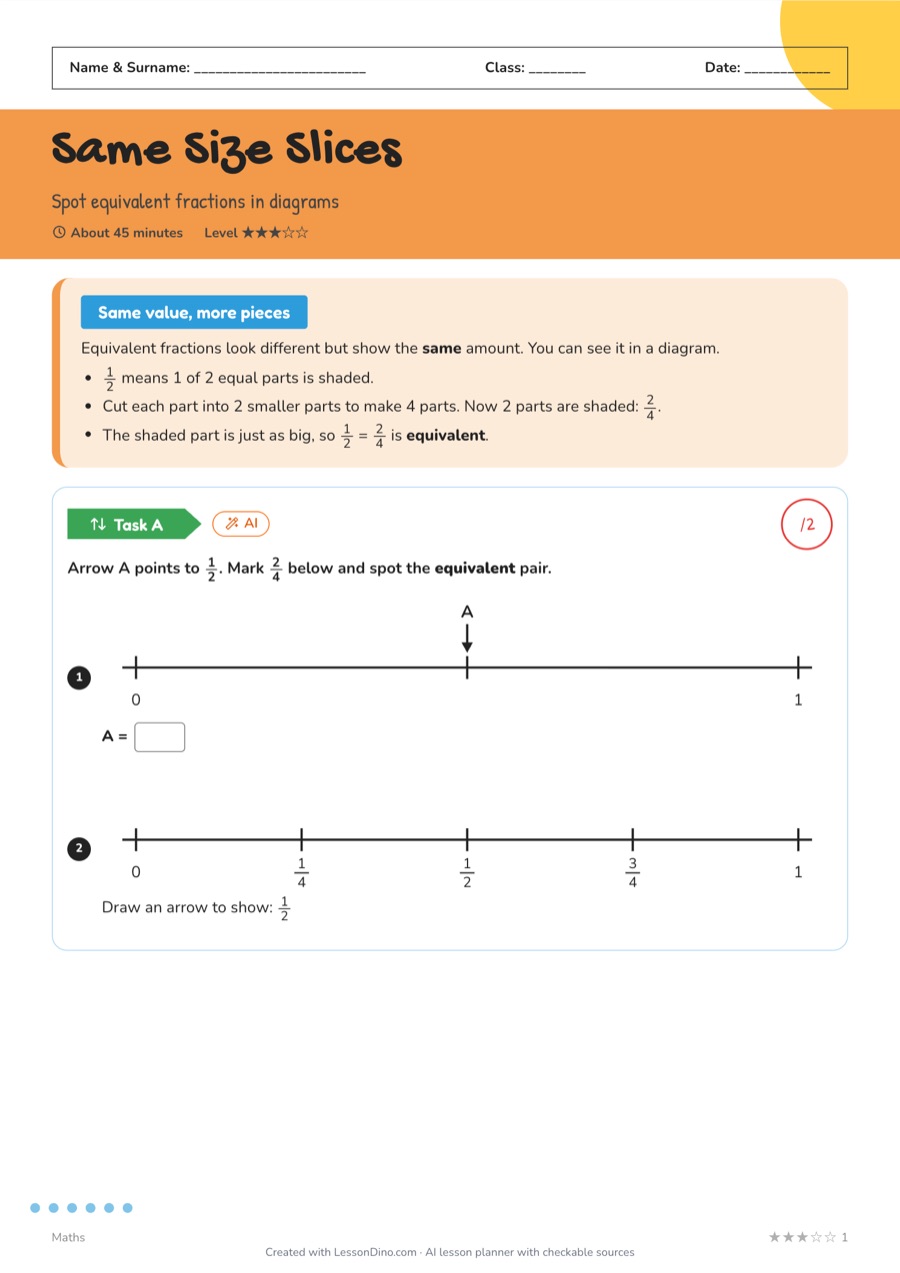
| 25 min | Main activity | To make area models that prove equivalent pairs cover the same amount. Show Slide 9: Draw two same-size bars. Colour 1/2 on one and 2/4 on the other. Check with your partner: same length? Hand out squared paper, colouring pencils, scissors and glue and model colouring 1 part of 2 and 2 parts of 4. Model cutting and layering one bar over the other to prove the shaded area matches. Give Worksheet Task D for students to shade the same amount on more parts. |
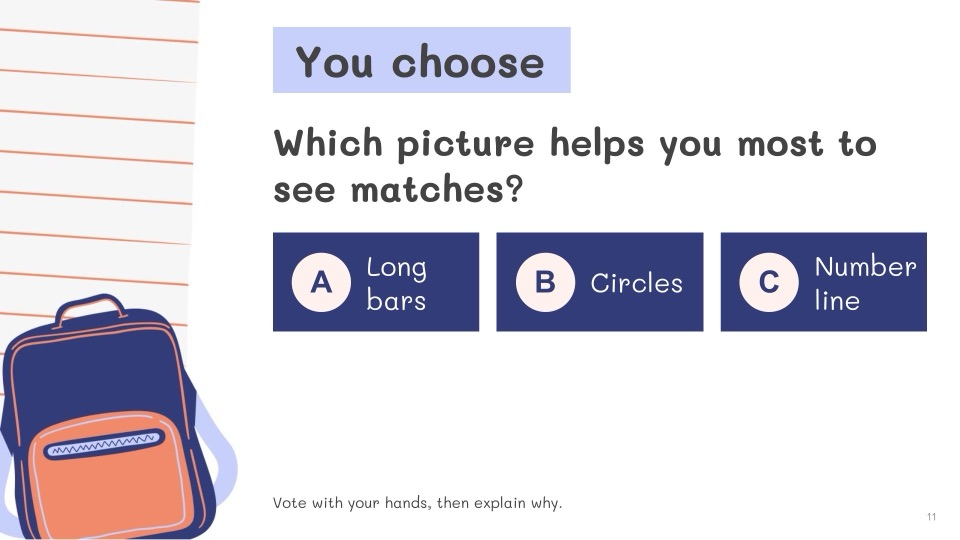
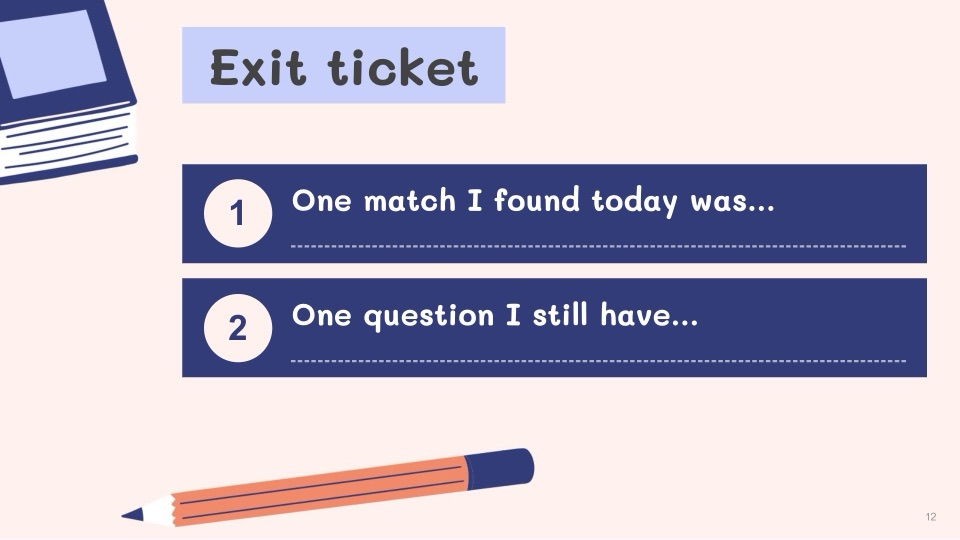
| 10 min | Plenary | To name matches found and check who can recognise and show equivalents. Display posters and read Slide 10 pairs: Half a bar matches two quarters, One third matches two sixths, Two thirds matches four sixths. Run Slide 11 vote: Which picture helps you most to see matches? Long bars, Circles, Number line. Show Slide 12 exit ticket and collect one match and one question from each student. Praise clear same-size bars with equal parts and matching shading. |
Common mistakes
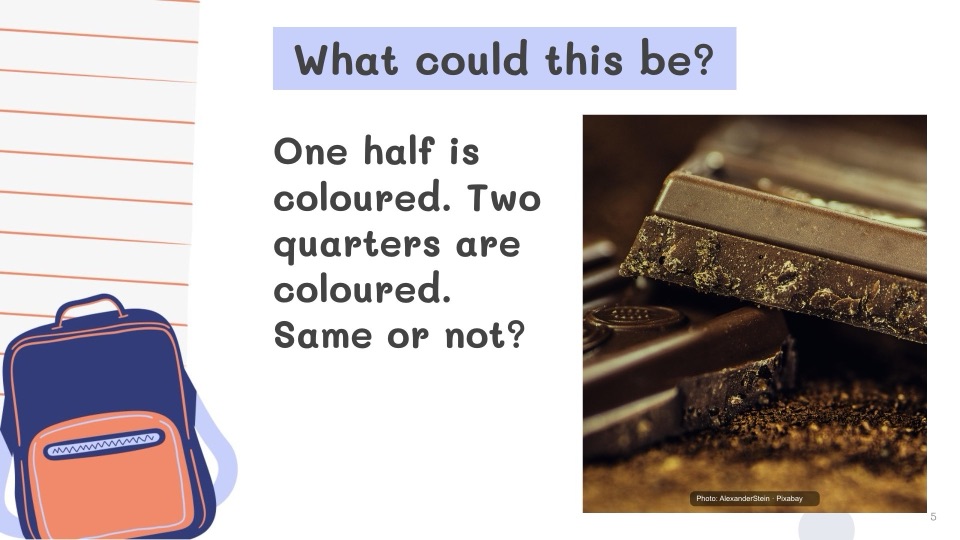
- Thinking 1/2 and 1/4 match because both have 1 on top.
How to spot it: Student keeps pairs with same numerator but different coloured lengths.
Line up same-size bars and compare coloured length; different size means not equivalent. - Changing only the top or only the bottom number to make a match.
How to spot it: Student writes 1/2 = 2/3 or colours 2 parts without re-splitting the whole.
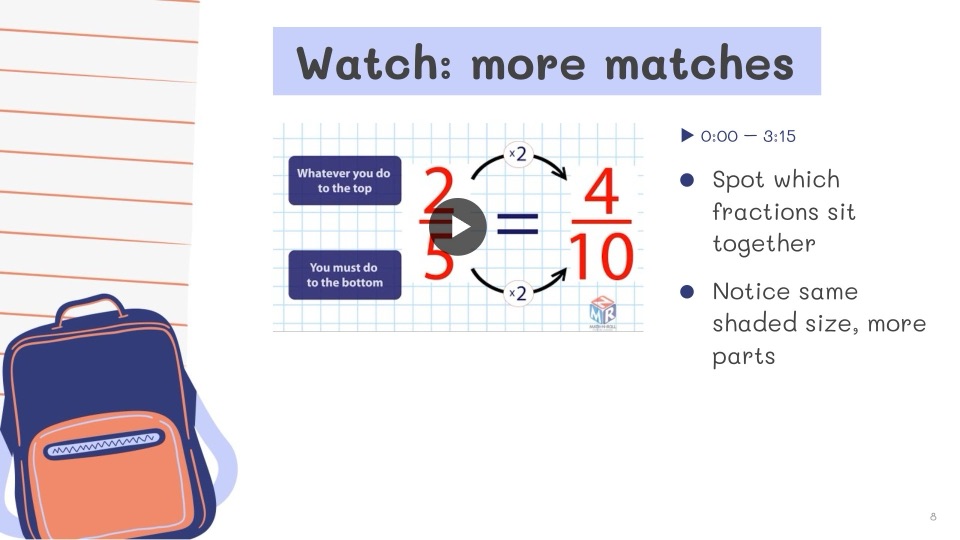
Remind: whatever you do to the numerator, you must also do to the denominator; you only multiply or divide, never add or subtract, to get an equivalent fraction. - Thinking more pieces always means a bigger amount.
How to spot it: Student says 2/4 must be bigger than 1/2 because 4 is bigger than 2.
Show the shaded area remains the same, but each model has been divided into a different number of parts.
Support
- Provide rectangles already split into halves and quarters so students focus on colouring the correct number of parts.
Stretch
- Make a third rectangle to show 3/6 or 4/8 as another twin for 1/2.
Check questions
- Are 1/2 and 2/4 equivalent? How do you know?
Answer: Yes, the coloured length is the same size in same-size bars. - Are 1/2 and 1/4 equivalent?
Answer: No, the coloured parts are different sizes. - Draw two same-size bars to show 1/3 = 2/6.
Answer: One bar split into 3 with 1 shaded, second same-size bar split into 6 with 2 shaded, same shaded length.
Curriculum
recognise and show, using diagrams, equivalent fractions with small denominators
Video clips
Clips on YouTube, from the start and end times we chose. Check each one before you show it.
-
3rd grade equivalent fractions from 0:00 to 5:00
Kids Academy: Equivalent Fractions | Math for 3rd Grade | Kids Academy
Made for 3rd grade aged about 8 so the pace, language and diagrams are ideal for Year 3 aged 7-8 learning to recognise equivalents with small denominators.
-
Grade 3 equivalents from 0:00 to 3:15
MATH-N-ROLL: Equivalent Fractions. Grade 3
Made for Grade 3 aged about 7-8 so it directly matches Year 3 and shows equivalent fractions with simple diagrams.
Worksheet
Sources
- Tuesday Maths equivalent fractions decimals and percentages slingsby.n-yorks.sch.uk
- Equivalent fractions - KS2 Maths resources for Year 4 - BBC bbc.co.uk
- How to find equivalent fractions - BBC Bitesize bbc.co.uk
- Kids Math: Equivalent Fractions - Ducksters ducksters.com
- Flexi answers - How can you tell if a fraction is equivalent? | CK-12 Foundation ck12.org
- Equivalent Fractions For Kids | Fractions With The Same Value learnwithsitesforkids.com
- Equivalent Fractions Explained | Definition, Examples & Quiz ... workybooks.com
- Equivalent Fractions mathsisfun.com
Picture credits
Made with Lesson Dino's AI on 17 October 2026. AI can make mistakes, so check facts against the sources before you teach.