The worksheet
About this worksheet
Pupils learn that perimeter is the distance round a shape. They measure sides in centimetres and add them to find it. This Year 3 Maths worksheet gives students (ages 7–8) five pages of practice on perimeter, part of the measurement unit. It goes with our free Perimeter lesson, which has the slides and a timed lesson plan.
What it covers
By the end, students should be able to:
- Students will measure each straight side of simple 2-D shapes in centimetres.
- Students will add all side lengths together to find the perimeter.
- Students will explain perimeter as the distance all round a shape.
How to use it
- Worksheet practice (12 minutes): Hand out Worksheet Task B and read the instruction together.
- Support: Give shapes with whole centimetre sides and only three or four sides, with start dots marked for where to place the ruler.
- Stretch: Ask pupils to predict the last side before measuring, using what they notice about the other sides.
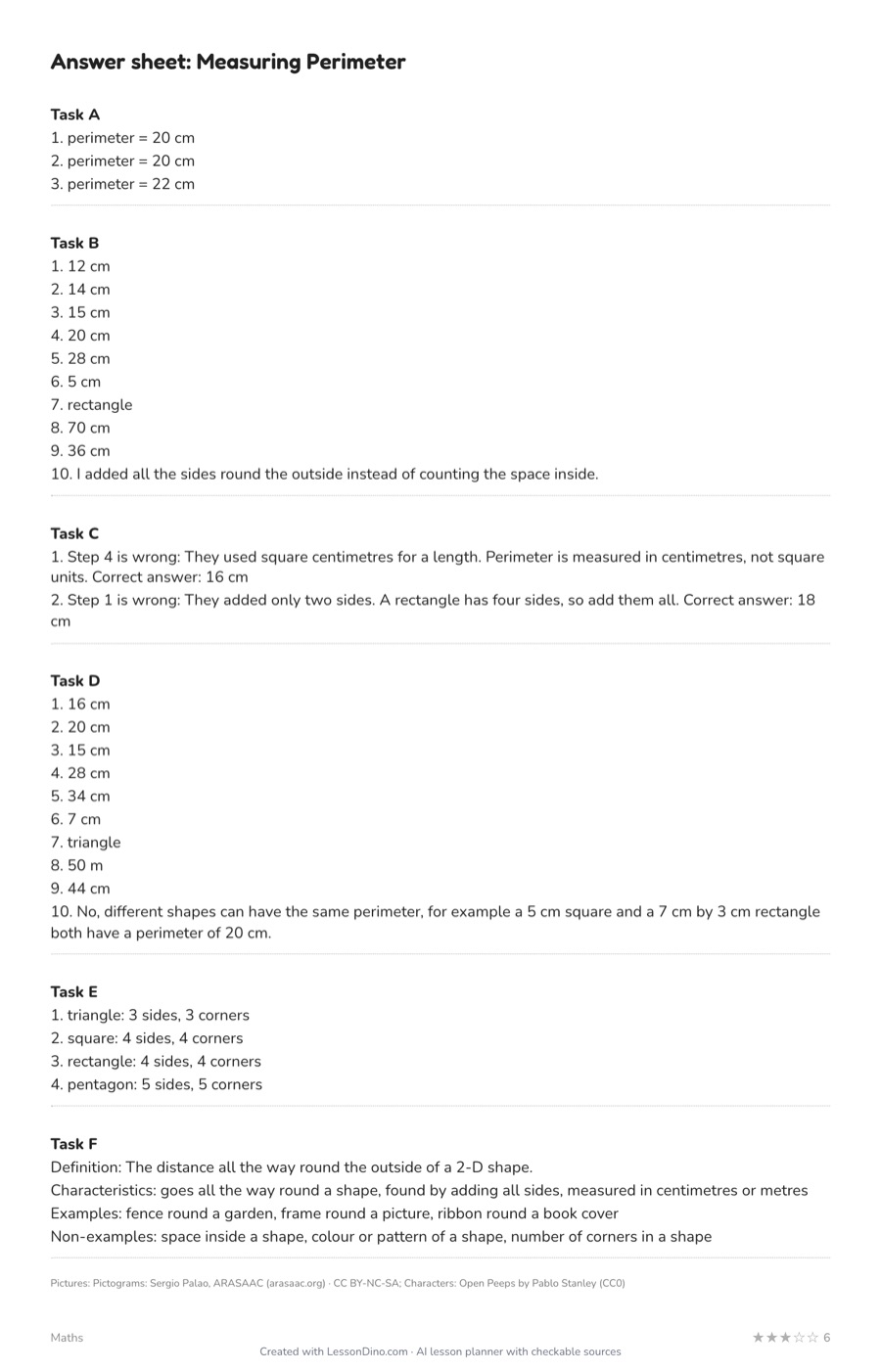
- The answer sheet is the last page, so you can print it on its own or let students check their own work.
Key vocabulary
- perimeter: the distance all round the outside of a shape
- centimetre: a small unit for measuring length, written as cm
- side: one straight edge round a shape
- rectangle: a shape with four corners where opposite edges are equal
- square: a shape with four edges that are all the same length
Mistakes to watch for
- Adding only the two labelled sides, for example 6 cm + 3 cm = 9 cm for a rectangle. Touch and number sides 1 to 4 and remember to include the length of every side.
- Writing the total without units, for example 18 instead of 18 cm. Insist on cm each time because perimeter is a length measured in centimetres and metres.
- Measuring from the 1 cm mark or skipping a side when counting round. Start the ruler at 0 at the dot, tick each side once, and go around the whole shape back to the start.
What's on the worksheet
Walk the Edge!
Learn what perimeter means and try your first shapes.
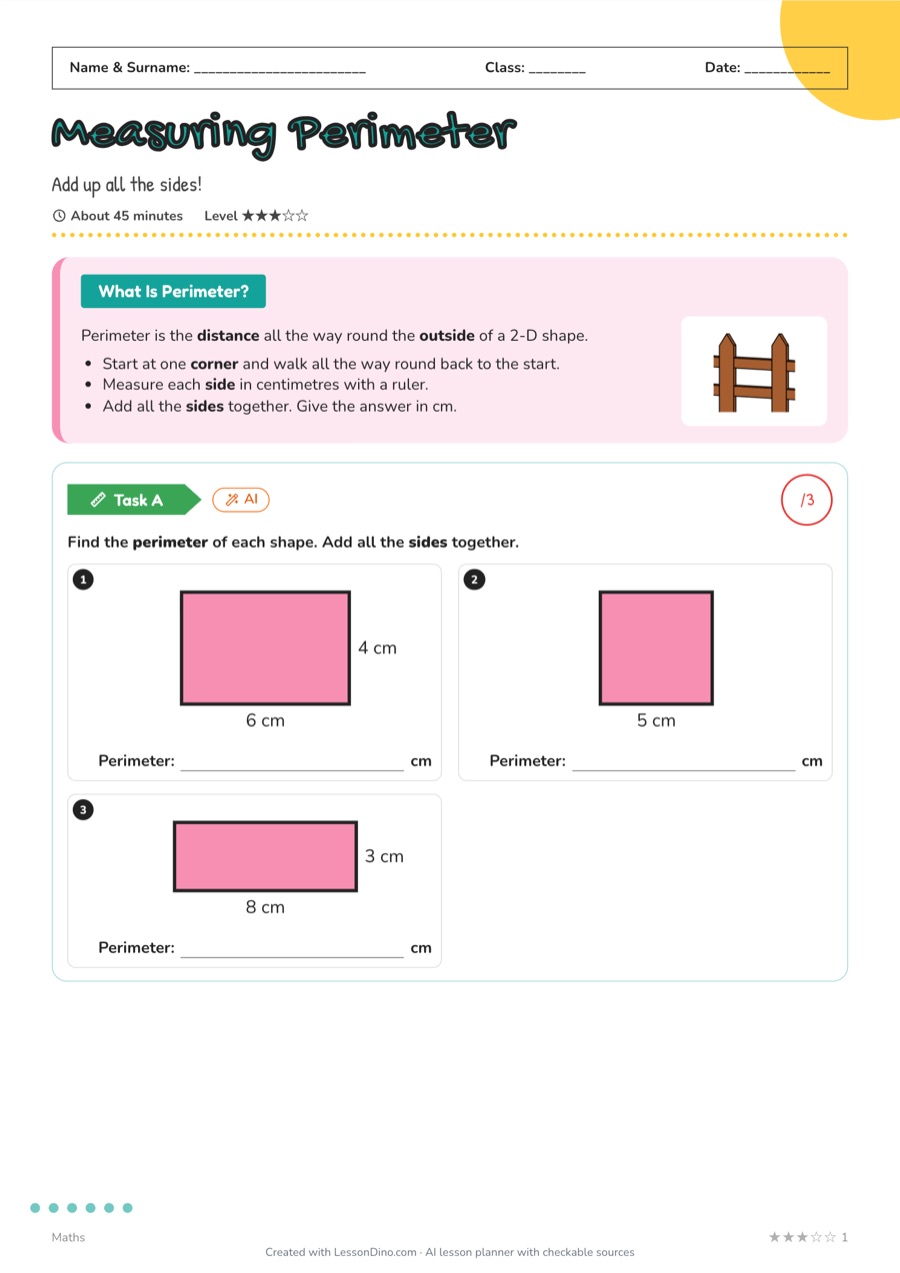
What Is Perimeter?
- Perimeter is the distance all the way round the outside of a 2-D shape.
- Start at one corner and walk all the way round back to the start.
- Measure each side in centimetres with a ruler.
- Add all the sides together. Give the answer in cm.
Find the perimeter of each shape. Add all the sides together.
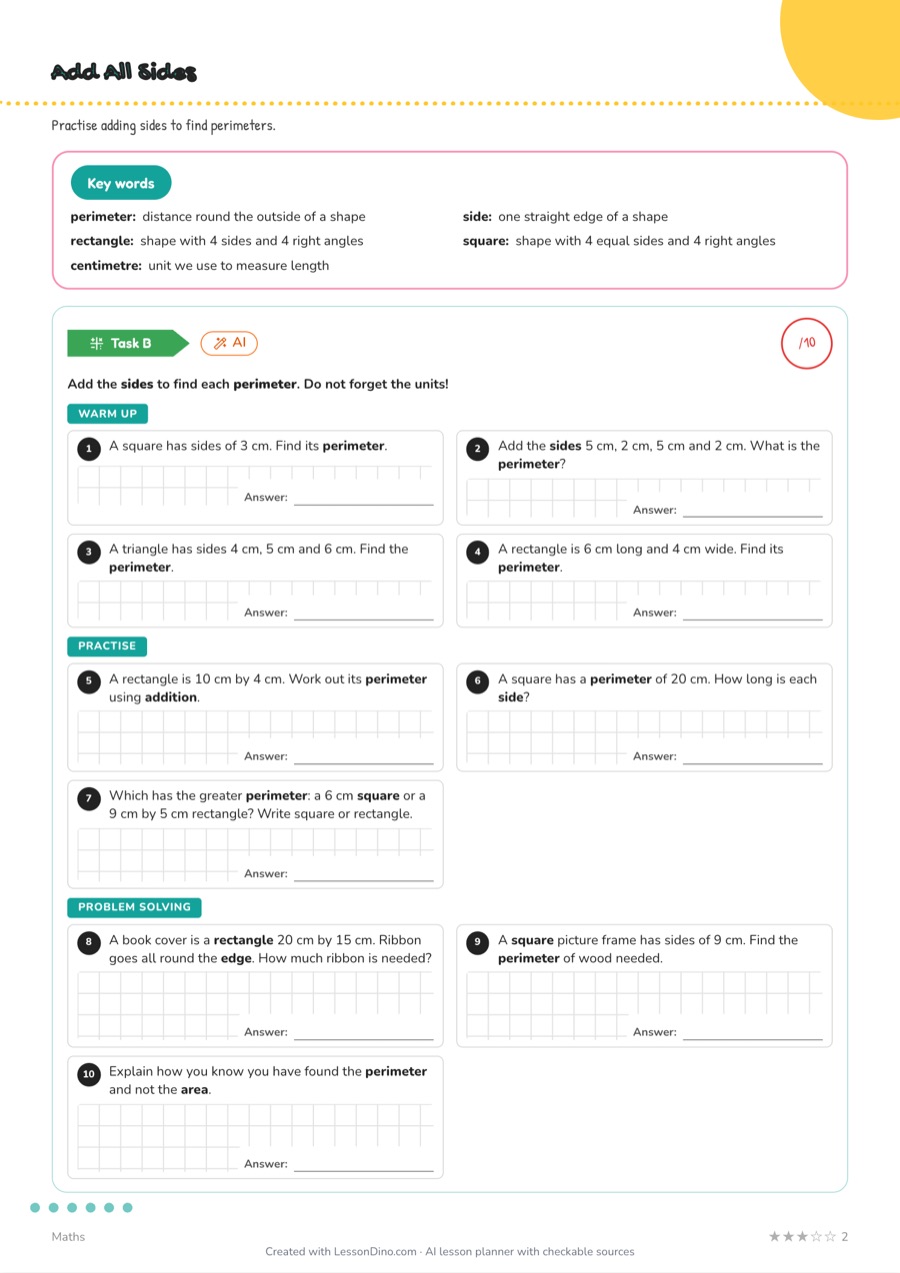
Add All Sides
Practise adding sides to find perimeters.
| Word | Meaning |
|---|---|
| perimeter | distance round the outside of a shape |
| side | one straight edge of a shape |
| rectangle | shape with 4 sides and 4 right angles |
| square | shape with 4 equal sides and 4 right angles |
| centimetre | unit we use to measure length |
Add the sides to find each perimeter. Do not forget the units!
Warm up
- A square has sides of 3 cm. Find its perimeter.
- Add the sides 5 cm, 2 cm, 5 cm and 2 cm. What is the perimeter?
- A triangle has sides 4 cm, 5 cm and 6 cm. Find the perimeter.
- A rectangle is 6 cm long and 4 cm wide. Find its perimeter.
Practise
- A rectangle is 10 cm by 4 cm. Work out its perimeter using addition.
- A square has a perimeter of 20 cm. How long is each side?
- Which has the greater perimeter: a 6 cm square or a 9 cm by 5 cm rectangle? Write square or rectangle.
Problem solving
- A book cover is a rectangle 20 cm by 15 cm. Ribbon goes all round the edge. How much ribbon is needed?
- A square picture frame has sides of 9 cm. Find the perimeter of wood needed.
- Explain how you know you have found the perimeter and not the area.
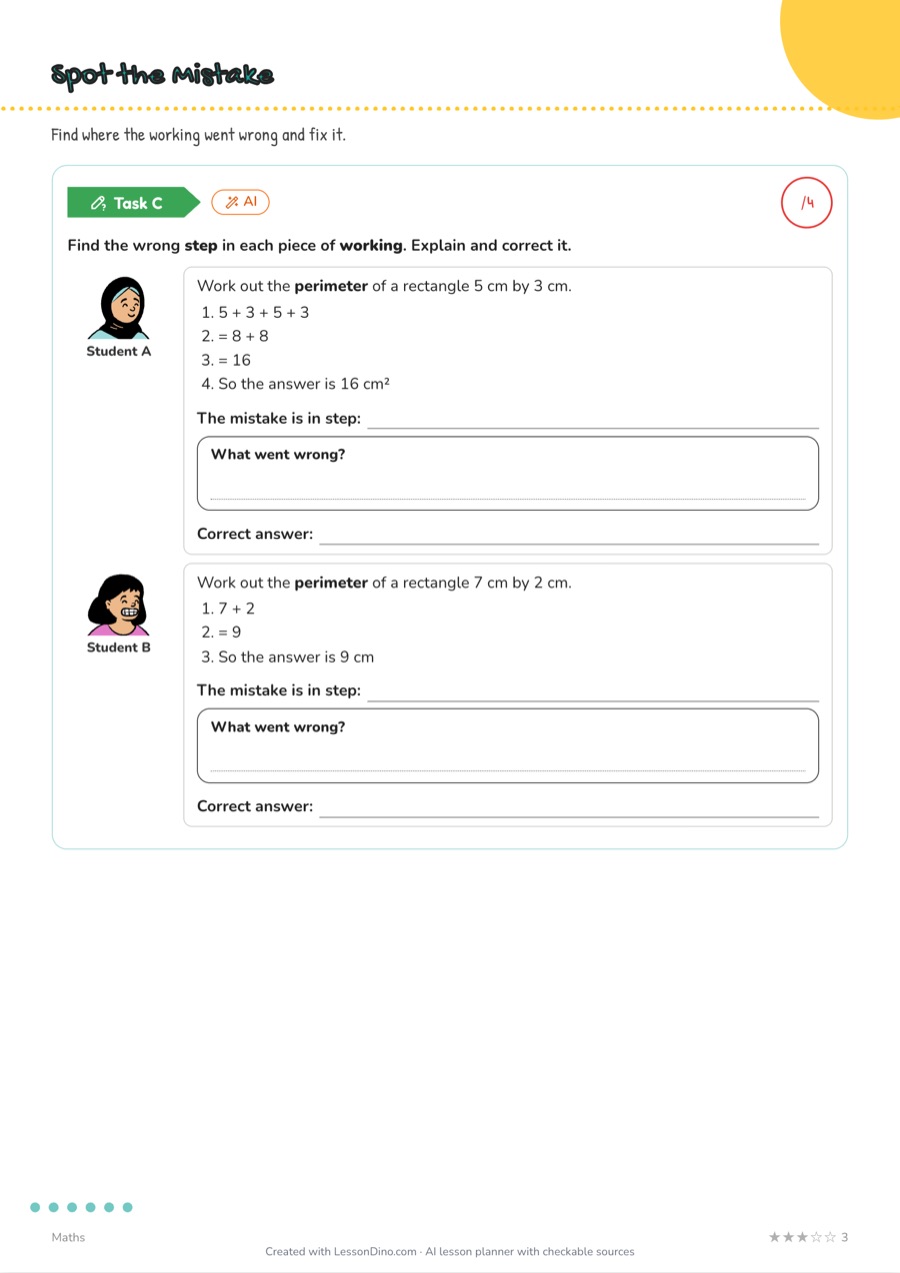
Spot the Mistake
Find where the working went wrong and fix it.
Find the wrong step in each piece of working. Explain and correct it.
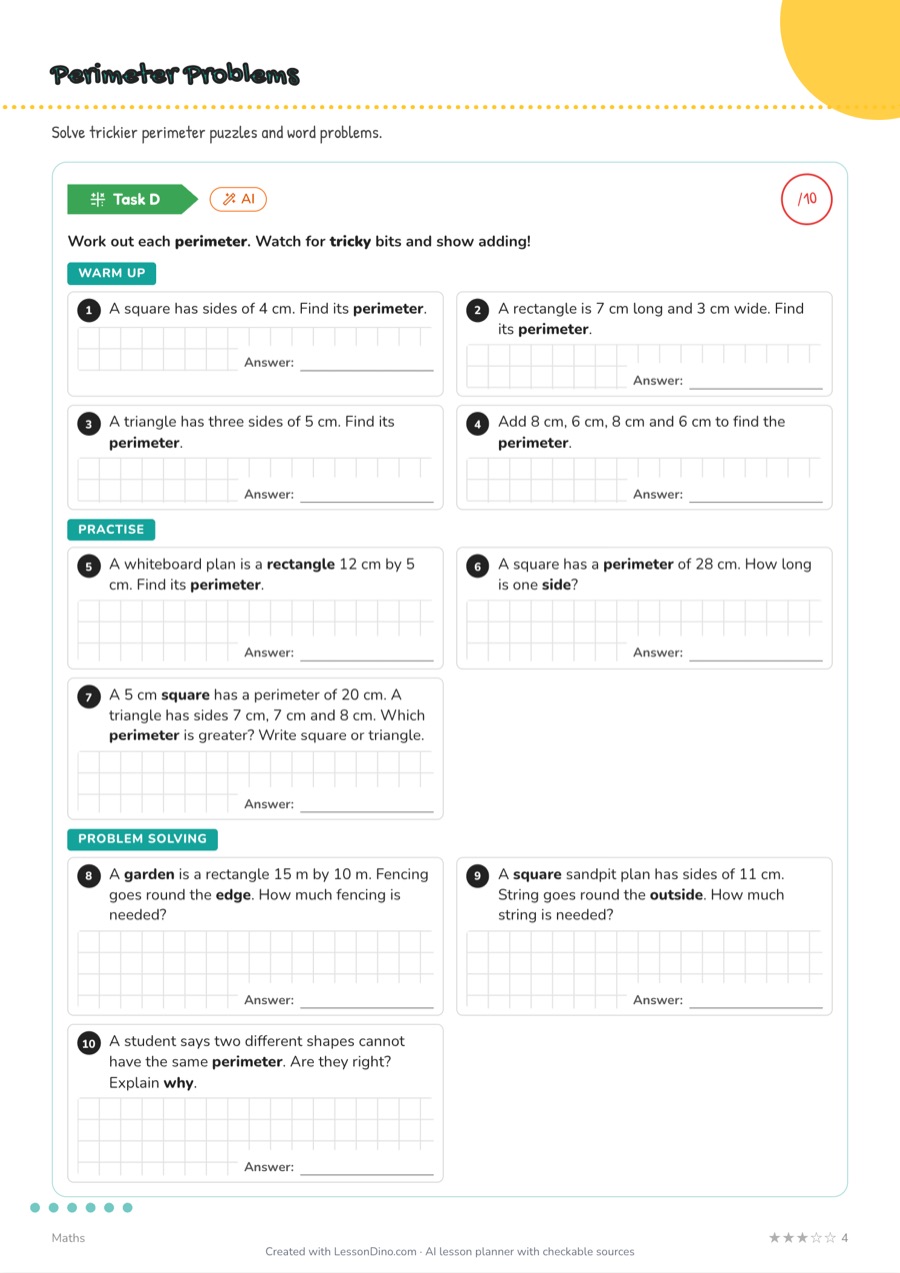
Perimeter Problems
Solve trickier perimeter puzzles and word problems.
Work out each perimeter. Watch for tricky bits and show adding!
Warm up
- A square has sides of 4 cm. Find its perimeter.
- A rectangle is 7 cm long and 3 cm wide. Find its perimeter.
- A triangle has three sides of 5 cm. Find its perimeter.
- Add 8 cm, 6 cm, 8 cm and 6 cm to find the perimeter.
Practise
- A whiteboard plan is a rectangle 12 cm by 5 cm. Find its perimeter.
- A square has a perimeter of 28 cm. How long is one side?
- A 5 cm square has a perimeter of 20 cm. A triangle has sides 7 cm, 7 cm and 8 cm. Which perimeter is greater? Write square or triangle.
Problem solving
- A garden is a rectangle 15 m by 10 m. Fencing goes round the edge. How much fencing is needed?
- A square sandpit plan has sides of 11 cm. String goes round the outside. How much string is needed?
- A student says two different shapes cannot have the same perimeter. Are they right? Explain why.
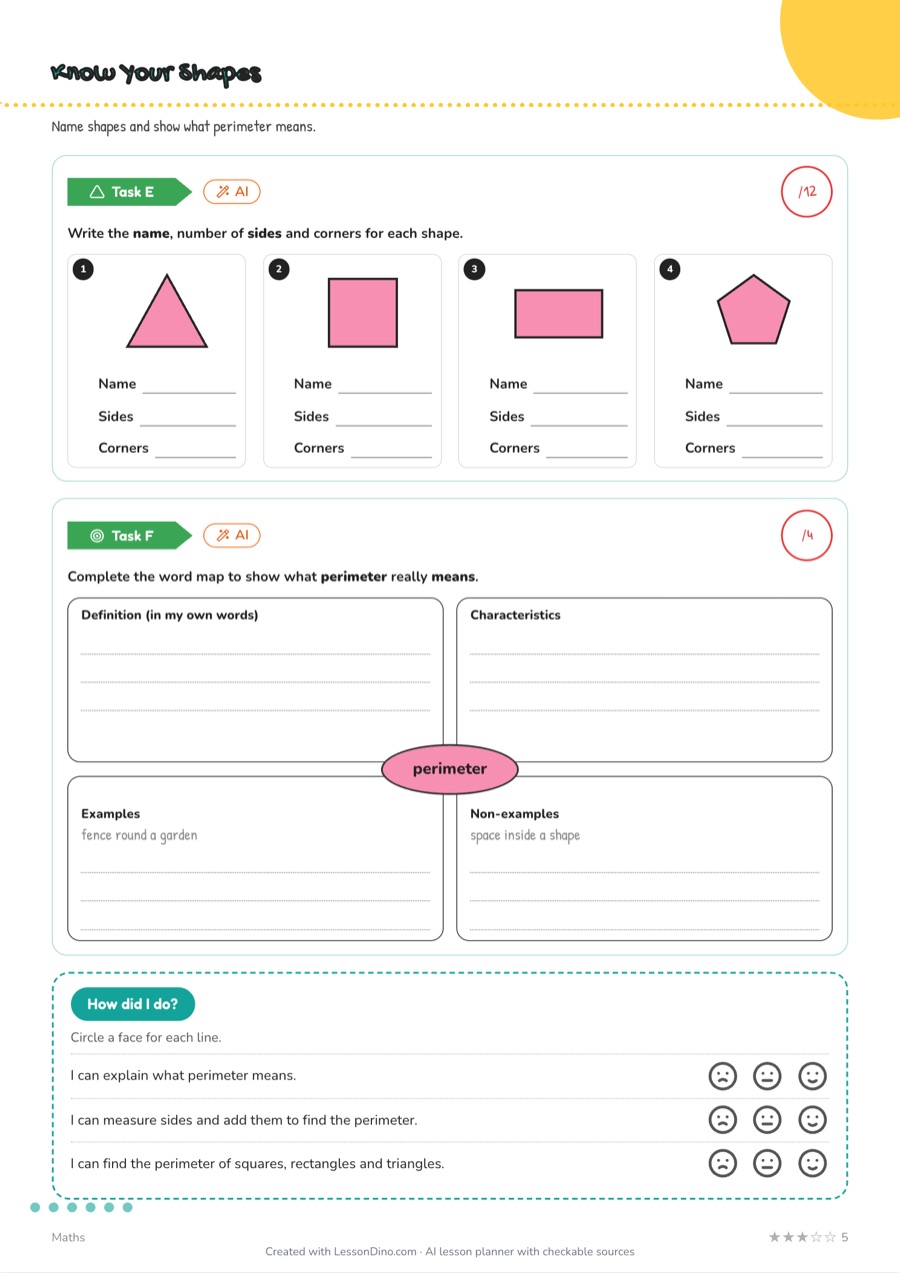
Know Your Shapes
Name shapes and show what perimeter means.
Write the name, number of sides and corners for each shape.
Complete the word map to show what perimeter really means.
Answers
Show the answers
- A square has sides of 3 cm. Find its perimeter. 12 cm
- Add the sides 5 cm, 2 cm, 5 cm and 2 cm. What is the perimeter? 14 cm
- A triangle has sides 4 cm, 5 cm and 6 cm. Find the perimeter. 15 cm
- A rectangle is 6 cm long and 4 cm wide. Find its perimeter. 20 cm
- A rectangle is 10 cm by 4 cm. Work out its perimeter using addition. 28 cm
- A square has a perimeter of 20 cm. How long is each side? 5 cm
- Which has the greater perimeter: a 6 cm square or a 9 cm by 5 cm rectangle? Write square or rectangle. rectangle
- A book cover is a rectangle 20 cm by 15 cm. Ribbon goes all round the edge. How much ribbon is needed? 70 cm
- A square picture frame has sides of 9 cm. Find the perimeter of wood needed. 36 cm
- Explain how you know you have found the perimeter and not the area. I added all the sides round the outside instead of counting the space inside.
- A square has sides of 4 cm. Find its perimeter. 16 cm
- A rectangle is 7 cm long and 3 cm wide. Find its perimeter. 20 cm
- A triangle has three sides of 5 cm. Find its perimeter. 15 cm
- Add 8 cm, 6 cm, 8 cm and 6 cm to find the perimeter. 28 cm
- A whiteboard plan is a rectangle 12 cm by 5 cm. Find its perimeter. 34 cm
- A square has a perimeter of 28 cm. How long is one side? 7 cm
- A 5 cm square has a perimeter of 20 cm. A triangle has sides 7 cm, 7 cm and 8 cm. Which perimeter is greater? Write square or triangle. triangle
- A garden is a rectangle 15 m by 10 m. Fencing goes round the edge. How much fencing is needed? 50 m
- A square sandpit plan has sides of 11 cm. String goes round the outside. How much string is needed? 44 cm
- A student says two different shapes cannot have the same perimeter. Are they right? Explain why. No, different shapes can have the same perimeter, for example a 5 cm square and a 7 cm by 3 cm rectangle both have a perimeter of 20 cm.
The answer sheet is the last picture above.
Curriculum
measure the perimeter of simple 2-D shapes
Made with Lesson Dino's AI on 17 October 2026. AI can make mistakes, so check the answers and facts against the sources before you teach.