The worksheet
About this worksheet
Students learn to cite several clues for explicit meaning and inferences. They practice finding proof and then solve a text mystery as detectives. This Grade 7 ELA worksheet gives students (ages 12–13) six pages of practice on reading comprehension: citing evidence, part of the reading literature unit. It goes with our free Reading comprehension: citing evidence lesson, which has the slides and a timed lesson plan.
What it covers
By the end, students should be able to:
- Students will cite two or more clues for what text says directly.
- Students will cite two or more clues to support an inference.
- Students will explain how each clue supports the analysis in writing.
How to use it
- Starter (8 minutes): Lead Worksheet Task A talk with no writing about evidence and inferences.
- Guided practice (12 minutes): Guide Worksheet Task B: fill the wide column with quotes and short paraphrases plus paragraph numbers, drawing upon evidence from literary text. Lead Worksheet Task E to compare which quote gives strongest support for the same claim.
- Support: Give a version with three key sentences already underlined so students choose from those.
- Stretch: Ask students to add a third piece of evidence that argues against a different inference and explain why theirs is stronger.
- The answer sheet is the last page, so you can print it on its own or let students check their own work.
Key vocabulary
- evidence: clues from the words that prove an idea is true
- explicit: said clearly and directly by the author
- inference: a smart guess made by combining clues and what you know
- quote: exact words copied from the text
- paraphrase: saying the author's idea again using your own words
Mistakes to watch for
- Using only one piece of evidence for a claim. Require a different line or paragraph and remind to consider a wider range of textual evidence.
- Confusing what is stated directly with an inference. Ask: Does the author say it directly or did you combine clues? Sort into Said It or Hinted It.
- Copying long or unrelated details instead of short proof. Limit to three to seven words and ask how it proves the idea using quotes and paraphrases.
What's on the worksheet
Evidence Proves Ideas
Learn what strong textual evidence looks like.
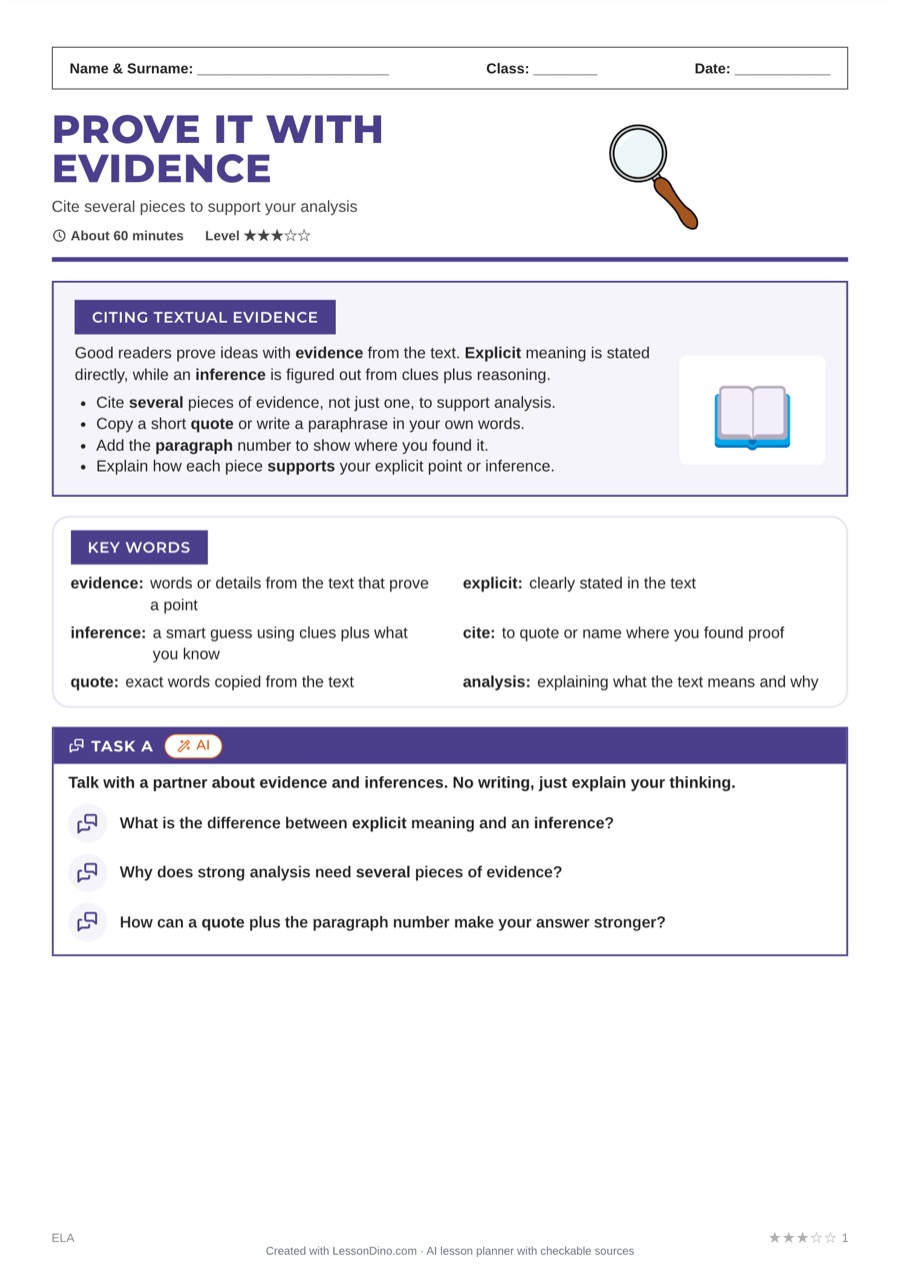
Citing Textual Evidence
- Good readers prove ideas with evidence from the text. Explicit meaning is stated directly, while an inference is figured out from clues plus reasoning.
- Cite several pieces of evidence, not just one, to support analysis.
- Copy a short quote or write a paraphrase in your own words.
- Add the paragraph number to show where you found it.
- Explain how each piece supports your explicit point or inference.
| Word | Meaning |
|---|---|
| evidence | words or details from the text that prove a point |
| explicit | clearly stated in the text |
| inference | a smart guess using clues plus what you know |
| cite | to quote or name where you found proof |
| quote | exact words copied from the text |
| analysis | explaining what the text means and why |
Talk with a partner about evidence and inferences. No writing, just explain your thinking.
- What is the difference between explicit meaning and an inference?
- Why does strong analysis need several pieces of evidence?
- How can a quote plus the paragraph number make your answer stronger?
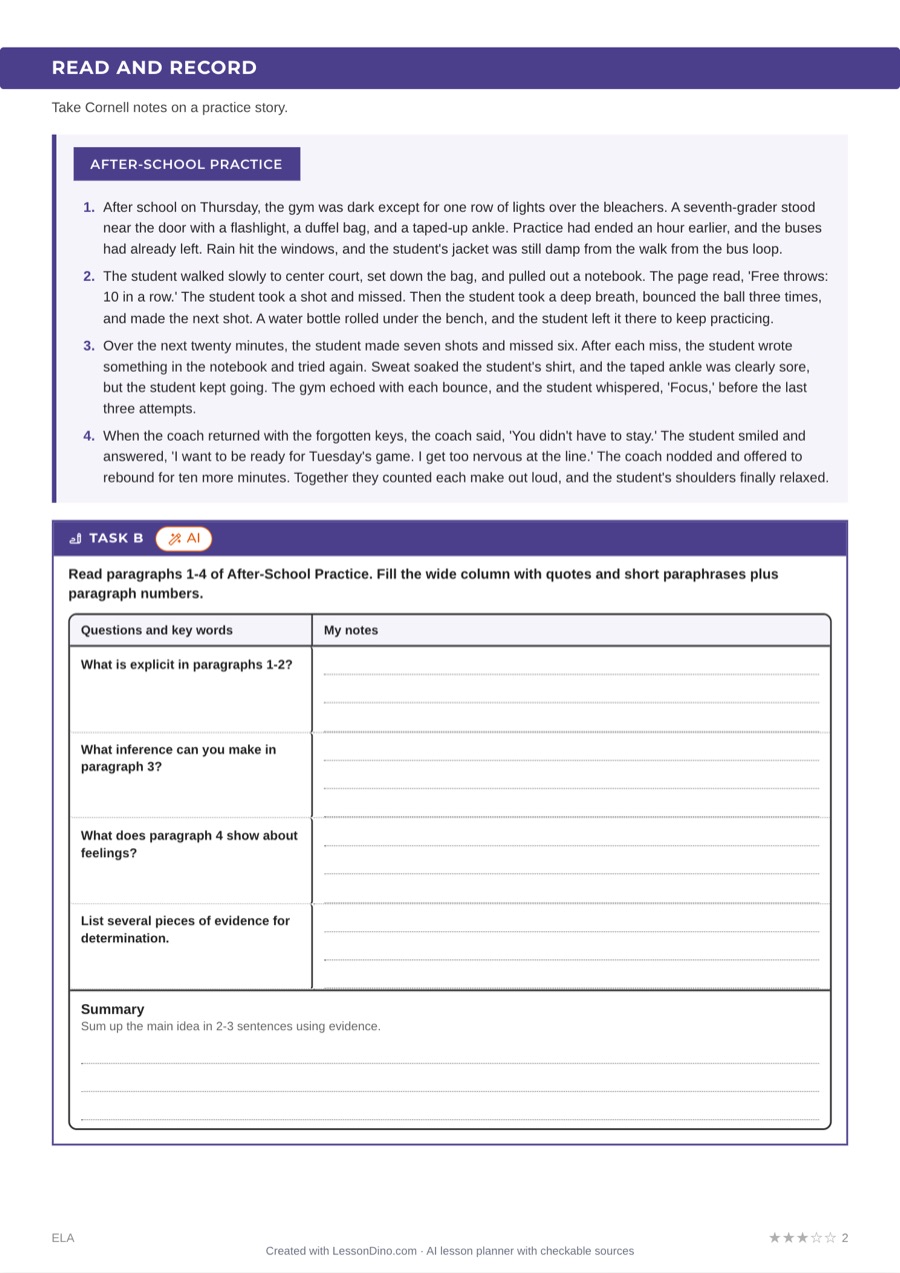
Read and Record
Take Cornell notes on a practice story.
After-School Practice
Read paragraphs 1-4 of After-School Practice. Fill the wide column with quotes and short paraphrases plus paragraph numbers.
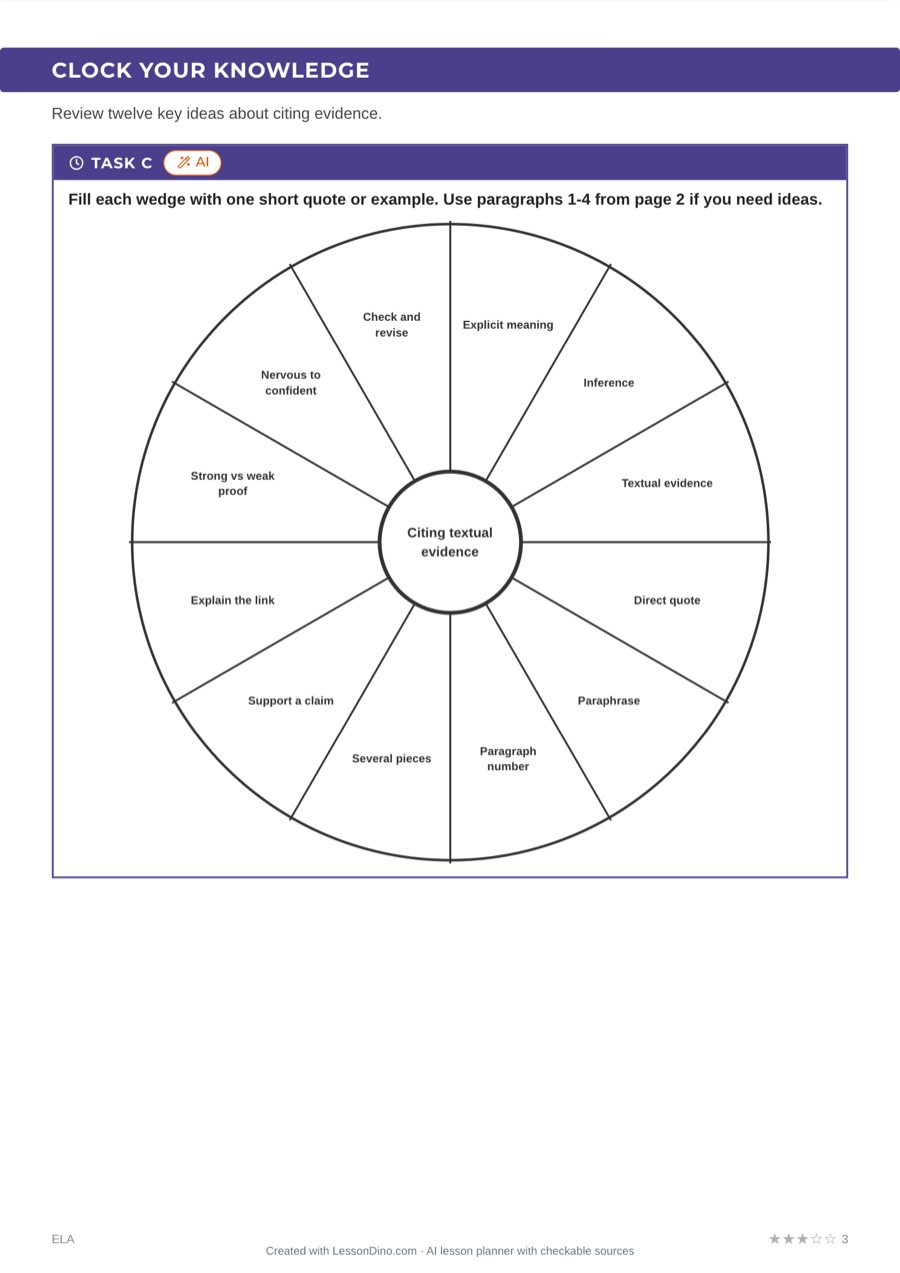
Clock Your Knowledge
Review twelve key ideas about citing evidence.
Fill each wedge with one short quote or example. Use paragraphs 1-4 from page 2 if you need ideas.
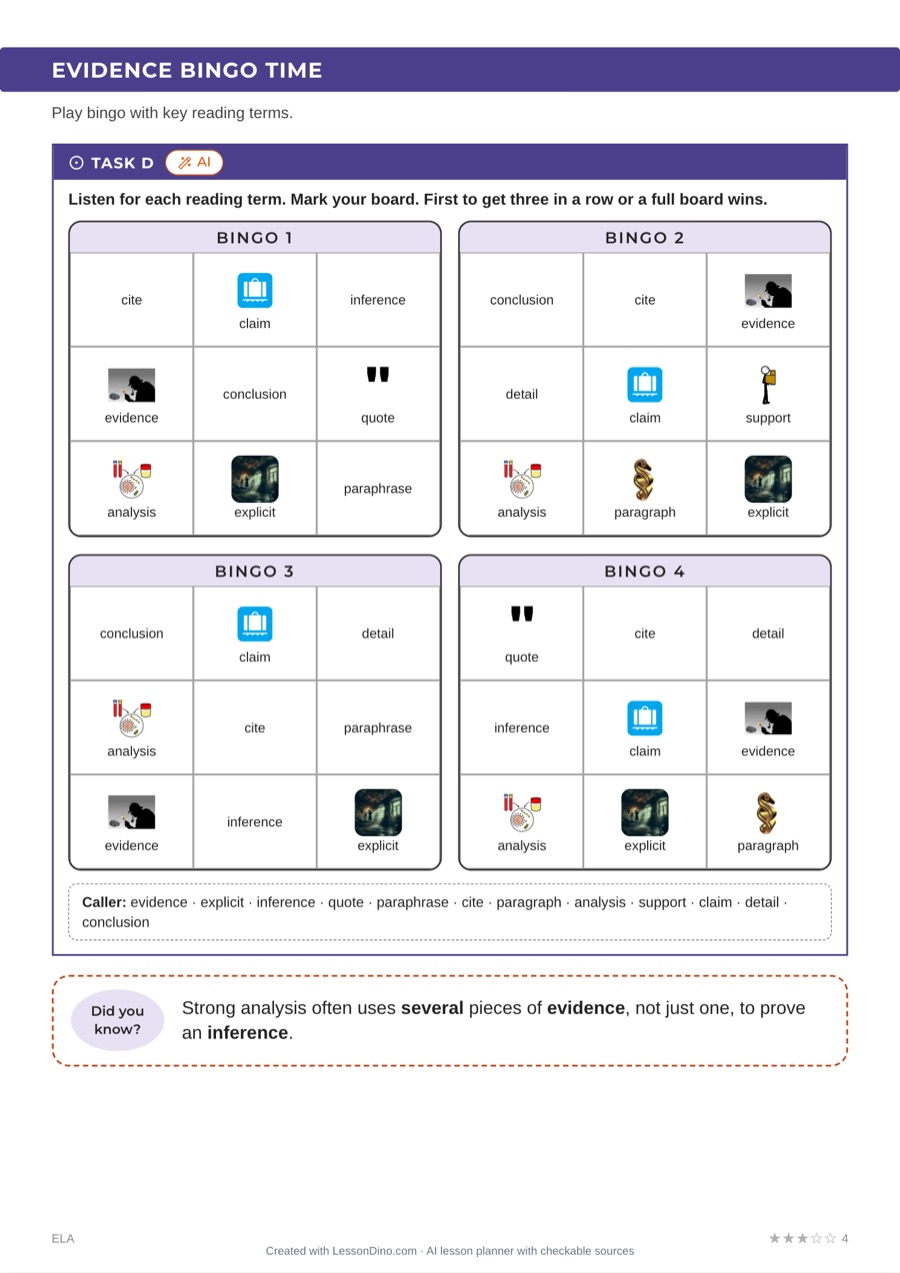
Evidence Bingo Time
Play bingo with key reading terms.
Listen for each reading term. Mark your board. First to get three in a row or a full board wins.
- Strong analysis often uses several pieces of evidence, not just one, to prove an inference.
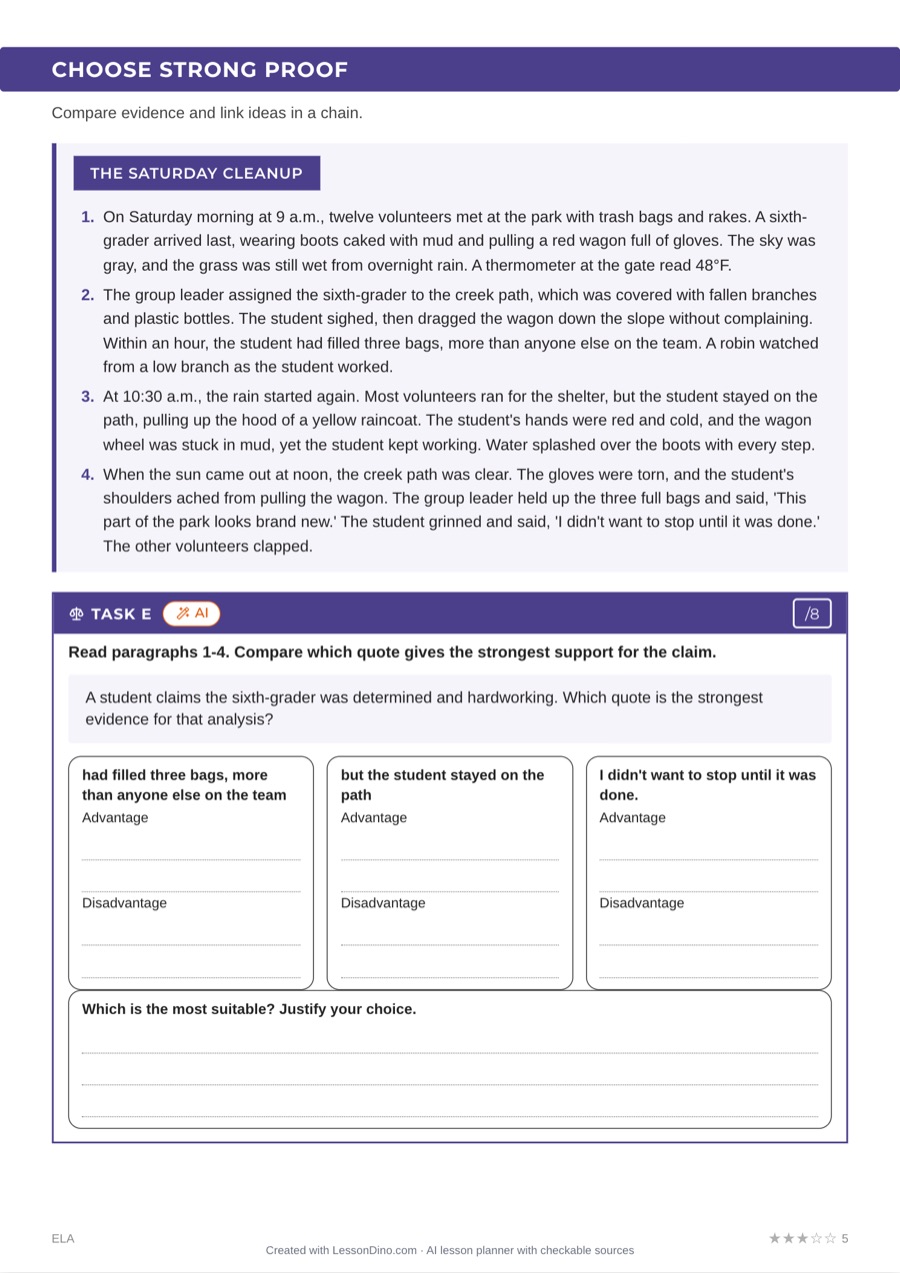
Choose Strong Proof
Compare evidence and link ideas in a chain.
The Saturday Cleanup
Read paragraphs 1-4. Compare which quote gives the strongest support for the claim.
Page 6
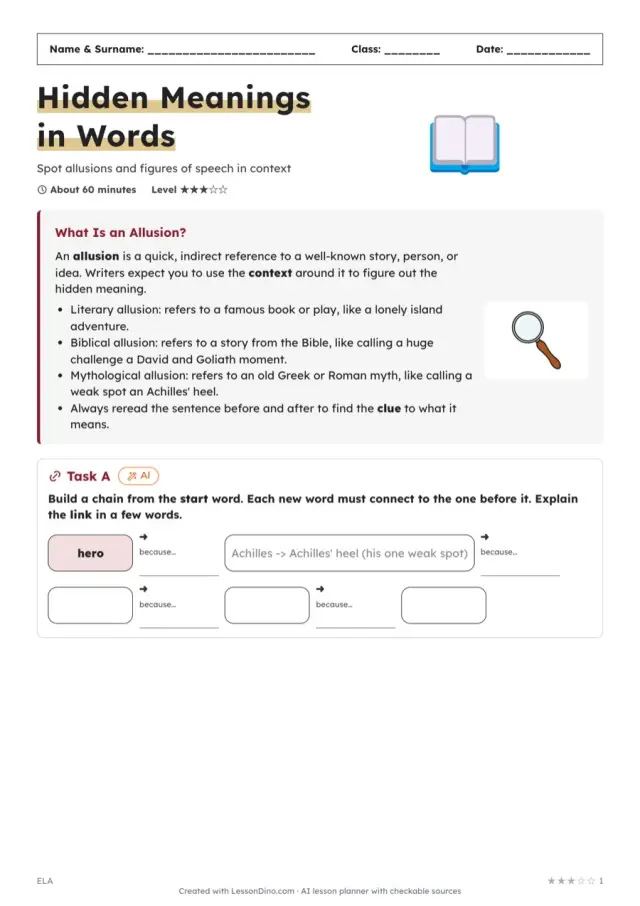
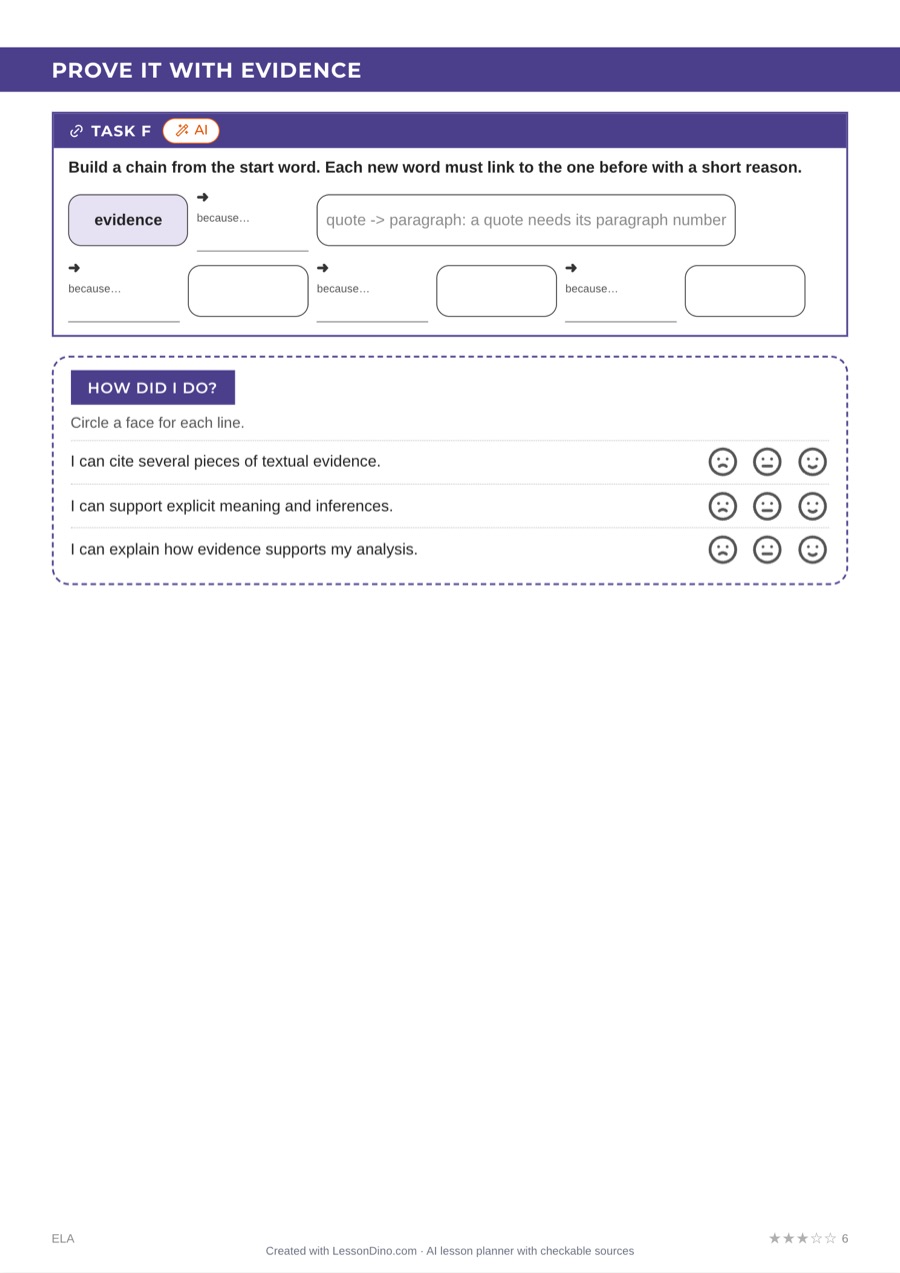
Build a chain from the start word. Each new word must link to the one before with a short reason.
Answers
Show the answers
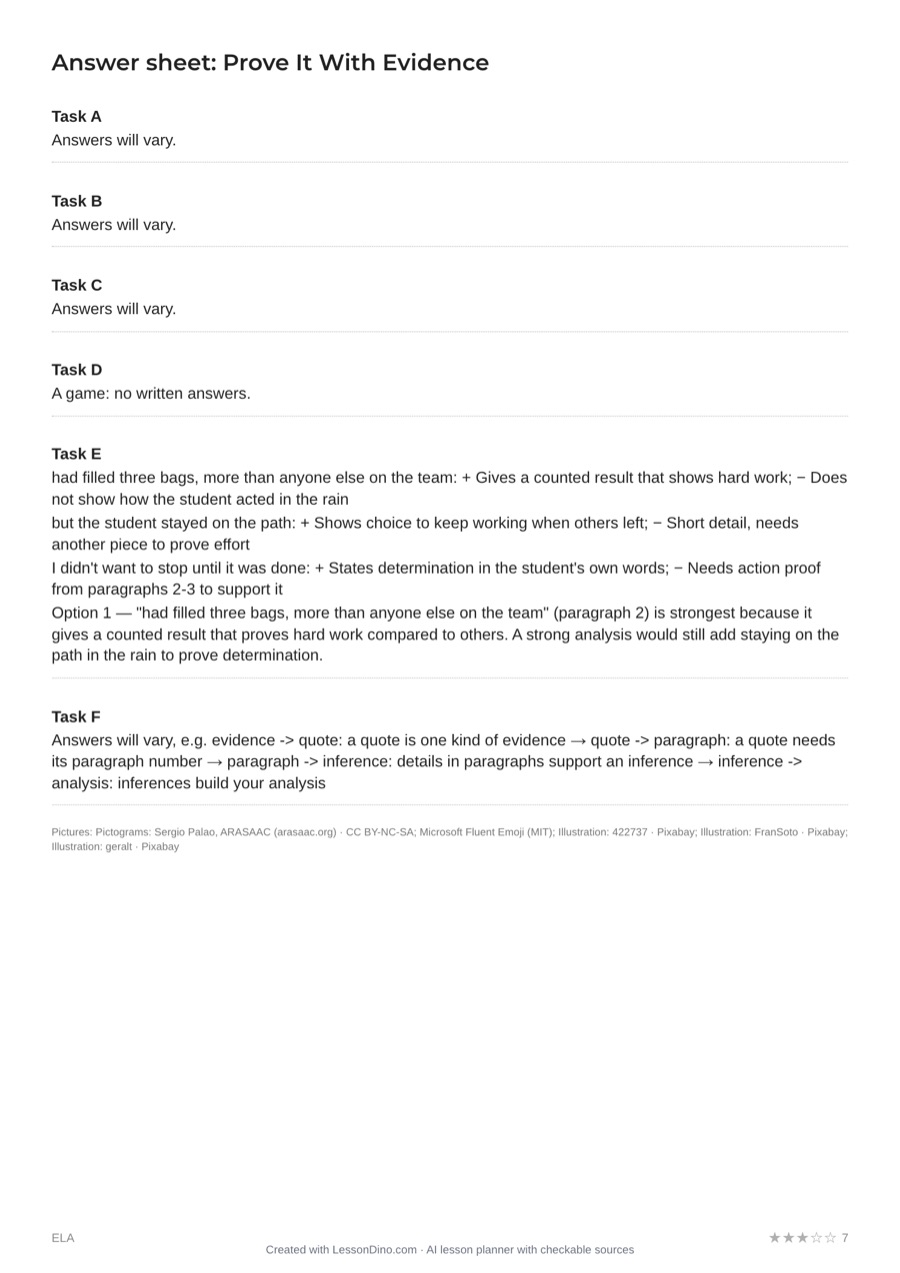
The answers are on the answer sheet, the last picture above.
Curriculum
Cite several pieces of textual evidence to support analysis of what the text says explicitly as well as inferences drawn from the text.
Made with Lesson Dino's AI on 17 October 2026. AI can make mistakes, so check the answers and facts against the sources before you teach.