Slides
Lesson plan
Prove It Twice With Text Clues
Students learn to cite several clues for explicit meaning and inferences. They practice finding proof and then solve a text mystery as detectives.
Objectives
- Students will cite two or more clues for what text says directly.
- Students will cite two or more clues to support an inference.
- Students will explain how each clue supports the analysis in writing.
Success criteria
- I can point to two quotes for an explicit detail.
- I can use two clues to prove an inference.
- I can explain how my evidence supports my idea.
Key words
| Word | Meaning |
|---|---|
| evidence | clues from the words that prove an idea is true |
| explicit | said clearly and directly by the author |
| inference | a smart guess made by combining clues and what you know |
| quote | exact words copied from the text |
| paraphrase | saying the author's idea again using your own words |
Timed plan (60 minutes)
| Time | Stage | What happens |
|---|---|---|
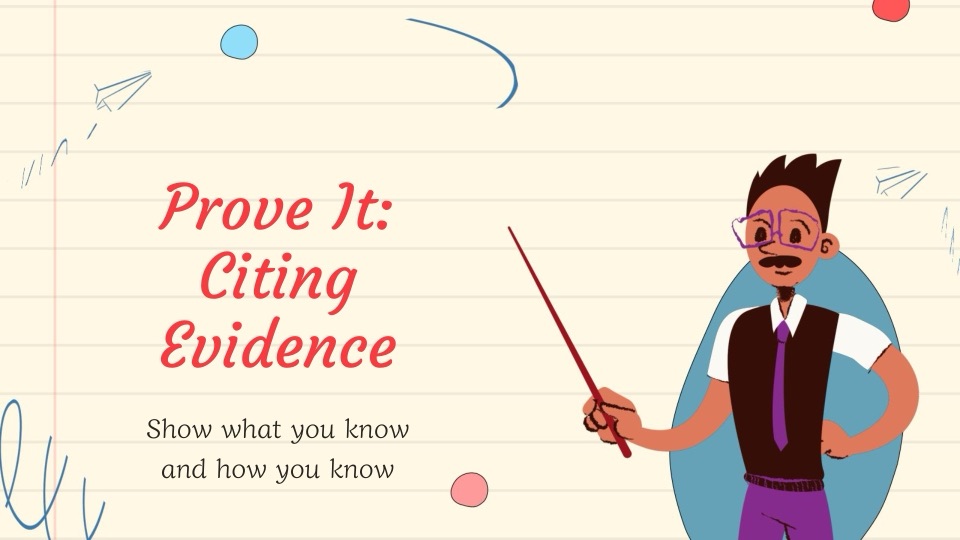
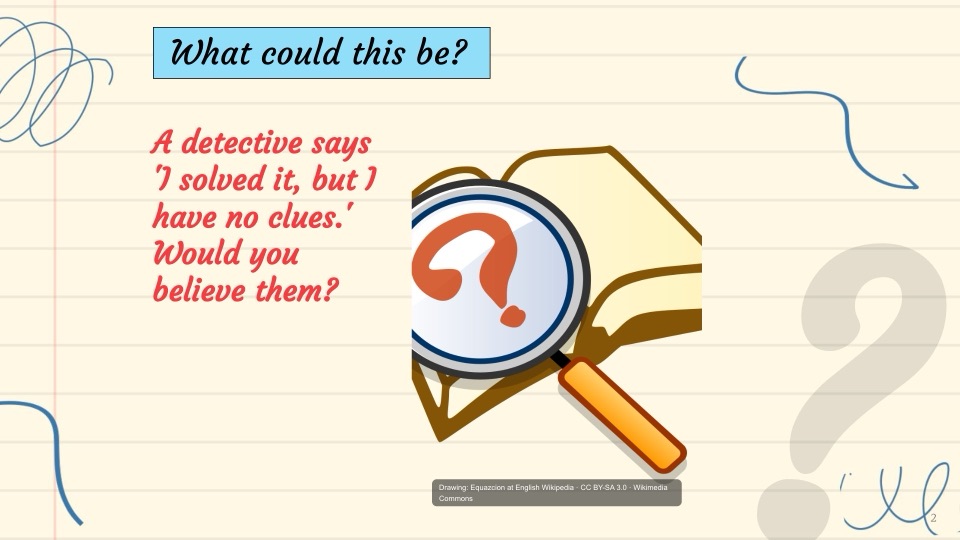
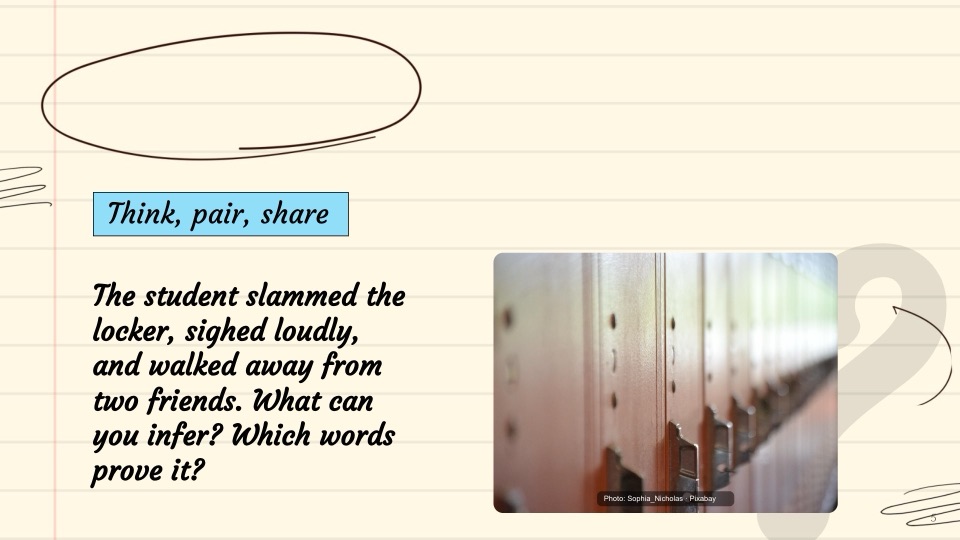
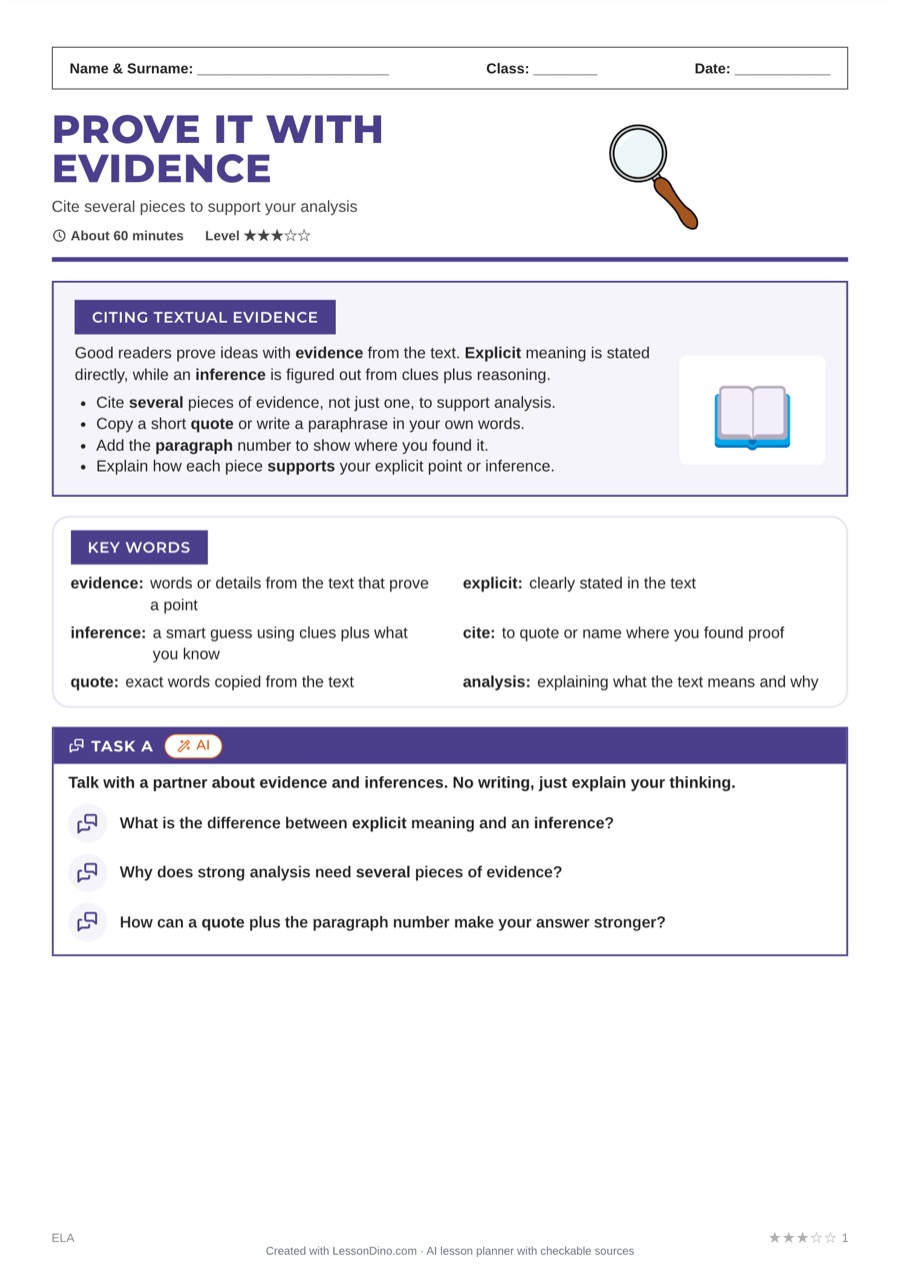
| 8 min | Starter | To hook students on needing several clues and recall explicit versus inference. Show Slide 1 Prove It: Citing Evidence and read title Show what you know and how you know. Show Slide 2 mystery: A detective says 'I solved it, but I have no clues.' Would you believe them? Say hook: The trash can tipped over in the hall. I know who did it, but I can't prove it unless you find me two clues from the report. Show Slide 5 question and read it aloud for think, pair, share. Lead Worksheet Task A talk with no writing about evidence and inferences. |
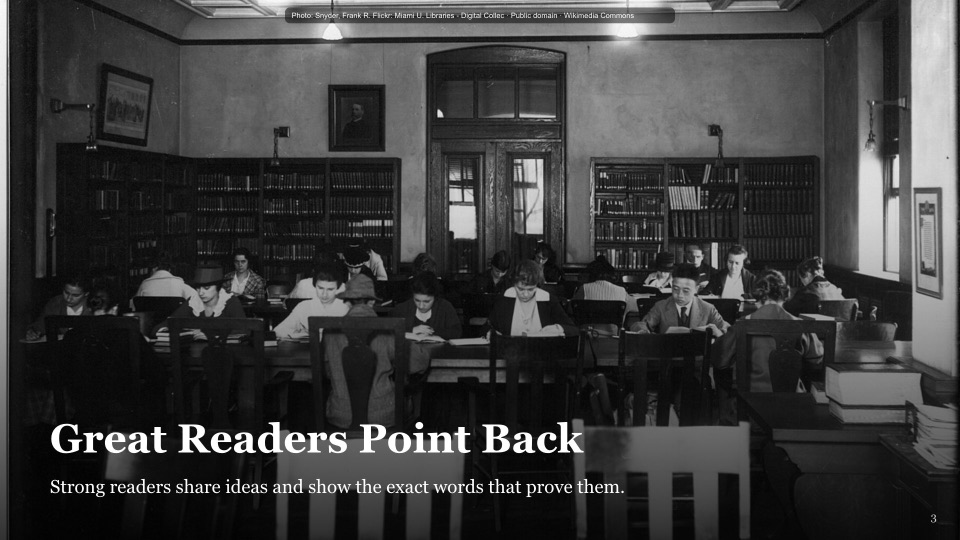
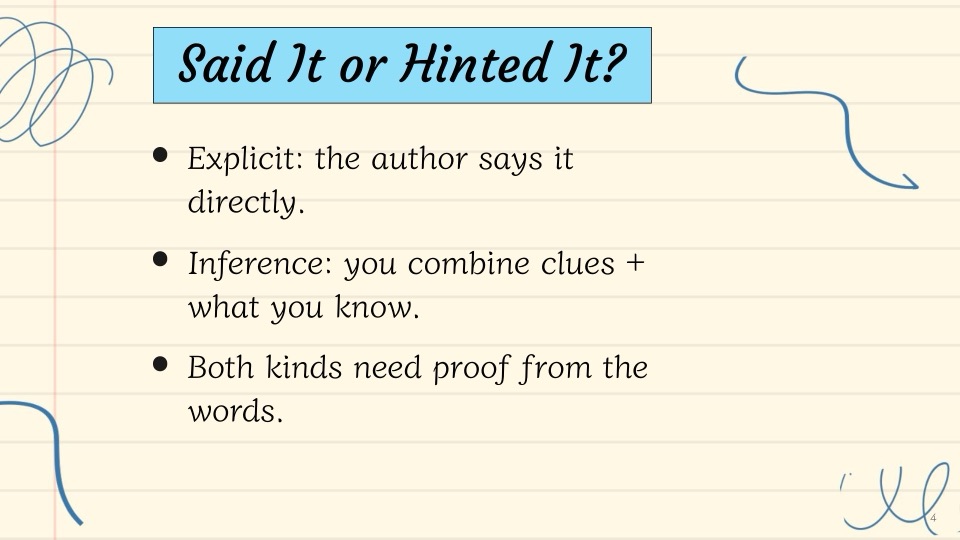
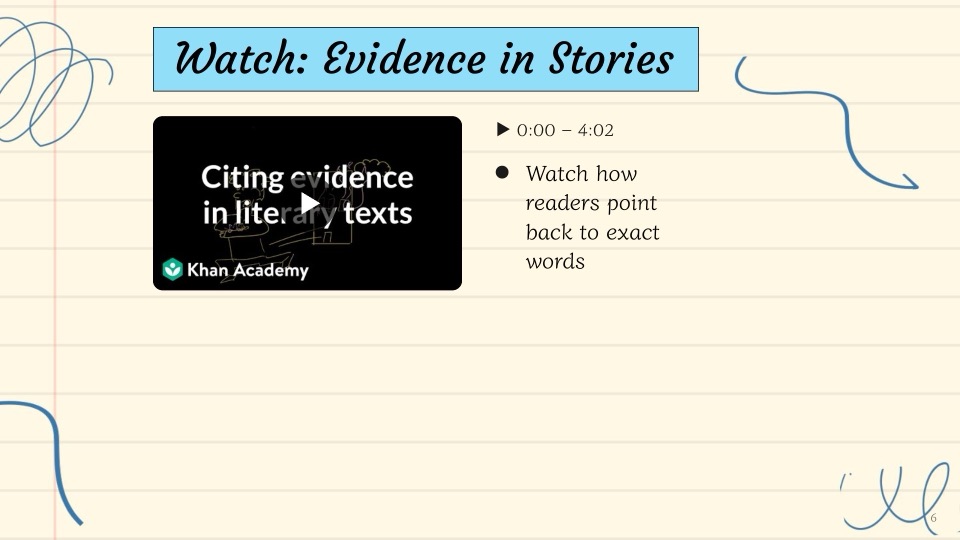
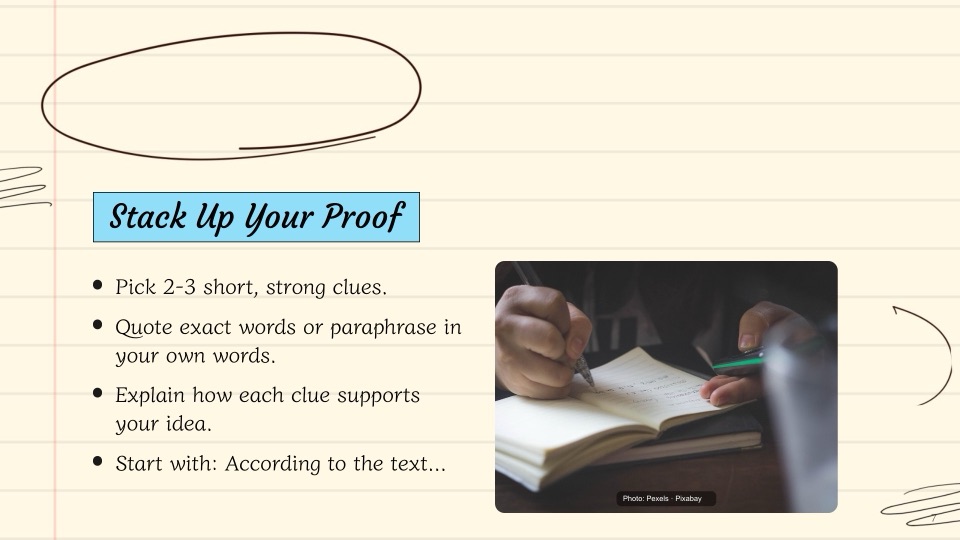
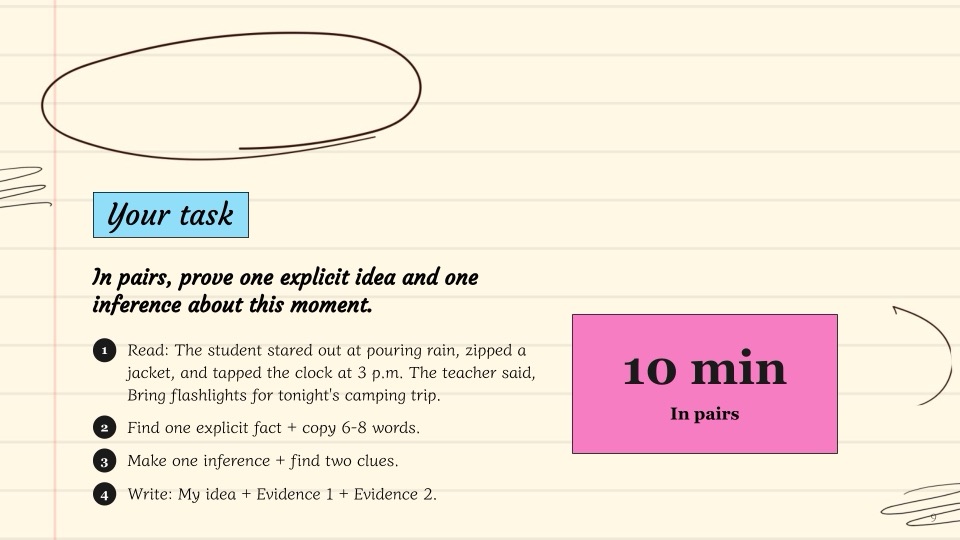
| 12 min | Teaching | To model how to pick two to three short clues and explain the link. Show Slide 3 photo and Slide 4 bullets: Explicit: the author says it directly. Inference: you combine clues + what you know. Both kinds need proof from the words. Play Video clip 1 Citing evidence in literary texts (0:00-4:02) on Slide 6 and pause to note pointing to exact words. Model with Slide 9 text using think-aloud and stack-up steps, considering a wider range of textual evidence. Show Slide 7 bullets and model starter According to the text with quote and paraphrase as forms of evidence. |
| 12 min | Guided practice | To practice together finding several quotes with paragraph numbers in a story. Hand out After-School Practice paragraphs 1-4 and read paragraph 1 aloud while students follow. Guide Worksheet Task B: fill the wide column with quotes and short paraphrases plus paragraph numbers, drawing upon evidence from literary text. Model paragraph 4 inference about nervousness with two clues, building comprehension alongside vocabulary use. Lead Worksheet Task E to compare which quote gives strongest support for the same claim. |
| 20 min | Main activity | To cite two pieces of evidence each for an explicit point and an inference. Hand out short mystery paragraph and detective evidence log handout with pencils. Read paragraph aloud once, then have pairs reread and underline explicit and inference clues using quotes and paraphrases. Direct pairs to complete log: claim, Evidence 1, Evidence 2, and one sentence explaining how the evidence supports it. Circulate to check for two separate quotes and push for wider range of evidence. |
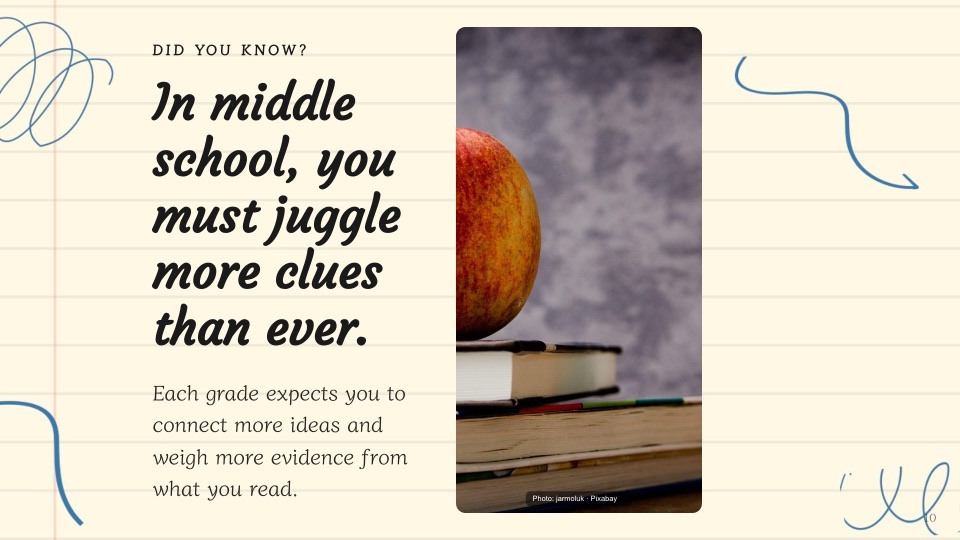
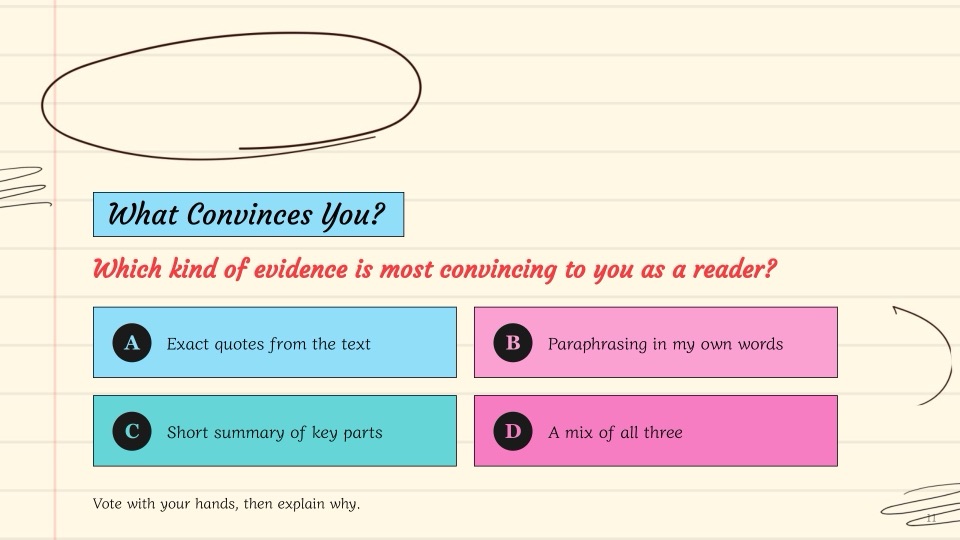
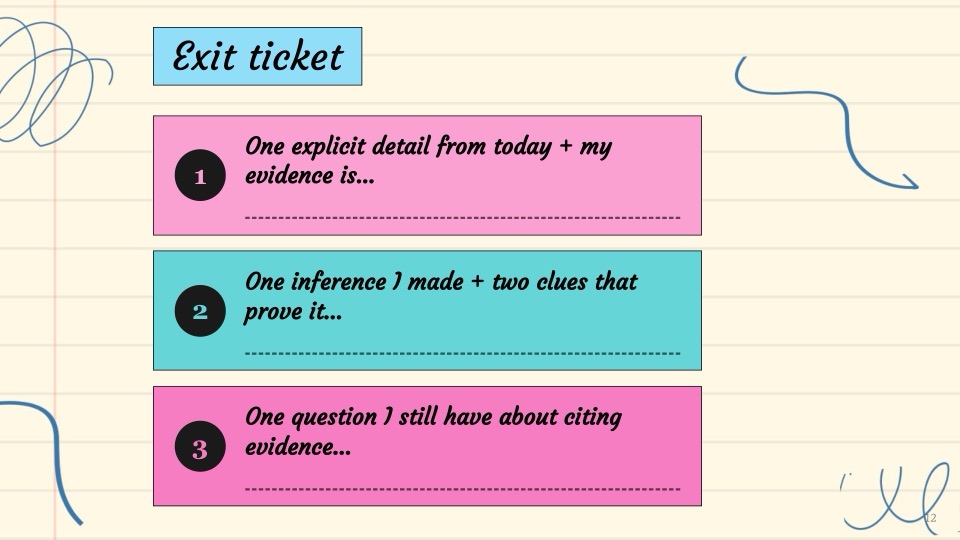
| 8 min | Plenary | To review convincing evidence and check citing for explicit and inference. Show Slide 10 fact and remind class each grade expects more connections and more evidence. Run Slide 11 vote: Which kind of evidence is most convincing to you as a reader? Exact quotes, paraphrasing, summary, mix. Hand out Slide 12 exit ticket for independent writing. Preview that strong writers draw upon and write about evidence from literary and informational texts. |
Common mistakes
- Using only one piece of evidence for a claim
How to spot it: Log shows Evidence 2 blank or same quote repeated
Require a different line or paragraph and remind to consider a wider range of textual evidence - Confusing what is stated directly with an inference
How to spot it: Student labels a guess as explicit even though words do not say it
Ask: Does the author say it directly or did you combine clues? Sort into Said It or Hinted It - Copying long or unrelated details instead of short proof
How to spot it: Evidence is a whole paragraph or off-topic detail like the robin
Limit to three to seven words and ask how it proves the idea using quotes and paraphrases
Support
- Give a version with three key sentences already underlined so students choose from those.
- Provide sentence starters and paragraph numbers for hunting clues.
Stretch
- Ask students to add a third piece of evidence that argues against a different inference and explain why theirs is stronger.
- Require ranking three pieces from strongest to weakest and defending the order.
Check questions
- Give one explicit detail from After-School Practice and the words that prove it.
Answer: Practice had ended an hour earlier / buses had already left, paragraph 1. - Make one inference about the student and give two clues that prove it.
Answer: Student is nervous but determined; I get too nervous at the line and kept going / wrote and tried again. - Why do you need several pieces of evidence and how do you show the link?
Answer: Several clues make analysis convincing; quote or paraphrase then explain how each supports the idea.
Curriculum
Cite several pieces of textual evidence to support analysis of what the text says explicitly as well as inferences drawn from the text.
Video clips
Clips on YouTube, from the start and end times we chose. Check each one before you show it.
-
Citing evidence in literary texts from 0:00 to 4:02
Khan Academy: Citing evidence in literary texts | Reading | Khan Academy
Directly about citing evidence in literary texts with vocabulary and pace made for 12-13-year-olds.
-
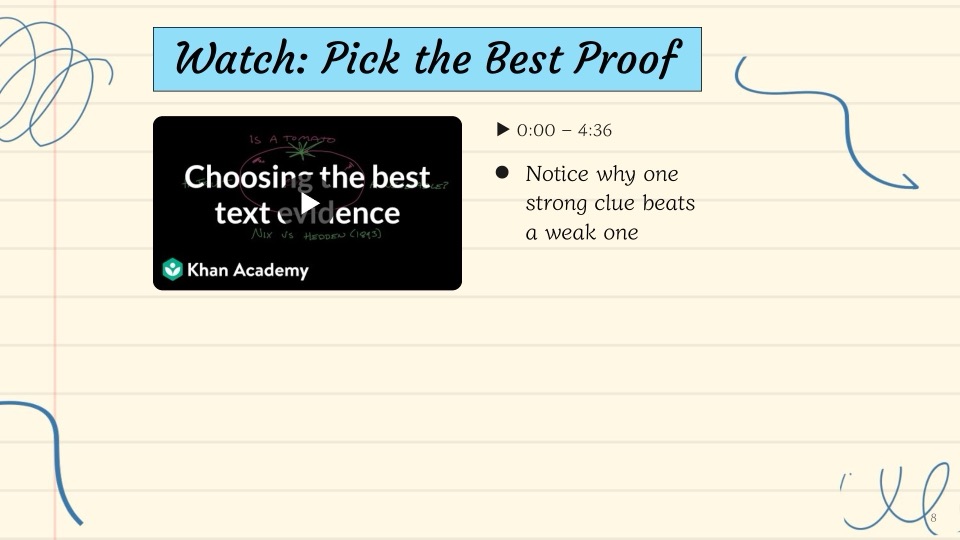
Choosing the best text evidence from 0:00 to 4:36
Khan Academy: Choosing the best text evidence | Reading | Khan Academy
Teaches choosing several strong pieces of evidence, perfect for Grade 7 analysis at age 12-13.
Worksheet
Sources
- How to Read the Standards thecorestandards.org
- Foundational Skills (K-5) cps.edu
- Reading - Wikipedia en.m.wikipedia.org
- Reading, Berkshire - Wikipedia en.m.wikipedia.org
- Citing Evidence From the Text Worksheets: Building Evidence ... worksheetzone.org
Picture credits
- Photo: sasint · Pixabay
- Drawing: Equazcion at English Wikipedia · CC BY-SA 3.0 · Wikimedia Commons
- Photo: Snyder, Frank R. Flickr: Miami U. Libraries - Digital Collec · Public domain · Wikimedia Commons
- Photo: Sophia_Nicholas · Pixabay
- Photo: Pexels · Pixabay
- Photo: jarmoluk · Pixabay
- Microsoft Fluent Emoji (MIT)
- Illustration: 422737 · Pixabay
- Illustration: FranSoto · Pixabay
- Pictograms: Sergio Palao, ARASAAC (arasaac.org) · CC BY-NC-SA
- Illustration: geralt · Pixabay
Made with Lesson Dino's AI on 17 October 2026. AI can make mistakes, so check facts against the sources before you teach.