Slides
Lesson plan
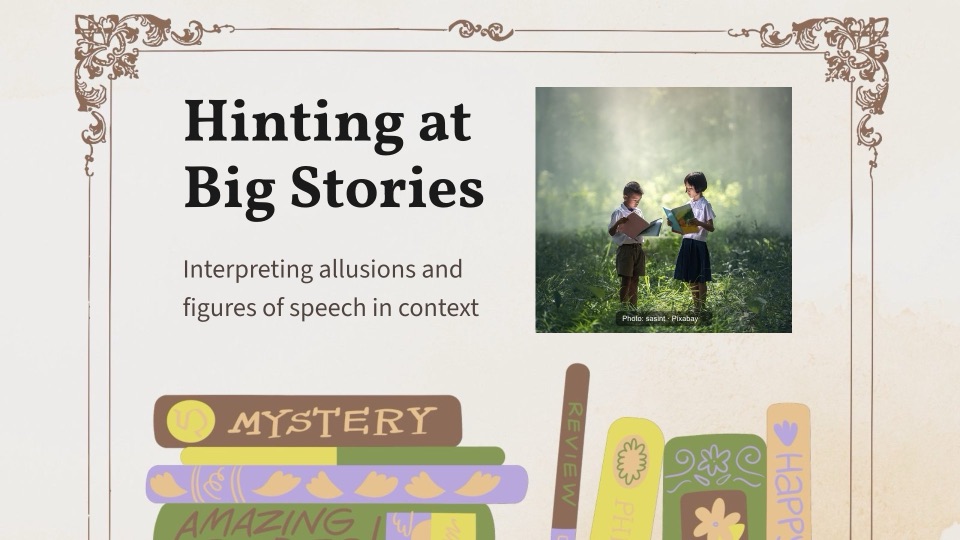
Hinting at Big Stories
Students learn to interpret literary, biblical, and mythological allusions in context. They sort examples in groups and prove meanings with clue words.
Objectives
- Students will interpret literary, biblical, and mythological allusions using context clues.
- Students will classify allusions by type and explain clues that show meaning.
Success criteria
- I can say what an allusion means in context in my own words.
- I can name its type and point to clue words as proof.
Key words
| Word | Meaning |
|---|---|
| allusion | a short hint that borrows a well-known story |
| figure of speech | words that mean more than just the plain words |
| context | the words and situation around a hint |
| interpret | to say what something means in this place |
Timed plan (60 minutes)
| Time | Stage | What happens |
|---|---|---|
| 5 min | Starter | To hook curiosity and recall that short hints can borrow big stories. Show Slide 1 title: Hinting at Big Stories. Say the hook and show Slide 2 fact that a few words can borrow a whole story. Ask students to turn and talk about any famous hint they have heard. Cold-call two pairs and link answers to today's goal of interpreting in context. |
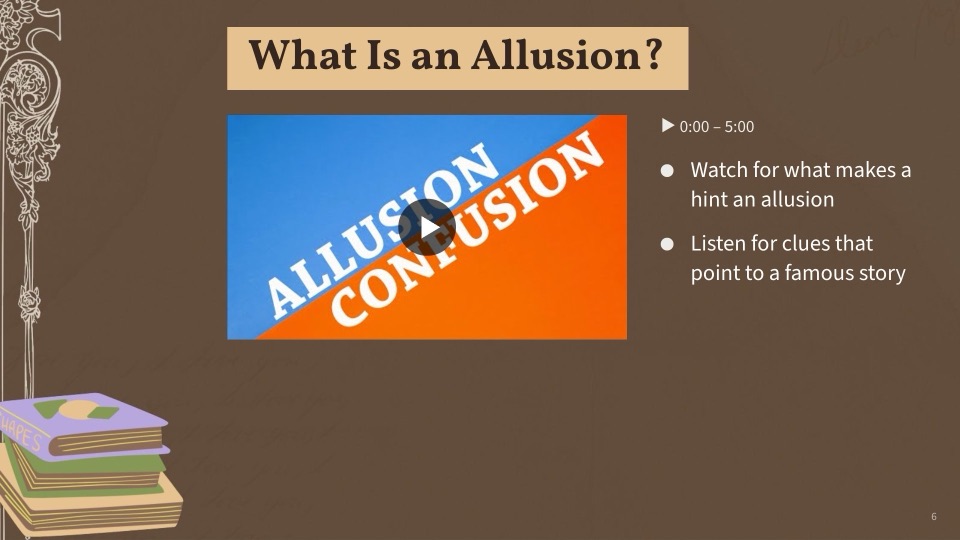
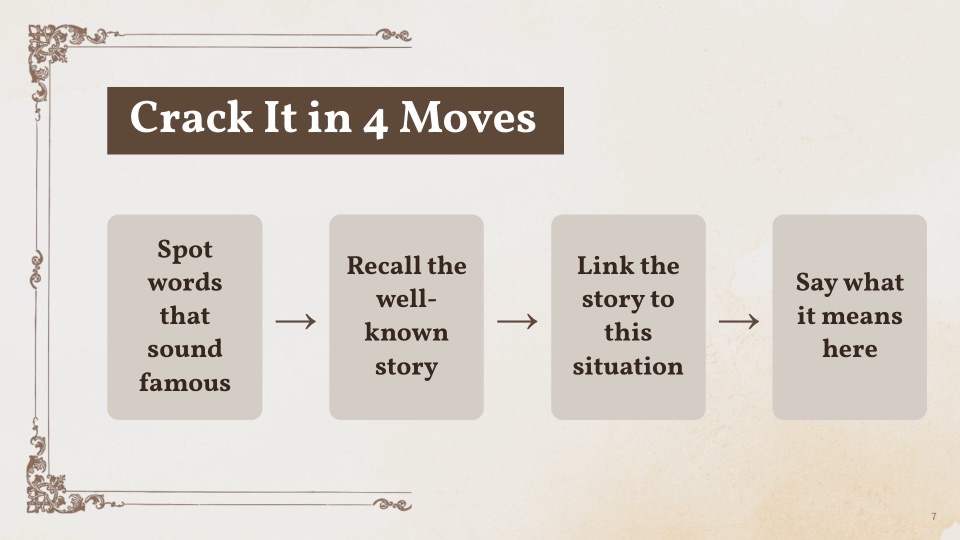
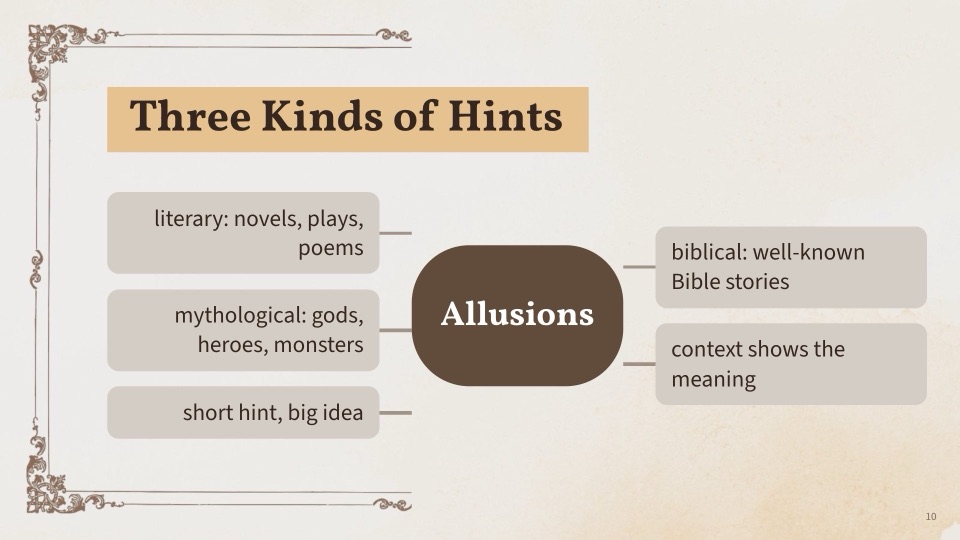
| 12 min | Teaching | To model the 4-step method and the three allusion types. Teach Slide 3 key words: allusion, figure of speech, context, interpret. Play Video clip 1 on Slide 6 and tell students to listen for what makes a hint an allusion. Model with the real example that The group adopted the name Destiny's Child in 1996, based upon a passage in the Book of Isaiah. Show Slide 7 chain and Slide 10 mindmap to name literary, biblical, and mythological types. |
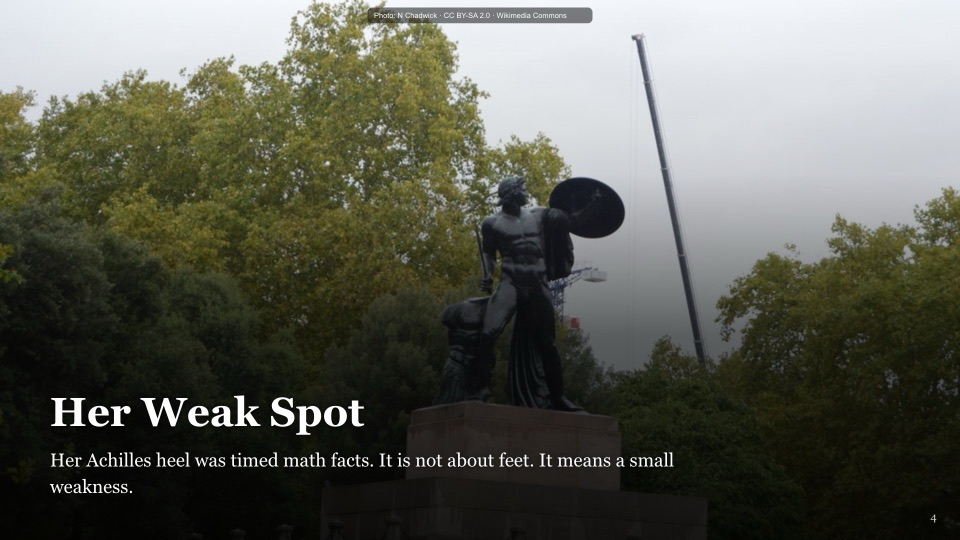
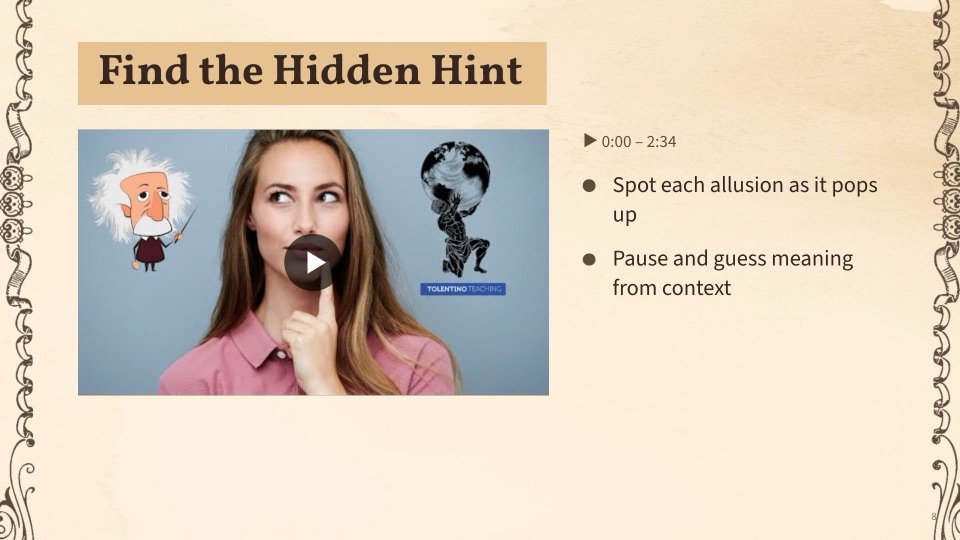
| 13 min | Guided practice | To practice spotting hints and guessing meaning together from context. Show Slide 4 photo sentence and model literal versus intended meaning. Ask Slide 5 question for think, pair, share about the coach warning. Play Video clip 2 on Slide 8, pausing to guess each meaning from context. Chart strong clue words students name on the whiteboard. |
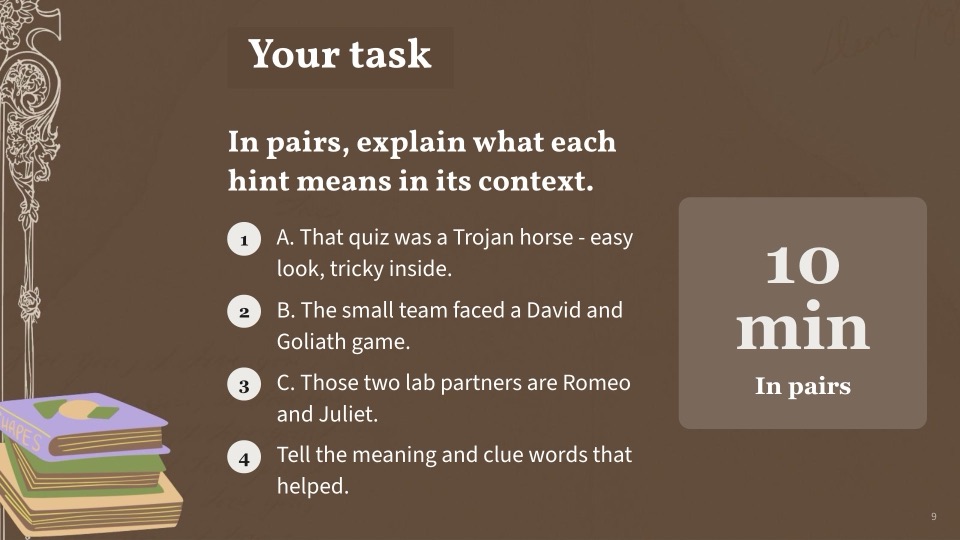
| 20 min | Main activity | To sort allusions by type and prove meaning with clue words. Hand out index cards printed with Slide 9 sentences and markers and chart paper. Remind groups of the Isaiah model: The group adopted the name Destiny's Child in 1996, based upon a passage in the Book of Isaiah. Direct groups to sort, label each as literary, biblical, or mythological, and underline hint words around it. Choose two groups to stick one card on chart paper and explain clues, not literal words. |
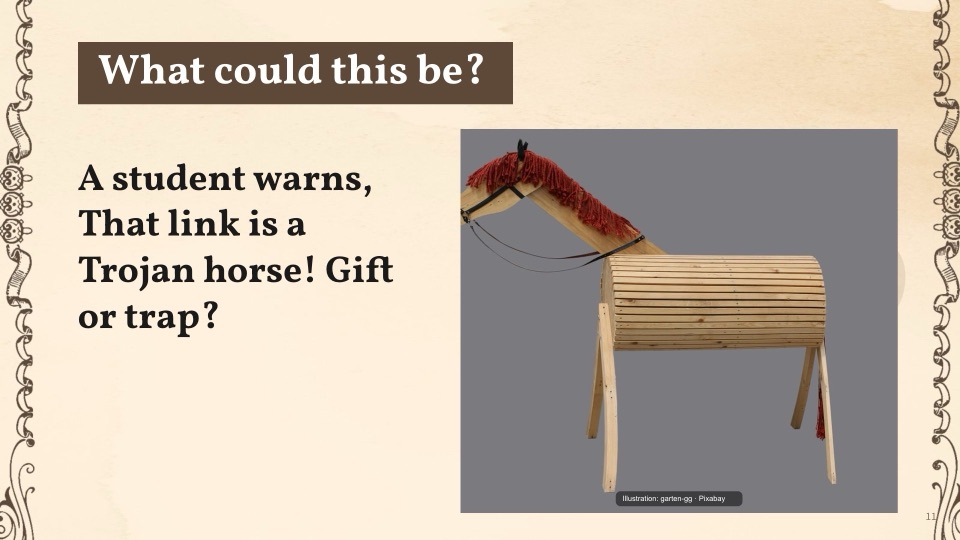
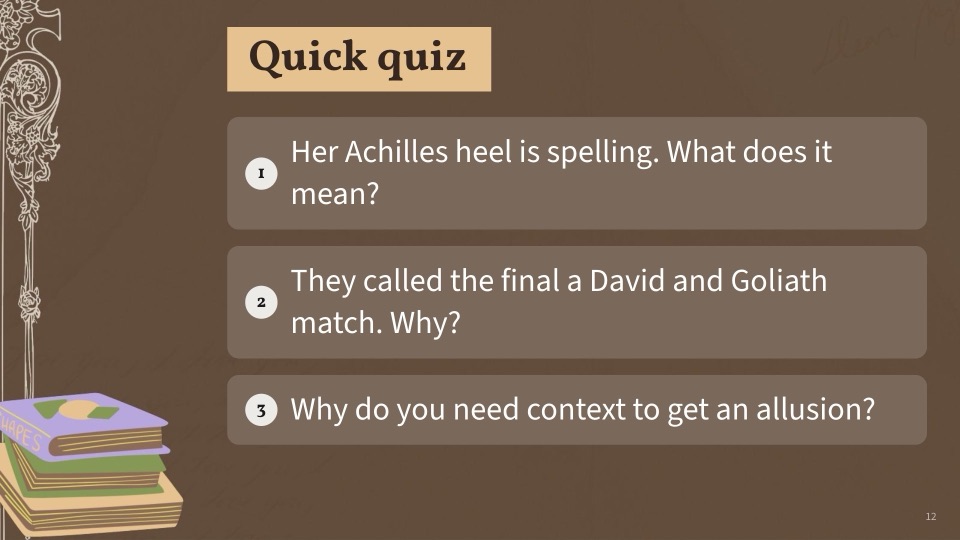
| 10 min | Plenary | To check interpretation and confirm learning against success criteria. Show Slide 11 mystery: A student warns, That link is a Trojan horse! Gift or trap? Reveal answer: A trap - looks helpful but hides trouble, like the myth, and ask for clue words. Quiz with Slide 12: Her Achilles heel is spelling. What does it mean? Collect exit slips on sticky notes. |
Common mistakes
- Taking the allusion literally, like Achilles heel is about feet.
How to spot it: Student draws or explains feet, injury, or shoes.
Point to Slide 4: It is not about feet. It means a small weakness. Ask what surrounding words describe. - Naming the story but ignoring context, so same hint always means same thing.
How to spot it: Student gives memorized meaning that does not fit the sentence clues.
Cover the allusion, read only the rest of the sentence, then ask what feeling fits: praise, humor, or warning. - Mixing up literary, biblical, and mythological labels.
How to spot it: Student calls David and Goliath mythological or Romeo and Juliet biblical.
Use Slide 10 mindmap test: play or poem, Bible story, or gods and monsters. Recall Destiny's Child links to the Book of Isaiah, so biblical.
Support
- Give cards with the context clues already bolded and a word bank with plain-language meanings to choose from.
- Provide sentence starters like I think it means ___ because the text says ___.
Stretch
- Have students explain in writing why the writer used an allusion instead of plain language and what tone it adds.
- Have students rewrite one plain sentence as a new sentence with a different allusion that fits the same context.
Check questions
- That quiz was a Trojan horse - easy look, tricky inside. What does it mean and what type is it?
Answer: Looked easy but was tricky; mythological. - The small team faced a David and Goliath game. What does it mean and what type is it?
Answer: Underdog versus much stronger team; biblical. - Those two lab partners are Romeo and Juliet. What does it suggest and what type is it?
Answer: They act like young sweethearts; literary.
Curriculum
Interpret figures of speech (e.g., literary, biblical, and mythological allusions) in context.
Video clips
Clips on YouTube, from the start and end times we chose. Check each one before you show it.
-
What is an Allusion? from 0:00 to 5:00
The ELA Connection: What is an Allusion? (Figurative Language Tutorial)
Directly teaches allusion definition and examples with clear vocabulary and pace perfect for 12-13-year-olds.
-
Can You Find the Allusion? from 0:00 to 2:34
TolentinoTeaching (Resources for English Teachers): Can you Find the Allusion?
Quick interactive allusion examples made for middle-school ELA and ideal for 12-13-year-olds.
Worksheet
Sources
- ELA Grade 7 - Chicago Public Schools cps.edu
- Ohio's Model Curriculum with Instructional Supports-ELA, Grade 7 education.ohio.gov
- Beyoncé Wikipedia
- Harold Macmillan Wikipedia
- Beslan school siege Wikipedia
Picture credits
- Photo: sasint · Pixabay
- Photo: Myriams-Fotos · Pixabay
- Photo: Pexels · Pixabay
- Photo: N Chadwick · CC BY-SA 2.0 · Wikimedia Commons
- Photo: luvmybry · Pixabay
- Illustration: garten-gg · Pixabay
- Microsoft Fluent Emoji (MIT)
- Pictograms: Sergio Palao, ARASAAC (arasaac.org) · CC BY-NC-SA
- Drawing: Heinrich Vogeler · Public domain · Wikimedia Commons
- Illustration: dilsadakcaoglu · Pixabay
- Illustration: ymyphoto · Pixabay
- Illustration: alanajordan · Pixabay
- Illustration: JESUS_is_our_only_HOPE · Pixabay
- Illustration: GDJ · Pixabay
- Illustration: GDJ · Pixabay
- Illustration: Airgilstudio · Pixabay
- Illustration: 422737 · Pixabay
Made with Lesson Dino's AI on 17 October 2026. AI can make mistakes, so check facts against the sources before you teach.