Slides
Lesson plan
Prove Your Point in a Paragraph
Students learn to support a claim with clear reasons and relevant evidence. They plan and write one argument paragraph about a school topic.
Objectives
- Students will write a clear claim with reasons and relevant evidence.
- Students will tell reasons apart from evidence and link them clearly.
Success criteria
- I can write a clear claim with a clear reason.
- I can add relevant evidence and explain how it proves my reason.
- I can tell a reason apart from evidence.
Key words
| Word | Meaning |
|---|---|
| claim | the main point you are trying to prove, often called a thesis statement |
| reason | why you think your main point is right and matters |
| evidence | a checkable fact or example that shows a point is true |
| explanation | one or two sentences that show how your fact proves your why |
Timed plan (60 minutes)
| Time | Stage | What happens |
|---|---|---|
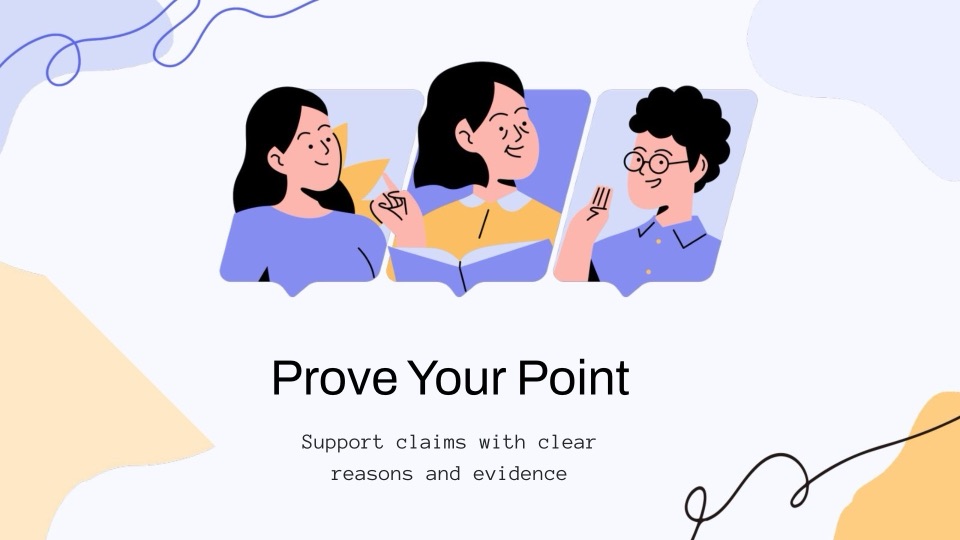
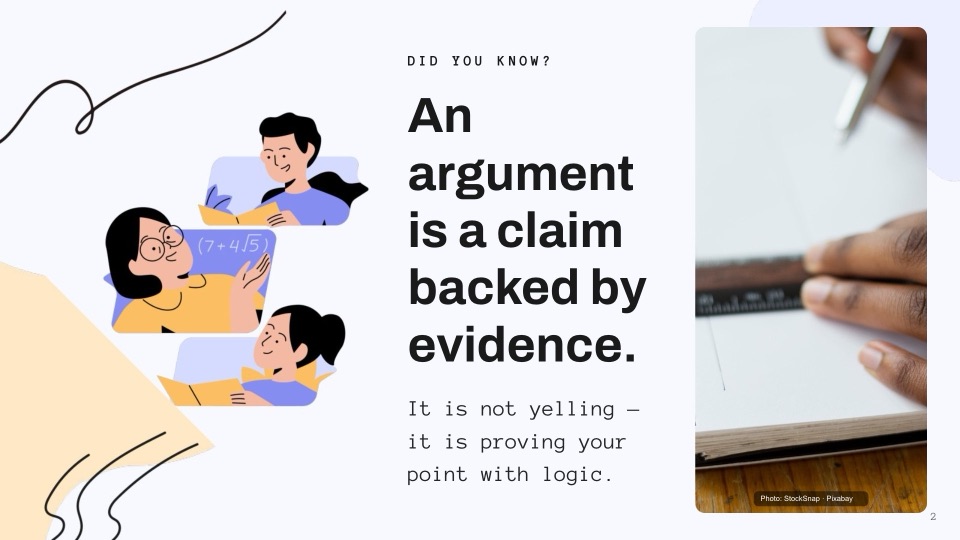
| 8 min | Starter | Activate ideas about argument and hook students on building a clear claim. Welcome class and show Slide 1 Prove Your Point. Show Slide 2 and read its fact that an argument is a claim backed by evidence. Deliver the hook and ask pairs to turn and talk about a time they had to prove a point. Take 2 quick shares and link answers to claim plus proof. |
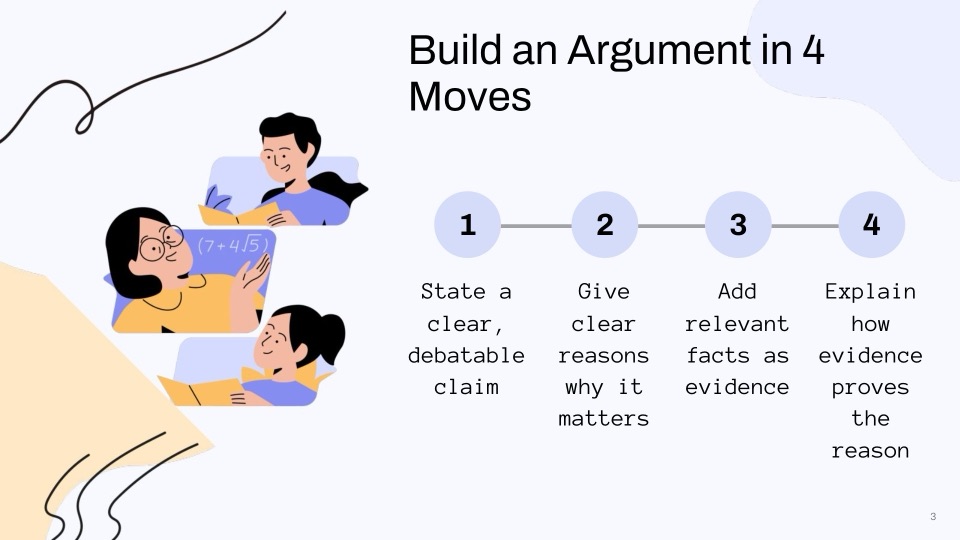
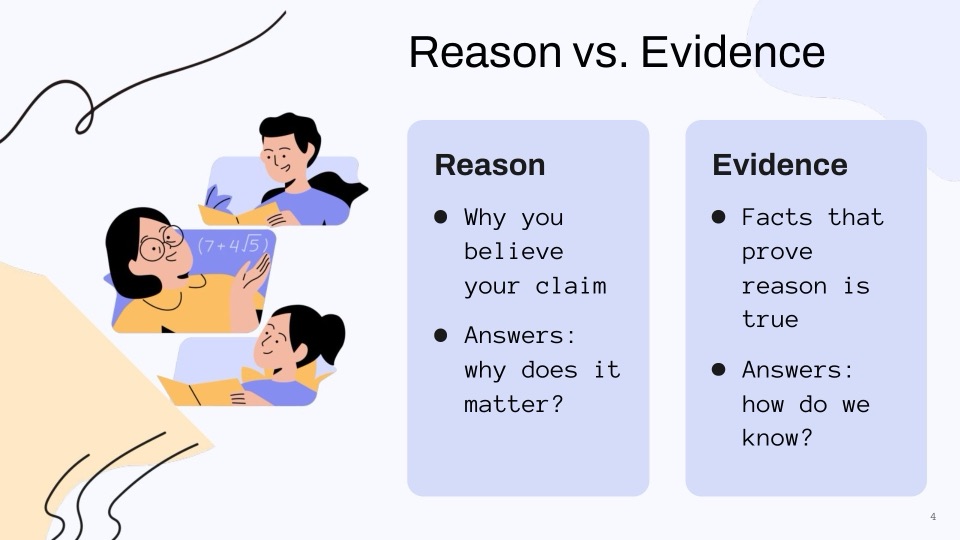
| 12 min | Mini-Lesson: Reason vs Evidence | Teach the difference between a reason and evidence and how they support a claim. Show Slide 3 Build an Argument in 4 Moves and read the four steps together. Show Slide 4 and contrast reason as why you believe and evidence as facts that prove it. Model a short paragraph where you state a clear main point, then expand on it with facts and evidence. Think aloud one sentence that explains how the facts support the main point. |
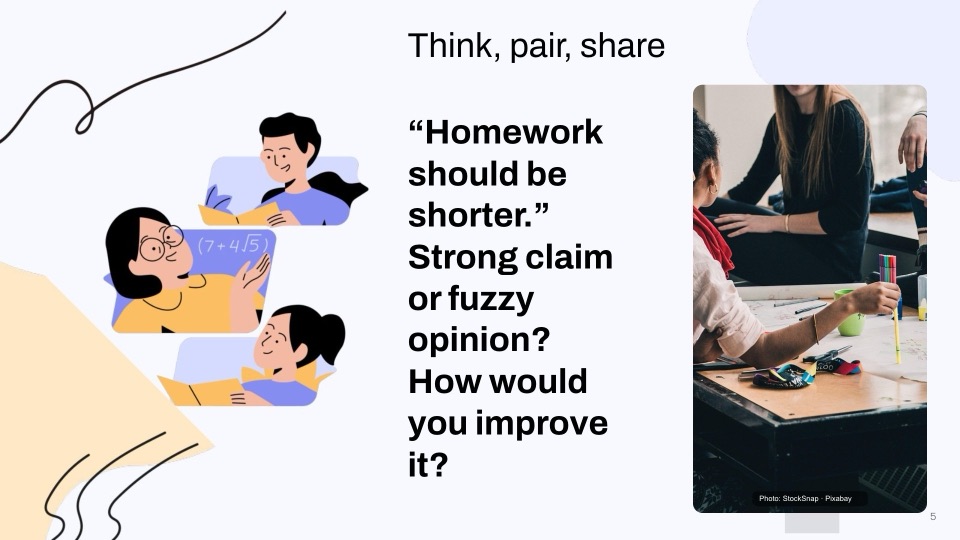
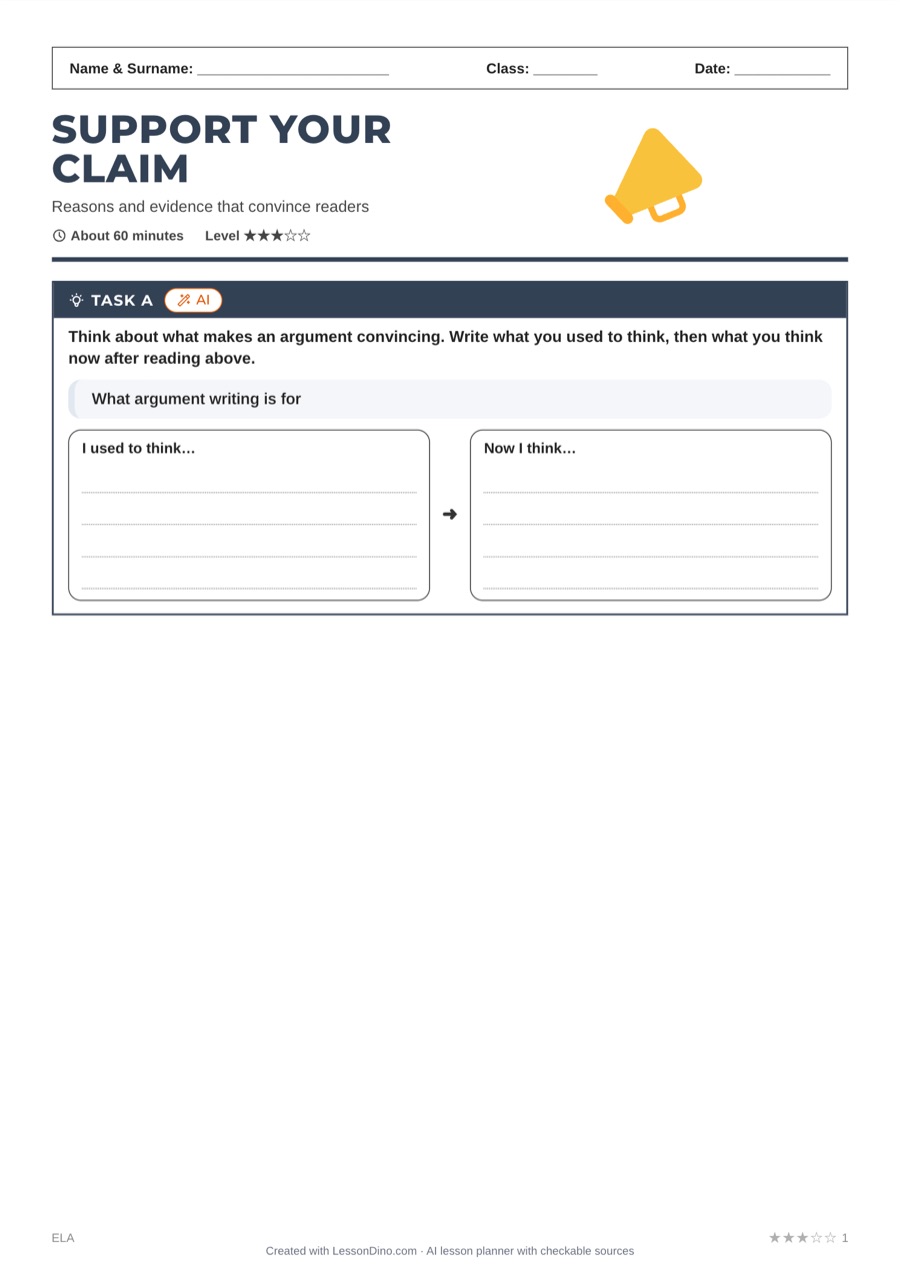
| 10 min | We Do Together | Practice sorting reasons from evidence before independent writing. Show Slide 5 question about Homework should be shorter and ask if it is strong or fuzzy. Hand out Worksheet Task D and model coloring one box as reason or evidence. Circulate as pairs color each box for a later start and improve the fuzzy claim. Stop class and confirm answers for two tricky boxes. |
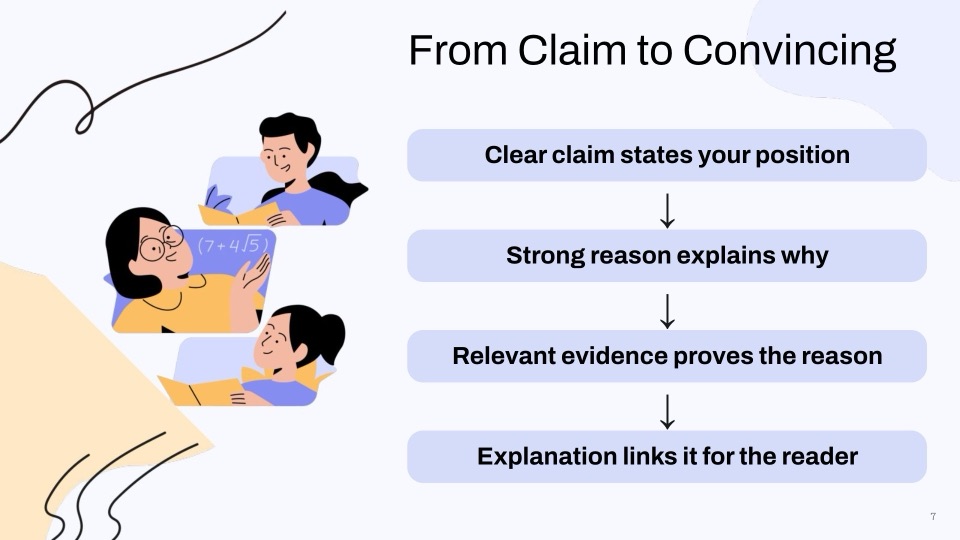
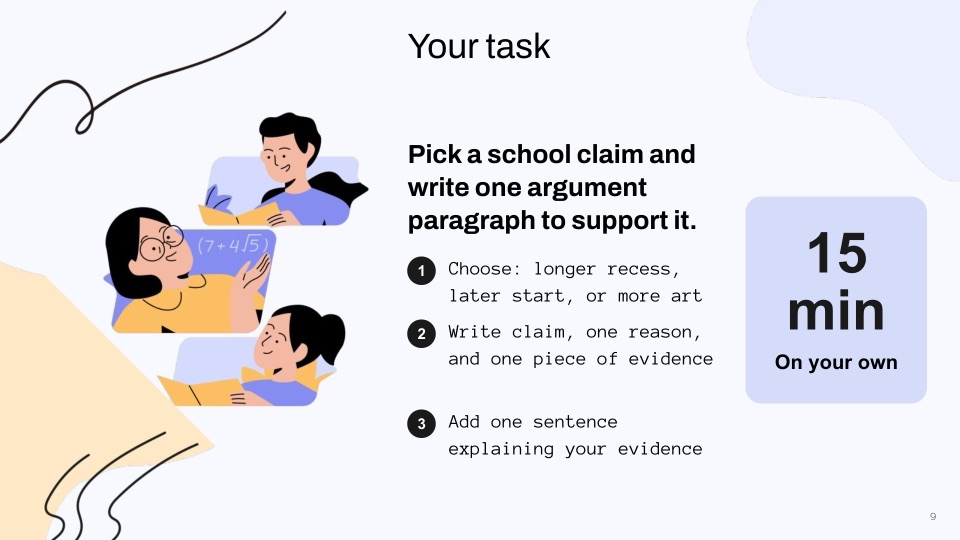
| 20 min | Reason Sandwich Build | Write one argument paragraph with claim, reason, evidence, and explanation. Show Slide 7 chain and remind students of the order: claim, reason, evidence, explanation. Show Slide 9 task and let students choose longer recess, later start, or more art. Hand out the sandwich organizer and give 6 minutes to plan, then 12 minutes to write 5-6 sentences. Remind students to underline the claim once and the evidence twice. |
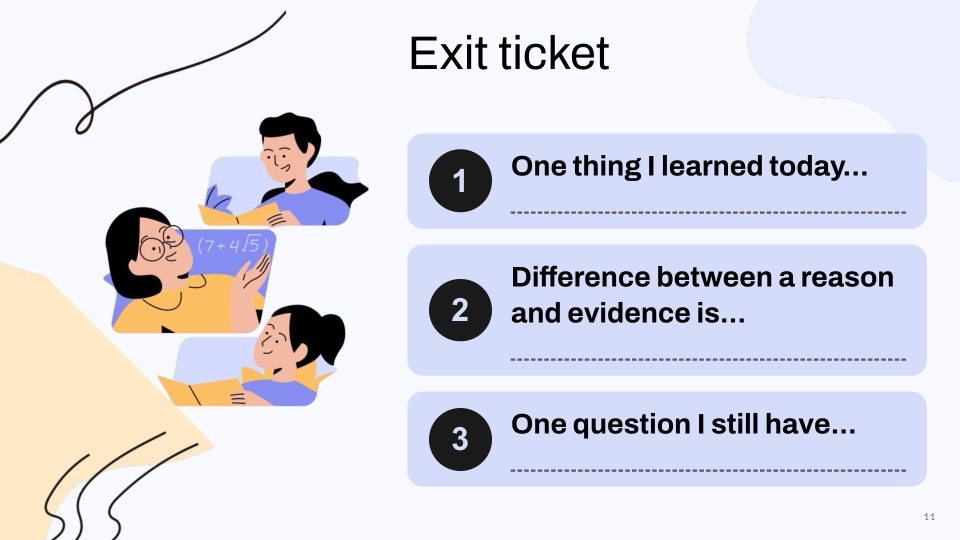
| 10 min | Plenary and Exit | Review learning and check who can separate reason from evidence. Invite two students to read paragraphs aloud and class names the claim, reason, and evidence. Restate success criteria and fix any confusion between reason and evidence. Show Slide 11 exit ticket and give 5 minutes to write silently. Collect exits and preview next step on counterclaims. |
Common mistakes
- Mixing up reason and evidence
How to spot it: Paragraph lists two whys but no checkable fact, or lists facts with no why
Use Slide 4 test: If it answers why it matters, it is a reason. If it answers how we know with a fact, it is evidence. - Thinking a thesis is a title
How to spot it: Opening line is just Later Start with no point or reasons
Remind that a thesis is not a title. Use frame: School should ___ because ___ and ___. - Using feelings instead of logic
How to spot it: Writing relies on promises or emotional words with no fact you could check
Highlight verifiable facts in one color and emotional appeals in another. Rewrite feelings into checkable proof, since argument focuses on logic with verifiable facts.
Support
- Provide a half-filled organizer with the claim and first reason done so students only add evidence and explanation.
Stretch
- Have students add a second piece of evidence from a different type of source and explain which is more credible, since the credibility of the source is essential to the argument.
Check questions
- What is a claim?
Answer: A clear main point you are trying to prove. - What is the difference between a reason and evidence?
Answer: A reason tells why the claim matters; evidence is a checkable fact that proves the reason. - Which evidence best supports: Students focus better with more recess?
Answer: A relevant, checkable fact like class work completion rose after longer recess, plus one sentence explaining the link.
Curriculum
Write arguments to support claims with clear reasons and relevant evidence.
Video clips
Clips on YouTube, from the start and end times we chose. Check each one before you show it.
-
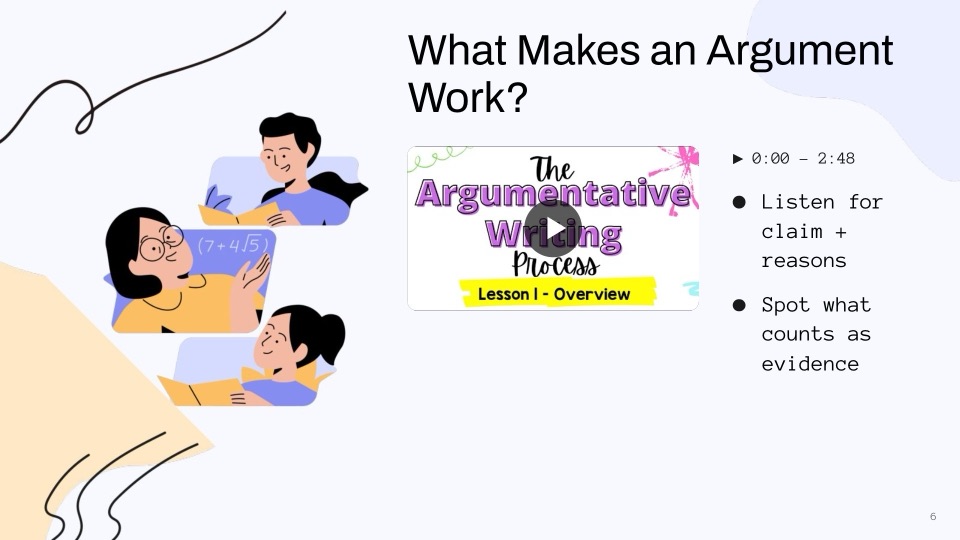
Argument Overview from 0:00 to 2:48
Teaching Intentionally: Argumentative Writing Lesson 1: Overview
Gives a clear Grade 7-level overview of claims supported by reasons and evidence at the right pace for 12-13-year-olds.
-
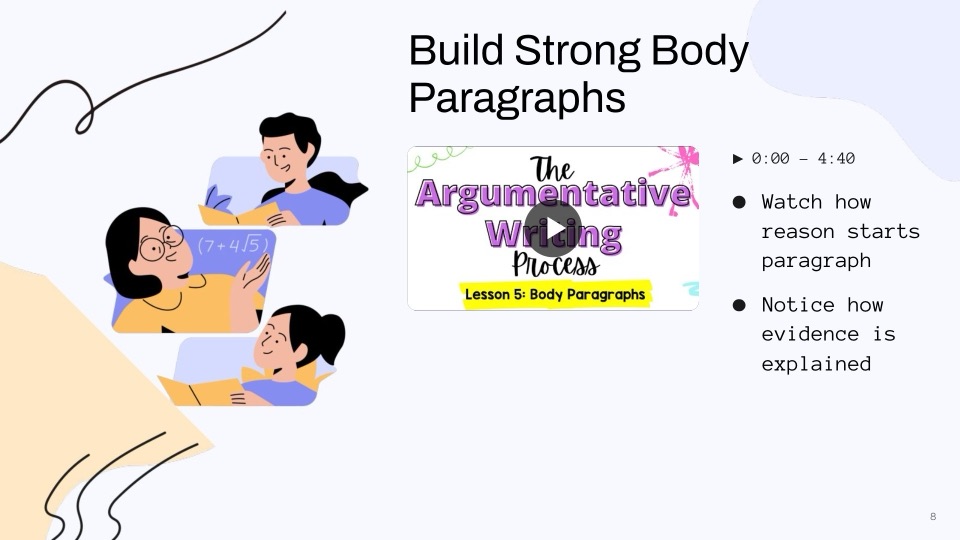
Body Paragraphs from 0:00 to 4:40
Teaching Intentionally: Argumentative Writing Unit - Lesson 5: Body Paragraphs
Models how to build body paragraphs with clear reasons and relevant evidence using language ideal for 12-13-year-olds.
Worksheet
Sources
- How to Read the Standards thecorestandards.org
- English Language Arts cps.edu
- Argumentative Essays - Purdue OWL® - Purdue University owl.purdue.edu
- Argument – The Writing Center writingcenter.unc.edu
- Argument Papers - Purdue OWL® - Purdue University owl.purdue.edu
- Argumentative Writing and Using Evidence - San José State ... sjsu.edu
- University Writing Center: Argumentative Writing - JMU jmu.edu
- Using single paragraph outlines to plan an effective argument thenational.academy
- How to build an argument for KS3 English students - BBC bbc.co.uk
- Academic writing en.wikipedia.org
- ELA 9 : Argument writing - UnboundEd lessons.unbounded.org
- Meeting the Common Core Standards for English Language Arts: Argument ... socialstudies.org
- How to Teach Argument Writing Basics | LearnCrux learncrux.com
- How to Teach Argument Writing Step-By-Step - ELA Buffet elabuffet.com
- Making a Claim: Teaching Students Argument Writing Through Close Reading - Pedagogue pedagogue.app
- 50+ Argument Writing worksheets on Wayground | Free & Printable wayground.com
- Developing Evidence-Based Arguments from Texts | Read Write Think readwritethink.org
- Argumentative Writing - UEN uen.org
- Teach Argument Writing: Capture the Idea | eslwriting.org eslwriting.org
Picture credits
- Photo: StockSnap · Pixabay
- Photo: StockSnap · Pixabay
- Microsoft Fluent Emoji (MIT)
Made with Lesson Dino's AI on 17 October 2026. AI can make mistakes, so check facts against the sources before you teach.