The worksheet
About this worksheet
Students learn hooks, showing details, and clear event order. They plan and draft a short real or imagined narrative. This Grade 7 ELA worksheet gives students (ages 12–13) five pages of practice on creative writing: narratives, part of the writing unit. It goes with our free Creative writing: narratives lesson, which has the slides and a timed lesson plan.
What it covers
By the end, students should be able to:
- Students will order five events so a problem grows to a climax and resolves.
- Students will use hooks, dialogue and pacing as technique to develop experiences.
- Students will add relevant sensory details that show people, place and feelings.
How to use it
- Guided practice (15 minutes): Hand out Worksheet Task A and give pairs 5 minutes to place sentences from weak to strong.
- Support: Use partially filled mountain with first two events done; students finish last three.
- Stretch: Add a second small climax twist on a sticky note between falling action and resolution.
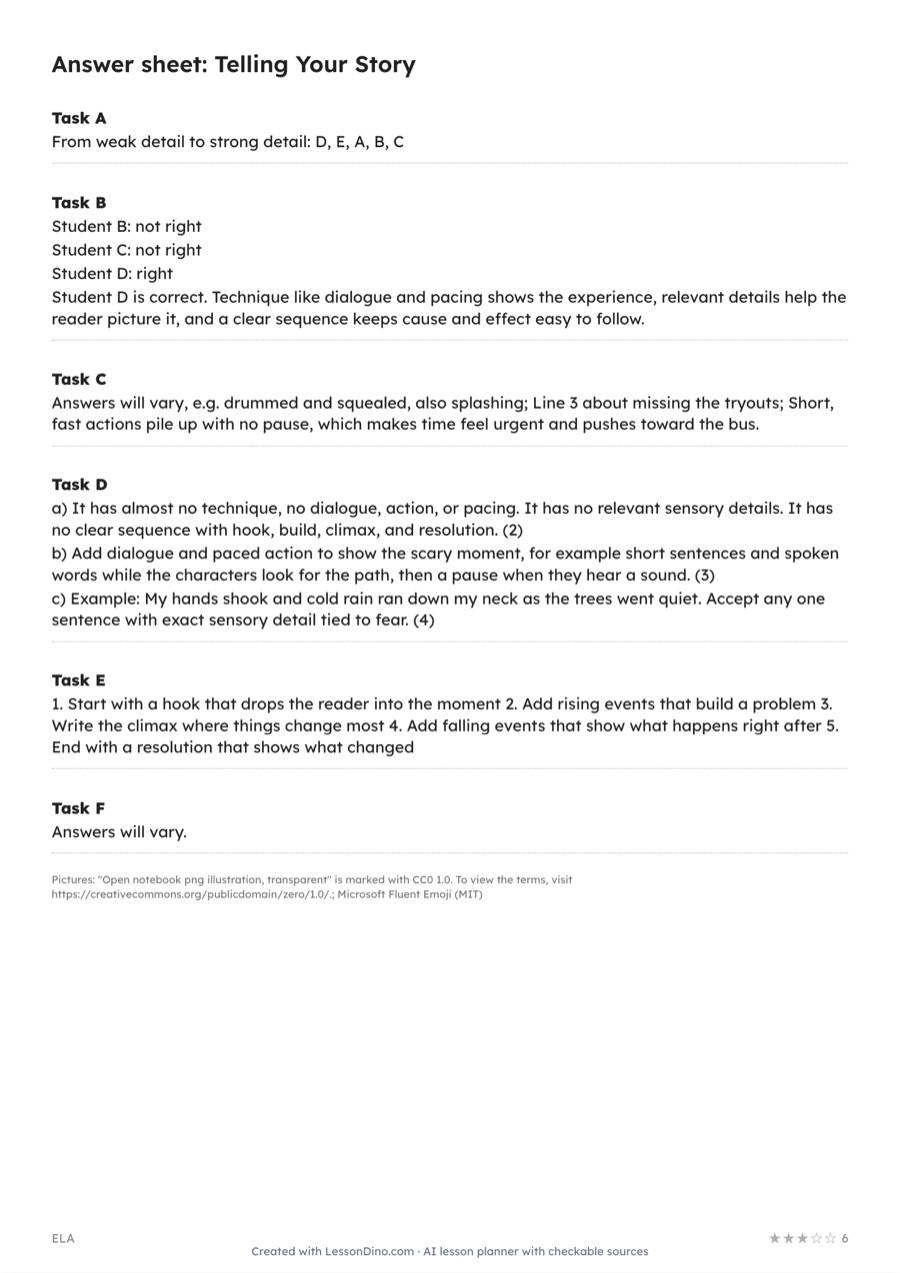
- The answer sheet is the last page, so you can print it on its own or let students check their own work.
Key vocabulary
- narrative: a story about real or made-up events told in order
- sequence: the order in which events happen, where each causes the next
- climax: the biggest turning moment or choice at the top of the mountain
- dialogue: the words people in a story say out loud to each other
- sensory detail: words that show what can be seen, heard, felt, smelled or tasted
- hook: a mysterious opening that makes readers ask what happens next
Mistakes to watch for
- Telling feelings instead of showing them (She was scared). Rewrite with actions and senses; craft means showing through detail, not summary.
- Events listed but not connected by cause and effect. Add so/because link and check each event causes the next in the structure.
- Dialogue sounds flat with no beat or tag. Add one action beat and voice choice to develop character through speech.
What's on the worksheet
Strong Narratives Start
Learn what makes a narrative work.
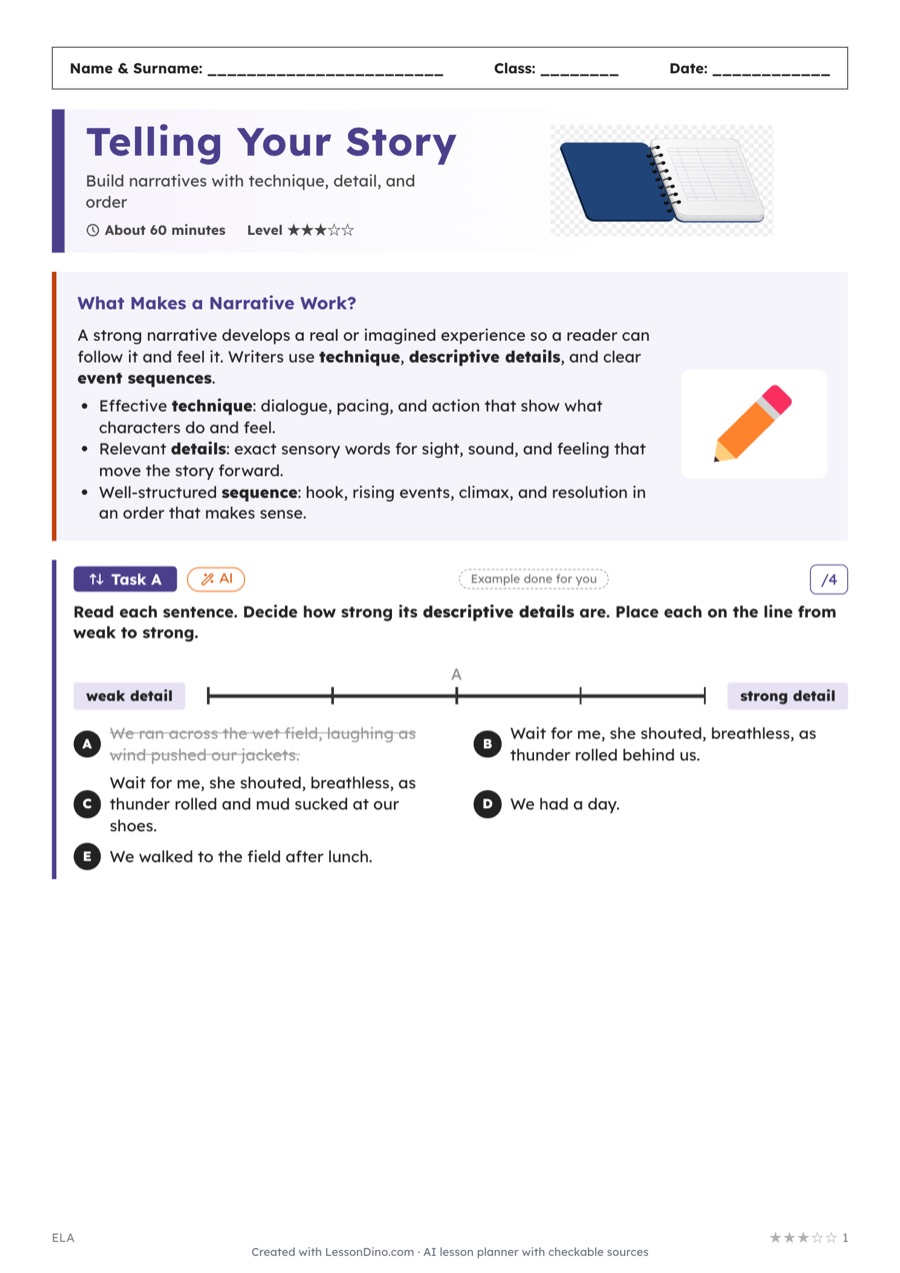
What Makes a Narrative Work?
- A strong narrative develops a real or imagined experience so a reader can follow it and feel it. Writers use technique, descriptive details, and clear event sequences.
- Effective technique: dialogue, pacing, and action that show what characters do and feel.
- Relevant details: exact sensory words for sight, sound, and feeling that move the story forward.
- Well-structured sequence: hook, rising events, climax, and resolution in an order that makes sense.
Read each sentence. Decide how strong its descriptive details are. Place each on the line from weak to strong.
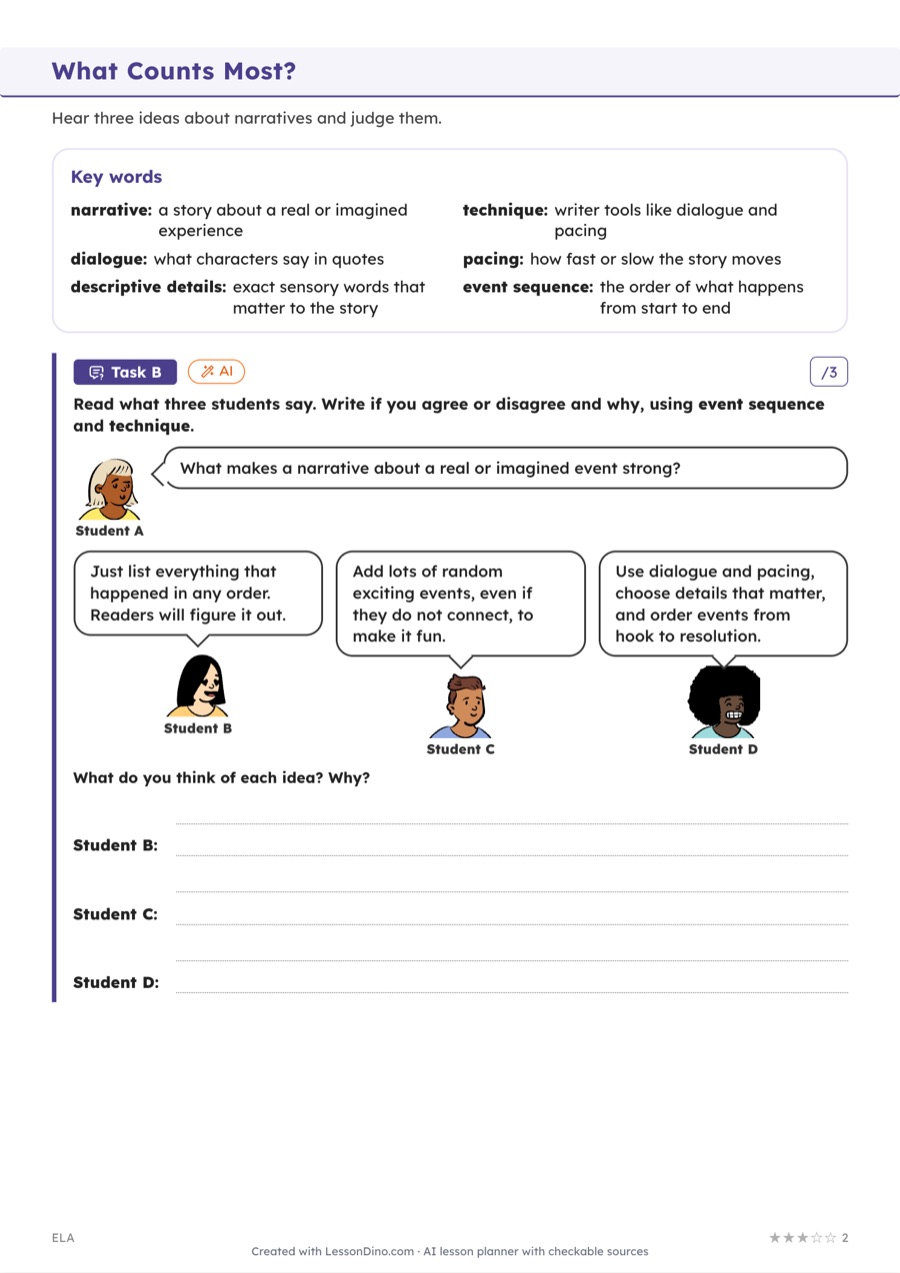
What Counts Most?
Hear three ideas about narratives and judge them.
| Word | Meaning |
|---|---|
| narrative | a story about a real or imagined experience |
| technique | writer tools like dialogue and pacing |
| dialogue | what characters say in quotes |
| pacing | how fast or slow the story moves |
| descriptive details | exact sensory words that matter to the story |
| event sequence | the order of what happens from start to end |
Read what three students say. Write if you agree or disagree and why, using event sequence and technique.
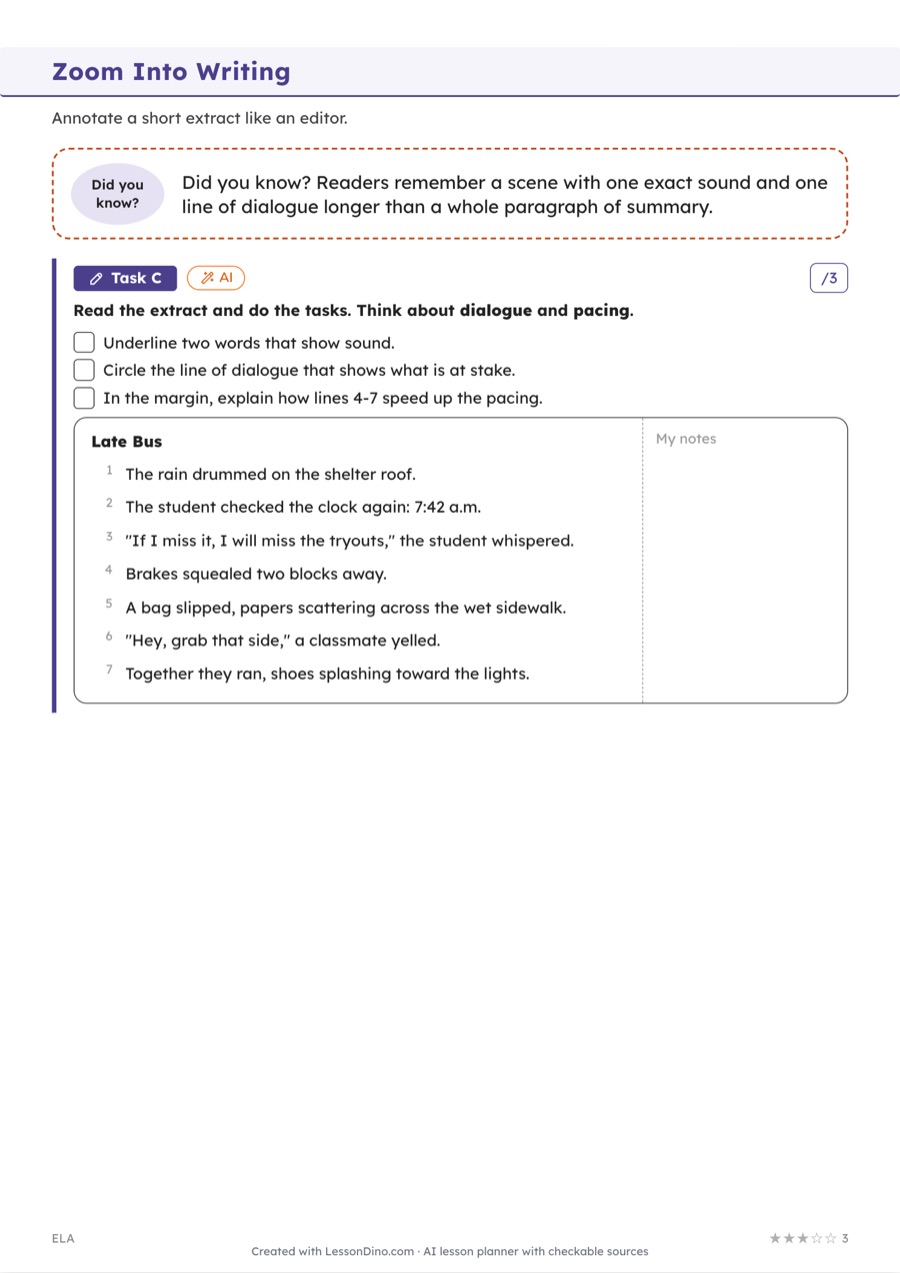
Zoom Into Writing
Annotate a short extract like an editor.
- Did you know? Readers remember a scene with one exact sound and one line of dialogue longer than a whole paragraph of summary.
Read the extract and do the tasks. Think about dialogue and pacing.
- The rain drummed on the shelter roof.
- The student checked the clock again: 7:42 a.m.
- "If I miss it, I will miss the tryouts," the student whispered.
- Brakes squealed two blocks away.
- A bag slipped, papers scattering across the wet sidewalk.
- "Hey, grab that side," a classmate yelled.
- Together they ran, shoes splashing toward the lights.
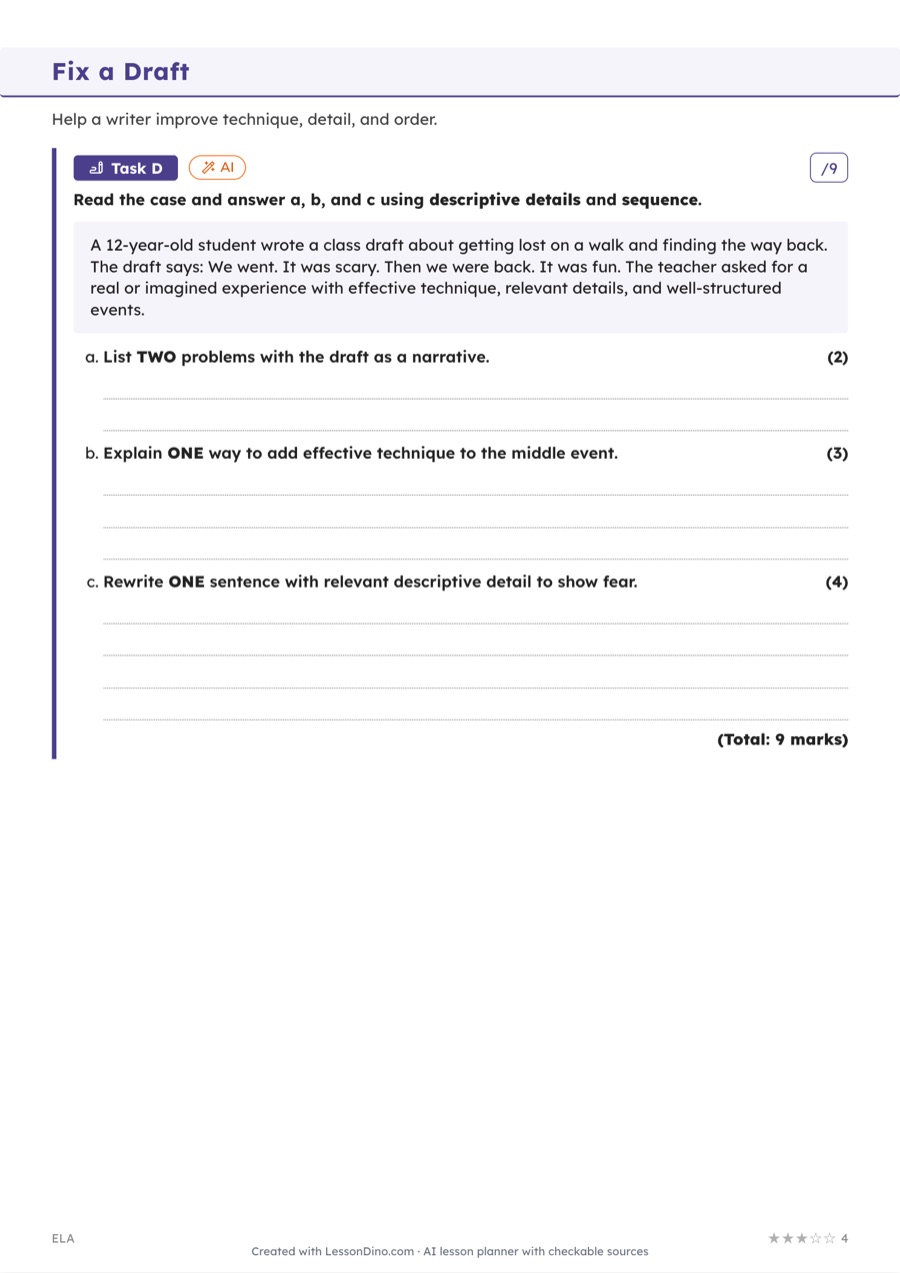
Fix a Draft
Help a writer improve technique, detail, and order.
Read the case and answer a, b, and c using descriptive details and sequence.
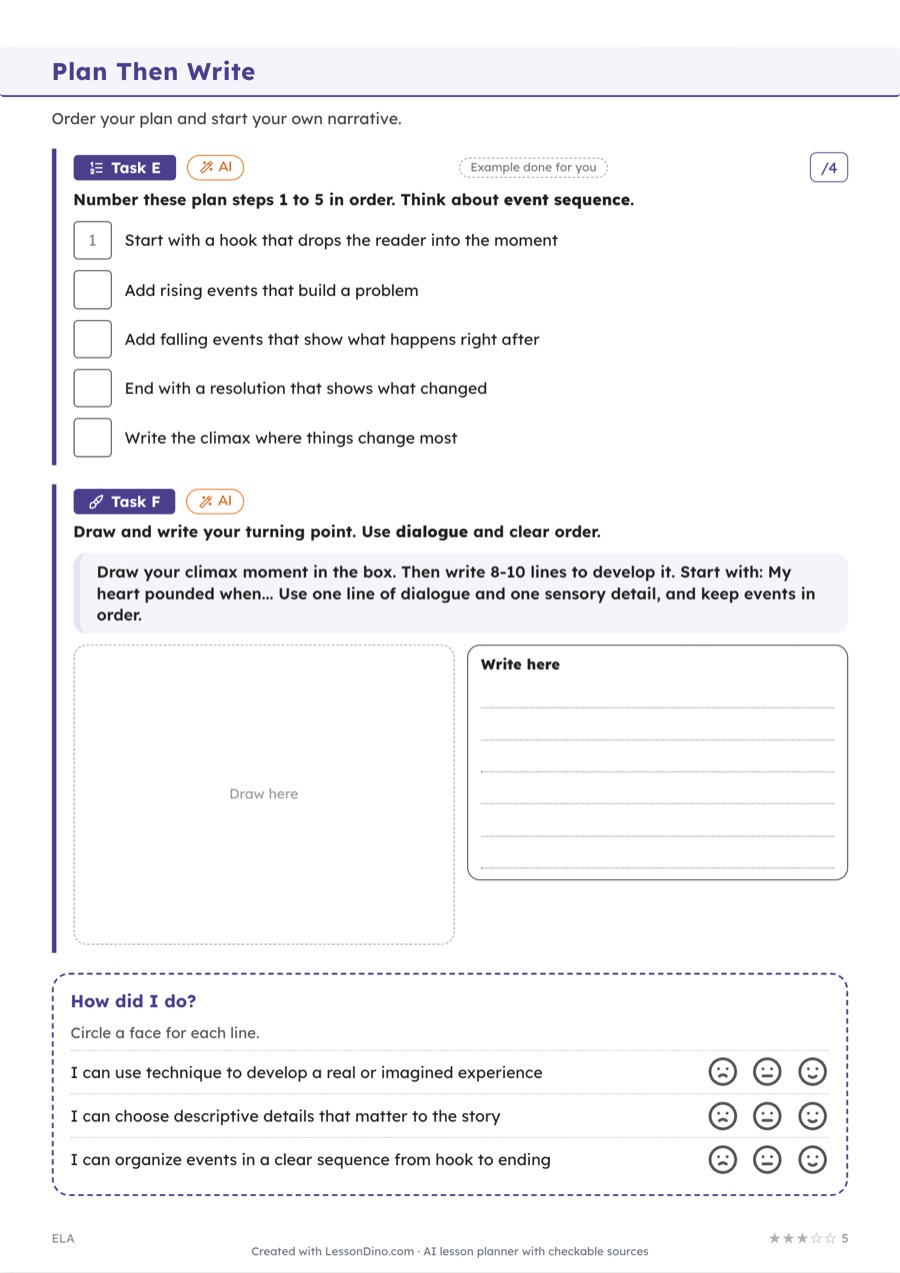
Plan Then Write
Order your plan and start your own narrative.
Number these plan steps 1 to 5 in order. Think about event sequence.
Draw and write your turning point. Use dialogue and clear order.
Answers
Show the answers
- List TWO problems with the draft as a narrative. It has almost no technique, no dialogue, action, or pacing. It has no relevant sensory details. It has no clear sequence with hook, build, climax, and resolution.
- Explain ONE way to add effective technique to the middle event. Add dialogue and paced action to show the scary moment, for example short sentences and spoken words while the characters look for the path, then a pause when they hear a sound.
- Rewrite ONE sentence with relevant descriptive detail to show fear. Example: My hands shook and cold rain ran down my neck as the trees went quiet. Accept any one sentence with exact sensory detail tied to fear.
The answer sheet is the last picture above.
Curriculum
Write narratives to develop real or imagined experiences or events using effective technique, relevant descriptive details, and well-structured event sequences.
Made with Lesson Dino's AI on 16 October 2026. AI can make mistakes, so check the answers and facts against the sources before you teach.