Slides
Lesson plan
What Job Is It Doing in the Sentence?
Students learn what phrases and clauses do in general and in specific sentences. They discuss jobs, build sentences, and explain each added part.
Objectives
- Students will explain how different phrases and clauses work in sentences generally.
- Students will identify phrases and clauses and explain their job in specific sentences.
- Students will expand plain sentences with phrases and clauses to add clear detail.
Success criteria
- I can tell a phrase from a clause and independent from dependent.
- I can explain what a phrase or clause does in a sentence.
- I can add a phrase and a clause to improve a sentence.
Key words
| Word | Meaning |
|---|---|
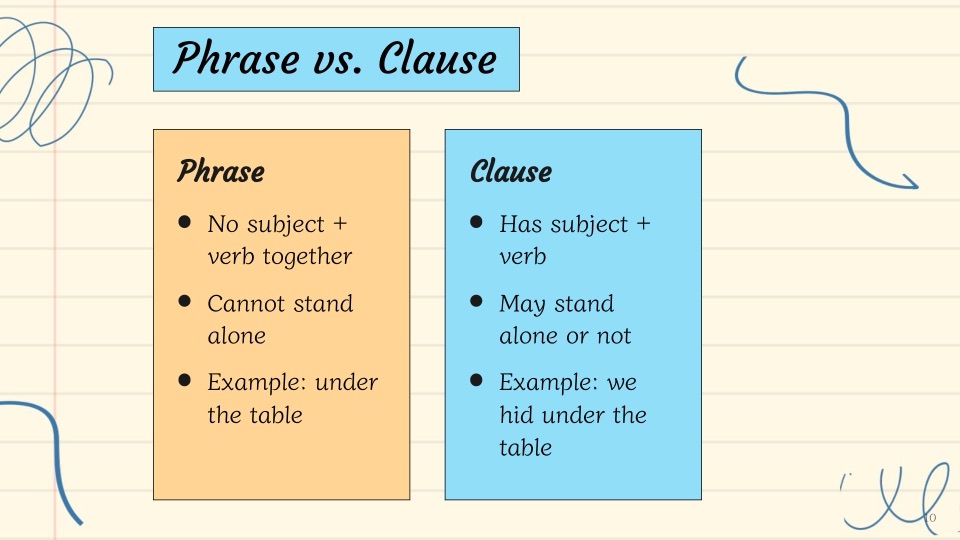
| phrase | a group of words that works as one part of a sentence |
| clause | a group of words with a doer and an action word together |
| independent clause | a doer-plus-action group that makes a full thought alone |
| dependent clause | a doer-plus-action group that cannot stand alone and needs another part |
Timed plan (60 minutes)
| Time | Stage | What happens |
|---|---|---|
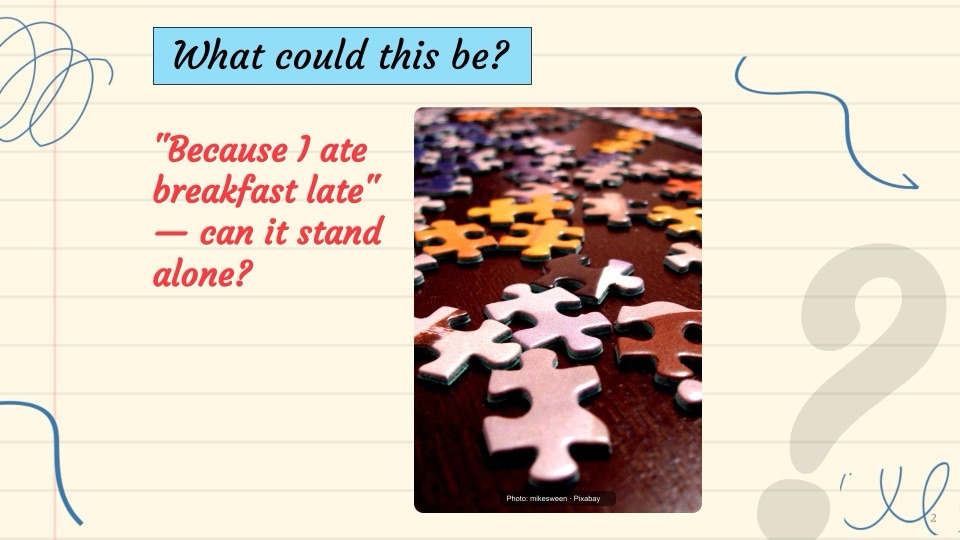
| 7 min | Starter | Hook students and surface ideas about parts that add detail but cannot stand alone. Show Slide 1 and read the title about small word groups building powerful sentences. Say the hook sentence and ask what happens if the last part is removed. Show Slide 2 mystery: Because I ate breakfast late - can it stand alone? Take a quick vote and confirm it is a dependent clause that needs a main clause. |
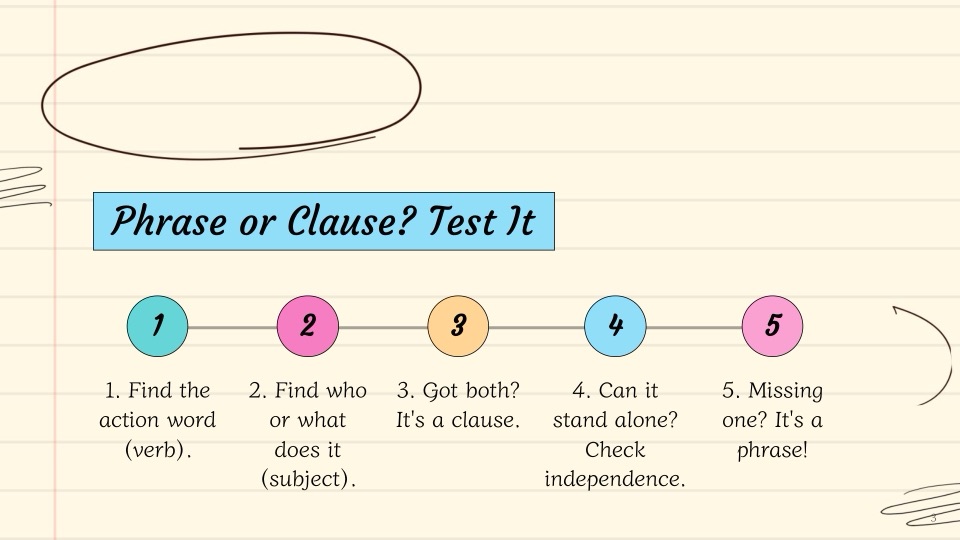
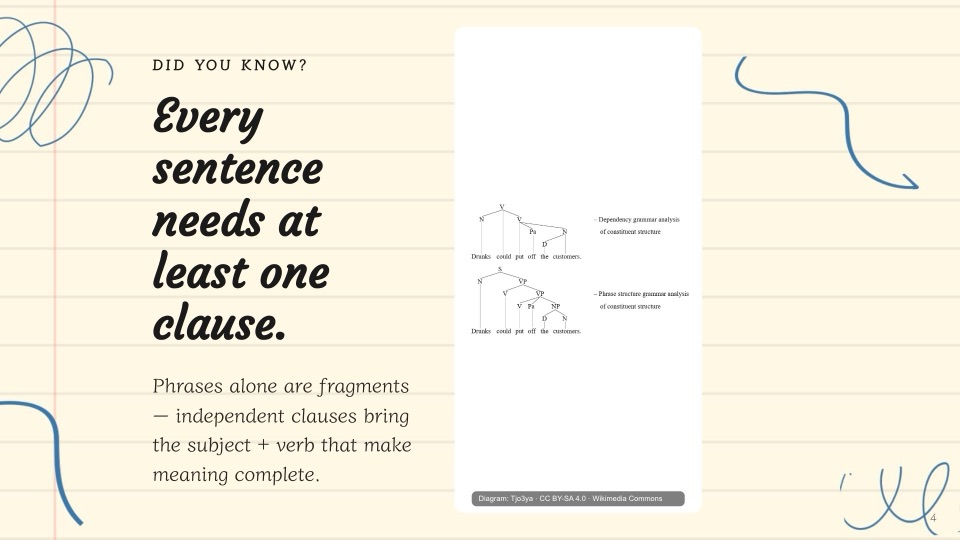
| 13 min | Teaching | Teach the test for phrases and clauses and for independent and dependent clauses. Show Slide 3 steps and model the test aloud on two word groups. Show Slide 4 fact and stress that every sentence needs at least one clause. Think aloud with underlining of subject once and verb twice. Summarize the general function: phrases add detail, clauses carry doer plus action. |
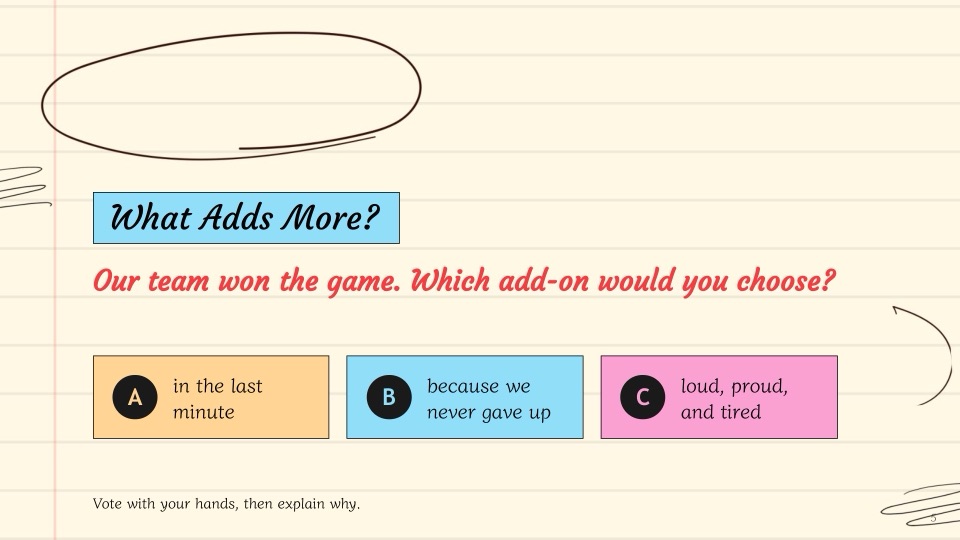
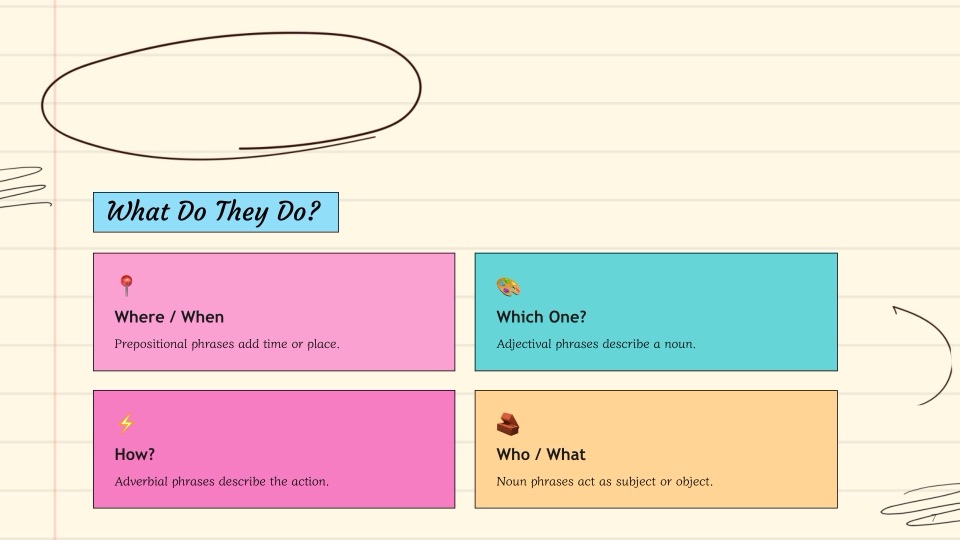
| 15 min | Guided practice | Model how to name the job a phrase or clause does in a specific sentence. Show Slide 5 vote sentence Our team won the game with three add-ons. Model the frame: this part is a phrase or clause, and in this sentence it tells when, why, or which one. Show Slide 7 cards for Where/When, Which One, and How. Lead pairs to decide the job of each add-on in that specific sentence. |
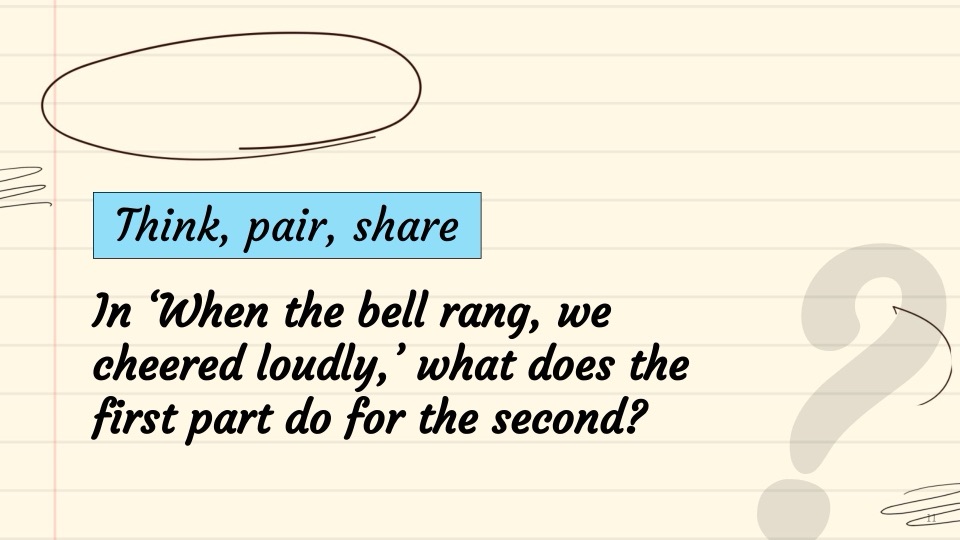
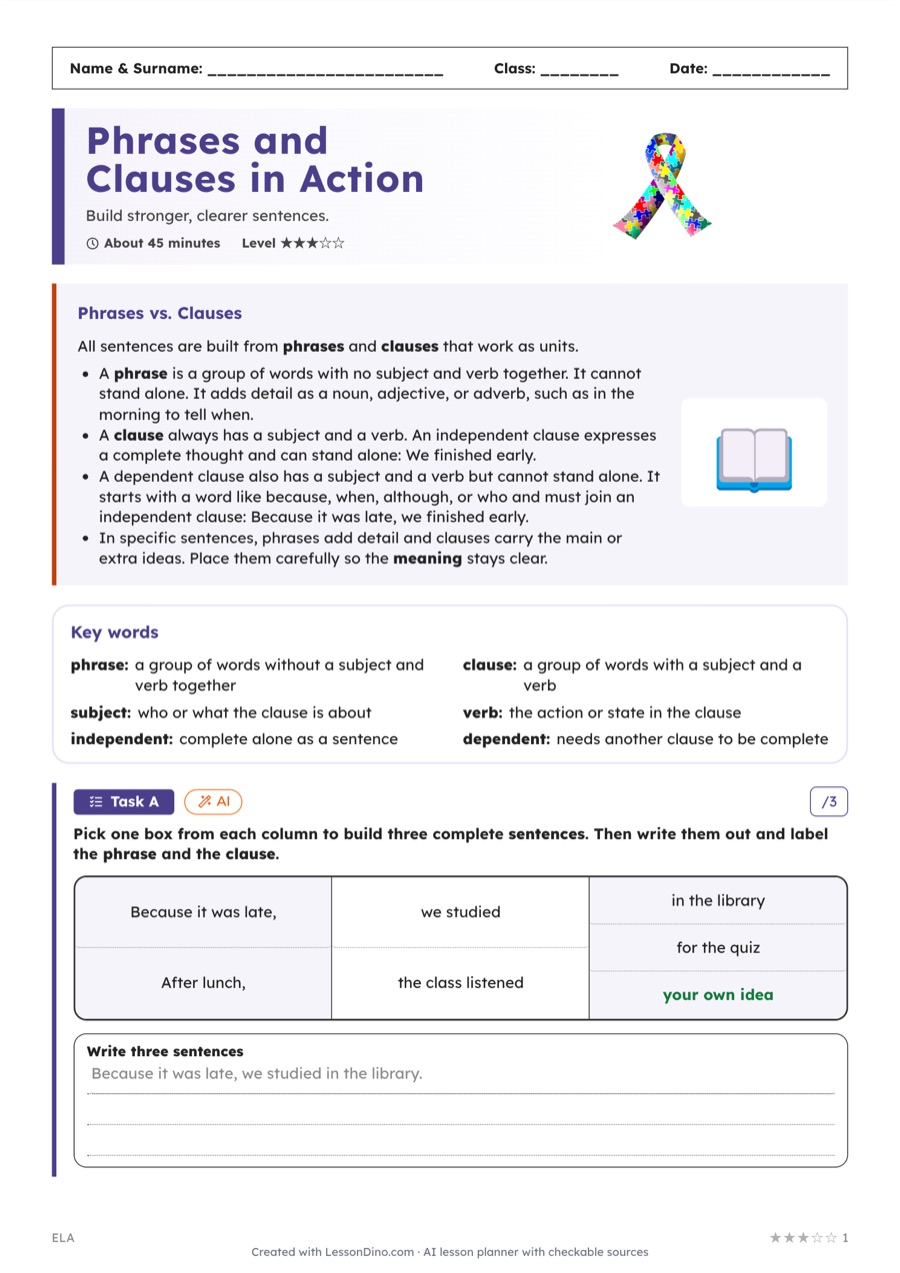
| 18 min | Main activity | Explain in groups what each underlined phrase or clause does, then build and label sentences. Put groups of three and hand out Worksheet Task A. Display these three sentences: 1. Our team won the game in the last minute. 2. Our team won the game because we never gave up. 3. When the bell rang, we cheered loudly. Direct groups to name each underlined part as phrase or clause and its job using the frame. Direct groups to then complete Worksheet Task A to build three sentences and label phrase and clause. |
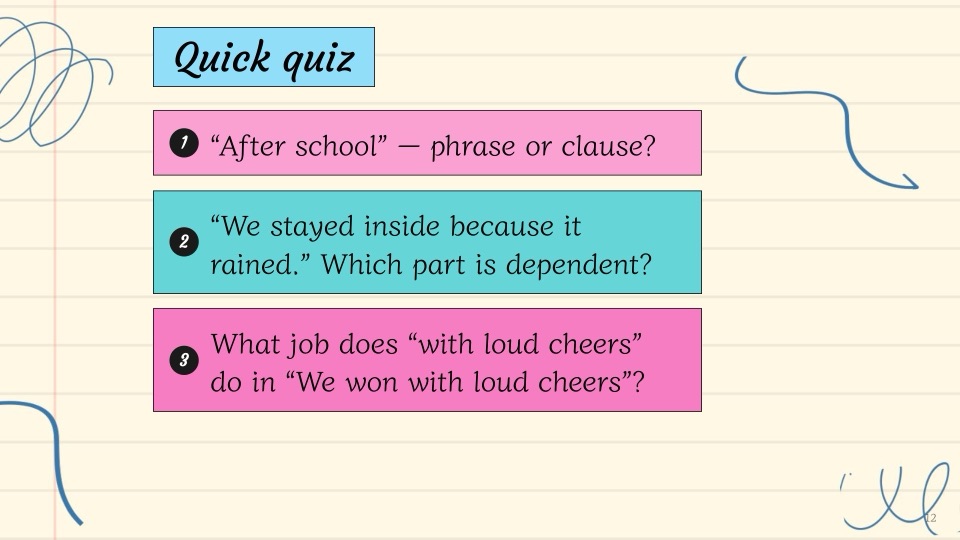
| 7 min | Plenary | Check that students can explain phrase and clause function in general and in specific sentences. Show Slide 10 compare of phrase versus clause for quick review. Show Slide 12 quiz and ask both questions without giving answers first. Link answers back to objectives and success criteria. Set homework and collect Task A sheets. |
Common mistakes
- Thinking a long word group must be a clause.
How to spot it: Student labels in the last minute of the game as a clause.
Underline doer and action. No subject plus verb together means phrase, not clause. - Thinking a dependent clause can stand alone as a sentence.
How to spot it: Student writes Because we never gave up as a full sentence.
Ask then what? Show it depends on an independent clause to make sense.
Support
- Provide two everyday sentences with the phrase or clause already underlined and a where, when, why, which-one word bank.
- Give clause cards with the subject underlined and ready-made phrases like on the bus to build around a clear independent clause.
Stretch
- Have students rewrite the same sentence by moving the phrase or clause and explain how the emphasis changes.
- Have fast finishers build a compound-complex sentence and explain the link among ideas.
Check questions
- Is under the table a phrase or a clause? Why?
Answer: Phrase, no subject and verb together. - In We stayed inside because it rained, what does because it rained do?
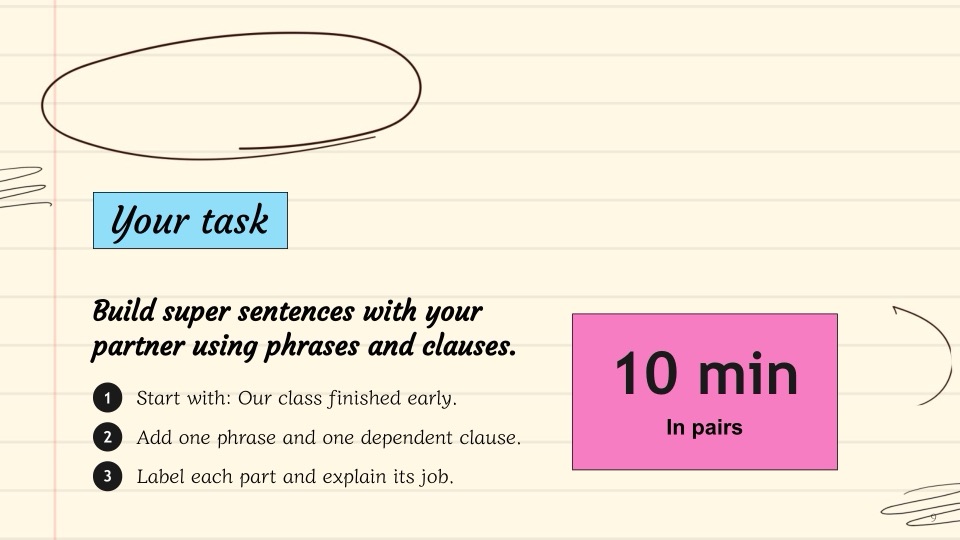
Answer: Dependent clause that tells why and needs the main clause. - Add a phrase to Our class finished early and explain its job.
Answer: Example: in the library, phrase that tells where the class finished.
Curriculum
Explain the function of phrases and clauses in general and their function in specific sentences.
Video clips
Clips on YouTube, from the start and end times we chose. Check each one before you show it.
-
7th grade phrases and clauses review from 0:00 to 5:00
Jonathan White: 7th Grade ELA - Grammar Review - Phrases and Clauses
Made exactly for 7th grade ages 12-13 and reviews how phrases and clauses function in sentences with grade-level examples.
-
phrases and clauses in sentences from 0:00 to 5:00
Khan Academy: Phrases and clauses | Syntax | Khan Academy
Khan Academy pacing and vocabulary suit ages 12-13 and it clearly models how phrases and clauses work in sentences.
Worksheet
Sources
- English Language Arts Standards » Language » Grade 7 thecorestandards.org
- English Language Arts Standards » Language » Grade 7 » 1 » a thecorestandards.org
- Phrases and Clauses - Grammar and Punctuation Rules ... library.csp.edu
- Clauses and Phrases - University of Illinois Springfield uis.edu
- Phrases and Clauses - Sam M. Walton College of Business walton.uark.edu
- Phrases and clauses - Graduate Writing Center - Naval Postgraduate School nps.edu
- Phrases and Clauses tacopeland.people.ysu.edu
- Phrases Handout - apsu.edu apsu.edu
- Sentences, clauses, and phrases | Grammar: 7th and 8th grade ... khanacademy.org
- Grammar: Sentences, clauses, and phrases | Khan Academy en.khanacademy.org
- Phrases and clauses (article) | Khan Academy khanacademy.org
- Phrases and Clauses worksheets | Worksheetzone worksheetzone.org
- Phrases and Clauses: Definition, Types, Identification ... edu.com
- Phrases, dependent clauses, and independent clauses en.khanacademy.org
- Clauses and Phrases | Language Arts Worksheets and Activities ereadingworksheets.com
- Activities to Teach Students About Phrases and Clauses pedagogue.app
- Phrases and Clauses | English Composition 1 - Lumen Learning courses.lumenlearning.com
- Phrases and Clauses - Pennington Publishing blog.penningtonpublishing.com
- All about Clauses and Phrases - ELA Lesson Plans - SplashLearn splashlearn.com
- BYJU'S Online learning Programs For K3, K10, K12, NEET, JEE ... byjus.com
- Crafting Clever Sentences; Organizers for Phrases and Clauses Practice sadlier.com
- Sentences, words and phrases - Grammar – WJEC - GCSE English ... bbc.co.uk
- Free Printable Phrases and Clauses worksheets - Quizizz wayground.com
- Clause and Phrase Worksheets easyteacherworksheets.com
- Phrase vs Clause vs Sentence - With Example Sentences englishclub.com
Picture credits
- Photo: Pexels · Pixabay
- Photo: mikesween · Pixabay
- Diagram: Tjo3ya · CC BY-SA 4.0 · Wikimedia Commons
- Drawing: J_Alves · CC0 · Wikimedia Commons
- Microsoft Fluent Emoji (MIT)
- Drawing: Wikitect · CC BY-SA 4.0 · Wikimedia Commons
- Pictograms: Sergio Palao, ARASAAC (arasaac.org) · CC BY-NC-SA
- Drawing: CC BY-SA 4.0 · Wikimedia Commons
- Illustration: dandelion_tea · Pixabay
Made with Lesson Dino's AI on 16 October 2026. AI can make mistakes, so check facts against the sources before you teach.