Slides
Lesson plan
Grass Saves the Hill: Weathering and Erosion
Students learn how weathering breaks rock and erosion moves it. They test two soil hills to measure how grass changes erosion.
Objectives
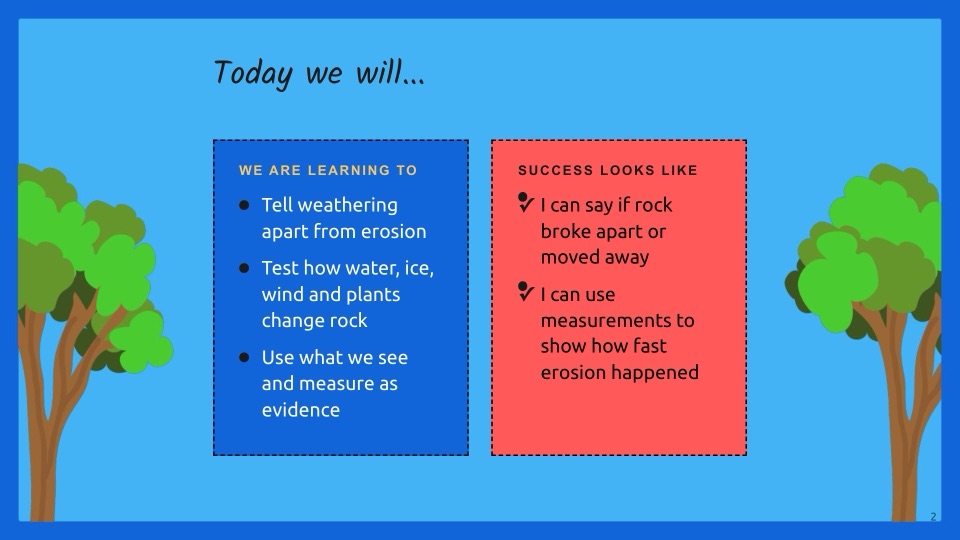
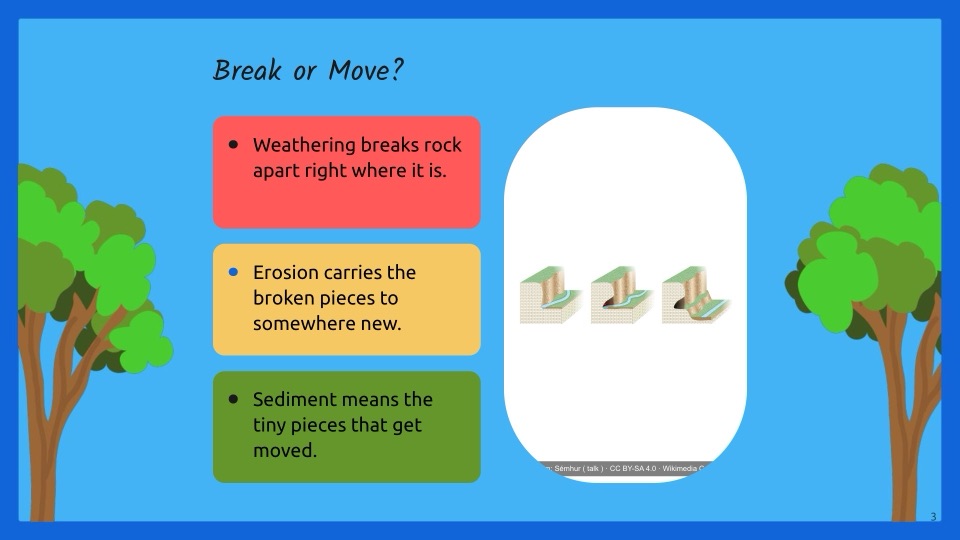
- Students will explain weathering as breaking apart and erosion as moving away.
- Students will measure how grass changes the rate of erosion by water.
- Students will use observations and measurements as evidence for erosion rate.
Success criteria
- I can say if rock broke apart in place or moved away.
- I can measure in inches how far soil moved with and without grass.
- I can use my numbers to tell which hill eroded faster.
Key words
| Word | Meaning |
|---|---|
| weathering | breaking of stone into smaller bits right where it sits |
| erosion | carrying of broken stone and soil away to a new spot |
| sediment | tiny bits of broken rock and soil that water or wind can carry |
| vegetation | plants such as grass that can hold soil in place |
| glacier | huge slow river of ice that scrapes land and pushes rock along |
Timed plan (60 minutes)
| Time | Stage | What happens |
|---|---|---|
| 8 min | Starter | To hook interest and set up weathering as breaking and erosion as moving. Show Slide 1 title: Weathering Breaks It, Erosion Takes It Away. Use the hook: Two hills get the same rain. One is bare soil and one is covered in grass. Which hill survives? Take votes. Show Slide 3 and read together: Weathering breaks rock apart right where it is. Erosion carries the broken pieces to somewhere new. Link votes to learning goal: today we will measure how plants change the rate of erosion by water. |
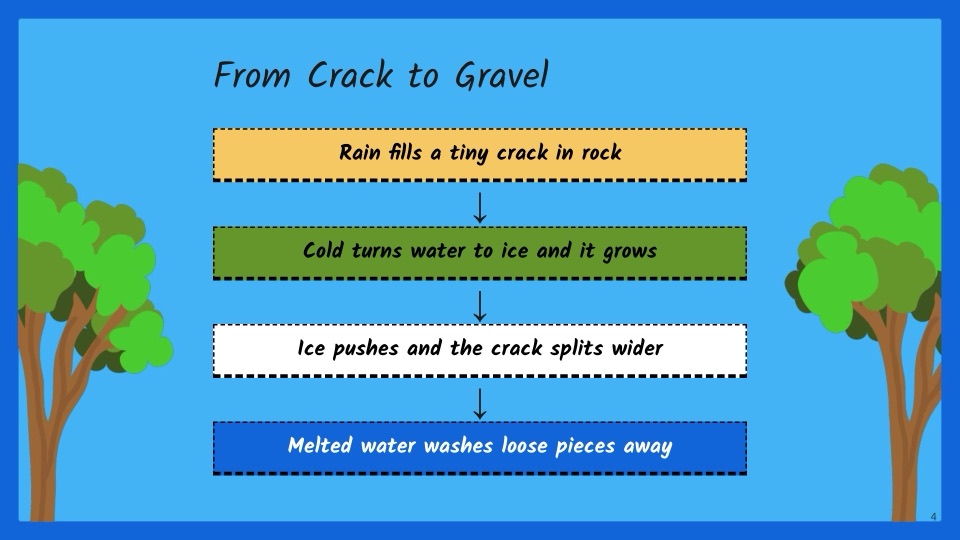
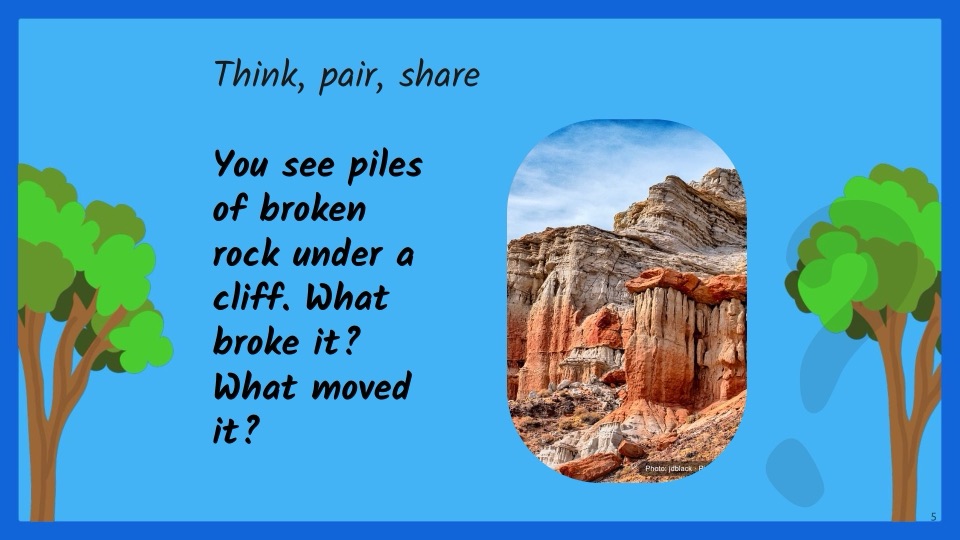
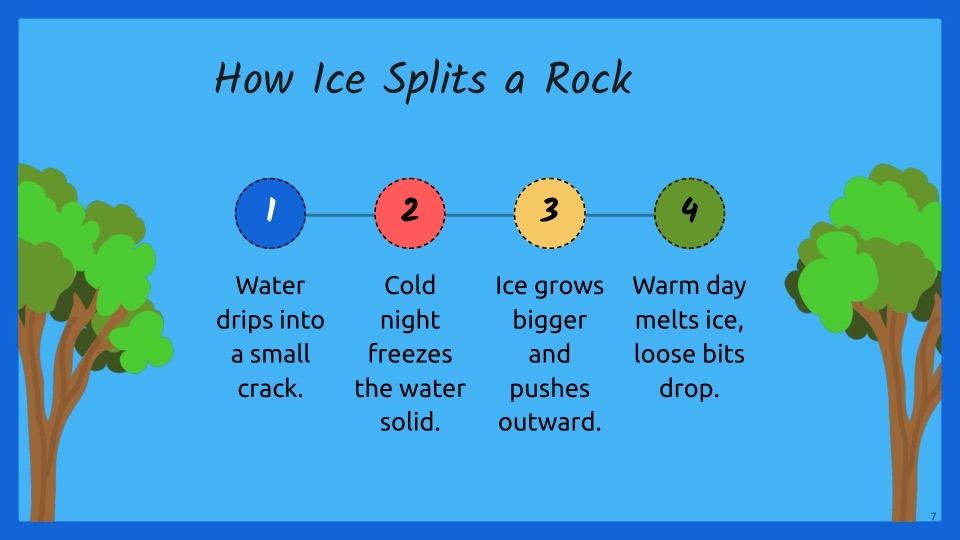
| 12 min | Teaching | To explain how water, ice, wind and plants break rock and move pieces. Show Slide 4 chain and walk through crack to gravel: rain fills crack, ice grows, crack splits, water washes pieces away. Show Slide 7 steps for ice: water drips, freezes solid, grows bigger and pushes, melts and bits drop. Show Slide 5 question: You see piles of broken rock under a cliff. What broke it? What moved it? Take pair ideas. Summarize: scattered piles of broken rock at cliff bases show weathering, and wind and moving water move those particles. |
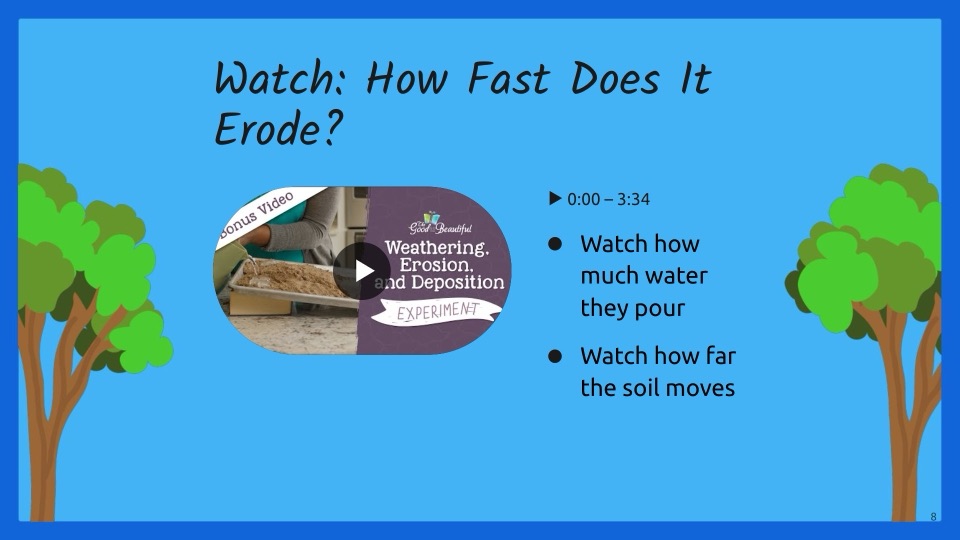
| 10 min | Video and model | To show how to pour, watch, and measure erosion rate. Show Slide 8 prompts: watch how much water they pour and how far soil moves. Play Video clip 5 Erosion experiment demo (0:00–3:34). Pause halfway to name breaker and mover: water breaks and carries, using Slide 6 prompt to name water, ice, wind, plants. Model measuring with a ruler in inches from hill edge to farthest sediment in tray. |
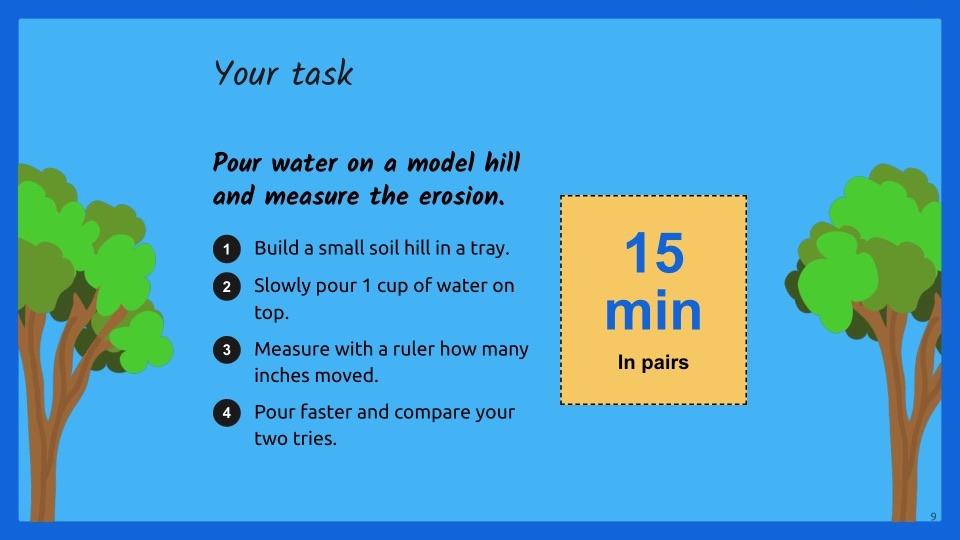
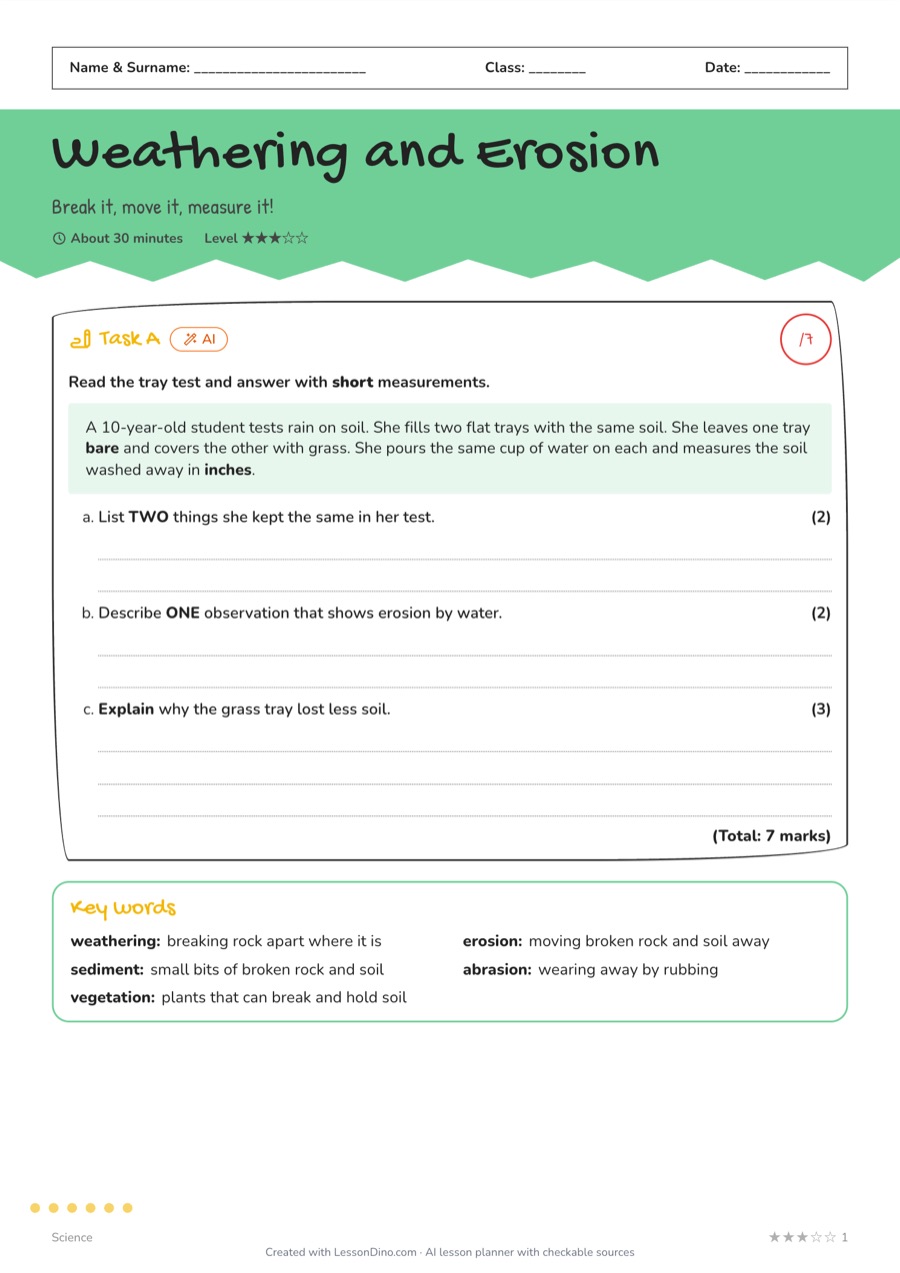
| 20 min | Main activity | To measure and compare erosion rate on bare and grass-covered hills. Hand out pans, cups, rulers, trays and Worksheet Task B. Show Slide 9 task steps. Direct fair test: slowly pour one half cup of water from same height on each hill over its tray. Remind groups to observe color and measure depth and distance of collected sediment in inches. Circulate, help read rulers, and ask which hill eroded faster and why. |
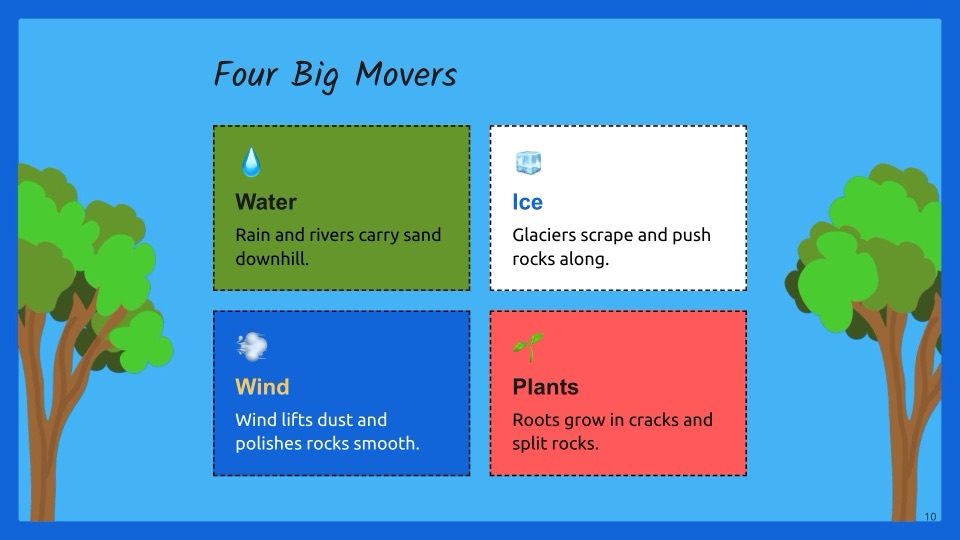
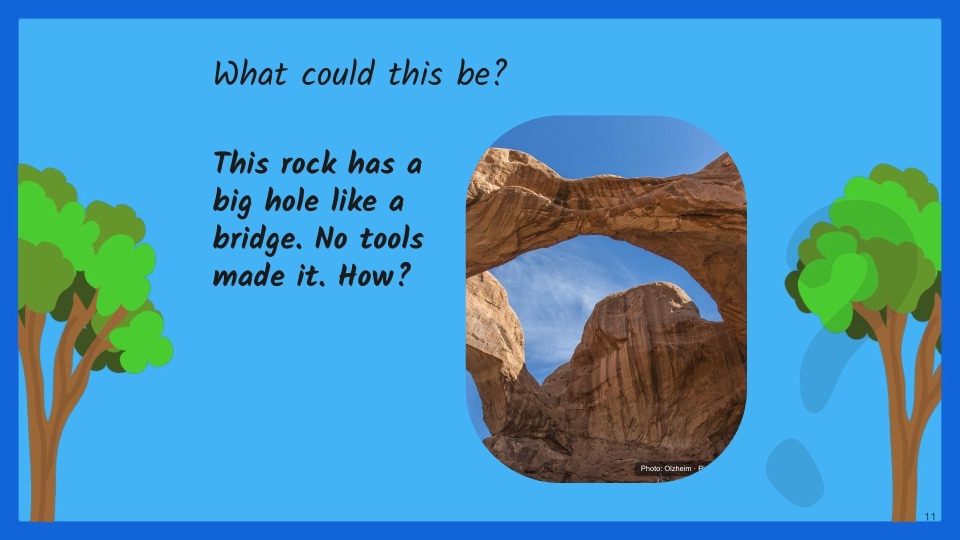
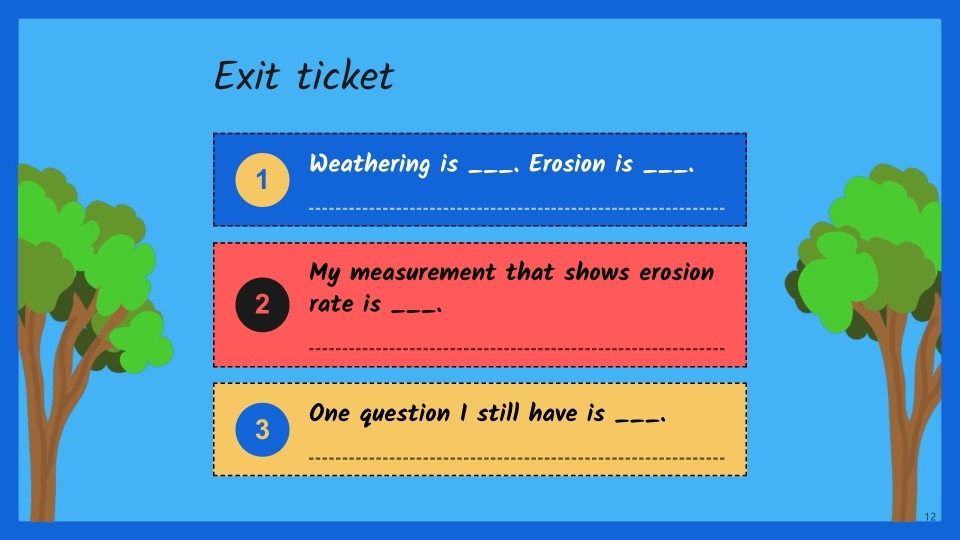
| 10 min | Plenary | To review break versus move and use measurements as evidence. Show Slide 10 Four Big Agents and review water, ice, wind, plants lines with class actions. Show Slide 11 mystery: wind and water broke soft rock, then carried pieces away to make a bridge shape. Show Slide 12 exit and have students write: Weathering is __. Erosion is __. My measurement is __. Collect Task B and exit lines, preview next lesson on deposition. |
Common mistakes
- Mixing up weathering and erosion as the same process.
How to spot it: Labels breaking in place as erosion or carrying away as weathering.
Restate that weathering breaks apart at its location while erosion transports it away, sort two photos again. - Thinking grass stops all erosion so no measurement is needed.
How to spot it: Says grass hill had zero change without looking at tray.
Check tray closely; planting grass holds soil in place but some fine grains still move, so measure inches to prove rate. - Measuring from the wrong start point each time.
How to spot it: Inch numbers jump a lot between tries or groups.
Always start ruler zero at hill edge and read to farthest sediment; liquid water is the main mover to watch, so keep pour height same.
Support
- Use collection cups marked in inches and a simple chart for muddy or clear.
- Give picture word bank for break in place and move away and sentence frames.
- Pair students so one pours while the other measures and records.
Stretch
- Have students test pouring from higher up and compare the measurements.
- Have students compare slow versus faster pours and explain rate change with numbers.
- Have students draw and add two new break-or-move cards for another team to sort.
Check questions
- Weathering is __.
Answer: Breaking rock apart right where it is. - Erosion is __.
Answer: Carrying the broken pieces to somewhere new. - Which hill eroded faster and what measurement proves it?
Answer: Bare-soil hill; it moved more inches of sediment and made muddier runoff than the grass hill.
Curriculum
Make observations and/or measurements to provide evidence of the effects of weathering or the rate of erosion by water, ice, wind, or vegetation.
Video clips
Clips on YouTube, from the start and end times we chose. Check each one before you show it.
-
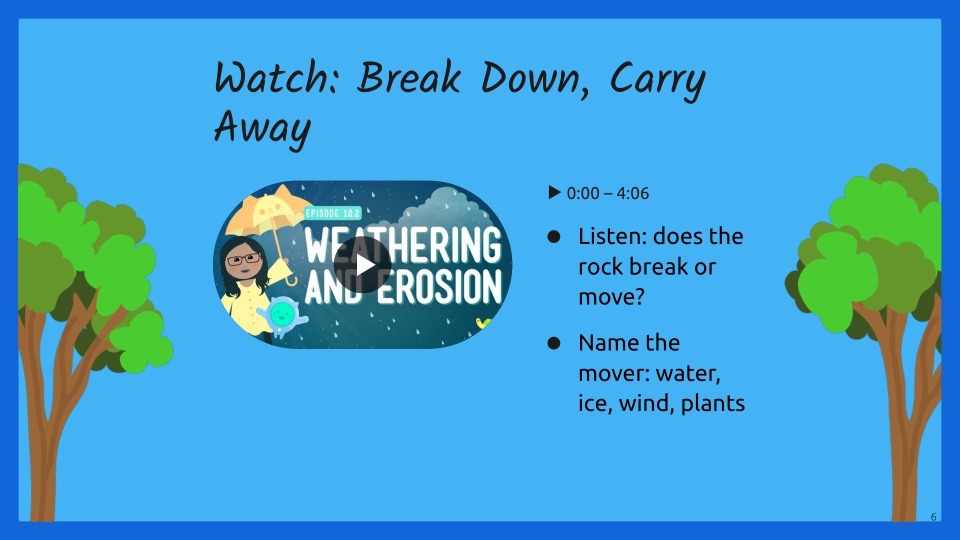
Weathering and erosion basics from 0:00 to 4:06
Crash Course Kids: Weathering and Erosion: Crash Course Kids #10.2
Made for upper-elementary by Crash Course Kids with vocabulary and pace perfect for ages 9-10 on weathering and erosion.
-
Erosion experiment demo from 0:00 to 3:34
The Good and the Beautiful Homeschool Science: Weathering, Erosion, and Deposition Experiment | Geology | The Good and the Beautiful
Shows a simple geology experiment with pace and steps that suit ages 9-10 to observe erosion.
Worksheet
Sources
- 4-ESS2-1 Earth's Systems | Next Generation Science Standards nextgenscience.org
- Weathering and Erosion - U.S. National Park Service nps.gov
- Chapter 4 Weathering and Erosion – *Introduction to World ... pressbooks.howardcc.edu
- Weathering, Erosion, and Sedimentary Rocks – Introduction to ... pressbooks.lib.vt.edu
- Chapter 9 - Weathering, Erosion, and Mass Wasting gotbooks.miracosta.edu
- weathering and erosion - Students | Britannica Kids ... kids.britannica.com
- Erosion, weathering and mass movement - River processes ... - BBC bbc.co.uk
- Flexi answers - How is weathering different from erosion? | CK-12 Foundation ck12.org
- Weathering Facts for Kids kids.kiddle.co
- Erosion Facts for Kids kids.kiddle.co
- Weathering and Erosion Information and Effects | National Geogra… nationalgeographic.com
- weathering - Kids | Britannica Kids | Homework Help kids.britannica.com
- Erosion and Weathering: Examples & Processes - Geology Science geologyscience.com
- Weathering and Erosion Explained: How Rocks Break and Move ... academickids.com
- The Difference Between Weathering & Erosion - Sciencing sciencing.com
- Earth Science for Kids: Erosion - Ducksters ducksters.com
Picture credits
Made with Lesson Dino's AI on 16 October 2026. AI can make mistakes, so check facts against the sources before you teach.