Slides
Lesson plan
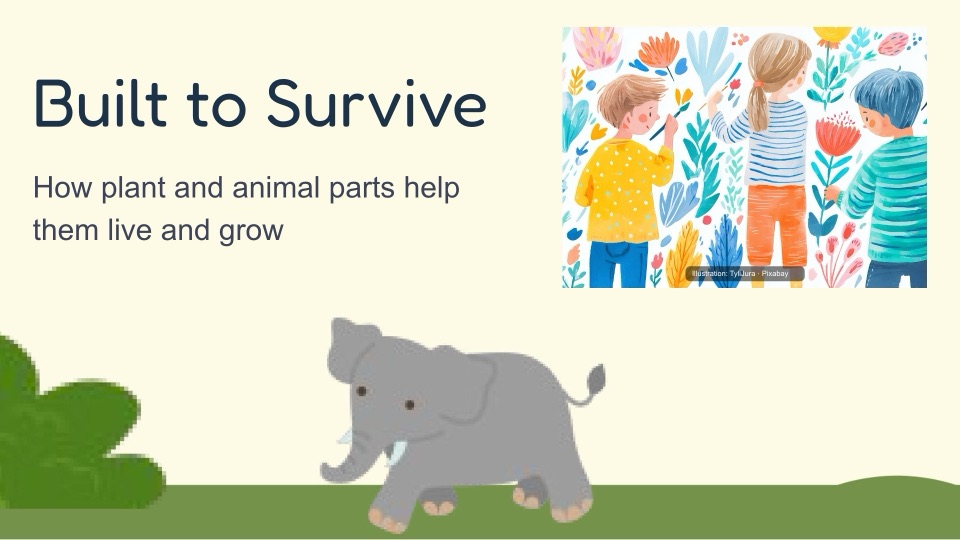
Built to Survive: Parts With Jobs
Students learn how internal and external parts help plants and animals live and grow. They make an X-ray poster to argue their ideas with evidence.
Objectives
- Students will identify external and internal structures of plants and animals.
- Students will explain how structures support survival, growth, behavior, and reproduction.
- Students will construct an argument using evidence from observations and diagrams.
Success criteria
- I can name plant and animal structures inside and outside the body.
- I can explain how a structure helps survival, growth, behavior, or reproduction.
- I can make a claim and support it with two pieces of evidence.
Key words
| Word | Meaning |
|---|---|
| structure | a body part of a plant or animal |
| function | the job a part does to help a living thing live |
| xylem | tubes that carry water from roots up to leaves |
| phloem | tubes that carry sugars made in leaves down to other parts |
| evidence | what you see in observations or diagrams that proves an idea |
Timed plan (60 minutes)
| Time | Stage | What happens |
|---|---|---|
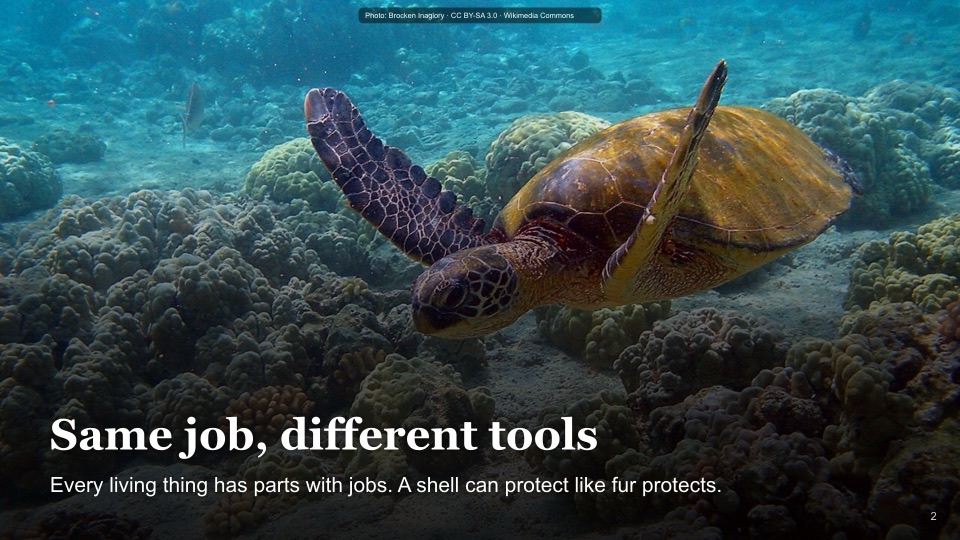
| 5 min | Starter | Hook interest and recall that living things have parts with jobs. Show Slide 1 and say the X-ray hook to the class. Show Slide 2 and point out that every living thing has parts with jobs. Ask pairs to name one plant or animal part and what it does. Link answers to the lesson goal about arguing how structures support survival and growth. |
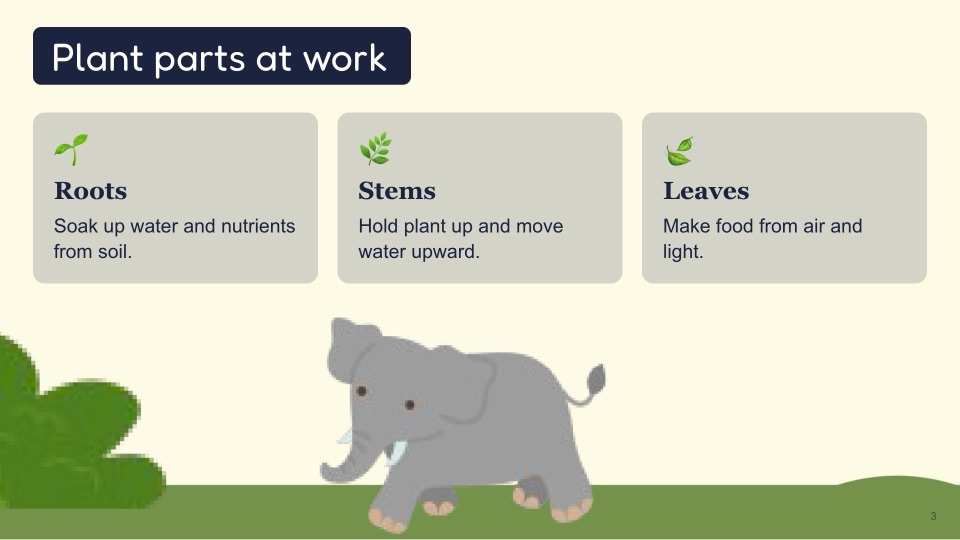
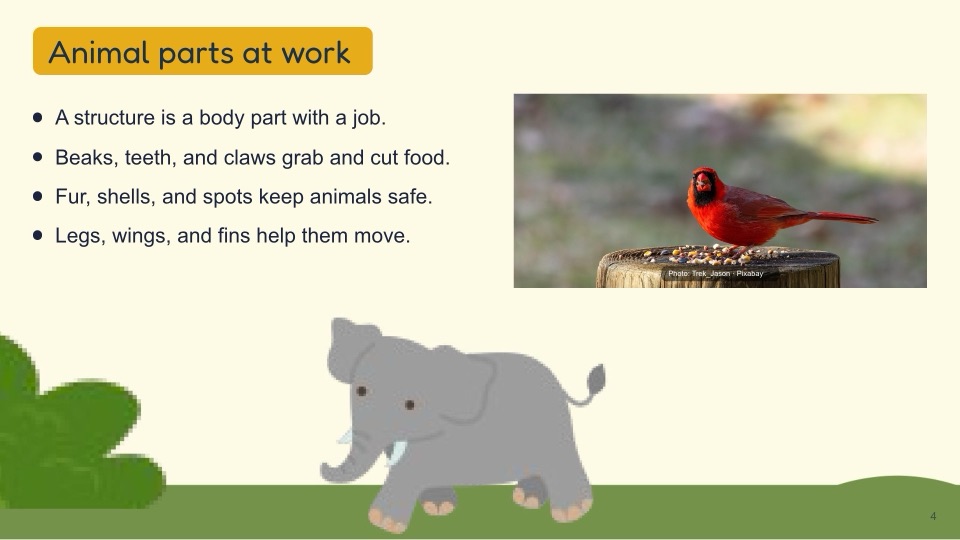
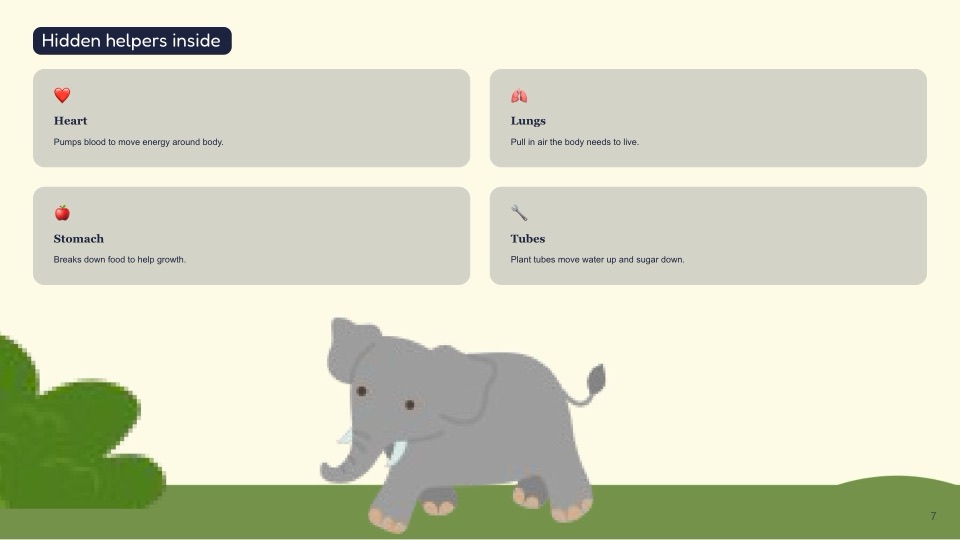
| 12 min | Teaching | Teach key external and internal structures and their jobs. Show Slides 3-4 and explain plant roots, stems, leaves and animal beaks, teeth, claws, fur, shells, legs, wings, and fins. Show Slide 7 and explain heart, lungs, and stomach as hidden helpers inside. Explain that both internal and external structures are suited to support survival, growth, behavior, and reproduction. Use questioning to connect each part to getting what it needs, staying safe, or having offspring. |
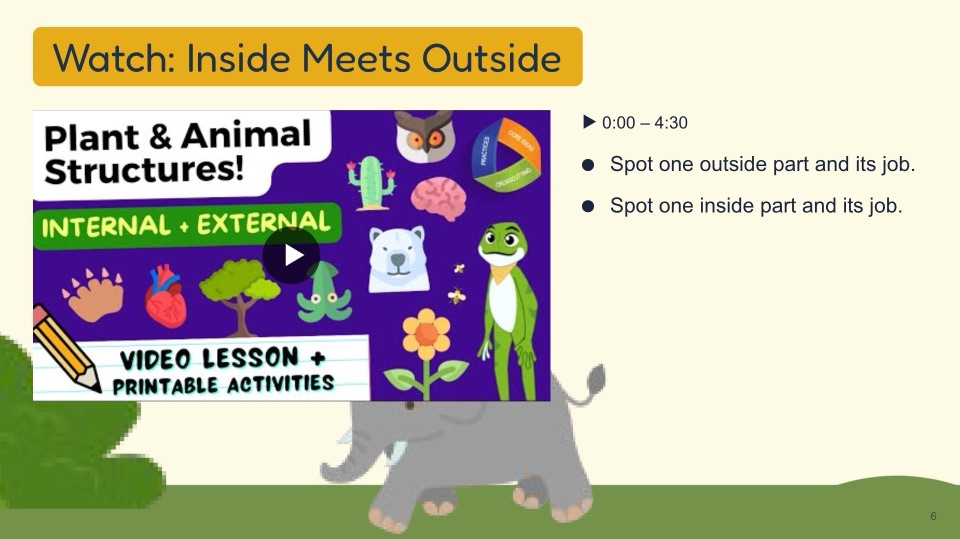
| 13 min | Watch and model | Model how to use observations and diagrams as evidence for an argument. Show Slide 6 and play Video clip 1 (0:00–4:30) so students spot one outside part and one inside part and its job. Pause and record one outside example and one inside example on the board. Model a written argument with claim and two pieces of evidence using xylem and phloem. Show that all parts of the system for eating and digesting food must work together. |
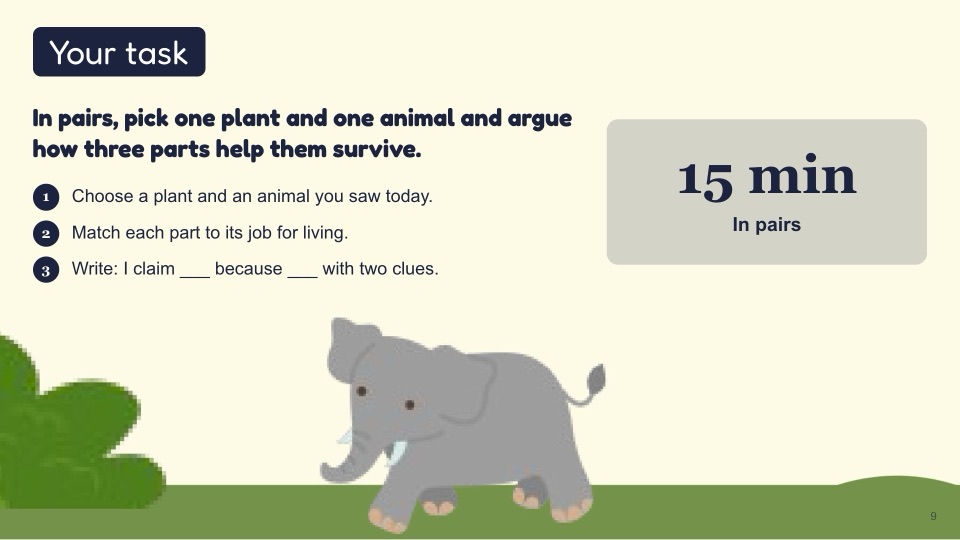
| 20 min | Main activity | Pairs construct an X-ray poster arguing how three parts help survival. Show Slide 9 and explain the pair task to pick one plant and one animal and argue how three parts help them survive. Give out large paper, markers, plant and animal diagrams, and sentence starters. Remind pairs to draw an outside view and an X-ray inside view and label each part with its job for survival, growth, behavior, or reproduction. Circulate, prompt for two pieces of evidence, and push ready pairs to add a counter-idea. |
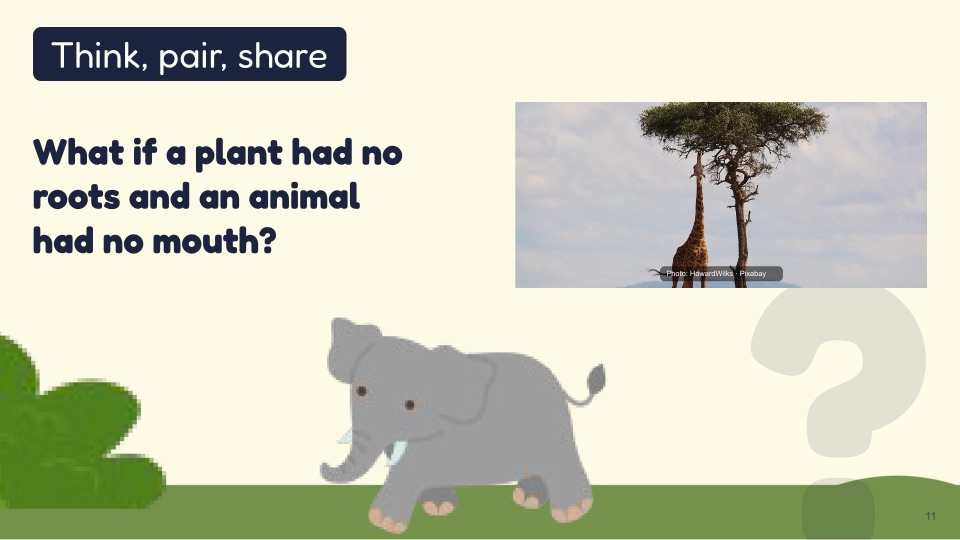
| 10 min | Plenary | Return to the big idea and check matching of structures to jobs. Show Slide 10 and restate that every part has a job that helps living things survive and grow. Show Slide 11 and have pairs discuss what would happen with no roots and no mouth. Hand out Worksheet Task H and have students match each structure to its job. Collect Task H and restate success criteria with two poster examples. |
Common mistakes
- Thinking plants have no inside parts, only animals do.
How to spot it: Poster shows only roots and leaves with no tubes inside the stem.
Show that a system of tubes called the xylem carries water up and the phloem carries sugars down inside the plant. - Thinking one part works alone.
How to spot it: Claim mentions only teeth or only stomach for getting energy.
Remind that all parts of the system for eating and digesting food must work together. - Mixing up which tube moves water up and which moves sugar down.
How to spot it: Arrows point sugar up and water down.
Point to the labeled diagram: xylem carries water from roots up to leaves and phloem carries sugars from leaves down.
Support
- Provide sentence starters for claim and evidence and a labeled diagram showing xylem carrying water to leaves and phloem carrying sugar to other parts.
Stretch
- Have students add a counter-idea, such as what would happen without one structure, and rebut it with evidence.
Check questions
- What job do roots do?
Answer: Soak up water and nutrients from soil through roots. - What do plant tubes called xylem carry?
Answer: Water from roots up to leaves. - Give one internal animal structure and how it helps survival.
Answer: Heart pumps blood to move energy, lungs pull in air, or stomach breaks down food to help growth.
Curriculum
Construct an argument that plants and animals have internal and external structures that function to support survival, growth, behavior, and reproduction.
Video clips
Clips on YouTube, from the start and end times we chose. Check each one before you show it.
-
Internal and External Structures Overview from 0:00 to 4:30
Hiikoo Learning: Plant & Animal Structures for Kids! Internal & External Structures | NGSS 4-LS1-1 | 4th Grade 🌱🐕🫀
Made for 4th grade age 9-10 and exactly matches NGSS 4-LS1-1 on plant and animal structures.
-
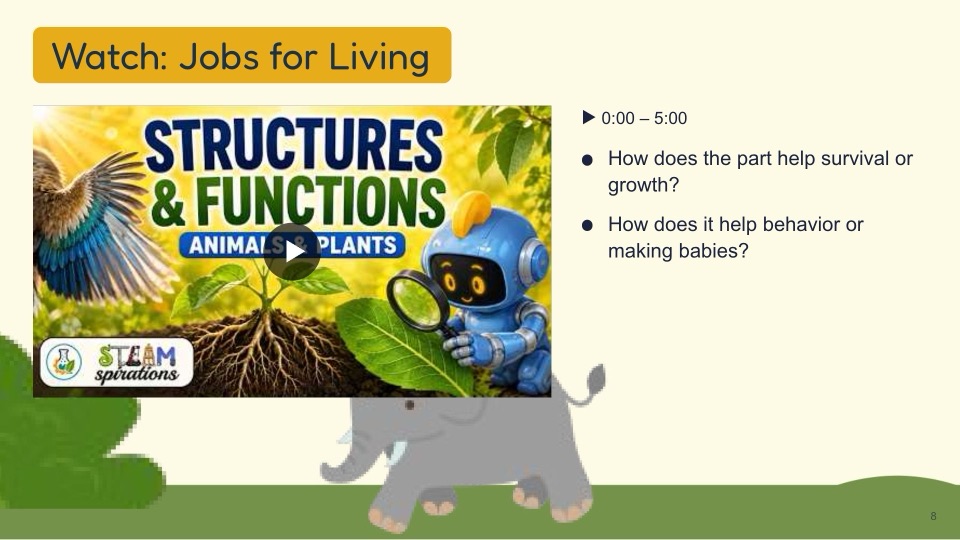
How Structures and Functions Help from 0:00 to 5:00
STEAMspirations: How Structures and Functions Help Animals and plants
Kid-friendly explanation of structure and function that suits age 9-10.
Worksheet
Sources
- Social Science cps.edu
- Acellus® Grade 4 Science science.edu
- Life Science - STRUCTURE AND FUNCTION: Internal and External digitalcommons.imsa.edu
- A glossary of plant cell structures: Current insights and ... pmc.ncbi.nlm.nih.gov
- Functions and Structures of Plants and Animals - Providence ... providencechildrensmuseum.org
- Plant and animal cells - Cell structure - AQA - GCSE Combined ... bbc.co.uk
- What are plant and animal cells? - BBC Bitesize bbc.co.uk
- Unit Plan 19 (Grade 4 Science): Plant & Animal Structures teachmaverick.com
- Structure of plants and animals - Thunderbolt Kids thunderboltkids.co.za
- Animal structure KS1 | Y1 Science | Lesson Resources thenational.academy
Picture credits
- Illustration: TyliJura · Pixabay
- Photo: Brocken Inaglory · CC BY-SA 3.0 · Wikimedia Commons
- Photo: Trek_Jason · Pixabay
- Photo: HowardWilks · Pixabay
- Picture: unknown · CC0 · rawpixel via Openverse
- Illustration: Radfotosonn · Pixabay
- Pictograms: Sergio Palao, ARASAAC (arasaac.org) · CC BY-NC-SA
Made with Lesson Dino's AI on 17 October 2026. AI can make mistakes, so check facts against the sources before you teach.