Slides
Lesson plan
History Pages in Rock
Students learn how rock layers and fossils show how land changes. They draw a 3-layer cliff and use it to tell the Earth story.
Objectives
- Students will order flat rock layers from oldest at bottom to youngest at top.
- Students will tell water or land habitats from shells, plants and footprints in rock.
- Students will explain landscape change using layer and fossil patterns as evidence.
Success criteria
- I can put oldest layers at the bottom and youngest on top.
- I can tell if a layer formed under water or on land from its fossils.
- I can tell how a place changed using rock and fossil clues.
Key words
| Word | Meaning |
|---|---|
| strata | flat bands of rock piled one on top of another |
| sedimentary rock | hard material made when tiny bits of sand and mud press together in flat bands |
| fossil | remains or marks of a plant or animal saved in rock |
| evidence | clues you can see that help show what happened in the past |
| environment | the water or land around where a plant or animal lived |
Timed plan (60 minutes)
| Time | Stage | What happens |
|---|---|---|
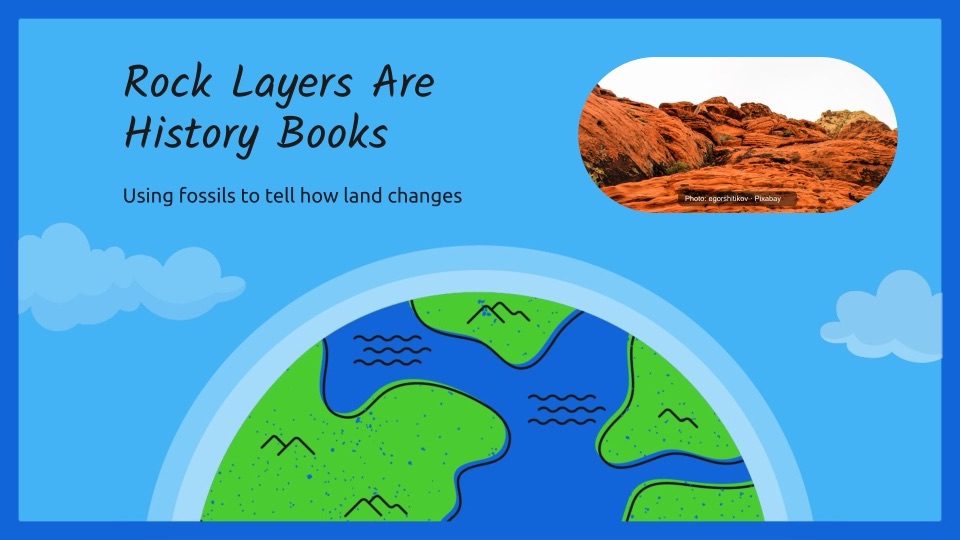
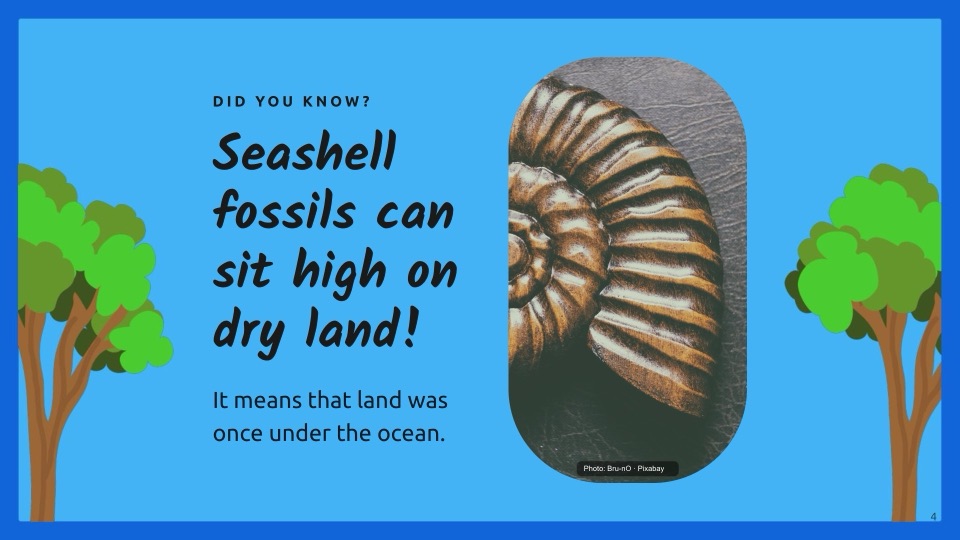
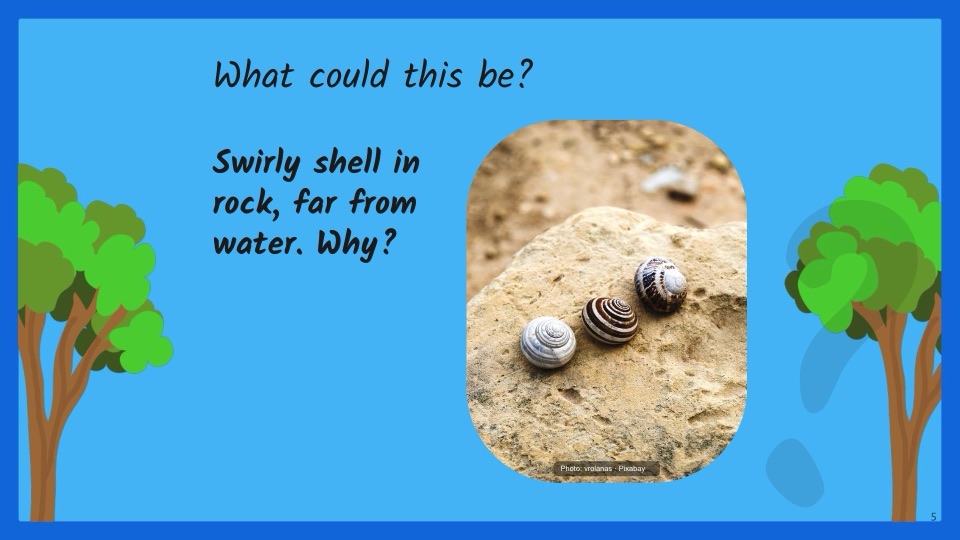
| 8 min | Starter | Spark curiosity about sea fossils on land and link it to drawing a cliff story. Show Slide 1 and read Rock Layers Are History Books and Using fossils to tell how land changes. Show Slide 4 and read Seashell fossils can sit high on dry land! and It means that land was once under the ocean. Show Slide 5 mystery Swirly shell in rock, far from water. Why? and let pairs whisper ideas. Link to today with the hook line and preview the 3-layer cliff drawing task. |
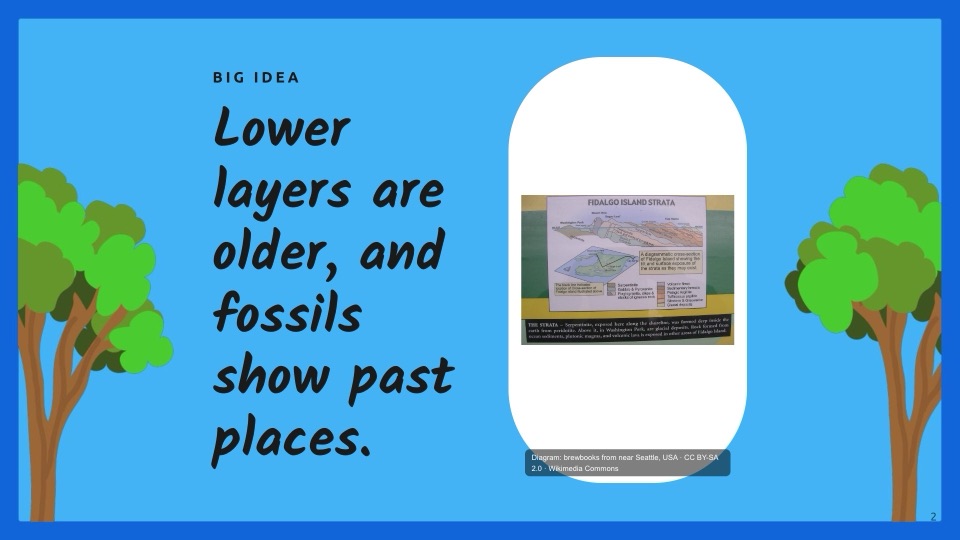
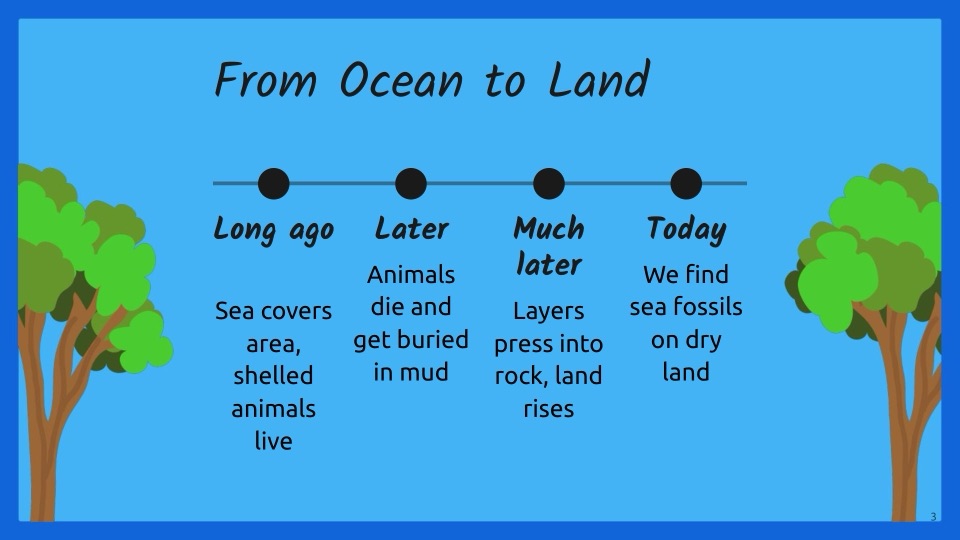
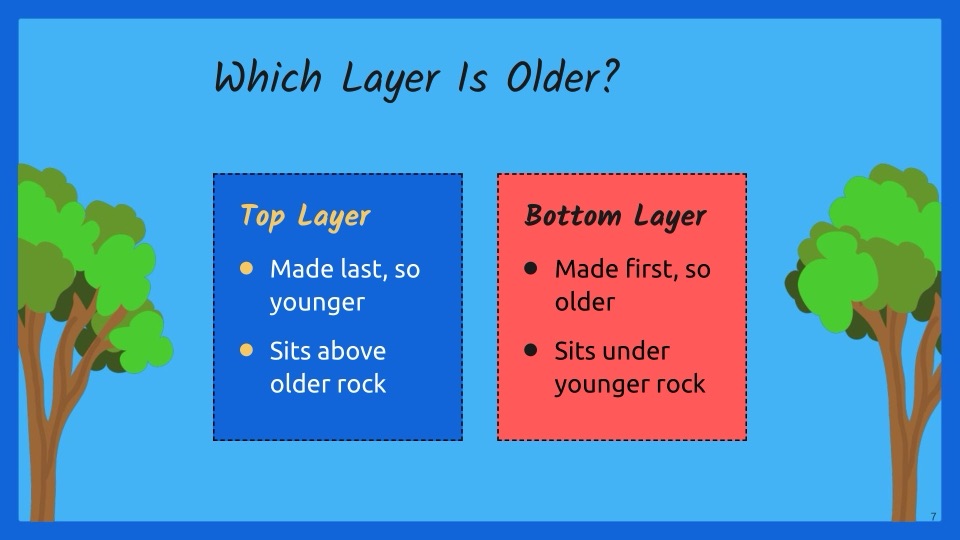
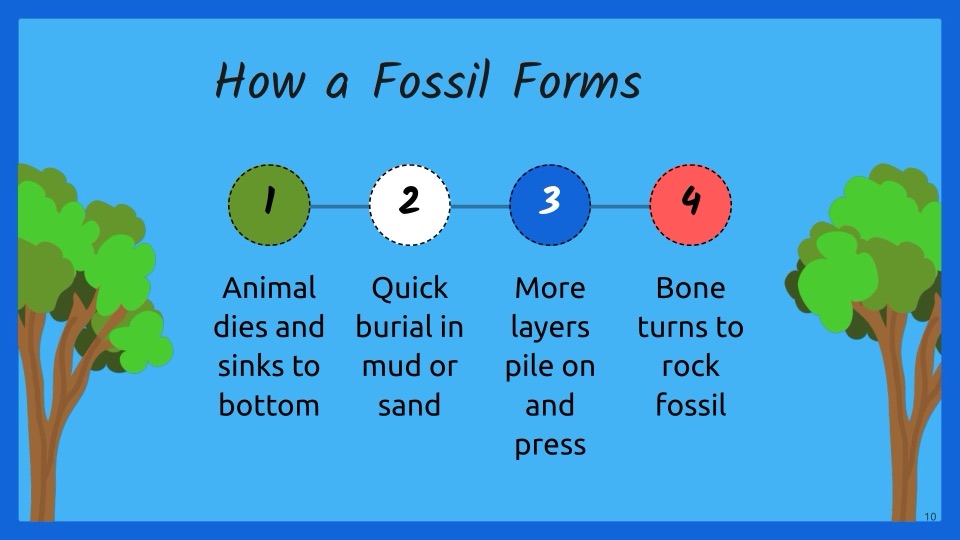
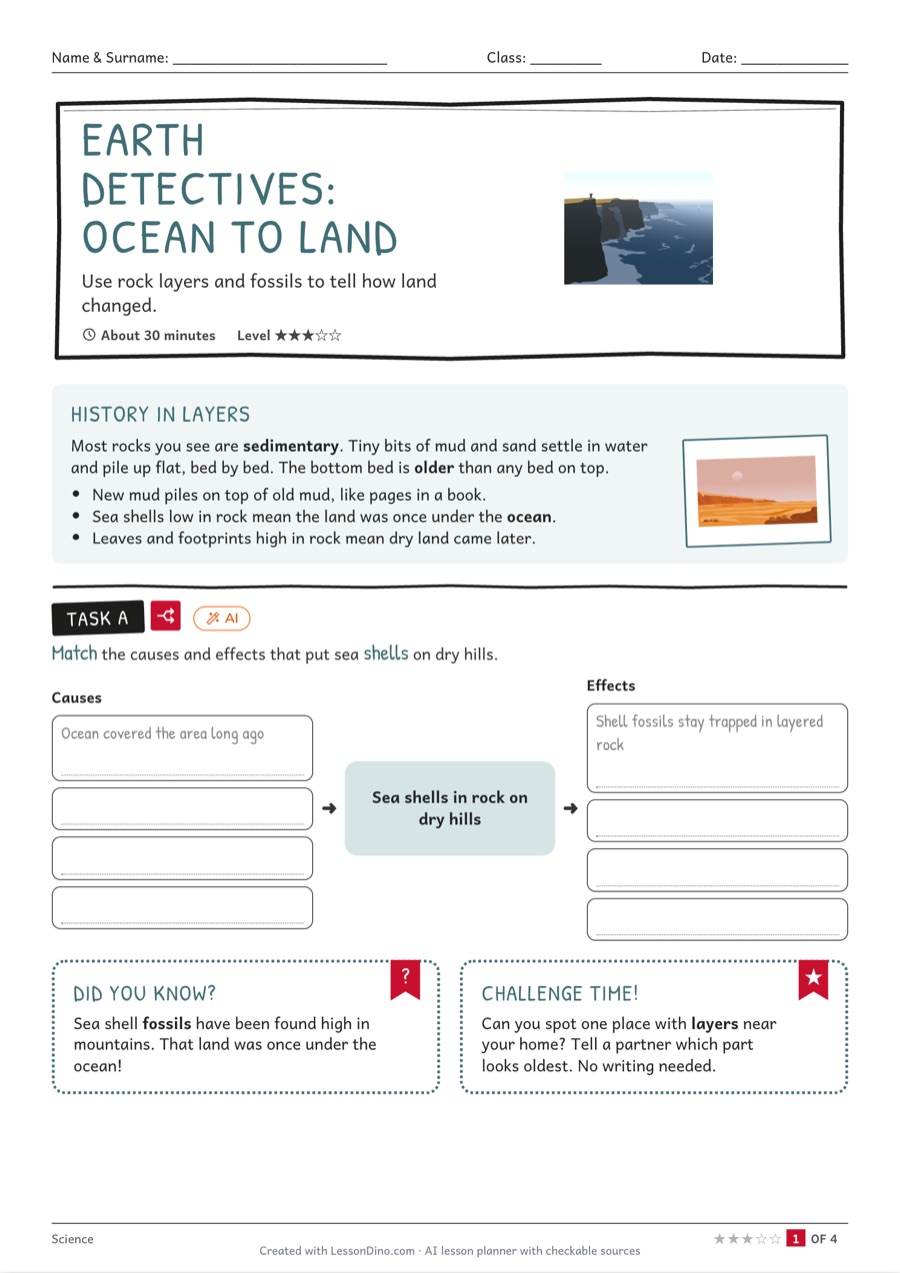
| 15 min | Teaching | Show how layers stack oldest at bottom and how fossils record water or land. Display Slide 2 and read Lower layers are older, and fossils show past places. Explain most surface rocks are sedimentary, formed when broken bits carried by water settle to the bottom in rivers, lakes, and oceans. Walk through Slide 3 timeline from Sea covers area, shelled animals live through Animals die and get buried in mud to Layers press into rock, land rises. Point out the largest, or heaviest, particles settle first and layers pile one on top of the other. Use Slide 7 to compare Top Layer Made last, so younger with Bottom Layer Made first, so older. Stress in any undisturbed stack the bottom bed is older than any bed on top and most sediments were laid down horizontally. Show Slide 10 steps Animal dies and sinks to bottom, Quick burial in mud or sand, More layers pile on and press, Bone turns to rock fossil. Explain quick burial matters because sediment in water covers sea creatures quickly with mud and sand and most fossils are found in sedimentary rock such as shale, limestone, and sandstone. Then start Worksheet Task B in pairs to link each fossil-formation step to its science. |
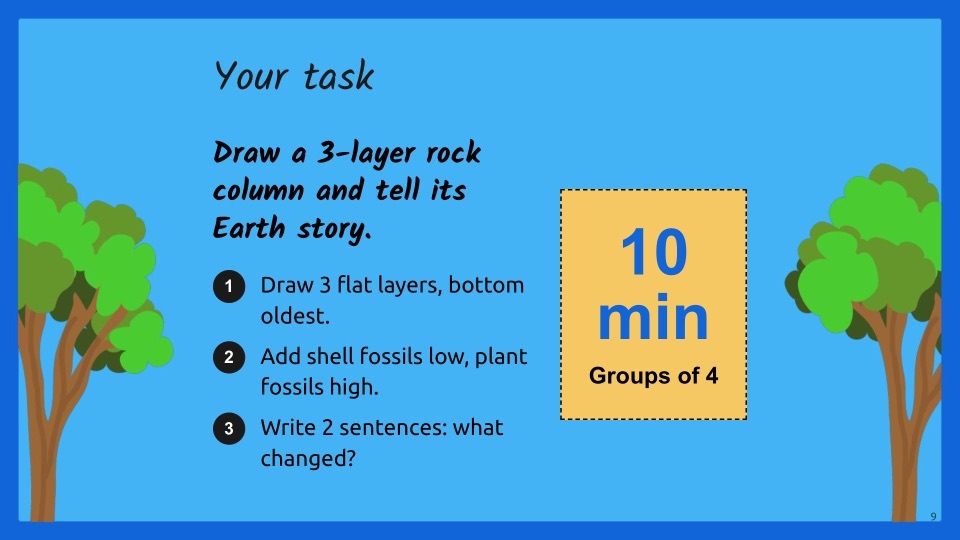
| 25 min | Main activity | Build a 3-layer cliff that uses fossil patterns to explain a change from ocean to land. Show Slide 9 Your task Draw a 3-layer rock column and tell its Earth story. State Groups of 4, Draw 3 flat layers, bottom oldest, Add shell fossils low, plant fossils high. Model on board with ruler three flat colored stripes for strata, since rock layers are also called strata and layering is the most obvious feature of sedimentary rocks. Add shells low and leaves high, showing sand becoming sandstone and mud becoming mudstone or shale. Hand out white paper, colored pencils, rulers and support template, and set 20 minutes for drawing plus 5 minutes for captions. Circulate, ask each group to read its stack bottom to top and name oldest and youngest. |
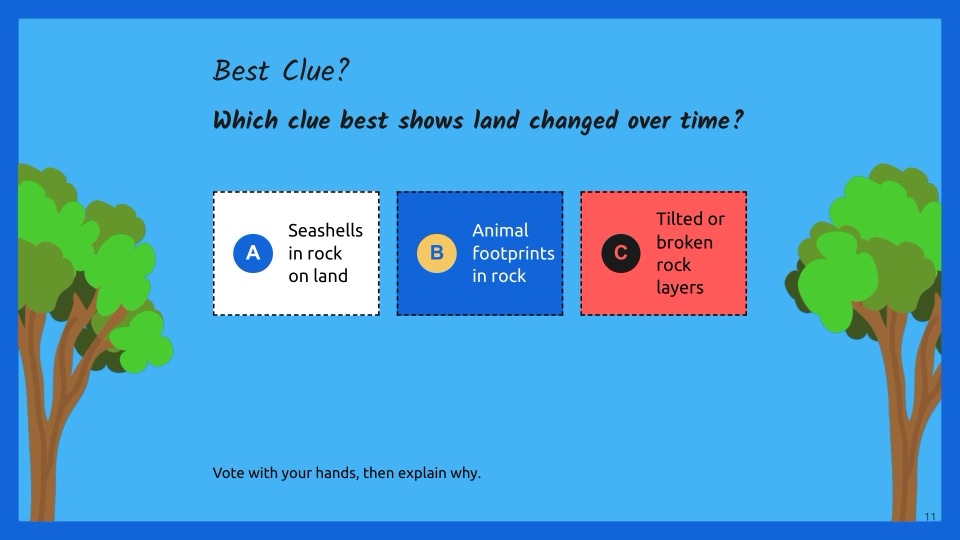
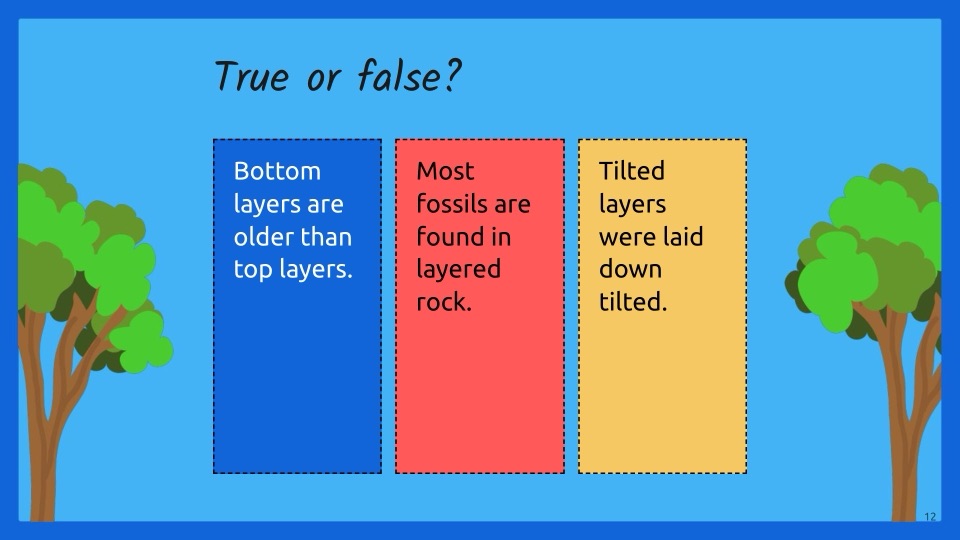
| 12 min | Plenary | Share stories and check which clues prove the landscape changed over time. Lead Slide 11 vote Best Clue? with choices Seashells in rock on land, Animal footprints in rock, Tilted or broken rock layers. Tally hands. Run Slide 12 True or false? for New layers pile on top of old and Bottom layers are older than top layers. Have class answer together. Hand out Worksheet Task D Odd one out for pairs to circle and write one line why. Revisit success lines and collect panels. |
Common mistakes
- Top layers are oldest because they are on top.
How to spot it: Labels youngest at bottom and oldest at top in drawing.
Retell pile rule: in any undisturbed stack the bottom bed is older than any bed on top. Have them point down for older. - Any rock can hold fossils, even cooled lava rock.
How to spot it: Draws bones in speckled granite-like rock.
Remind most fossils are found in sedimentary rock such as shale, limestone, and sandstone, formed from pressed mud and sand. - Tilted layers formed tilted.
How to spot it: Says tilt happened first when explaining crack.
Remind most sediments were laid down horizontally, so tilt must happen after forming during mountain building.
Support
- Three-box template with bottom box labeled oldest to color inside.
- Word bank: older, younger, evidence, ocean, land and sentence starter I see __ on the bottom, so I think __.
Stretch
- Add a crack or tilt to one side and explain what event happened last.
- Add a fourth panel predicting what erosion might do next.
Check questions
- Are top or bottom layers older in flat rock? Why?
Answer: Bottom, because new layers pile on top of old. - Hill rock has sea shells. What was it long ago?
Answer: Under the ocean. - Give one fossil clue for land.
Answer: Leaves or footprints high in the rock.
Curriculum
Identify evidence from patterns in rock formations and fossils in rock layers to support an explanation for changes in a landscape over time.
Video clips
Clips on YouTube, from the start and end times we chose. Check each one before you show it.
-
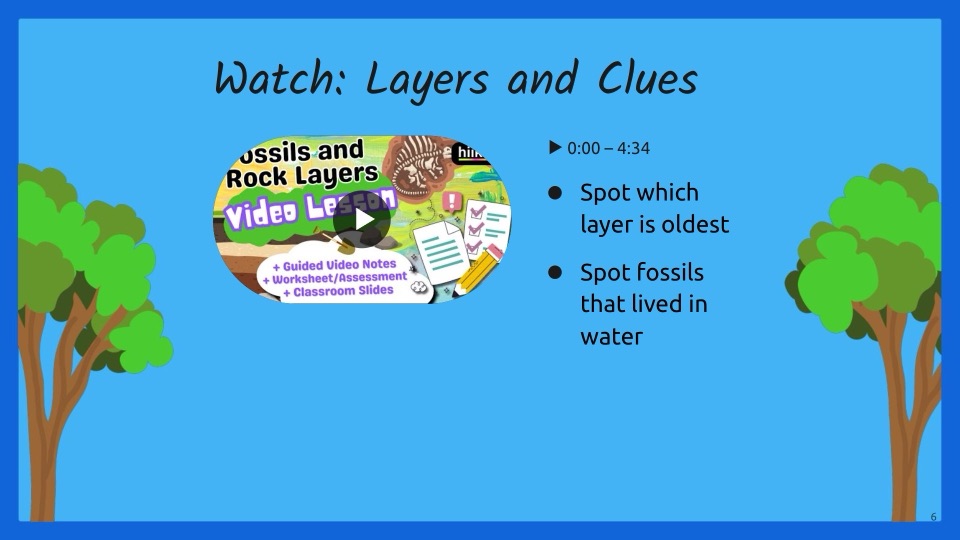
Fossils and Rock Layers NGSS from 0:00 to 4:34
Hiikoo Learning: Fossils and Rock Layers for Kids! (NGSS 4-ESS1-1) 🌎🦕
Made for kids and matched to NGSS 4-ESS1-1 so vocabulary and pace are ideal for ages 9-10 learning layers and landscape change.
-
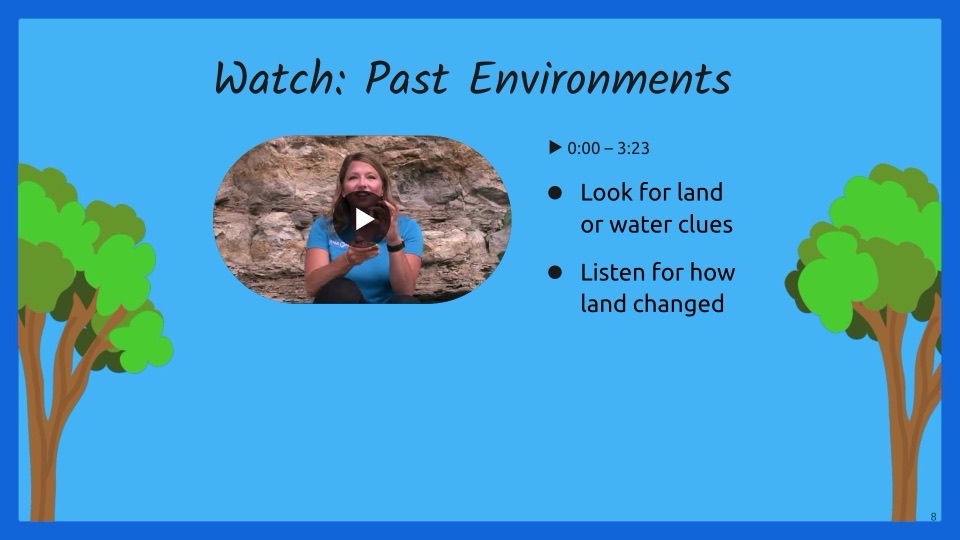
Rock Layers and Fossils Within from 0:00 to 3:23
Iowa PBS: Rock Layers and the Fossils Within | FIND Iowa
PBS style with clear visuals and simple explanations suits ages 9-10 learning how layers and fossils show past environments.
Worksheet
Sources
- Science Grade 4 - Chicago Public Schools cps.edu
- Acellus® Grade 4 Science science.edu
- Fossils, Rocks, and Time: Rocks and Layers pubs.usgs.gov
- Fossils – KS2 Science curriculum - BBC Bitesize bbc.co.uk
- Evidence of evolution - rock fossils - Evolution - AQA - GCSE ... bbc.co.uk
- Rainbow rocks: Science primary resource | National Geographic ... natgeokids.com
- How Are Fossils Used to Date Rock Layers? - sciencenewstoday.org sciencenewstoday.org
- fossils: geological dating - Students - Britannica Kids kids.britannica.com
- Teaching About Fossils - Evidence in Layers of Sedimentary Rock enjoy-teaching.com
- Unit Plan 28 (Grade 4 Science): Rock Layers & Fossils teachmaverick.com
- Earth Science for Kids: Rocks, Rock Cycle, and Formation ducksters.com
- Earth Science for Kids: Fossils - Ducksters ducksters.com
- Types of rock – KS2 Science curriculum - BBC Bitesize bbc.co.uk
- Fossils - Library For Kids libraryforkids.com
- Q2 W7 - LESSON Fossils - odysseyk12.org odysseyk12.org
Picture credits
- Photo: egorshitikov · Pixabay
- Diagram: brewbooks from near Seattle, USA · CC BY-SA 2.0 · Wikimedia Commons
- Photo: Bru-nO · Pixabay
- Photo: vrolanas · Pixabay
- Illustration: the_iop · Pixabay
- Illustration: MostafaElTurkey36 · Pixabay
- Pictograms: Sergio Palao, ARASAAC (arasaac.org) · CC BY-NC-SA
- Illustration: ArtsyBeeKids · Pixabay
- Illustration: susan-lu4esm · Pixabay
- Illustration: OpenClipart-Vectors · Pixabay
Made with Lesson Dino's AI on 17 October 2026. AI can make mistakes, so check facts against the sources before you teach.